
You are currently browsing the category archive for the ‘Health’ category.
I’m a little cranky this week. At least, that’s how it may seem with some of the ways I’ve been responding to things I’ve seen online.

Yesterday, mice were cured again which was awesome and wonderful if I were a mouse, as suggested in the photo to the right.
Alas, I am not, so I felt the way I usually do when I hear of diabetes disappearing in rodents – ambivalent, as I crabbily pointed out to anyone who would listen. (It was quite timely when this article came across my radar which did a good job explaining how mice and humans are different and therefore what works for a mouse may not work for a Renza…or any other human.)
And then there was Monday’s post about the Twitter discussion about how much power and influence healthcare users have in the healthcare system (spoiler alert: the answer is very, very little…).
But today, I’m writing about an ongoing Twitter discussion that has me shaking my head for different reasons.
I wasn’t around the diabetes world when home blood glucose monitors came onto the market. I was handed a meter the day I was diagnosed in 1998, and I was able to take myself off to an NDSS outlet and pick up strips. Blood glucose monitoring was expected then, and I was easily able to access what I needed to meet the recommended glucose monitoring treatment I was prescribed. I remember being told just how essential it was that I prick my finger and check my glucose levels before meals and before bed – at least. This was the technology that was readily and affordably available to people in Australia and healthcare professionals were very, very in favour of using it.
But it wasn’t always the case.
In the early 1980s, home blood glucose meters started being offered to people with diabetes to take home and use. It was the start of self-monitoring blood glucose (SMBG) – before this, it was all about weeing on a stick and analysing colours. The advent of SMBG is certainly one of those moments on the diabetes timeline that stands out as an important step in diabetes management and improved care.
At the time, there was a lot of criticism of this new-fangled device, with many HCPs believing that it wouldn’t take off, the expense was needless and that there was not enough evidence to support the ongoing subsidisation of such technology. According to a short reflection piece to BMJ in May 1998, the introduction of SMBG had clinicians believing home glucose monitoring ‘a dangerous practice’.
As insulin pumps became more popular, the same attitudes were emerging and in 2001, when I decided I wanted to start on a pump, I had to doctor shop before I could find an endo who would agree to filling out the necessary paperwork. The reasons for refusing my request ranged from ‘You’ve not had diabetes long enough yet,’ (I started on a pump almost three years after diagnosis) to ‘They’re not safe’, and ‘There’s no evidence a pump will improve your A1c’, to which I replied ‘Okay – but will it let me sleep in on a Saturday morning and present more flexible food timings and options? Because my quality of life is seriously impacted on having to freedom to live my life because of the restrictions my current diabetes treatment regimen demands and I am becoming burnout and resentful of it right now.’
I wish I could say that these ideas ceased when I started on a pump, but we still hear today people being refused pump therapy for a litany of reasons that, quite frankly, don’t hold water in most cases.
And then, the arrival of CGM was met with exactly the same reaction. ‘It will make people obsessive,’ and ‘there’s no evidence to suggest that it actually improves clinical outcomes and A1c’ and ‘It’s a gimmick – we have blood glucose monitoring that works just fine,
This, despite a recent talk I attended at ADA where endocrinologist, Steve Edelman from TYOCD declared:

Which brings us to the the Twitter discussion this week which centred around FreeStyle Libre and concerns that there is not enough evidence to warrant subsidy of the product in the UK (following a report on the device from NICE in the UK). Arguments shared in 140 characters or fewer very much centred on the lack of evidence about the Libre.
I understand the arguments: clinicians were calling for randomised control trials (RCTs) to provide the evidence they feel comfortable with before they are willing to recommend a product: they want evidence to support clinical outcomes (i.e. lower A1c).
The problem here is that RCTs are costly, take a lot of time and often don’t measure anything more than clinical outcomes. Plus, they are rarely, if ever, co-designed by the people impacted by whatever is being studied.
It was the same sentiments as when other new tech was released into the market. Often it’s new diabetes tech that provides the user with more information, more data….and more control over how and what they are doing to manage their diabetes.
The pattern repeats itself each time there is something new: clinicians are wary (which, it could be argued is their role), people with diabetes are excited. In the case of Libre, I know of many people who, after years of refusing to measure their blood glucose due to pain and intrusion, have started actively monitoring their glucose and making meaningful treatment decisions due to the ease of Libre. One woman said that it has meant that for the first time in over a decade she feels she actually has some idea of what is going on with her glucose levels which has resulted in her making smarted food choices.
As I read the tweets, I started experiencing very strong feelings of déjà vu. And I also was once again reminded of why so many subscribe to the #WeAreNotWaiting movement. And I ask: Is it any wonder that people are hacking diabetes devices and building their own systems to do what we want them to – what they are capable of doing – now?
P.S. Just a reminder that there is currently a stakeholder engagement underway following a submission to list FreeStyle Libre on the NDSS. You can read all about it here (where you’ll also find the link to take you to the survey).
Saturday afternoon I was flaked out on the sofa, the Winter sun shining palely through the front window. It had been a cold day and I’d been dealing with an unpleasant and tedious head cold, so I was enjoying the comfort of the house, a dog snoozing on my feet helping to keep me warm.
I was lazily scrolling through some things that I’d missed on Twitter and I stumbled across a protracted twitter exchange that began with this tweet:
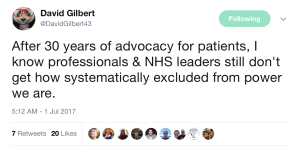
Fair point. And reading David Gilbert’s Twitter feed and skimming through his blog, his commitment to patient-led healthcare is strong. He has a lot of experience fighting for the rights of healthcare users to be true partners in the system.
I was interested in the commentary that followed after Partha Kar, an NHS clinical director, quoted the tweet suggesting that things are different in the diabetes world. You can read that thread here.
I struggled with the exchange, feeling a little discomfort when every point made by the original poster was almost dismissed with a ‘but we are doing better’ comment, which completely and utterly missed the point.
I typed a couple of quick responses, deleting all of them. My head was foggy and I was not sure that my thoughts could be condensed in 140 characters or fewer. But I was trying to say that while I actually agree that ‘patients’ do have very limited ‘power’ and are often actively excluded from processes, that isn’t the point. For me, the discomfort was stemming from someone’s personal experiences being rejected by someone who is actually not in the same position – or rather, by someone who holds a position of responsibility in the very system being questioned.
Let’s reframe it this way. There is a gender pay gap that continues in every industry. Women are significantly under-represented as Company Board Directors, as CEOs, and in politics. Health outcomes for women are worse than they are for men. As a woman, I am conscious of the imbalance; I have fought for equality for as long as I can remember; I see the discrimination; I have experienced the discrimination firsthand.
Are there initiatives in place to try to address these gaps? Yep. Is the situation improved today as compared with 100 years ago? Perhaps. Are there men who are fighting for the rights of women? Of course there are.
But does that mean that women who are affected by the imbalance should have their (our) concerns and experiences dismissed because some are ‘trying to make a difference’? Absolutely not.
It is the same in healthcare. Just because there are some dedicated people steadfastly working to support and deliver a more person-centred, inclusive approach with its foundations in true partnership doesn’t mean that the problems are not still there. And it certainly doesn’t mean that we should stop paying attention to those who speak up about the inequality.
If people are feeling excluded – especially people with 30 years of experience in health advocacy, a Twitter following and a blog – we need to believe people are being excluded.
Just as it is not the place for men – even men who might be unequivocally feminist in their words and actions – to tell women that we need not feel discrimination because there are people committed to levelling the playing field, it is not up to HCPs to question the experience of healthcare consumers when we say we have no power and no ability to influence.
For the record, I agree with David’s original tweet. How much power do healthcare consumers really have in shaping healthcare? How much opportunity is there to truly influence the way the system, activities and programs are designed? In fact, how much of the system, and how many of the activities and programs are co-designed?
If we look at diabetes, how many positions are dedicated specifically to people affected by diabetes on Boards, expert reference groups, working parties, organising committees (etc.)? Can you think of an example when the split between HCPs and people with diabetes was equal?
And finally, a thought on language. The word ‘patient’ was used throughout the Twitter discussion and I believe it is problematic. It’s not a word I use; I don’t refer to myself that way. The Diabetes Australia Language Positions Statement advises against the use of the word because it ‘implies the person is a passive recipient of care, rather than an active agent in his or her own self-care’.
In a discussion about people feeling they have no power, using a word that clearly diminishes the role and involvement of the central person in the healthcare equation speaks volumes. At least I think it does.
If you can, think back to when you were diagnosed with diabetes. Can you remember much of it?
I can. I can remember almost every word that the endo, diabetes educator and dietitian said to me. I can remember that, in amongst the explanations of what diabetes was all about and how it would impact on my life, there were thinly-veiled threats about what would happen if I strayed from the plan I was being given with the expectation that I would follow it. I remember the rigid ‘my-way-or-the-highway’ instructions about how life with diabetes would be.
But mostly, I remember what was missing. There was no mention about the impact of diabetes on my emotional wellbeing. No one suggested that speaking with peers – others living with diabetes – might provide me with some much need comfort or camaraderie. No one hinted that I might like to do some of my own reading and investigating to come up with my own ideas of how to best manage this chronic condition that had moved into my body, my mind, my life.
No one told me there were options or suggested that I needed to carve out my own path and then work out to navigate it best.
If only I’d had a guide to help me do that – something to give me some ideas that felt more in line with how I lived before diabetes. I wanted something that shared real-life experience about how to make diabetes fit into an already really busy life, and help me be conscious of making healthier choices, but choices that didn’t feel as though they were suffocating me.
Now I have it – albeit 19 years too late!
Adam Brown from diaTribe has written Bright Spot and Landmines which he has sub-headed ‘The Diabetes Guide I Wish Someone Had Handed Me’.

Click on link to be taken to the first chapter.
As I read this book, I started to think about how different those early diabetes years would have been for me – the years before I found my voice, my people and an ability to work out my own way with diabetes.
I could use words such as ‘sensible’ and ‘practical’ and ‘level-headed’ to describe the advice gently doled out in Adam’s book, and they would all be accurate.
But they would be underselling the value of the book.
Adam highlights the landmines – the things we all do to take short cuts – that inevitably negatively affect our diabetes. Often we think these short cuts save us time or ‘fix’ a diabetes problem quickly, only to find that they often turn out to be time consuming and actually end up causing more problems than the original one we were trying to address.
The bright spots are suggestions on how to positively and sustainably live with diabetes. They are easy to manage, and don’t ask for a significant shift in thinking, or large financial or even time investment to make the changes.
The book is segmented into four sections: Food, Exercise, Mindset and Sleep. This makes it super easy to use as a reference book and dive into it to help target specific areas that you want to think about. I’ve read the whole book through twice now, but keep going back to the sleep section, because I realised that it is an area of my life that I really need to address now.
I honestly wish that the day I’d been diagnosed with diabetes I’d been handed this book. I wish I’d had it on my shelf all those years as a resource to refer back to in moments of burnout or no motivation, or when I needed a little push to encourage me. I wish I’d been able to tap into Adam’s wisdom on specific issues when I was struggling with being in a food rut that was affecting my glucose levels, or in a funk because my mind was not clear or focused.
I’m so glad to have it now and have already made some changes which have been very positive. It might be 19 years late to the party, but this book will be on my shelf to be pulled down very, very often.
It doesn’t matter how long you’ve had diabetes; you WILL get something out of Adam’s book. But if you or a loved one is newly diagnosed, I would recommend you stopping whatever you are doing RIGHT NOW and getting a copy. You can buy a paperback copy here, or download the PDF here, naming your own price.
If you would like to win a copy of Bright Spots and Landmines, I can hook you up! Adam generously provided me with some copies when I caught up with him recently at ADA. Just click here and tell me in 25 words or fewer why you would like to win a copy of Bright Spots and Landmines. But chop chop! You’ve only got until the end of the weekend to enter.
As someone who is rather passionate about the words we use when we are talking about diabetes, I was framing how I would respond in my endo appointment when I finally received my pathology results yesterday. ‘Path results are not a moral compass, Renza. They give you a snapshot of data and that is information to help you inform treatment decisions moving forward. Nothing more. Nothing less. Your value as a person is not based on the numbers on the paper.’ I repeated the words rhythmically over and over and over again.
And maybe, I almost started to believe them.
I walked into the office and sat down anxiously. With a smile, she handed me sheets of paper. ‘You’ll be happy,’ she said to me. She told me my A1c as she knew that was what I would want to know first.
I flipped through the papers, the numbers starting to blur. I heard the A1c number but the rest stopped making any sense. ‘I don’t know what I’m looking at all of a sudden!’ I said to her.
‘Ah,’ she said. ‘Let’s start with your kidney check because I know that always worries you.’
We went through all the other results too. I was smiling and almost bursting into tears. ‘I’m so pleased,’ I said. ‘I’m so pleased with myself.’ And it’s true. I was feeling good about myself. And then I stopped taking.
Of course I was pleased; the results were all good. The numbers were in my target range. All of the worries I’d had for the last week melted away. But along with the celebration, I was starting to feel uncomfortable.
If the numbers were not where I wanted, my response would have been disappointment and, perhaps a little shame. I would not have been pleased with myself, instead chastising my lack of effort and feeling I was not enough. Yet, the effort would have been the same regardless of the numbers on the page.
Try as I might, I cannot divorce the idea that an in-target number is somehow connected to my value as a ‘good person’, which translates to an out-of-target number means I’m not. I fight this idea all the time. I write about it, I talk about it, I genuinely thought I believed it. Does the entrenched messaging we are told over and over again by some HCPs mean we actually should assess our own value as people based on numbers (a pathology check, BGL check, CGM trace, weight, blood pressure….)? Can we simply not move beyond the judgement?
I pushed away the thoughts and tried to just breathe with the relief I was feeling.
I walked out, paid the bill and walked to my car. I decided that I wanted to share the good news with Aaron, and I sent him a text with my A1c result. He responded perfectly with a gorgeous message…and then brought me Tim Tams for dessert.
And while we were munching on those Tim Tams, I said to Aaron, ‘You know, I’m really pleased with everything here. I’m pleased with my A1c, but the thing that relieved me more than anything are these five words…’ I leaned over and pointed to the paper at the five words I was referring to:

And I breathed out. Possibly for the first time in a very, very long while.
Last Wednesday, I walked into a local pathology office, rolled up my sleeves, held out my arm and watched as the pathology nurse filled three vials of my blood to be sent away. I then peed into a little yellow-lidded plastic jar, placed the jar in a plastic bag and handed that to the nurse waiting outside the bathroom.
And then I walked out of the office, headed to one of my favourite cafés, sat down and worked for a few hours.
I’d like to say that’s end of a very boring story. But it’s not. It’s Monday today and for the last six days, I’ve not stopped thinking about those drops of blood and pee. (I know; slightly gross.)
This week on Wednesday, I have an appointment with my endo. It’s a follow up from my visit last month. I walked out of that consultation with the path slip in my hands and a promise in my head and heart that I would go and have the blood draw done and face the results.
It’s been a very long time since I last had my A1c checked. Very.Long.Time. As in – no freaking idea the last time. It’s also been a while (the same length of time, I guess) since I had any other diabetes complications screening. I’ve not had my kidney function measured or my coeliac screening done. With only half of my thyroid still in my body, (the right half was removed along with a benign tumour back in 1998), I should be having that checked regularly. But I’ve not.
I don’t know why I am so committed and diligent about getting my eye screening done, but that is truly the only diabetes screening that is always – ALWAYS – up-to-date.
So for the last six days, I’ve had many hours, often in the dark of the night when the rest of the household is sleeping, lying wide awake wondering what those drops of bodily fluids have to say. (Again, yuck.) That’s when the nasty self-talking me comes out.
The nasty self-talking me is destructive. She’s relentless and actually quite nasty. ‘I bet your A1c is high, Renza. Really high. And I bet that your urine test is going to show some problems with your kidneys. And you know what? If there is, it’s all your own fault for not being on top of it.
My nasty self-talking me hasn’t read the Diabetes Australia Language Position Statement and says things like ‘You’re totally non-compliant. You know that, right?’ and ‘You’re a bad diabetic. The results are going to not be good at all.’
Last night I dreamt that it was Thursday and I’d missed my appointment, and try as I might, no one would give me my results. I called my endo’s office and the receptionist told me that as I’d forgotten to show up for my appointment the results had expired and disappeared. And then she called me non-compliant and unreliable. (This is so totally not what would happen because she is delightful and lovely and no one in my endo’s office is nasty and judge-y.)
When it’s not the middle of the night and I am thinking logically, the usual self-talking me – the rational one – says sensible things. ‘Yep, you’re right. It has been a while since you had all your screening things done. But you’ve done it now and that’s awesome. Just sit tight until Wednesday and then you’ll see where things are. And if there are problems, we can address it then. Do you need a new pair of boots?’
And when nasty self-talking me says things like ‘Bad, bad diabetic whose A1c is going to be terrible’, the rational self-talking me says ‘It’s just a number. You know that. And if it is higher than you would like, you can put some strategies in place to bring it back to where you are comfortable.’
I like the rational self-talking me. She’s sensible and uses words I like to hear. But it does seem that when there is even a shadow of doubt, she is very much overwhelmed by the nasty self-talking me. And, boy, does she has some attitude! She makes me feel that I should measure myself by numbers. She makes me feel like a failure for not always staying on top of all my diabetes screening. She makes me feel that if anything goes wrong I am to blame. She’s nasty. Really, really nasty!
So right now, with rational self-talking me typing away, I’m putting this here for the next couple of days (and for future reference) when nasty self-talking me is the louder voice:
- You are not defined by your A1c or any other number.
- You are not a bad person because you have let some of your diabetes management slip.
- If it turns out that the results are not what you hoped for – in any way – you can and will deal with that.
- And it’s not your fault if that is the case.
- Diabetes complications do not mean that you have failed.
- You work bloody hard to manage your diabetes as best as you can at any moment and you should go and eat a cupcake right now to congratulate yourself for that.
- If you feel that you could be doing better, work out how to make that happen. Your endo appointment on Wednesday might be a good place to start.
- Tell that nasty self-talking part of you to piss right off.
- And yes. You do need a new pair of boots.

After my pathology visit, I went to one of my favourite local cafes which sometimes has puppies to cuddle. How cute is Juno?!
It’s day four of the eighth annual #DBlogWeek, created by Karen from Bittersweet Diabetes. This is the sixth year I’ve taken part and it’s a great opportunity to not only write about some truly interesting topics, but also a chance to read some blogs you may not otherwise. Here are the links to today’s posts.

Today’s prompt: May is Mental Health Month (in the US) so now seems like a great time to explore the emotional side of living with, or caring for someone with, diabetes. What things can make dealing with diabetes an emotional issue for you and / or your loved one, and how do you cope?
One of the things I’ve found about living with diabetes is that the way I respond to certain situations is inconsistent. Some days, I’ll look at a rollercoaster CGM trace, shrug my shoulders and think ‘That’s diabetes!’ and move on. Other times, I’ll look at a similar rollercoaster CGM trace and burst into tears, wanting to curl up in the corner under a quilt, asking ‘Why? Why? WHY?’ while someone brings me a cup of tea and Lindt orange chocolate.
There are periods when my resilience stores are high and I can manage anything thrown at me, and other days where the smallest diabetes issue sends me into a spiral of despair. The unpredictability of diabetes is matched only by my own haphazard responses.
There do seem to be some things that do get me down pretty much any time they happen. When diabetes starts to affect my family, making my health issue theirs, I get very emotional and upset. I think it is probably a combination of sadness, guilt, anger and frustration that guarantees an emotional response.
The unknown of diabetes worries and scares me. I don’t think about it most of the time – I guess that is how I cope. The fears and anxiety are neatly packaged up and hidden away, brought out only in moments of weakness – or perhaps when my resilience is low.
Earlier this month, when I was an invited speaker at the Primary Care Diabetes Society of Australia (#PCDSAus) conference, and in the same session as me was Dr Christel Hendrieckx from the Australian Centre for Behavioural Research in Diabetes. Christel was very clear that clinicians need to consider diabetes and emotional health side by side as the two are undeniably connected.

I truly think that when we break it down, we can’t separate the two. When we live with a condition that is so ever-present; that we invest so much of our time and energy into managing; that we can’t put in a box when we are feeling over it and come back to it when we feel more equipped, it’s impossible for it to not impact emotionally.
We, all too often, draw a line with the physical on one side and the emotional on the other side. That line is terribly blurred – if it’s even there at all – when it comes to diabetes.
It’s day two of the eighth annual #DBlogWeek, created by Karen from Bittersweet Diabetes. This is the sixth year I’ve taken part and it’s a great opportunity to not only write about some truly interesting topics, but also a chance to read some blogs you may not otherwise. Make sure you check out the list for today’s posts here.
Today’s prompt: Insulin and other diabetes medications and supplies can be costly. In the US, insurance status and age (as in Medicare eligibility) can impact both the cost and coverage. So today, let’s discuss how cost impacts our diabetes care. Do you have advice to share? For those outside the US, is cost a concern? Are there other factors such as accessibility or education that cause barriers to your diabetes care?
Diabetes is an expensive condition with which to coexist. Every now and then, I tally my annual diabetes expenses, at which point, the reason for my frequent flyer status at the pharmacy becomes more than apparent. Between insulin, insulin pump consumables and blood glucose strips, it doesn’t take long for the costs to add up.
Then I add the fees to see diabetes-related HCPs. I choose to see all my HCPs privately, so there is a gap (out of pocket) cost for all these appointments. Fortunately, pathology is bulk-billed, so I don’t pay to have my A1c checked or for any other blood work.
Private health insurance (PHI) is a significant cost each year. We pay about $450 per month to cover the whole family for top hospital and extras cover. PHI means that every four years, the full cost of my insulin pump replacement is covered, and it also means a choice of doctors if we’re in hospital, subsidised stays at a private hospital, and we claim optical, dental and orthodontic each year, plus other things as well.
I wear CGM every day of the year, which adds about $4,000 per year to the tally.
It’s a lot of money. Without factoring in incidentals such as hypo treatments and other things that just seem to come up, my out-of-pocket expenses for diabetes (excluding health insurance) would be about $6,500 per year.
And yet, I feel oddly fortunate, because there are few surprises – or changes – each year when it comes to my medical expenses. I know how it will all play out in the family budget each year.
I know the prices that I pay for all my diabetes expenses are pretty much set, and that means I can plan for them.
I know that every time I walk into the pharmacy to fill an insulin prescription, I will hand over $38.80 for five 10ml vials of insulin. We are never at the mercy of Big Pharma’s arbitrary price hikes. (Last week’s announcement from Lilly of a 7.8 per cent increase on the cost of Humalog – after years of substantial increases – has left me reeling and astonished at how my American friends can afford to just survive with diabetes, let alone live or thrive…)
I know that my diabetes consumables will be the same price every time I order them thanks to the NDSS. The National Diabetes Services Scheme (NDSS) is celebrating 30 years this year – that’s 30 years of subsidised diabetes supplies for all people living with diabetes.
I know how much my doctor will charge me and I know the Medicare rebate. And I know that if I was unable to afford to see my doctors at their private offices, I’d have access to the free diabetes clinic at the tertiary hospital less than 10 minutes from my home, and a bulk billing GP of my choice.
I know that if I couldn’t afford private health insurance, my ability to buy insulin, diabetes supplies or see healthcare professionals would not be affected.
I know that there is no time that I will need to ration insulin doses. I know there will be no time that I cannot afford to see a doctor. I know my pharmacy will always be able to provide me with the supplies I need to live with diabetes and drive the devices I use to manage as best I can. I know I am not really limited by maximum rebate amounts or that if I need more BGL strips, I can get them.
And I also know – and acknowledge – the privilege that allows me to afford health insurance that pays for my insulin pump, and to self-fund CGM, and to see the endocrinologist of my choice privately.
I know there are many other Australians with diabetes who are not as fortunate.
The outcomes for Indigenous Australians are worse – far worse. Poorer Australians have poorer health outcomes. People living in remote areas often struggle to access decent, timely and appropriate healthcare. Australians from CALD backgrounds may not understand a new diagnosis or the treatment being prescribed which affects how they manage their health.
Our system here in Australia is not perfect and we should be continually striving to do better. But it is certainly better than in a lot of other places. The thing about diabetes is that, as many of us wrote yesterday, we are wrangling a health condition that likes surprising us. We often feel we are fighting our own bodies. We shouldn’t need to fight to afford our care – and our health – as well.

The cards that cover my diabetes – and other health – needs. (Oh – and a credit card for all the out-of-pocket expenses…)
The term ‘mansplaining’ has made its way into modern language – and with good reason.
But I’d like to get ‘diabetesplaining’ in there, too. Recently, I’ve had a few diabplaining episodes that have left me shaking my head (and making up words…).
In all of these cases, the person doing the diabetesplaining didn’t have diabetes. And yet, they felt that I needed their advice on how to live with, and how to feel about, the health condition that I’ve been managing for the last nineteen years.
I am always happy to speak about diabetes and answer any questions people have. (Provided, of course that people are polite and respectful.) But I don’t appreciate unsolicited advice and explanations, or someone thinking they know more about my diabetes than I know. (Spoiler alert: no one does.)
These are just some of the gems that have been fired in my direction recently:
‘You know, someone at my work has diabetes and they don’t seem to have all the things you have to manage it. Maybe you should try to simplify what you are doing. You don’t need all of those things.’
‘Diabetes is a really easy to manage condition if you just eat the right foods. Do you eat the right foods? Let me tell you the foods that are good for diabetes.’
‘You shouldn’t worry about diabetes. You look really healthy. There is no need for you to worry.’
‘Your preoccupation with how people speak about diabetes is ridiculous. There is no need to stress out about that. Do you think you really need to be so concerned about it? Instead, you should channel that energy into something else…’ (There was no suggestions as to what else I could channel all that wasted energy into…)
With diabetes being a health issue with considerable attention, it makes sense that people want to have a say. I am actually all for that! I think that we need to have people speaking about diabetes and hearing about it too.
But the best people to drive the conversation has to be people actually affected by diabetes – not those who only think they know about it, or have become armchair experts because they saw a Michael Mosley doco on the issue!
Plus, those of us who are living with diabetes who have concerns or fears or a focus on any particular issue, or are managing our diabetes in a certain way don’t need to be told that we are unnecessarily ‘overdoing it’ or could be doing it better.
So, how did I respond to these comments? Not as ferociously as I would like, to be honest. But equally, not in the manner in which I really would like. It’s bloody hard to keep myself nice when I feel that someone is trying to enlighten to me when I really just want them to shush. Because as arrogant as this makes me sound, the chance that someone has something new to tell me about how I could better think or deal with my diabetes is slim to none.
It’s actually very tiring being on the receiving end of these sorts of comments. I don’t always want to be in ‘diabetes education mode’. I don’t feel equipped sometime to have to defend the way I feel, or explain why I do something to keep myself as healthy as I can. Diabetes is hard enough without having to justify myself. And I don’t need anyone to explain the finer details of diabetes, especially when there are far more interesting things we could be talking about. Such as these awesome ninjabread cookie cutters.
I had an appointment with my endocrinologist the other day.
My appointments with my endo don’t really take a particular form, because she absolutely lets me drive the agenda.
Having said that, they do start the same way. She asks me how I am, and then sits, looking at me until I finish answering. My response may be ‘good thanks…’ and the off we go. Or it may be a much longer response. Or, it may involve me bursting into tears two and a half minutes after sitting down. But she never interrupts or looks away, instead, focusing on me and what I am saying. Occasionally she may make a note on the notepad in front of her (she doesn’t take notes on the computer during the consultation). I feel I have her full attention the whole time.
This week, as I was making my way to the appointment, I thought about what my attitude towards my diabetes has been recently, and the word that came to mind was ‘meandering’.
I’m not really in a diabetes rut, but equally, I don’t particularly feel like I have any goals that I am working towards. I’m just wandering around, doing what I need to, stopping every now and then to have a look around, maybe sitting down sometimes and admiring the view, and then getting back on my feet and heading back off in a different, or maybe the same direction. Drifting is probably the right word.
I don’t really feel bad about it – my CGM numbers don’t scare me too much. Hypos are manageable and not too frequent. I calibrate my CGM, I bolus insulin before or as I sit down to eat. Last week I started to think about basal testing in a burst of focus and dedication. Basically, I am just going along, albeit aimlessly.
While that’s okay, it kinda makes endo appointments difficult. I did have a few things I needed to get done: VicRoads were asking for my first born child medical review (again), and I needed my usual diabetes-related screenings done. It had been a rather long time since my last A1c. I wanted to know what my bloody pressure was. But that was really all the ‘tasks’ I had planned.
And I also wanted to have a chat about my new eating attitude. It’s been quite a while since I’ve been eating lower carb. Sometimes I am more commuted to it than other times. But generally, I know that I am eating between 50 and 80 grams of carbs a day.
While I wasn’t looking for approval, I certainly did want to hear what she had to say about my new approach to food and my diet. She listened to me explain the changes I’d made and the reasons behind them. And the results I was seeing. I explained that I felt better overall and was really pleased with what I was seeing in my CGM trace as a result of my decisions.
Our discussion was brilliant. She nodded at what I was saying and answered some questions I had about the science of low(er) carb eating. She drew me some graphs that really put into perspective some of the things I’d been wanting answers to. We spoke about where there was evidence, but also where the evidence was lacking. The thing I loved was that at no point was I made to feel that a lack of evidence means that I shouldn’t be doing what I’m doing, or that I am silly for even trying it.
There is a reason that I choose health professionals like my endo to be work with. I have heard many other HCPs absolutely reject someone’s treatment choices. Low carb eating is one of those choices that does seem to cause such dismissals! But our discussion was open, without any judgement at all.
I walked away from the appointment feeling that I was better informed about what I was doing and energised to keep going. I felt engaged and focused, armed with information to make smarter choices.
And I felt grateful (yet again) to have this particular health professional alongside me on this diabetes road, even if I am just meandering sometimes.
There’s a war going on and it’s getting very, very messy.
Fat or carbs? These are the two big hitters in our diets, and when it comes to diabetes, are demonised by some, celebrated by others. And it’s confusing to say the least.
It’s also incredibly polarising and some of the most brutal arguments I’ve seen online within the diabetes community are about the foods we choose to eat or the eating plans we choose to follow.
My own personal decision to eat a lower carb diet was met with almost comical responses. Both sides of the fence told me I was being an idiot, all of which I happily ignored and continued doing what I was doing. Because it was working for me and is none of anyone else’s business.
When we look at the science of food, it’s confusing. I don’t for a minute pretend to understand how things work, I really don’t. I know how different foods impact my glucose levels, I know foods that make me feel better and I know that I like to eat.
But having made all of those disclaimers, I am health (and food) literate and I do understand some aspects of the science. I understand the basics of the carbs versus fat argument. But mostly, I understand that choice needs to be the driving force, along with acknowledging no one way of eating will ever work for every person. (Because if that were true, we’d all just eat Nutella ALL the time, because it tastes so bloody good and if you believe their spin, it’s a health food! Don’t believe their spin.)
What I really don’t like about the debate though is the acrimony. It makes me uncomfortable when either side take to cheap shots or aggression. Exhibit A is in the form of a tweet which I’m not sharing, because its writer is selling diet books and I’ve no intention of giving her any publicity here. But the gist of her tweet was condemning dietary guidelines and slamming carbs because she doesn’t (and this is a direct quote) ‘want to be fat and diabetic’.
The tweeter managed to food shame, fat shame, stigmatise and judge – all in 140 characters. As well as get things wrong. There are plenty of people who do follow dietary guidelines and eat carbs, yet do not have diabetes and nor are they overweight.
I get that there is some real anger, particularly within the LCHF community because there is so little recognition of how eating in this way can, for some people, help manage weight, diabetes and overall health. And some feel cheated that LCHF is frequently not even presented or recommended as an option, instead ignored or claimed to be dangerous. I get that this is frustrating for people who have seen great results after adopting this sort of diet.
I’m actually one of those people. But I refuse to think for one minute that just because this is working for me that everyone else should do it, too. I’ve never subscribed to thinking that any aspect of diabetes management is one size fits all.
So, what’s the answer? Well, I’ve no idea really. Ever since taking an interest in different eating habits, I’ve been astounded at just how many new diets are released. Obviously some of them are more sound than others, but regardless, there are always new ideas out there.
Perhaps the answer is to be patient. The ‘in’ and guideline-approved way of eating changes every decade or so. Perhaps those who are cross that their chosen eating plan isn’t the plan de jour just need to wait a few years before it is. And then they can say ‘told you so’. At least, until it’s old hat and replaced by some other new trend.
This is the first of a couple of food/diet-related posts I have ready to go over the next few days. I’m really interested to hear what others have to say about what works/doesn’t and why. And also how people deal with the judgement and commentary that inevitable comes when we are talking about what we eat.





 Diabetogenic