
You are currently browsing the category archive for the ‘Health’ category.
 I get to meet some pretty awesome people with diabetes around the globe. At EASD I caught up with Cathy Van de Moortele who has lived with diabetes for fifteen years. She lives in Belgium and, according to her Instagram feed, spends a lot of time baking and cooking. Her photos of her culinary creations look straight out of a cookbook…She really should write one!
Cathy and I were messaging last week and she told me about an awful experience she had when she was in hospital recently. While she wasn’t the target of the unpleasantness, she took it upon herself to stand up to the hospital staff, in the hope that other people would not need to go through the same thing. She has kindly written it out for me to share here. Thanks, Cathy!
______________
‘Good day sir. Unfortunately we were not able to save your toes. There’s no need to worry though. We’ll bring you back into surgery tomorrow and we’ll amputate your foot. It won’t bother you much. We’ll put some sort of prosthetic in your shoe and you’ll barely notice…’
I’m shocked. Still waking up from my own surgery, I’m in the recovery room. Between myself and my neighbour, there’s no more than a curtain on a rail separating us. I feel his pain and anxiety. He is just waking up from a surgery that couldn’t save his toes. This man, who is facing surgery again, leaving him without his foot. How is he gonna get through this day? How will he have to go on?
The nurse besides my bed, is prepping me to go back to my room. I tell him I’m shocked. He doesn’t understand. I ask him if he didn’t hear the conversation? His reaction makes me burst into tears.
‘Oh well, it’s probably one of those type 2 diabetics, who could not care less about taking care of himself.’
I’m angry, disappointed, sad and confounded. I ask him if he knows this person. Does he know his background? Did this man get the education he deserves and does he have a doctor who has the best interest in his patient? Is he being provided with the right medication? Did he have bad luck? Does he, as a nurse, have any idea how hard diabetes is?
The nurse can tell I’m angry. He takes me upstairs in silence. My eyes are wet with tears and I can only feel for this man and for anyone who is facing prejudice day in day out. I’m afraid to face him when we pass his bed. All I can see is the white sheet over his feet. Over his foot, without toes. Over his foot, that will no longer be there tomorrow. I want to wish him all the best, but no words can express how I feel.
What am I supposed to do about this? Not care? Where did respect go? How is this even possible? Why do we accept this as normal? Have we become immune for other people’s misery?
I file a complaint against the policy of this hospital. A meeting is scheduled. They don’t understand how I feel about the lack of respect for this patient. They tell me to shake if off. Am I even sure this patient overheard the conversation? Well, I heard it… it was disrespectful and totally unacceptable.
Medical staff need to get the opportunity to vent, I totally agree. They have a hard job and they face misery and pain on a daily basis. They take care of their patients and do whatever is in their power to assist when needed. They need a way to vent in order to go home and relax. I get that. This was not the right place. It was wrong and it still is wrong. This is NOT OKAY!
Helen Edwards from Diabetes Can’t Stop Me has written a thoughtful piece today on her blog about why she has ‘broken up with CGM’.
I truly love this post, because it once again reinforces the ‘one size fits no one’ approach that I have always advocated when it comes to diabetes.
As I read Helen’s story, I realised I could have written this post. I was reminded of the long and very winding road that it took for me to get to a point where I could live comfortably with all the tech. Learning to love it took even longer. It certainly was not love at first sensor! For a long time, I felt overwhelmed by all the data, the alarms drove me to distraction and I struggled at times to live with an invisible condition when all my robot bits are on show.
I showed the below photo during my talk at ADATS last week. It’s from a few years ago (and accompanied this post) when I was really struggling to live alongside CGM. I had to work up to convince myself to put on a sensor and made all sorts of deals to try to limit the stress I was feeling. I turned off all the alarms except for the low alarm. I promised myself that I would rip the sensor out if I was starting to be paralysed with all the information being constantly thrown at me. And I reminded myself that the data was just numbers trying to retrain my brain to not feel judged by the electronic device.

This wasn’t the first time I made such a deal with myself. And it took this and many other attempts of starting to wear CGM before everything feel into place. There were times where I pulled sensors out after two days because I just couldn’t cope with it.
Learning to live alongside diabetes technology is not an easy decision. There is bargaining, sacrificing and trade-offs. The tech is brilliant, but it rarely, if ever, works as simply as the shiny brochures promise. It’s not perfect and the limitations of the technology should never be blamed on the person wearing it.
Also, it’s no good speaking to people like me, because I’m all evangelical about it and spend all my time telling people how much I love it – while conveniently forgetting how long it took to find that place.
The tech is not for everyone and no one should be made to feel bad if they choose a more analogue approach to diabetes management. This is another slide I showed at last week’s ADATS meeting (from this post):

Right device; right time; right person. The right device might actually be no device at all. And that is absolutely fine!
(Hat tip to Professor Tim Skinner for the title of today’s blog post.)
In an effort to terrify the bejeezus out of healthcare professionals get the word out about Loop and OpenAPS to a group of diabetes healthcare professionals, I decided to work my Loop story into my talk at last Friday’s #ADATS meeting. I was a little nervous about it, but being on the ADATS Committee, and recognising the name of the conference – Australasian Diabetes ADVANCEMENTS and TECHNOLOGIES Summit – I knew that there was no way I could talk about the latest diabetes tech advances and not talk about the DIY movement.
To set the scene, I started with the old chestnut of showing how far diabetes technology has come:
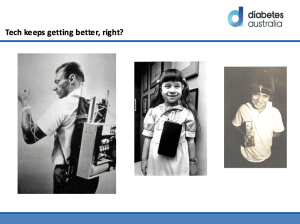
Then showed a slide with all our shiny new tech:
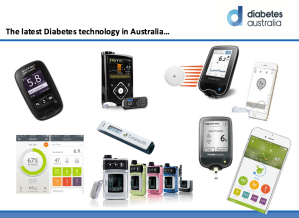
But then I stopped, and changed the slide a little, leaving the same photos, but altering the title to ask a question:

And then, I showed them what cutting edge diabetes tech really looks like:
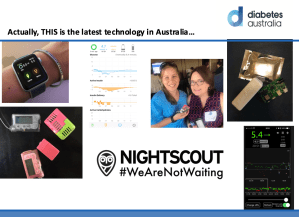
I used the next slide to explain how I drive my Dtech these days, and how my iPhone and Apple Watch are part of my diabetes tech arsenal.
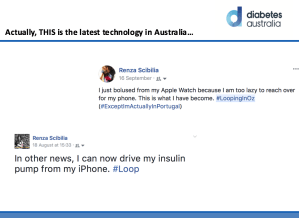
‘So…How many of you know about OpenAPS or Loop,’ I asked. Very, very few hands went up.
‘What about Nightscout? How many of you know about, and understand,d Nightscout?’ A few more went up – but really not many.
I nodded my head, completely unsurprised.
Then I told the audience I’ve been using Loop for almost three months. I explained how I ‘hacked’ an insulin pump, ‘became an app developer and built an app’… and now, my basal insulin is fully automated. I showed a screenshot of the app, and pointed out the dozens and dozens of small basal rate adjustments automatically made every day.
I explained how much better I feel, how much more time my glucose levels are in range and how I simply wouldn’t be without this technology now. I told them how I now wake up feeling that I can move mountains because night after night after night my glucose levels remain in a flat, straight line thanks to those micro basal adjustments, and I wake to a number that ranges no more than between about 5mmol/l and 5.8mmol/l.
‘How many of you are a little scared by this?’ I asked and waited. Hands shot up; many heads nodded. I waited some more, shrugging my shoulders a little.
‘This isn’t the scary future,’ I said. ‘It’s not dangerous, futuristic or downright terrifying – which is what I’m sure some of you are thinking. This is happening here and now. There are two other people in this room using one of the two systems and there are probably around thirty people across Australia who have started using one of them.
‘And if you are a healthcare professional working with people with diabetes, it makes sense to be aware of these technologies. Also, Nightscout has been around for a number of years now. It’s really not okay if you are working with people with diabetes and you don’t know about Nightscout…’
I know that my talk received a mixed reception. There was a lot of nervousness from some of the device company reps in the room – especially the maker of Loop-able pumps. Some HCPs were simply aghast and did nothing to hide their feelings, one person telling me that I was being irresponsible doing such a thing and even more irresponsible talking about it.
But others were far more interested. The rep. with type 1 diabetes from a device company who announced at the end of the day that he was ‘going home to hack his insulin pump’ was obviously interested. As were a number of other people with diabetes in the room. A couple of HCPs spoke to me about my experience, and one told me that he knows someone in the process of setting up Loop.
But mostly, there was nervousness and shock that not only is this happening, but that there are step-by-step instructions online so that anyone can get onboard. ‘You mean that ANYONE can access the instructions? For free? So any of my patients could do this if they knew about it?’ asked one endocrinologist while a diabetes educator he works with stood behind him sharing his horror. ‘Yep!’ I said cheerfully. ‘It’s all open source. No one is trying to make a buck out of this. It’s for everyone. Isn’t that fantastic! They didn’t share my enthusiasm.
Here’s the thing…I wasn’t (and am not) for a moment suggesting that it is the role of HCPs to start recommending this technology to the PWD they see. But it is naive of them to deny it is happening, or that the only way people with diabetes will find out about it is if their HCP mentions it. Also, I’m not recommending that everyone with diabetes should find a suitable pump and start Looping. I’m simply sharing my story – which is what I have always done here on this blog, and elsewhere as a diabetes advocate.
The title of this blog post came about when I mentioned the mixed reception a little later on in the day. I was sitting with three others at ADATS (who I knew would be sympathetic), and psychologist Tim Skinner commented that one of the reasons that HCPs might be so uncomfortable is because I am going beyond simply not following their directions of how I should be managing my diabetes. ‘You’re actually being a deliberately non-compliant diabetic,’ he said cheekily (Tim was one of the authors on the Diabetes Australia Language Position Statement, so he knew the response he’d get from me using such terminology). ‘This is a lot more than simply being ‘non-compliant’. You have actively hacked a diabetes device and are using that to change the way you are managing your diabetes. Deliberately non-compliant!’
He’s right. I never thought I’d wear the term ‘non-compliant’ as a badge of honour, but right then and there, I kind of was.

Even my t-shirt is deliberately non-compliant. (You can get your own by clicking on the photo.)
LOOP!!! I know you want more info. You can read my last couple of posts about my experience here and here, but the full details, continually updated by the brilliant Loop and OpenAPS brains trust can be found here. Read them. Also, you may want to join the (closed) Looped Facebook group. And if you are in Australia, we have our own (closed) page dedicated to local issues at Aussie Aussie Aussie. Loop, Loop, Loop. (And just a reminder – no one can build your Loop system. You have to do it yourself, but it is actually super easy once you have all the components.)
Disclosure
My travel costs were covered by the National Association of Diabetes Centres, the organisers of ADATS. I was on the ADATS organising committee.
Are you an adult (aged 18 – 75 years) with type 1 or type 2 diabetes living in Australia or the UK?
No? Avert your eyes and go back to looking at pictures of of cats on the internet.
Yes? Stop right there…. You can go back to looking at pictures of cats later, ‘cause right now, you have better things to do.
Like THIS:

Click to take the survey.
YourSay (Self-management And You): Quality of Life Study needs people just like you to have your say about the impact of living with, and managing diabetes on your quality of life.
You only have until the end of the month to participate, so now is definitely the time to do it.
And to say thank you, I baked these and am virtually sending you a couple:

You’re welcome!
Last night, I attended an event at Parliament House in Canberra, acknowledging and celebrating two milestones: 60 years of Diabetes Australia and 30 years of the National Diabetes Services Scheme (NDSS).
I spent the night chasing down people who were instrumental in the establishment of the NDSS to thank them for their efforts and try to explain just how significant the Scheme has been in my diabetes life for the last (almost) 20 years.
I never knew diabetes before the NDSS. On the day following my diagnosis, after spending the morning seeing my new best friends (endo, CDE, dietitian…actually, the dietitian and I never hit it off), I took a couple of freshly-filled-in forms to 100 Collins Street in the city and took a creaky elevator to the third floor. It was there I was introduced to the NDSS. I handed over the registration form and then the order form. Box after box was piled onto the counter in front of me and I looked at the unfamiliar words on unfamiliar boxes wondering where I was going to put it all and how much it was going to cost.
A few boxes of needle tips for insulin pens and a few boxes of glucose strips and a box or two of urine strips. It was tallied up and I was surprised that it wasn’t a lot more expensive. I was given a card and told to bring it in any time I needed further supplies.
As I came to learn about diabetes in other countries, I realised just how unique the NDSS is and how fortunate we are in Australia to have it.
I proudly speak about the NDSS to diabetes friends from all over the world. Often, these friends are astounded that the NDSS is free to join and available to everyone with diabetes. They are astonished that the price of diabetes supplies is the same for everyone and not reliant on insurance. Often they can’t get their head around the idea that we can choose which strips to use for which meter we prefer, with no interference from an insurance provider. And they simply cannot believe that while there are some limitations to the quantities that we can purchase, the amount we can access is actually quite significant, and there are allowances and exemptions for people who need more than the limits determined by the government.
The NDSS is more than a diabetes supplies program. It is intrinsically linked with Diabetes Australia who was instrumental in the establishment and implementation of the NDSS back in 1987. Diabetes Australia continues to administer the NDSS and runs all the services associated with the Scheme – from diabetes camps, information events, information resources and support services.
But more than that, Diabetes Australia continues to lobby the government to extend the NDSS. More than five years of consistent lobbying resulted in the CGM initiative being announced and launched, and Diabetes Australia is actively urging the broadening of initiative to include other groups of people with diabetes who benefit from CGM (as outlined in the original joint submission from Diabetes Australia, JDRF, ADS, ADEA and APEG). Back in 2004, following a similarly consistent campaign, pump consumables were added to the Scheme. Recently, Diabetes Australia’s responded to the stakeholder engagement regarding the listing of Freestyle Libre on the NDSS with this submission. From the initial lobbying for the introduction of the NDSS to today, the link between Diabetes Australia and the NDSS has resulted in supporting people living with diabetes and making our lives easier.
The NDSS remains the only scheme of its kind in the world. It has enjoyed bipartisan support from consecutive governments.
Of course, our health system is not perfect here in Australia. I believe that there should be more funding and more subsidies on the NDSS. I don’t believe in restricting access to glucose strips for people with type 2 diabetes not using insulin. I know that a lot of people still find the cost of diabetes prohibitive and there is still a divide between those who can afford the latest technologies and those who cannot.
But the NDSS does go a long way towards lessening the burden in some ways and I certainly am glad – and proud – that we have it.

Disclosure
I have been an employee of Diabetes Australia (and Diabetes Victoria) since 2001. I cover all costs for all NDSS products I use.
Last week, a recipe was posted on the Medtronic Australia Facebook page. The recipe was for a Chocolate Tim Tam Cake, which looked rather gooey and very chocolate-y.
I was looking for something to bake over the weekend, but decided that this cake wasn’t really the sort of baking I was up to, so I scrolled on, searching for the right recipe for my baking adventures.
But for some reason, I kept seeing the recipe appear in my FB feed, a couple of times because it had been posted in some of the LCHF groups I follow.
And then I did what I know I shouldn’t do. I looked at the comments, and down the rabbit whole of the very angry LCHF brigade I tumbled.
I am always very wary when it comes to dietary advice. I don’t follow the Australian Dietary Guidelines because I find the quantity of carbs recommended is just simply too difficult for my non-functioning pancreas. Or rather, for my (frequently barely-functioning) brain which has to act like my non-functioning pancreas. Also, I just don’t really want to have to bolus large quantities of insulin in one go. But that’s just me.
Equally, I don’t follow a paleo diet or I Quit Sugar or Dr Bernstein because anything that is so prescriptive is never going to work for me. Instead, I pick and choose what I know will work for me and, more importantly, what I can manage sustainably. I couldn’t really care less what other people with diabetes (or people without diabetes) eat, because I’m far too concerned with my own diabetes existence. And being obsessed with the @TrumpGoogles Insta account…
In exactly the same way I would never accept a HCP who judged what people eat or the tools people choose to manage their diabetes, I don’t take too kindly to other PWD (or anyone, really) suggesting that people who prefer to eat in a certain way are ‘killing themselves’. This is what was happening in the case of the recipe posted by Medtronic.
You can read the comments yourself (the post is here), or you can just assume that they all had to do with the criminality of a company daring to post the recipe while suggesting that people with diabetes might want a piece of cake. And varying versions of ‘you might as well just kill yourself’.
I’m not bagging the LCHF movement and anyone who fully subscribes to it. But I am calling out the frequent aggressive and belligerent rhetoric of some LCHF folk. I’ve had more than enough disrespectful and rude comments sent my way anytime I write about food or share recipes. Despite that, I’m not for a minute suggesting that the way you are choosing to eat is harmful, in fact, I completely agree that eating LCHF is one way for some people to best manage their diabetes. I know a significant number of people of have changed to this way of eating and they have found the results to be incredibly positive.
I also know a significant number of people who simply haven’t found it to be the right thing for them. Some say they have found it unsustainable, others say they found it boring. Others say they are simply not interested because they found it too restrictive, or too expensive. And some say the results they saw simply didn’t warrant the effort they needed to put in.
I know that for me, exclusively following a LCHF diet doesn’t work because I just don’t do food restriction. I’ve never dieted in my life and I don’t do well with being told what I can and can’t eat. I also know that I can quite easily manage to limit my carbs to around 50 grams per day and that the results I have seen since doing that have been worth the effort for me. I also know that all carbs are not created equal and I try to be smart about what I choose to make up those 50g (or so).
Oh – and mostly I know that sometimes…sometimes, those 50 grams of carbs are going to be a doughnut. I’m okay with that. Doughnuts are delicious and bolus-worthy.
As I firmly and resolutely believe, everyone has the right to manage their diabetes in a way that works for them. And they have a right to do that without being bothered by others. Being told that what you are eating is ‘poisoning your body’, or being told that the devices you are using are toxic helps no one.
Oh, and the personal attacks are also totally unnecessary. The person who sent me an aggressive FB message after seeing this profile photo can just pull their head in. I ate a few bites of chocolate cake (the best chocolate cake ever), not ‘poison’. And yes – even after eating those few bites, I still have both my legs, and my kidneys continue to work just fine. But thanks for asking.
Eat how you want. Let others eat how they want. It’s really not that hard.
For the record – this is what I made on Saturday evening. (This one went to the neighbours, but I also made a smaller one for home.) It’s a blueberry crostata. I added a little ricotta underneath the fruit and made a ridiculously buttery pastry to hold it all together. Super easy. Super delicious. (And my CGM trace peaked at 7.3mmol/l for anyone wondering…)

There’s lots happening, but I can’t look away from my Loop app at the moment because I’m so damn excited and obsessed! (I’ll be writing something about it sometime this week.)
But if I wasn’t doing that, I’d be (re)reading these things…
Why it costs so much to see a specialist
I’ve always paid to see my endos privately. In fact, I generally ‘go private’ for all my healthcare needs – I can’t remember the last time I was bulk-billed for a medical consultation.
It does cost a lot, and I am grateful I can afford it, but the excessive costs often discourage people from seeking the right care they need. Of course, we do have excellent public health in Australia. My choice for seeing HCPs privately include wanting continuity of care, and not being subject to frequently very long waiting periods.
This piece in The Conversation looks at why specialist care is so expensive. And what can be done to reduce costs.
Lookiee! A diabetes Wookiee!
For those who participate in OzDOC (and other DOC activities) you may have come across David Burren. I met David last week to talk all things tech (actually, I just fired questions at him about Loop and he patiently answered them without rolling his eyes even once). He’s started a diabetes blog all about diabetes and technology and, thankfully, it is in language that even I can understand.
Check out David’s Bionic Wookiee blog here.
Statues are like tumo(u)rs.
With all the nonsense going on in America at the moment, this piece from McSweeney’s most adequately explains why the ridiculous idea that statues commemorating less than favourable moments in history need to remain. Here’s my favourite part:
I view this tumor as an important symbol of your body’s history and heritage. Removing the tumor would be yet another example of misguided medical correctness in today’s liberal America. I protest this surgery and refuse to whitewash your rich medical history. The tumor must be kept prominently displayed inside your body.
Do better, America. We all know you can.
More on what’s on the inside
Mel Seed’s blog about normalising mental healthcare in diabetes follows on from DX2Melbourne and is well worth a read. Read it here.
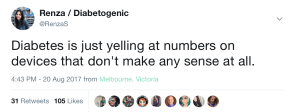
Diabetes is just…
This…
Faster insulin coming to Aus
A couple of weeks ago, I shared on my socials the exciting news that ultra-fast insulin, FIASP, had received TGA registration. No actual ‘launch’ date info as yet, although next week is the ADS ADEA Annual Scientific Meeting, so we may hear more then.
And in news that we already know…
Apparently, CGM is not just for abdomens anymore… File under ‘No Shit Sherlock’.
Swear-y
My blog emails keep getting blocked by the profanity filter at my husband’s work. Every now and then, he forwards me the message he’s received which states that the email was not delivered due to ‘offensive language’. #SwearyWife
This Twitter account definitely wouldn’t make it through, but it’s one of the best things I’ve seen on the interwebs for a while. I’d like to print THIS up poster size and put it on the wall of my office/wear it on a t-shirt, but perhaps that’s not appropriate.
D-parents and sharing the scary parts of their child’s diabetes online
I’ve linked to Moira McCarthy’s writing before because I think that she gets it right every single time she writes about the role of parents in their child’s diabetes.
This piece asks parents to consider if sharing their child’s scary and dramatic diabetes stories online is doing more harm than good. (I rather clumsily explored a similar issue last year in this post.)
Read her piece at ASweetLife here.
4Ts on Diabetes Mine…
Last month, during National Diabetes Week, in an endeavour to get our 4Ts message out as widely as possible, the good folks at Diabetes Mine allowed me to write a little about our campaign. You can read that here.
Living and loving someone with diabetes
As much as I think I am the most delightful and easy-to-live-with person in all the world, I have to admit that diabetes can and does impact on all relationships… and makes me perhaps not the most delightful and easy-to-live-with person. Aaron and I chalked up 23 years together yesterday. Diabetes has been part of the equation for over 19 of those years.
Diabetes advocates Nicole Johnson and Lorraine Stiehl have written a new book which has been called a practical guide to loving a person with diabetes. I’ve ordered a copy and will be leaving relevant pages open for my loved ones to read.
You can get a copy of What To Do When Your Partner Has Diabetes: A Survival Guide from Amazon.
Meme-y and true
There are a lot of diabetes memes out there, but sometimes I see one that just hits the mark so perfectly. Such as this from a TuDiabetes community member:

At #DX2Melbourne last week, we had a live webcast in an attempt to include people not invited to be part of the event to hear from some of the bloggers and contribute to the discussion. The hour-long webcast was about diabetes and mental health.
With delusions of Jenny Brockie and Tony Jones, I facilitated the discussion – which was actually quite difficult as there were thirteen of us sitting in a row meaning we couldn’t all see anyone other than who was sitting directly next to us without leaning dangerously forward. Also, I kept nearly falling off my stool, which suggests that I am the most ungraceful creature to have ever been positioned in front of a camera.

I’d put together some questions and discussion points to guide the discussion, but was very open to any tangent the group wanted to take to really navigate and explore the topic of diabetes and emotional wellbeing.
As the discussion flowed, I couldn’t help but feel a sense of déjà vu. Another talk about how diabetes affects us emotionally; another talk about not getting the support from psychologists and counsellors that we need; another talk about how usually it’s not even recommended that we may need to speak with someone about the mental health aspect of living with a chronic health condition; another talk from well-connected diabetes advocates saying that there is more to diabetes than simply being told our A1c, or any other number for that matter.
Amongst all the chatter, I asked myself how many times I’d participated in talks, how many talks I’d given, how many tweet chats I’d tweeted in, how many blog posts I’d written that were about the emotional side of diabetes. And then today, on my TimeHop app came this tweet, from an OzDOC tweet chat about mental health, held exactly 12 months ago today:

I’m not saying this because I think we’ve ‘done’ this topic and should leave it alone now. Not at all. I’m just suggesting that we’ve been having the same discussions about this really important topic for a long time, and yet diabetes care still seems to have this imaginary, yet somehow real, line down the middle, with the physical aspects of diabetes to one side, and the emotional aspects on the other as if the two are not fundamentally connected.
I knew that there would be some people listening in who would be hearing all of this for the first time. It would be the first time that although they had probably worked out that there was something missing from their diabetes care, they weren’t sure what it was. Or, they may have known they needed to speak to a psychologist or a counsellor, but didn’t know who to ask about it…and anyway, they may have thought, surely if this was something that lots of people with diabetes feel, someone would have mentioned it by now, right? Right???
Nineteen years I’ve had diabetes. And for at least seventeen of them, I’ve understood and known the importance of checking in on how the emotional impact of diabetes is contributing to how I am managing my diabetes. Or how I am not managing my diabetes (see above tweet….).
The idea that we can separate our mental health and emotional wellbeing from our diabetes is ridiculous. A condition that permeates every aspect of our life, moves in, makes itself a home and lords over us with terrifying threats of what lies ahead, impacts on our abilities to manage the day-to-day physical things we need to do.
Those watching the webcast at home could submit questions for the panel. A couple of diabetes healthcare professionals were watching and one asked a question that, as I read it, made my heart sink. He said that he sees people with diabetes who he believes would benefit from seeing a psychologist, but he is concerned that they will be offended if he suggests it. He asked the panel for ideas on how to broach the subject without causing offense.
Why did my heart sink? Because the question showed that there is still so much stigma associated with seeing a mental health professional, that other HCPs – on the ball, sensitive ones who know and understand the intersection between diabetes and mental health – feel worried that they might upset someone with diabetes if they suggest referring to a psychologist.
Until we normalise psychological support – until at diagnosis when we’re introduced to our new diabetes HCP best friends and psych support is part of that team – the stigma will continue. I’m not suggesting that everyone will need or want to see a psychologist. But putting it on the list, alongside a dietitian and a diabetes educator and an eye specialist will at least people understand that, if needed, there will be someone there to help with that particular piece of diabetes. (And to be perfectly honest, I really do wish I’d seen a psychologist at diagnosis rather than the dietitian who has scarred me for life with her ridiculously large rubber-mould portions of carbohydrate she insisted I eat at every meal!)
I don’t feel as though I am a failure because I have needed to consult a mental health professional in the past. I don’t think that it suggests that I can’t cope or that I can’t manage diabetes. I see it as important a part of my diabetes management as anything (and anyone) else. A lot of the time, I don’t feel as though I need to see someone. But other times, I do. And that is fine.
DISCLOSURES
Abbott Diabetes Care covered all my costs to attend #Dx2Melbourne, and provided all attendees with two FreeStyle Libre sensors and, if requested, a scanner. There was no expectation from Abbott that I would write about the event or any of their products, and everything I do write about it is my opinion, in my own words, and in no way reflects those of Abbott – or anyone else, for that matter.
For the last sixteen years, I’ve been directly involved in National Diabetes Week (NDW) in some way. Admittedly, I missed a couple because we decided the middle of July is a good time to go to New York to escape the Melbourne Winter. Two years ago I missed half of NDW because I was in Orlando at FFL – I returned just in time for Kellion! Oh, and there was the year I had a little wee lass who I couldn’t stop looking at and cuddling.
But whichever way you look at it, I’ve been involved in NDW for a while. A lot of that was spent very much on the sidelines, because the campaign was type 2 diabetes focused and I was not. Or rather, my role at work was exclusively directed towards type 1 diabetes activities, and campaigns were always about raising awareness of type 2 diabetes.
This year, for the first time, there is an element of the NDW campaign that is exclusively focused on type 1 diabetes and it was launched today. It’s all about the importance of early diagnosis of type 1 diabetes, aiming to reduce the 600-plus hospital admissions each year because the early signs of type 1 diabetes have been missed. I know so many stories of people with diabetes being told they had a virus/urinary tract infection/were run down/growing pains (in the case of kids)/needed a holiday, and sent home with a prescription for antibiotics. Their type 1 diagnosis only came after ending up, very sick, in emergency, many needing ICU attention.
The campaign highlights the 4Ts of type 1 diabetes – Thirst, Toilet, Tired, Thinner.
We leaked a sneak peek of the campaign on Saturday to let everyone know that it was coming. The leaked video, which tells the diagnosis story of 9-year-old Isabelle, has been viewed by tens of thousands of people.
The response to the video and campaign details has been overwhelmingly positive, with people sharing the video widely amongst their networks. And comments have also been encouraging, telling us that the campaign is right in its tone and focus.
Today, the campaign was officially launched in Brisbane and all materials are now available for you to see and share. Here’s the campaign poster:

What can YOU do?
As this is a public awareness campaign, we need to get this information out to people outside the diabetes community. Mostly, those of us affected by diabetes now know the early signs of type 1, but that’s not the case for people who don’t have type 1 or know someone living with it.
You can help by sharing the video on all your social networks. Set your shares to public and encourage your friends to watch and share.
Share the poster – both online and off. You could print off a copies and take them to your GP office, school, supermarket and anywhere else with a community notice board. Ask your church or community group, or child’s school if the poster could be shared in newsletters.
Also, I wrote this piece for Mamamia Women’s Network – again as a way of reaching an audience outside the diabetes world. Please read and share this too.
Use the following hashtags: #ItsAboutTime / #NDW2017 / #4Ts
My A1c came back a few weeks ago in my target range. As soon as I saw the number, I said to my endo: ‘It’s because of this,’ and I gently patted my arm where my Dexcom was sitting firmly, doing its thing.
I was right. Wearing CGM fulltime has allowed me to better understand what is going on with my glucose levels and how they responds to a variety of different factors.

Puppy on my lap and CGM on my arm.
But it’s only part of the picture and the more I’ve thought about it, the more I’ve come to realise it. I’ve been using CGM almost fulltime for four years now, yet this A1c was ‘more’ in-range than any other in that time.
It can’t just be the device.
No, it’s when I add the low(er) carb way I’ve been eating to the equation that the improvement starts to make sense.
The most obvious thing I noticed when I started eating lower carb was that my CGM trace stayed far straighter for far more of the time.
Before I started eating this way, I’d see a lot of spikes. Sure, I’d come back into range after an hour or two, but there was a good while there that I was above range while I waited for the insulin to do its thing with the carbs I’d just ingested. Insulin isn’t perfect; its action can be unpredictable.
Eating lower carb means the spikes just don’t happen as they used to. Of course there are other contributing factors that do cause my glucose levels to head out of range, but by eliminating – or rather minimising – the one that is most responsible has resulted in a significant change.
So, what is that change? It’s all about time in range (TIR).
And that is how I now measure my glucose management. It’s not about A1c – I don’t like averages because they conceal a lot of what is going on. The A1c average might be a pretty number, but what is going on outside that number to get there? But when I look at how much of the day is spent in range, there is less place to hide. It is starkly clear the days that I am within my upper and lower limits.
And there is a flow on effect from more time in range. When I think about how I feel on the days that I am far more in range than out, I feel better – more energised, more focused, more able to just get things done.
CGM data easily provides me with this data (and flash glucose monitoring would as well) so I can see at a glance just how much of each day is actually spent in my target range. This means that I don’t really care about what my A1c is. It may creep up a little bit, but if overall I am spending more time in range, then I’m happy.
This is just another reason that A1c measurements are flawed. It was first recommended as a way to measure diabetes management back in 1976 and a lot has happened in diabetes since then. I’m certainly not suggesting that we throw it out the window. But I am saying that with new (and some not-so-new) tools to provide even more information – more meaningful information – I certainly am not using it as the only way I to track and measure how I am going.
TIR. I’m calling it the new A1c! (And adding yet another acronym to my diabetes lexicon…)
Want more? This great piece about ‘going beyond A1C’ from diaTribe is a must read.





 Diabetogenic