
You are currently browsing the category archive for the ‘Awareness’ category.
There was a piece in the Huff Post the other day about things to not ask someone living with a chronic health condition – specifically ‘Have you tried….’
You get the idea:
Have you tried not eating after 6pm to help your blood sugars?
Have you tried to quit sugar? Completely?
Have you tried the drug they were talking about on A Current Affair the other night?
Have you tried giving up coffee? (While I don’t advocate violence, it is perfectly acceptable to respond to the fool asking this question with a sharp slap to the back of the head.)
Sometimes the ‘have you tried’ suggestions are just plain ridiculous. In last week’s OzDOC tweet chat, moderator Ms Kim came up with this beauty, asking for us to tweet how we would respond.
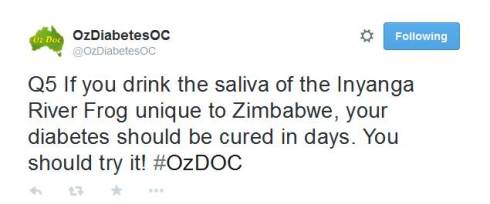 My take on comments like this is to roll my eyes and try to change the subject. I don’t believe there is any malice in someone making these suggestions; they really are trying to help. They want to help.
It’s what it represents that pisses me off a little. My diabetes management is not for up public tender. I manage it in a way that I see fit. I will ask if I need help. Actually, I’m not great at asking if I need help, but that’s not the point.
It is as though having a chronic health condition is a ticket for everyone to offer their ideas and suggestions. I’m fairly certain I’ve never asked people to workshop my diabetes management and I certainly haven’t sought to crowd source ideas for helping me out. And yet, it feels like it’s a public free-for-all at times!
I am sure that this is the same for people living with conditions other than diabetes. But with diabetes, perhaps because there is the link with food, and food is in the public domain all the time that people think they can weigh in. It doesn’t help that there are twits like the frequently-mentioned-in-this-blog-because-she-infuriates-me-so-much-and-is-a-dangerous-tool, Sarah Wilson, and the equally-derided Pete Evans who have mega-huge megaphones that reach a lot of people and feel that their pseudo-science programs are a good way to treat chronic health conditions. (Spoiler alert – they are not.)
For some people, the most difficult thing about living with diabetes, is the way that the public perceives the condition. While I seem to not get too hot under the collar about the public’s perception, I do understand how tiring some people get at the constant comments about diabetes, the misconceptions and how others want to get involved.
Diabetes seems to be rather unique in this sense. That public ownership of a condition that is a significant public health burden is certainly annoying at times. It’s similar to people commenting on the size of a pregnant woman’s belly (or overall pregnant body). Because it’s a bit ‘out there’ some think it’s okay to offer comment or offer suggestions. When I was pregnant, I was standing at the counter of a juice bar at the Queen Victoria Market and a man I am quite certain I’ve never met before, put his hand on my belly and told me that I was ‘a good size.’ I asked him to remove his hand and suggested that he mind his own business. Or at least buy me my pineapple juice if he wanted to get involved.
Finding ways to deflect comments without appearing ungrateful or rude can be tough. I know people want to help. But there is no curing diabetes and there is no magic potion that is going to make it better. It is sometimes a little insulting when people suggest things – especially things that are clearly straight off the snake oil shelf. Most who know me should realise that I am pretty linked in with what’s going on in the diabetes world. Do they really think that I could have missed that cure?
I (hope I) have a long life ahead of me and as it stands, that life is going to be shared with type 1 diabetes (well, at least for the next five years). I accept this and know that it is my lot in life. It would certainly be easier if people just didn’t think that it was public property and they had a free pass to comment.
I really hope I don’t sound ungrateful. Or rude…
By the way, this is how I responded to the OzDOC zinger from last week: 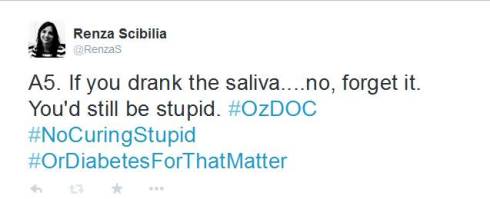
Because it’s so true. There ain’t no curing stupid!
Okay folks, it’s December. And my treat to you for the next couple of weeks is to provide you with fabulous Holiday songs. (I say Holiday not because I don’t want to say Christmas, but because they may not all be Christmas Carols.) Hold on – you’re in for a ride. Our Holiday album collection is certainly eclectic!
So, today, I’m starting with one of my all-time favourite musicians, John Pizzarelli singing Let it Snow.
I’m going to start by being honest and telling you that I think Sarah Wilson is an idiot. Her whole I Quit Sugar bullshit is nothing more than a moneymaking scam, and I will never understand why she thinks her D-grade celebrity status gives her any credibility when it comes to offering health advice.
But today, she has gone from being just a misinformed fool to an absolute troll. Because surely, that can be the only reason she would write that autoimmune conditions are all caused by self-hatred.
Oh yes she did.
Read this. I really don’t want to promote her stupid rantings, but read it. Read the ridiculous rhetoric. Read the assumptions. Read the complete and utter lack of anything resembling evidence. Read that this thoughtless opinion was a result of watching a TED talk given by Dr Habib Sadeghi, a so-called ‘healer to the stars’.
In addition to telling the world that autoimmune conditions are a result of self-loathing (as a person with three AI conditions, I clearly despise myself!), she also writes about a magic talent she has. So magic, that I am unable to understand why she is not teaching at Hogwarts.
Apparently, Sarah Wilson has the ability to ‘spot at “autoimmune type”’. What’s an autoimmune type? Well, the type who ‘…have an intensity about them, a desire to impress. They’re always the ones at the front of my lectures, frantically taking notes. They have an air of “I’m not good enough as I am’. I know as I write this, many heads out there are nodding.’
No, Sarah, no. They are not heads nodding, you foolish woman, they are heads shaking. In shock and disgust and amazement that someone could be so stupid, and dismay and outright disbelief that someone with a megaphone gets to say such damaging things.
Helpfully, Sarah has given us the secret of how to heal ourselves from these pesky autoimmune conditions we have hated upon ourselves.
It turns out The Beatles were right – all you need is love. Self-love.
Yes. That’s right. Sarah Wilson tells us that all autoimmune conditions can be cured with self-love.
Now, I am the first person to say that we should all be kind to ourselves. We shouldn’t feel guilt for our health conditions or blame ourselves (or anyone else for that matter). And when I am feeling good about myself – when I feel emotionally robust – it certainly does make it easier to care for myself and my diabetes.
But no matter how much I like or love myself – and truthfully, I actually do think I’m a bit of alright – I cannot cure my diabetes. And it would be irresponsible of me to think that I could.
Sarah Wilson, please, please stop writing such rubbish. Please stop outright lying to people about medical issues. Stop using your wide reach to say such damaging things. Please just stop.

Generally, I need a bloody good excuse to consider exercising. It’s been well-documented here on this very blog that I am exercise averse and would do pretty much anything to avoid donning a pair of runners to be physically active.
Little inspires me to keep fit and I really have never, ever understood the attraction of a workout.
However, guilt doing something good so that I can boast and be supercilious is a motivator.
Enter, the Big Blue Test.
This is the fifth year the Diabetes Hands Foundation (DHF) is running this campaign which raises diabetes awareness and funds. Since it started in 2010, DHF has donated about $250,000 to charities helping people with diabetes. This year, the aim is to raise $35,000 which equate to 35,000 Big Blue Tests being logged.
In case you need a feel good reason to exercise – there it is!
BUT! There is no time to waste. YOU ONLY HAVE TODAY!
It’s easy, easy, lemon squeezy to take part in. There are only four steps:
- Check your BGL
- Exercise for between 14 and 20 minutes
- Check your BGL
- Log it – here. (Or, to be a fancy Nancy, get the iOS or Android app.)
Could. Not. Be. Easier.
By the way, exercise doesn’t necessarily mean running or walking or getting on a bike. Think out of the box. Gardening, vacuuming, walking the kids to school, washing windows can all count as physical activity. I know that I hypo anytime I so much as look at a vacuum cleaner!
And, ahem, for another out-of-the-box idea, a morning, afternoon or evening quickie could not only be the perfect interlude in your day, but also a nice way to log a Big Blue Test. Plus, it’s nice to do charity work with a loved one.
By the way, the Big Blue Test is for EVERYONE – not just people with diabetes. Those with working pancreata (it’s the plural – look it up) simply log their exercise. (And that’s ANOTHER good idea to consider the quickie idea – you get two Big Blue Tests for your buck! Oh, stop it. I said BUCK!)
What are you waiting for? Go!
I was driving to pick up my daughter from school last Friday afternoon, and could feel the pressure of the previous week lifting. World Diabetes Day was all but over. There was, of course, the matter of a 24 hour tweetathon organised by the clever Cherise from DCAF, but that would be fun and interactive. The official things were over. Done and dusted for another year.
The thought of picking up the kidlet and chatting about her day, and things we had planned for the weekend made me smile. I’d been distracted with the craziness of the week and we’d not had our usual long, meandering conversations. I was looking forward to hearing what she’d been up to and NOT talking about WDD.
She ran out of her classroom to greet me, a big smile on her face, her bag hanging from her back and her latest book in her arms. And off she went filling me in on the day she’d had.
After telling me who she’d played with and what she had done in PE and reminding me that on Monday her Italian Choir was rehearsing for an upcoming concert at a neighbouring school and that she would really like to go cherry picking soon and how Sooty would like a run in the park, she said, ‘I told Mr D that it was World Diabetes Day today. I wrote it up on the board at the beginning of the day.’
I looked at her, surprised at the direction her stream of consciousness conversation had just taken.
‘What’s that, darling?’ I asked.
‘This morning. When I got to school. I told Mr D that it was World Diabetes Day and he said I could write it up on the board. Then we had a discussion about it.’
‘Really? What did you talk about?’
‘Mr D wanted to know if there was anyone who knew someone with diabetes. Of course, I said I did. And so did A.’ She was referring to my beautiful neighbour Jo’s gorgeous boy who is in the same class. ‘And S – her grandmother has diabetes. Type 2 diabetes. She checks her blood sugar like you do.’
‘I was surprised that Mr D knows so much about diabetes. But then he said that one of his friends has type 1 – that’s why he knows about it. We spoke about the different sorts of diabetes. A and I were saying that type 1 is because the body stops making insulin. And we talked about pumps. Hey mum – can we go get iced chocolates for afternoon tea?’
Subject changed, we headed to our local café, sat outside and enjoyed the sunshine.
I looked across the table at my nine year old as she slurped at her iced chocolate. World Diabetes Day is about raising awareness of diabetes to people in the community. In her own little way, she had done that in her classroom. Just because she could. Just because mum has diabetes. I had a little advocate on my hands. And I couldn’t have been prouder.

The kidlet and her side kick.
It’s World Diabetes Day and everyone is talking diabetes. Or so it seems.
Do we need another awareness-raising day?
Yep. We do.
We know the numbers. We know that diabetes is serious. We know that prevention is the key – prevention of type 2 diabetes (where possible) and of complications in those already living with diabetes. I could write how World Diabetes Day can draw attention to these facts.
But instead, I’ll tell you why I – a person living with diabetes – need World Diabetes Day.
I need today because it gives an opportunity to talk about real life with diabetes.
On Wednesday, (also known as ‘I hate diabetes day’) I spoke at the Austin Hospital’s Grand Rounds. Most hospitals have Grand Rounds – it is a learning opportunity for doctors and other healthcare professionals to hear presentations and ask questions about different medical conditions – sometimes outside their area of specialty.
Wednesday’s session had a World Diabetes Day focus – the lecture theatre was adorned in blue balloons and just about everyone in the room was wearing an item of blue clothing.
I gave my talk which consisted a discussion of the consumer-focused program we run at Diabetes Australia – Vic; how healthcare professionals can use social media to interact with people with diabetes and how PWD use social media to connect.
At the end of my planned talk, I looked around the room. I think my talk had been well received – I know that I am certainly different to the usual healthcare professional presenting and I also knew that the next speaker – the wonderful Professor Joe Proietto – was giving a talk on type 2 diabetes medication.
‘Just before I go, I want to say something,’ I said. I took a deep breath. ‘I hope you have enjoyed my talk. I hope that it has given you a better idea of some of the programs and activities available to be people with diabetes. I hope you are thinking about what your Twitter handle is going to be because I really want to see ALL of you in the Twittersphere next week!! But I just want to add something.’
I moved away from the lectern and stood in the middle of the stage.
‘I look okay today, right?’ I saw heads nodding around the room. ‘My dress is neat, my hair is clean. I have make up on and I know I have matching shoes on – I checked before I left the house. My lipstick is on straight. I just gave you a twenty minute talk, and I think it all made sense….I think? The words did form coherent sentences, right?’ More nods from the people in the theatre.
‘I look okay.’ I paused again.
‘But let me tell you how I am feeling. I had a terrifying hypo overnight and was awake for a good part of the night. I needed help to deal with it, and my daughter, when she woke up this morning, had to see me feeling pretty damn crap. My dad is sitting over in the corner there because I was just too tired to drive here from Brunswick, and he kindly offered to chauffeur me so I wouldn’t need to take a cab.’ I looked over at my dad and smiled. And then kept going.
‘Why did this happen? Well, I guess if we want to find a reason, we could say it was because before I went to bed last night, I didn’t check my blood sugar. You see, I just couldn’t be bothered. Now, before you think ‘how stupid’ or ‘serves her right’ or start to judge me, know that I had already checked my BGL about 15 times throughout the day and the thought of doing another BGL check was just too much for me. And I thought that I was okay based on the previous check and knowing that I had no insulin on board.
‘But you know what? It doesn’t matter why it happened and if I wasn’t telling you this now, you would never know. You wouldn’t know that I really would like to curl up under one of the seats and fall asleep; you wouldn’t know that I am still dealing with the hypo-rebound and my BGL is sitting somewhere in the mid-teens. You wouldn’t know that my arms and legs are heavy from being post-hypo-exhausted. You wouldn’t know that I kind of want to cry because today, my diabetes is other people’s problems. Not just my own.
‘Now, I’m not telling you this because I want you to feel sorry for me. I’m not telling you this because I want you to pity me because I have diabetes. It’s crap and that’s all there is to it. I’m telling you this because I want you to remember this story next time you are sitting opposite one of your patients who is living with diabetes – or any other medical condition for that matter – and they look all great. Don’t assume. Don’t ever assume that everything is all fine. Because I can tell you for sure that while I will be blogging about this to share with other people with diabetes, I certainly won’t be sitting in my next appointment telling my endo about it.’
I stopped again. The room was silent – no one moved.
‘Thank you so much for having me here today. And happy World Diabetes Day for Friday.’
I walked off the stage.
I love Joni Mitchell. And I love this song – Blue – which is, of course, perfect for today.

There are some very clever people in the diabetes world and today I want to write about the incredibly astute and hip crew from mySugr who look for innovative and fun ways to help ‘tame the monster’ that is diabetes.
I met Fredrik Debong from mySugr at the first EASD Blogger Summit where I heard about his diabetes-focused start-up and saw first-hand some of the things they were developing. Fredrik kept saying that we need to bring sexy back to diabetes – he and his team do it incredibly well! (Seriously – have a look at them all!)
Since then, I’ve been fortunate enough to meet others from the team – including Marlis Schosser, (who will forever be known as the saviour in the Pumpless in Vienna story I keep sharing in conference talks), and Ilka Gdanietz who has been at all three Blogger Summits. (Ilka is wonderful for a number of reasons, one of which is she shares my love of Nutella!) This year, Ilka gave us a sneak preview of some of the exciting things happening at mySugr headquarters. mySugr launched in the US last year and the team there is headed up by Kyle Rose and Scott Johnson.
The mySugr Companion app has been around for a few years now and I would really encourage you to have a look at it. As far as a logbook app goes, it is pretty damn perfect, and the version for kids is adorable! I guess that’s what happens when you have real people with diabetes creating tech for real people with diabetes. It just works!
But wait! There’s more.
Just this week, mySugr has launched their new initiative: mySugr Academy. The Academy will offer online training programs for people with diabetes and the curriculum has been developed by healthcare professionals and people with diabetes. The first course to be offered has been designed specifically for people with type 2 diabetes. Have a look at this teaser clip to give you an idea of what to expect.
Coming courses will be for people with type 1 diabetes.
mySugr is all about diabetes education and information, but it does it in an incredibly fun, interesting, accessible and cheeky way. It is groups like this – with a first-hand understanding of real life with diabetes – that make products that I want to use. Great, great stuff!

Monster-taming at mySugr HQ in Vienna.
Today I hate diabetes.
I am completely and utterly sick of the World Diabetes Day messages that are scrolling through my screen. I am over looking at posters and diabetes empowerment messages and I cannot be bothered being involved in the activities that are all around me. I don’t want to talk about it – which is actually really unfortunate as I am giving a Grand Rounds talk at the Austin Hospital today about life with type 1 diabetes.
This morning I am hypo-fucked after dealing with a low that would not quit. This is the sort of low that mocks and teases and is just plain cruel. And when it finally passes, glimpses and flashbacks plague my mind for the coming days, reminding me how vulnerable and scared I feel.
I needed help to manage it – and I absolutely hate making my lows someone else’s problem. Eventually, after a jar of jelly snakes, raisin toast and two glasses of milk, my BGL started to resemble something respectful and I was able to change out of my sweat-soaked PJs. Despite being in something dry and under a warm doona, I was chilled to the bone and shivered for an hour before finally falling asleep.
Today, diabetes made me break a promise I’d made to my daughter – a walk to school with the puppy. But what made me feel even worse was the way she nodded her head in acceptance – and understanding – of why I was breaking the promise. I hate that diabetes is part of my daughter’s life because of me. I hate that she understands diabetes. I hate that she ‘gets it’ when I tell her that I can’t do something because of my stupid blood sugar.
Today I hate diabetes.
Today, I feel defeated. Today, I desperately want to not be living with this condition.
Yesterday, I took part in Diabetes Queensland’s WDD social media campaign that asks people to share what ‘type 1 diabetes for me is….’ (#T1D4MeIs). Here is what I came up with:
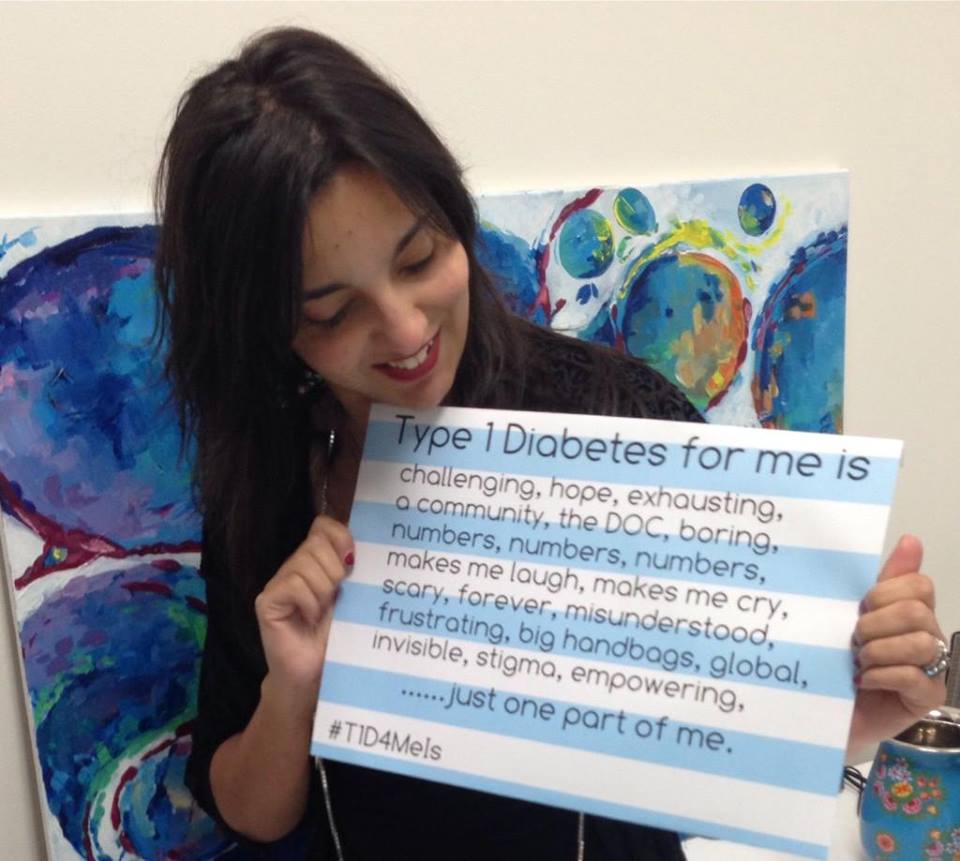
Today, my poster would look a lot different. It would have just one word.
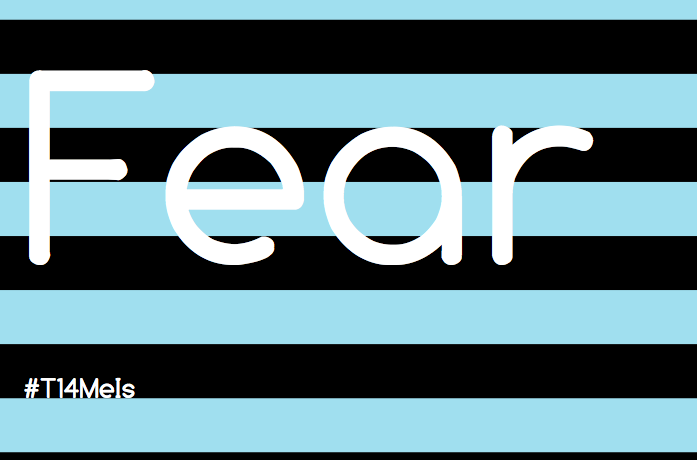
Today I hate diabetes. I don’t feel empowered. I don’t feel ‘in control’. I just feel sad. And scared.
My Facebook and Twitter feeds are full of diabetes awareness campaigns and it is only going to get busier in the next few days. World Diabetes Day is a global event, and around the world there is much going on to help get people talking and thinking about diabetes.
My favourite campaigns are those that strive to shoot down diabetes myths and one that is getting some well-deserved traction this week is Walk With D.
The aim of Walk with D is to help people without diabetes understand what life with diabetes is all about. But more than that, it hopes to address the misconceptions within the diabetes community too.
Diabetes myths are rife. Every day, I hear things that are simply not right about what diabetes is all about. It frustrates me; it angers me; it infuriates me – never more so than when it is coming from within our own community.
I am filled with despair when I see people with type 1 diabetes perpetuating myths about type 2 diabetes with incredibly destructive ‘type 2 bashing’. I don’t know how many times I’ve said the words ‘No one asks to get ANY kind of diabetes’, but believe me when I say if I had a dollar every time I’d uttered that sentence, I’d be wearing a new pair of Manolos almost every week!
‘Even within the diabetes community, there are levels of misunderstanding, misrepresentation, and mistaken messaging, often creating a divide where there should be a bridge.’ – Walk With D website
Help stop the stigma!
As with any successful social media campaign, it’s easy to get involved with the Walk With D campaign. Share your story and use the #WalkWithD hashtag. Make it personal and make it real. Visit the Tagboard on the Walk With D website to see what others are saying about their real life with diabetes. And share. Share. Share.
And if you need more of an incentive to get on board, Lifescan Inc will donate 100 BGL strips to Life for a Child every time the #WalkWithD hashtag is used during November. Get tagging, good people!
Everyone’s diabetes story is going to be different – the diversity of our community is actually one of its strengths! But we can surely unite in our aim to have diabetes spoken about respectfully and with courtesy. Surely we can bond over the fact that diabetes just plain sucks. Surely we can walk together with diabetes, united, with our heads held high and our arms linked.
This Friday is World Diabetes Day which is a chance for diabetes to get some much-needed mainstream attention and awareness.
There is an absolute plethora of activity this week in the lead up to the big day and, as usual, there is much online activity. Social media has the potential to reach a lot of people quickly, easily and cheaply. I’ve been involved in several campaigns in recent years and am always keen to see what clever ideas people come up with to raise awareness of diabetes around the world.
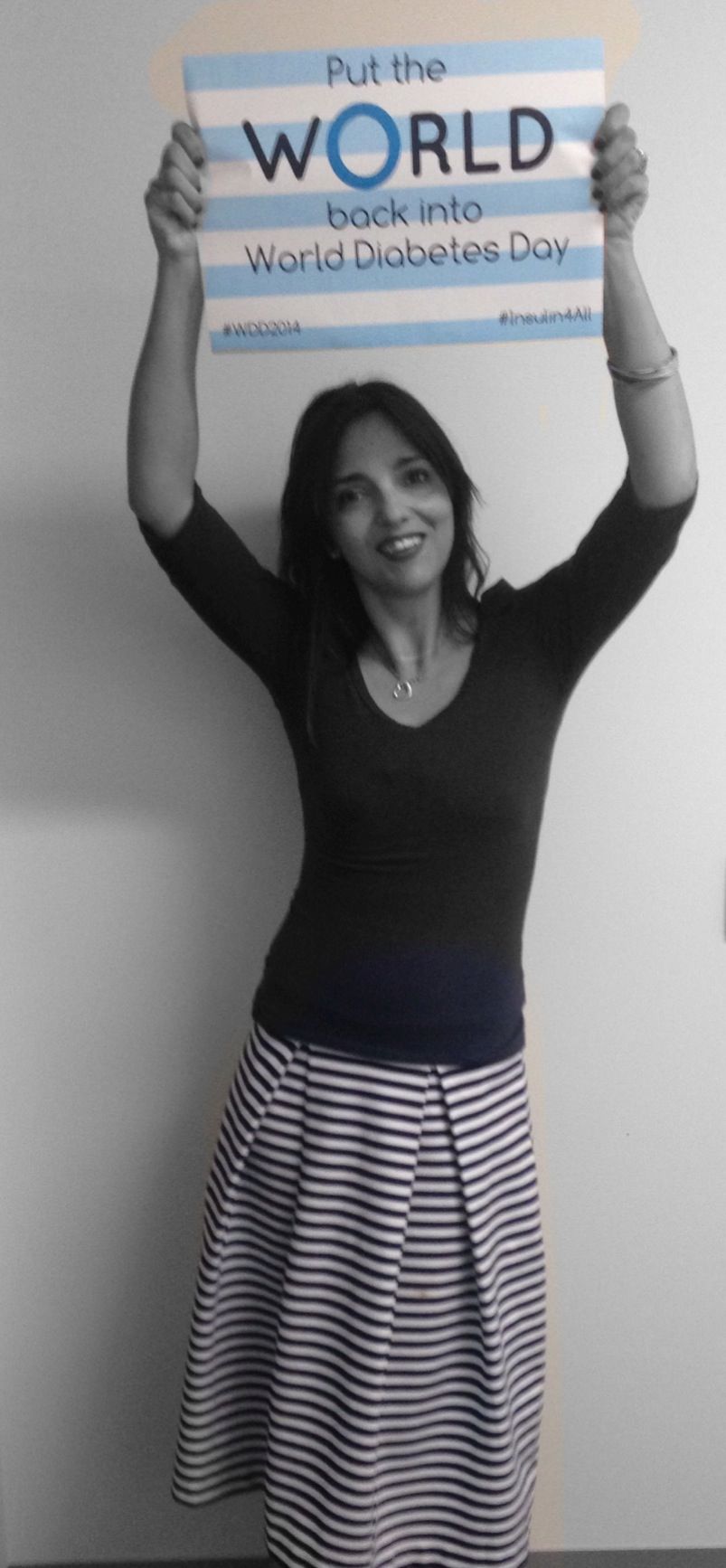
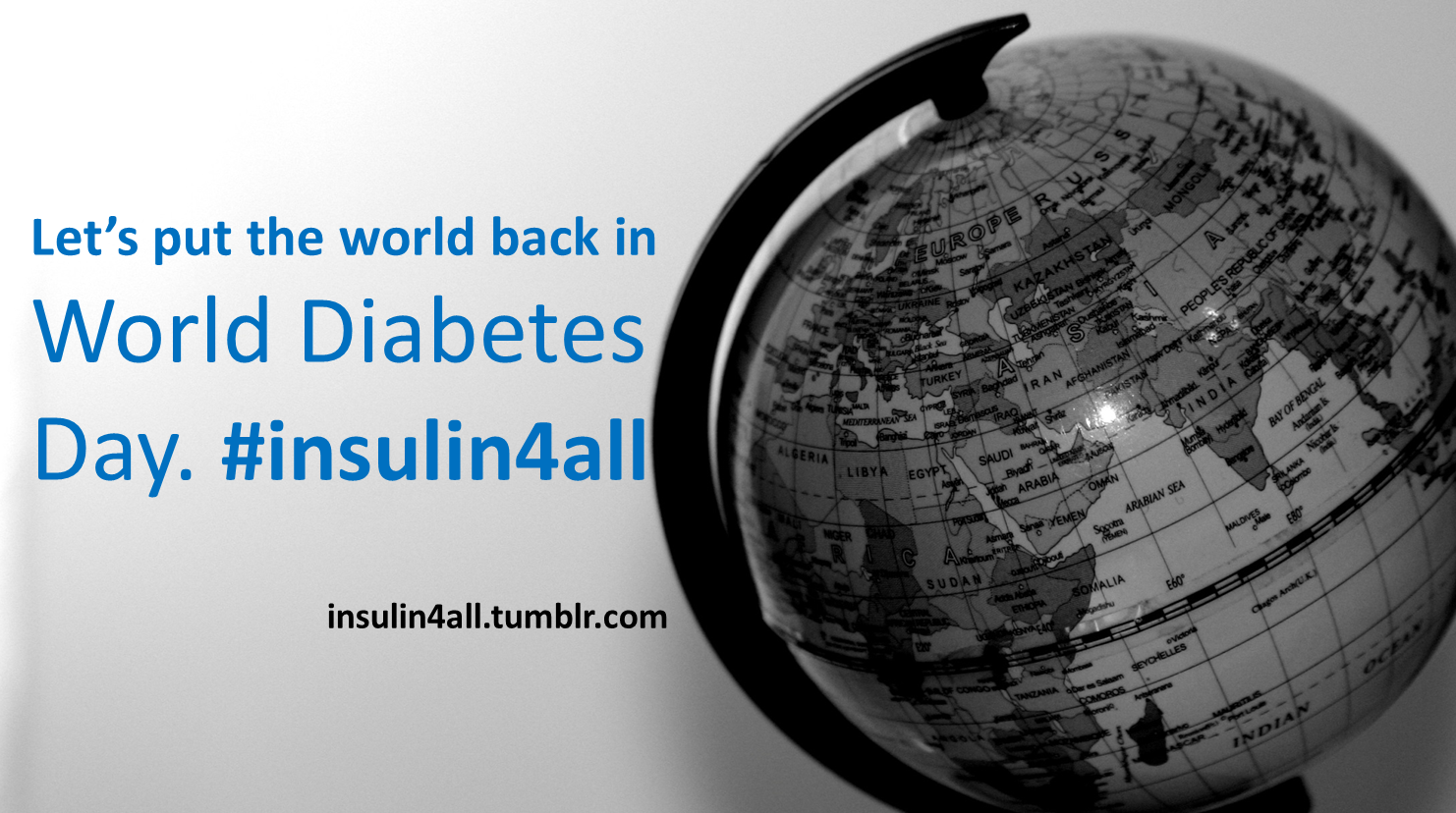 This year, one of my favourites is about access to insulin. The Access Alliance has created a Tumblr to draw attention to the fact that many people do not have easy access to insulin and other management tools, diabetes education and support. It breaks my heart that in 2014, almost 100 years since the discovery of insulin, there are still many, many people who cannot afford the insulin needed to manage their diabetes. This campaign is asking people to remember diabetes is a global issue and for some, accessing the things many of us take for granted – insulin, test strips, BGL meters – is a huge struggle.
I think about this often – in fact, every single time that I walk out of the pharmacy with my 5 x 10ml vials of insulin to load into my insulin pump. For less than $40, I have the next three month’s supply of insulin in my hands to take home, and keep safe and cool in the fridge. I feel guilty when I bitch and moan about the fact that I had to make a phone call to order in the insulin because the pharmacy doesn’t keep it in stock. Really? That’s the burden I deal with when I need insulin? I have to make a phone call and wait 24 hours before popping in to get my prescription filled. 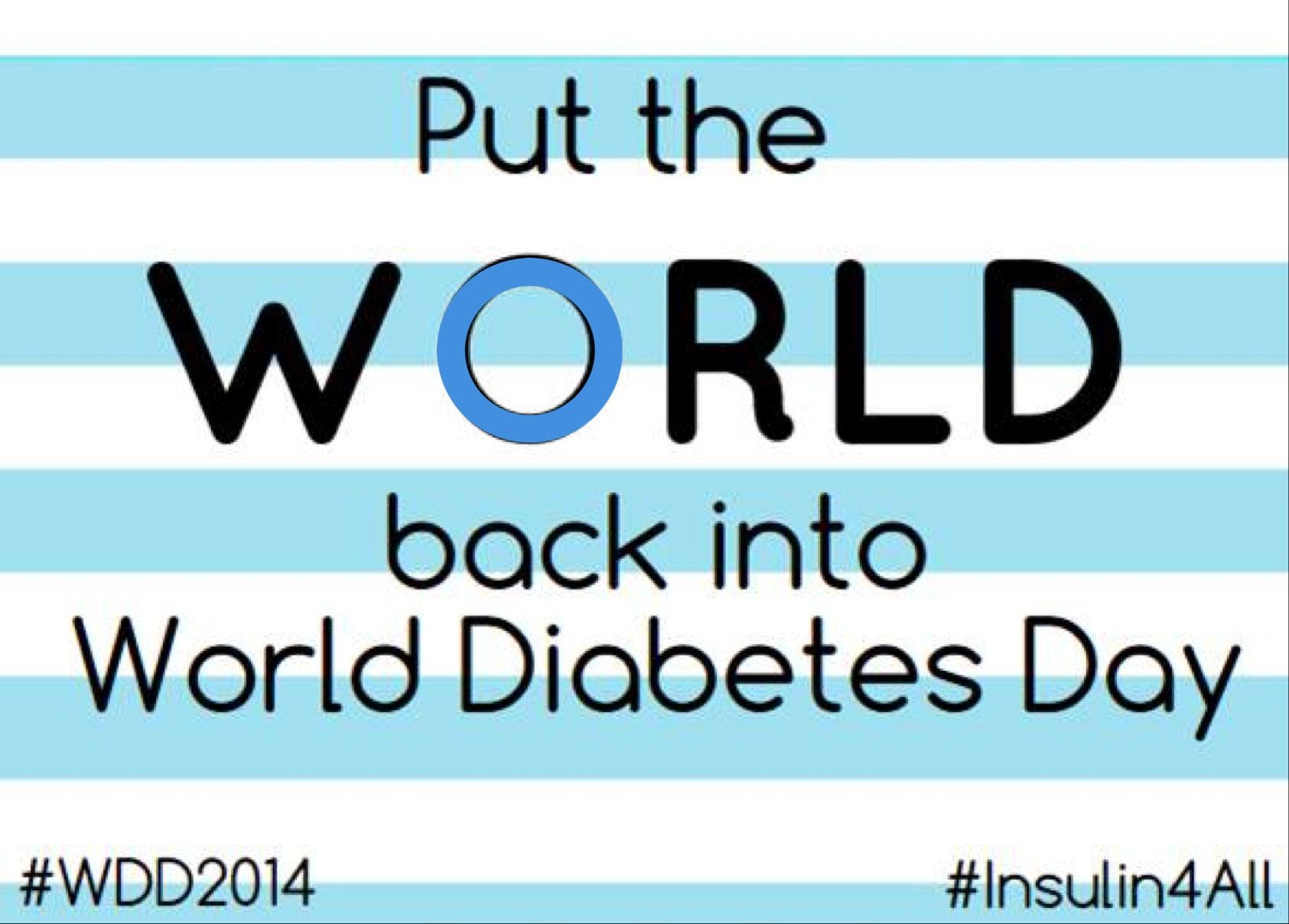
No one in this day and age should find accessing insulin – or any life-saving drug – a struggle.
So, get creative and make a poster. Take a photo and upload it to the #Insulin4All Tumblr. And then share it with everyone you know – not just people with diabetes. Preaching to the converted is really important because it strengthens the numbers of people advocating, but reaching out to the general community, making people aware of the issues, getting others angry at the inequity of access to healthcare is important if we are going to make change.
Today, a piece I wrote about diabetes-related eating disorders has been published on The Glow (which is Mamamia‘s health and beauty sister site.)
I’ve written before about this topic, and, following some research i did as part of a work project, have presented findings at conferences. The study we did focused on young women with type 1 diabetes. One of the things that kept coming up again and again was how many of these women thought that they were the only one manipulating insulin for weight loss and, as a result, felt ashamed and unsure of where to turn for help.
Help is available. But we need people to be aware of it. We need to be talking about diabetes-related eating disorders – often referred to as diabulimia. I am really pleased that The Glow has published this (they also published one of pieces during National Diabetes Week) and I think it’s great that this condition is being discussed in mainstream media.





