
You are currently browsing the category archive for the ‘Awareness’ category.
Last year, I wrote a piece for Mamamia’s health and beauty site The Glow about diabetes-related eating disorders, specifically insulin omission, manipulation or restriction for the purpose of weight loss. This is sometimes known as ‘diabulimia’.
This morning, when I checked my Facebook feed, I was really pleased to see that Mamamia had reposted an edited version of the piece on their website. Raising awareness of this issue is, in my opinion, really important, so to see it in mainstream media is a very positive step.
I am dismayed, although not really surprised, at some of the comments following the reposting of this piece. Today’s comments echo those that followed the original post in November last year.
Some commenters have called both me as the author and Mamamia irresponsible for writing about, and then publishing, the post.
I refute that and have done so ever since I started doing work in the area of diabetes and eating disorders more than seven years ago. This wasn’t some self-serving project that I started. I started this work – which including seeking funding to conduct research and developing a consumer resource – because it was clear that it was an issue of concern for many people living with type 1 diabetes. More so, many people who were in fact manipulating insulin to lose weight
The first time I presented our research and the resource we developed (in close consultation with people living with diabetes) at a healthcare professional conference, I was met with some resistance. One HCP stood up and told me that we had just written a ‘how to’ guide – that is, we were showing people with type 1 diabetes just how they could use insulin manipulation to lose weight. She said that she would not be promoting the resource.
And this is the gist of some of the comments on the Mamamia Facebook page today.
I maintain that this thinking is seriously flawed in many ways. It is assuming that only a small number of people are engaging in this practice and that not many people know about it. It suggests that the resource – which focuses on how to begin to discuss the issues and where to find help – is the first time that people reading it will have heard about insulin manipulation for weight loss.
However, this is just not true. The research conducted by Diabetes Australia – Vic in 2008 showed that 60 per cent of respondents (women with type 1 diabetes aged between 18 and 35 years) had omitted or restricted insulin at some point to control weight. And of those, one third did so on a daily basis. This finding was consistent with international research.
That’s not a tiny number.
So why do I think we should be openly talking about this issue? There are so many reasons.
When we don’t talk about things in an open and safe way they go underground. People start to feel that they are the only ones doing it and subsequently don’t talk about it. They feel isolated, shamed, stigmatised and unsure where to go for help.
We need to be talking about it so that HCPs understand that this is a serious and common issue – and to develop strategies to regularly screen for these behaviours and assist people who are engaged in this practice.
The research showed that health professionals working with people with diabetes are ill-equipped to deal with diabetes-related eating disorders. In fact, the same research showed that 85 per cent of those surveyed had never even been approached by a healthcare professional about insulin manipulation, and of those almost 60 per cent reported manipulating insulin for weight loss
We are wasting precious time and energy debating whether or not we should be talking about ‘diabulimia’. Instead, our focus should be on how we talk about it and what we do to treat it. We should be removing shame and stigma so that people with diabetes don’t feel embarrassed or fear judgement if they tell their HCP that they are manipulating insulin to lose weight. We should be removing barriers that prevent people seeking help.
I would argue that in this case being irresponsible has nothing to do with trying to shed light on diabetes-related eating disorders. I believe it is irresponsible to think that not speaking about it – not highlighting it as a serious issue – is that same as actually doing something about it.
So today, I urge you to share the article with your networks and start and contribute to discussions. Don’t sweep this under the carpet. Talk about it. Get it out there.
Sting is in Melbourne at the moment, getting ready to do a couple of concerts. Last night, he just happened to pop into Bennett’s Lane in Melbourne and sang a song with Adelaide musician Jo Lawry who is in his band. Here they are together singing one of my favourite Sting songs ‘Whenever I Say Your Name’.
I discovered my love of Kate Spade New York on one of our trips to the Big Apple. Wandering around Soho, we came across the whimsical corner store and in I went. I was hooked by the quirky, fun, stylish clothes and the beautiful accessories.
Since then, I’ve bought a couple of bags and some other accessories. My favourites of all the Kate Spade things I own are the gorgeous jingly-jangly bangles. I have at least one on most days, coordinating – or violently clashing – with whatever else I am wearing, frequently livening up my ‘Melbourne-Girl-Black’.
But the thing I love most about them is the secret message imprinted on the inside of each bangle. I actually didn’t know about these inscriptions until quite recently when it was pointed out to me by one of their sales staff.
For years, I’d been wearing them without knowing that there was a cute or inspirational or just plain silly little message concealed away. The inscriptions says thing like ‘It’s written in the stars’ or ‘Life’s a breeze’ or ‘Here comes the sun’. But they are hidden away. No one would ever know.
People are often surprised to learn that I have diabetes. (There was one time that a certain former Health Minister who may or may not now be PM – for a few more days anyway – looked surprised when told that I have diabetes and responded with ‘Really? You don’t look diabetic’.)
I’m not sure what people with diabetes are meant to look like. I have dozens and dozens of friends with diabetes and I’m yet to find the common characteristic or style that we all have in common. You can’t ‘tell a person with diabetes’ just by looking at them. Despite what Sarah Wilson says.
I was reminded of this the other day when I caught up with a friend I’d not seen for some time. Facebook updates have kept me across what she has been up to, but I was surprised when she told me that she had been having a really tough time, ‘diabetically-speaking’.
She didn’t tell me what had been going on until we’d been speaking for some time, talking about the great things she has been doing at work, a recent trip to Queensland and plans for a further family holiday to the U.S. We spoke about my family holiday and we chatted about our kids heading back to school.
And then she told me the rest of what she had been managing and it was huge. I looked at her and then said four stupid words ‘But you look fine.‘
I immediately apologised. Of course she looks fine. Diabetes is invisible, even at its nastiest. I think of the most horrid diabetes things I’ve had to deal with and they are relatively minor. Yet even at the most difficult of times, most people don’t know. Unless I tell them.
If I had a secret message inside of me which explained my ‘diabetes state of mind’, it would change every day. Most of the time it would be probably say something like ‘Yep, it’s still there!’ And nothing more. But other times it would say ‘today is tough’ or ‘I want off this BGL roller coaster’ or ‘I don’t want to do this anymore’. Because that is how I feel inside some days.
Today, the secret message in my bracelet says ‘Like Hotcakes’. I’m pretty sure it is referring to the saying ‘Selling like hotcakes’, however I’m going to interpret it as a command. Lunch is sorted!
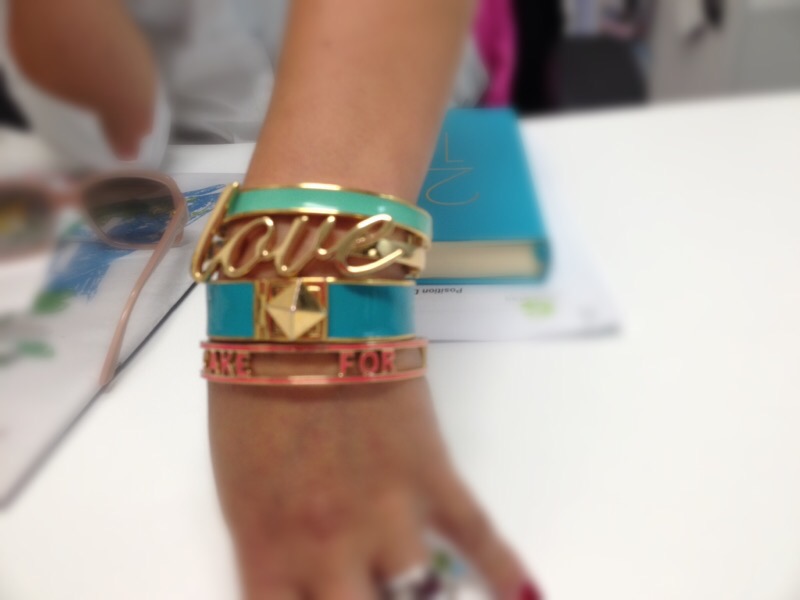
Today’s arm candy.
Things I know to be true:
- It’s February already.
- Melbourne seems to have misplaced its Summer.
- As much as I loved being in New York and had the best holiday ever, it’s always swell to come home.
- And having Melbourne coffee running through my veins is making me a happy chicken.
- Being at work is not the worst thing, especially when there is a year of really exciting things on the horizon.
- I am confused that my computer does not recognise the word Nutella and wants to correct it to Nigella. Which is equally awesome and sexy.
Also – the internet never disappoints.
Frocking brilliant
Sometimes it’s tough for a dame to find a place for her insulin pump. Bra? Good in theory, but what if you’re not wearing a bra? Or your bra is being uncooperative? Thigh strap? Again, great idea, but not great if the thigh strap comes loose and starts rolling down your leg and you end up in the Ministry of Silly Walks. Also, it can look like you are packing heat. Or you end up using ugly (although effective) Tubigrip. Pocket? Usually produces an unsightly bulge that may have people searching for a matching Adam’s apple.
What’s the solution?
Read here about some clever folk who have come up with a rather dashing frock with a secret little place to hide a pump.
And who doesn’t love a LBD? Can’t wait to get my hands on – and body into – one of them! Available soon – keep an eye out here.
Two spreads in one
There are many tough decisions in life. Lennon or McCartney? Coffee or tea? Jaffas or Malteasers? (Both, obviously.)
And the most difficult: peanut butter or Nutella? Can’t decide? Then have both! In domestic goddess mode on Sunday (full skirt, frilly apron, high heels and tiara) I made these.
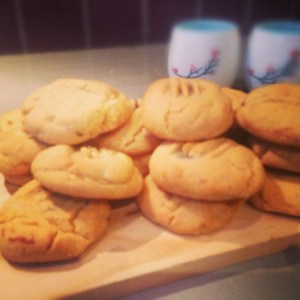
And they are were good. And totally bolus worthy!
Here’s the recipe. (And here’s a tip. When freezing the Nutella before making the biscuits, do half on one baking sheet and half on another. Take out one baking sheet, make half the biscuits. THEN take our the second baking sheet and make the second half. Otherwise the Nutella starts to melt and ends up all messy and all over your fingers and you have to lick it off your fingers and then freeze more.)
Oh, and while we’re talking Nutella, let me introduce you to my happy place:

Support DA-Vic and enjoy the Melbourne Food and Wine Festival (WIN WIN!!)
This year, Diabetes Australia – Vic (disclaimer: my place of employment, but I am writing about this because I want to, not because I was asked. Also it is about food. And wine. So there’s that too.) is the charity partner for the Melbourne Food and Wine Festival. Some people may think that this is an odd partnership, but actually, the messages of both DA-Vic and MFWF are strongly aligned. It’s all about people taking an active role in managing their health – regardless of if they are living with diabetes or not. And having a good understanding of the food we choose to eat is part of this.
It’s also a great opportunity to raise awareness of diabetes, reaching people we may otherwise not reach.
Now, everyone knows that I am not really an exercise fan. However, I can definitely get on board this. It’s literally a moveable – well moving – feast where participants take a walk around the Tan, stopping at stations for a delicious five course brekkie. And better yet, 5 per cent of ticket/registration fees will be donated to DA-Vic.
Noteworthy connections
Many of you may not know that in a former life I was a classically-trained musician. That ship sailed a long time ago and I no longer play music. However, my husband is a musician and music is a huge part of my family’s life.
I have always been interested in the link between music and health. The Greek God, Apollo, was God of both healing and music, so the connection has been around for a long time!
Music has been used as therapy in a variety of medical conditions from Parkinson’s Disease to recovery from stroke. I am not going to say the healing powers of music can cure diabetes (although I’m pretty sure some fool will tell you that). But, music can be a stress reliever. And for me, reduced stress means less erratic BGLs.
There are also strong links between music having positive effects on mental health as discussed in this information sheet from ReachOut.
I love this so much
I’ve shared this blog before here, but this post from Annabel over at The Understudy Pancreas is one of the most beautiful pieces of writing. Full stop.
I can’t begin to imagine what parenting a child with diabetes would be like, but Annie does such a wonderful job of explaining how her family do it.
The thing that I probably admire most is how Annie never, ever makes her daughter’s (Pumplette) diabetes about herself. She supports her daughter in the best ways possible, encouraging her independence, and being there for her – with what Pumplette needs. Great parenting advice all ‘round, really.
I wish I could reach into my computer and give you a huge hug, Annie. Your darling girl is so great.
Radio Deluxe
When we were in New York, we spent a very pleasant evening at Birdland listening to John Pizzarelli and Jessica Molaskey perform. It was a gorgeous gig, made even more wonderful when they dedicated a song to the ‘family from Australia’.
Each week, John and Jessica have a syndicated radio show (they claim it is ‘live from high above Lexington Avenue in the Deluxe Living Room’, and while I suspect it is actually recorded in a studio, I like to think of them in their living room at home, gazing out over the New York skyline, casually chatting into a couple of vintage microphones) and it is an absolute treat to listen to.
Check it out here. It makes a great soundtrack to the workday!
What do ‘patients’ really think? (Maybe stop using the word ‘patient’ to begin with…..)
British medical journal The BMJ has started a fascinating new series called Do you know what your patient is thinking? This is part of their patient partnership strategy and will hopefully help HCPs better understand all aspects of life with a chronic health condition – not just what …..
The first in the series, Why there’s no point telling me to lose weight, can be read here. New submissions will be published monthly.
Living Vertical
Steve Richert has lived with diabetes for 17 years. A couple of years ago, Steve wanted to show that diabetes hasn’t stopped him from doing what he wants, so he and his wife, Stefanie, travelled across North America and climbed for 365 consecutive days. Just like with diabetes, there were no days off.
I absolutely love the catalyst for this project. This is what Steve writes on the Glu website:
‘In 2011, I had lived for almost 13 years with type 1 diabetes, and despite the normal ups and downs, seasoned with occasional close calls, it had never stopped me from being me. In fact, it made me who I was. When I was on a trip to visit friends, Stefanie and I drove past a billboard aimed at fundraising for diabetes research. It made my blood boil.
It was a smattering of grim statistics and stock imagery geared to promote the idea that life with diabetes was no life at all—that we are weak and helpless victims of this condition. Before this point it hadn’t ever occurred to me that the message of being empowered had any place in diabetes. I didn’t know anyone else with type 1 diabetes and I assumed everyone just came to terms with it as I did. Seeing this billboard made me aware for the first time of how we are portrayed—and how that can impact someone.’
A film has been made of Steve and Stefanie’s adventure. You can read about and watch Living Vertical: Project 365 here.
Save a child…..
Thinking about Valentine’s Day? Don’t forget to Spare a Rose, Save a Child.
No four words sum up this campaign better than this ‘Flowers die. Children shouldn’t’.
Please donate. Remember the equation: One rose = insulin for one month. Multiply as many times as you can.
That’s all for now, folks. Happy Tuesday.
Click
The sound the applicator of my CGM made as the introducer needle pierced the sensor through my skin made me wince. It’s an involuntary response and not because of pain. The little pinch I feel as the needle shoots in is so insignificant it doesn’t really warrant a response.
My last sensor fell out in bed on one of the first nights of our holiday. The next morning as I removed the spent sensor from the transmitter, I decided that I wouldn’t put in another sensor straight away. And then after a few days of enjoying having one fewer device stuck to my skin, I decided that because I was spending so little time alone, I really didn’t need the safety net of a CGM. Plus I had no plans to try to tighten up basal rates or make any other adjustments.
More than five weeks and no CGM.
But the afternoon after we returned from New York, as Aaron was getting ready to go to a gig, I realised that jet lag would possibly be sending me to sleep before he got home. And I’d been chasing hypos all day – continually going low just as I thought I had managed to get on top of things.
I knew that it was time to get hooked up again to my CGM. I needed my safety net back.
So, I pulled out a fresh sensor, swabbed the back of the transmitter and with a click, the new sensor was attached firmly to me.
The clicking sound hit me with a force that surprised me. I actually felt it in the pit of my stomach – a sinking feeling. I felt my breathing quicken. What’s going on? I thought. I checked the site where the sensor had gone in and where I had fastened the transmitter. It looked fine. There was no pain.
I stood in the mirror, my top tucked under my chin and there, staring back at me, was the reason for this sudden unease. Two medical devices. My cannula on my right side, the pump tubing snaking its way up my chest to the middle of my bra where my pump was neatly tucked away, and my CGM sensor and transmitter just to the left side of my belly button.
I could suddenly feel the numbers, I could feel the data, I could sense the information that would soon be available to me. I could feel the vibrating of the alarms.
And the feeling of burnout – that darkness that lives at the pit of of my stomach – sprang to life after having lived quite dormant for a few weeks.
I felt overwhelmed and my sensor wasn’t even transmitting data yet! In fact, I hadn’t even hit the ‘start sensor’ button on my pump yet.
I sat on the bed and breathed deeply before grabbing a piece of paper and pen. I started to make a list of reasons to not get overwhelmed and distressed about reconnecting to my CGM.

I re-read the list and started to feel calmer. But I was surprised at just how sudden and intense the reaction was. I couldn’t really make sense of it either. I love this technology. I love the information it gives. I use a device that is incredibly accurate and reliable. I do feel safer when I have a sensor attached. And I know that, given the cost of running a CGM, I am very fortunate to be able to use it.
So why was I feeling dread instead of reassurance?
I’m not sure; I’m really not.
Later that night, I crawled into bed. It was still light outside – jet lag had indeed hit me! The kidlet was reading in her room getting ready to sleep. Aaron wasn’t home yet and still wouldn’t be for a while.
I started to read and before long, my eyes felt heavy and just as I was about to put my book down, my pump, lying loose in the bed beside me started to vibrate. I looked and saw the two arrows pointing down. I wasn’t low, but would be in about 30 minutes. I reached over and pulled two jelly snakes from the jar on the side table.
As I started to doze, I felt calm and relaxed, looking forward to a good night’s sleep, and woke on Australia Day feeling refreshed. I located my pump amid tangled sheets, and saw the CMG’s straight line. My hand moved to touch my CGM, sitting comfortably on my stomach. Doing its job. Nothing more. Nothing less.
I’m back at work today (pretty sure you can feel my delight in just those five little words). I know I am back at work because I am wearing a pencil skirt, tights and black high-heeled pumps instead of jeans, boots, a scarf, a hat, gloves and a puffer jacket with some sort of fur lining. Today I look like I am ready for work rather than ready for a day of wandering around New York.
But all is not lost. It’s been six weeks and I have a wonderful holiday of nothing but great memories and a photo album of nothing but gorgeous photos. So, onwards and upwards and all that.
Yesterday, as I sped around the supermarket, the onslaught of the next commercial opportunity hit me fair and square in the face. No, I’m not talking about Easter (I could act all outraged that there are Hot Cross Buns in Woolies, but we bought some and have been eating them, so that would be kind of hypocritical). I am talking about the festival of love – Valentine’s Day.
Valentine’s Day can go one of three ways for people. It can be a day of overt love declarations involving flowers, cards, poems, sky writing, gorilla-grams, stripper-grams (don’t judge), candle light, champagne, walks on the beach; it can be a day of sadness and misery and feeling left out; or it can be a day of complete oblivion where one is confused why there are so many people carrying bunches of balloons with ‘I wuv you, Shnookums’ written on them in glitter.
This year, I say screw that. This year, I say how about you do something that is meaningful that will not only help others, but also make you feel great. This year, it doesn’t matter if you have a Valentine or not. Everyone can play.
I am, of course, speaking of the Spare a Rose Save a Child campaign.

Now, if you have diabetes and/or any links to the diabetes word, you have probably seen and heard about this campaign before. I’ve even written about it here. The general gist is that instead of sending a dozen roses to your Valentine, send eleven instead and with the money that would have bought the extra one (about $6 in Aussie money) make a donation to Life for a Child. Those five bucks will provide insulin to a kid in a developing country for a whole month. Or, give your Valentine ten roses and donate $12.
All good, right?
But I have a little challenge for you.
This is a brilliant campaign because it is so simple. It’s easy to explain and it’s really easy to get involved. So my challenge is this. Let’s get this moving way out of the diabetes world. Let’s get this into the hands and hearts of our friends and family who may not really consider this as an idea for Valentine’s Day. Let’s tell our workplace HR teams and see if they can encourage it as a work-place wide giving program (there’s even a tool kit to get you started!). Pop in to visit your neighbours and ask them to get involved. Next time you are going for a walk in your local shopping centre, drop in to some of the small businesses and ask them to get involved. Ask your kids if they would like to donate some of their pocket money.
Roses and diamonds and jewellery and books and CDs and vouchers for massages and guitars and DVDs of favourite movies are all lovely and fun for Valentine’s Day and I am not suggesting you complete give up on the idea of sharing gifts. But how about sharing the love a little this year? I know that I certainly will be making a donation and have already strongly suggested to my Valentine that he do the same. (And check out this and this cute card to attach to your gift, telling your Valentine how you’ve shared the love this year.)
So, how about making sure a child has life-saving insulin available to them by donating just a few dollars in your loved one’s – or your – name. Because THAT is a gift of love and I honestly can’t think of anything I would like more this Valentine’s Day.
Four weeks into a family holiday, away from the mundanity of every day, away from schedules, away from stresses, and I can see just how much better I feel – emotionally as well as diabetes-wise.
After writing an extremely raw account of the diabetes burnout I have been experiencing for some time, I have spent time wondering just how I was going to get diabetes back to a place that would stop causing me so much concern and guilt and stress and anxiety. Because that’s the thing with the way I do diabetes burnout – I don’t just burnout, I then focus on the burnout. Which makes me more burnt out. And then I focus on how much bigger the burnout is getting. You get the picture.
But here, in New York, surrounded by my family and visits from friends, I am feeling that things are slowly, but surely, balancing out again.
Diabetes management has gently snaked it’s way back into my life – just as a regular part of my routine. I’ve found myself checking my BGLs with more frequency – and less frustration – than had been the norm at the end of recent times.
I don’t get to the end of the day and find a pressing feeling on my chest because I have been suppressing the guilt of not checking my BGLs. I don’t ignore high BGLs that I know to be the result of a pump line that really needs to be changed. Diabetes tasks like these just happen; far more effortlessly.
But I am taking things slowly and easily. Baby steps.
I decided not to reconnect my CGM after the sensor fell out during the first week here. I’m spending most of the time with my family, so not feeling I need it as my safety net as I do when either travelling alone or at home at night while Aaron is out doing gigs.
I know that this isn’t reality – as much as I wish it really were – but I am absolutely savouring this time. This somewhat alternate existence is such a privilege – I feel lucky. I feel happy, actually. For the first time in a very, very long time, I feel truly content.
And of course, that makes the overall shitty-ness of diabetes a little easier to manage. But (make no mistake) it doesn’t make it less shitty overall…
I came to this realisation the other day as I was pushing in a new infusion set. I packed away the waste and tucked the freshly-primed pump into my bra, thinking about how much I really dislike diabetes tasks. Because I do. I don’t want to check my BGL or shove a sharp introducer needle into my side to re-site my cannula. But I just do it.
When I am burnt out, one of the reasons I don’t want to do these things is because I hate them. But even when I am just getting on with things and all is ticking along okay, I still don’t enjoy these tasks.
And you know what – that’s perfectly okay!
Perhaps for me what comes after burnout isn’t just getting back on track. Perhaps every episode of burnout – however long or debilitating – ends with a realisation that diabetes is still a shit. There’s just a little more acceptance.
And a tangible sigh of relief to find myself seeing some light for the first time in a very, very long time.
The bathrooms at Madison Square Garden would have to be the cleanest public toilets I’ve ever seen. It was tough to get up and take a break from what was turning into one of the best gigs I’d ever been to, but when nature calls, you answer – even if Billy Joel is on stage!
I found an empty cubicle, quickly peed (TMI) and went to wash my hands. At the basin, out of the corner of my eye, I saw a women rummaging in her bag. I was about to look away, when, in the reflection of the mirror, I saw her pull out some thing familiar. It was an insulin pen. She bent over ever so slightly and jabbed the needle into her thigh, right through her jeans.
Our eyes met. ‘Oh, sorry,’ she said. I could tell it was a reflex – said in the same tone as if she had accidentally knocked elbows with me.
‘Don’t be,‘ I said. ‘I have diabetes too.’
She smiled at me and looked relieved. ‘My blood glucose is high. I needed some insulin…’Suddenly she looked a little sheepish. ‘I shouldn’t inject through my clothes though. Right?’
‘Ah – shoulda coulda woulda!‘ I said to her. ‘Whatever works for you! I was high at the beginning of the night. It’s coming back down though, but now I’m paying for the water I was guzzling earlier! If you don’t mind me asking, why are you injecting in the loo?’
She looked confused.
‘Ah…bathroom.’ I corrected myself. I keep forgetting that even though we allegedly speak the same language, I spend a lot of time rephrasing what I say here in the US to make myself understood.
‘I always do,‘ she said. ‘Some of my friends and family get uncomfortable around needles,‘ she said. ‘So I use the restrooms. I don’t want to upset them. Where do you inject?’
I finished washing my hands. ‘I use a pump,’ I said. ‘But I always would just inject wherever I was – I never used the bathroom. But that was my choice. My attitude has always been that if someone has a problem with seeing me do my diabetes stuff, look away. And grotty…um…dirty bathrooms are not the place to manage my diabetes. Not that these bathrooms are dirty – they’re spotless!’
‘Do you like the pump? I’ve read a lot about them. I’ve only had diabetes for a year.’
I could see in her face that she really wanted to talk. And I really wanted to talk to her.
But I was at Madison Square Garden, and Billy Joel was playing. And I wanted to get back out there and keep dancing and singing and enjoying the gig too.
‘I do,’ I said. ‘I’ve been using a pump for almost 14 years now and a CGM for about 5. For me, it’s the right choice for managing my diabetes as best I can. If you are interested in hearing what people think, maybe have a read of some diabetes blogs. I find that they give the best – and usually most unbiased – views of diabetes technology and treatments.‘
‘Yes, I have started to read some really great blogs that have helped me. It’s so great to find people who are going through the same things. It makes me feel like I am gong to be okay.’
‘You are,‘ I told her. ‘Really; you are.’ I looked at her square in the eye, hoping to help her understand.
‘Right. I’m going to head back out there. But it’s been lovely meeting you. Good luck with everything. And enjoy the rest of the gig. Hope your sugars come back down soon.’
As I walked out of the bathroom, the cleaners continued to wipe up the basins and clean out the cubicles.
I ran down the stairs and took my seat just as the piano intro to ‘And So It Goes‘ was being played, and squeezed my husband’s hand.
‘You good?’
I looked around the stadium, at the thousands of people in the room and wondered what the odds were of me and another PWD bumping into each other. I shook my head a little and smiled.
‘Yes, babe.’ I replied. ‘I’m so good.’
Eighteen months ago, we’d never even heard of American Girl. In fact, it was a completely blank look I gave one of my friends when she told me that we had to take the kidlet to AG when we were visiting the US in the middle of last year.
‘What is it?’ I asked
‘Only the best doll shop in the world.’ My friend had bought her daughter – a friend of our daughter – an AG doll when she was in NYC the year before.
And so it started. Walking the streets of NYC, out of the corner of my eye, I caught the red awning and overall ‘pinkness’ of the three-story American Girl emporium in Midtown Manhattan. My husband saw it too and despite our best efforts to distract our daughter and guide her line of vision away from the store, she noticed it. And started jumping up and down.
‘American Girl! American Girl!’ she squealed. ‘We HAVE to go in.’ And without waiting for us to agree, she stormed through the doors. ‘Oh-Em-Gee,’ she announced. I cringed.
We walked the three floors of the store in delight (the kiddo) and terror (her parents). I started calculating currency conversions in my head and worked out that if we bought only one doll and one outfit we could probably keep both our cars and only get one second mortgage on the house.
Of course, there was not only one outfit. Because there were also accessories, books, shoes, jewellery and a matching outfit for the kid. (Thankfully, there were no ‘But I want a pony!’ demands from our child, unlike the kid near us who was throwing a tantrum and cursing her mother as the ‘WORST MOM IN THE WORLD I CAN’T HAVE A PONY. NOW’ (Possibly, her name was Veruca Salt.)
Our daughter picked out a doll that had long, dark-brown hair, dark eyes and no fringe. She named her Iris. ‘I want her because she looks like me,’ said the kidlet. And she was right; she kind of did. We walked all around New York with Iris, and people in the street would comment that they looked alike. Our daughter smiled proudly.
We retuned to Australia with Iris and her wardrobe of outfits and accessories, and she became the favourite toy – and has remained that way.
When we decided on a return trip to NYC, the kidlet spent all her planning time working out how many times we would visit AG. She saved her birthday money and worked out what she would buy and announced to everyone that the reason we were going to New York was to go to American Girl. (Please know, that is NOT the truth. The reason we are here is to visit Doughnut Plant. Of course.)
So, we arrived last Wednesday and on Thursday, we walked through the revolving door, the kidlet squealing again.
This time, knowing what to expect, I spent the time really looking at all the dolls and the accessories. I actually quite like the back-stories to some of the dolls – it’s an interesting and fun way to introduce kids to different periods of history.
We looked at the accessories and outfits. And there, amongst the dance, soccer and karate uniforms, roller-skates, doll-sized musical instruments, equestrian gear, camping equipment and skis, I noticed a wheelchair, crutches, a hearing aid and seeing glasses.
American Girl dolls come in every hair colour and style, they have different colour eyes, some have freckles, and they have different skin tones. Most girls can find an AG doll that looks just like them, and the boys can find a look-alike Bitty Baby.
Dolls can be customised to look and BE just like the kid who it belongs to. And that’s kind of cool.
‘I wish there was an American Girl insulin pump and CGM. Then I would buy one.’ I said. And you know what? I totally would.
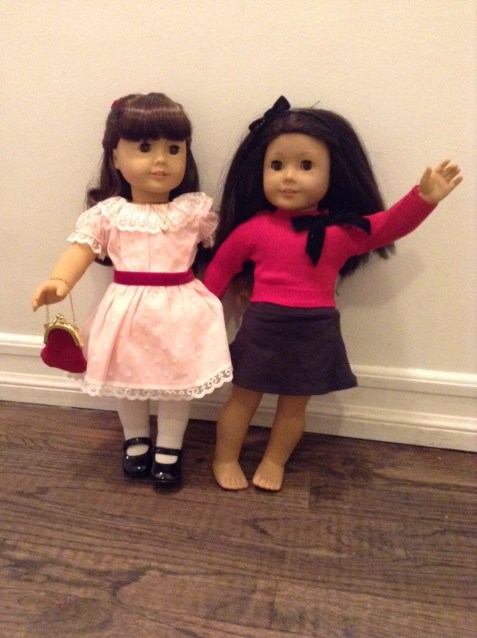
Samantha (on the left) and Iris.
This week, I wrote a personal piece about an extended bout of diabetes burnout. (Whoa – that’s a lot of words with ‘…out’ in them….)
I have been overwhelmed by love and support from the diabetes online community, and people outside the community as well. Seriously, completely and breathtakingly overwhelmed – and wish I could reach out to every single one of you who has reached out to me to thank you and give you a Nutella cupcake.
I wrote about this for one simple reason – it is my real life with diabetes, and that is what this blog is meant to be all about. Sugar-coating (ha ha – whatever) life with diabetes does no one any good and there is no point pretending it is all fun and games.
Talking about the times things are going well is really easy. Being humorous and looking at the bright side is easy too – and as a person who really does usually see her (champagne) glass/coffee cup as being half full, it is easy for me to seem positive about things all the time.
But the problem with that is that we don’t talk enough about the tough things. And that leads to feelings of shame, which, in turn contributes to stigma.
One of the reason I am such a huge supporter of the Australian Centre for Behavioural Research in Diabetes (ACBRD) is because, apart from being a bunch of fabulous, smart, funny and lovely people, their work means we are talking about the emotional wellbeing side of diabetes. Thanks to the immense body of work they are doing, diabetes is being seen as far more than a numbers game. The quality of life implications of living with this chronic condition are being considered and we are getting a better understanding of distress, anxiety and depression that is related to diabetes. Even more importantly, we are talking about it. And even more importantly, there are strategies being developed to address these things.
I’ve been writing about mental health and diabetes – and wellbeing and diabetes – for some time now because we need to be able to discuss it freely, free from judgement, devoid of stigma.
It’s the same reason that I have written so openly about my miscarriages. I don’t do it because I want people to feel sorry for me or pity me. I do it because it is part of my story. And I do it so that others can see that it is a perfectly normal thing to happen and that there is no shame in it. After I had my second miscarriage, my mothers’ group met. We were sitting around in someone’s living room with our young kids toddling around, playing quietly. It had been a while since we’d caught up and we were going around saying what we’d been up to.
‘Oh, things are their usual crazy self,’ I said. ‘But I had a miscarriage last month, so have been dealing with that too.’ It was the first time I had told anyone, apart from my immediate family and very close friends.
One of the other mums looked up sharply. ‘What? Why didn’t you say something? Why didn’t you let us know? I had a miscarriage three weeks ago. I don’t know anyone else who’s had one. I really need to talk about it, but didn’t know who to turn to. I really wish I had known.’ And she burst into tears, coming over to give me a hug. We sat there and discussed our experiences and how we were feeling and how we were dealing with things. We both felt guilt and shame. We both felt we had somehow failed ourselves and our partners and our families. We both felt the same way – yet were telling each other that we were wrong to feel that way.
It was at that point, I decided that I would no longer hide my story. Because hiding it – when I am usually such an open person – suggests it is something to be ashamed about. Because that’s what happens when issues go underground, we feel shame. I don’t want any woman to feel ashamed because she has had trouble carrying a baby. I don’t want any person to feel ashamed because they are feeling overwhelmed or depressed or in distress because of their diabetes.
There is no ‘fault’. And there should be no guilt. So when we open up and talk about the not-so-good things, we see and accept that this is part of life. It normalises things. It allows for open and easier discussion. And it helps us connect with others who are sharing the same experiences.
Because I can promise you, my story of burnout is not unique. Absolutely not.
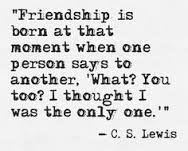
I’ve decided that my two favourite words in the world are not ‘coffee, please’ or ‘shoe sale’. No. They are ‘me too’.
Apparently, it’s snowing in New York! So the Brian Setzer Orchestra, live at the Rockefeller Centre with ‘Winter Wonderland‘ seems more than a little appropriate today!
I’ve been thinking a lot about diabetes burnout lately. A lot.
I have been burnt out for a long time now – it’s been 18 months. I can see how it started – I know the trigger. I miscarried in terrible circumstances and, after the constant monitoring and intense management that comes with trying to get pregnant and then conceiving, losing the baby allowed me to ‘take a break’.
I’ve not come back from that break.
My question is this: When does it stop being ‘diabetes burnout’ and become something more? And what is the ‘more’?
We use the term burnout so much in diabetes; I feel that I’ve become a little desensitised. It’s the norm – most people go through periods where they are so unmotivated that they can’t deal with their diabetes, or pay less attention than they typically would. But how long is ‘normal’? How long can we go on like this?
My burnout is scaring me because it has been going on for so long. I fear I’ll never get my mojo back and actually get to a point where I am able to care for my diabetes in a capable way.
I go through periods of so few BGL tests that my meter resets itself. I have not seen my endo for far too long and I’m way behind in my complications screening. The only thing I am up to date with is eye screening because I had cataract surgery in the last twelve months.
A button on my pump has been playing up for over 3 months – half the time taking three or four attempts to get it to work – and instead of getting straight on the phone to the company’s customer service team and organising a replacement, I let it slide until Monday, when I realised that next week I am getting on a plane and going away for 6 weeks and if I don’t get it sorted I’ll end up with a dead pump while overseas.
I’m taking my insulin, although haven’t basal tested for a long while and know that the rates need adjusting. I ‘blind bolus’ a lot of the time. Wearing a CGM is useful because it gives me an idea of my glucose levels, but I don’t actually do anything constructive with the data I am receiving.
I keep in touch with the online community which is my link to seeing and hearing how others are coping. While I don’t participate in every week’s OzDOC chat, when I do get there I feel supported and know that I have people to turn to if I need them. I guess I’m not completely disengaged.
A nasty hypo often gives me a shock and I get a few days of decent and frequent monitoring out of it, but this is short-lived and I fall back into minimal self-care pretty quickly.
And I feel totally and completely shit about the whole thing. And guilty. Of course I feel guilty.
In a couple of years of some pretty difficult stuff, diabetes is the thing that I can let go of. At least, I feel I can. I mean, I can’t stop being a mum. I can’t stop being a wife, daughter, sister, friend. I can’t stop coming to work. I can’t stop doing the things I need to do to be a functioning human. But I can stop with the self-care.
And because I am an idiot, or in denial, or just plain over it, I can’t see just how short-sighted this thinking is. I may be getting through the day and doing all those things that I tell myself I can’t stop doing. But how is all that going to work if something actually does happen as a result of my minimal self-care?
I honestly don’t know where to go from here. I feel paralysed and unable to make decisions that I know may help me start with some baby steps to get back on track. Is it a matter of re-engaging with my HCPs and talking to them for strategies? Do I try to set myself tiny goals, like a morning BGL check each day – or even every second day – that is achievable and will start to give me some data to work with? Do I go back to seeing a psychologist again and discuss ways to get back on track?
I don’t know.
It all seems too exhausting. It all seems too damn hard.
Is this burnout? Or is it something more?
I really don’t know.
This isn’t really a Christmas song, but I still think it’s a good song for this time of year. The wonderfully gorgeous Joni Mitchell and River.





