
You are currently browsing the category archive for the ‘Awareness’ category.
There is much known about the progression to the development of type 1 diabetes, but a lot still remains a mystery. We are told there is a two-pronged process, which involves genetic predisposition and a trigger.
But what is the trigger?
Some say it was a virus or a period of particular stress. Others believe it’s environmental. For me, I’ve no idea. I wasn’t unwell with a cold or flu or stomach bug. It was a stressful year with planning our wedding, looking for a house to buy and running my own business. But more stressful than usual? I’m not really sure.
We hear the word ‘trigger’ a lot in health. I know that for me there are triggers that can see me in a downwards spiral leading to diabetes distress, and its good mate, diabetes burnout. Others say they can identify the trigger that resulted in their first anxiety attack. There are triggers that result in ‘attacks’ for those living with coeliac disease or triggers that can cause flare-ups for people with lupus or rheumatoid arthritis, or triggers leading to seizures.
I’ve always wondered about the word. It implies a fully loaded gun that is about to go off – quite an appropriate description really. But what happens for the trigger to be pulled?
Is there, in fact, a ‘trigger point’ as such or is it the moment that we stop and acknowledge that there is something that needs attention?
I can rarely signpost the exact moment that results in diabetes distress. It’s never ‘an event’; it sneaks up on me. Sometimes – though not always – I can see that it is approaching. Does this mean I do something to stop it getting to the point where I am so distressed that I stop my diabetes self-care? Ha – no!
While I may have become better at recognizing that I am on the road to diabetes distress, I’m not so good at identifying the things that send me in that direction. Simplistically, I could say it’s just me getting sick and tired of doing this day in day out, and I am sure that is part of it.
But when I am being particular self-aware and intuitive I know that there are other things that contribute. When I wasn’t feeling good about myself earlier this year, diabetes self-care was the last thing on my mind – possibly because it couldn’t fit in there with all the feelings of sadness.
And I wonder how much of it is also about feeling that my broken body doesn’t deserve looking after. ‘My pancreas is hopeless – so the rest of me may as well be too.’
The one thing that does come out of this all for me though is a renewed sense about what living with diabetes is all about. When I start to see the light and start to feel better about myself and, slowly, slowly, start to reintroduce my self-management tasks, I am able to refocus. I remember that the numbers which scared me and pointed to being a failure are just moments in time. I remember why I deserve to be well and look after myself.
Being able to identify triggers and then respond is a really useful tool in managing health conditions. It’s just finding a way to do that. BEFORE the trigger is pulled. Because no matter what John Lennon says, happiness is NOT a warm gun.
I am as guilty as the next person of being judgemental at times. I like to think that I am not, but I’d be lying to myself if I honestly believed that I never uttered a pejorative comment about other people’s choices.
I really, really try to not be judgemental when it comes to how people choose to manage their diabetes. But I know that I am a zealot when it comes to technology and have been very, very guilty in the past of having conversations that sound like this
‘Are you on a pump? Why are you not on a pump? You should be on a pump? Pumps rock! Your life would be so much better if you were on a pump? That’s not a valid reason for not being on a pump. Do you want the details of my pump educator? Here, let me list the million reasons why I love being on a pump. Let me list them in a LOUDER VOICE to convince you. If you’re not on a pump you don’t really care about yourself.’
I know; I’m an absolute joy to be around sometimes.
But I’m trying to not be like this anymore. And to help remind me, I have made a poster of one of the things that has become a bit of a mantra and have it hanging in my office.

Feel free to substitute ‘diabetes’ for any other health condition. Or simply for the word ‘life’.
Because here’s the thing: when you make a decision about how you manage your diabetes, it is about your health. And that is an incredibly personal decision based on your own perspective, circumstances and experience. It’s got nothing to do with anyone else.
There is one caveat to this that I think is really important.
This works and is all fine as long as the decisions that you make as part of your ‘whatever’, (your diabetes, your life etc.) don’t negatively impact on others.
As a result, anti-vaxxers don’t get to claim this as their own. Because their irresponsible actions do affect others.
Same goes for doing anything that emotionally or physically hurts another person, or has the potential to.
Actually, also goes for people who wear leggings as pants. Because, LEGGINGS ARE NOT PANTS and your decision to treat them that way hurts my eyes.
BUT! If you are making decisions that impact on you and you alone, knock yourself out. You don’t owe anyone an explanation or need to justify your choices. Own it.
Stop for a moment and imagine that the cost of buying insulin for a month was financially crippling to you and your family.
 Think about having to make the choice between buying insulin or buying food.
Think about rationing insulin and taking the smallest quantity possible – just so you are taking something, but not what you need.
Think about how terrible you would feel. Think about the thirst and the exhaustion and the fuzziness.
Think.
I don’t do emotive and I don’t do scare campaigns, but this is the reality for many children – and adults – living with insulin-requiring diabetes.
It’s unfair and it’s terrible.
And now think about doing something about it that is actually quite simple.
Many of you will be aware of the ‘Spare a Rose, Save a Child’ campaign that has been run over the last two years around St Valentine’s Day. The basics are – instead of sending a dozen roses to your loved one, send eleven. And with the five bucks you’ve saved, make a donation to the International Diabetes Federation’s Life for a Child Program. That fiver has just provided insulin for a month to a child whose family could otherwise not afford it.
There are many, many reasons to love this campaign; but for me, I adore it because it is simple and tangible. One rose = one month of insulin. Two roses = two months of insulin. I’m a simpleton – this sort of maths works for me!
I know that it’s not Valentine’s Day right now, but it will be in a mere 137 days. Which means that you have 137 days to plan to see how you could possibly contribute to this great initiative.
Contributing doesn’t necessarily mean making a donation – although it is wonderful if you can. You can blog about it, spread the word on Facebook and Twitter, ask your workplace or school to get behind it. You can just TALK to people about it.
Oh – by the way, this was set up by a few do-gooders in the DOC. Yep, that’s right, with nothing but the internet, their contacts and 140 characters or less (and some blogs, Facebook pages and other social media things) they managed to get this up and running. The first year, they raised about $3,000. The second year, they made close to $30,000. (You can use this the next time someone tells you that social media is the work of the devil and nothing good will ever come of it!)
The ‘Spare a Rose, Save a Child’ campaign was discussed at the 2014 Euro Bloggers Summit (disclaimer-y bits on this page). Kerri Sparling spoke about how the campaign came about and how people could get involved. One of the aims of the Summit is to share great work being done by people in the diabetes community. If you have something you would like others to know about, pease feel free to comment below.
There are times – frequently – that I really don’t want to have to speak or think about diabetes. But it comes up. Often in the most unlikely places.
Other times, I hope it won’t, but it does.
Such as going through security at airports. As we left Vienna to travel to London, I was stopped after I set off alarms (again). I had already taken off my boots, my necklaces and my bangles, but I was still making the alarm sound.
I was taken to a curtained-off room for a search and when I produced my pump was shocked to hear the lovely woman from security tell me she’d never seen one before. ‘Never?’ I asked. ‘Never,’ she confirmed.
Same thing happened as we headed Amsterdam. More alarms, more searches, more pat downs and a special little swab for my pump.
So far, it was three for three – Dubai, Vienna and now London.
When we landed in the UK and got to the end of the customs queue, we had a most friendly customs agent chat to us about the reason for our stay. ‘Well, I’m doing some work. And I’ve come from a conference in Vienna.’ ‘What do you do?’ He asked. ‘I work for a diabetes organisation in Australia and I’ll be spending some time with diabetes people here. The conference was a diabetes conference.’ And he was off, sharing the he used to work for a health insurance fund and diabetes is a really, really big problem and why don’t people look after themselves and even when you tell people what could happen to them if they don’t start looking after themselves they ignore you and then they get complications and then……’
And then I decided to not listen anymore, smiled blankly and waited for a new stamp to appear in my passport. Because UK Passport Control is not where I look to have a discussion about diabetes.
A visit to the chemist to buy cough mixture came with the question, ‘Do you have diabetes.’ I wish I could lie and just say no, because when I said yes, there was then a big discussion about the sugar free mixture and having to ask the pharmacist ‘can diabetics take this?’
And then there are the times when it is just a pain in the bum and whilst trying to enjoy a stroll, we have to stop so I can replenish my glucose stores.

Hypo-treating on the streets of London.
A couple of weeks ago in Vienna, I was surrounded by members of the diabetes community – many of whom I am lucky to call my friends. We may live with this condition, but it really isn’t what we talk about when we sit together after the official stuff is over. No, we talk about anything but diabetes for most of the time. It’s actually refreshing!
Because so often, it seems that even when I don’t want to have to think about diabetes, I do.
The diabetes online community is a truly global network. We see that every week in tweetchats and anytime we log onto social media. We know that connections are made that are life changing and, (as in the case of my dear friend’s ‘Pumpless in Vienna’ story – to be told here soon), life saving.
For the last three years, I have been privileged to attend the European Bloggers Summit, which is a satellite event run alongside the EASD Scientific Meeting. This event is a chance to really look at ways that consumer advocates can work together and support each other to make significant change to living with diabetes.
It was sobering to be reminded several times yesterday that those of us sitting behind our laptops, participating in the dialogue of the community are already very lucky. We looked at programs out there that are providing insulin to people who would not otherwise have access. Again – life saving.
The beauty of these events is that they are not simply a day or two of navel gazing and patting ourselves on the back for the work we do. We challenge ourselves and each other to do more, do better and reach more people. We plan for what we want to achieve and then hold ourselves accountable for what we have said we want to deliver.
The issues that we have in Australia and that I frequently write about right here are so often universal. Hearing friends from Europe say that the language of diabetes is an issue, or access to technology or medicines is prohibitive for some, reminds me that it is worth continuing to be in this space. When I hear about the frustrations experienced by others when it comes to consumer representation, I know that every time I say ‘nothing about me without me’ it is echoed around the world.
There are some amazing things going on, and over the coming weeks I’m going to write about some of the things I learnt about because I not only want to share this work, I also want to encourage others to get involved.

DISCLAIMER
The 2015 European Bloggers Summit was sponsored by Johnson & Johnson. I was invited by Johnson & Johnson to attend the event and did not receive any funds from Johnson & Johnson to cover travel or accommodation costs to Vienna or to attend the EASD conference. These costs were covered by my employer, Diabetes Australia – Vic.
Yesterday, I sat in meetings, listened to talks and attended press briefings. The EASD conference is shaping up to be a very busy one and I am doing my best to get to as many things as I can whilst still making sure I get to catch up with as many online community people as possible.
And thank goodness for those people; for the people I’ve seen in person at the conference and for being able to sit in for a very short while on this week’s OzDOC tweetchat.
These conferences are critically important for a number of reasons. They bring together the biggest and brightest people who are most admirably working to improve the lives of people living with diabetes. These are minds far smarted than mine – they are amazingly brilliant professionals. I admire them on many, many levels.
But too often I get the feeling that people with diabetes are lost in the messaging and completely forgotten. The language being used has us as passive ‘subjects’ (thank you to Professor Richard Holt (@RichardGHolt) for your tweet, by the way!), not involved in what’s going on. It’s kind of like these conferences are a magical land where diabetes is spoken about as a thing on its own, forgetting that it is always attached to actual real people living actual real lives in the actual real world.
One meeting I sat in today listed ‘key stakeholders’ involved in a new ‘patient’ education program. The glaring omission in this esteemed list was people with diabetes.
In another session, the speaker was complaining about the inability to get accurate data from device companies about ‘patient opinion’ of their products. There seemed to be a complete lack of thought that perhaps people using those devices might be able to provide the information being sought.
In both sessions, I thought about standing up and saying something, but you know what? Sometimes I get sick of the sound of my own voice saying the same things over and over.
This is not where I say that people with diabetes need a seat at the table of organising committees and advisory boards. Because I say that all the time.
No.
This is where I remember that it is up to us to cut through the noise, ignore the fanfare and the superfluous crap (of which there is much) and try to find the things that are actually going to make life with diabetes a little – just a little – bit easier. It’s there – it’s being spoken about and there are glossy brochures promoting it.
It’s just that the wrong people are being spoken to.
I got up close and personal with the new Abbott FreeStyle Libre system today, getting to see it in action on a representative from Abbott. Despite begging, pleading and promising to not tell anyone (except, of course, the pretend people who read this blog), I was unable to get any details about an Australian release date. Social media musings, however, suggest that we are looking at early next year. Watch this space!
Last week, there was a very interesting infographic doing the rounds on social media sites about where people donate as compared with the diseases that kill us.
It looks like this:
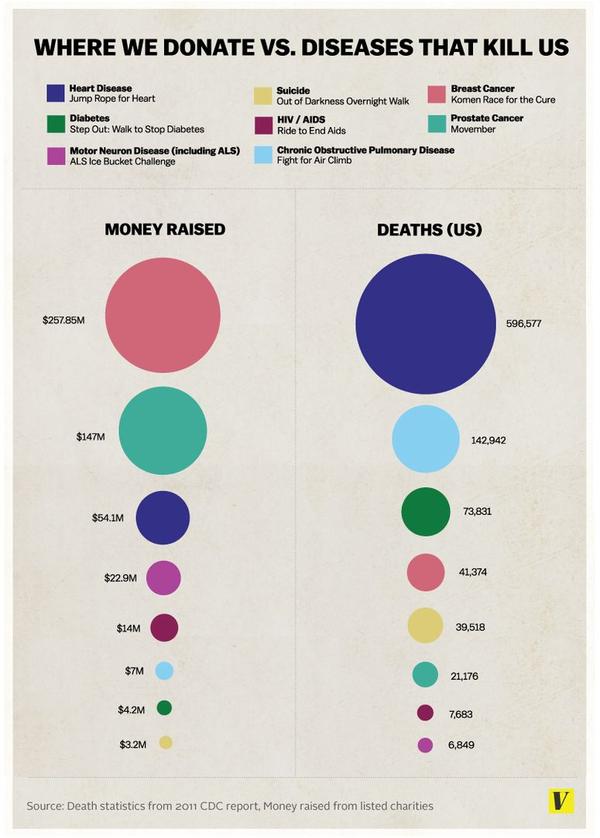
As you can see, diabetes is credited with causing the third most deaths, yet it accounts for relatively little money raised.
Firstly, this isn’t a game of ‘my health condition is worse than yours’. As someone most eloquently wrote on a Facebook status the other day: ‘all diseases suck’. Equally, every single condition is worthy of people’s donations. There simply isn’t enough money to go around to do the research, run the programs and assist people dealing with whatever health condition they have.
But I think unpacking why some conditions attract more donations than others is worthwhile.
Despite being responsible for many, many deaths and affecting millions of people both here in Australia and around the world, diabetes just doesn’t seem to be the ‘disease of choice’ when people reach into their wallets to make a donation.
Why is this? Why is diabetes not at the top of people’s minds when they want to do some good?
I’m just going to say this.
Diabetes isn’t sexy. It’s really not. It’s chronic; there’s no cure; and while there is the cute factor when we’re talking about little kids with type 1 diabetes, they grow up. And then it’s just boring adults with boring diabetes.
But there’s more than that.
The media does a great job of stigmatising this condition. Plus, there’s the ‘you did this to yourself’ misconception that means it’s okay to blame people for developing (type 2) diabetes in the first place and ‘…why the hell should I donate to you. Get off the couch and go for a walk’. Helpful. Really, really helpful.
Diabetes needs a makeover. Plain and simple. We need people in the general community to change the way that they currently think about diabetes so when it’s time for a little generosity, they consider making a donation to diabetes research or consumer organisations.
The neat little packages we seem to have about diabetes are misleading. Tying up type 1 with kids means that adults with type 1 have no voice at all. Blaming all people with type 2 diabetes for ‘doing this to themselves’ completely forgets the facts that genes play a significant role in developing type 2 diabetes. Calling diabetes ‘a touch of sugar’ ignores the seriousness of everyday life with diabetes. In fact, the very idea that this is all about eating sugar results in such misunderstanding about diabetes that people think the solution is as simple as not eating cake. The misconception that insulin is a cure ignores the multitude of factors that are involved with the daily management of this condition. And by thinking it is just about sticking needles into our bodies negates the distress and anxiety life with diabetes can bring.
I don’t know what the answer is. But I do know that what we’re doing at the moment isn’t working. Our messaging is wrong. How do we get it right?





