You are currently browsing the category archive for the ‘Awareness’ category.
 Last night, I had the privilege of attending the fifth anniversary celebrations for the Australian Centre for Behavioural Research in Diabetes. The event was held at my favourite Melbourne building – the State Library – so I was able to get my geek girl on and wander the stacks before heading to the reception.
I have written frequently about the ACBRD because I am a huge fan and supporter of their work. Before the Centre was established, there was very limited attention being given to the psychosocial impacts of living with diabetes. Diabetes was presented as a numbers game. People with diabetes were talking about what living with diabetes actually meant – we understand the day-to-day implications and the distress and the burnout and the fear and the anxiety. But there was no one dedicated to researching these things.
Much work has been completed since the Centre started. All of it is of great value, but there are certainly some stand-out pieces for me:
- The Diabetes Australia Language Position Statement, led by the ACBRD, which was launched back in 2011, is a much-needed ‘guide’ to assist journalists and HCP understand how to speak about and to people with diabetes. I can’t think of the number of times I have emailed, tweeted, handed-out a copy of this report to someone who has referred to PWD as non-compliant, a ‘diabetes sufferer’ or something equally damaging!
- Dr Jessica Browne, Research Fellow, has been leading a world-first program researching the social stigma of diabetes. Reaching far and wide (Washington Post, anyone?) it is so wonderful to have evidence supporting what we have heard from PWD for so long – diabetes is stigmatising and that we often feel blamed and judged for having this condition. I’ve said it a million times and I will continue to say it until the stigma stops – ‘No one asks to get diabetes.’
- The Diabetes MILES report still remains an important body of work. It was the first time that the psychological wellbeing of people with diabetes was investigated and the results confirmed what people living with diabetes already knew – emotional problems associated with living with diabetes are common, considerable and a very real part of living with diabetes.
The thing I love about the Centre is that in addition to conducting research and publishing articles, they actually provide practical tips and advice to HCPs about how to address these issues and concerns. And most pleasingly, they speak directly to and consult with people with diabetes.
As I explained in my talk last night, I have been lucky enough to present alongside Foundation Director Jane Speight on numerous occasions. The way this works is that I get up, rant, rave, wave my hands around and talk about the ‘living with it’ experience and then Jane gets up, speaks incredibly eloquently and provides the evidence to support what I have said. (So, thanks for making me look good, Jane!)

The always eloquent Professor Jane Speight. And me. Waving my arms around.
It was an honour to be able to celebrate the Centre’s first five years’ successes last night. Congratulations to all the ACBRD staff. Looking forward to seeing what you all do next!
Jump over to the Diabetes Victoria blog where today, I have written about how ‘Choosing Wisely Australia’ got diabetes wrong with its diabetes recommendation.
But while you’re here, check out these headlines from the Daily Express. So, so many ways to beat diabetes! Who knew?

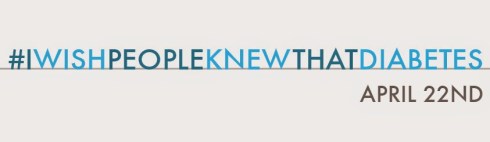
If you have anything to do with diabetes and glanced at Twitter this week, it’s unlikely that you could have missed the juggernaut that was #IWishPeopleKnewThatDiabetes.
Wednesday 22 April was designated the day that the Diabetes Online Community would come together and share what we wish people knew about diabetes. We kicked it off with great force here in Australia and it took off like a runaway train from there! Late on our Wednesday night, I watched the US wake up and Twitter explode with the #IWishPeopleKnewThatDiabetes hashtag. I had to force myself to turn off my devices and go to sleep because I could quite easily have stayed up all night following.
I was amazed at the diversity of the things people were sharing. I found myself laughing out loud and wiping away tears at some of the things I read, and a lot of the time, nodding in agreement.
Critics of these sorts of activities say that they are a waste of time – that we are preaching to the converted and that it is a self-indulgent pity party. I say that’s rubbish!
Firstly, even if the majority of people who read the tweets are others with diabetes, why is that a bad thing? Building our community – coming together, supporting each other, listening to others’ stories – is how and why we become stronger. I had several people reply to my tweets telling me that they felt the same way. I did the same thing several times.
And there is absolutely nothing wrong with fist pumping and patting ourselves on the back for living with diabetes. Or saying it is tough. Diabetes does suck sometimes; it is difficult to live with; it is a shit. Acknowledging that doesn’t make us weak or pathetic. It doesn’t mean that we have given up or that we think that we have it worse than anyone else in the world. It is just saying how we feel.
I didn’t read all the #IWishPeopleKnewThatDiabetes tweets (there are over six and a half thousand of them!) but I did read a lot of them. I read tweets from people I know well and those I’ve never come across. I connected with new people and retweeted and retweeted and retweeted until I thought I was going to be sent to Twitter purgatory for a while and told to settle down!
Well done to Kelly Kunik who kicked this off last week. I don’t know that Kelly has had much sleep over the last few days. She seemed to be tweeting and retweeting pretty much around the clock! Kelly is a bit of a force of nature. I caught up with her and another DOC friend, Stacey, when I was in NY and the three of us spoke so much we forgot to eat. Seriously. We remembered to drink coffee, but somehow we didn’t remember to order lunch! Hope you’re getting some rest now, Kelly!
I couldn’t even begin to say what my favourite tweets were. Perhaps the ones that focussed on advocacy issues and dispelling myths. But every single one did resonate in some way – even if the experience was not the same as mine. I feel that I have a better insight into how diabetes affects people’s lives. I hope – and am sure – that others have walked away feeling the same way.
(To see the reach of the #IWishPeopleKnewThatDiabetes hashtag, click on this link. At the time this blog was published, it was up to almost 14,000,000 impressions.)
We added another SHAG print to our collection the other night after attending an exhibition opening at the fabulous Outré Gallery. We now have two huge artist proofs that are based on the fabulous Peter Seller’s film The Party. Dance your way into the weekend with the soundtrack here!
Go away. There is nothing to see here today.
Instead, enter #IWishPeopleKnewThatDiabetes into your search engine and spend the day reading about the things we all want everyone to know about diabetes.
This is the initiative of Kelly Kunik from Diabetesaliciousness. But don’t read her blog today either. You can do that tomorrow.
Today it’s all about this hashtag: #IWishPeopleKnewThatDiabetes
Go!
I could never ever work in advertising. A combination of cynicism and disbelief at anything I ever see in an ad would make me a difficult employee!
There is a very real gap between the truth of diabetes and what we see in advertisements for diabetes products. I frequently find myself shaking my head in disbelief at the way diabetes is portrayed.
This is what a stomach using an insulin pump looks like. That is my stomach (apologies if you are eating, drinking or just looking). Those dots are the ghosts of infusion sets past in various stages of healing. There is also probably some tape residue stubbornly stuck to my skin. Pretty (gross), isn’t it?

#NoFilter. Obviously
This is what a stomach in a pump ad looks like. Magically, any hint of previous infusion sites have disappeared.

This morning, here is what my meter announced my BGL to be. (Hashtag: fuckoff)
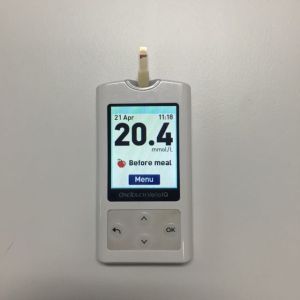
This is what the reading on pretty much every box and poster of BGL meters looks like. (Hashtag: bullshit)
 CGM graphs in real life look like the trajectory of rollercoasters with mountainous highs and cavernous lows, while the slick promotional materials show straight lines, nicely fitting in between the upper and lower alarm limits.
People in advertisements for diabetes paraphernalia are always outdoors, happy and rolling down hills, big smiles plastered on their faces. They wake up looking well-rested.
Real people with diabetes may spend time smiling and happy (I love rolling down hills – especially at this time of the year and getting all covered in Autumn leaves), but I’m putting it out there and saying that their glee is not because they have just done a BGL check. Unless the result is 5.5mmol/l. Each and every time. (See about meter photo. There was no smiling at that!)
I get it. No one wants to see my stomach on an ad for insulin pump therapy – that’s not selling units of product! But surely there needs to be a middle ground somewhere. I would like there to be an occasional BGL reading of over 15mmol/l on a poster for a meter. Because it happens. It’s not the end of the world and it doesn’t mean the meter is crap. And a stomach with a few pock marks from old infusion sets doesn’t reflect the quality of the infusion set. It reflects reality.
Diabetes isn’t pretty. It’s an ugly, scary and pretty un-fun thing to live with a lot of the time. That doesn’t mean that I spend most of my time in a ‘pity me’ funk, but I do admit – quite honestly – that it is shit at times. How about we aim for a bit of honesty and truth in diabetes advertising? Telling it like it is doesn’t mean we are weak or showing defeat. It’s just being authentic.
I have an app on my iPhone that tells me what I was doing (social media-wise) on this day in history. When I clicked on the app today, I discovered that I am clearly a creature of habit. Here are some posts for 15 April over the last four years.


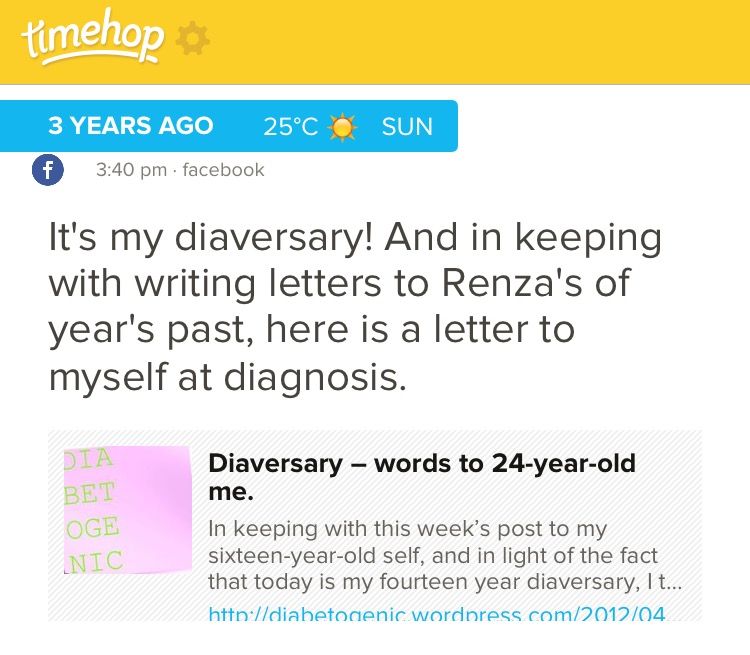

Do you see a pattern? Every year there has been cake and ceremonial yelling from the rooftops that I am another diabetes year older. And someone – anyone – get me damn cupcake!
This year, I’m marking my diaversary with a quiet nod to the last seventeen years, but not much more. I’m just not in the right head space to do anything more.
However, today just happens to be the launch of the Consultation Paper for the development of the Australian National Diabetes Strategy and the opening of the consultation process. You can read all about it in my post at the Diabetes Victoria blog here.
Perhaps instead of using my diaversary to look back at my diabetes life and celebrate the last year, I’ll use it to think about looking forward. I. I might just find myself a little cupcake and consider what I hope to achieve in the next five years. Until there is a cure for diabetes.
Today, I (literally) rolled up my sleeves and put my money where my mouth is.
It’s fluvax day at work and with most of my colleagues, I lined up to get a free lollypop. And my annual flu vaccination. With all my banging on about how important it is for us to be vaccinated, it would be pretty hypocritical of me to not get my flu jab each year.
Here’s how it played out:
Step 1 – look of great suspicion from me because no one but no one can give a needle like I can.

Step 2– Squeeeeeze! And waiting for the sting.

Step 3 – Here. Let me help you! (AKA – I’m really not good at letting other people jab me with needles.)

Step 4 – I’ll take it from here.

Step 5 – Nope – didn’t hurt.

Step 6 – Worth it!

Okay, so here’s the deal. People living with chronic health conditions – such as diabetes – are more susceptible to catching (and experiencing complications from) the flu. The flu is not a little sniffle that has you deciding to take the day off so you can sit on the couch, eat left over Easter eggs and binge-watch Netflix. The flu is terribly debilitating. Approximately 3,000 Australians die every year because of the seasonal flu, or complications due to the flu or pneumonia. Yes – it’s serious.
This terrific information sheet offers lots of information about the flu, and this year’s vaccination program. It’s been developed by the Australian Government’s Department of Health, so if you are an anti-vax twit, now is your time to start talking about conspiracy theories and how the Government is in the pocket of Big Pharma. (Please do it away from me. I’m not interested.)
Also useful is this piece that appeared last month on The Conversation.
The flu is incredibly contagious and spreads easily through infected droplets in the air and by hands. Vaccination is the best way to prevent and stop the spread of the flu. I don’t know about you, but I do as much as I can to live a healthy life. Getting my annual flu vax is a really simple, relatively painless and safe way to help me on my way.
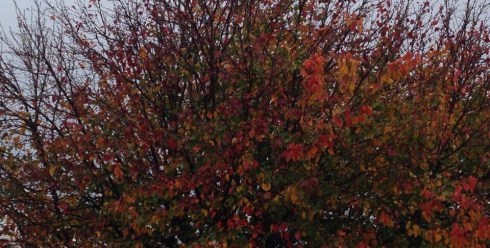
Yesterday, I looked out the kitchen window into the back garden and out over the back fence on the other side of the laneway, and I noticed that our neighbours’ beautiful big tree was starting to wear its Autumn colours. The green leaves were giving way to the most beautiful deep reds and I know that in just a couple of weeks, the branches will be bare, letting in the pale Winter sun.
I don’t think I’ve ever been so aware of the seasons changing as I have in the last couple of years. Perhaps it’s because with more friends overseas I see their seasons change in opposition to ours – we swelter whilst they curse snow; we shiver while their Summer blazes.
But with each season that passes, I am more and more conscious of the time I’ve lived with diabetes.
In the middle of this month, I will have lived with type 1 diabetes for seventeen years. I know that in the grand scheme of things – and when I think of celebrating Kellion medallists – seventeen years is nothing more than a drop in the ocean.
But to me, it feels like a long time. In fact, it’s the first time that I’ve thought the number and it has felt big. While in single figures, it was tiny and even hitting ten or twelve years didn’t seem much. Neither did sixteen.
Seventeen, however, seems big. Really big.
I always plan to celebrate my diaversary and mark it in some way. Sometimes it’s just a cupcake with the family or friends. But I mark it and recognise it as something I want to acknowledge and celebrate. I celebrate that I am living well with diabetes and that I am still doing all the things I love. I celebrate the minimal impact diabetes has had on the previous year.
This year though, I am not feeling like that. It’s not that I don’t want to celebrate (I’m not one to pass up cake), it’s just that I’m not sure what I am celebrating anymore. I’m still living well, but the impact over the last 12 months has seemed greater than ever before.
I have always been proud of the position diabetes has held in my life. And I have always been proud of the way that I have never let it stop me doing anything. But in recent times, I’ve come to wonder and worry – if the reason that things have been that way aren’t so much of my doing, but rather because that’s how my diabetes has been.
The privilege of being able to say ‘diabetes hasn’t stopped me from (insert whatever)’ is because my diabetes has been manageable, and well behaved. What if that really changes? What if things suddenly mean that I am stopped from doing what I want?
I feel like diabetes is, in some ways, stripping me bare with its relentlessness. Feeling like I am managing and coping has become a desperate pursuit and feel overwhelmed and overcome more easily.
I’m not sure if is purely the emotional toll, which has in recent times been more significant, or if is that combined with difficult lows that seem to be becoming more frequent.
But whatever it is, I’m feeling exposed – although to what, I’m not sure.
I thought of all this as I stood at the kitchen window and looked at the tree. I thought about how exposed the branches would be soon. But I also thought about how it was only for a few months. Come Springtime, the branches would be covered in pretty blossom and after that, full again with bright green new growth. The seasons are so defined and clear.
Perhaps the way I feel about diabetes is all cyclical and seasonal too. Maybe the impending cold is why I am feeling exposed at the moment. Maybe I just need to batten down for a few months, wrap myself up and keep myself warm until the season changes again.
And in the meantime, gently and quietly recognise my diaversary, give a nod to the year that has passed and just keep going on.