You are currently browsing the category archive for the ‘Awareness’ category.
Yesterday was Social Media Day. Actually, it’s still going in the northern hemisphere.
And here is an example of how to be a dick on social media:

Now, after being a dick on social media, here is what you should do. (It’s actually quite easy.)

Instead here is how you keep being a dick:

(The Nick Jonas reference was in response to this tweet.)
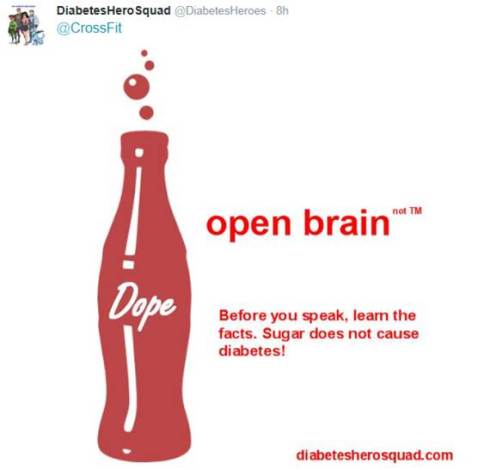
Seriously CrossFit, shut up!
Also, if you want to insult all people with diabetes, how about trying something original? This has been done to death. Jamie Oliver did it earlier this year; Aussie comedian Dave Hughes did it a few years ago. And a pathetic little café in Sydney did something similar exactly 12 months ago today. It’s old…really old.
Making fun of health conditions is not clever. It shows ignorance and it is just plain nasty. How about you show some kindness and talk about how your program can actually help people living with (all types) of diabetes? Wouldn’t that be inclusive rather than divisive? Novel, I know.
Last word goes to the Diabetes Hero Squad (who makes me laugh daily!) with this.
Consumer engagement. There are a couple of buzz words if I’ve ever heard them.
Today, I am attending the Health Issues Centre Forum, ‘Listening to the Consumer Voice: what does healthy dialogue look like in 2015?‘ I was the opening presenter where I spoke about the role of the consumer in healthcRe.
My position is clear – consumers have a place at every conversation taking place about healthcare. Whether it be at a governance, strategic or operational level, the voice of the consumer should be the loudest and proudest in the room.
All too often, this representation is tokenistic. It is an all-too-simple ‘tick-the-box’ requirement of health services. And it’s the same in the broader health community.
Most of what I have heard today I have heard before. This discussion has been going on for a long time, and as one of the speakers said ‘Why are we even having this conversation anymore?‘ And he is right. Why do we need to be defending the right of the consumer voice? Why is it not a given?
My talk was followed by palliative care physician, A/Professor Natasha Michael who gave a fabulous talk about the challenges faced by clinicians for finding the balance between ‘benevolent paternalism’ and patient autonomy.
Her analogy was simple – if she contracts an electrician to do some work for her, the last thing she wants is the electrician to stand in her house and ask ‘Where would you like me to put the green wire? And the red one? And the blue one?‘ They are the expert – that’s why she called them.
At face value, that sounds reasonable. But actually, I don’t think I really am comfortable with it because it completely minimises the expertise I have gathered in the 17 years I have lived with diabetes.
When I expect to engage in a dialogue with my HCP it is not discrediting their expertise; it is acknowledging that I have something to bring to the table.
At a higher level, consumer involvement can emote difficult. How are consumers included in strategic decisions, on boards and at a governance level? And how does that work?
Possibly my favourite take-home message from today came from Damian Ferrie who is the CEO of Inner South Community Health. Damian said that measuring if consumers are participating in a meaningful way is quite easy: ‘If consumers have no power to influence in your organisation, it’s tokenistic.’
I wish I could say that I am seeing more examples of consumers having power to influence, but that isn’t the case. Our involvement is still tokenistic. It is largely unpaid which further reduces our worth.
And yet, health services and health organisations claim frequently that they are listening to the consumer voice, that consumers are critically important, that consumers are the basis of their work.
By and large, I think it is lip service, with primarily examples of organisations talking the talk, but not walking the walk. And that is why we are still having these conversations. We need to be. I wish we didn’t. But we do.
Tomorrow, I am flying to Boston to attend the American Diabetes Association 75th Scientific Sessions. (Play along from home by following #2015ADA!)
There will be a strong consumer (reminder to self – use ‘patient’) contingent, which is always terrific. I get to catch up with old friends from the DOC and hear what they have been up to. I learn about new consumer patient-led advocacy efforts that manage to cut through in a way that only people living with diabetes can. I am reminded that conferences ARE the place for people living with the health condition that is being spoken about at that conference.
I attend conferences with my eyes wide open and leave with great excitement. I see new technologies yet to be released here, or still in development. I hear from people on trials of new drugs and devices. And I see the potential and possibilities for making diabetes easier, more streamlined, more user-focused and feel inspired and hopeful. This is good.
But, I am approaching this conference with a slightly different attitude. With some of the recently announced changes to diabetes supplies in Australia (as I wrote about here and here), I really want to speak with some of my US DOC friends about what it means to be reliant on a health system that limits choice. We have never really had that to date.
Whilst we may not have access to every pump or meter on the market, the consumables for the devices that are here have been available to all. Distribution has been overseen by Diabetes Australia (please read the disclaimer in this post!!) – an organisation representing people with diabetes, not big business or shareholders.
Last night, I attended a dinner at Parliament House in Canberra for the Parliamentary Friends of Diabetes Group. It was a grand occasion, attended by many influential politicians. Health Minister, Sussan Ley made this comment:

This is, indeed a noble pursuit.
Diabetes Australia President, Judi Moylan stated:

I would ask that in amidst all of those politically-charged reviews, reports and cost-cutting measures that seem to be the focus of diabetes in Australia at the moment, the human aspect is identified. It is hard to find amongst all the facts and figures.
But it is absolutely critical for our leaders to consider if they want to do best by people living with diabetes. Extraordinary leaders would search for it, find it – and make sure they listen to it. And remember that those extraordinary leaders include people living with diabetes.
There is much inequality with the health system here in Australia. I know that we have it better than a lot of other countries, but unfortunately, it’s not fair for all. However, there are some things that are, indeed, great.
I have always been exceptionally proud of our National Diabetes Services Scheme. I love telling people about it when I am travelling, explaining how it makes the lives of people with diabetes considerably easier. We don’t need to get our health insurance providers involved; no one is forcing us to use one particular make of meter or strips because that is all that is covered; registering on the NDSS is not all that difficult.
The NDSS has been around since 1987, and in a health system of oft-quoted disparity, it is a shining light in its fairness. (I say this with full knowledge and understanding that people with type 2 diabetes do not have access to insulin pump consumables, but this therapy is primarily used by people with type 1 diabetes – even before the NDSS subsidy came into effect back in 2004.)
However, when it has come to needles, BGL strips and other consumables required in the management of diabetes there has been no discrimination; it has been available to all.
Until now.
Last week, Commonwealth Health Minister, Sussan Ley, announced that following the findings of the Post-Market Reviews of Products Used in the Management of Diabetes, BGL strips would no longer be available to people with non-insulin-treated type 2 diabetes as they have been to date, questioning the effectiveness of self-monitoring of blood glucose (SMBG) for this group.
The report (Part 1 – Blood Glucose Test Strips) announced that people with non-insulin-treated type 2 diabetes will have limited access to BGL strips. That is, access will be provided for up to 12 months’ supply of strips – initially six months and then an additional six months if it is determined the person with diabetes will benefit from further monitoring. The decision is in the hands of the healthcare professional – not the person with diabetes.
The Minister claims these findings to be in line with the Choose Wisely campaign, which, when it comes to type 2 diabetes, I also consider to be flawed.
When the PBAC reviews were first announced (back at the end of 2012), I wrote this piece for the Diabetes Victoria blog about why limiting access to diabetes consumables for any group of people with diabetes is potentially damaging – especially when it relates to taking ownership of managing diabetes – and short sighted. I actually think it is downright irresponsible policy making.
The findings of this review concern me – they worry me greatly. This is the first step in removing control of the tools we need to manage our diabetes in the way we choose. The removal of choice is destructive and limits our ability to tailor our healthcare to our needs.
I don’t have type 2 diabetes, so this in no way affects what I am able to access through the NDSS. But I know many people with non-insulin-treated type 2 diabetes who rely on regular BGL monitoring to assist them to live well with diabetes. They use it as a tool to make better food choices, noting how certain foods affect their BGLs. They use it to monitor the effectiveness of exercise as part of their diabetes management. And they use it because it gives them a sense of control, piece of mind and ownership over their health.
This is sending the message that non-insulin-treated type 2 diabetes is not serious. And that is a very, very dangerous statement to be making.
Disclaimer – I was involved in Diabetes Australia’s submission to the PBAC on all aspects of the Post-Market Reviews of Products Used in the Management of Diabetes. Diabetes Australia strongly supported SMBG for people with non-insulin-treated type 2 diabetes in Part 1 of the reviews.
I had a lovely dinner last night with a colleague and friend. We ate great food, drank terrific cocktails and didn’t shut up except for when the waiter was telling us the evening’s specials (and even then we ‘oohed’, ’aahed’ and ‘yummed’ our way through that).
At one point, my friend reminded me of a beautiful part of the book Captain Corelli’s Mandolin, a book I read when it first came out back in the mid-1990s.
As soon as I got home from our dinner, I searched for it so I could read the words again. Here they are:

When I first read the book, these words kind of washed over me. I was hearing them quoted a lot, and in the coming years I heard them read at weddings. They are beautiful words; read aloud it is beautiful prose.
But it wasn’t until last night that I read it and felt really understood it. The poem is an ode to enduring love, but that’s not what struck me. At least, not necessarily the love bit. But the endurance bit certainly did.
Over the last couple of years, things have been difficult. When I look at how I have been managing my diabetes, it has been a series of fits and starts. There are spurts of focus, then dips of almost denial. There are times of desperation and exhaustion and then periods of energy. It’s uneven. New devices see me get enthusiastic and motivated, but only for a short period. Then I return to the slump.
It’s not the exhilarating times that matter. Of course they are wonderful and enjoyable and sustaining and thrilling. Having a new pump or a new meter or a new CGM is a sure-fire way to get me thinking more about diabetes. But this doesn’t last. And it also doesn’t really count.
Equally, it’s not the slumps that matter.
What really matters is actually what you might call the boring times. It’s what comes before and after the flurry of interest of a new toy. Or the times around the ‘nosedives’. I feel best about my diabetes management not when I am stressed about how little I am doing or happy because I am so focused. It is actually the time when it is just there, plodding along, being considered at an ‘appropriate’ level. It’s not sexy. It’s not dramatic. But it’s so good because I feel relaxed and comfortable about it. It just is.
I am sure that there is something to be said about the fast-paced world we live in and this idea that we always need to be thrilled by something new. It’s too easy to get complacent and comfortable. That’s probably one of the reasons that I embrace new and emerging technologies with such zealousness.
However, if I was relying only on the new stuff to sustain me, it would never last. A new pump becomes just a pump very quickly. A new meter stops being new and shiny after a while and becomes just a meter. And a CGM may be magical and brilliant and life-changing until it become just another tool in the diabetes tool kit. That doesn’t make them any less important or valuable. But if I was relying on the excitement of the new, I would need a new toy every week or so!
The endurance of ‘just being’. That’s the sweet spot. That’s when I know I am getting it right. I just wish I could work out how to be there a whole lot more!
I am lucky that Aaron is always listening to new music. This CD was a recent purchase. Sometimes I hear something that makes me just so delighted. Like this live performance of my favourite track from the CD.
It’s kinda ingenuous to refer to today’s post as ‘Wordless Wednesday’ given the image below is full of words. Plus I’m typing words. So I may as well keep typing a few more.
Inspirational quotes give me the shits. Whether it’s posters on the walls of corporate offices or on the walls of my social media feed, they annoy me.
So here’s one for today!

This one, (found on the Diabetes Support Facebook page), I actually rather love. I am so guilty of referring to myself as a failure because I am not managing my diabetes as well as I would like to be. But at no time have I decided that my health is not worth the effort. And certainly, at no time have I thought that I am not the effort.
But I have slipped up. I have screwed up. I have lost focus and caved. I’ve given in. I’m busy. I’ve become lazy and I have been so, so, so, so distracted. This is a set back. Nothing more. Nothing less. A set back.
Pop over to the Diabetes Victoria blog for my post about this Saturday’s Diabetes Expo. It’s going to be a jam-packed day of diabetes information! If you’re going, make sure you come and say hi to me. I’ll be emceeing throughout the day.
Diabetes is really not a topic of conversation much for me when outside of work. And outside of this blog. I know – hard to believe. But when I am around friends or with my family, there may be a passing comment, but it rarely dominates discussion.
Having said that, we had our neighbours over for dinner last weekend and the ‘Pumpless in Vienna’ story got an airing – and not by me! It was interesting to hear it told from the perspective of one of the main characters in the story.
And then yesterday, while I was in Geelong, I had lunch with my team mate Kim (this is Kim!) and not once in our hour long chat did we speak about diabetes. Not once. In fact, it wasn’t until I got up to leave and mentioned to the waitress that I would love to continue to sit by the fire, but had to rush off to give a talk, and she asked me what the talk was about, did the word ‘diabetes’ come up.
‘Oh. Is it about type 1 or type 2 diabetes?’ she asked. Kim and I looked at each other with surprise – and a little delight. ‘Well, in this case both. But usually we work with people with type 1 diabetes,’ I said. ‘Our waitress over there has type 1 diabetes,’ she continued. It’s possible that Kim and I squealed at that point. ‘I’m so annoyed that I need to leave now – I’d love to chat with her. But Kim here isn’t going anywhere!’ And out I walked. I hope they had a chance to catch up!
I love a good diabetes in the wild story!
Other things occupying my small mind this week.
Cards to send when you don’t know what to say
I love these! They have been all over my social media feeds. They are such a wonderful idea. Emily McDowell has created empathy cards for people with serious health conditions.
I love the one that says ‘I’m really sorry I haven’t been in touch. I didn’t know what to say’ because often that is the case. We don’t know what to say. But if we have a friend going through a tough time, it’s not about us or our awkwardness. This card shows that even though you feel clumsy with words, you are thinking of your friend.
This is my favourite – and probably most relevant to diabetes. Please don’t tell me about you grandmother who lost her limbs because of lemons. Okay?

Numbers mean nothing on their own
I had a very cool Twitter exchange with the super clever Dr Rick Kausman after I tweeted a link to this terrific piece he wrote for The Conversation this week. Numbers (in this article’s case weight) only ever tell part of the story – and often not the most important part!
Quick! Time’s running out for MILES 2
Diabetes MILES 2 is about to close. Do it. Do it now! (Read about it. Read about it here!)
There is a place for Dr Google in our healthcare teams.
While seeking medical advice exclusively from Dr Google isn’t the best idea, there is no denying that the internet and social media are indeed a significant source of information that really can benefit people living with health conditions. I hear blogs are a good source of information and support. Apparently. So I’ve heard.
Have a read of this great piece from MD Joyce Lee. I think she gets it right when she says this:
Healthcare, wake up. It’s not the 1990s anymore.Social media, google, and the internet ARE medical therapy.
Dr House was wrong
What do you know about Lupus? Dr House seems to believe that ‘It’s never lupus’, but actually, sometimes it is. I’ve grown up with an understanding of this autoimmune condition. My gorgeous mum has been living with it kicking its arse for more than 30 years.
Here’s some information to brush up your basic lupus knowledge. And considering that May is Lupus Awareness Month, now is a good time to get some facts!
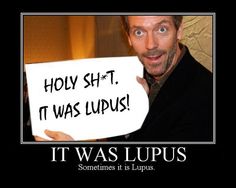
Sorry – couldn’t help myself.
Taking a diabetes break
Well kind of. There are some lucky teens taking an artificial pancreas for a spin in the real world as part of a study being run out of Yale. Read all about it!
There will be no sleep
Next week is Diabetes Blog week. It’s gonna be huge!
Happy Mother’s day, Mum!
My Mum is brilliant. She really is. And when she sent me this text message bagging the paleo diet, she hit new levels of brilliance.
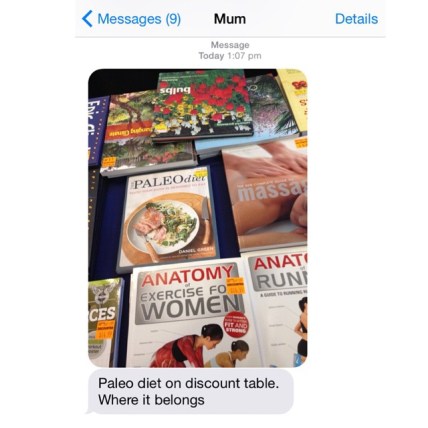
Happy Mother’s Day, Mum. If I can be half the mother you are, I’ll be doing well. Love you. x
It’s International No Diet Day! No Diet Day promotes and celebrates natural beauty and diversity. People are found in all shapes and sizes and there is no one ideal. It also encourages people to stop dieting for the day and put aside all weight loss plans or food restriction practices and put an end to weight discrimination.
There are lots of ways that we can celebrate No Diet Day. But for me and my family, it will be just another day of eating the way we always do – mostly fresh food, lots of coffee (for the grownups, not the kidlet!) and, in all likelihood, something with some Nutella spread over it at some point of the day.
And I will also be thinking a lot about diabetes-related eating disorders and how common they are amongst people living with diabetes.
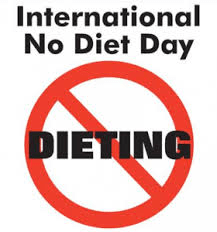
I applaud these sorts of awareness campaigns, but the danger is that in the positive messaging, there is still a risk of shaming. No Diet Day is not about shaming people who are thin. When reading up about No Diet Day, I came across a lot of materials that were celebrating ‘real women’ and ‘real bodies’, claiming that real women have curves. This actually doesn’t advance the cause it all. All women are real women. Whatever shape or size you are, if you have a vagina, you’re a woman. Go get that on a t-shirt!
I guess the thing that we can all take away from today is remembering that diets don’t work. That’s the bottom line. Diets Do Not Work. So with that in mind, perhaps we should be aiming for every day to be No Diet Day. I know I certainly do.
In other news, jump over to the Diabetes Victoria blog where today I’ve written the second in a series about the consultation that is underway around the development of the new Australian National Diabetes Strategy. You still have 11 days to complete the online survey and I really urge you to take the time and provide some feedback.
Yesterday, as I sat in the waiting room to see my endo, I couldn’t help but feel that I was walking into a wasted appointment. I had seen her about six weeks earlier and left with promises to myself of being more engaged with my diabetes care. I promised I would have my blood work done. I thought about goals and how I could work to achieve them.
And yet, there I was, waiting to go in and wondering what the hell I had to say to her. There would be no discussion of lab results. I haven’t gone to pathology to have the checks done. There wouldn’t be any pulling out of data for me to show her – I hadn’t been logging anything. I was pretty much in the same state of mind about my diabetes as I had been last time I sat waiting to go in to see her.
I was wasting her time and I felt really bad about it. Not that she would ever tell me that. In fact, not that she would even be thinking that. But it’s how I felt. I have such respect for this endocrinologist, and I felt that in some ways I was actually being disrespectful in showing up so unprepared.
There were no tears yesterday. But there was an honest and open admission from me that I need help. I have tried everything I know to try and pull myself out of the motivation slump I have been in for so long. There are been periods where things seem to be better and I am able to make more of an effort, but they are fleeting and before long, I am back to feeling burnt out.
Let me be clear – I am not completely ignoring my diabetes. I am bolusing insulin at all the appropriate times; I check my blood sugar, albeit nowhere near as much as I know I need to – or that I would like to; I have started seeing my endo again. I eat well. At no time has diabetes completely fallen off the radar. But it certainly has deviated from being as much of a focus as I would like.
It’s not the mechanics of diabetes that is the problem. It is the trouble-shooting and problem solving and thinking about diabetes in a way that makes me feel confident that I am dealing with my health and wellbeing as much as my blood sugars. But I’m not doing that. I’m in a fog of burnout from which I now know I am unable to emerge without some real help.
I can pinpoint the source of the burnout; I can trace its progression; I can see why it happened. I understand all of that. I understand that dealing with the loss of our baby following a miscarriage and all the things that happened around it were often all I could deal with – both at the time and for periods since then too. But even though I have words to explain how this has happened, I don’t have actions to get me out of it.
I’ve tried. I’ve tried everything I could think of – all the techniques that have worked in the past. But I suspect that the combination of grief and the longevity of this burnout have resulted in me simply not being able to fix it alone. I need help.
I also believe that tied up in all of this is the way that I am feeling about my body and its failings. Because I do feel I have failed. Or at least my body failed me – again – when I miscarried. I really did think that I was ‘over’ it and was moving on, but not a day goes by where I don’t, in some way, feel sad and broken about it. I don’t know how to stop feeling this way. Again, I need help.
So, I asked for a referral to someone who can help me work though things – someone to help with strategies. I have been in therapy before; I know that it will help. It’s not a quick fix – I know that too.
I am trying to be all Pollyanna-ish about this and make grand ‘the first step is the hardest’ statements. And I am being positive and saying that it is certainly a step in the right direction. It’s going to take time. It’s going to take effort. Perhaps I am ready for that now. I know I certainly haven’t been to date. But maybe – hopefully – I am now.
I’m back on the bandwagon today. Or back on my high horse. Or back on my soap box. Whatever analogy you want to use, I’m on something. But I’m always on message!
Last week we heard a story of the tragic and just so very sad death of a beautiful little boy with type 1 diabetes. According to media reports, seven year old Aiden Fenton, who had type 1 diabetes, was taken, by his parents, to a hotel in Sydney, where he was denied food and insulin and slapped repeatedly as part of a barbaric treatment meant to cure him of his type 1 diabetes.
This is a tragedy. There is no other word for it.
The theory behind this brutal treatment is that repeatedly slapping the body builds heat, which will allow ‘chi’ to flow which results in toxins to be released. This will, apparently, cure what ails you.
And while this may be the extreme, what we have here is yet another example of ridiculous assertions by people claiming to have an understanding of health and wellbeing. But there is no understanding. There is no science behind these claims. There is no evidence to suggest that they work.
There’s that word again: ‘toxin’. It’s a favourite with many wellness experts and Instagram diet and fitness frauds who seem to have forgotten that the body has a fabulously powerful and clever organ called the liver. They should Google it – they’ll get pictures to go with explanations of the role this organ plays in the body and its connection to ‘toxins’. Pictures like this one:

You’re welcome.
Thankfully, there are others – many others – much smarter and with much better reach than I asking questions and calling out these dangerous cults.
Yesterday, the CSIRO (I think we can pretty much bet they are all about science) tweeted this.
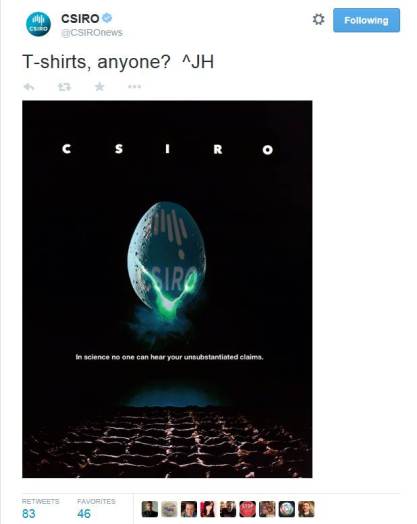
Yes please; I’ll take one in a 10.
Helen Razer wrote a fabulous (and very swear-y) piece a few weeks ago about the stupidity of the paleo movement and other dangerous messages being regularly expounded by equally dangerous idiots wellness experts. You should read it (language warning again in case those sorts of things offend you.) My favourite line is the caption used under a photo of Pete Evans: ‘Stupid is the new science’. Yes – I want that on a t-shirt, too.
And take a few minutes – well ten and a half – and watch the brilliance of Tim Minchin with this fabulous animated short of his poem ‘Storm’.
Minchin first wrote this as a jazz-backed beat poem for a live show. From there, it was the animated short was made and, most recently, a graphic novel which I’ll be purchasing next time I head to my favourite books store, Readings. You can read how the poem came about in this piece Minchin wrote for The Guardian.
Yes, I know. I keep harping on about the same things. But alternative therapies and the ‘wellness movement’ are responsible for a little boy’s death. They fuel eating disorders, they confuse people, they deliberately and intentionally target the vulnerable who are desperate for answers and cures. And there is no evidence to support that they work in any way. In fact, they harm. A little boy is dead. Just keep thinking about that.