
You are currently browsing the category archive for the ‘Awareness’ category.
There is so much about diabetes that can’t be simply explained or managed. And even if we understand the mechanism behind why something happens, we can’t necessarily fix it!
The intersection between diabetes and anxiety is certainly one of those things. When I am anxious, I go high. That’s the way it is. If I am extremely anxious and have a panic attack, the adrenalin rush sends me to insanely high glucose levels that I know I can’t treat by just bolusing insulin, because there will a swift, aggressive crash at some point and any excess insulin will make it worse. Much worse, because nausea often accompanies how I am feeling in the moment, so the thought of an ‘eat-the-kitchen’ hypo is not great at all.
I was feeling pretty anxious yesterday. It was a medium level hum that at times swelled to a loud banging noise, and I could sense that there was a topple on effect with my glucose levels. Except there wasn’t. At least not one that could be detected on my CGM graph, which was chugging along in range, albeit at the slightly higher end of that range.
But Loop was working hard to keep it that way. Micro changes to basal insulin showed a Loop graph of constantly changing dosing throughout the morning – at the same time I was feeling loud-banging-noise-anxious. At the moment there was a surge in anxiety levels – and I can pinpoint that moment – there was an accompanying surge in my insulin dose, but only for a little while. Because as my anxiety ebbed and flowed, so did my insulin dosing. All with me doing nothing.
Living with anxiety is one of the things that makes diabetes super difficult. I mean, there are so many things, but anxiety is a next level issue because the very idea of thinking about dealing with diabetes while dealing with an intense moment of anxiety is, quite simply, impossible. But even if I could, there is no way that I would be able to predict just how my glucose levels would respond, or the timing of that response, to act effectively.
As ever when writing and thinking about automated insulin delivery it comes with a very honest understanding, and acknowledgement of my privilege and knowing that I am extraordinarily fortunate to have at my disposal the technology that can help me in this way. I’ve written and spoken about this a number of times, and I am always acutely aware of the advantage of having a system that takes away so much of the brain power needed to manage such a complex health condition. I say this not as an afterthought – it is an ever-present thought.
But also ever-present is the gratitude that there is something with me that is providing such incredible insight into just how my diabetes behaves, operates and reacts to different situations. That is, of course, what CGM does. But it’s Loop gives an extra layer of insight – it shows me what my body would have been doing if my beta cells hadn’t gone on a permanent ‘tools down’ almost twenty-three years ago. And gives me an appreciation, and a reminder, of just how difficult diabetes is, and how incredibly challenging it is to attempt to perform the function of a highly sophisticated and evolved body organ!
Anxiety is unpleasant. What it does to diabetes is unpleasant. But having the tools to help manage its impacts on diabetes does help. It’s one less thing to worry about at a moment when it feels that I am being engulfed in a whole world of darkness and worry which is how I felt yesterday.
Now if someone could just magic up a DIY tool to stop the anxiety happening in the first place, that would be just dandy!

Here’s some stuff I’ve seen in the diabetes online world that I think is pretty cool. And I also think you might like it too if you’ve missed it.
If nothing else, this serves as a reminder that there are some super talented, smart, funny, productive, and downright awesome folks who are doing some super brilliant things and I am always happy to share that around. (I’m forever grateful when others in the DOC have shared my posts and other work. Building each other up is always a lovely thing to do!)
Vaccine in Australia (finally)
We may be a little behind the curve, but Australia’s COVID-19 vaccine rollout has finally started! Some links that might be useful to folks with diabetes:
- THIS statement from Diabetes Australia (disclaimer: I work there), the Australian Diabetes Society and the Australian Diabetes Educators Association
- THIS piece from Diabetes Mine
- THIS eligibility calculator from the Australian Government which will give you an idea of when you can expect to get your jab.
And THIS message from me (and science):

Diabetes poetry to make you laugh and cry
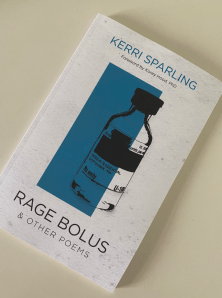
Kerri Sparling has just released her book of diabetes poetry. It’s called Rage Bolus and it is all shades of wonderful. It’s a gorgeous collection of words that will have you nodding, laughing (chortling) and crying, and is a must on the shelves of all folks with diabetes.
You can get your own copy here.
A new diabetes podcast to check out
Chelcie Rice has been around the DOC for a long time now and frequently provides thoughtful commentary on what’s going on in the diabetes world. And so, I’m thrilled to see that he has just launched a new podcast, ‘The Soul of Diabetes’.
The launch episode can be heard here, and then you should subscribe!
Also, Chelcie shared a video of his thoughts on the recent Dexcom Superbowl advertisement and it’s definitely worth a look.
Clare Diabetes Group meeting
More than a little honoured to have been invited to speak at the upcoming meeting of the Clare Diabetes Group in Ireland. You can register here.

Not an easy read…
Phyllisa Deroze remains one of the most incredible voices in the diabetes community. I have been lucky enough to hear her speak (she is such an engaging speaker!), and read everything she writes because I know it will get me thinking. On Valentine’s Day she wrote about her diagnosis story, which is not an easy read, but it is a very important one.
Phyllisa’s blog is called ‘Diagnosed Not Defeated’ and I don’t think that has ever been more accurate or relevant than in this post. Read it here.
CORONADO Study
Just today DiabTribe has published this great piece breaking down the findings from the latest findings of the CORONADO Study which looks at people with diabetes hospitalised with COVID-19 in a number of centres across France.
Read their article here (and there is a link to the full study there).
Totally not relative to anything diabetes wise, but why?
I’m just going to leave this here…
Can you see it??
Check out this advertisement from Bonds Australia for a bit of diabetes technology on show! A little representation can go a long way! (You’ll have to watch carefully…but check out the 36/37 second mark.)
Keep wearing a mask…
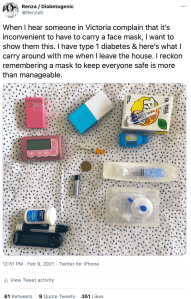
…because the science says they work. And share this with anyone without diabetes who is complaining about just how inconvenient it is to have to carry around a bit of fabric with them when they head out to the supermarket!
Spare a Rose final push
And finally, February is dwindling and that means that the 2021 Spare a Rose campaign is coming to its end. So far, an amazing USD$40,000 has come in from the community – that is, donations from people with diabetes and others affected by or associated with diabetes. There will also be corporate donations added to the final tally.
If you’ve not yet donated, or even if you have and would like to donate again, there is still time to make your contribution count towards the final tally. Every single donation makes a difference to the life of a child with diabetes.
Last year, a lot of the work I did centred around mental health and diabetes. It’s funny how things happen – we had always planned for it to be the focus for our National Diabetes Week campaign at Diabetes Australia (disclosure: I work there), and then COVID-19 happened, and it seemed all the more important to make sure that we were flagging just how much people with diabetes’ mental health was being impacted by the pandemic. Spoiler alert – the answer was, and still is, a lot.
Last year also happened to be the year that my own anxiety went from being something I’d dealt with mostly in the past to something that became very much in the present and a bigger issue for me than living with diabetes. I had a few panic attacks that terrified me and had the domino effect of adding to my anxiety as I’d wait for the next one to strike. But it wasn’t just those acute moments that made me feel anxious. It was a low-grade hum that became the soundtrack to every waking moment, sometimes exploding into a roar.
Of course, COVID-19 contributed to it all, because how could it not? But I also knew that these feelings of disquiet and unease had started well before the pandemic was firmly on my radar, before our first lockdown, and before Melbourne’s second lockdown – the longest and strictest is the world.
Trying to keep it all in check was tough but at the time I thought that the fact that there was just so much going on with work was a good thing. I simply couldn’t examine too closely what was going on with my mental health because work was just so, so intense, and anyway, of course I was feeling fretful and anxious because who wasn’t?! Hindsight, of course, suggests that it probably would have been better to stop for a moment and address that hum rather than try to explain it away or drown it out with more and more noise that actually only made it worse.
And so, I started putting words to what I was feeling because that was a first step to acknowledging that I needed to do something. And that I needed help. I started to check in on my anxiety levels each morning. Or when something significant, (or even not all that significant) happened, I’d stop and ask myself how anxious I felt. Starting to be able to name how I was feeling, and rate it, meant I could do something about it.
I had occasional telehealth appointments with a psychologist, to work through and to help develop strategies for coping. And to spend time working out where this anxiety had stemmed from. This is something that has always been important for me to do. When I have had periods of extreme anxiety before, there has been no coming out of it without being able to pinpoint where, when and how it started.
Sometimes that’s not all that easy to do, other times it’s glaringly obvious. When diabetes has been acknowledged as the cause of my increased anxiety, it’s never enough to just say ‘diabetes’ – it’s usually something more nuanced and specific. And so down the rabbit hole I go as I try to pinpoint exactly what I need to work through to start feel better.
But this time, it was clear. It wasn’t having diabetes; it was being in diabetes. I know that sounds ridiculous, but it makes sense to anyone who has ever worked in a diabetes-related job, or spent a lot of time in the diabetes community. It was the latter that was making me very, very anxious. I’d already been aware that I was experiencing diabetes advocacy burnout, but anxiety is different to burnout. It was more than just the sense of feeling overwhelmed and nervous every time I raised my head above the parapet (which is a lot because of my job and advocacy work). So, I had a head start on what needed attention even before speaking with the psychologist, but we did work at narrowing down just what the triggers were for me that increased my anxiety levels, how to avoid them and how to cope if I couldn’t.
I learnt to ‘catch the fall’. That’s why checking in became important to me. When I could start to verbalise how I was feeling, and isolate when anxiety levels were increasing, I could do something. Breathing exercises, grabbing a book – any book – from the bookshelf and focusing on a page of words, going for a walk around the old laneways of our old neighbourhood. These all acted as circuit breakers, allowing me to catch the fall before I started to feel really, really anxious. And managed to catch most panic attacks. In fact, the rare times I actually did have something resembling a panic attack was a trigger that hit me in the face without warning. It happens – those triggers pop up despite best efforts to avoid them.
I’ve just returned to work from almost five weeks of holidays. It had been twelve months since I’d taken any time off, and (again: hindsight) I should have been smarter and taken a break when my anxiety was really starting to affect my day-to-day existence. Because right now, of course I feel like I can breathe freely and as though my head is clear. The dread I’d wake up with – a pressing down feeling that came at me from every angle – slowly lifted. It wasn’t just work that I took the break from. I removed myself from social media completely. Actually, that’s a lie. I doom scrolled my way through Twitter for about two weeks following what was going on in the US, but I had every single diabetes term, hashtag and phrase muted.
I am still anxious. I still do my regular check ins to see just how anxious I am feeling about different situations (the one I did yesterday morning where I asked myself I how I was feeling about actually going into my office for the first time in almost a year resulted in tears, so I rated that as ‘quite anxious’, but I was easily about to understand where that was coming from! COVID-19 is still here, even in Melbourne.)
Unsurprisingly for me, the most anxious I felt (rating: really, really, really anxious right now and can I please crawl under a blanket on the sofa with a doggo at my feet) was when I checked in after spending an hour on Twitter after unmuting the word diabetes. I muted it again, because baby steps and still steps.
And so, this rambling, messy post exploring just how I’ve been feeling in my head has no answers or solutions or ideas. Except I know that 2020 was tough. And I know that I am not alone in having felt that way. I also know that in the scheme of things, despite anxiety, despite COVID-19 and despite…well…everything, I’m mostly okay. And I’m starting 2021 in a place of some clarity and freshness, which I hope means that if that anxiety hum starts to get louder again, I’ll be able to hear that happen. And catch the fall before it’s too late.

My email autoreply is on and I have a glorious four weeks of holidays to look forward to. The last time I took any time off was back in January when my family travelled to NYC. There is no travelling this year. We have a new, beautifully landscaped back garden to camp out in over the next month instead. (By ‘camp out’ I mean sit comfortably on a sun lounger and drink Pimm’s.)
My plans are simple – do as little as possible. I’ve rallied against taking any time off this year because I’ve not seen the point. Why would I take time off to simply stay within the walls that I’ve stayed within for most of the year?
That was a mistake. I should have taken some time off. I should have stepped away from the computer and from work – even if it were just for a couple of days.
And so, I’m going to truly try to log off, to not stare at my computer, or open my laptop to just write a quick thing, revise something I’ve been working on, message a friend. I’m going to remove SoMe apps from my phone so that it’s not all that simple to quickly check for an update of what is going on in the Twitterverse or the world of Facebook and Instagram.
I wanted to finish the year on a positive by highlighting some of the people who have made the DOC truly remarkable. So, this is a little Interweb Jumble of the folks in the DOC who have made the place safe, happy and continue to truly be about community. Check them out if you already don’t. Expanding your view of the DOC is important if you want to learn about more than just your part of the world.
Cherise Shockley has a new podcast…
…and you should subscribe! It’s called ‘Don’t Keep it to Yourself’ and it’s my favourite new diabetes podcast which is completely not about diabetes! Instead, Cherise is pushing people outside their comfort zones and asking them to share things that others may not know about them. I’ve loved hearing the episodes she’s already shared and had an absolute ball chatting with her.
The thing about Cherise is that she IS community. Even though her podcast is not about diabetes, it is still about people supporting and looking out for each other. Because that is who this woman is! Subscribe and listen from wherever you subscribe and listen to podcasts.
DOC friends who have made me uncomfortable – but in a good way.
First up is wonderful Steffi from Pep Me Up whose Instagram stories challenged me to look at what was going on in the world in different ways. She has been absolutely relentless in her efforts to elevate the stories of people who are forgotten or left behind and highlight the bias we inherently have. You can find Steffi on Instagram here.
And secondly, the also wonderful Tine who you can find on Twitter at @SayTine. We’ve known each other for a number of years now and we bonded over a mutual love of food. We have been allies in the language matters movement. Tine’s feminism has always been aligned with my own, but she has introduced me to different people and ideas that have made me consider some of my own ideas.
Accessible Dtech information…
…from the always enthusiastic and excited Nerdabetic. I met Kamil for the first time a year or so ago and discovered that he is every bit as awesome and lovely in real life as he is online. I love the way he makes the latest in diabetes tech accessible and relevant to tech-imbeciles like me while also making it relevant to people whose interest in and understanding of technology generally makes my brain synapsis short circuit. It’s great to see Kamil appearing in the global DOC more with appearances on diaTribe. Kamil’s YouTube channel is here.
Brilliant photography…
…from a DOC stalwart. Mike Durbin was one of the first people I noticed in the DOC when I started participating in DSMA tweetchats over ten years ago. I’ve never met him, but am always interested in what he has to say, and his thoughtful takes on the diabetes world. Mike appears in every single presentation I give about diabetes peer support and the DOC because I always share this picture. It speaks community to me.
On top of being such an integral and wonderful part of the DOC, Mike is a truly outstanding photographer and this year, I have found myself absolutely obsessed with what he has shared. You can see his work on Twitter here.
More Clever creatives
I adore the gorgeous artwork Nicole Buchanan shares on her Instagram. She absolutely nails diabetes moments with stunning designs and clever captions. I’ve shared so many of her posts because it’s like she has climbed into my head and then perfectly explained the mess in there with a beautiful illustration. You can follow her on Instagram here.
Another favourite diabetes creative is Katie Lamb, another talented illustrator who manages to capture diabetes in her lush drawings. She’ll even draw you for a small fee! Find her here.
Aussie Jenna Cantamessa continues to share beautiful drawings on her Instagram here, and she has just opened an Etsy store so you can own one of her beautiful pictures.
Special mention to dedoc for keeping PWD at conferences…
…because it would have been all too easy for us to have been forgotten with conferences going online. Bastian has done a stellar job getting DEDOC Voices up and running, offering scholarships to PWD to be part of ATTD (the only IRL large-scale conference this year), EASD and ISPAD.
CWD keeping people connected
Children with Diabetes did a herculean job of not only running hugely successful Friends for Life conferences online, but also churned out relevant content all year, and seemed to run a bazillion meetups to keep people connected. In case you missed the fireside chat hosted by Kerri Sparling about #LanguageMatters, you can play catch up here.
Spare a Rose…
…will be back next year, but I just wanted to mention the amazing efforts of the community this year as we smashed all previous records and delivered a magnificent USD$73,748 straight to Life for a Child. How remarkable is it when the DOC stops looking inwards??
The offline DOC friends who kept me going…
…are the reason that I have reached this stage of this year with some sense of balance. A huge thank you to the squad of four friends from the US & UK who have shared their lives with me throughout this clusterfuck of a year in an endless message thread that has kept me going. And the IRL friends too – with special mentions to Georgie and Jo. I am so grateful we live close to each other.
And don’t forget…
…please do consider making a donation to Insulin for Life’s Secret Santa Campaign.
Finally…
…that’s all from me for 2020. I’ll be back in the new year, but for now I am switching off and doing everything in my power to be less busy, less online and less engaged. Probably the only downside I see with Loop is how reliant it is on being close to my iPhone at all times, because honestly, I would like to let my phone battery run flat and not charge it up again until the end of January! But I am making a concerted effort to turn off and ignore notifications and be more present with the people I am so, so lucky to spend my life with. To those celebrating, have a wonderful festive season. Thanks to everyone who has stopped by. See you in 2021.
I know…it’s almost Christmas. And if you are anything like me and mine, you’ve left the run of gift buying a little late. Or you’ve wound up in lockdown. Or the thought of battling crowds is not something that you are all that keen on because there are too many un-masked bandits in the shops.
And so, here’s another little reminder that there is no need to panic because Insulin for Life is doing Secret Santa and your can absolutely buy the BEST. PRESENT. EVER. with heaps of time to spare. All without hitting pause on your Netflix binge!
It only takes $5/€5/£5 to make a real difference to a person with diabetes in an under-resourced country. That small amount will provide a week’s worth of insulin and diabetes supplies to someone who otherwise might not have them.
My family made the decision this year that in lieu of gifts for my cousins’ kids, we’d make donations instead. We absolutely adore these kids, but know that they probably won’t miss the book or book voucher we usually give them. And we also know that making a donation in their names literally means saving a life. That seems like a pretty good trade.
Without a doubt, 2020 has been horrid for many, and those doing it toughest were already likely doing it tough even before a year-long pandemic. If you are in the position to make a donation to this cause, please do. If you can share the link to the donation page with friends, colleagues and loved ones, please do.
I know that the diabetes community comes together to support our own beautifully. We’ve seen it in a million different ways. I’m hoping that in the lead up to Christmas that support will look like people making donations to Insulin for Life…and encouraging others to do the same. Please do help if you can.

I’m loathe to talk Christmas while still in November. In fact, we have rules in our house that we do not even mention the word until after my daughter’s and my birthdays which both fall in the last week of the month.
However, the other day as I was doing some supermarket shopping, I heard the strains of Silent Night and noticed glittery decorations starting to adorn the streets. Honestly, this year is so all over the shop that I have no idea what month it really is, but if Woolies wants me to believe it’s the festive season, who am I to argue?
And so, let’s talk Christmas…specifically this:

We all know how tough this year has been. We all know that there is no corner of our globe that has not been touched some way by the COVID-19 pandemic. What we should all also know is that even though COVID-19 may be global, there are some people who have been disproportionately affected, and it is always the most vulnerable people in the most vulnerable places that find themselves in that situation. Contrary to the idea that COVID doesn’t discriminate, people already doing it tough are finding things even tougher.
Which, to me, means that for those of us who can, now is as good a time as ever to step up and support anyone finding themselves in that situation.
I’ve been trying to get rid of the tradition Secret Santa or Kris Kringle (or whatever you call it in your family or workplace) for years now, instead directing those funds to a charity that supports people with diabetes living in under-resourced countries . You can read my grinch-like posts about that here and here oh, and here, where I yell that NO ONE WANTS A BATH BOMB!! It’s true. NO.ONE.WANTS.A.BATH.BOMB.
BUT! People with diabetes want insulin, diabetes supplies and education, and by ‘want’ I obviously mean ‘need’. (NO.ONE.NEEDS.A.BATH.BOMB.)
Insulin for Life Global is a charity that helps people with diabetes in need of the things that I (try really hard not to) take for granted. I have spoken and written a lot about Life for a Child (LFAC), mostly in relation to the Spare a Rose campaign. Insulin for Life Global picks up where LFAC ages out. Because, diabetes is for life, not just until you’re 26 years old.
This year, Insulin for Life is launching its new #IFLSecretSanta campaign and is asking the diabetes community to please get on board. I’m totally on board with this Secret Santa campaign because it will be more than just a novelty gift that is likely to end up in landfill.
A donation of $5 (or €5 or £5) will provide a week’s worth of insulin and diabetes supplies to a person with diabetes in one of the countries supported by the charity.
I asked around, and it seems that most office Secret Santa gifts have a limit of $10. That’s two whole weeks of diabetes supplies (including insulin) to an adult with diabetes who might otherwise not have it. If your whole workplace gets on board (or family, or friendship group, or book club…) that suddenly starts to add up to a whole lot of weeks of diabetes supplies!
As with any campaign like this, it works best when people share to help raise awareness of just how easy it is to be a part of it. AS well as making a donation, it would be terrific if as many people in the DOC could share details of the #IFLSecretSanta drive and encourage friends and family to donate.
I promise that no one is going to miss not getting a bath bomb. But people with diabetes, unable to access or afford essential diabetes meds and supplies, will be grateful if the money for that bath bomb was redirected to the charity that helps them.
Okay, DOC, now’s the time to do our thing. We do this and we do this well. While there are lots of people in this community and we certainly do not all agree, or even all like each other, it’s campaigns like this that seem like a good time to put aside differences and come together. Let’s see just what we can do to help Insulin for Life and their first #IFLSecretSanta campaign.
Donate here. (It will take you straight to PayPal to donate, and your donation will go directly to Insulin for Life.)
Hashtag away on your preferred socials: #IFLSecretSanta
I am, of course, concerned about privacy. In a world where pretty much everything there is to know about me is contained in a device I hold in my hand, I am well aware that there is a lot of data (diabetes and non-diabetes) available.
Obviously, I’m not all that concerned. I have my location settings switched on all the time. I check into places I visit – or rather, used to check into places because these days those check ins would be ‘bedroom’, ‘living room’, ‘kitchen’, ‘home office’, ‘garden; and not much else. I use social media extensively, at times offering a pretty intimate picture of my day-to-day activities. I happily installed the COVIDSafe App without a second though to what that would mean in terms of being able to trace where I had visited. I have done so much online shopping in the last few months that Amazon will have a very accurate and specific profile of my buying habits and what the inside of my house looks like. I happily sign up to new apps and websites, and pretty much every non-Murdoch news outlet has my details so I can access the latest in news. I do ridiculous, mindless quizzes on Facebook, signing up to have the privilege of finding out what my birthstone says about me.
But the thing about it is that I am happy to choose to hand over that info (and yes, I get that I have little idea which third party organisation is then given access to my data, but really, if they want to know ‘what 1970s song’ I am, they are welcome to that information). I also keep an eye on just who I have given access to, and frequently unauthorise apps and subscriptions.
Because I can do that.
I have the same attitude when it comes to my diabetes data. My personal situation is that I don’t share my data with anyone. I don’t have anyone real time monitoring my CGM. I don’t ever give access to my data to my HCP unless there is a specific issue I need help with and then sharing data is limited and on my terms. To be honest, I haven’t had anything downloaded for a HCP in the whole three years I’ve been Looping. And yet, the medical appointments I’ve had in that time have been the most rewarding, the most satisfying and the most relevant consultations I’ve ever had. I walk out with clear ideas about what I need to do to keep going with my diabetes, and feel so satisfied that the things that I wanted to discuss have been addressed.
I have recently done a couple of meetings where discussion has been around what is important when it comes to the development of an app or program. One meeting was referring specifically to an app that would be collecting data about day-to-day feelings of wellbeing, the other was about collecting data from a connected device. The meetings included a discussion about who would be able to see the data, and how they would be shared.
For me, the undeniable most important thing is being able to determine who sees my data, when they see it, how they see it and why they see it. I remember a few years ago, when Cellnovo was launching in Australia, attending a workshop where the inventor of the pump was showing off the fancy data collection app and how it was set up. I was a little astonished when we were told that the default setting for data sharing was up to the HCP. It was automatically turned on, and could be turned off, but that had to be done by the HCP. There were a couple of diabetes advocates in the room that night, and none of us seemed all that impressed about that.
When asked in these meetings what was important about the set up of these new data collection apps, the first thing I said was the PWD being in absolute control of who they share the data with. In my mind, that is a non-negotiable.
Last week, I was surprised to hear that some of the meeting participants say that it is a condition of access to diabetes devices that downloads by HCPs are compulsory. I asked for that to be clarified, thinking perhaps I’d misheard, but no, I had heard correctly the first time.
I have thought about this a lot over the last week. I thought about my ‘old days’ when I used to ‘forget’ to take in BG record books to avoid having to go over them with my HCP, or not have a meter with me in case I was asked for a download. This was, of course, before I realised that I didn’t need to agree to sharing the information on my device. It’s much harder in 2020 when we have our devices literally strapped to our bodies and driven by our phones to make the ‘I left it at home’ claim.
And I’ve also wondered how it is possible that in 2020, the agenda for a diabetes consultation is not being set by the PWD. It seems that data remains king to a lot of HCPs who have made the determination that access to data is not negotiable. I have been on advisory boards here in Australia and know that there is no way that this sort of thing would fly as national policy. Some centres may insist that data be downloaded, but PWD could still push back if they were comfortable doing so. (For the record, there should be no need to do that. Permission should be asked each and every time access to data is requested, and consent should be granted for it to happen. This also refers to the idea of having to be weighed at all appointments as matter of course.)
Obviously, in the true spirit of YDMV, there is no one way to do this and if people are happy to share their data, and for their HCP to have access to it, then brilliant! But that actually isn’t the point of today’s post. It’s not about deciding that you are okay with it. It is about not having a say. It’s about the idea that HCPs consider themselves the gatekeepers of MY data, or that they have a right to it. To me, I don’t think that is okay at all.
Postscript
This post is referring to adults, but if you want to read about my unpopular posts about kids consenting to sharing their data as they get older, try here or here.
This week, it’s EASD. It’s is the first year since 2012 that I have not been in Europe for the meeting. EASD was the first large diabetes professional meeting I had ever been to, and I remember being struck at that very first one in Berlin by the stark absence of people with diabetes on the program and involved in the actual meeting.
My, how things have changed.
Except, of course, they haven’t. Sure, these days you will see growing numbers of PWD wandering the conference centre and attending sessions, but that really is only because we created opportunities for PWD to attend. And once we found a way to get there, we then made sure that we were visible in different ways such as leading social media charges and holding events open to all attendees.
There has been some very well placed and relevant conversation on twitter about the lack of diversity in the EASD organising committee. Too few women; too many white faces. But when we talk about inclusion, surely, surely we need to look at other groups that are significantly and obviously absent. Where are the advocates on there? Where are the BIPOC with diabetes? Where are people living with both diabetes and disabilities? Where is there representation from the diabetes LBGTIQ community? All of these factors impact on diabetes management, so wanting to see presentations that address them makes sense. And where is the lived experience on the program to underline, and provide real relevance, to the work that is being presented by HCPs, researchers and academics?
You bet there should be more women and more BIPOC on the organising committee for EASD. But if those on the committee, those doing the research, those HCPS seeing PWD truly want to beat the ‘person-centred’ drum, PWD need to be part of the group of people putting the conference together, and then strongly represented on the stage too.
#NothingAboutUsWithoutUs seems to STILL be missing from this whole meeting – from the organisation right through to the actual delivery of information. (I suspect that there may be some PWD on the program who are HCPs. While that is terrific, it is very different from having advocates who are not HCPs up on stage.)
So, this week, if you can, please support initiatives that do highlight the people who are actually living with diabetes. Please check and double check the times. I’ve tried to work out the AEST start time for all of the events, but don’t take my word for it! (Disclosure statement at the end of this article.)
#docday° & #dedoc° voices
This is the eleventh (I think??) #docday° event and I am so proud to say that I have been involved in every single one of these events. The first one was held in the back room of an overheated and overcrowded café in Stockholm five years ago. It feels like yesterday, and a lifetime ago all at once. Organiser, Bastian Hauck, asked me to say a few words, and this is what I wrote in a blog post about the event:
‘I highlighted for me what is the most important thing when we are talking about the DOC: No one owns this community. No one is more important or more relevant or more powerful. Sure, some of us are very fortunate that we get to actually meet IRL and attend conferences, but we do it as part of our jobs – whether it be like me (through my work at a diabetes organisation mixed with my online work) or through independent consulting or other work. But regardless if you are in the room or following along on Twitter, everyone has the same right to be here and to be part of it.’
We have livestreamed #docday° events in recent years, and I have written about most of them, and done all I could to encourage as many people as possible to come along and join in. This year, it will once again be livestreamed from the #dedoc° Facebook page from Tuesday (today) 12pm CET tonight, which is 8pm AEDT.
Also, make sure you keep an eye out for all the terrific advocates who received a scholarship to attend EASD via the #dedoc° voices program. They are sharing what they are seeing at the meeting on a variety of social platforms.

SOLVABLE PROBLEMS IN DIABETES
A few hours later, diaTribe will be continuing the Solvable Problems in Diabetes events which have been regular satellite events at European diabetes meetings in recent years. During COVID times, these events have been kicked off with a community focus event, showcasing diabetes advocates, which is a brilliant (and necessary) addition to the HCP discussion that follows. I’m a huge fan of diaTribe, and have been for a long time, but it has been the addition of Cherise Shockley to their team as Community Manager that has seen a wonderful increase in representation of PWD in their activities. But, of course it has. Cherise is all about community and the way she has been able to weave her magic to make diaTribe even more relevant to PWD – and more representative – is what she does best. You’ll need to register for this event (it’s free) here, and it kicks off at Tuesday 11.30am ET, which is (gulp) Wednesday 1.30am AEDT.

SEPTEMBER SESSIONS
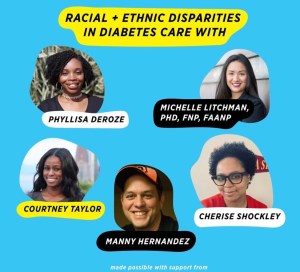
While not part of EASD, Beyond Type 1 is hosting the next in their Summer Sessions and this week it’s focusing on racial and ethnic disparities in diabetes care. There is an absolutely stellar line up in this webinar. Please do follow along if you can – this event will also be via Facebook Live over at Beyond Type 1, and is on Wednesday 8pm ET, which is Thursday 10am AEST.
DISCLOSURES
- I am ad advisor to the #dedoc° voices program. I do not receive any payment for this role.
- I am speaking at the Solvable Problems in Diabetes Community Focus Sessions. I am not receiving any payment for my involvement. I am a regular contributor to diaTribe, and I am paid for commissioned articles.
- I am on the Leadership Council for Beyond Type 1. I do not receive any payment for this role.





 Diabetogenic