
You are currently browsing the category archive for the ‘Awareness’ category.
For more information (all Australian sites):
Diabetes conferences and scientific meetings in 2020 have looked very different than in previous years. It looked as though we were off to a flying start with a successful ATTD in Spain back in February. But not long after all the attendees returned to their corners of the globe, the world turned upside down and decided that, along with everything else, in-person meetings were done.
Major professional conferences such as those run by ADA, DUK, EASD, ISPAD, ADS & ADEA and IDF have all either happened, or will be happening, virtually, with a Zoom (or other) platform being where we meet, rather than a massive conference centre in a major city.
As ever, I search for a silver lining and if there is one it is this: the pivot to virtual conferences means that some of the main barriers in the way preventing PWD attending diabetes conferences are somewhat reduced. With travel, accommodation and a lot of the other expenses out of the way, it may be easier for advocates who would like to attend to find their way in. Let’s look at that as the disruption we needed to have to get PWD flocking to meetings in droves.
There is still the matter of registration passes, and we know that is not always the easiest thing to overcome. The registration fee is significant, and some conferences only allow HCPs and researchers in. Usually, press passes provide a way to get passed security, but they require letters of assignment (sometimes from diabetes organisations who ask PWD to act as ‘on the ground’ reporters), or other criteria be met. And, of course, there are invitations to attend satellite events extended from device and drug companies to some advocates. While there is often criticism at these methods, they have meant that there are PWD at conferences, many of whom provide information back to the community.
At ATTD, there was a new way in. Advocacy group #dedoc° launched a new program, #dedoc° voices, which you can read all about here. For the pilot of the program in Madrid, the diabetes advocates whose applications were successful had access to all parts of the meeting.
#dedoc° voices is happening again for EASD (coming up next month), and it’s not too late to apply. And as an added bonus, successful applicants will also receive registration to the ISPAD conference in October. ISPAD is the International Society for Pediatric and Adolescent Diabetes, so if you are a parent of a kid with diabetes involved in advocacy and peer support, you may be super keen to attend this one.
To apply, go here. #dedoc° voices is open to PWD now, so if you have always wanted to attend a major diabetes conference, there is nothing stopping you from applying, right now. Any one from anywhere around the world can apply – the only consideration is how you’ll manage time zone horrors if you don’t live in the same zone as the conference. (But please don’t come crying to me about that – I’ve spent the last six months settling in for hour long meetings hosted out of Europe of the US which begin long after sunset and involve perky people just waking up while I yawn and struggle not to fall asleep in my Zoom square!)
What are you waiting for? Apply now and come be a part of one of the biggest diabetes meetings in the world. I promise there will be lots of other PWD there for you to (virtually) meet up, and share ideas with. Come say hi!
Disclosure
I am an advisor to the #dedoc° voices program. I do not receive any payment for this role. 
This was one of the first things I saw when I opened my email this morning: the lead article in the latest edition of The Limbic – ‘Subsidised CGM has not improved outcomes in Australian children with T1D’.
I’m relying on the The Limbic’s commentary as the study is not open access (I have requested a copy from one of the authors), and according to the report, the focus of the study was improvements in A1C and reductions in severe hypoglycaemia.
It will come as no surprise to anyone who has read anything I have written about technology or heard me give one of my many, many talks on user experience that I found this report problematic. Screaming that a well-funded and hard-fought for program, providing much needed diabetes technology to children (and adults) is ‘underwhelming’ does not sit well with me at all, especially when the main way the program’s success has been evaluated is a highly flawed clinical measurement.
When I look at the benefits I list when it comes to using any sort of diabetes tech – or other diabetes management, whether that be a drug, an education program or even peer support – changes to my A1C is far down on the list. I understand that for some people, this is certainly a measure of success, but it is not even close to one of the first things I would consider.
My history of using diabetes technology is long and elaborate. Perhaps one of the best examples of just why A1C gives a very incomplete picture of how I measure success is my initial foray into using an insulin pump. It was almost 20 years ago, and I was only three years into living with diabetes. That story is one that could be used as an example of ‘How NOT to do pump therapy’.
I was educated (and I use that term very loosely) by a rep from the pump company. She talked at me for three hours, pressed buttons, loaded some numbers into the device and then stepped out so a dietitian could teach me all I needed to know about carb counting. She was in the room for forty-five minutes. (For context, this was my introduction to carb counting, because my first dietitian encounters were only about low GI, with a general direction of ‘Eat as much as you want of it as long as it is low GI’).
I was released from the hospital with this new device strapped to me, step by step instructions for how to do a cannula change in three days’ time, and absolutely no idea what I was doing.
But here’s what happened: I could sleep in again. I didn’t need to eat unless I really wanted to; eating by the clock became a thing of the past! I could eat brunch out with friends again, without having already had breakfast at 7am. I ate more of the foods I wanted to and stopped stressing out each time I sat down for a meal. I felt more relaxed. My life felt just a little bit more mine, rather than dictated to my a most unwelcome health condition. And sleep! Did I mention sleeping in?
My A1C was the highest it ever was. By all clinical measures, I was absolutely messing this up. But by my measures – which were based on how I was feeling, how emotionally robust I was, how burnt out I felt, how late I could sleep in on the weekend (I see a theme) – I was ticking every single box.
My endocrinologist told me that I was wasting my money (and his time) being on a pump, and nothing I could do to explain that for the first time in three years I felt like myself. Sure, I knew that I had work to do on my A1C, but I finally felt emotionally resilient enough to do that. He just shook his head and sent me on my way…and was promptly sacked.
(Luckily for me, the story ends well because about eight months later, I came across a woman called Cheryl Steele. Suddenly I could use a pump properly. My A1C came down; my quality of life remained elevated.)
My story is not uncommon. I have spoken with dozens and dozens of people who have benefited from the CGM initiate and overwhelmingly, the stories I hear are people who are grateful for the tech for what it has offered them. Interestingly, we rarely talk about those measures that HCPs and researchers seem to think are the best way to gauge the success of any sort of intervention. They talk about those same things I mentioned earlier. When the CGM initiative was first launched, parents of kids with diabetes told me they had slept for more than three hours at a time at night for the first time in years. They told me how they stopped fearing hypoglycaemia so much, because they were being alerted if their kids glucose levels were trending downwards. They told me that their kids were having sleepovers and heading off to school camp for the first time.
A1C? Maybe we would mention that somewhere down the track, but that wasn’t what got us the most excited. That wasn’t the bit we spoke about when we uttered the words ‘life changing’.
Obviously, research is important. Data is essential. It was data that provided the strong case for Diabetes Australia, JDRF, ADS, ADEA and APEG to advocate for CGM funding as part of the NDSS. But the case that was put forward also included research that looked at QoL, because the organisations know that this matters.
Research that focuses on A1C is always going to be problematic in a health condition that will never only be about that number. It’s problematic for a number of reasons – not just because it gets my shackles up before I’ve had my morning coffee. We know the pot of money that goes to supporting and funding initiatives, such as the one in this study, is very limited. Funding authorities don’t have the nuanced understanding of all the different interventions that need funding, so if a study like this comes across their desk, it could raise red flags.
I am not for a moment saying that this sort of research should not be conducted or that negative results should be buried. What I am saying is that any results need to be flagged as only ever presenting part of the issue as a whole.
I am looking forward to reading the whole study – and truly, I’m hoping that this blustering post is all a waste of time because somewhere in there, I will get to see that the researchers spent a fair bit of effort evaluation QoL as well. I’m hoping that the trumpeting heading from The Limbic is nothing more than their typical sensationalism.
My fear, however, is that there won’t be more, and that once again, PWD will have been reduced to nothing more than a flawed metric that shows only one corner of the picture of our lives with diabetes.
I’ll finish with one final thought. I advocate for PWD’s involvement in every single step of diabetes research (not just as participants of studies), and one of the reasons I do that is because when we are at the table when studies are being first mapped out, we are given the chance to remind those conducting the work that the answers they are seeking are coming from people. Real people who will always be far more than their diabetes. And somehow, that needs to be reflected in the study they are doing. It can be done. Unfortunately, this seems to have missed the mark.
Spend enough time trawling through social media posts with a #DOC somewhere in the hashtag, and it is inevitable that you will see photos of people’s CGM graphs. Often, it’s PWD getting excited at their flat line graphs because they have managed to stay within range for a certain period of time. Or perhaps it’s to show shock and utter disbelief at loop systems doing all the work. It can be because we won’t to show how we have managed to nail the timing and amount of a bolus, and that usually-difficult to manage food nemesis (hello, rice!), completely avoiding a spike. Or, it could be just because we feel like sharing.
I don’t share my graphs a heap these days, but have in the past. It’s a personal decision as to whether we want to share their data online, and if you do, knock yourself out. Your data, your rules! I understand why some feel that it can be considered not especially helpful for others, setting us up to feel we are failing if we compare. But the conversation sharing can generate is really useful for a lot of people.
Every now and then, a non-PWD will share their libre or CGM trace to show that even those with a perfectly working pancreases are subject to glucose fluctuations. This is done with the intention of support and encouragement and to show that flat lines really are unrealistic. While I’m sure that those sharing glucose graphs of people without diabetes is never done with any malice – in fact, completely the opposite – I believe it is nonetheless problematic, and misses the point.
I get it. It’s a noble goal to try to make PWD feel less negative when we are unable to manage a perfectly flat line at 4.0mmol/l for hours on end. And to also understand that’s not how the body actually works, even when everything is doing what it should be doing.
But it is totally redundant. And downright annoying. And also, completely inconsiderate.
I live with diabetes and am fixated on trying to limit the variation of my glucose levels because I have to. PWD are told that keeping those numbers between 4mmol/l and 8 mmol/l is the goal. And we’re told that when we go outside of those numbers – especially when we go beyond the upper limit, all manner of nasty things will happen to us. That’s what was told to me the day I was diagnosed with diabetes, and repeatedly what I have seen since.
Showing me your graph that just happens without any effort on your part is not reassuring. It’s pointless. And somewhat heartless. When your level goes up to 12 because you ate a family block of chocolate, it comes back in-range fairly quickly. And not because you had to do any fancy-pants calculations, or micro (or rage) boluses.
When I eat a block of chocolate, whatever happens next is pretty much 100% due to my efforts. I have done some fancy pants calculations. I have had to bolus – maybe once, most likely a number of times – to get my glucose level back in range. And then I sit there and hope that I haven’t over bolused…
Oh – and when you show me that your glucose levels dipped into the low range or sat there for a while, it doesn’t reassure me or make me feel ‘normal’. Because the difference is that when that happens to me, I am doing all I can to make sure that I am okay, that I don’t pass out, that I don’t overtreat (again!), and that I am safe. And then I get to recover from a hypo hangover – something you are fortunate to never experience.
To be honest, I actually find it completely ironic when it is HCPs sharing their data to make me feel better, and a little thoughtless because the reason that I am in constant pursuit of these straight, tightly-in range lines is because it is HCPs that told me in the first place that is where I must stay to ‘prevent’ all.the.nasty.things.
And finally, when this happens, it centres people without diabetes in a conversation that should very much have the spotlight firmly shone on us. Your glucose level data, and the patterns they make are not like ours. They do not represent the blood, sweat and tears, the emotional turmoil, the frustration, the fear that that is somehow reflected in our data.
Perhaps rather than sharing non-PWD data, instead acknowledge just how difficult it is to do diabetes, and commend people with diabetes for showing up, day after day, to do the best we can – regardless the shape of our CGM graph.
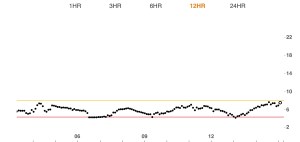
A real-life PWD CGM graph. Mine, from about 10 minutes ago.
This blog has been quiet for the last couple of weeks because, honestly, there is nothing that I had to say that was of any value. Instead, I’ve been listening, learning, talking with friends and family, crying with friends, having difficult conversations with people. And feeling uncomfortable. I’m learning to not fight that discomfort, but instead examine it and work out how I can be involved in change.
Today, I’m dipping a toe back in slowly, and sharing this from New Yorker Cartoons (maybe this blog really is going to become nothing more than an appreciation page of New Yorker Cartoons and Effin’ Birds). This cartoon spoke to me. Because: tone policing.

Recent New Yorker Cartoon by Jason Adam Katzenstein. (Click for source)
I write about being tone policed in the healthcare space, and that is what I am writing about today. It’s happened for as long as I’ve spoken up about my experiences of diabetes and my thoughts and ideas about healthcare. I’ve been called aggressive so many times by HCPs who have not liked it when a mere ‘patient’ has suggested that they are being damaging to people with diabetes in the words they are using to talk to and about us.
The bolshie nuns who taught me at secondary school taught me that when women are accused of being aggressive (or strident), it is usually because we are being assertive. I’ve come to learn that it’s not just women. It’s anyone who has, for too long, been expected to just take what is dished up – and to accept it with gratitude.
Being assertive, being aggressive, being challenging and saying enough is enough should not result in being told to tone down. Or to be excluded from discussions unless we agree to be more moderate. Or more respectful. When that respect is truly a two-way street, then let’s talk about that. But for as long as power imbalances are at play, and HCPs insist on speaking on behalf of us, or only agreeing to speak with us if they like what we are going to say; or when HPCs feature more in diabetes campaigns because they insist on centring themselves rather than actual people living with the condition…well, then we don’t have true two-way respect.
Our diabetes community is not immune from tone policing each other. It’s happened to me. I continue to listen to type 2 diabetes voices because I can never expect to understand what they are experiencing in our community unless they tell me. It may be uncomfortable for me to hear – but that discomfort comes from a place of my complicity. It is not my place to tell them to moderate the way they are speaking about their experiences, just because it makes me feel prickly. But it does happen. In the timeline of my involvement in the diabetes world, I know that when I was first diagnosed, I contributed to the stigma many people with type 2 talk about, and then, as I learnt more, I moved to being quiet about it when I saw and heard it – even though I disagreed with it. Now I am trying to be a better ally and calling it out when I see it. And shutting up and listening and accepting what people with type 2 say.
We learn when we listen. We learn when we are open to accepting that we do not have all the answers. We learn when we stop being so centred on our own experience and try to turn the spotlight onto ourselves when instead we should be shining it on others.
We learn when we don’t tell people how they should feel or how they should speak.
As details of the coronavirus pandemic started to be revealed, the message for people with pre-existing chronic health conditions wasn’t good. It became apparent pretty early on that we were in the ‘at risk’ group. When the ‘only the elderly and those with health conditions need to worry’ lines were trotted out on every forum imaginable, many people with diabetes worried, because we were part of that ‘only’.
And so, people with or affected by diabetes tried to collect the best information about how to keep ourselves safe. One of the most common topics of discussion in diabetes online discussion groups, was about seeing diabetes healthcare professionals. Was it safe? Should we go? What about flu shots? And HbA1c checks? As telehealth services popped up, some were relieved, others were confused. Some people felt they didn’t want to be a burden on their HCP, and indeed the health system that we were told was about to be inundated and overwhelmed. Some diabetes clinics were suspended, only taking appointments for urgent matters.
Last week, Monash University released a report that showed that people with diabetes are not seeing their GP at the same rate as this time last year. The development of diabetes care plans is down my two thirds, and diabetes screening is down by one third.
I was interviewed for a television news story yesterday about these finding. Before agreeing to be the case study, I contacted the reporter to get an idea of just how the story was going to be pitched. ‘We’ll be highlighting the findings of the report, how there are concerns now that there will be an influx of people with diabetes needing to see their doctors in coming months, and how it is understandable that people may be anxious about exposure to coronavirus if they do go to the doctor, and therefore are cancelling, postponing or not making appointments at the moment.’ She paused before finishing with, ‘We’re not blaming people at all.’
They were the magic words I needed to hear and gave her our address, after informing her that the interview would have to take place on the front veranda or in the garden because we were not accepting visitors into our house still.
The under two-minute new story was pretty factual and outlined details of the study. (The grab from me they used had me explaining how I had made the decision to postpone my annual eye screening by a few weeks, rather than the appointments that I had still decided to keep such as my flu jab and telehealth appointments). But overall, it was a good story – factual and definitely not blaming.

Sunday afternoon at the (home) office.
And so, perhaps I was feeling a false sense of safety when I read a newspaper report today that mentioned the study. Speaking about the fallout from people not seeing their GP during the pandemic, a doctor quoted in the story said:
‘The last thing we want is a tsunami of serious health issues and worsening chronic conditions coming after this virus, simply because people have stopped taking care of themselves or consulting their GP.’
I read that, re-read it and then couldn’t get past these nine words:
Simply. Because. People. Have. Stopped. Taking. Care. Of. Themselves.
How could a health professional think this about people living with chronic health conditions at any time, but even more so, how could they think that during the confusion and anxiety of living through a global pandemic where outcomes for those same people are likely to be worse?
People may not be going to see their GP, but it is not in defiance or because they have made the wilful decision to stop taking care of themselves. In fact, I honestly don’t know of anyone who has ever made that decision – pandemic or not.
Delaying my eye appointment isn’t an example of me not looking after myself. It is a reflection of the real anxiety I am feeling about exposure to coronavirus – anxiety that became heightened last week when restrictions were eased, and then only got worse again when I heard the news about deaths of people with diabetes. And I know I am not the only person who is feeling the way I am at this time.
And any other time that I have been accused of ‘not taking care of myself’, I was doing the absolute best I could in that moment, considering all the other things that were going on in my life. And yet, it took me a long time to find a diabetes healthcare professional who acknowledged that when I am not in the right place to be managing my diabetes, we first need to start through those other things first. She never blamed me. She just helped me through.
A health professional making the comment that people not attending appointments are ‘not taking care of themselves’ is actually a much bigger problem than just when looked at in the context of COVID-19. It happens all the time.
Stop blaming people with diabetes. Just stop the blame. Stop blaming people if they don’t get diagnosed early. Stop blaming us if we develop complications. Stop blaming us if we develop complications that didn’t get diagnosed early. Stop blaming us for not caring for ourselves.
But then, I guess, it won’t be quite so easy for HCPs to wash their hands of any responsibility they may have for the health outcomes of people with diabetes if, instead of pointing fingers, they hold a mirror up for a moment.
Today, my social media feeds are full of this screaming headline:
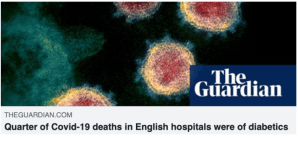
(Click for article)
As soon as I saw this, I threw my phone away from me and put my head back under the doona. Aren’t Fridays meant to be about celebrating a week well done and looking forward to the weekend?
Instead, I woke to far too many notifications about diabetes and death – words I really don’t like to see together, especially not so early in the morning. Fortified with coffee, I took a deep breath and in I went, reading the article from top to bottom.
I’ve had a knot in the pit of my stomach all week. It moved in and made itself comfortable when the Australian PM started talking about easing lockdown restrictions. I’ve spent the last few days trying to work out how I can manage this anxiety in a sensible way, and not do what I really want, which is to build a cellar under our house, stock it with coffee, prosecco and Nutella, and move in there until sometime in 2030.
This article and the subsequent commentary twisted that knot tighter and pushed it in deeper. ‘I live here now,’ it seemed to be saying. And then added, ‘Get better WIFI; it’s patchy in here.’
The fact that the article raises more questions than it actually answers hasn’t helped. More details – details that may help to better understand exactly what is going on – won’t be published until next week. And so, without enough content to provide explanations, advice and information that might help PWD feel that perhaps it’s not all hopeless. Instead, The Guardian offered some throw-away lines about the associations and causes of type 1 and type 2 diabetes:
‘NHS England’s breakdown, published for the first time on Thursday, did not specify how many of the 5,873 diabetics who died had type 1 diabetes, an autoimmune condition not related to lifestyle, and type 2 diabetes, which is closely linked to being overweight. Fuller details will be published in an article in a medical journal next week.’
This just seems like an opportunity for people to appease people with type 1 diabetes, and point the finger and further stigmatise people with type 2 diabetes, instead of acknowledging that people with ALL types of diabetes might possibly find this news confronting. What is the relevance here to being overweight? If there is a correlation, please let us know and does it impact people with type 1 diabetes who are also overweight?
I am not for a moment saying that this sort of information should be hidden away or swept under the carpet. Of course, I want to understand how diabetes and COVID-19 interact. But there has to be a better way to get information to the masses without adding to the anxiety and worry. And definitely in a way that doesn’t sensationalise, point fingers and add to social stigma.
The article goes on to highlight the link between Alzheimer’s disease and deaths due to COVID-19, and as I read the quote from Alzheimer’s Research UK’s director of policy and public affairs, Samantha Benham-Hermetz, I wanted to reach into my MacBook and give her a metaphoric, and therefore socially distant, hug. She said:
‘This shocking news will no doubt bring even more worry and fear to people affected by dementia and their loved ones, during an already challenging time.’
I know that I and so many of my friends living with diabetes, and their loved ones, have been feeling worried and scared since this all started, and this article has the potential to add a lot more. The fact that this response was acknowledged out loud (and I think it’s fair to say that people affected by diabetes would be feeling the same as those affected by dementia) made me feel so grateful and heard.
Statistics are statistics, and data are important; I know that. But sharing data with the masses only works if it is done effectively and communicated in a way that doesn’t leave people feeling hopeless, but rather empowers us to make decisions that contribute to minimising risk.
My heart breaks for my friends with type 2 diabetes, and their families, who not only have to digest this headline and information, but also need to consider how the cavalier and simplistic definition of type 2 diabetes will now be interpreted by the general population who already are so quick to blame and stigmatise.
I live with diabetes, and I understand that I am high risk of complications, and so it seems, death if I get COVID-19. But mostly, more than anything else, I am a person trying to make sense of all of this and stay safe, healthy and sane – just like everyone else.
P.S. Hey – Guardian UK – I fixed this para for you:
‘NHS England’s breakdown, published for the first time on Thursday, did not specify the type of diabetes with which the 5,873 people who died were diagnosed. Fuller details will be published in an article in a medical journal next week.’
One of the things the diabetes community does best is come together in tough times, and this new initiative from JDRF and Beyond Type 1 is a stellar example of how it can be done. JDRF and Beyond Type 1 formed an alliance last year, and have put together a terrific site providing important, up-to-date information and advise about coronavirus and diabetes.
But this is initiative goes way beyond just two diabetes organisations. In fact, over one hundred diabetes organisations, charities, and companies are helping to spread the word and share the information via their networks
Charities and diabetes organisations from Australia, USA, Canada, Italy, Chile, Portugal, Mexico, Bulgaria, Germany, India, Cyprus, New Zealand, Spain and other countries too are represented. I’m thrilled that Diabetes Australia is one of the community partners on the ever-growing list!
International organisations such as Life for a Child, ISPAD, IDF, NCD Alliance as well as industry partners have also rallied together, joining the other groups. This is big. Big! Huge!
The information on this new site is simple and clear. And it’s available in English, Spanish and Portuguese.
Plus, the advice is all practical and sensible. We might, in ordinary times, think that practical and sensible is boring, but I know it’s something I’m craving at the moment. And I’m also craving information that cuts through all the overwhelming noise and tells me exactly what I need to know.
This site does that.
Massive, massive kudos to JDRF and Beyond Type 1 for getting this initiative up and running. And well done to all the organisations who have happily supported and shared it. This isn’t about ownership and needing to be the holders of all information. It’s about ensuring people with diabetes have access to what we need to know, and what can help and support us. That’s only a good thing, right?
Click on the image below to be taken straight to the site. And stay safe. That’s really what we all want and are hoping for.

DISCLOSURE
I am employed by Diabetes Australia. I am on the Beyond Type 1 Leadership Council.
The other day, I went to a local pharmacy to buy some pump lines. There is one pharmacy in my neighbourhood that usually has insulin pump consumables on the shelf, so I don’t need to order them in. I just pop in when it’s time to top up my supplies and get what I need. I asked for a box of the lines I use. ‘There are two on the shelf,’ said the sales assistant. ‘Do you want both? You probably should stock up.’
‘No thanks,’ I said to her. I only ever buy one box at a time, usually when I am down to my last three or four lines. With the new box, I would easily have a six to eight-week supply.
‘Oh,’ I said to her. ‘You really don’t need to encourage people to buy more than their usual order. We don’t have shortages – that has been confirmed by Diabetes Australia and the Department of Health. Suggesting people stockpile is not a good idea at all.’
Are you stockpiling, or thinking about it? If so, I’m ask you to please reconsider.
I get that these are confusing and stressful times. I haven’t seen a roll of loo paper on the shelves at my local Woolies for weeks now. Other pantry staples are in high demand. And since the weekend, fresh fruit and meat sections have been almost stripped bare. Despite being told that we don’t need to panic buy, we’re seeing this behaviour and it is causing a great deal of distress to a huge number of people.
The last thing we need is for there to be the same situation when it comes to diabetes meds and supplies.
Here’s the deal: we are okay. There are no shortages. We don’t need to panic and stress. That has come directly from the Department of Health who has oversight of all drugs and NDSS supplies. It has also been communicated from Diabetes Australia*.
Where things have the potential to go the way of loo paper is if people suddenly start changing their buying behaviours. Then we have problems.
Think about it this way: before coronavirus, when was the last time you couldn’t find loo paper if you needed it? Never, right? And now, because there was some weird idea that toilet rolls were going to run out, people bought packs and packs of it. I know people who have hundreds of rolls of loo paper stocked up in their houses at the moment. I also know people who have been down to their last roll and are desperately trying to find kindly neighbours who will happily and readily spare a square (or two).
This is what happens when people change their buying behaviour and we really don’t want that to happen with diabetes medications and supplies.
WHAT YOU CAN DO
Be sensible! And don’t change from what you usually do.
What is your usual buying pattern? For me, I have always called in my insulin prescription when I open my second to last vial of insulin. That has been my pattern for years.
I buy pump consumables when I am down to the last few of each. A box of lines lasts me around six weeks; cannulas longer because I tend to reuse them a couple of times. I top up blood glucose strips when I’m down to half a box. (A box lasts me forever because I really only use them to calibrate, and I am rather lax at that).
The only, only thing I have a ridiculous stockpile of is lancets. Because: who changes lancets? And the only reason I have that stockpile is because every new meter comes with about ten of them. Plus, I think I still have the same box I bought 22 years ago at diagnosis…
I am making no changes to my buying pattern and behaviour and I would urge everyone to do the same. If people just keep on keeping on, we will not have shortages. If people start to make changes and panic buy, we could be in situation loo paper.
OTHER CONSIDERATIONS
We do have limits on our NDSS usage. I know I rarely think about this, because I never reach mine. I remember needing a special exemption when I was pregnant because I was doing a heap more BGL checks each day, but other than during that time, I have never needed to worry about getting to my limit.
ALL drugs and diabetes supplies have ‘use-by’ dates. The shelf life on some items (such as sensors) is shorter that on others. If you stockpile, there is a good chance that what you have hoarded will be out of date by the time you get through your supply. That will mean that when you eventually go to use them, they are not covered if something goes wrong (such as sensors not lasting their full time etc).
Also, if you reach your limit, that could mean that you are no longer able to access subsidised product, and you may be required to pay the full amount for them. For those of us who remember the days before pump consumables were on the NDSS, it suddenly makes running a pump VERY expensive…
PLEASE THINK OF OTHERS
When I left the second box of lines of the shelf at my pharmacy last week, I did that knowing it was likely that someone else would be in soon after needing the same lines. If you order two or three times more than usual, someone downstream is going to potentially have trouble accessing what they need when they need it.
Some people can only afford their diabetes supplies on pay day, or when they are running really low on supplies. They rely on being able to access things WHEN they need them and cannot stock up beforehand. Please be considerate of people in all situations.
If we all are sensible about this, we can completely avoid supply problems.
WHAT TO DO IF YOU ARE ALREADY STRUGGLING TO GET WHAT YOU NEED
Contact the NDSS (1800 637 700) with every single detail of what is going on in your situation. Provide details of the access point (usually a pharmacy) that has not been able to provide you with what you need. How long has this been the case? What are you trying to purchase? Have you tried somewhere else locally? (Remember that most pharmacies do not keep insulin or NDSS products in stock and they need to be ordered in.)
Also, please, please, please do not engage in online speculation of shortages online. This is what causes panic! If you have a personal experience, contact the NDSS!
TWO FINAL THINGS
- Keep washing your hands!
- IF YOU ARE STOCKPILING LANCETS, STOP IT. STOP IT NOW!! You KNOW you will never use them! And no one else will either, so they will haunt and mock you from your diabetes supplies cupboard/drawer for the rest of your days.
*DISCLOSURE
Yes, I work for Diabetes Australia, however I am not writing this because of that and have not been asked by anyone at Diabetes Australia or the NDSS to write this.
I am writing it because I am a person with diabetes who does not want to find herself struggling to access the meds and supplies that I need to stay alive, nor do I want any of my diabetes brothers or sisters to find themselves in the same situation.
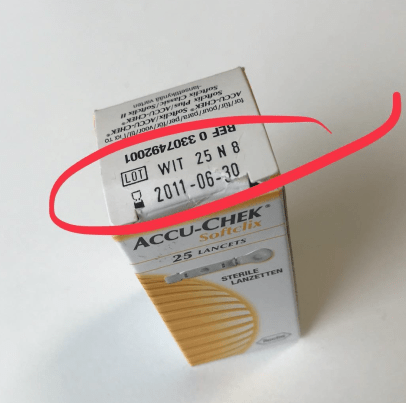
No need to stockpile lancets. Or anything else!





 Diabetogenic