You are currently browsing the category archive for the ‘Real life’ category.
The other day, I was in a beautiful shop looking for a card to attach to the wedding gift we were giving my cousin and his bride when I saw this one:
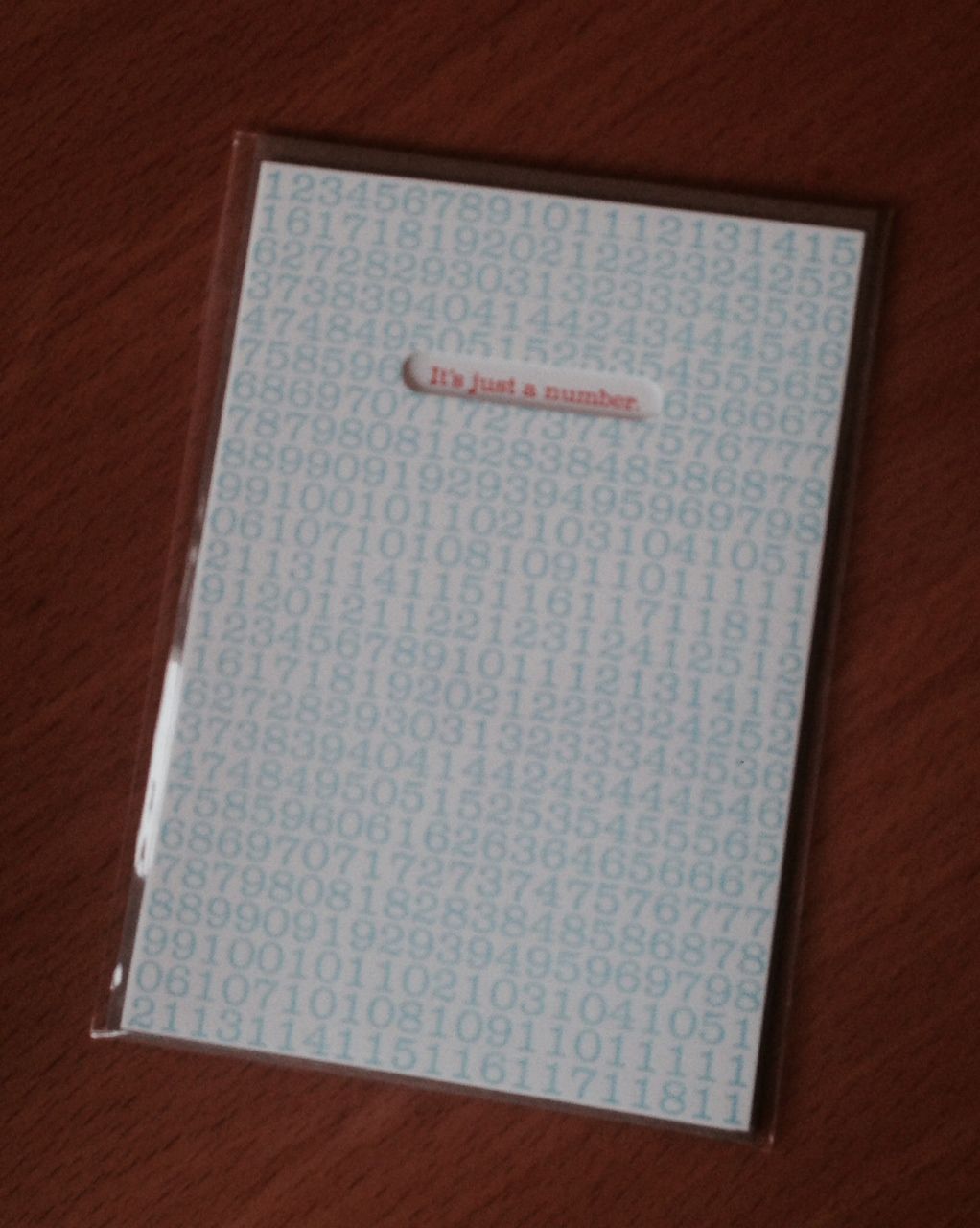
Obviously, not appropriate as a wedding card – the artist had surely designed it with birthdays in mind – but I couldn’t help buy it for myself. Despite being one of the world’s loudest ‘It’s only a number’ advocates when it comes to diabetes numbers, sometimes I need a gentle reminder to not be so hard on myself.
This card is now pinned up in my study at home amongst all the other cards and postcards and photos and drawings and paraphernalia that I have accumulated over the years. And just like those other things, it reminds me to keep things in perspective.
The card is from Eggpress– have a look; they have some gorgeous stuff!
I am all for going with the flow. I’m happy to try out something new, and one of my least favourite things is when I hear people say ‘…but we’ve always done it this way‘. I like visiting new places and being challenged by new adventures.
But equally, I love a bit of routine in my day – especially on weekday mornings and at bedtime.
We have a morning routine that ensures everyone is out of the house dressed, organised, fed and watered and where they need to be. Our daughter heads to school with her lunch packed, notes signed, homework done and packed away, and her hat ready for playtime.
We do this every single Monday to Friday during the school term. Weekends and holidays are all over the place because we rarely need to be somewhere in a clean uniform by 9am.
Bedtime is the same. This is also all about routine. PJs on, teeth cleaned, hair brushed and plaited, and lots and lots of cuddles with last chats about the day. Then into bed for a spot of reading. This is followed by the added-extras. The kidlet tries to bargain another five minutes of reading time, sneaks her light back on when she’s told to sleep, and gets up for a drink of water. She says good night to her puppy about fifteen times and tries to find the cat, coaxing Cherry to sleep on her bed.
It’s the bedtime routine that we do pretty much every night. It works – even with the bargaining and distracting.
Last night’s cuddles were given over the phone because I am away for work overnight in Sydney. It’s the first time in two years that I’ve not done the bedtime routine (apart from the overseas travel and her occasional sleepover with friends) and when I hung up from her, I realised I’d forgotten to ask if there was any last thing she wanted to say to me. I told her I loved her, but I didn’t say ‘I love you mostest.‘ At which point we would both say ‘Not a word!‘ I’m out of practice with the one-night-away-from-each-other routine.
Actually, as it turns out, I’m out of practice with the one whole night away from home thing! I arrived in Sydney without any toothpaste and three strips for my BGL meter. This was remedied with a quick visit to an NDSS pharmacy (for both strips and toothpaste). There were three jelly beans languishing around the bottom of my bag which weren’t going to be particularly helpful if I went low, so I popped into the convenience store across from the hotel to replenish hypo supplies.
I also forgot to pack spare diabetes consumables. Of course, I have my contingency bag that has one spare line and reservoir. But none of these spares helped when I ripped (and I mean ripped – blood everywhere!) my two day old sensor from my skin as I got changed.
Now, this wouldn’t have been a problem if I was not travelling alone. But being on my own without my CGM makes me nervous. A phone call to a friend living in Sydney who made a mercy dash into the city with a spare sensor has made me feel so much more relaxed.
I don’t wear a sensor all the time, but I do make a point to if I am travelling – especially if travelling on my own which I’ve really not done for some time. Ordinarily (at home), if I ripped a sensor out, I wouldn’t bother putting one straight back in. But I knew that I’d have a really restless night (of no sleep) without the security blanket that is an alarming-if-low CGM.
I used to do a lot of overnight travel and I had it just right. I had the packing perfect, I timed line changes just right and I had a mental checklist that I would work through with great skill and precision. I rarely – if ever – forgot anything.
Routine gets a bad wrap because it’s considered boring and unadventurous. And that may be the case. But the stress that comes from being without the necessary diabetes stuff – or having a really lousy hypo that could have been prevented with a CGM – is far more boring. And quite frankly, these are adventures I can do without!
‘What’s that?’
I was standing at the basin in the bathrooms of the restaurant that was the location for my cousin’s wedding and spun around to see who was speaking to me. I looked down and saw a little girl – maybe four – pointing at my chest.
I followed the direction of her outstretched finger and noticed that the tubing from my pump was slightly visible over the top of my dress.
‘Oh, that’s just some tubing from a machine I wear that gives me insulin. I have diabetes.’ I looked at the little girl’s mum and smiled, then changed the subject and told the little girl that she looked as though she was having a wonderful time at the party playing with the other kids. She nodded and said yes, then grabbed her mum’s hand and they walked out of the bathroom.
I stood there, looking at myself critically as I tried to tuck the pump line back into my bra. Stubbornly, it kept jumping out until I pulled my pump out and turned it upside down before depositing it roughly back down the top of my dress.
I kept staring at myself and ran my hand across my stomach where I had spied the slight bump from my CGMS sensor. I felt the sensor and turned slightly to the side so I could see just how obvious the lump was.
I sighed.
I’d felt really good when we’d piled into the car in the morning, all dolled up, looking rather lovely. I thought my dress got the ‘fancy frocks’ directive on the invitation just right! But right then, I felt pretty average. I felt uncomfortable. And I wished that I didn’t have robot parts that struggled to remain contained in the beautiful and very fitted dress I was wearing.
Right then and there, my invisible illness didn’t feel invisible at all. In fact, it felt as though I had a huge flashing neon sign above my head announcing to one and all that I had diabetes.
I took a deep breath, made sure my pump was secure and ran my hand over my sensor again, flattening out my dress around it as best I could. I reapplied some bright red lipstick avoiding looking myself in the eye. I turned away, walked out of the bathroom and joined the wedding. It was a beautiful celebration.
Today, I am so pleased to have Jane Reid guest blog for me. I’ve never met Jane in real life (I hope to one day!), but we are friends on Facebook and seem to have very similar interests. We share a lot of posts about books, libraries, grammar and punctuation. Jane often posts really thoughtful and honest comments to my blog posts and I am always so interested to hear her opinion and experiences. Thanks for sharing today, Jane.
I have lived with T1 for 50 years – well, almost, but who’s counting?
It seems like a long time, but it has whizzed by. From diagnosis, (diabetic ketoacidosis and coma), to now, (pump, some hypo unawareness and some complications), I have lived it all with the help of my parents, my friends, my HCPs, and most of all, my husband who has put up with nearly 43 years of type 1. He told me yesterday that any sort of illness or set back that affects one of us is OUR problem. That is true love.
For the first few years I lived through what I call the ‘dark ages’. Glass syringes, horrible, large needles that went blunt quickly and testing (if you can call it that) with tablets dropped into a mixture of urine and water. If the result was blue, you were probably hypo; if the result was orange-brown you were high. My first specialist-physician (did they even have endos in 1965?) did me the greatest favour he could have. He told me that I would be the person who knew most about my diabetes, and he was correct. Thank you, Tom Robertson!

Jane
When I look back, I now realise that I had gastroparesis from quite early on, although it was only diagnosed ten years ago. Maybe I just didn’t want to know at that time, and I certainly never told any HCPs. I could probably have saved myself a lot of grief if I had.
The complication I really feared was retinopathy. I am a voracious reader, and I had heard gruesome tales of people going blind. Well, it wasn’t as bad as that, and it took over twenty years to develop. The treatment was worse than the fear, and the waiting around to see the ophthalmologist was worse than the treatment. I was treated by an ophthalmologist whom I can only describe as arrogant, and patronising. He did, however, save the majority of my sight, although I have almost no peripheral vision and can no longer drive.
I have had no treatment for over twenty years, so I guess he knew what he was doing. Losing my driving licence was the worst thing for me, although it was not until ten years ago. It has, to a certain extent, taken away my autonomy and independence, although every time I get into the car I know why I no longer drive. Believe me; everyone else on the road is safer because I’m not behind the wheel!
My latest complication is diabetic nephropathy (CKD). I was, to put it mildly, surprised and depressed when I found out. Luckily, the specialist I was sent to in the ACT, put me at ease, told me all about it, and arranged for a kidney biopsy. That showed that the disease was not nearly as bad as first thought, and was only at the very first stage. His comment to me was ‘I’m the same age as you, and I’ll look after you for the next seven years, and then I’ll hand you onto someone else when I retire’. That was reassuring!
I’d prefer not to have type 1 diabetes, but I can live with it. I’ve found out that I can live with complications; sure, I’d prefer not to, but they just become part of life. The worry and the fear are worse than the reality. I just do the best I can. None of us can do more than that.
Jane Reid is a proud member of the Newcastle Knights Rugby League Club and early next year will be eligible to receive a Kellion Medal for living with type 1 diabetes for 50 years – congratulations Jane!
I got a new car a couple of years ago and in pure German auto-engineering genius, there are alerts and alarms and warnings for absolutely everything! I thought that this was wonderful and a sure sign that I was driving the world’s safest car.
Until the alarms started. The car has front, rear and side sensors. This is ostensibly to assist with parking. Now, I’m a great parker – I’ve lived in inner-Melbourne for a long time. I can negotiate a tight parking space incredibly well and love to prove people wrong when they dismissively pronounce ‘You can’t fit in there.’ ‘Oh yes I can, ye of little faith! Just watch me!’
Despite my superior parking abilities, I was more than happy to have a bit of technology to help out and make things even easier. I got used to the lights that flashed like a Christmas tree when I was getting too close to the car in front and the gentle beeping that became more and more persistent as I approached any object.
After two days of driving, I called the dealer, asked to be put through to their service centre, asked to speak to the senior mechanic and said ‘turn those effing sensors off.’ ‘Ha ha’, he laughed in a German accent. ‘Not possible!’
The problem wasn’t that the sensors weren’t helpful when I was parking; actually, they were great. The problem was that they went off when I didn’t need them to.
Sitting at a red light, the front sensors would sound if someone walked too close to the bonnet of the car. If a bike came too close to the rear or side, the sensors would go off too. Why? If I am stationary and someone is walking too close to my car, surely the alarm should be for them, not me.
It turns out, that there was no way that I was going to be able to have the alerts turned off.
My insulin pump has been designed by someone trained in German auto-engineering sadism genius. Again, there are alerts and alarms for everything. Connect it to my CGM and it makes vibrating sounds all the freaking time. The soundtrack to my life is a buzzing, beeping little box.
Now generally, these alarms are great – especially the ones that alert me to rapidly falling BGLs BEFORE it becomes a hypo problem.
But some of the others drive me nuts.
The YOUR BLOOD SUGAR IS ABOVE 14. DO SOMETHING NOW. DO SOMETHING NOW. DO SOMETHING NOW alarm is unhelpful to say the least. This one comes up when I am entering my BGL meter result into my pump to give myself a correction bolus. This frustrates me no end and usually results in me having this conversation with my pump (we will workshop that last statement another day):
Firstly, I know my BGL is above 14, you judgemental little pump, because I just did a BGL check on my meter and it told me (in a significantly LESS judgemental way). I am entering it into your system, you judgemental little pump, so again, I know what the number is. Also, I am plugging it into your correction bolus wizard so you can do some clever maths and tell my how much insulin I need in order to stop being so high. So quite frankly, you and this particular little alert can shove it up your judgemental little pump-ass.
This alarm cannot be turned off.
The problem with all the alarms and alerts (and bells and whistles) is that we stop responding to them. I know that I almost never wake up anymore when my pump alarms. Sometimes, it’s just telling me that the battery is getting low and I should change it. That’s an alarm that can wait until morning, rather than causing pump-alert-anger in others woken by the incessant noise.
I understand that the main reason for these alarms is safety. I really do get that what the pump company (and car designers) are trying to do is alert to and reduce risky situations.
But when there are so many alerts and alarms and warnings, having to deal with the ones that are less important to us means that we can stop paying attention to all of them – including the really useful ones! I know that’s what I do.
In my perfect world, my perfect pump will be completely customisable and only warn me of things I really need to know. Actually, in my perfect world, I won’t have diabetes. But for the sake of this, in my perfect world, I have perfect diabetes that is managed by my perfect pump. Perfect.
Dear almost everyone I know, and many people I’ve not actually met,
Yes, I am aware of the possibility of the worldwide Nutella shortage. Thanks to about a million copies of various links from online publications having been emailed, text messaged, tweeted, Facebooked and snail-mailed to me, I am mindful that due to poor weather in Turkey, there is a hazelnut scarcity and, as a result, I may not be able to replenish my stocks of this life-saving treatment condiment.
Please note that I have made provisions to ensure that I am not disadvantaged during this most difficult period. There is still half a 5kg jar in our kitchen at home to be consumed. I may or may not have just cleared the local Woolies of their supply. And Coles. And IGA. And Mediterranean Wholesalers. And Lygon Street, Carlton.
I have also let myself into my parents’ house and pilfered their supply.

I have put into action a clear directive in my home that the current stockpile is to be used for medicinal purposes only and may not be consumed by anyone unless their BGL is below 3.5mmol/l (as confirmed by a finger-prick check, so none of this ‘I feel hypo’ crap that seems to come out of the mouths of those I live with when they feel like one of my jelly snake hypo stash).
I also have investigated alternative sources of nut-based chocolaty goodness in case I need to substitute the hazelnut delectability of Nutella with an alternative spread. I hope that it does not get to this stage, however I am willing to make sacrifices to ensure I continue to enjoy chocolate-nutty-yumminess on my sourdough.
I thank you all for your concern. This is a period of incredible distress for me, but I hope that with your support and the measures I’ve put in place, I will not have to do without.
Best wishes to you all,
Renza
Friday playlist. Rufus Wainwright (who I adore, but my favourite Wainwright is his dad….more from him in coming weeks).

The day after I was diagnosed with diabetes, I was sent to see a dietitian. It was over 16 years ago and yet I can still remember so much in such clear detail. ‘You need to eat this amount of carbs,’ she told me, throwing down a rubber food model of what was meant to represent mashed potato, but really looked like a fake vomit toy that you might find in a novelty show bag. ‘In a year?’ I asked her incredulously, calculating that there would have been the equivalent of at least four huge potatoes in the model. ‘No. Each meal.’ She said.
This was pre-DAFNE, pre-Lantus and, for me, pre-pump. But despite understanding that I was going to need to make some changes to the way that I was eating, I was also sensible enough to know that there was no way that I could eat that quantity of anything in one sitting.
‘Well, you have to!’ She said. As you can imagine, I really wasn’t enjoying where this consultation was going. ‘You’re taking insulin and you need to eat that much carbohydrate.’
‘Okay. Perhaps I could take less insulin then so I wouldn’t have to eat as much?’ I asked. She looked at me as though I was stupid.
After three years of living with diabetes – trying to manage force-feeding myself enough carbs to not hypo – I started using a pump. There were many reasons behind this and one of them was that I craved the spontaneity and flexibility that I seemed to have lost since being diagnosed. I was sick of having to eat what seemed the equivalent of a loaf of bread every time I sat down to eat. I was sick of having to eat snacks of carbs in between each meal of carbs. And I was sick of drinking corn-flour milk before bed to avoid a crashing hypo, or waking ridiculously high, which was pretty much all that Protophane could manage.
A week or so into using my pump, I remember feeling slightly weird. ‘What’s that feeling? I must be low.’ Nope – BGL check was fine. I couldn’t work out what it was.
And then I realised. It was hunger. I’d not felt hungry for three years because I had been eating to the clock. My body never had time to actually feel like I wanted or needed to eat.
Today, I eat as many or as few carbs as I want. There are days where barely a carb would pass my lips. And then there are days that end with a late night piece of cheesecake and Italian hot chocolate. I simply bolus (or don’t) as required for whatever I feel like eating.
Many people within the diabetes community are huge advocates for low carb eating believing that such diets provide more stable BGLs. I concur with that – the days that I eat sashimi for lunch and a low carb meal for dinner generally result in a level graph on my CGM with few spikes – and fewer dips too. But I am not committed enough to dedicate myself to a purely low carb existence.
Perhaps it’s because I don’t want to simply replace the inflexibility of needing to eat carbs with the inflexibility of never eating carbs. I love food too much to subscribe to any plan that does not allow me to eat whatever I want. Such as doughnuts! Nutella doughnuts need to feature whenever I feel like it. Buon appetite!

Yesterday, I won at diabetes.
My BGLs sat between 4 and 6 all day. Every time I pricked my finger to check, a beautiful number stared at me. My usual clumsiness was absent and my diabetes tasks were fluid and smooth. If I was in a movie, there would have been soft lighting, a very cool soundtrack and possibly glitter. Or fireworks. I love fireworks. And a unicorn. Yes, a unicorn.
But did I enjoy it? Not so much. Because I was incredibly suspicious of it all. I was waiting for the moment where things would turn. Or I refused to believe my BGL meter – I checked four times on three different meters at one point to prove that there was no way I could be sitting at 5.0mmol/l. I was – at least within a 0.2mmol/l margin.
I couldn’t relish the fact that I was feeling ‘even’. I couldn’t just say ‘this is a good diabetes day’.
But it was. When the day came to an end, and I scrolled through my meter readings, it was a good day, based on numbers.
Diabetes has a way of sucking the enjoyment out of life. Those days when we are low, low, low or high, high, high our energy is zapped and we feel just blah (technical, highly-scientific terminology there). But that kind of makes sense. Low blood sugar sends me into a fog. So does persistently high blood sugar. I feel crap. I worry about things. I hate diabetes.
It annoys me that on the days where I’m ‘just right’ and not feeling terrible I can’t (or don’t) just cruise along and feel great.
It was back to reality today. A lovely mid-teens number to wake up with reminded me that yesterday was certainly not typical. I’ve been chasing a low since then, and now, as I sit down to lunch, I’m sorting out my plan of attack to stop the yo-yoing. That right there? That’s the diabetes I’ve come to know and love expect.
How often do you think about diabetes in a day? In an hour?
On those days that I think of diabetes about once an hour (when awake), I know that I’m doing okay. That may seem a lot, but it could be because I’m checking my BGL, bolusing for something I’m eating, doing a line change, thinking about eating something, making something to eat, about to drink a coffee with added sugar. It could be when I am getting dressed in the morning and remembering to reconnect my pump or pulling my pump out from my bra to check my CGM.
Sometimes they are passive thoughts, other times deliberate and actioned.
When this is my activity level, I know that I’m tracking okay.
But when I go for a few (say 4 or 5) hours or even a whole day without thinking about diabetes, I know I’m not tracking quite so well. On those days, I don’t check my BGLs, I don’t check what my CGM is telling me (maybe because I’ve not got a sensor in, maybe because I just can’t be bothered), I may not be eating particularly well or at all, so don’t bother bolusing. Sure, I passively thought about diabetes when I stepped out of the shower that morning and reconnected my pump, and perhaps I blind bolused for the sushi roll that made up lunch, but that could be my entire day of diabetes ‘chores’.
And equally, if I’m thinking about it more than once an hour, I know that something is not quite right. It could be that I’m high and trying to manage that by checking my BGL every 10 minutes hoping for a drop – even a teeny tiny drop – in numbers. At the same time, I’m anxiously trying to walk the tightrope that is enough insulin to bring me down from the hyper ledge, but not rage bolus and send me crashing. I’ll probably be starving, so I’ll be thinking about food and calculating carbs and making deals with myself as to what my BGL has to get to before I can eat.
Or, I could be low and trying to deal with the pounding heart rate that is a doof-doof reminder of my hypo-state. Probably over-eating, I’ll be checking my BGL every five minutes, looking for an upward trend in my numbers.
Either way – high or low – I’ll be thinking food, numbers, hoping for balance, worrying about over-treating, over-medicating.
It’s such a fine line.
Too much…
Too little…
Just right.