
You are currently browsing the category archive for the ‘Real life’ category.
A few years ago, when the Diabetes Australia Language Position Statement was released, I wrote a post about why words used to describe people matter. At the time, I asked people around me to pick a noun or two that they would use to describe me. The polite suggestions made it on the list which looked like this:

These terms are all still correct. Actually, that’s not true. I’d probably replace ‘Twitter novice’ with ‘Twitter enthusiast’, but the rest are all true. Although, having said that, there have been (brief) periods in the intervening years where things have changed a little. I point specifically to the short-lived-but-still-boasted-about walking period. But that’s over now, so what-the-hey! What you see up there still describes me perfectly.
Many of these words are consistent with what I use for my author profile when I write for another site, or speaker bios when I present at conferences. When I have three or four short sentences, I want to convey the things that are the most important in my life – the focus.
Generally, all bios start with the same thing: ‘diabetes consumer advocate’. This is the bit that is particularly relevant to my work and what it is that I am writing or presenting about. But then there are other things that try to give a fuller representation of who I am. My Twitter profile has ‘wearer of stripes’. A recent bio noted my love of New York. Another pointed to my boot collection. In this blog’s bio, the pets get a mention.
And there, along with explaining where I live and with whom, you will find out that I have diabetes, but this is simply wrapped up in the other things that make me part of who I am.
Why is all this important? Because the things that make me who I am shape my thoughts and experiences of living with diabetes. The inner-city dwelling bit is important because when I write about ‘interviewing health care professionals’ it makes sense. I wouldn’t have this privilege if I was living in a remote area serviced by a single GP.
The scarf collector comment above along with the mentions of striped clothing and boots help explain the sartorial importance of diabetes paraphernalia. (Or I could just be shallow – you decide!)
And if I am talking at a conference about how I use social media for peer support, you can understand my love (and use) of Twitter or Facebook as a means of connecting with people.
Telling you that I am a mum to a gorgeous nine year old goes towards explaining the anxiety I feel when thinking of the genetics of type 1 diabetes. And when I write about how worried I am about how diabetes impacts on those around me, you can appreciate why I’d feel that way because I’ve briefly mentioned my immediate and extended family.
Even if we say – and truly want to believe – that diabetes doesn’t shape us, the truth of the matter is – it does. Of course it does. How can a condition that is so present, sends out reminders constantly, requires so much time and attention not feature in who we are? If it were not for diabetes, my life would be significantly different today.
I’ve no idea what I would be doing had my beta cells not taken early retirement, but I doubt it would involve being an advocate for a condition about which I know nothing (which is precisely how much I knew about diabetes before my diagnosis). But here’s the thing. All of those other things – the family, the love of travel, the addiction to coffee, the preoccupation with words and punctuation, being drawn to stripy clothes and loving cupcakes – those things would still be the same. All of them. It’s the diabetes that would be different. It just wouldn’t be there.
Yesterday afternoon, I made a mercy dash to the florist because I felt an overwhelming need to have some white flowers in the house. On our kitchen table, we now how a huge bunch of early cheer sending out the sweet fragrance of the promise of Spring, and in our bedroom is a bunch of pretty, delicate white roses.
Flowers and anniversaries go together, hand in hand – sometimes as a celebration. Other times to commemorate.
The last couple of weeks have been quite difficult for me as it’s the anniversary of my miscarriage. Twelve months ago today was the final in a series of operations I needed – I guess it represents the ‘closure’ of the pregnancy. The actual date of the miscarriage was two weekends ago, and it was a tough day for me. And today is also a difficult one.
Anniversaries – the good and the bad – are important to me and I like to mark them all in some way. Not everyone feels this way, but for me celebrations such as birthdays, wedding anniversaries, diaversaries, are significant and definitely should be recognised. This doesn’t necessary mean with grand gestures, but at least an acknowledgement. I also believe in commemorating the sad occasions.
Perhaps fortunately, it has been a very busy time at work, so I’ve not really been able to think too much about this particular anniversary. But in quiet moments, when I’ve been alone with my thoughts, the memory of what we lost and what could have been has occupied my mind.
This weekend I’m planning to take things a little easy. The flowers in our home will be a reminder not only of what happened, but also how far I’ve come in the last twelve months. Gently, gently, moving forward.
Today is #dblogcheck day. The idea is to ‘check in’ by commenting on any diabetes blogs you read today. The hope is that by commenting, you’ll be reminding people that they are not alone. I love this idea! Thanks to Christopher Snider (@iam_spartacus). Look for the #dblogcheck tag to find some #dblogs to read. You may find a new favourite!
I make dozens of diabetes choices every day. From what I will eat, to the dose of insulin I take, to how many times I’ll check my BGLs, these are all choices that I make. Sometimes they are made with careful consideration. Other times, I barely give them a second thought.
But regardless, I stand by these decisions and their consequences – good or bad. Generally, the outcomes impact me and me alone: too little insulin, a BGL of 20mmol/l means I guzzle water, rage bolus and feel like crap until I get back in range; too much insulin, a low that is usually managed with a juice or a handful of jelly beans. Most of time, I manage to ‘fix the damage’ and move on without involvement of anyone else.
But sometimes, that’s not how it pans out.
One of the burdens of diabetes is how it affects those around us. On the rare occasions I need assistance I experience incredible guilt afterwards. I know I shouldn’t, and I’m never made to feel guilty, but it is how I feel.
I have never heard anyone in my family complain or even comment on their role in my diabetes. I know that doesn’t mean that they don’t get pissed off by my AWOL beta cells (being woken up in the middle of the night and then having to get up to grab me a juice or put on some toast is, whilst a rare occurrence, certainly not fun for my husband), but I never hear complaining.
To date, my daughter’s involvement has been minimal. There have been a handful of times, perhaps, when I have asked her to grab me my lolly jar. For her, I suspect the biggest inconvenience is having to explain to her friends why said lolly jar is out of bounds for their grabby (grubby?) fingers, and the times where we’ve had to briefly postpone whatever we’re about to do as I wait for my BGLs to come up to a safer level.
Last year, when a friend needed to call an ambulance after a particularly nasty hypo, I worried for a long time (I still do!) about how she would feel about my diabetes. For a while, it felt that she was watching me very closely every time we went out to make sure that I wasn’t going to collapse on her again.
I can’t imagine how scary it would have been to have me suddenly pass out. She did such a sterling job of managing this situation (right down to warning the paramedic that I was going to be seriously annoyed when I ‘came to’ and start asking a million questions), and I couldn’t have asked for a more sensible or thoughtful person to have around for this. But still – I worry that it was a choice I made (or didn’t) that resulted in her having to take an active role in dealing with my diabetes. She didn’t sign up for that when she and I became friends back when we were teenagers.
While I try to make choices that yield results that impact me and me alone, I think a lot about how others feel about my diabetes. What I want those around me to know is that I’m sorry when they have to get involved. But also, I’m so grateful.
I haven’t quit sugar and I’ve no intention of doing so because Nutella, doughnuts and the red velvet Tim Tams* that Adriano Zumbo has just developed with Arnott’s. Also, candied bacon.
So looking at the I Quit Sugar Facebook page the other day was a pointless exercise that was only ever going to end in stress eating (of foods mentioned above). And the development of a twitch in my right eye.
The I Quit Sugar (IQS) Facebook admins had caught on that last week was National Diabetes Week and were outraged – OUTRAGED – to discover that on some diabetes sites were recipes containing sugar. Because, you know, sugar causes diabetes. Right?
Wrong!
But let’s not allow facts, a broad evidence-base, and the medical fraternity to get in the way of a good bit of ignorance, will we?
I know; I should have walked away. Shoulda, coulda, woulda. Instead, I read. And read and read and read post after post after post of ignorance and judgement and lies.
Whilst for the most part I sat there shaking my head at the witlessness of the posts, it was when people started outright lying that I decided that I had to write something. One woman claimed that the Australian Paediatric Endocrine Group (APEG) is run by ‘pharmacy companies that make insulin’. She went on to say that JDRF is ‘owned and run by pharmacy companies with an interest in insulin’.
Both these statements are complete lies. The APEG Council is made up of very highly regarded healthcare professionals. The current President of APEG is Professor Fergus Cameron who is the head of Diabetes Services at the Royal Children’s Hospital in Melbourne.
JDRF is a global not-for-profit, raising much-needed funds which go towards research that is looking to find a cure for, and improve management of type 1 diabetes. Run by pharmacy companies? I don’t think so.
The conspiracy theorists on the IQS bandwagon remind me of the anti-vax brigade. The ridiculous claims that the entire medical establishment is simply trying to keep people unwell and feed the pockets of Big Pharma is offensive. The only difference between the two is that the anti-vaxxers are stupid and dangerous. The IQS zealots are just plain stupid.
But here’s the other thing that I find so offensive about so many of the posts from proponents of IQS – the judgement. One woman (in a comment that has now been removed) said she’d like to ‘slap diabetics who eat sugar’.
Quitting sugar is a personal choice – a lifestyle choice, if you will. In exactly the same way that doing yoga, going for a run, not eating red meat or only wearing stripes is a personal choice. These things may work for you, which is terrific, but judging someone because they still want to eat sugar – or wear polka dots – is crazy.
The foolish conspiracies on the IQS website say the advice provided by the medical establishment and health organisations should be questioned and ignored.
But, as I posted in my comment on their FB page, whose integrity should we really be questioning here? Researchers and healthcare professionals with years of training in their specialised field? Organisations supporting people, and raising money to help researchers further developments in living well with these conditions? Or money-making endeavours based on pseudo-science with no evidence-base run by a celebrity?
DISCLAIMERS
*I am so not sponsored by Arnott’s, but seriously – these are amazing! And perfect for an intended week of eating only red food to coincide with a new-found addiction to True Blood!
Professor Fergus Cameron is a member of the Medical Advisory Committee of the Diabetes Camps Victoria Program at Diabetes Australia – Vic. I am employed by DA-Vic and the chair of this committee.
On the sixth day of #NDW14, I’m looking beyond our shores and remembering that we really are lucky here when it comes to accessing diabetes supplies.
Last night, I attended a special screening of Sweet 16, a movie about a young Canadian woman with type 1 diabetes. The documentary film tells the story of Katia Shannon, who shares her story of life with diabetes.
Featured in the film is Insulin for Life, a not-for-profit organisation founded (and based) here in Australia. There are affiliates all over the world. I’ve known about Insulin for Life (IFL) for a long time and have been aware of the incredibly important work undertaken by this organisation. The objectives of IFL include obtaining diabetes supplies (insulin, syringes, BGL meters and strips) and then donating and distributing them to diabetes associations in countries in need. They also look at developing and implementing sustainable improvements in accessing diabetes supplies in countries in need.
The film last night highlighted a kids’ camp program in Ecuador. The average monthly income for many families in this South American country is $250 and a month’s supply of insulin is $200. Do the maths and think about that for a minute. You can see how dire this situation is for many families. Without IFL, many people in Ecuador would not be able to access insulin to treat their type 1 diabetes. This is just one country supported by IFL.
Today, with National Diabetes Week drawing to a close, have a look at the Insulin for Life website and see some of the amazing and much-needed work they are doing. Supporting them is good karma.
It’s Friday after a very long week, but’s not over yet? So, to keep up our energy, here’s some Georgie Fame to get you (go-go) dancing. Yeh Yeh!
1.13am – Heart thumping at what feels like 1,000,000 beats per minute
1.15am – 1.8mmol/l
1.15am – 10 jelly beans
1.20am – 1.8mmol/l
1.22am – 200ml pineapple juice
1.28am – 1.7mmol/l
1.28am – 10 jelly beans
1.28am – 1 pump’s basal rates reduced to -100% for 30 minutes
1.35am – 1.8mmol/l
1.39am – 1 piece of toast with 2 tablespoons of Nutella
1.45am – 1.8mmol/l
1.45am – 30 minutes under 2.0mmol/l
1.50am – 2 mandarins
1.55am – 1.9mmol/l
2.05am – 1.9mmol/l
2.05am – 5 jelly snakes
2.14am – 1.9mmol/l
2.15am – 60 minutes under 2.0mmol/l
2.15am – 200ml pineapple juice
2.29am – 2.0mmol/l
2.30am – 1 high 5 for hitting 2.0mmol/l
2.42am – 2.0mmol/l
2.55am – 2.0mmol/l
2.55am – 1 fridge raid resulting in 1 small tub peaches and 1 small tub yoghurt
3.13am – 1.8mmol/l
3.13am – awake dealing with this low for 120 minutes
3.13am – 5 very loud curse words beginning with f
3.15am – 20 jelly beans
3.22am – 2.3mmol/l
3.34am – 2.9mmol/l
3.48am – 3.2mmol/l
3.48am – first time in 2 hours and 33 minutes I’ve been above 3mmol/l
3.59am – 3.8mmol/l
3.59am – 1 deep sigh of relief
4.08am – start counting sheep. 1….2….3….4….
4.35am – 1 person with diabetes, wide awake, unable to sleep
Sometimes, it actually is all about numbers….
Last night I was completing an online survey about wellbeing and came to the questions that asked about my health – specifically did I feel healthy?
The answer was yes, I do feel healthy. The only time I don’t is when I am dealing with a cold or virus of some description. Then I generally feel like crap and whinge a lot.
But I do have diabetes – a chronic health condition. Yet I’ve never thought that diabetes makes me unhealthy. Does the simple fact that my beta cells have been AWOL for over 16 years now mean that I am not ‘in the pink’?
To me, health has always been about more than those nonoperational beta cells? Surely that negative gets over-ridden, or at least balanced out, by the many positives in my life.
It had me thinking about health and happiness. I wondered how healthy we can be when we are feeling unhappy. I know that in times when happiness has seemed an abstract concept, I’ve not felt healthy. But this rarely has anything to do with diabetes. My diabetes numbers can look fine, but overall, I don’t feel great, perhaps because I am ‘not looking after myself’ and eating a well-balanced diet (or not eating at all). Perhaps because I just shrink away and don’t surround myself with the things that contribute to my happiness.
The next section of the survey focussed on happiness. Did I feel happy?
My answer to that question at that very moment was also yes. I was in our warm home, dinner was about to be served up to me and I could hear the kidlet in the other room playing with the cat – of course I was happy (the cat? Maybe not so happy as she was being killed with love and kindness)! I was then asked to list the things that contribute to my happiness. That was easy.
I have a family that brings me great pleasure. My husband and daughter as my immediate family, and my (rather huge) extended family of parents, sister, in-laws, cousins, aunts and uncles may be crazy and loud (and at times frustrating) but generally are fun to be around. There is a lot of laughter and isn’t that good for the soul and our health?
I have friends here and abroad who I love. They provide much support, joy and fun.
And I have a job that is rewarding and enjoyable and one for which I feel incredible passion. I feel very fortunate that my nine-to-five isn’t mundane or boring or devoid of any real interest.
I am very lucky to be able to regularly do things that I enjoy – I see a lot of movies and live music and sit in cafés and bake and cook and feed friends and travel and read.
These things contribute to my happiness. And contribute to my sense of wellbeing. Which contribute to my feelings of health.
I do believe that there is an inextricable link between happiness and healthiness. It’s tangled and can be messy. Perhaps happiness also contributes to emotional wellbeing and that leads to good health. I don’t know the answers here. All I know is that I answered ‘yes’ to feeling both happy and healthy. I should feel (and do feel) pretty fortunate for that.
Melbourne is experiencing some very nasty weather today. I’m writing this while sitting in my office eating my lunch and wondering if the roof is about to fly off our building. I’m also expecting the trampoline and television antenna at home to have moved neighbourhoods by the time I get home at the end of the day.
It’s often said that if you don’t like the weather in Melbourne to wait ten minutes and check outside again. It’s true – four seasons in one day is not really all that unusual. The end of a heatwave can see temperatures drop by 20 degrees (Centigrade) in a matter of minutes. Pelting rain can give way to blue skies and sunshine that will result in sunburn.
As a lifelong Melbournian, I’ve learnt to be prepared for all weather contingencies and carry an umbrella, even if my weather app predicts only a 10 per cent chance of rain. Always have an umbrella in the car. Wear layers than can be easily peeled off (or added) as the temperature jumps around. And understand that just because it is sunny this minute, don’t think it will be in half an hour’s time. Because it probably won’t be.
My diabetes contingency purse is the same. It covers a lot of possibilities and emergency situations. There are batteries for my pump, the charger for my meter, a spare cannula and cartridge for my pump, insulin, syringes (in case of pump fail, or if needed to syringe insulin into a cartridge), a five cent coin (new addition!), a spare needle and plunger to refill a cartridge if necessary, a copy of my basal rates (also saved on my iPhone).
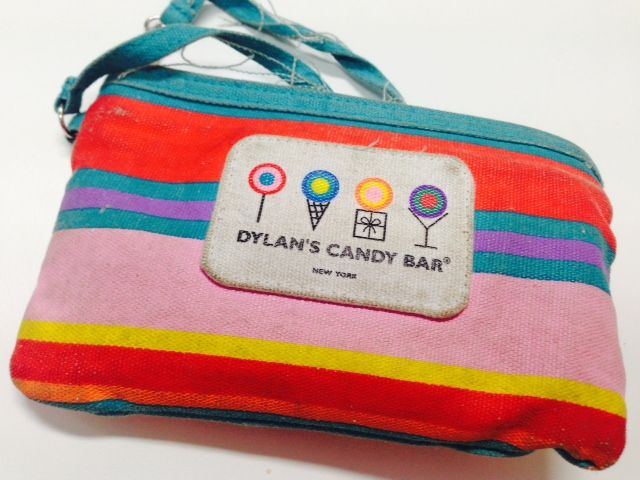 And all of this fits into a small bright purse. From Dylan’s Candy Bar New York.
It’s an insurance policy of sorts because I know that as soon as I leave that bag at home, or fail to replace something I use, I’ll need it. I’ll have ignored the low cartridge warning on my pump and be out of insulin; I’ll catch my pump line on a door handle and rip the cannula clean from my skin; my meter will need recharging.
It’s just like those days when I’ve left my brolly drying out on the porch and forget to pack in back in the car. That’s when, in the ten minute drive from home to work, I watch the skies turn from bright, sparkling blue, to light grey to dark, to gloomy black and watch as the rain starts. And there I am in my car, cursing that I forgot the contingency plan. I should know better. Sometimes, I fear I’ll never learn.
Do you ever play that game where you change one word in a song or movie title for another? One that I find fun is changing the word ‘love’ for ‘lunch’ in old jazz standards: Love Lunch for Sale; What is This Things Called Love Lunch; I’ve Got My Love Lunch to Keep Me Warm. You get the idea. (Or for another idea, check out this Harry Potter-inspired fun!)
Today, when this ‘inspirational quote; came up in in my Facebook feed, I replaced the word ‘life’ with ‘diabetes.

I think perhaps it translates quite well. I am certain that diabetes hasn’t gotten easier for me. I’m sixteen years in – still a baby, when I think of the Kellion medallists I met recently – but even though I know a hell of a lot more about diabetes today than when I was first diagnosed, it’s not easier and it’s certainly not more forgiving. In fact, each year as I tick off another diaversary, I worry more and more about complications. Hypos have become less predictable. I still second guess myself; something that I hoped I would not do as I gained the wisdom I expected would come with diabetes longevity. I’m still waiting….
As for getting stronger and more resilient, I know that definitely is true. I’ve found that I can build up my resilience stores – it helps when things are going well and I feel that I’m top of everything.
And the strength I have found to deal with some terrible situations has surprised me. At moments where I have thought that I was beaten and broken, from somewhere I have found the strength survive. And often even thrive.
I am definitely a stronger person overall because of my diabetes. Whilst diabetes has been fairly gentle to me overall, it has certainly blindsided me at times. But despite that, I’ve coped.
I think living with diabetes means we just have to be resilient – it isn’t a choice. Giving up isn’t an option when it comes to this relentless condition.
It’s Friday! Here’s the wonderful John Pizzarelli singing ‘I like Jersey Best’.
Do a Google search of the term ‘empowered patient’ and you will be inundated with thousands and thousands of links defining the empowered patient, instructing how to be an empowered patient or advising how to deal with an empowered patient (run for the hills and refer them on to another HCP). Health conferences have sessions dedicated to patient empowerment, there are countless social media sites and blogs on the topic, and there are many journal articles – written from the perspective of both the patient and HCPs about what patient empowerment means in healthcare. It could be considered a buzz term, even though it’s been around for some time.
Health organisations for conditions from diabetes to Sjögren’s syndrome(look it up!) dedicate pages of their websites, events and resources to guiding people to become empowered and ‘own’ their condition. It’s not a new thing, and while embraced my many, is still treated with some scepticism and nervousness by some and dismissed by others.
I am what I (and most) would call an ‘empowered patient’. Whilst, I acknowledge that the term is widely understood, I’m not sure that it really is a term with which I’m comfortable. Perhaps because the empowered patient can be considered difficult and annoying – a know-it-all who is there to try to take over the expertise of their HCP. That’s absolutely not what I am trying to do with my healthcare. When it comes to diabetes, I am the first to say I know nothing about diabetes – that’s why I see an incredible endo. But MY diabetes? I am the Universe’s leading expert in that!
For me, being an empowered patient simply means that I am in the driving seat as well as being navigator of my health issues– primarily diabetes, but also other things as well. (Last year, I demanded that I have a D&C following a miscarriage despite the OB wanting to just ‘wait and see’. Waiting and seeing for me would involve horrible pain; excessive bleeding and dealing with the miscarriage whilst on a long haul flight back home from NYC. Previous experience told me that. So I made sure that my wishes were not only known, but also carried out.)
In sixteen years managing diabetes there have been very few instances where I have blindly followed medical advice without asking questions, weighing up all possibilities and talking with others about their experiences.
But I wonder how much being empowered about my health condition and active in decision making is simply because that’s the sort of person I am. When planning for anything, I am organised and informed. I seek out the right people to speak with, I consider options, I ask a lot of questions. I make decisions based on what I have learnt and what I think will be best for me. Whether it is planning a holiday, choosing a contractor or looking after my health, I empower, educate myself. It’s my personality; it’s how I roll.
So does it mean that people who are not naturally like this miss out on the choices and options afforded to people who seek them? Does it mean that if someone is unable to empower themselves (perhaps because of language or cultural barriers, their personality or a lack of understanding of, or an inability to navigate the system) they wind up with substandard care?
Being an empowered patient isn’t at the expense of the expertise and knowledge of the HCP experts we’re working with. It helps form a partnership. I honestly do believe that it is because of our empowerment – our demands and expectations – that we receive better care, better options and, possible, achieve better outcomes. We make our HCPs accountable and answerable, but more than that, we make ourselves accountable and answerable. Sharing in the decision making means we also have to take responsibility when a medical treatment doesn’t necessarily work out the way we hoped. But I’m willing to take on that responsibility.





