
You are currently browsing the category archive for the ‘Real life’ category.
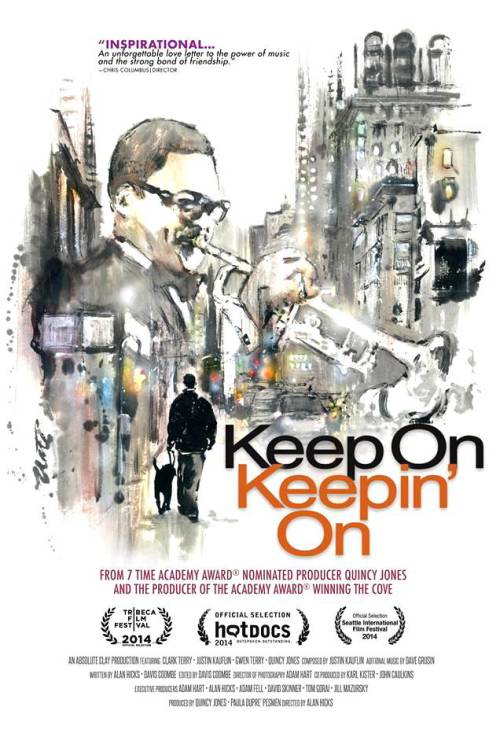
 Last night, my husband and I saw a documentary about jazz great, Clark Terry. The fim is called Keep on Keepin’ On and I would urge you to see it if you can. Terry, a trumpeter from Arkansas, played with jazz legends including Dizzy Gillespie and Count Basie and influenced other jazz greats such as Miles Davis and Quincy Jones. He has been a prominent educator and a presence in the jazz scene since the 1930s. Just this week, Wynton Marsalis paid tribute to Terry in this beautiful post on his Facebook page.
I knew very little about Terry before going in to see the movie, but I was briefed on a few key highlights of his career and some detailed anecdotes as well. (This is what happens when married to a musician with an encyclopaedic memory.)
What I didn’t know going into the movie that Clark Terry has diabetes. I am not sure what type – no specific mention was made in the movie – however his wife Gwen said that he had lived with diabetes for over 60 years. I wanted to stand and applaud at that point, but figured the Cinema Nova movie-going crowd would not appreciate, nor understand, the ovation.
The documentary was gorgeous and showed Terry’s talent and generous spirit. A significant part of the film followed one of Terry’ students, a young pianist, Justin Kauflin. Kauflin obviously has a great deal of admiration and respect for Terry, but that was returned in spades by Terry himself. And one of the things that connected the two – apart from the music – was they are both vision impaired – Kauflin is blind due to a rare eye disease and Terry has significant vision loss due to his diabetes.
The film was mostly focused on the last four years, although there were lots of incredibly flashbacks of Terry’s impressive career (including this – you have to watch this!). In recent years, Terry’s health has declined and recently, he had both legs amputated below the knee due to wounds in his feet that would not heal – of course, this is a complication of diabetes.
I thoroughly enjoyed the documentary, but there were times I was in tears and found it really difficult to watch. I love the way that diabetes was portrayed in the film – it was not sensationalised at all. But it was still tough to watch.
Seeing diabetes complications playing out in someone’s life is a difficult thing. I cried when he was given the news that the treatment he had been undergoing to treat the wound in his foot had not worked and the only option remaining was amputation. The same thing happened with his other foot. I cried harder when he was telling his wife just how much pain he was in. But mostly, I cried when he said he wanted the surgery to work. His determination was startling to me – he just refused to give up because he feels he still has so much to give – so much to offer young musicians.
When we left the movie, I said to my husband that there were parts that were really tough for me. But he reminded me that Terry has lived with diabetes for 60 years. That’s a long time. A long, long time.
Clark Terry turns 94 on Sunday. His contribution to jazz music is clearly significant. He is recognised as a pioneer and has appeared on over 900 recordings. He did this all with diabetes. And although he no longer performs, clearly he is continuing to make a difference in his chosen field. Diabetes hasn’t stopped him.
Pretty much anytime I see a movie at Nova, I head across the road to Readings – often to buy the movie’s soundtrack! But last night I was looking at their Christmas music CDs. I really wanted the Neil Diamond album (most obviously called ‘A Cherry Cherry Christmas’) but was outvoted by those with taste. Vince Guaraldi’s ‘A Charlie Brown Christmas’ won out. My favourite tune on the album is not a Christmas song at all, but it is fun and joyful and I love it! Here’s Linus and Lucy.
I’ve been thinking a lot about diabetes burnout lately. A lot.
I have been burnt out for a long time now – it’s been 18 months. I can see how it started – I know the trigger. I miscarried in terrible circumstances and, after the constant monitoring and intense management that comes with trying to get pregnant and then conceiving, losing the baby allowed me to ‘take a break’.
I’ve not come back from that break.
My question is this: When does it stop being ‘diabetes burnout’ and become something more? And what is the ‘more’?
We use the term burnout so much in diabetes; I feel that I’ve become a little desensitised. It’s the norm – most people go through periods where they are so unmotivated that they can’t deal with their diabetes, or pay less attention than they typically would. But how long is ‘normal’? How long can we go on like this?
My burnout is scaring me because it has been going on for so long. I fear I’ll never get my mojo back and actually get to a point where I am able to care for my diabetes in a capable way.
I go through periods of so few BGL tests that my meter resets itself. I have not seen my endo for far too long and I’m way behind in my complications screening. The only thing I am up to date with is eye screening because I had cataract surgery in the last twelve months.
A button on my pump has been playing up for over 3 months – half the time taking three or four attempts to get it to work – and instead of getting straight on the phone to the company’s customer service team and organising a replacement, I let it slide until Monday, when I realised that next week I am getting on a plane and going away for 6 weeks and if I don’t get it sorted I’ll end up with a dead pump while overseas.
I’m taking my insulin, although haven’t basal tested for a long while and know that the rates need adjusting. I ‘blind bolus’ a lot of the time. Wearing a CGM is useful because it gives me an idea of my glucose levels, but I don’t actually do anything constructive with the data I am receiving.
I keep in touch with the online community which is my link to seeing and hearing how others are coping. While I don’t participate in every week’s OzDOC chat, when I do get there I feel supported and know that I have people to turn to if I need them. I guess I’m not completely disengaged.
A nasty hypo often gives me a shock and I get a few days of decent and frequent monitoring out of it, but this is short-lived and I fall back into minimal self-care pretty quickly.
And I feel totally and completely shit about the whole thing. And guilty. Of course I feel guilty.
In a couple of years of some pretty difficult stuff, diabetes is the thing that I can let go of. At least, I feel I can. I mean, I can’t stop being a mum. I can’t stop being a wife, daughter, sister, friend. I can’t stop coming to work. I can’t stop doing the things I need to do to be a functioning human. But I can stop with the self-care.
And because I am an idiot, or in denial, or just plain over it, I can’t see just how short-sighted this thinking is. I may be getting through the day and doing all those things that I tell myself I can’t stop doing. But how is all that going to work if something actually does happen as a result of my minimal self-care?
I honestly don’t know where to go from here. I feel paralysed and unable to make decisions that I know may help me start with some baby steps to get back on track. Is it a matter of re-engaging with my HCPs and talking to them for strategies? Do I try to set myself tiny goals, like a morning BGL check each day – or even every second day – that is achievable and will start to give me some data to work with? Do I go back to seeing a psychologist again and discuss ways to get back on track?
I don’t know.
It all seems too exhausting. It all seems too damn hard.
Is this burnout? Or is it something more?
I really don’t know.
This isn’t really a Christmas song, but I still think it’s a good song for this time of year. The wonderfully gorgeous Joni Mitchell and River.
‘Okay, so I’ll deal with the diabetic who’s just been brought in. She’s been in here four times in the last couple of months. Completely non-compliant.’
Whoa!
I was walking through the rabbit-warren-like corridors of the Epworth Hospital and passed a nurses’ station at the exact moment those words were spoken, stopping me dead in my tracks. If I was in a Warner Bros cartoon, there would have been a dust and smoke cloud around me as I screeched to a halt.
‘Move on, Renz,’ said the first voice in my head.
‘Not freaking likely,’ said the louder voice.
I turned to the nurses who hadn’t noticed me yet.
‘Hi,’ I said. I was trying for sweet and polite, but could already hear the patronising tone in my voice.
They turned and looked at me.
‘Um. I just wanted to say a couple of things. Calling someone a ‘diabetic’ isn’t helpful for anyone. It labels them as their condition and I’m pretty sure that the person you are referring to is a lot more than her insulin problems. Secondly, non-compliant is a really nasty term. I’m guessing that you’ve no idea what else is going on in her life – I have no idea either – but I am pretty sure that there is a reason that she is not managing her diabetes as well as she’d probably be hoping to. Non-compliant suggests that it is a deliberate ploy to make herself unwell – which it may be and if that is the case, then that is something that needs to be addressed.’
At this point, the nurses were just looking at me with a mix of surprise, suspicion, annoyance and interest.
‘Also, to be compliant means following a defined set of rules or guidelines. Diabetes has a funny way of mocking such an idea. The rules keep changing – without notice.
‘Now, I am hoping that you wouldn’t use this language around the person you’ve been referring to when you are actually in the same room as them, but here’s the thing. You’re saying those words now, and that means that somewhere deep inside (or, probably just on the surface) that’s how you really feel.
‘No one wants to have diabetes. No one wants to be in hospital. No one wants to be so overwhelmed by diabetes that they don’t – for whatever reason – manage their condition the best way possible. But sometimes, it gets like that. The never-ending relentlessness of diabetes can be so debilitating that all self-care stops. And then, sometimes, you wind up in hospital. Four times in a month, sometimes.
‘I have diabetes. I’ve been that person you are speaking about. But I wasn’t being non-compliant. I just couldn’t cope. And I felt really bad and guilty that I couldn’t cope. So on top of feeling crap about my diabetes, I also felt crap about not looking after my diabetes.
‘So. Maybe think about what else is going on in her life. She is more than diabetes (that’s why calling her a ‘diabetic’ isn’t a great idea) and I bet she is going to respond a lot better to some kindness and concern and perhaps a suggestion she see a psychologist if she’s not already doing so. Because the judgement and judgemental language is not helping at all.’
I looked at both nurses. I was still using a really calm, level voice, but I could tell that they were a little annoyed. And more than a little stunned. I smiled at them.
‘Okay then. Bye.’ I started to walk off, but stopped and turned back around. ‘Oh – can you tell me how to get to room 18A please?’
Right-oh. Next up on the holiday playlist is James Taylor. Have Yourself a Merry Little Christmas.
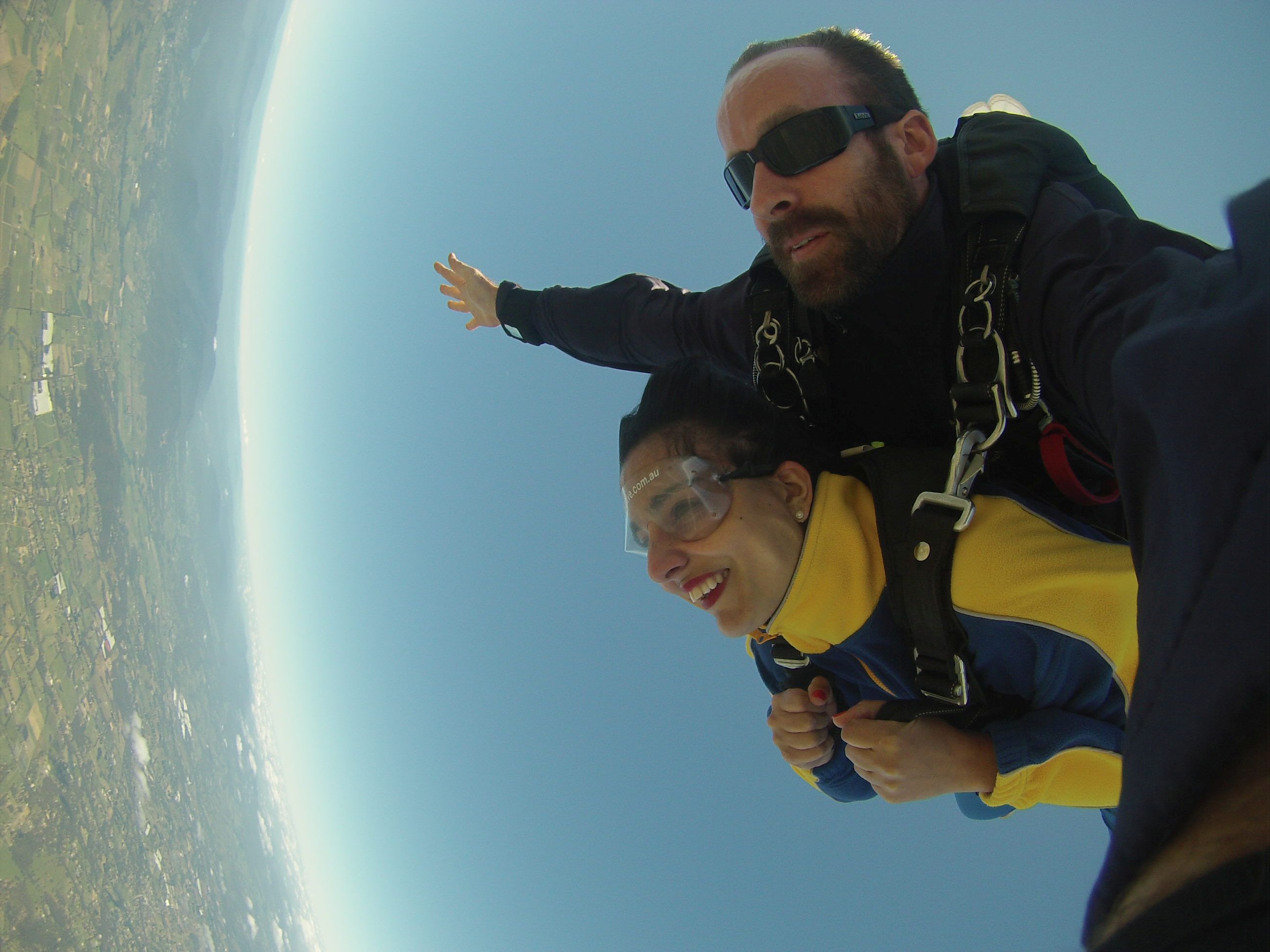
Free falling!
Over the weekend, I jumped out a plane. I didn’t mean to – it was completely unplanned. I had intended to go cherry picking while my husband went sky diving, returning just in time to see and photograph him landing safely. But as he was checking-in for his adventure, the lovely woman passing him some paperwork said to me ‘Do you want to jump?’ and inexplicably, I heard myself saying ‘Yes. Yes I do.’
Wait? What? I was meant to be picking cherries!
Instead, I found myself at 12,000 feet above the ground in a tiny Cessna, strapped to and sitting on the lap of a young man I’d met only half an hour earlier. We traded in clichés: ‘How long have you been doing this for?’ I asked him. ‘Today is my first day,’ he joked (I think…I hope…). ‘Shouldn’t you have bought me dinner first?’ I said as he strapped himself very tightly to me, pressing his body hard up against mine. Oh, how we laughed! Considering he was about to push himself out of a plane with me strapped to his front, we were very relaxed and chilled!
Let me tell you what jumping out of a plane does to ones blood glucose levels.
Just before I got out of the car – where the highest I planned to get for the day was up a ladder in a cherry orchard – my BGL was sitting nicely around 7.0mmol/l. Quite good, I thought, considering I’d eaten a lime brulee doughnut a mere 50 minutes earlier.

Floating….
Just before I climbed into the plane to fly into the sky and then hurtle to the ground, my BGL had crept up to 12mmol/l. I gave myself a correction bolus before disconnecting my pump and leaving it on the ground.
I have no idea how high my BGL got, but I suspect that if I had checked the moment I was sitting half out of the plane, with my legs hanging somewhat lifelessly over the edge of the step, about to tumble into the sky, free-falling to the ground at around 200 kilometres an hour, it would have been stratospheric and my meter would have expoded!
When I got to the ground and finished screaming with absolute, unabashed joy, and jumping up and down, and high-fiving anyone near me, I checked again to see a nice 17.9mmol/l.
I was running on pure adrenaline. I could feel the blood pulsing through my veins, the bright blue sky was vivid, people’s voices were crystal clear. It was as though my senses had all been heightened and I was feeling everything with an increased, crisp intensity. It was like nothing I had ever experienced before.
Apart from being interested in my BGLs, diabetes was completely insignificant in this little adventure. I filled in a few forms, one of them asking the requisite medical questions. I told the woman behind the counter that I have type 1 diabetes and use a pump. ‘Disconnect it and leave it with me,’ she said. ‘Same with your meter. Just check your sugars before you jump.’ I must have looked surprised. ‘A friend has diabetes. She’s jumped heaps of times. But never with her pump – she leaves it with me. They are worth a bit, aren’t they?’

Still floating…
I have never had a burning desire to sky dive; it’s not been on my bucket list – actually, I don’t even really have a bucket list. So perhaps because I hadn’t been thinking about it for years, I didn’t really have any expectations. I know deciding to do it was simply a spur of the moment decision – I wasn’t doing it to prove anything or to feel like a daredevil. It was just something to do because I was there at that moment.
I wasn’t nervous, I wasn’t scared. I just was. I hear all the time that people do things like this to shake up their lives or when they feel they are in some sort of rut. Was that why I did it?
As I was floating back to the ground, I thought about what I had just done and I realised that perhaps I hadn’t jumped to escape any feelings of boredom. I was not doing it to distance myself from feeling I was in a rut. I was jumping, and now floating, towards something. Towards my life. A life where, if I decided to, I would – and could – jump out of a plane. A life where nothing stopped me from doing things out of the ordinary; not even diabetes could stop me!
We headed to a cherry farm later the day. But picking our own fruit sounded like too much work, so we just walked up to the packing shed and bought a couple of kilos to take home with us. ‘I was going to pick my own,’ I said to the woman at the farm. ‘But instead I jumped out of a plane.’
I heard how strange that sounded and laughed, popping a cherry into my mouth. I had just jumped out of a plane. I had just jumped out of a plane.
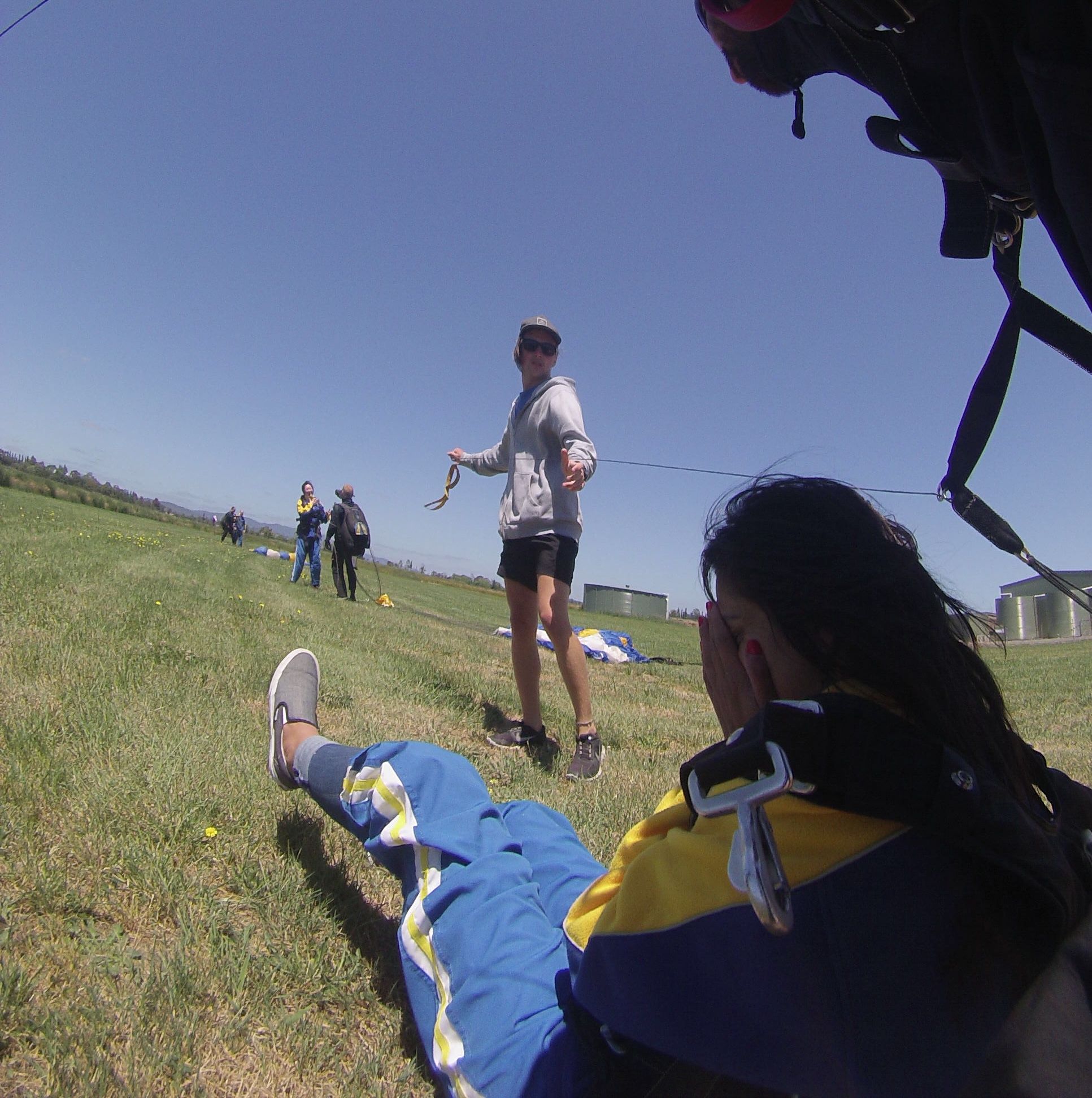
Landed.
If you are looking for somewhere to go cherry picking around the Yarra Valley, I suggest you head to Lanidale Orchard in Wandin. Awesome cherries and friendly staff.
We don’t have Thanksgiving here in Australia. At this time of the year, we’ve just escaped from the craziness that is the Spring Carnival and we’re on the downhill slide to Summer, holidays, Christmas and long, sunny, lazy days.
But my social media feeds have been full of my US friends and their Thanksgiving celebrations, which is always lovely. The lists of what people are thankful for are beautiful and thoughtful and make me smile. I love that people are thankful for such different things. I love that people feel loved and grateful for what they have. I love that people are acknowledging those around them who make their life special.
I started to wonder what happens when we are not thankful for anything. What happens when we can’t – or are unable to – think of anything to be grateful for?
There was a time in my life – a number of years ago – when I was really unwell. I had problems with my stomach and experiencing constant and terrible pain. Eating caused pain. Not eating caused pain. Food started to scare me – which, in itself, terrified me, because my life has always been so focused on food as a means of celebration. Food for me was only ever associated with love and family and friends and sharing and fun times.
Not anymore. Suddenly, it was all about pain.
And at that time, I really struggled to feel thankful for anything.
I started spiralling because when I was unable to feel thankful for anything in my life at that particular moment, I started to struggle seeing anything to feel thankful for in the future. I think that’s the thing that gets you through tough times – the promise of ‘this too shall pass’ and believing that there are better things to come. I didn’t feel that way. I only saw darkness.
There was one night when I was in hospital where I just could not stop crying. The pain was terrible and nothing was helping. The pain killers that had provided some relief stopped working and I was starting to feel that this would never end.
And I wanted it to. I really, really wanted it to.
I felt that at that moment, there was nothing good; nothing worth feeling happy about. But even more, I wasn’t sure that I ever would again. JK Rowling’s Dementors are perhaps a perfect explanation of how I felt. In fact, I remember when I read Harry Potter and the Prisoner of Azkaban, and came across Harry’s first encounter with the terrible creatures that I thought ‘I have felt like that.’
That night remains one of the darkest in my life, and today when I think of it, I still can feel the blackness and the emptiness. I can remember how it enveloped me and threatened to capture me forever.
When I think of it now, the thing that stands out most is how my family must have felt seeing me like that. I feel such guilt that I put them through that – they could see how desperate I was; how awful I felt. And they were unable to do anything to help me. Helplessness when a loved one is going through such a terrible time is awful.
In that moment, when I couldn’t see out of the darkness, I honestly felt that I had nothing to feel grateful or thankful for. Of course, this wasn’t the case. I had so much in my life at that moment, and the promise of so much more.
I’ve never ever felt that way again. That’s not to say there have not been tough times. When I miscarried I was probably the saddest that I ever felt, but I never felt the hopelessness.
I’m not going to write my list of things I’m thankful for – it is a long list! But I will indeed think about it. Today and frequently.
Today’s Friday music was sent to me yesterday by my wonderful friend Biagio who I met in Berlin at the first EASD Bloggers Summit. Biagio, who is involved in the diabetes online community in Italy, is joy personified and knowing him is certainly one thing for which I am very grateful. Enjoy!
I was standing at the counter of a beautiful patisserie. In front of me was a stylish French barista with his attractive French accent wearing his exquisite French clothes. He was trying to upsell me pastries to go with the coffees I’d just ordered.
‘Try the tarte tatin. Or the pain au chocolat. And the éclairs are especially good today.’ His voice sounded a little muffled as if coming through an antique speaker.
I agreed to a couple flaky pastries, one with jewel-like berries, another with apricot jam.
I was about to walk away when he said – ‘this is for you’ and in my hand he placed a log of nougat.
I looked at it and broke a piece off, biting into the soft, gooey, chewy confection. It was sweet. So sweet.
I sat down at a nearby table, waiting for the pastries and coffees to arrive. They were placed in front of us and all I could focus on was eating and tasting the delicious pastry. The jam oozed from one and I scooped it up, licking it from my finger. I greedily picked a strawberry from the other, exposing the frangipane underneath.
I pulled my coffee towards me and added a couple of sugars. Then a couple more. And a couple more. I stirred. And I stirred and I stirred the sugar into the bowl of milky coffee. More sugar. More stirring.
And then.
Then I woke up and realised with great clarity that I was low.
My hypo had infiltrated my dream. I was imagining a feast of carb-laden foods that would, of course, address the low blood sugar muddling my thoughts.
I sat up, adrenaline surging, realising just how low I was and grabbed the jar on my bedside table.
‘Are you okay?’
‘Mmm – just low. I was dreaming about French pasty.’
Diabetes has a way of twisting its way into my subconscious. On nights where my BGL is high and I need to get up overnight to pee, I wake suddenly, remembering dreams of water and pools and swimming in the ocean.
When I am low, I dream of gingerbread houses, fluffy marshmallow clouds and giant bowls of Skittles. Once, I dreamt that I was being chased by a huge jelly snake. Another time, the chair I was sitting on became a cupcake. I woke in the middle of one night confused and disoriented after dreaming I was in Enid Blyton’s Land of Goodies at the top of the Faraway Tree. (Obviously all that climbing had sent my BGLs plummeting!)
Alarms on my pump blend their way into dreams so that suddenly I hear doorbells ring, or metronomes ding. Once, my dream turned frightening – I was running (ha – as if!), running, running during an earthquake. The ‘shaking’ ground was actually my pump vibrating.
The other night, after I ate my jelly beans and felt the adrenaline rush subside, I lay back down and started to fall asleep, willing myself back to the patisserie. And thinking about how when it was morning, heading to a local French bakery for breakfast sounded like a perfect start to the day. It seems that I like to spend my time dreaming just how I like to spend my time awake. Food and coffee. Coffee and food.
A couple of weeks ago, I found a lump in my breast. This was the first time I’d ever noticed anything in my breast – any change or anything to worry about, and spent the next 24 hours catastrophising the situation, expecting the worst.
Of course, it turned out to be nothing, but I had a week of being majorly stressed and anxious about it.
Here is how the whole thing played out.
Friday night – 7.30pm It was a warm night, and I was wearing a loose fitting top. I was on the couch, reading in the quiet house. The only noise was from the sleeping puppy at my feet.I scratched my right side and stopped. I thought I’d felt a lump on the outside of my breast. I flattened my hand and, using the tips of my fingers, prodded gently. There was definitely a lump there. ‘There is a pea-sized lump in my breast,’ I said to myself. I couldn’t stop pressing my skin, trying to get an idea of what was going on under there. How long had it been there for? It wasn’t painful – was that good thing?
I’d never thought of my breasts as being a health issue before. Now it was all I could think about.
Saturday Denial day. Refused to think about it which, of course, meant I thought of nothing else. My left hand was almost permanently attached to the side of my right breast, prodding at the lump, trying to determine if it was the same size as the night before. It was. Sunday I woke up and sprang into action, heading to the Sunday-morning drop-in clinic at my GPs. He wrote me out a referral for a mammogram and (if needed) an ultrasound at a private imaging centre. ‘Make an appointment for as soon as you can,’ he said to me, handing me the referral form. ‘More for your own peace of mind than anything else.’He asked me to make an appointment to see him again on Friday, saying that it may not be necessary and I could cancel if I didn’t need to see him again. I nodded. ‘In most cases, it turns out to be nothing, Renza,’ he said to me, clearly noting the look of unease on my face. ‘Get it checked out. Okay?’
Monday I called the imaging centre and was given a 10.30 appointment that had just come up after someone cancelled.I had no idea what to expect – I’d never had a mammogram before. My mum refers to them as ‘boob sandwiches.’ It was a perfect description! After contorting my body into the most bizarre positions to get the image, the mammogram was over and I was told that I would also need an ultrasound.
‘Is that bad? Why?’ I asked, panicked that it was because there was a problem.
‘You have dense breasts,’ I was told with no further explanation and I was too confused to ask what that meant.
I had an ultrasound and asked the radiologist what she could see knowing full well that you wouldn’t say anything. ‘Your doctor will have the results in the next day or so.’ Was all I could get from her.
Tuesday Public holiday and I wore a gorgeous red spotty dress that fitted tightly across my breasts. I somehow felt the anxiety of the previous few days had lessened. There was nothing more I could do at this stage. I had found a lump. I had seen a doctor. I had been to have scans. Nothing more for me to do. But wait. Wednesday Let’s not discuss the ordeal of actually getting my results from the GP. But at 5.30pm, I had a call from the doctor I’d seen on Saturday who told me that the mammogram and ultrasound ‘looked good’ but I needed to see a breast doctor ASAP – ‘just to close out the investigation,’ he said. ‘I’ll cancel your appointment with me on Friday – I will fax a referral across the specialist now. Here is her number…..’‘It’s okay,’ I related to the people I’d told. ‘Looks good. I just need to get the final okay from a specialist.’
Thursday Called breast doctor. Another cancellation meant I could get in to see her the following afternoon. Friday Appointment with breast doctor. She was absolutely delightful as was the breast nurse who took my medical history. The breast specialist wasn’t really sure why the radiologist referred me to her as the scans clearly showed cysts. ‘Did you tell the radiologist you are in pain?’ She asked me. ‘No – I’m not in any pain,’ I said.She told me that there was nothing to worry about at all. The cysts visible in both my breasts are hormonal and incredibly common. They could disappear. Or they could get bigger and become painful in which case I should call her and she would drain them.
I had questions to ask and she answered them very clearly and gave me a few things to read. ‘You can call me anytime you are concerned.’ She explained that I really don’t need to have a mammogram again until I am fifty and if I was to find any new lumps, I should see my GP and ask that I be referred for an ultrasound. ‘You have dense breasts,’ she told me. Again with the dense breasts. ‘A mammogram can’t see enough’.
‘Thank you for seeing me at such short notice,’ I said, as was leaving. ‘And thank you for being so kind and answering all my questions. You’ve really put me at ease. Don’t take this the wrong way – I hope I don’t have to see you again.’
She let out a loud laugh. ‘I hope so too!’ She said.
That’s how it played out.
But it was interesting to be dealing with a health concern that is outside of my usual area of comfort. I was stressed – really stressed – before each appointment. I had no idea what to expect and I was unsure of what the process would be.
‘Why do you have to see the GP again on Friday?’ my husband asked me at one point during the week.
‘I’m not sure,’ I replied. And I wasn’t. Why would I need to see him again if the scan was all clear? And if it wasn’t clear, surely I’d need to see a specialist.
‘If the scan looks okay, why are you seeing a breast specialist?’ he asked me after the GP had given me the results.
‘I don’t know.’ And I started to worry again, the relief I’d felt just a moment before when I’d been assured that the scans looked fine suddenly evaporating. Could it still mean that there was something more sinister than a benign cyst in my breast? My hand automatically moved to the side of my breast again, probing for the lump.
‘Will the breast specialist do a biopsy?’ a few people asked me.
I don’t know. I don’t know. I don’t know. Because I hadn’t asked the questions that I would have –that I knew I should have – because I didn’t understand this landscape. I didn’t know the questions to ask.
‘I’m out of my comfort zone.’ I told my husband. ‘I don’t know how this system works. I know diabetes. This? This I’ve got no clues about.’ I hated feeling this way. I felt out of control.
When I reflected on the week, I focussed on the positive – the good – outcome. I had seen every healthcare professional I needed to quickly – seeing them privately and being prepared to pay surely helped speed up the process. I had the answers I was looking for. But it was scary for a while there – because I had no idea how to navigate the system or know what to expect. I was stressed wondering what the lump was about and I was stressed trying to work out the system.
I take for granted that I have to operate within the healthcare system far more than I would like. But I have carved a place in the diabetes system where I am comfortable, confident and self-assured. It wasn’t always that way. I must have felt anxious one time. Surely?
Friday night 7.30pm A week exactly to when I first found the lump. I was shopping in the city with my family. We ate sushi, we looked in shops, I found a dress to wear for World Diabetes Day. All without a care in the world about my breasts…
It’s World Diabetes Day and everyone is talking diabetes. Or so it seems.
Do we need another awareness-raising day?
Yep. We do.
We know the numbers. We know that diabetes is serious. We know that prevention is the key – prevention of type 2 diabetes (where possible) and of complications in those already living with diabetes. I could write how World Diabetes Day can draw attention to these facts.
But instead, I’ll tell you why I – a person living with diabetes – need World Diabetes Day.
I need today because it gives an opportunity to talk about real life with diabetes.
On Wednesday, (also known as ‘I hate diabetes day’) I spoke at the Austin Hospital’s Grand Rounds. Most hospitals have Grand Rounds – it is a learning opportunity for doctors and other healthcare professionals to hear presentations and ask questions about different medical conditions – sometimes outside their area of specialty.
Wednesday’s session had a World Diabetes Day focus – the lecture theatre was adorned in blue balloons and just about everyone in the room was wearing an item of blue clothing.
I gave my talk which consisted a discussion of the consumer-focused program we run at Diabetes Australia – Vic; how healthcare professionals can use social media to interact with people with diabetes and how PWD use social media to connect.
At the end of my planned talk, I looked around the room. I think my talk had been well received – I know that I am certainly different to the usual healthcare professional presenting and I also knew that the next speaker – the wonderful Professor Joe Proietto – was giving a talk on type 2 diabetes medication.
‘Just before I go, I want to say something,’ I said. I took a deep breath. ‘I hope you have enjoyed my talk. I hope that it has given you a better idea of some of the programs and activities available to be people with diabetes. I hope you are thinking about what your Twitter handle is going to be because I really want to see ALL of you in the Twittersphere next week!! But I just want to add something.’
I moved away from the lectern and stood in the middle of the stage.
‘I look okay today, right?’ I saw heads nodding around the room. ‘My dress is neat, my hair is clean. I have make up on and I know I have matching shoes on – I checked before I left the house. My lipstick is on straight. I just gave you a twenty minute talk, and I think it all made sense….I think? The words did form coherent sentences, right?’ More nods from the people in the theatre.
‘I look okay.’ I paused again.
‘But let me tell you how I am feeling. I had a terrifying hypo overnight and was awake for a good part of the night. I needed help to deal with it, and my daughter, when she woke up this morning, had to see me feeling pretty damn crap. My dad is sitting over in the corner there because I was just too tired to drive here from Brunswick, and he kindly offered to chauffeur me so I wouldn’t need to take a cab.’ I looked over at my dad and smiled. And then kept going.
‘Why did this happen? Well, I guess if we want to find a reason, we could say it was because before I went to bed last night, I didn’t check my blood sugar. You see, I just couldn’t be bothered. Now, before you think ‘how stupid’ or ‘serves her right’ or start to judge me, know that I had already checked my BGL about 15 times throughout the day and the thought of doing another BGL check was just too much for me. And I thought that I was okay based on the previous check and knowing that I had no insulin on board.
‘But you know what? It doesn’t matter why it happened and if I wasn’t telling you this now, you would never know. You wouldn’t know that I really would like to curl up under one of the seats and fall asleep; you wouldn’t know that I am still dealing with the hypo-rebound and my BGL is sitting somewhere in the mid-teens. You wouldn’t know that my arms and legs are heavy from being post-hypo-exhausted. You wouldn’t know that I kind of want to cry because today, my diabetes is other people’s problems. Not just my own.
‘Now, I’m not telling you this because I want you to feel sorry for me. I’m not telling you this because I want you to pity me because I have diabetes. It’s crap and that’s all there is to it. I’m telling you this because I want you to remember this story next time you are sitting opposite one of your patients who is living with diabetes – or any other medical condition for that matter – and they look all great. Don’t assume. Don’t ever assume that everything is all fine. Because I can tell you for sure that while I will be blogging about this to share with other people with diabetes, I certainly won’t be sitting in my next appointment telling my endo about it.’
I stopped again. The room was silent – no one moved.
‘Thank you so much for having me here today. And happy World Diabetes Day for Friday.’
I walked off the stage.
I love Joni Mitchell. And I love this song – Blue – which is, of course, perfect for today.
Today, a piece I wrote about diabetes-related eating disorders has been published on The Glow (which is Mamamia‘s health and beauty sister site.)
I’ve written before about this topic, and, following some research i did as part of a work project, have presented findings at conferences. The study we did focused on young women with type 1 diabetes. One of the things that kept coming up again and again was how many of these women thought that they were the only one manipulating insulin for weight loss and, as a result, felt ashamed and unsure of where to turn for help.
Help is available. But we need people to be aware of it. We need to be talking about diabetes-related eating disorders – often referred to as diabulimia. I am really pleased that The Glow has published this (they also published one of pieces during National Diabetes Week) and I think it’s great that this condition is being discussed in mainstream media.
I really should be careful what I read and where I read it! The other day I sat at a gate lounge at Sydney Airport crying as I read an incredibly candid piece on the Huffington Post that inexplicably told my story so honestly and accurately that I wondered if I had written it and not remembered.
And then I read this piece by Rebecca Sparrow on The Glow and again, floods of tears as I nodded at everything she wrote.
I remember one day sitting with a group of other women all around the same age and we were speaking about skin care products (and then we giggled about boys, plaited each other’s hair and painted our toe nails). I was the only one who had not been using so-called anti-ageing products for a number of years. Because that’s the thing – we’re meant to be anti-ageing and do things to turn back the clock.
I am forty years old. This is not something I feel the need to hide nor be ashamed of. I celebrated last year with a week of parties and lovely gifts. I wanted to celebrate this milestone – just as I do every milestone. Next month, I turn 41 and have every intention of celebrating that too.
Rebecca Sparrow writes that ageing and getting older is a privilege as she tells the story of a friend of hers who, at 22 years has been diagnosed with terminal cancer. This young woman is not going to be afforded the opportunity to age and get wrinkly and turn grey. She is going to die at an age where most of us feel completely immortal.
Ageing is a privilege – I understand that more and more every day. With our daughter growing up – she’s going to be 10 next month – I can easily measure time. We see how she has changed and how, with each passing month, she is becoming an incredible young girl we are so proud of. And we are so lucky to be able to watch this.
I am over the idea that ageing is something that we should hide from and do everything in our power to avoid. I am forty years old. I look older than I did when I was 17 and doing year 12, or when I was 25, or when I was 30 and pregnant, or even than I did a couple of years ago. Of course I do. And if truth be known, I really don’t want to turn back the clock – on how I look physically or how I feel emotionally. With age comes wisdom – it may be a cliché, but it is true. But even more – with age comes experiences and confidence and a sense of self that only seems to grow each year.
Ageing is a privilege. It is normal. And devastatingly, for some, they never will age.
Less than 100 years ago, being diagnosed with type 1 diabetes was a death sentence. Think about that for a moment. If I had have been diagnosed prior to insulin being available, I would have died before I was 25 years old. I never would have travelled, worked in a job that gives me incredible joy, spent so much time with friends and family, seen Tony Bennett live, learnt what an octothorpe is, watched the West Wing, attended my 20 year school reunion – or my 10 year school reunion for that matter, danced on the turf of the MCG as The Police sang, seen the Book of Mormon, read Harry Potter, gone to (and fallen in love with) New York City, met Oliver Jeffers, used an iPhone, gotten married or had a daughter.
My life would have ended before any of these things.
I want to look forty – I want every battle scar I’ve earned to be visible; every success – and every failure – to be shown on my face; the story of every victory and disappointment to be told. Because these are part of who I am and I am so, so lucky to be here to keep telling my story.
It’s a wonderful, fabulous, gorgeous long weekend! Dance to some Dire Straits – I have been!





