
You are currently browsing the category archive for the ‘Real life’ category.
My sister is pretty cool. She actually got all the cool genes in the family, and I’m okay with that. She also got the biting sense of humour, so I’m a little afraid of her at times. Plus, she got the decent cleavage out of the two of us and, since our teen years, has thought it fitting to bring this up any time she feels like it – no matter who is around.
Toots (her nickname because when she was born I couldn’t say Tonya) is ridiculously successful, has travelled more than anyone else I know, and takes crap from absolutely no one. My kid loves her because Toots does cool things with her, swears like a sailor, and is the embodiment of the inappropriate aunt…and perfect role model for a teenage girl.
A loved one of someone Toots knows was recently diagnosed with type 1 diabetes. She messaged me to see if it would be okay for them to contact me if they needed to. ‘Of course, chicken,’ I said to her. She said thanks, and then made some snarky comment about the shoes I was wearing and hung up on me before I had a chance to think of an equally snarky comeback. (And to be honest, there was no way I would have matched hers.)
Anyway. A couple of days later, she called about something completely unrelated – probably to laugh about something one of our parents had said, or threaten to tell dad after I revealed on Facebook that I wagged every single religion class in year 12 – and as she was about to hang up, she said, ‘Oh wait! So, I was asked about what to do at Easter time with diabetes being so new in the family. I suggested that they go and get some really good quality dark chocolate to share so that the newly diagnosed person wouldn’t feel left out. And just to monitor a little more to keep an eye on their glucose levels. That works, right?’
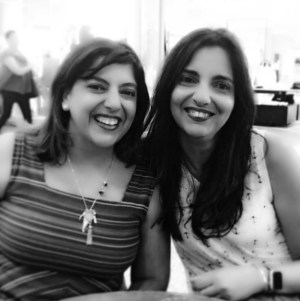
Here’s the thing about my sister. We rarely talk about diabetes. I rarely to her about my own diabetes because, quite frankly, we have far more interesting things to talk about. And shopping to do where I boss her around and she resolutely ignores me, while yelling about how bossy I am.
And yet, she would know a shitload more about diabetes – mine and diabetes in general –than almost anyone else I know. Because that’s what she does. She collects information relevant to people around her and files it away for when they need it.
On Easter, she showed up at our place for breakfast and handed me a huge dark chocolate Haigh’s egg. She’s all about the good stuff – and practising what she preaches.
Sisters can be hard going. We have our moments. But even when she wants to push me off the bed and give me concussion (which she did when we were younger, although she will tell you I fell on my own…), and even though she recently threatened to harm me with my new shoes (admittedly, because it was all I spoke to her about for three weeks), she still has my back.
I’m all about the redundant post titles these days, aren’t I? (See: here.) But this last long weekend, diabetes really didn’t make sense.
On late Wednesday afternoon, I noticed a slight tinge on the lower right side of my jaw. I started calculating the last time I’d been to the dentist and thought it was about time for me to make an appointment for a check-up.
Within an hour, I was reaching for some ibuprofen to help with the now more-than-niggling pain, and was on the phone trying to get an appointment with my dentist as soon as possible.
I could spend a long time explaining the pain I was in by late Wednesday night, but I won’t because it was nowhere near as bad as what I had coming for the next two and a half days. Plus, at this point, the pain was still responding to Nurofen every six hours, and I managed to get a good night’s sleep.
By Thursday morning, the pain had increased, and I found myself counting down after I took a dose of pain killers for the next time I would be able to find some relief.
I saw the dentist around the midday on Thursday, and after a quick couple of x-rays, he gently announced that the troublesome tooth would need to come out. There was a nasty infection, and the root canal that I’d had a number of years earlier just wasn’t cutting it anymore. (There was probably a far more technical term for what was going on, but I’d tuned out by this stage and was just wanting some decent relief from the pain that was becoming more incessant.)
I was sent on my way with a prescription for some strong antibiotics and an appointment for a week later when the infection had cleared. That’s when the tooth would come out.
Two hours later, the ibuprofen dose I’d taken earlier hadn’t even touched the sides of the pain and I was starting to think I was in agony. Rookie mistake – that was still a few hours off. I called the dentist and asked if he could recommend any more effective pain relief. The usual suggestion of alternating between ibuprofen and paracetamol wasn’t an option of course, thanks to my Dexcom, so he prescribed me some ibuprofen with codeine. (New prescribing regulations from earlier this year mean codeine is now a prescription only drug.)
The codeine worked. At least it did for the first dose. By 10pm only five hours after I’d taken the two tablets, my understanding of pain had been taken to a new level. Not the top level, mind – that was still to come. But I knew that there was no way I would get any sleep unless I had someone help me deal with the pain.
As it turns out, we don’t have a 24 hour emergency dental service in Victoria. The so-called 24 hour dental clinics I found online didn’t answer their phones when I called, and the dental hospital closes at 9.30pm. Hospitals won’t touch people with dental problems, although the triage nurse did kindly suggest I could go in and sit in the A & E waiting room until I could be seen, ‘…but the wait will probably be at least four hours.’ She suggested I find a late-night GP clinic and go there.
Which I did. An hour later, I was back home, after having filled a prescription for a pain killer, taken the first one and found that it that pretty much killed the pain. (Love it when things do exactly what they say on the box!)
I wish I could say that was the end of the saga. But alas, by the morning, that new drug stopped working too and I spent the next 24 hours in dark rooms, holding an ice pack to the side of my head. I wondered how long it was going to ne before the antibiotics kicked in (I’d been promised bet ween 24 and 48 hours), and the pain would start to truly ease.
By Saturday morning (about 36 hours on antibiotics), the pain had started to subside and by Sunday morning, in time for the Easter Bunny’s visit, I was only needing straight ibuprofen to manage the pain.
And today, Tuesday, I’m back at work and it’s been over 24 hours since I’ve needed any pain meds at all.
So, where was my diabetes in all this? Well, I had a frightful infection. I was in more pain than I have ever experienced in all my life. My blood pressure was up. And my diabetes looked like this:

This made absolutely no sense to me (hence this post title). Usually, just the hint of an infection sends my glucose levels sky-high. Any sort of pain – whether it be a sore throat, aching back or headache will be reflected in rising glucose levels.
But I was looking at this trace: the lowest point was around the 3.4mmol/l mark and the highest was 9.3mmol/l.
Also, my brain was incapable of dealing with anything other than the extreme pain, so I literally did not touch Loop in that whole time, other than to keep checking what my numbers were doing, fully expecting I’d need some serious rage bolusing highs. But the highs never came.
Loop was certainly working overtime, but not as much as I would have expected. My insulin requirements didn’t increase all that much at all, really. At least not until Sunday morning when I had my first hot cross bun of the season, but I can’t blame the infection on that!
I’m just chalking this up to yet another example of diabetes not making any sense; plus being grateful for the technology to help me keep an eye on things with as little effort as possible.
In one of those moments of coincidence, this article came across my Twitter feed today. Apparently, people with diabetes see the dentist less frequently (as compared with people without diabetes). So, my CSA today is: if you’ve not been to the dentist for a while, think of making an appointment today.
Any time there is something even remotely new in diabetes – from a new-fangled device, new education program, new research study, new funding model – it is referred to as a ‘game changer’. The so-called game of diabetes has transformed so many bloody times that just as you think you are on top of the latest and greatest, sure enough it all gets changed up again once someone releases a new app or data management system.
I kind of wish we would stop using the term ‘game changer’ because diabetes isn’t a game. At least, it’s not one that I particularly want to play. Games are meant to be fun and entertaining. Diabetes is not fun. And it is certainly not entertaining.
Also, what is referred to as a game changer is rarely anything that makes any real impact. In fact, in most cases, it’s just a matter of moving pieces around a board without anyone actually advancing towards the finish line. Are these alleged game changers really just a matter of doing the same things in a slightly different, perhaps more technologically-advanced, way?
CGM or Flash glucose monitoring aren’t game changers – they’re just different ways of monitoring glucose, in the same way that home blood glucose monitors were just a different way of monitoring glucose. The aim is the same: monitor glucose levels.
Insulin pumps aren’t game changers – they’re just a different way of delivering insulin, in the same way that pens and disposable syringes were. The aim is the same: deliver insulin into body.
New education programs aren’t game changers – they’re just different ways of delivering the same information in a slightly different way. The aim is the same: provide education to people with diabetes, often education that is not necessarily what people want, or in a way they want it.
And the result of all these so-called game changers also seems the same. Not necessarily optimal results most of the time. Do not pass go; do not collect $200.
We’re moving around the pieces and changing the rules, but what has really and truly changed? Is it that we have better outcomes? Perhaps it’s that there are more ladders than snakes on the board now?
I’m guilty of using the term. I have referred to Loop as a game changer because although the aims are the same, the result has been to somewhat lessen my diabetes burden and that shouldn’t be minimised.
But I still have diabetes. I still have to do a lot to manage it. The way I manage it may be simplified now, but a lot of it is still the same.
Games are meant to end. There is a winner and a loser, and I really don’t like to look at diabetes in those terms.
Surely the only true game changer in diabetes is going to be when there is a cure. But until then, it’s the same board, just with ever changing pieces, ever changing design, and ever, ever, ever changing rules.

Look at this! Googling ‘Diabetes Games’ I came across this from Jamie Naessens on her blog ‘Flying Furballs’. I love that rather than there being a ‘jail’ square, you get a free cupcake instead! Click on image to be taken to the original source.
In the talk I gave the other day at a diabetes educator conference, I shared my most recent A1c result with the audience. I did this after very careful consideration, because I generally don’t share that information.
But I decided that the context and situation was right – the room was full of HCPs who still often use A1c as the way to measure the success of a diabetes treatment or technology. Plus, I knew that there may be a lot of concern about the off-off-off label technology I was using. Surely a way to win over the crowd and point to the value of Loop was to play to my audience and give the crowd what they want.
When I announced my A1c to the room, the audience clapped. That’s right; they broke into spontaneous applause. I responded by asking them to stop – to please not applaud an in-range number.
I felt extraordinarily uncomfortable hearing the applause, because I couldn’t help but feel that if instead I’d declared an A1c out of range, the response would have been the sound of sharp intakes of breath. I know this, because I have spoken about high numbers before, and that is the noise a roomful of HCPs make when I talk about double-digit A1cs.

This week, I’ve been thinking a lot about how the impact of what we are told about many different aspects of diabetes – and the way things are framed – can be long lasting. And as my head is increasingly in the communication around diabetes complication space, I keep coming back to the need to reframe the way we present diabetes.
My newly-diagnosed self wouldn’t have batted an eye lid if I heard of HCPs applauding at an in-range A1c, because that was what I was told was a measure of success, and we applaud success, right? Just as that newly diagnosed me truly believed that someone being accused of failing to care for themselves because they had developed diabetes complications was a fair call.
These were the beliefs that were anchored in my mind as the absolutes of diabetes. But all they managed to do was anchor me to feeling as though I was constantly failing.
It took a long time to overcome those biases that seem to be the lifeblood of the diabetes narrative. I wish it happened sooner. I wish I hadn’t been anchored down for so long. Now I understand that we can acknowledge effort, but not applaud a number. How liberating this is; how much lighter I feel!
More musings on A1c
The saying goes ‘don’t sweat the small stuff’ and it has, to a degree, become a mantra of mine. There are a lot of things just not worth getting all worked up about, because life is too short, And there are too many coffees to drink, books to read, movies to see, boots to wear, places to visit.
So, I’ve become quite good at managing the annoying small stuff with a well-placed eye roll.
But the good small stuff? That I’m all about celebrating.
Things that I am all about doing a happy dance for include:
- Those diabetes-nirvana moments of a 5.5mmol/l readings on my Dex.
- The days that my cartridge running out perfectly aligns with needing to do a line change.
- Even better – the days that a new sensor day matches line change day and I get to have a perfectly-naked-no-devices-or-tape-stuck-to-my-body shower.

Perfect timing – frangipane tart out of the oven just as I’m sitting below target.
- Realising the pyjama shorts I impulse bought have pockets.
- Thinking I have run out of blood glucose strips, only to open my diabetes cupboard and see that there is another unopened box waiting for me.
- Seeing how between my bolusing into Loop, and Loop’s magic automation has worked perfectly – so perfectly – even though I just ate a notoriously difficult to manage meal of Pad Thai, and I am smack-bang at my target two hours after eating.
- Arriving home at the exact moment that my pump tells me its cartridge is empty, having been playing ‘insulin roulette’ all day.
- Knowing I’m onto my last bottle of insulin, don’t have a current prescription, BUT seeing my endo that day and have already called in the insulin order from my pharmacy, so it’s ready for me to collect on my way home from my appointment.
- Finding a bra that fits me perfectly comfortably, and securely houses my pump and RileyLink. (So I buy it in every single colour!)
- Baking the most perfect grape frangipane tart and pulling it out of the oven, ready to serve warm at the exact moment that I know I need a few carbs to keep things right in the range I want them.
I might not get diabetes right all the time; in fact, I may actually be not good at diabetes far more often than I care to admit. But when things work out, and the diabetes planets all line up, there is fist pumping and high fiving all around. I celebrate the small victories because when you add them up, they equal a whole lot.
I wrote a piece last week about how nervous I was about a talk I was giving at the Victorian ADEA Branch Conference about my personal Loop experience. The conference was held on Saturday, and I did my talk and escaped unscathed. It’s a good news story!
Thanks to everyone who encouraged and sent me words of support before my talk. I decided that I’d come clean before starting and admit to the audience that I was feeling a little nervous because I understood just how contentious many may consider what I was about to say.
Having legendary CDE Cheryl Steele share the stage with me – and her story with the audience – certainly helped!
Here are my and Cheryl’s talks.
A reminder – I am not recommending using Loop. This is my personal story and my personal experience. If you would like more information, please search ‘Loop’ on the blog. (There’s lots here because I keep banging on and won’t shut up about it!)
*this is the most redundant blog post title ever.
Yesterday, I was invited to speak with the Roche Diabetes Care team at their annual meeting so they could hear from a real-life-walking-talking-person-with-diabetes.
The idea of the talk was about how I try to make diabetes – the most complex health condition in the world – simple. Which, as I pointed out at the very beginning, is laughable, because diabetes and simple are words that should never be in the same sentence.
I started by saying that the idea that diabetes is a simple mathematics equation with the factors energy in, energy out, insulin and current glucose level is wishful thinking. There is a lot more than those four factors affecting glucose levels. And thanks to diaTribe, I was able to show them a list of 42 of them!
And I explained that the 121 diabetes decisions I make every day are all my own responsibility, because, you know, we only get about 4 hours of time with our HCP team.
I’m sure there was nothing new in there for them. At least, I hoped that was the case.
‘To manage diabetes, I have had to wear many hats,’ I said, and then listed all the things I have had to become just to try to deal with diabetes. These included:
- A one-person multidisciplinary healthcare team – because my team are not – and should not – be on call to be 24/7.
- A mathematician – because I do use algebra every.single.day. And do fancy pants calculations.
- A detective – because somehow I have to sleuth my way through health advice from Khloe Kardashian and Dr Oz.
- A scheduler – because of the regular ‘check-up’ appointments, complications screenings, blood work and anything else that needs doing.
- Fluent in a new language – the language of diabetese.
- A technology geek – because of all the devices I have stuck to my body and reading to my phone need to be driven by someone. And that someone is me.
- An advocate – for myself firstly, and then became one for others too.
- An engineer – because I did, after all, build my own artificial pancreas (lots of disclaimers after that saying that really all I had to do was follow step-by-step instructions much the same as one does when putting together Ikea furniture with an Allen key).
- Thick skinned – to deal with everyone who wants to tell me what I should be doing better to better manage my diabetes.
- A data analyst – because there is fucking data everywhere.
- A negotiator – mostly negotiating with myself to try to do better.
- A word nerd – because #LanguageMatters (Also, I am incapable of giving a talk and not talking about language it seems…)
- A comic – because finding the funny side of diabetes is sometimes necessary o get through the day.
- A social media whore – because I have found my tribe, love them hard and because so many of them live on the other side of the world, we hang out in the cafes of Facebook and Twitter lands.
The thing about diabetes is that apart from being the very opposite of simple, the thing that all of us living with the condition know is that even those things that are meant to help streamline our management, often add to the complexity.
It was at this point, I spoke about technology. ‘I love technology. I love diabetes technology. I want to be the first person using things. I will jump on a diabetes tech bandwagon as quickly as I can,’ I said. ‘But the thing about technology, is that while it may make some things easier, it can also create more work.’
I spoke about the work insulin pumps can be – the need for very regular glucose checks, the needing to make sure there is enough insulin to last the day, changing sites and checking them for infection, feeling frustrated when there is a technology glitch. And of course CGM – as wonderful as it is – can be frustrating, beeping, alarming and causing nothing but angst.
The tech is great when it works, when it is doing what we need it to do and when we feel that we are able to operate it as best we can. That’s certainly not always the case. And it’s important for people to understand – especially the people who make the technology and are speaking about it – to know that.
That was the take home message from my talk. Well, that and a reminder that even with the myriad hats that I wear to try to manage my diabetes, the hat that is by far the most important is the one that I wear when I am with the people I love, doing the things I love….and that is never, ever diabetes.
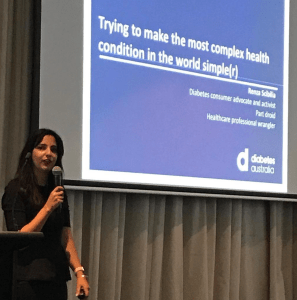
Roche Diabetes Care invited me to speak at the meeting. They covered my flights and transport costs.
Today I’m in Sydney giving a talk to the team at Roche about how I try (and generally fail) to simplify the most complex health condition in the world.

Alas, as I finished prepping my slide deck, I realised I have no real solutions and actually, diabetes remains bloody complex.
As you were…
When I first spoke to my endo about Loop, I wasn’t really all that concerned or nervous. The decision to take my diabetes management in a new direction was mine and mine alone and I knew she would support and work with me. My approach was pretty much the same as when I have changed any aspect of my management, whether it be introducing new tech, a new eating plan or anything else that deviates from the norm.
And after my first post-loop appointment, when she listened to what I was doing and how it was going, her response was brilliant. I guess that after she heard how great I was feeling and how well I was going since looping she realised that this was the best thing for me to do at the moment and she wanted to know how to continue to support me.
But I know that is not the case for everyone and that is especially evident at the moment with more and more people using DIY diabetes technology solutions.
I frequently see discussions online from people who are very apprehensive about an upcoming appointment when they will be telling their HCP that they are Looping. And I have heard stories of HCPs refusing to continue to see people with diabetes who have started using the technology.
This actually isn’t about Loop. At the moment, a lot of the discussion may be about DIY technologies, but actually, this goes far beyond that.
It’s the same as for people who have adopted a LCHF approach to eating and have been told by their HCPs that it is not healthy and they would be better off returning to an evidence-based eating plan.
It is the same as when pumps were new and CGM was new and Libre was new, and HCPs were wary to recommend or encourage their use due to the lack of evidence supporting the technologies.
I am keeping all this in mind as I prepare for a talk I’m giving this weekend for the Victorian branch of the Australian Diabetes Educators Association. I guess I am a little battle-scarred after my talk at ADATS last year, and am being far less cavalier about charging in and extolling the brilliance of Loop. I know that the audience is new to this technology, know little about it, and might be uncomfortable with the idea that I ‘built my own pancreas’. For some, it will be the first time they have ever seen or heard of it.
I’m trying to think of a way to talk about it so that the audience responds positively to the technology rather than the way many responded at ADATS last year.
But I am a little stuck. Because if I stand up there and say that since looping I feel so, so well, have more energy than in forever, am sleeping better than I have in 20 years, feel less anxious about my diabetes and feel safer, don’t have hypos anymore, feel the least diabetes burden ever, and have an A1c that is beautifully in range… and people still question my decision to use the technology, I’m not sure what else I have. I don’t know what more I can say to try to convince the audience just how much this has benefitted me.
The ending I’m looking for in my talk is for the audience to leave feeling interested in the technology and open to the idea of Loop as a possible tool for some of the people with diabetes they see.
But perhaps more than that, it is wanting the HCPs to think about the way they react when someone walks into their rooms, wanting to talk about something different or something new. It’s about being open to new ideas, accepting that the best thing for the PWD is not what the guidelines say, and realising that there is a lot going on out there that is driven by the end user. And perhaps it’s time to really start listening.
The three most important women in my life are forces of nature: My mother, president of union, has instilled in me a desire to do work that helps others. My sister, the fiercest, feistiest, smartest person I know, who constantly challenges me to think outside my comfort zone. And my daughter – my amazing, miracle kid, (and kids like her) – is why I feel that the world is actually going to be okay.
The supporting cast of close family – mother-in-law who just happens to be an Australian aviation pioneer, my sister-in-law, aunts, cousins – and friends means that I am constantly surrounded by brilliant women doing brilliant things. I am astounded, daily, at the challenges they overcome, their triumphs, the lives they change, the impact they are making.
And in my diabetes life it is women – the incredible women – who keep me going and keep me motivated. My diabetes healthcare team is made up exclusively of women who truly breathe the whole person-centred care belief system, building me up and then supporting me as I do the best I can with diabetes. The women I have worked with, and continue to work with, in diabetes organisations who champion those who would otherwise be forgotten have become friends, mentors and daily cheerleaders.
It is people like Cherise Shockley, founder of DSMA; Dana Lewis, creator of Open APS; Susan Alberti, philanthropist; Jane Speight, diabetes language forerunner; Taryn Black, Diabetes Australia policy director and champion for having the voice of PWD heard; Riva Greenburg, journalist, changing the way we see people living with diabetes; Annie Astle, advocate and speaker, and the person I am most grateful to have come to know because of diabetes; Monique Hanley, cycling legend; Christel Marchand Aprigliano, advocate leader; Cheryl Steele, CDE extraordinaire and leader in diabetes technology education; Kerri Sparling, author, blogger and incredible advocate; Anna Norton, Sarah Mart and Karen Graffeo, the women behind Diabetes Sisters; Melissa Lee, incredible communicator, singer, former leader of DHF and now at Bigfoot Biomedical; Kelly Close, founder of diaTribe and Close Concerns; Georgie Peters, speaker, blogger, diabetes and eating disorders advocate…
And you know what? I haven’t even scratched the surface. The diabetes world is shaped by women, built by women, sustained by women. Advocacy efforts are often the brainchild and then led through the blood sweat and tears of women. And how lucky the world is!
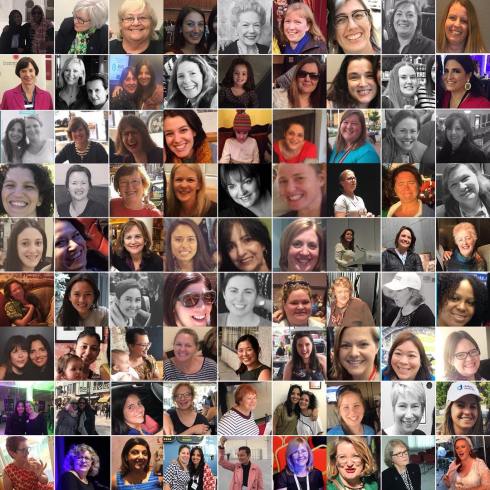
I celebrate these women today and every day!
More writing about women and diabetes, and women’s health.
This is what Diabetes Privilege Looks Like
One Foot in Front of the Other





 Diabetogenic