
You are currently browsing the category archive for the ‘Real life’ category.
*this is the most redundant blog post title ever.
Yesterday, I was invited to speak with the Roche Diabetes Care team at their annual meeting so they could hear from a real-life-walking-talking-person-with-diabetes.
The idea of the talk was about how I try to make diabetes – the most complex health condition in the world – simple. Which, as I pointed out at the very beginning, is laughable, because diabetes and simple are words that should never be in the same sentence.
I started by saying that the idea that diabetes is a simple mathematics equation with the factors energy in, energy out, insulin and current glucose level is wishful thinking. There is a lot more than those four factors affecting glucose levels. And thanks to diaTribe, I was able to show them a list of 42 of them!
And I explained that the 121 diabetes decisions I make every day are all my own responsibility, because, you know, we only get about 4 hours of time with our HCP team.
I’m sure there was nothing new in there for them. At least, I hoped that was the case.
‘To manage diabetes, I have had to wear many hats,’ I said, and then listed all the things I have had to become just to try to deal with diabetes. These included:
- A one-person multidisciplinary healthcare team – because my team are not – and should not – be on call to be 24/7.
- A mathematician – because I do use algebra every.single.day. And do fancy pants calculations.
- A detective – because somehow I have to sleuth my way through health advice from Khloe Kardashian and Dr Oz.
- A scheduler – because of the regular ‘check-up’ appointments, complications screenings, blood work and anything else that needs doing.
- Fluent in a new language – the language of diabetese.
- A technology geek – because of all the devices I have stuck to my body and reading to my phone need to be driven by someone. And that someone is me.
- An advocate – for myself firstly, and then became one for others too.
- An engineer – because I did, after all, build my own artificial pancreas (lots of disclaimers after that saying that really all I had to do was follow step-by-step instructions much the same as one does when putting together Ikea furniture with an Allen key).
- Thick skinned – to deal with everyone who wants to tell me what I should be doing better to better manage my diabetes.
- A data analyst – because there is fucking data everywhere.
- A negotiator – mostly negotiating with myself to try to do better.
- A word nerd – because #LanguageMatters (Also, I am incapable of giving a talk and not talking about language it seems…)
- A comic – because finding the funny side of diabetes is sometimes necessary o get through the day.
- A social media whore – because I have found my tribe, love them hard and because so many of them live on the other side of the world, we hang out in the cafes of Facebook and Twitter lands.
The thing about diabetes is that apart from being the very opposite of simple, the thing that all of us living with the condition know is that even those things that are meant to help streamline our management, often add to the complexity.
It was at this point, I spoke about technology. ‘I love technology. I love diabetes technology. I want to be the first person using things. I will jump on a diabetes tech bandwagon as quickly as I can,’ I said. ‘But the thing about technology, is that while it may make some things easier, it can also create more work.’
I spoke about the work insulin pumps can be – the need for very regular glucose checks, the needing to make sure there is enough insulin to last the day, changing sites and checking them for infection, feeling frustrated when there is a technology glitch. And of course CGM – as wonderful as it is – can be frustrating, beeping, alarming and causing nothing but angst.
The tech is great when it works, when it is doing what we need it to do and when we feel that we are able to operate it as best we can. That’s certainly not always the case. And it’s important for people to understand – especially the people who make the technology and are speaking about it – to know that.
That was the take home message from my talk. Well, that and a reminder that even with the myriad hats that I wear to try to manage my diabetes, the hat that is by far the most important is the one that I wear when I am with the people I love, doing the things I love….and that is never, ever diabetes.
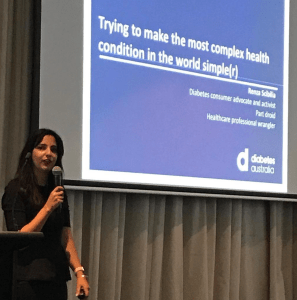
Roche Diabetes Care invited me to speak at the meeting. They covered my flights and transport costs.
Today I’m in Sydney giving a talk to the team at Roche about how I try (and generally fail) to simplify the most complex health condition in the world.

Alas, as I finished prepping my slide deck, I realised I have no real solutions and actually, diabetes remains bloody complex.
As you were…
When I first spoke to my endo about Loop, I wasn’t really all that concerned or nervous. The decision to take my diabetes management in a new direction was mine and mine alone and I knew she would support and work with me. My approach was pretty much the same as when I have changed any aspect of my management, whether it be introducing new tech, a new eating plan or anything else that deviates from the norm.
And after my first post-loop appointment, when she listened to what I was doing and how it was going, her response was brilliant. I guess that after she heard how great I was feeling and how well I was going since looping she realised that this was the best thing for me to do at the moment and she wanted to know how to continue to support me.
But I know that is not the case for everyone and that is especially evident at the moment with more and more people using DIY diabetes technology solutions.
I frequently see discussions online from people who are very apprehensive about an upcoming appointment when they will be telling their HCP that they are Looping. And I have heard stories of HCPs refusing to continue to see people with diabetes who have started using the technology.
This actually isn’t about Loop. At the moment, a lot of the discussion may be about DIY technologies, but actually, this goes far beyond that.
It’s the same as for people who have adopted a LCHF approach to eating and have been told by their HCPs that it is not healthy and they would be better off returning to an evidence-based eating plan.
It is the same as when pumps were new and CGM was new and Libre was new, and HCPs were wary to recommend or encourage their use due to the lack of evidence supporting the technologies.
I am keeping all this in mind as I prepare for a talk I’m giving this weekend for the Victorian branch of the Australian Diabetes Educators Association. I guess I am a little battle-scarred after my talk at ADATS last year, and am being far less cavalier about charging in and extolling the brilliance of Loop. I know that the audience is new to this technology, know little about it, and might be uncomfortable with the idea that I ‘built my own pancreas’. For some, it will be the first time they have ever seen or heard of it.
I’m trying to think of a way to talk about it so that the audience responds positively to the technology rather than the way many responded at ADATS last year.
But I am a little stuck. Because if I stand up there and say that since looping I feel so, so well, have more energy than in forever, am sleeping better than I have in 20 years, feel less anxious about my diabetes and feel safer, don’t have hypos anymore, feel the least diabetes burden ever, and have an A1c that is beautifully in range… and people still question my decision to use the technology, I’m not sure what else I have. I don’t know what more I can say to try to convince the audience just how much this has benefitted me.
The ending I’m looking for in my talk is for the audience to leave feeling interested in the technology and open to the idea of Loop as a possible tool for some of the people with diabetes they see.
But perhaps more than that, it is wanting the HCPs to think about the way they react when someone walks into their rooms, wanting to talk about something different or something new. It’s about being open to new ideas, accepting that the best thing for the PWD is not what the guidelines say, and realising that there is a lot going on out there that is driven by the end user. And perhaps it’s time to really start listening.
The three most important women in my life are forces of nature: My mother, president of union, has instilled in me a desire to do work that helps others. My sister, the fiercest, feistiest, smartest person I know, who constantly challenges me to think outside my comfort zone. And my daughter – my amazing, miracle kid, (and kids like her) – is why I feel that the world is actually going to be okay.
The supporting cast of close family – mother-in-law who just happens to be an Australian aviation pioneer, my sister-in-law, aunts, cousins – and friends means that I am constantly surrounded by brilliant women doing brilliant things. I am astounded, daily, at the challenges they overcome, their triumphs, the lives they change, the impact they are making.
And in my diabetes life it is women – the incredible women – who keep me going and keep me motivated. My diabetes healthcare team is made up exclusively of women who truly breathe the whole person-centred care belief system, building me up and then supporting me as I do the best I can with diabetes. The women I have worked with, and continue to work with, in diabetes organisations who champion those who would otherwise be forgotten have become friends, mentors and daily cheerleaders.
It is people like Cherise Shockley, founder of DSMA; Dana Lewis, creator of Open APS; Susan Alberti, philanthropist; Jane Speight, diabetes language forerunner; Taryn Black, Diabetes Australia policy director and champion for having the voice of PWD heard; Riva Greenburg, journalist, changing the way we see people living with diabetes; Annie Astle, advocate and speaker, and the person I am most grateful to have come to know because of diabetes; Monique Hanley, cycling legend; Christel Marchand Aprigliano, advocate leader; Cheryl Steele, CDE extraordinaire and leader in diabetes technology education; Kerri Sparling, author, blogger and incredible advocate; Anna Norton, Sarah Mart and Karen Graffeo, the women behind Diabetes Sisters; Melissa Lee, incredible communicator, singer, former leader of DHF and now at Bigfoot Biomedical; Kelly Close, founder of diaTribe and Close Concerns; Georgie Peters, speaker, blogger, diabetes and eating disorders advocate…
And you know what? I haven’t even scratched the surface. The diabetes world is shaped by women, built by women, sustained by women. Advocacy efforts are often the brainchild and then led through the blood sweat and tears of women. And how lucky the world is!
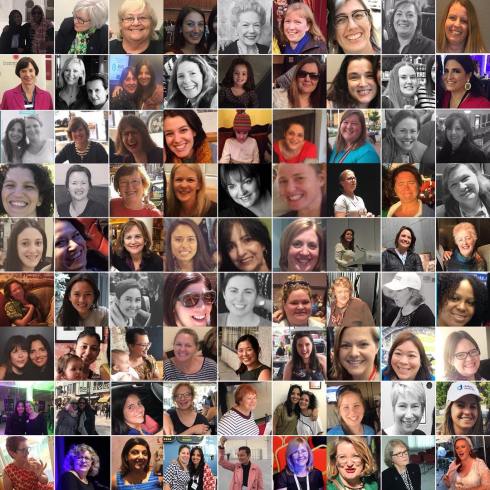
I celebrate these women today and every day!
More writing about women and diabetes, and women’s health.
This is what Diabetes Privilege Looks Like
One Foot in Front of the Other
About a month ago, we needed a new Netflix series to binge on and Aaron suggested we have a look at ‘The Good Place’. I’m so glad he did. It was fucking forking brilliant.
I adored all the characters and one if my favourites was definitely the name-dropping, poor-little-rich-girl Tahani, played by the exquisite Jameela Jamil.
The other day, while trawling through Twitter for Oscars updates, I came across her extraordinary #IWeigh initiative and have become a little obsessed. Jamil started this all with a blog post following a truly horrendous – as in ‘what the fuck fork were they thinking’ horrendous – photo of the women in the Kardashian family with their weights superimposed over the top of them. The photo was shared on an Instagram account claiming to be about ‘fashion, beauty, lifestyle’ which apparently is code for ‘Your-life-is-not-good-enough-you-piece-of-shit.’. Who knew?!
Anyway clearly Jamil was unimpressed by this photo – not only that these poor women had been labelled by their weigh in kilograms, but then there was a discussion afterwards that included posters doubting the truth of the numbers given. Awesome, not only were these women being judged about the number they see on the scales, they were also being called out as liars.
I looked at the photo and I stopped seeing the faces of the Kardahsians (I’ll be honest – I wasn’t all that upset) and started seeing them as bathroom scales. Oh – the insta post got better: it asked followers to share how much they weigh, because that’s a metric that we are ALL comfortable sharing with an Instagram audience. (Hashtag fitspo/thinspo/any-other-damaging-spo.)
Jamil’s impassioned post called out the bullshit and begging that we stop defining a woman’s worth by her weight, posting a photo of how she weighs her worth:

This resulted in a rush on women listing how they ‘weigh’ themselves.
While I think many women could relate to what was going on here, add diabetes to the mix and we have it tenfold! In diabetes, we get judged by more than just our weight. We become defined in the eyes of some HCPs by all the numbers associated with our condition whether it be the snapshot BGL check we do in front of them, our A1c, our blood pressure, our CGM trace or even our time in range. The measure of who we are is in those numbers, as if a number can define who we are.
But just like women cannot be measured by their weight (stop it! No, seriously – stop it!) people with diabetes cannot be measured by any of our numbers. Because of course, we are always, always, always about much more than that average number.
I measure my weight as a person not in kilograms or pounds, but in the things that make me who I am. Some of those things weigh me down, others lighten me. But together, they define me and make me who I am.

I’m not sure if it is age, acceptance, or perhaps even an admission of defeat, but these days when I look at my body, I have come to own that it is broken.
I actually say this with a feeling of achievement – I don’t really feel sad about it anymore. I don’t look at it and wish the brokenness away. I don’t want to cry and dream of a day when it will be ‘all better’.
I don’t even really hate what it is anymore, and that is a huge shift from a few years ago.
I have also come to understand – and accept – a lot of those feelings of hopelessness and helplessness were tied up with my fertility, but it has always been more than that.
It has also been about feeling that I am not enough and that my body is not enough. I’m acutely aware of how limiting diabetes can be some days, even if I am the only one who truly knows it. And often, I am the only one who truly knows it. Because my diabetes, by its very nature, has been easy to conceal.
The invisibility of diabetes doesn’t really make sense when it is your body it’s hiding away in. While my diabetes may be shrouded in a cloak of invisibility to everyone else, to me it may as well be covered in glitter, lit by neon and be accompanied by a marching band. There are days it’s all I ever see and all I ever feel.
The confusing thing is that while it has always been so obvious to me, I’ve tried to hide it away from everyone else. Clearly, I don’t mean I’ve tried to hide away the fact that I live with diabetes (exhibits A – Z: this blog/my job/talking endlessly about living with diabetes to anyone who will listen and those who won’t… etc.), but I certainly have frequently tried to hide away how it impacts my daily life.
Some periods in the last (almost) 20 years, diabetes has been harder to hide. Other times, it’s easier. It certainly has been easier since I’ve been Looping because overall, living with diabetes has been easier.
So when something happens that reminds me of just how difficult it can be, it is like a bolt of lightning.
A dodgy sensor on Saturday meant that I wasn’t Looping for most of the day, and that, combined with a shitty chest infection, resulted in some horridly high glucose levels – the highest I’ve seen in over six months. It hit me for six as the limitation of diabetes reared its ugly head. I tried to hide it until the waves of nausea started crashing over me and I took myself home and lay on the couch waiting for it to subside.
But as I dealt with it, I did something I wouldn’t have done in the past. Instead of denying there was anything wrong, or trying to blame anything else I could point my fingers at, I admitted just what it was: it was diabetes.
My broken body is my diabetes body. And it’s all I have. I can’t have one without the other. I may be lucky enough to be able to say that by and large I can manage to keep it in a place I’m happy with. But it is undeniable that there are times I cannot. We can’t always fix what is broken, but we can work around the brokenness. That’s what I do. Every single day.
Broken denim on my broken body.
There is an indescribable feeling I have following a diabetes conference. Swirled in amongst the exhaustion, information overload, jet lag (because conferences are always in ridiculous time zones that are not AET), and memories, I come back galvanised in a way that can only happen when spending time with those in my tribe: others living with diabetes.

I returned from three days in Vienna bone-achingly exhausted. After being reunited with my family and not being able to stop hugging them, a few days of not-great-but-okay sleep and bucket-loads of Melbourne coffee under my belt, and time to process and write about what I learnt, I find myself recalibrated and ready for what’s next.
The hours of travel is a memory, the conference sits comfortably alongside all the others I’ve been too, my conference name badge is hanging in my office with all the others, and I’ve plans already underway from successful meetings.
In a lot of ways, the status quo has been restored and I am back to my real life after a few days of conference life.

But what is not the same is the level of vitality I now have, my veins pounding with the vigour that comes only from spending time with the people who are working to and for the same things because they get it at a personal level that is only apparent to those of us whose very DNA is affected by this condition.
I came to realise a few years ago that I have an invisible jar in my mind, and how empty or full that jar is depends on the time I’ve spent with likeminded diabetes friends. When the jar is nearing empty, I find it difficult to focus my energies on the advocacy and support issues that often are front and centre of my mind. I feel myself flailing and falling short because I don’t have the support of those I need to boost me up.

Of course, I am lucky enough to have others with diabetes around me even when I am in Melbourne (hello neighbour!), but it is those I see at these sorts of conferences – the ones whose minds and hearts are full of similar ideas, similar frustrations and find similar reasons to celebrate– that fill that jar right up. It is when I can simply turn to someone because they are sitting right there, have an animated conversation and high five each other with our enthusiasm that I feel capable and able to take on the world.
Those people who share my pancreatically-challenged existence, who breathe the same health condition, and struggle, celebrate and despair in similar ways to me, are the ones who fill up the jar ways to sustain me until the next time. My motivation is high, the momentum fast, my mind is working overtime. And my jar is overflowing right now with those people who may have beta cells that don’t work, but they make up for it in ways you couldn’t even begin to imagine.
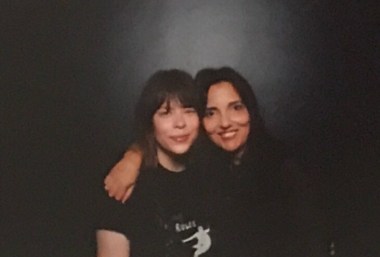
Tine – who inspires me every time we speak.
It’s easy to remember the difficult moments we’ve experienced at the hands of healthcare professionals who have been less than kind.
And, equally, we remember those moments where kindness was shown in spades.
I know I certainly remember moments of kindness in healthcare. And those moments transformed me. I so appreciated the kindness that came from HCPs at moments when a tsunami of grief or despair or pain or a diagnosis washed over me, knocked me to the ground and left me doubtful that I would ever be able to get back up again.
I remember kind words, the silences afforded to me giving me a moment or two (or dozens) to think, the time I was given to understand what was happening and formulate a plan to manage… I remember them all because they left me stronger, more determined, better supported and far more empowered to cope.
Kindness is a highly underrated quality in healthcare. I’m not sure how it should be included in a curriculum full of critically essential information, but it needs to be taught from the very beginning of any healthcare courses, and it’s importance highlighted and stated over and over and over again.
In the last year or so, I’ve read a few books written by (as the publicity often claims) ‘healthcare professionals turned patients’. (I’ve found this to be quite an odd term, because surely everyone at one point or another has been a patient.)
A recurring theme throughout the books is how difficult the HCPs have found it being on the other side of the HCP / patient divide. They often appear astounded at the red tape and bureaucracy they came up against, the hoops they need to jump through to receive the appropriate care, and the sheer unfriendliness of the system. And they write about the extraordinary moments of kindness that often feel far too infrequent.
Sometimes, they have written about how they didn’t realise that the way they themselves behaved could be interpreted as having a lack of consideration and kindness – explaining it was simply their manner and how they made sure they got through the day as efficiently as possible in a system often built on the foundation of complete and utter inefficiency. And yet now…now they understood.
While the books I read have been beautifully written, heart breaking at times, and often end terribly, the stories in them were not surprising. They tell truths about the system – and the lack of kindness – that people with diabetes face every day in every encounter.
When Kate Grainger launched #HelloMyNameIs, she was echoing the calls of countless people before her: please treat us like people. Please tell us what you are doing here. Please know we are scared. Please tell us who you are and what your role in my care will be.
She did it beautifully, simply, eloquently and changed the landscape of healthcare communication. I am so sad that she had to be so ill for this to happen. But her legacy is one for which I am so grateful.
Kindness in healthcare makes all the difference. Some may think it is completely unnecessary and that as long as we are receiving the right diagnosis, good care and excellent treatment, there is nothing more we need. But that is not true. Kindness adds a human element. We need warm hands, warm hearts and warm words alongside the cool tech, sterile environments and scary diagnoses.
Kindness takes no more time; it takes no more effort. But it’s effects can indeed be monumental.
Recently, I spoke with someone who had been diagnosed with type 1 diabetes about twelve months ago. A mutual friend had connected us.
‘How long have you had diabetes?’ That was her first question.
‘Almost 20 years,’ I said.
‘I’m really struggling. Will I move on and get over it?’
I wish I had been able to say something to ease her anxiety. Instead I just nodded and told her she would be okay.
But I haven’t been able to stop thinking about that question.
Because, the truth is, I don’t think we do move on. I don’t think we do get over it. We move through it. We learn to get through it, but it’s a chronic health condition and it never, ever goes away.
I went through some tough times a few years ago and I remember a conversation with a friend who was a great source of comfort to me. ‘When does this awfulness stop? When does it go away?’ I asked, tearily, one day.
 ‘It doesn’t, but it will get easier. Think of it like this… You’re in your car and you’ve just driven past a horrific car accident. You can’t stop, you have to keep driving, but you are driving very, very slowly because there is a lot of traffic backed up. You’re shocked and can’t believe what you have just seen. It’s gruesome. You look in the rear view mirror and you can still see it – all the details, all the goriness, all the pain.
You can’t help but keep checking the mirror. Every time you do, you feel the horror of what you saw, but the accident is a little further away in the mirror’s reflection, so the detail of what you are seeing is a little less.
After a while, all you can see are some flashing lights and a crumpled mess, but no details – it’s starting to be a blur and the shock and pain you felt is starting to numb.
And then, eventually, after a long time, you look back and you see nothing. You’re on the open road, going about your driving, and all you see behind you is road and other cars. But you still think about what you saw. You still have flashes of it. You still remember it.
It doesn’t go away – you don’t get over it. But you got through it. And your life will be forever changed by it. But it will always be there.’
I remember being incredibly reassured by this analogy. And it was actually so true. The pain I felt did wane – I never forgot it and I’m not ‘over’ it. But it is far more distant in my rear view mirror now and eventually, it may completely disappear from view. But it is still part of my memory bank.
I’d never applied this way of thinking to diabetes – that analogy belonged to a time of incredible and quite acute emotional pain – but it actually is perfect for diabetes too.
I wish my response to my new friend’s question was simply: ‘I don’t think that I have moved on from diabetes; I don’t think I am over it. But it is easier today than it was twenty years ago. And every day I move through it, and I get through it. I hope that gives you some comfort.’
I look at those who have gone before me and those who are living a diabetes life alongside me and I see us all moving through it. Some days are harder, some days are easier. But we keep moving. We move through diabetes. As best we can.
New year, new jumble. And lots of saved links from the last few weeks to share.
#OzDOC 2.0
Did you know that after OzDOC had it’s ‘final’ tweetchat at the beginning of December last year, it’s had a reboot and is now continuing to go at a great rate. David Burren (AKA Bionic Wookiee) kicked off the chat but is looking for people to volunteer to the moderators’ roster. There’s a brand new Twitter account to follow (@OzDOC_host), but the #OzDOC hashtag continues to shine brightly.
Same #OzDOC time, same #OzDOC channel. (i.e. Tuesdays at 8.30pm AEDT)
And while we’re talking tweetchats…
…make sure you keep an eye out on the #GBDOC tweetchats, which also had a bit of a restart last year and are going absolutely brilliantly. Follow @GbdocTChost for topics and moderators.
Now is a great time for Aussies to participate in #GBDOC because with the time zone difference, the chat is on Thursday 8am AEDT…which is actually quite pleasant. (It all goes to pot and becomes more difficult when daylight saving kicks in/out in respective hemispheres in coming months, but for now, it’s certainly manageable!)
Jane’s profile
It’s no secret that I’m a huge fan of Professor Jane Speight and I make no apologies for mentioning her so frequently on this blog. She is truly a champion for and of people with diabetes and her pioneering work on diabetes and #LanguageMatters, and social stigma are changing the landscape for those of us living with diabetes.
Last week, a profile of Jane and her work was published in The Lancet. Congrats, Jane. I can’t imagine a more worthy recipient of this attention. Please keep on keeping on. I for one am very grateful to have you on our side!
Read the article here – it’s free, but you will need to register/log in to access it.

(Click photo for source)
Dear ‘patient’
I was really interested to read this BMJ Opinion piece about medical letters, with the writers suggesting that instead of addressing ‘report letters’ to referring (and other) doctors and HCPs, that they should be addressed directly to the person, CCing in the doctor who would ordinarily have been sent the letter.
I love that idea! My endo generally copies me in on anything she sends out to my other HCPs to keep me in the loop, but I think that actually writing directly to me is even better.
HCPs would need to completely reconsider the language they adopt, the terminology they use and the overall tone of the communication, and I believe that there is nothing that should be shared with another HCP about me that shouldn’t be shared directly with me.
Interesting idea. And interesting to see if it has legs…
Writing for Grumps
After writing for me a few weeks ago, I returned the favour and wrote a post for The Grumpy Pumper. (I think the deal he made was something like ‘I’ll show you mine if you show me yours’, so I had to come up with the goods.)
This is all part of Grumps’ attempts to get people with diabetes speaking about #TalkAboutComplications in an open and honest way to help reduce the shame that seem to go hand in hand with a complications diagnosis.
Get ready for Spare a Rose spam
This year’s campaign is about to kick off. And if you want to know why I support this campaign, here’s just one reason.
Hospital admissions and T1D study
Rebecca Munt from Flinders University is currently enrolled in a PhD at Flinders University and is looking for participants in her research.
The focus of her study is to explore the experiences of self-management for adults with type 1 diabetes in the hospital setting (when T1D is not the primary admission diagnosis). If you’re interested in participating in Rebecca’s study, have type 1 diabetes, are over 18 years of age and have been admitted to hospital within the last two to five years (not for diabetes), please call Rebecca on (08) 8201 5749 or email rebecca.munt@flinders.edu.au
(The project has Social Behavioural Research Ethics Committee approval from Flinders University.)
Future of medical conferences
I have been very vocal in recent years about the shortcomings of diabetes conferences, specifically the lack of involvement and engagement of people with diabetes as part of the planning, running and presenting of the conference. So this piece really resonated about why medical meetings need a revamp, and some ideas for what could be done differently.
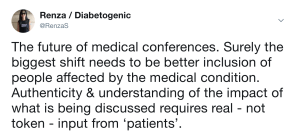
(Click for original tweet)
Because #NothingAboutUsWithoutUs.
Does the story we know and love about Banting need a rewrite?
I was fascinated to watch the short documentary shared in this story which suggests that the frequently-told story of the discovery of insulin is missing out a critical part.
It was the best of times, it was the worst of times…
This blog post by Sue Robins detailing two vastly different medical appointments is compelling – and quite heartbreaking –reading.
More D Merch
Totally true!
Click image to get your own!





 Diabetogenic