
You are currently browsing the category archive for the ‘Lived experience’ category.
Do you remember life before diabetes? It’s getting harder and harder for me to. I had 24 years without diabetes, and occasionally, I’ll look at a photo from the BD years and think about how much simpler my days were.
Today, I’m wondering how much I remember diabetes before I started using automated insulin delivery (AID). It’s been eight years. Eight years of Loop. Happy loopiversary to me! Diabetes BL (before Loop) felt heavier. And scarier. I remember those months just after I started looping and how different things felt. I remember the better sleep and the increased energy. I remember a lightness that I hadn’t experienced since I was diagnosed.
That’s now my “diabetes normal”. Life with Loop is simply easier than life BL. On the very rare occasions I’ve had to DIY diabetes, it’s been a jolt as I’ve realised just how truly bad I am at diabetes. Embarrassingly bad.
While there was a stark difference back then between people who were using DIYAPS and those who were using interoperable devices on the market, today that difference is less. AID systems are not just for people who choose to build one for themselves. These days, it’s so great to know that there are commercial systems available which means more people have access to AID. We can debate which algorithm is better or whether a commercial or an open-source system is better, but I think that’s a little pointless. If people are doing less diabetes and feeling happier, better and less burdened, it doesn’t matter what they’re using. Your diabetes; your rules!
Eight years on, and despite there being commercial systems I could access, I’ve decided to keep using Loop – the same system I started on 8 years ago. The changes I’ve made are the devices with which I am using Loop. My pink Medtronic pump has been retired, along with the Orange Link (which was obviously in a pink case). Instead, I now use Omnipod, a single device instead of two which has further simplified my diabetes. It’s also meant not worrying about a working back up Medtronic pump, and it means carrying less bulky supplies when travelling.
These may all seem like little things, but they add up.
My decision to not move to a commercial system has been based on a couple of different reasons. I always said that I wouldn’t move to something that required a trade-off whereby any of the convenience of Loop was compromised. I’ve been blousing from my iPhone or Apple watch since 2017, and I refused to let that go. In my mind, having to wrangle my pump from my bra or carry an additional PDM to bolus was a step backwards. Of course, this is now available on some commercial systems, and it’s been super cool to see diabetes friends have access to something that does make diabetes a little less intrusive.
The customisability of Loop has meant that my target levels are set by me and me alone. The lower limit on commercial systems is not what I like mine set at. I wasn’t prepared to sacrifice the flexibility of personalised settings fora one-size-fits-all approach.
I do understand that there are pros to having a commercial system. Having helplines to trouble shoot and customer support on call is certainly a positive. Knowing that an annual Loop rebuild (always anxiety inducing because …well, technology?) is upcoming is stressful. And the worry that the update will break something that’s been working perfectly.
And yet, measure for measure, the decision to continue to use Loop has been very easy.
I still thank the magicians behind open-source technologies for their brilliance and generosity every single day. I’m grateful for the algorithm developers, the people who have written step by step instructions that even I can follow, and I am so thankful for the people who have tried to make devices more affordable. I believe that device makers do genuinely want to make diabetes simpler and help ease the load of diabetes. But in my mind, it’s undeniable that user-led developments have been more successful in actually making diabetes easier. These magicians know firsthand just what it means to claw back from diabetes.
In the end, the goal for me has always been clear: I want diabetes to intrude in my life as little as possible, and I will avail myself of anything that helps. It’s why I continue to use an Anubis even though there is no out of pocket cost for G6 transmitters. Using an Anubis means I change my sensor when it’s getting spotty, not when the factory setting insists, and the transmitter last six instead of three months. See? Fewer diabetes tasks. Less diabetes. That’s the whole point. (And it’s also why I’m hesitant about moving to G7)
When I try to quantify how much less diabetes, I just come back to Justin Walker and his presentation at Diabetes Mine’s DData back in 2018 when he said ‘By wearing Open APS, I save myself about an hour a day not doing diabetes’. Eight years down the track, that’s 2,922 hours I’ve gained back. That’s almost 122 days. It may be thirty seconds here, a minute there. But it adds up. And that time is better in my pocket than in diabetes’.
And so, here I am. Eight years on. With diabetes in the background as much as it can be with the tools I have available to me. I still really don’t like diabetes. I still really resent it takes up the time and brain space it does, and I still want a cure for all of us. Damn, we deserve that.
But in the meantime, I’m going to keep leaning into what the community has done for the community and know how lucky I am to benefit from that knowledge and expertise. Never bet against the T1D community. We know exactly what diabetes takes from us every day. And exactly what it takes to give some of it back.
More on my experiences with Loop
That time I scared the hell out of healthcare professionals
What looping on holidays looks like
A list of how Looped changed my diabetes life (and all of it is still relevant today!)
Postscript
As ever, I’m very aware of my privilege. Access to AID is nowhere near where it should be. If we look at the Australian context, insulin pumps remain out of range for so many people with T1D thanks to outdated funding models. Remember the consensus statement developed last year? And beyond our borders, technology access varies significantly. As a diabetes community, we are not all beneficiaries from this tech until every single person with diabetes has access. And that starts with affordable, uninterrupted access to insulin, right through to the most sophisticated AID systems, to preventative treatments, to cell therapies.
This is a transcript of a talk I gave earlier this year to a European-based health consultancy and creative agency about my take on global diabetes community-based advocacy – the opportunities and challenges. The title I was given was ‘Making Engagement the norm rather than the exception’. AI did a remarkably decent job with this transcript, but I expect that there might be some clunky language in there that I missed when I read through it on a plane after being in transit for 27 hours straight. Or, I could simply have used clunky language. Either way, it’s my fault.
I often say that community is everything, but I want to begin by saying that it’s important to understand that there is no single, homogenous diabetes community. Everyone’s diabetes experiences are different. I truly believe that there are some issues that unite us all, but really, we are a very disparate group – something I have come to understand more and more the longer I have been involved in diabetes community advocacy. This poses possibly the largest challenge for everyone in this room wanting to work with “THE diabetes community” because if you’re looking for a group that agrees on everything and believes the same thing, I’m sorry to say that you’re going to be in for quite a ride!
But it is also the biggest opportunity – and the way to get an edge – because it gives anyone who works in the diabetes space – from healthcare professionals, researchers, industry, diabetes organisations, policy makers, the media – to roll up their sleeves and make a concerted effort to talk with a wide range of people with diabetes to understand our experiences and what we need. Look, I know that it would be easier for all of you if I said, ‘Speak with one person and then you’re good to go’, but that would be a lie. Sadly, a lot of people and organisations still believe this to be the case, and I have a great example to show you why that doesn’t work.
And that example? It’s me, hi, I’m the problem, it’s me.
A number of years ago, a researcher reached out to me with an invitation to be the ‘consumer representative’ on their project. After bristling at the term “consumer”, I asked what the project was about, and this is what they said, word for word because I wrote it down and have told this story a million times as a cautionary tale: ‘It’s a project on erectile dysfunction in men with type 2 diabetes, diagnosed over the age of 65.’
There was not a note of irony in this invitation. When I pointed out that I fit literally none of the categories in the study and then went on to point out that I am a woman; I have T1D; no erectile dysfunction; diagnosed at 24; was not within a decade of 65 years of age, the response was ‘Oh, but you have diabetes, so you’ll be great’.
Friends, I would not have been great.
For the purposes of this discussion, when I say diabetes community, I am referring to people with lived experience of diabetes. There is a lot of cross over in the diabetes advocacy space, and there are many examples I can point to that show how valuable advocacy efforts can be when people with diabetes are involved in efforts led by diabetes organisations or other stakeholders. In fact, at the end of last year, we saw a brilliant example of that with Breakthrough T1D in Australia receiving $50.1 million in funding from the Australian government for their Clinical Research Network. This is the power of an organisation meaningfully engaging with their community to tell the story of why their advocacy is important. I mean, what is more compelling than hearing from people with diabetes and their families about how research holds the key to a better diabetes future?
I’d encourage you to look at Breakthrough T1D Australia’s socials to see just how beautifully they centred people with lived experience to get their message across, and how it was people with diabetes who literally marched on parliament to tell the story. The coordination of the campaign may have come from a passionate advocacy and comms team in an organisation, but the words were all people with diabetes. (For transparency: I work for Breakthrough T1D, formerly JDRF, but not for the Australian affiliate. I am, however, extraordinarily proud of what Breakthrough T1D Australia has achieved and so, so impressed with the way their communications campaigns are never about the organisation or staff, but rather about the community.)
I believe that our community excels in telling the stories of our lives with diabetes, what we need to make our lives better, what works in our communities and how we can better work together. Some standout examples of this include the #dedoc° community, and, in particular, the #dedoc° voices scholarship program. This is the only truly global community where diabetes advocates are not only present but are leading conversations. #dedoc° has no agenda other than to provide a platform for people with diabetes which results in diverse stories and experiences being heard. And it also means that organisations want to work with #dedoc° because it’s an easy way to connect with community. (And another point of transparency: I’m the Head of Advocacy for #dedoc°.)
Organisations that thrive on working with community demonstrate their commitment to improving the lives of people with diabetes in ways that matter. If you don’t know about the Sonia Nabeta Foundation (SNF), you really should! The foundation has a network of ‘warrior coordinators’ who provide peer support and a whole lot more! I have now had the honour of chairing sessions at international conferences with four of these warrior coordinators and I can say without a doubt that Hamida, Moses, Nathan and Ramadhan’s stories resonated and stayed with the audience way beyond the allotted ten minutes of their talks. Addressing the challenge of a limited workforce and resources by engaging and employing people with diabetes to educate and support younger people with diabetes is so sensible and clever. And the results are remarkable.
I have seen similar examples in India. Visiting Dr Archana Sarda’s Udaan centre in Aurangabad and Dr Krishnan Swaminathan’s centre in Coimbatore completely changed my understanding of peer-led education. And groups like the Diabesties Foundation and Blue Circle Diabetes Foundation (also in India) are prime examples of the successes we can expect when people with diabetes take charge of programs and lead diabetes education.
Seeing these examples firsthand lit a fire under me to challenge what we have been told in high-resourced countries like Australia, and here across high-income countries in Europe. Why is it that we, as people with diabetes, are told to stay in our lane and not provide education? We may be considered ‘higher resourced’, but people fall through cracks because they are not getting what they need. Health systems remain challenged and overwhelmed.
The challenge we have in places like Australia is that PWD are very clearly told that we are not qualified to provide education. Rubbish! Our lived experience expertise puts us in the prime position to do more than just tell our own story, and I believe we need to boldly push back on beliefs that only health professionals are equipped to fill education and knowledge gaps. Because in addition to what we know, the expertise we hold and our ability to speak in the language that PWD understand, we also know about ‘going to the people’ and not expecting a one size fits all approach to work.
It would be naïve to think that community-led, and -driven programs and initiatives aren’t already happening. Community is integral in providing information that PWD are desperate for, even with caveats about consulting HCPs. There are 24/7 support lines available in the community, something that is simply not available in most healthcare settings. And anyway, who better than others with diabetes to give practical advice on real life with diabetes than those walking similar paths? In the moment and with direct experience.
The #WeAreNotWaiting community was established to not just offer advice but develop technologies to improve lives of people with diabetes and continues to do so today. A five minute lurk in any of the online community groups dedicated to open-source technologies is all it takes to see people with diabetes who had been at the end of their tether with conventional care now thriving thanks to community intervention.
And that is replicated in low carb groups where community provides advice and education on how to eat in a way that is often not recommended by HCPs. People share experiences how they are flourishing thanks to making informed decisions to eat this way, and air their frustrations about how they are often derided by HCPs about those decisions. The support that comes from these groups is often just as focussed on how to deal with the healthcare environment when going against the grain (unintended pun) as sharing ideas and advice on how the science behind how low carb diets work.
T1D groups talk about incorporating adjunct therapies into their diabetes management, moving from a glucose-centric approaches to looking at other meds and interventions that can support better outcomes. GLP1s may not be approved for use by people with T1D, but they are increasingly being used off label because of their CVD and kidney protective nature. These community discussions include suggestions on how to have conversations with HCPs to ask about how adjunct therapies might help, including pushing back if there is a blanket ‘no, it’s off label’ response. Before anyone thinks this isn’t a good thing, I remind you that we still need prescriptions from our HCP before we can start on any new drug. We should be listened to when we ask to have a discussion about new and different ways to manage our diabetes.
And there are also businesses led by community that have stepped into spaces that are traditionally organisation or HCP-led. A few years ago, Aussie woman Ashley Hanger started Stripped Supply to fill a massive gap when diabetes supplies could no longer be ordered online and shipped, instead necessitating a backstep where PWD had to go into pharmacies to pick up supplies. Ashley’s start up gave the people what we wanted and meant that, for a small subscription fee, supplies could be straight to our doors again. And it’s run by community – what’s better than that?
There is contention about people with diabetes working with industry, and that is a conversation for another time. But I will say that when we have people with diabetes involved in the development of the devices that we use and/or wear on our bodies every day, the end products are better. That’s just a fact. When you have people with diabetes employed by device manufacturers writing education and instruction manuals for those devices, they make sense because they are written from the perspective of someone who actually understands the practical application of using those devices. It’s a massive opportunity for industry to engage – and employ – people with diabetes. Way to get an edge!
What I would say to everyone here today is that if you are not directly working with people with lived experience of diabetes, you are missing out on the biggest piece of the diabetes stakeholder puzzle. But you have to do it meaningfully and perhaps the biggest challenge I face is dealing with the rampant tokenism that exists in the diabetes ecosystem. For my entire advocacy career I have been urging the implementation of meaningful engagement, and to be honest, a lot of the time I feel that I have failed in those attempts. Every time I see a crappy program or campaign come out of somewhere that claims to work with community, I realise that people with diabetes are being used in possibly the most nefarious way possible: to ‘lived experience wash’ the work of the organisation. I wrote a piece earlier this year about this and was completely and utterly unsurprised to receive comments justifying poor attempts of consultation.
But then, I see something like the video I am going to finish with from Breakthrough T1D in the UK, and I know that there is intent there to do the right thing and do it properly. To involve people with diabetes from the beginning, and centre them throughout the work. The result is a beautiful piece of storytelling that has been shared across the globe. I don’t know the metrics, and quite frankly, I don’t care. All I need to see is the response from the community to know and understand that this hits the spot. And you can too with your work if you engage properly. We’re here to help.
You can watch What a Cure Feels Like, the Breakthrough T1D UK video that concluded my talk here.
Disclosure
I was invited by a health consultancy firm to give a talk to fifty people working on public-facing health campaigns (NDA, can’t say anything more) and then run a workshop about working with lived experience representatives. I was paid for my time to present and prepare for the session, and reimbursed for ground transfers to and from the location of the meeting.

Last week I was in Geneva for the 78th World Health Assembly (WHA78). It’s always interesting being at a health event that is not diabetes specific. It means that I get to learn from others working in the broader health space and see how common themes play out in different health conditions.
It’s also useful to see where there are synergies and opportunities to learn from the experiences of other health communities, and my particular focus is always on issues such as language and communications, lived experience and community-led advocacy.
What I was reminded of last week is that is that stigma is not siloed. It permeates across health conditions and is often fuelled by the same problematic assumptions and biases that I am very familiar with in the diabetes landscape.
I eagerly attended a breakfast session titled ‘Better adherence, better control, better health’ presented by the World Heart Federation and sponsored by Servier. I say eagerly, because I was keen to understand just how and why the term ‘adherence’ continues to be the dominant framing when talking about treatment uptake (and medication taking). And I wanted to understand just how this language was acceptable that this was being used so determinately in one health space when it is so unaccepted in others. This was a follow on from the event at the IDF Congress last month and built on the World Heart Foundation’s World Adherence Day.

While the diabetes #LanguageMatters movement is well established, it is by no means the only one pushing back on unhelpful terminology. There has been research into communication and language for a number of health conditions and published guidance statements for other conditions such as HIV, obesity, mental health, and reproductive health, all challenging language that places blame on individuals instead of acknowledging broader systemic barriers.
I want to say from the outset that I believe that the speakers on the panel genuinely care about improving outcomes for people. But words matter as does the meaning behind those words. And when those words are delivered through paternalistic language it sends very contradictory messages. The focus of the event was very much heart conditions, although there was a representative from the IDF on the panel (more about that later). But regardless the health condition, the messaging was stigmatising.
The barriers to people following treatment plans and taking medications as prescribed were clearly outlined by the speakers – and they are not insignificant. In fact, each speaker took time to highlight these barriers and emphasise how substantial they are. I’m wary to share any of the slides because honestly, the language is so problematic, but I am going to share this one because it shows that the speakers were very aware and transparent about the myriad reasons that someone may not be able to start, continue with or consistently follow a treatment plan.
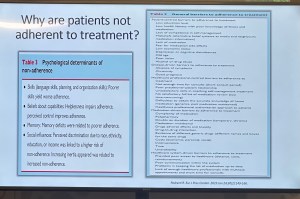
You’ll see that all the usual suspects are there: unaffordable pricing, patchy supply chains, unpleasant side effects, lack of culturally relevant options, varying levels of health literacy and limited engagement from healthcare professionals because working under conditions don’t allow the time they need.
And yet, despite the acknowledgement there is still an air of finger pointing and blaming that accompanies the messaging. This makes absolutely no sense to me. How is it possible to consider personal responsibility as a key reason for lack of engagement with treatment when the reasons are often way beyond the control of the individual?
The question should not be: Why are people not taking their medications? Especially as in so many situations medications are too expensive, not available, too complicated to manage, require unreasonable or inflexible time to take the meds, or come with side effects that significant impact quality of life. Being told to ‘push through’ those side effects without support or alternatives isn’t a solution. It is dismissive and is not in any way person-centred care.
The questions that should be asked are: How do we make meds more affordable, easier to take, and accessible? What are the opportunities to co-design treatment and medication plans with the people who are going to be following them? How do we remove the systemic barriers that make following these plans out of reach?
One of the slides presented showed the percentage people with different chronic conditions not following treatment. Have a look:

My initial thought was not ‘Look at those naughty people not doing what they’re told’. It was this: if 90% of people with a specific condition are not following the prescribed treatment plan, I would suggest – in fact, I did suggest when I took the microphone – the problem is not with the people.
It is with the treatment. Of course it is with the treatment.
The problem with the language of adherence is that it frames outcomes through the lens of personal responsibility. It absolves policy makers of any duty to act and address the structural, economic and systemic barriers that prevent people from accessing and maintaining treatment. Why would they intervene and develop policy if the issue is seen as people being lazy or not committing to their health?
And it means the healthcare professionals are let off the hook. It assumes they are the holders of all knowledge, the giver of treatment and medications, and the person in front of them is there do what they are told.
There is no room in that model for questions, preferences, or complexity. There is no room for lived experience. There are no opportunities for co-design, meaningful engagement or developing plans that are likely to result in better outcomes.
When the room was opened up to questions, I raised these concerns, and the response from the emcee was somewhat dismissive. In fact, she tried to shut me down before I had a chance to make my (short) comment and ask a question. I’ve been in this game long enough to know when to push through, so I did. I also don’t take kindly to anyone shutting down someone with lived experience, especially in a session where our perspective was seriously lacking. Her response was to suggest that diabetes is different. I suggest (actually, I know) she is wrong.
And I will also add: while there was a person with lived experience on the panel, they were given two questions and had minimal space to contribute beyond that. I understand that there were delays that meant they arrived just in time for their session, but they were not included in the list of speakers on the flyer for the event while all the health professionals and those with organisation affiliation were. There comments were at the very end of the session, and I was reminded of this piece I wrote back in 2016 where health blogger and activist Britt Johnson was expected to feel grateful that the emcee, who had ignored her throughout a panel discussion, gave her the last five minutes to contribute.
Collectively this all points to a bigger issue, and we should name that for what it is: tokenism.
I didn’t point this out at the time, but here is a free tip for all health event organisers: getting someone to emcee who is a journalist or on-air reporter does not necessarily a good emcee make. Because when you have someone with a superficial understanding of the nuance and complexity involved in living with a chronic health condition, or understand the power dynamics and sensitivities required when facilitating a conversation about long-term health conditions, you wind up with a presenter who may be able to introduce speakers, but you miss out on meaningful and empathetic framing of the situation. There are people with lived experience who are excellent emcees and moderators, and bring that authenticity to the role. Use them. (Or get someone like Femi Oke who moderated the Helmsley + Access to Medicine Foundation session later in the day. She had obviously done her homework and was absolutely brilliant.)
I know that there has been a lot of attention to language in the diabetes space. But we are not alone. In fact, so much of my understanding has come from the work done by those in the HIV/AIDS community who led the way for language reform. There are also language movements in cancer care, obesity, mental health and more. And even if there are not official guidelines, it takes nothing to listen to community voices to understand how words and communication impact us.
So where to from here? In my comment to the panel, I urged the World Heart Foundation to reconsider the name of their campaign. Rather than framing their activities around adherence, I encouraged them to look for ways to support engagement and work with communities to find a balance in their communications. I asked that they continue to focus on naming the barriers that were outlined in the presentations, and shift from ‘How to we get people to follow?’ to ‘How do we work with people to understand what it is that they can and want to follow?’.
Finally, it was great to see International Diabetes Federation VP Jackie Malouf on the program on the panel. She was there to represent the IDF, but also brought loved experience as the mother of a child with diabetes. The IDF had endorsed World Adherence Day and perhaps had seen some of the public backlash about the campaign and the IDF’s support. Jackie eloquently made the point about how the use of the word was problematic and reinforced stigma and exclusion, and that there needs to be better engagement with the community before continuing with the initiative.
One of the things of which I am most proud is seeing how the language matters movement has really made people stop and think about how we communicate about diabetes. Of course, there’s still a long way to go, but it is very clear that there have been great strides made to improve the framing of diabetes.
One area where there has been a noticeable difference is at diabetes conferences. I’m not for a moment suggesting that there is never negative language used at conferences and meetings, but the clangers stand out now and are likely to be highlighted by someone (i.e. #dedoc° voices) in the audience.
Earlier this month, the 75th IDF World Congress was held in Bangkok. Sadly, there was no livestream of the Congress, but it’s a funny thing when you have a lot of friends and colleagues (i.e. #dedoc° voices) in attendance. It meant that I had my own livestream. Sadly, the majority of what I was being sent were the language clangers.
But let’s step back a week or so to before the Congress even started. I was feeling horrendous and my brain was in a foggy, virus haze, yet I still managed to be indignant and vent at the horrendously titled ‘World Adherence Day’ which was being ‘celebrated’ on 27 March. Here is my post from LinkedIn, which has been viewed close to 12,000 times:

What I didn’t say in my post was that the IDF had eagerly endorsed the day with a media release and social media posts. My LinkedIn post took all my energy for that day, and I didn’t get a chance to follow up with the IDF. Plus, I assumed their attention would have been focused very much on the upcoming Congress.
Also, I hoped that it was a one-off misstep. I mean, surely the organisation had learnt its lesson after the Congress in South Korea when I boldly challenged incoming-president Andrew Boulton for his suggestion that people with diabetes need some ‘fear arousal’ to understand how serious diabetes is. You can see the video of my response to that at the end of this post and read the article I co-authored (Boulton was another co-author) about language here.
Alas, I was wrong. Just days before the Congress started, I saw flyers for this session shared online:

I was horrified and commented on a couple of the posts I saw. I was surprised to see some responses from advocates which amounted to ‘We can deal with it when we get there.’ Here are reasons that isn’t good enough. Firstly – not everyone is there, so all they see is the promotional of an event, comfortably using stigmatising language. It suggests that this language and the meaning behind it is okay. The discussion shouldn’t be happening after the fact. In fact, the question we should be asking is: HOW did this even happen? Where were the people with lived experience on the organising committee of the Congress speaking up about this? Did they get to see it before it was publicised? And how did the IDF miss it? This is, after all, the organisation that launched a ‘Language Philosophy’ document in 2014 (which sadly seems to be unavailable online today). It’s also the organisation that has invited me to give a number of talks about the importance of using appropriate and effective communication to IDF staff, attendees of the Young Leaders Program and as an invited speaker at a number of Congresses.
A major sponsor at the IDF Congress seemed to be very excited about the word adherence. In fact, it appeared over and over in their materials at the Congress. Here is just a couple of their questionable messaging sent to me by people (i.e. #dedoc° voices) attending the Congress:
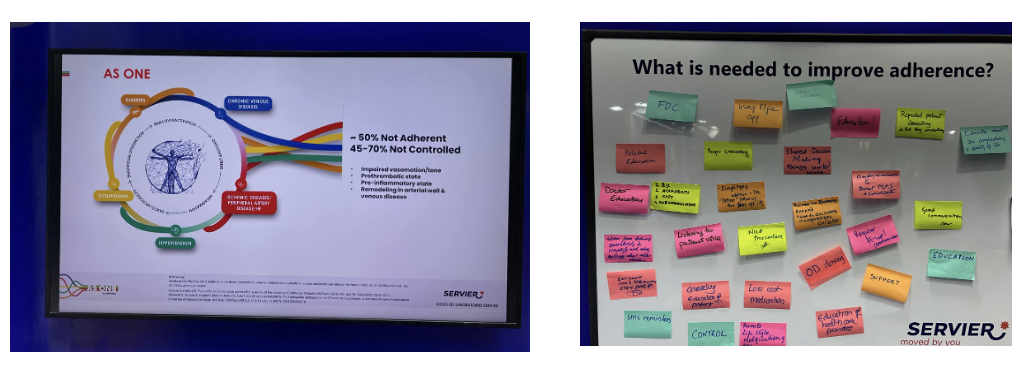
I will point out that the IDF obviously understands the impact of stigma on people with diabetes and the harm it causes. There were sessions at the Congress dedicated to diabetes-related stigma and how to address it. In fact, I had been invited to give one of those talks. But what is disappointing is that despite this, terminology that contributes to stigma is being used without question.
I wasn’t at the Congress but from what I saw there was indeed a vibrant lived experience cohort there. #dedoc° had a scholarship program, and, as usual, there was a Living with Diabetes stream. However, I will point out that the LWD stream was not chaired by a grassroots advocate as has been the case for all previous LWD streams. It was chaired by a doctor with diabetes and while I am in no way trying to delegitimise his lived experience, I am unapologetically saying that this is a backwards step by the IDF. When there is an opportunity for a person with diabetes who is not also a health professional is given to a health professional or a researcher, that’s a missed opportunity for a person with diabetes. There were seven streams at the IDF Congress. All except for one are 100% chaired by clinicians and researchers. Only the LWD stream is open to PWD. I know that when I chaired the stream, the four members of the committee were diligent about looking through the entire and identifying any sessions that could be considered problematic for people with diabetes. It appears that didn’t happen this time.
All of this points to a persistent disconnect. It is undeniable that the language matters movement is growing, but it is still not embedded across the board—even within organisations that should know better. If we are serious about addressing stigma and centring lived experience in diabetes care, then language can’t be an afterthought or a debate to have after the posters are printed and the sessions are underway. It must be part of the planning and the review process. The easiest way to connect the dots is to ensure the lived experience community is not only present, but also listened to, respected, and in positions to influence and lead. We are long past the point where being in the room or offered a solitary seat is enough – the room is ours; we are the table.
Postscript:
I have written extensively on why language – and in particular the word ‘adherence’ – is problematic. It’s old news to me and to many others as well. This piece isn’t about that. But if you want to know why it’s problematic, here’s an old post you can read.
Disclosures:
I was an invited to give a talk about diabetes-related stigma at the IDF Congress in Bangkok, but disappointingly, had to cancel my attendance due to illness. The invitation included flights and accommodation as well as Congress registration. I was also on the program for two other sessions and was due to present to the YLD Program.
Other IDF disclosures: I have been faculty for the YLD Program for the last 10 years; I chaired the LWD Stream at the 2019 Congress and was deputy chair of the 2017 Congress.
‘A fire has been lit.’ They were the words I wrote in my first post about AID access in Australia earlier this year.
There are some truths about grassroots advocacy that I have always known to be consistent. It has to come from community. If the issue isn’t important to a significant number of community members, nothing will happen. Advocacy efforts are truly organic. To be real and honest to the consultation process, there cannot be any pre-conceived ideas about the results of that consultation. Or rather, there needs to be an acceptance that agility and swift pivots are necessary if that is what the community directs. And there needs to be meaningful engagement every step of the way, with a genuine belief that expertise lies with all stakeholders, in particular people with lived experience. I am so pleased that this was the foundation and ran through every single step of the way with our AID grassroots advocacy over the last few months.
After months of working and meeting with the community, it was time to bring all stakeholders together. In May, I was so honoured to co-chair the National AID Access Summit with Professor Peter Colman. Again, this was always part of the plan – a clinician and a person with lived experience chairing the meeting to signpost how critical it is to have input from different cohorts. Unashamedly, we had almost as many people with lived experience as others in attendance, because that’s the way to centre people with diabetes. We also had independent facilitators directing traffic. This was important because we didn’t want there to be ownership of this work by any individuals or organisations. This wasn’t anyone’s show; it wasn’t anyone’s vanity project. This was a community endeavour. You know, with and by for people with T1D, not for us!
The outcome from the Summit, and the work that led to it, is a consensus statement that offers clear, concise recommendations. Stars aligned, and the statement was completed the same week as the Parliamentary Inquiry into Diabetes report was tabled. And that alignment was even more significant, when our recommendations neatly mirrored those in the report.
The consensus statement can be accessed and shared here, as well as from the survey for equitable access to AID that has been signed by almost 6,000 people.
Now, it’s over to the community. We have recommendations from the parliamentary inquiry, but that’s not enough. It’s now time to do the work to turn that into policy. And that’s where people in the community come to the fore once again. Today, I wrote to my local MP to ask for a time to meet with him, sharing with him the consensus statement. I am going to highlight just how important this tech is and how it’s not fair that only those of us who can afford it have access. The better outcomes AID delivers should be available to everyone with T1D, not just those who can afford private health insurance, or meet the eligibility for our Insulin Pump Program.
If you’re interested and able to get involved, please do. It is the groundswell of community efforts that has in the past seen some truly remarkable results. If we look back to the path to CGM access for all people with T1D, the community stepped up in truly remarkable ways. It took time, and it took energy, but we got there because people with diabetes never stopped pushing for it. Being able to access CGM really mattered to people with T1D and their families and that drove the ‘never give up’ attitude to get it done.
Now, it’s time for all Aussies with T1D to have access to AID if they choose. This update from the Access to AID Survey has some great ideas about how you can get involved. And reach out to me if you want any ideas.

Yesterday, the Australian parliamentary Inquiry into Diabetes report was launched. After eighteen months of countless submissions, interviews, and meetings with diabetes stakeholders from across the country, the report has been handed down with 23 recommendations aimed at improving the lives of Australians living by diabetes. There was much discussion and celebration among those of us advocating for increased access to Automated Insulin Delivery (AID) systems, particularly with the recommendation to expand funding for insulin pumps, which would increase the number of people using AID. Inquiry Chair Mike Freelander expressed strong support for this initiative in his report foreword.
It truly has been remarkable to see the community advocacy seed that was planted back in March in Florence absolutely flourish. Being involved with a dedicated group of people who have worked tirelessly, all volunteering our time to develop a single-issue advocacy movement is a wonderful demonstration of community commitment. We were clear from the beginning about what our aim was – equitable access to AID for Australians with T1D, with a specific focus on addressing the AID component that wasn’t already funded: insulin pumps. With the voices of people with lived experience centred in this work, a survey was launched, community discussions ran wild, a summit was convened and run and very soon a consensus statement will be launched to assist with the next steps of lobbying to have the inquiry recommendation transformed into a policy decision. This was for the T1D community, with the T1D community and by the T1D community. Focused and tailored.
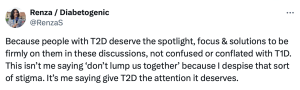
Many of the recommendations in the report focus on Type 2 diabetes (T2D), and people with T2D deserve the same focused and tailored attention. This isn’t about separating the types of diabetes and dividing advocacy efforts. It’s about targeted and impactful initiatives that highlight and address the unique challenges faced by people with T2D. There are undoubtedly considerations specific to T2D, and they should receive the attention and expertise they deserve – not be treated as an addendum to T1D efforts.
And it needs to be driven by the community. I know how difficult it can seem to find adequate representation and advocacy for T2D. When we look at the #dedoc° voices scholarship program, the number of people with T1D far outweighs the number of people with T2D. If we examine other community groups and initiatives, we see that T1D is overrepresented. But there are remarkable advocates with T2D out there already. I met some incredible advocates when I was involved in the DEEP network. There is a T2D community out there, and there will be people who not only rise to the occasion but will drive it with their passion and lived experience expertise. They may not congregate or use the same channels that the T1D community uses, or they may be less visible, but that doesn’t mean they are not there. It’s laziness on behalf of all of us who have said we can’t find people to speak or be involved in T2D community efforts. We have expected them to be in the same place that people with T1D are. Look further. Look harder. Look better. Remember what Chelcie Rice says ‘You can’t just put pie in the middle of the table. Deliver the pie to where they are.’ Deliver the pie to where they are.
This is an opportunity to move the discussion about T2D beyond personal responsibility, which is what public-facing campaigns have largely focused on to date. The stigma and blame these campaigns generate are often harmful. And one result of that stigma is community members who are reluctant to come forward. I mean, would you like to be a spokesperson for advocacy efforts about T2D if messaging has blamed you for getting T2D in the first place? I know I certainly wouldn’t.
This is an opportunity for real, meaningful systemic change that addresses failures in healthcare access, education, and prevention. Junk food advertising to kids, sugar taxes, and finding ways for the healthier choice to be as easy as the less healthy choice are all critical steps. Addressing food insecurity, socio-economic disparities, and providing better healthcare access are also necessary. All of these measures address the root causes on a large scale, rather than pointing the finger at individuals and telling them it’s their fault.
We can do hard things and be bold. But it will need a collective effort and strong leadership.
And while we’re at it, remember where to look for the innovation and advocacy that has driven change. The community. Access to continuous glucose monitors (CGMs), insulin pumps, and other advancements has all started in the community and been picked up and run with by other stakeholders to make things happen.
People with T2D deserve the same level of advocacy and support. Now seems like a fine time to do that. And as a person with T1D, I am here to support and be led by my T2D peers.
There’s been a lot said about AID equity over the last few weeks. Actually, way longer than that. The momentum may have ramped up since a meeting at ATTD in Florence, but this has been something that the community has been speaking about for ages. In fact, I found a policy document advocating for pump access for all people with T1D from ten years ago, and I spoke at its launch in Parliament House . In there is a direct quote from me: ‘I decided to start using an insulin pump because my husband and I wanted to start a family. I knew of the importance of tight diabetes management prior to and during pregnancy. Insulin pump therapy gave me the ability to tailor and adapt my insulin doses to provide me with the best possible outcome – a beautiful healthy daughter.’
For the last six years I’ve been talking about how transformative AID has been with quotes like this: ‘Short of a cure, the holy grail for me in diabetes is each and every incremental step we take that means diabetes intrudes less in my life. I will acknowledge with gratitude and amazement and relief at how much less disturbance and interruption there is today, thanks to LOOP (AID).’
But enough from me. This is an issue that the T1D community owns and is engaged in. Last week at the #dedoc° symposium at the Diabetes UK Professional Conference, brilliant diabetes advocate Emma Doble spoke about patient and public involvement, highlighting how it refers to being with or by the community, not to, about or for them. The AID equity work underway is definitely with and by. It’s something community is calling for as a priority. A visit to any online T1D group will demonstrate that, and spending any time speaking directly with community will provide insight into the number of people who simply cannot access AID because they cannot afford an insulin pump. This is standard T1D care. The evidence is clear.
To get an idea of just how the T1D, and broader diabetes community feels, have a read of their own words. These comments are from the Make Automated Insulin Delivery affordable for all Australians with type 1 diabetes petition. They’re all publicly available, so you can click here to read the comments I’ve shared and many, many more.

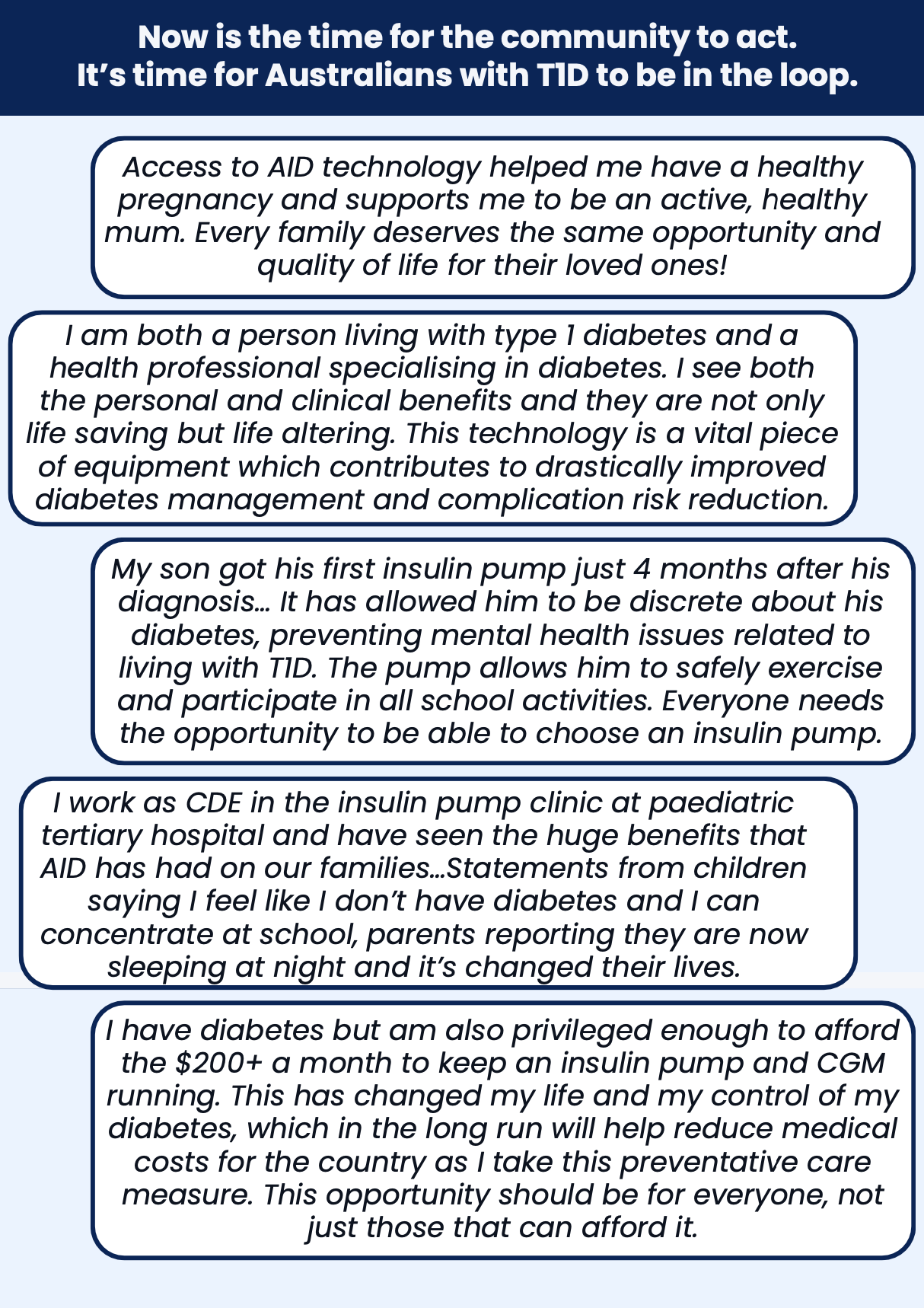
Hasn’t it been terrific this week seeing a couple of great news stories in the T1D tech world? Our friends across the ditch in NZ have welcomed an announcement from medical regulatory board Pharmac that all people with type 1 diabetes will have access to CGM and automated insulin delivery devices (AID). Meanwhile, this week saw the start of a five-year national roll out of AID in England and Wales which recommends access be granted to children and adolescence (under 18 years) with T1D, pregnant people with T1D and adults with T1D with an A1c higher than 7%.
So, where is Australia when it comes to people with T1D being able to affordably access automated insulin delivery devices?
Let’s start by highlighting the positives. There’s so much to be grateful for here in Australia. The NDSS continues to be a shining light for Australians with diabetes. Syringes and pen tips are free at NDSS collection points and BGL strips are subsidised. Since 2004, insulin pump consumables have been on the NDSS, CGM sensors and transmitters have been subsidised since 2022. Insulin is heavily subsidised by the PBS.
But even with these benefits diabetes remains costly, and the playing field isn’t level. Pumps remain out of reach for many Australians. Without private health insurance or meeting eligibility to apply for the government funded Insulin Pump Program, people with T1D are required to find up to $10,000 for an insulin pump. That’s simply not affordable and it means that Australians with T1D can’t access AID.
With AID providing real life-changing benefits and significant reduction in diabetes burden, now is the time to ensure that the tech is available to everyone with T1D who wants it – not just those who can afford it. And that means that it’s time to equitably fund the missing piece of the AID puzzle: Pumps.
A fire has been lit. From a small meeting at ATTD in Florence to catch ups, coffees and phone calls back home, the groundswell has well and truly started. People with diabetes are central to this, working closely with motivated and determined HCPs and diabetes community organisations. There is a united focus on what needs to be done: affordable insulin pumps so AID is a reality for every Australian with type 1 diabetes who chooses. And excitedly, there seems to be an appetite for this from policy makers.
So what can we learn from the recent successes in NZ and the UK? Well, it’s exactly what we know from our previous advocacy experiences and wins here in Australia. A united stakeholder approach is critical with everyone from individuals with diabetes, community groups, diabetes organisations, professional bodies, researchers, industry all being clear and consistent about the ask. Simple and effective communication about the issue is needed. Community drives the momentum – it always does and recognising that is essential. Using evidence to support why AID must be available to all with T1D is important, and goes perfectly with sharing examples of lived experience to highlight the benefit of the technology. Hearts and minds.
With the push already well established and a number of people powering the charge, it’s inevitable that the diabetes world in Australia is going to be hearing a lot about equitable AID and pump access in coming months. Keep an eye out on community groups for grassroots efforts to elevate the issue and for calls to get involved. We know that we can get this done – just as with getting CGMs funded for all people with T1D, for finding a novel way for Omnipod to be funded, and for Fiasp remaining on the PBS. (And, if we look further back, for getting pump consumables on the NDSS.)
Community will be critical to getting this across the line. Once again, we’ll need people with diabetes to step up and write letters, meet with local MPs, make noise, and show why this is necessary. Every single person with T1D and their families has a role to play here. If you’re already fortunate to be using AID, meet with your local MP and tell them how it has changed your life. If you haven’t had access, write about why you know it will help. For me, I’ll be talking about how much time I have grasped back not needing to do diabetes, how I have far fewer hypos, how I have an A1c in the ‘non-diabetes’ range which evidence suggests reduces my risk of developing costly complications. But most importantly, it has reduced my diabetes burden so much and that makes me a far happier, more productive person. And I want that for everyone with T1 D.
Postscript: a quick word (or two) about language. Media reports, especially in the UK, have incorrectly referred to the technology as an ‘artificial pancreas’. What we are talking about is automated insulin delivery devices (or hybrid closed loop systems). It’s important to get the language right for a couple of reasons: Artificial pancreas is simply not the correct term for what the technology is. It overstates what it does and potentially leads people to think the technology is a cure for T1D. Additionally, it underestimates the work that PWD do to drive the technology. More detail about why getting the terminology right is important can be found in this piece I wrote back in 2015 about the same issue and then again here from almost exactly two years ago.)
I’m introduced most generously by Adrian Sanders, Secretary General of the Parliamentarians for Diabetes Global Network.
Just what is the emotional labour associated with living with a life-long health condition like diabetes? I’ve been thinking about it a lot this week, firstly because I was asked to give a talk about it to a group of researchers to help them understand barriers they may experience with getting participants into their research. It was a great discussion, with plenty of questions and hopefully a new understanding of the burden diabetes unleashes on us. And then, I thought about it when I was feeling the weight of that burden – more so than usual.
The emotional labour of living with diabetes is a complex, often invisible force, shaping our lived experience in profound ways. It’s the mental and emotional effort we put into the never-ending demands of the condition. It’s accompanied by an inner dialogue that asks if we’re doing enough, trying enough, feeling enough, being enough. It comes on top of the physical labour of doing diabetes, which in itself, is significant. It’s an ever-accruing emotional toll of being perpetually alert, constant decision making and wondering how those decisions might impact our immediate and long-term health and wellbeing. The emotional resilience required to do diabetes each day is an additional burden of itself, the sum of all these parts equalling an unforgiving weight that, at times, just feels too damn heavy to carry anymore.
But it doesn’t end there. Living with diabetes is an act of advocacy in itself, even if that advocacy is for ourselves alone and whether we use the word or not. Some people who take on advocacy issues and causes, leading efforts, participating in them, speaking about them. Whether involved in advocacy as a paid day job, consulting-type role, voluntarily, or a hybrid version (me), all of it adds to the emotional labour of diabetes.
Of course advocacy can be energising – striving for better healthcare, pushing for more understanding, and campaigning for supportive policies are endeavours close to our hearts and seeing efforts result in stunning outcomes bolster our energy levels. Working together with others with diabetes to change our communities is motivating. But it can also be exhausting. Each act of advocacy draws from our already limited reserves. The constant need to explain, to justify, to fight for our rights and needs can lead to burnout, leaving us feeling drained and disheartened in a fight that seems unending.
That’s where I spent a lot of this week: drained, disheartened, devastated and frequently teary with the weight of advocacy casting a long, dark shadow.
I know that this is something people with diabetes speak about, and the mental health of diabetes is finally on agendas, but it still needs to be said that being adjacent to diabetes, or being a champion for mental healthcare doesn’t offer a true understanding of just what it feels like. The best allies I know are the ones who recognise this gap in understanding and do all they can to ensure they don’t add to it and try to learn by stepping back and not overshadowing our voices or efforts.
One of the ways people with diabetes have attempted to deal with this labour and resulting burnout is to build peer communities and networks. Solace from the weight of diabetes can be found in others with shared experiences in sanctuaries where our struggles don’t need to be explained but they are deeply understood. These are safe spaces where we exchange stories, share tips, and buoy each other’s spirits. These communities become a wellspring of support and encouragement, where our emotional labour is shared, and our advocacy efforts are collectively bolstered. Safeguarding those spaces is essential if we’re to draw strength from them rather than find ourselves being overwhelmed by them.
In recent years, I’ve found myself becoming more and more selective about where I find that support. Twitter was probably the first to be left behind as I no longer found it a safe space. I’m reminded of that any time I venture back an innocent tweet about my own diabetes choices is attacked from some low carb bro. I replaced the openness of social platforms with closed group chats of others with diabetes, knowing that the support was there without the risk of trolling. Those chats provide the light to guide my way through the shadows.
This week, with the heaviness of all that is diabetes weighing me down, it has been difficult to find that light. The networks I have are always there, but even that is sometimes not enough when everything is overwhelming. Hosting this week’s #docday°, and hearing from advocates from around the world doing incredible things wasn’t enough to help me see clear. I thought of how to push through this, and I don’t have an answer. Except this: One of the things we do so well in our community is lift each other up because our community and other people with diabetes are everything. And so, even while I am feeling weighted down, I can focus on that. And hope that in amplifying and cheerleading my peers with diabetes and their efforts, I’ll rise too.
Two community things you should know about…
Spare A Rose, Save a Life is continuing to accept donations here. Thanks to amazing advocate Tinotenda for driving this year’s campaign.
Sign and share this petition and read the consensus statement initiated by a group of #dedoc° voices which is calling for uninterrupted insulin access in humanitarian crises. Congrats to Lucia for coordinating this work.

Ten years ago, Australian Prime Minister Tony Abbott appointed himself as the Minister for Women. Much has been written about the message this sent and what the government of the time really thought about women, despite the carefully framed rhetoric being spewed in press releases and at doorstop press conferences. But this post is not a lesson in Australian politics. It merely sets the scene for me to speak about the underhanded ways that those whose voice should be heard are silenced.
Diabetes advocacy sits in an environment that often resists the voices of those most affected by diabetes, at times in somewhat sneaky ways. A wolf in sheep’s clothing in advocacy comes in the form of anyone claiming to advocate by ‘being the voice’ of people with diabetes, which is problematic not least because we have our own voices and don’t need others to speak for us. Being adjacent to diabetes does not give anyone license to speak on our behalf. In fact, the very idea that anyone thinks that they can represent those who should be centred is offensive.
It matters, by the way. When our insights are not the ones being heard, we find ourselves in a cycle of misunderstanding and misrepresentation. Our perspective must be heard because it is inevitably comes with the reality of diabetes. When a person with diabetes is asked about why we need to invest in better diabetes care, have better access to drugs and technology or improve funding in diabetes research, we will speak of how improved care leads to better engagement with our healthcare professionals, reduced emotional load and the resulting increased time we can spend with loved ones and being productive at work. We will speak about how increased access can equal decreased burden for us and what that means in our real lives. And we will speak about how research is the gateway for us to have better understanding of our diabetes, helping us make more informed decisions, and speak to how research has changed our lives to date. We speak about hope authentically because we hold onto it with both hands.
Someone speaking ‘on our behalf’ will inevitably focus on reducing burden to the health system (which often makes us feel as if we’re to blame for overwhelmed and overrun hospitals and adds to diabetes stigma) or resort to listing diabetes-related complications, a familiar trope that sounds like a shopping list that does well to scaring us! I spent years being a spokesperson for diabetes organisations and always ensured that the reality of day-to-day diabetes was part of the discussion, not just the rehearsed talking points that tell nothing of the people behind the numbers. Even more importantly, I learnt very early on in my own advocacy when it was not my voice that should be heard and ensured I had a network I could reach into to find the right person. I estimate that about ninety percent of the time I’m asked to give comment, I point whoever is asking in the direction of someone far better positioned to share their lived experience.
This year brought with it a new role where it was essential that I step into the background. I now find myself in the incredibly fortunate position of working with unbelievably brilliant grassroots and community advocates doing truly life changing work with people with diabetes across India. I am not here to tell their stories or about their work. I wouldn’t do it justice – I have more than enough self-awareness to know that. I recognise that they are the protagonists of their narrative. They are the ones doing living the experiences, doing the ground-breaking work, and pushing for change. My responsibility is to be an ally and a supporter, doing what I can to amplify their voices rather than overshadow them. Perhaps this speaks to my own confidence in my abilities as an advocate that I don’t feel threatened by others who are raising their voices. Effective advocacy thrives on collaboration and shared leadership, and I admire those in the advocacy world who willingly take a step back. I think it’s fair to say that others also see those who do that; and also those who do not.
There are more insidious and damaging ways that our voices are silenced. Let’s go back for a moment to our former Prime Minister. I said earlier that he made himself Minister for Women. Except, he didn’t. In fact, he abolished the position and moved it into the Office of PM and Cabinet, removing the seniority and decision-making powers it had previously held. Sure, he appointed Michaela Cash as an advisor, but this was no more than an exercise in tokenism. The reality was that the PM would have final control over decisions affecting women. Abbott bristled when questioned about his decision, refusing to listen to the myriad women and women’s groups criticising the move, instead responding defensively.
I use this as an example when consulting organisations about effective engagement and how to address commentary from the community they work with and for. Receiving criticism can be uncomfortable. However, by being open to how community responds and the feedback they generously offer, it is an opportunity for improvement and collaboration, rather than a threat to be neutralised. It’s incredibly disappointing when organisations respond by attempting to discredit or question the motives and expertise of those with lived experience or suggest that negative comments are part of efforts underpinned with ulterior motives. It’s disheartening to hear implications that individuals offering critical perspectives are merely being influenced by others, disregarding their ability to form independent thoughts and opinions. This is simply another way that community voices are effectively silenced, and proves to the community that contributions from those who should be heard are not valued at all.
I speak a lot about allyship as a pivotal force in including and amplifying rather than excluding and silencing the voices of those with lived experiences. Allyship is an active commitment to placing people with diabetes at the forefront of conversations; featuring them in all levels of decision making; putting them in the rooms where things happen. True allyship involves listening to and acting upon the needs and concerns of people with diabetes, even when what is being said is difficult to hear. What it isn’t is fantastic window dressing. We see right through that.
I wrote this piece while listening to Black Oak Ensembles 2019 album, ‘Silenced Voices’. It’s stunning.





 Diabetogenic