
You are currently browsing the category archive for the ‘Devices’ category.
My first car was a 1970s Fiat 128. It was bright yellow (‘limone’) and was my pride and joy. It cost me under $2,000 back in 1993 and it remains the coolest car I have ever driven.
I longingly think back to the days of driving around in a little zippy car that was bright and fun. Other Fiat drivers would toot their little horns when they saw me on the road, and I would raise my hand in a friendly wave of vintage-car solidarity.
But it was very basic. There was absolutely nothing fancy about this car. In fact, today, it would struggle to pass a road-worthy check.
I had to keep a little container of spare fuses in the glove box because the electrics were shot. When it rained, the wipers would stop working. (Useful, I know!) As water leaked through the bonnet and onto my shoes, the wiper fuse would blow after sparking dramatically. I became incredibly efficient at reaching over and into the glove box stash for a new fuse, removing the dead one from the fuse box located just under the steering wheel, and replacing it with one that would get my wipers swiping again. All while continuing to drive through the rain, squinting through the water droplets on the windscreen until the wipers sprung back into action and I could see properly again.
Oil needed to be checked daily as it would frequently leak from the engine, and I was terrified of blowing the head gasket if I let the oil tank run dry.
The speedometer read in MPH, so I had used specks of Liquid Paper to mark 60kms and 100kms in a lame endeavour to remain within the speed limit – something that I only did rarely anyway.
I developed enviable muscles in my upper arm steering the little thing because power steering hadn’t been invented when this car was built.
And, of course, it was a manual car, because automatic cars were for wimps who didn’t know how to drive. This idea was beaten into me by my cousins who taught me to drive on the winding Kew Boulevard near home with no instructions other than ‘Don’t brake around corners. And don’t go below 60KPH’. I learnt to drive with the attitude and confidence of a Roman taxi driver.
I grew up being driven around in Fiats and Lancias. Even now, my dad drives an Alfa Romeo. So does my sister. And most of my extended family. These days, when I drive up to family gatherings in my sensible German-made car, they look at me with pity, and then turn away as they continue to look at their stylish reflections in the stylish windows of their stylish Italian cars.
The kidlet has already decided that her first car will be a Fiat Cinquecento in pale blue. I think she is ashamed and embarrassed to be seen in my boring and decidedly uncool silver Merc, preferring a zippy little Italian number so she can legitimately shout obscenities at cars driving too slow on the road while waving her hands at them. (#HerMothersDaughter)
These days, I drive an automatic car that pretty much does everything for me. It alerts and alarms and warns me if there is anything likely to interfere with my driving. It reminds me when it needs servicing, and is easy as easy to drive. Everything is programmed and instinctive, and perfectly set out, in brilliant, efficient, modern and safe German order.
In fact, my car today operates much like the diabetes tech I use: the latest equipment; the most efficient. I was an early adopter of pump therapy, one of the first people to start using CGM here in Australia, and have always liked to have the newest and snazziest BGL meter in the little Marimekko purse in my handbag.
I have no sentimental feelings towards any of my tech – I’m more than happy to ditch whatever I am using as soon as something newer, faster, brighter, smarter comes along.
I can’t for a moment imagine wanting to go back to using diabetes tech from 1970 (was there any diabetes tech in the 1970s?), but the thought of my mid-seventies Fiat makes me swoon. It was also a time before diabetes. Maybe the rose coloured glasses that are firmly placed on my face when thinking about my Fiat, also reflect a time when I didn’t need technology to keep me alive.
The other day, I saw a little yellow Fiat like the first one I owned. They are pretty rare these days and I get incredibly excited when I see one. I was in my car, stopped at a set of lights, and there, in my perfectly aligned, safety-glass rear-view mirror, I saw a flash of yellow. The Fiat pulled up next to me on the passenger side of my car. There in the driver’s seat was a woman about my age. She looked over at me and I smiled.
I flashed back to being 19 years old, driving around Carlton feeling like the coolest kid ever, without a care in the world. I didn’t have to think or worry about diabetes then. I didn’t have to check my BGL before starting the engine. Or make sure I had a supply of hypo foods hidden away. I didn’t have to wonder if I was going low on a long trip and pull over and check my glucose levels to make sure I was safe to keep driving.
In fact, the only thing I had to check before I got in the car was that I looked sharp and cool. Oh and that I had enough fuses in the glovebox for the fifteen-minute drive to Uni!

22 years ago! My gorgeous little Fiat 128. And me looking like an extra from ‘Friends’ in my 1990s jeans!
The other night, I drove through the pouring rain to Geelong to speak at an information session for healthcare professionals about CGM technology. The event was run by AMSL, the distributors of Dexcom here in Australia (the disclosure song and dance can be found at the end of this post).
I sat on the panel with Dr Natalie Harrison, a terrific local endocrinologist (oh – how’s THIS for a bit of disclosure – we went to kindergarten together!!) and paediatrician and diabetes technology champion, Dr Peter Goss. I was there to bring the overall IQ of the panel down, share the ‘living with CGM’ story and be the point of difference between the glossy information presented by the CGM company.

On the left – the numbers of all readings in the glossy propaganda (it’s about 6.2 in our language). On the right – real life.
Both presentations by the doctors on the panel were enlightening. They clearly showed how CGM could be used in a number of different scenarios. The thing I particularly enjoyed was how both speakers are using this tech as tools of empowerment for the adult or child with diabetes – not for any other reason. Both repeatedly said that although in most of the cases they presented, there was a reduction in HbA1c, the biggest benefits to the PWD was improved quality of life. (I may have done a little fist pump each time they mentioned that!)
Examples included shift workers, tradies working on construction sights, exercise nuts, kids, adults, teens – demonstrating a terrific cross section of the diabetes community who may – and indeed have – benefitted from the technology. There was also a discussion about how CGM is useful in specific target groups and situations, with a considerable time of the discussion being about low carb diets and CGM. (And can I say just how refreshing it was to have this discussed with little judgement from the speakers. Too often LCHF or just LC is dismissed by healthcare professionals without any willingness to accept that there are many people who are using this as part of their diabetes management and achieving excellent results.)
Dr Goss also mentioned how useful CGM tech can be for families where ‘dead in bed’ is a real concern because it can show families just how stable glucose levels usually are overnight, and therefore may help reduce a lot of the anxiety parents feel. (There was also a discussion about the significant emotion around DIB and how it is frequently overplayed. This is really important because while one person dying from DIB is one person too many, it is thankfully a very, very rare occurrence (as shown in all local and international literature). The fear and the risks need to be in perspective and unfortunately, that is not the case at all times, and the anxiety it is causing is unnecessary.)
After the official, smart speakers finished, I stood up. At this stage, the AV equipment had called it a night, so I put aside the few slides I had developed, and shared a few things.
I spoke about why I love this technology and why I choose to use it pretty much all the time. But I also spoke about its limitations – specifically the emotional and psychological barriers that are of concern. I raised the point that reluctance to use CGM by PWD could be for myriad reasons and to never assume what that reason is (this was in direct response to the suggestion from one of the speakers that often PWD refusing to wear CGM have something to hide). I suggested that for some, it is a huge step to agree to wear something attached to one’s body all the time – something that provides a lot of confronting information, beeps, alarms and can be downright annoying. This is not a small consideration – it is big!
I also spoke about the necessity to customise just how PWD use the technology. I explained how I turn alerts on and off, depending on how engaged I am with my care. I could see that didn’t sit well with everyone so I tried to explain that being able to deal with – and respond to – a couple of alerts, is better than having the all on and doing nothing because it is too overwhelming. Or simply not wearing the technology at all.
And I also spoke about how what I do to make CGM work for me, even if it is against the direct advice of the company – and HCPs. Case in point, my sensor and transmitter are on my arm at the moment. I have found that recently, I get better readings and the sensors last longer if that’s where I site them. I also leave the sensors in for a lot longer than the suggested 7 days. (Peter Goss concurred with both those statements saying that most of the children and adolescents he sees prefer to wear sensors on the upper arm. And there was a bit of a ‘who leaves their sensor in the longest’ discussion, with Dr Goss sharing that the record in his clinic is 26 days. I did disclose that while I have a mental block about going beyond 21 days, I know people who have doubled that!)
This is why it is important to hear directly from people who use the technology. While both doctors shared case studies, the focus was really on how CGM helped smooth out glucose lines. And of course that’s important. But equally important is the way we manage the technology in our life, because if we can’t find a way to get it to work for us, we won’t wear it. After the presentations, a couple of HCPs thanked me for being there and said that I had raised a number of things that they just had not considered before – all things that are usually missed when a PWD is not part of the discussion.
And it served as a reminder again that even though it is terrific to have people with diabetes represented in some ways in presentations at these sorts of events (or conferences, meetings etc.), the only way to hear the real story is to hear it from someone living it.
Thanks to AMSL for inviting me to speak, but more so, for putting a person with diabetes up there on the panel. We belong there.
Disclosure
I was invited to speak at this event by AMSL Diabetes, Australian importers and distributors of Animas and Dexcom. I was provided with product to speak at this event…. The team from AMSL did not hear or see my presetantio prior to the evening and the only direction I was given was to share my experience of using Dexcom. Which I did – the good, the bad and the ugly.
(For the record, although not really relevant, but I’m disclosing the crap out of everything here, I also use an Animas pump. That was wholly paid for by my private insurance company whose premiums I pay each fortnight through clenched fists of frustration as their premiums continue to rise. I also pay for the ongoing consumables needed to drive said pump.)
I am not the sharpest tool in the shed sometimes. In fact, there are many times that I wonder how I have managed to get to this stage of my life without doing some permanent damage, or embarrassing myself so monumentally that I could never leave the house again without wearing a disguise.
But even though I am sometimes a sandwich short of a picnic, I am still able to decipher between high and low blood glucose levels and understand what constitutes in range, below range, above range, stratospherically-above-range-so-do-something-now and about-to-plummet-to-new-depths-if-you-don’t-mainline-glucose (the last two are highly technical terms).
Yesterday morning, I woke up with a start and within 2.1 milliseconds, realised I was low. Really low. I reached over to my bedside table and scanned the Libre reader across my arm to this:

There is some really useful information on that screen. The large font-size numbers confirmed my ‘I.Am.Low’ predicament. The graph is also useful (perhaps not while my glucose is sitting at 2.3mmol/l, but later on I was able to look at it and try to work out the reason for the rapid drop from 1am). The red line below my target range is also useful because it shows how long I had been floating around there before I woke.
The piece of not so useful information is the alert in the top left hand corner. A warning sign with the words ‘Low Glucose’
This is not only on the Libre. If I try to bolus on my Animas pump when my BGL is above range, the delivery steps are interrupted so that I can be told that I am high. I know, Sir Pump-a-lot. That’s why I am pressing buttons. I need you to do your thing and give me some insulin. It makes absolutely no sense to halt the process right now to remind me I am high.

I know I sound like I am whinging for the sake of it. I could just ignore the messages and focus on the fact that this great tech is helping me manage my diabetes is a really useful way.
But the problem with these little messages is that they are a constant reminder of how frequently I am out of range. It’s not enough just to see the out of target number, but my devices then do a little ‘ner ner ni ner ner’ song and dance about it too.
It makes me feel that a lot of time I am messing up and failing – because a lot of the time my numbers are not where they need to be. The last thing I need is to feel that my bloody diabetes tech is judging me. There is already enough of that in diabetes.
I have now been wearing the Freestyle Libre flash monitor for ten days and have some initial thoughts to share.
I wasn’t sure what to think of the Libre before using it. I had heard stories of people absolutely loving it and other tales of people not really being all that impressed. I was certainly excited to try it, as I am with any new technology and was interested to see how my experience compared with friends who had already had a go.
I went in with a very open mind, albeit a mind that has been completely and utterly won over by Dexcom and CGM technology.
Overall, I love this device and can see why, where and how it would be brilliant for some people and now, after a week and a half, have a better idea of where it fits in my diabetes management.
The Good
The insertion was simple. I could go into a whole lot of detail about how it works and what it looks like, but a very clever young lady has made a very cool video of it and she is far cuter than me. You can see it at the end of today’s post. (The caveat to this is that Ms Pumplette in the video is under 18 years and, at this stage, the Libre only has TGA approval (i.e. in Australia) for adults.)
I will just add that it was completely painless for me. As in: Did. Not. Feel. It.
The device is discreet. I have mine attached just under my upper arm, so it is completely hidden, even when wearing a short-sleeved shirt. This placement also means less likelihood of ripping it off on a doorframe or similar. The profile of the Libre sensor is fabulous – tiny, flat and completely unobtrusive. (But if you would like to pimp it, of course there is a cottage industry making lovely patches to stick either over the top of the white disc, or to augment the tape around it.)
I have found the device to be incredibly accurate – when compared with both my BGL meter and Dex. We were warned that new sensors could take up to 24 hours to start to read accurately, however I found the new Libre sensor to sync with my devices as soon as the 60 minute warm up period was over.
Obviously, one of the biggest selling points of the Libre is its convenience and there is a lot to be said for the incredible ease of just scanning a device over my arm rather than doing a BGL check.
I had a couple of Dex-less days and found that the Libre was brilliant, especially considering that within 2 hours of my last Dex sensor dying, I had a horrid hypo that left me feeling vulnerable and scared and more than a little fragile. I had the Libre scanner in my back pocket (replacing my iPhone as the reader for my Dex) and was scanning every 30 minutes or so which was very reassuring.
The less good (I am reluctant to use the word bad here)
The cost is going to prove prohibitive, with sensors coming in at $95 each, which is above both Medtronic and Dex sensors. Being factory set, there is no possibility of extending the 14-day sensor-life. I’ve not used Medtronic sensors for a while now, but from what I read, most people get a max of 14 days out of theirs. I get about 21 days from a Dex sensor – at which point I rip it out because I start to get a little grossed-out. (But I do know people routinely leave theirs in for longer.)
The reader/scanner for the Libre is $95 and is rechargeable. This is certainly a point of difference when comparing with CGM transmitters, which have a battery life of either 3 or 6 months (depending on the product you use), and cost significantly more. (Add a CGM receiver to the cost and the price goes up a whole lot more.) This is where the affordability of the Libre runs rings around the CGM devices.
I just want to quietly flag supply issues which I hope will not be a problem here in Australia. The Libre is not quite available for purchase here in Australia, but is only weeks away. At DX2Sydney, I asked if there are any supply concerns similar to those that plagued the product’s release in the UK and EU and was assured that there really should not be here in Australia. I suspect that part of the reason the launch was not immediately after TGA approval was to make sure that there would be product available.
The verdict for me
So, is this a product I would continue to use? Well, yes. And no.
I really like and I trust the Libre. Accuracy for me is THE most important measure when it comes to any diabetes device (whether that be measuring my glucose levels or delivering insulin). From that perspective, I found this to be a winner.
But the lack of alarms is a problem for me. As someone with impaired hypo awareness, being able to catch those lows is important and I can’t do that without a system that warms me. The Libre doesn’t do that.
HOWEVER – this is not a CGM device and therefore, I understand I need to frame it in that way. This is a replacement for BG monitoring and BG monitors do not alarm and I have no expectation that it will. Despite being a sensor, the Libre is meant a substitute for finger pricks and meters. Currently, I check my BG twice a day to calibrate my Dex. If I was not wearing CGM, I would absolutely use Libre over a BGL meter any day.
Pumplette talks Libre
DISCLOSURE (again!!)
DX2Sydney was being coordinated and run by Abbott Diabetes Care. The costs for me to attend the two day event (travel, accommodation, meals and transfers) were covered by Abbott. All attendees received Freestyle Libre products (one scanner and two sensors) so we could trial the new device.
There was no expectation that I would write about the event or my thoughts of the device. Abbott may have paid for me to attend, but they did not pay for my words on this blog, social media activity or anywhere else. I like to share, so that’s why I decided to write about my experience.
Day two of #Dx2Sydney is about to kick off. Yesterday was about getting to know just who is in the room, as well as getting an idea about the product and yes, we all did get to trial it last night and most of us are now sporting little white discs on our arms. I am slowly, but surely, making my transition to droid with three medical devices stuck on my body.
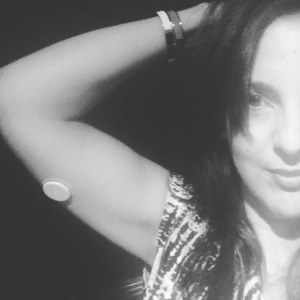
The droid you’ve been looking for…
Some of us have been commenting on our SoMe feeds already about the event, so I thought I’d quickly put together a list of who is here so you can follow along. There are eight Australian bloggers here and I’d encourage you to support our local talent and have a read (not only about this event – which they may or may not write about).
Ashley at Bittersweet Diagnosis
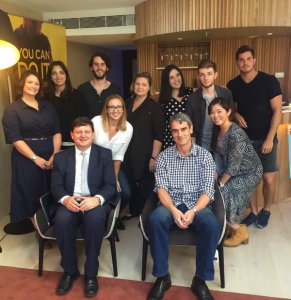
There have been a fair bit of tweeting throughout the couple of days, so you might want to jump on Twitter and check out #DX2Sydney.
Also, lots of people are asking about launch details (including costs) of the Freestyle Libre. The Abbott website has all the information you need.
DISCLOSURES
As explained in yesterday’s post, travel, accommodation, meals and transfer costs have been covered by Abbott. And all attendees have also been given two Freestyle Libre sensors and the reader.
I may write about my thoughts of using the Libre device after I’ve trialled it for a while. I might not. Abbott have no input to the words I may write.
 I’m in Sydney for the next couple of days for the Diabetes Exchange (DX) program hosted by Abbott Diabetes Care. The event which runs over two days is part of Abbott’s global DX initiative which aims to bring together diabetes bloggers from all over the world. The Sydney event follows on from the initial meeting in Berlin, and next month, there will be an EU event, this time in Stockholm. (How’s your French? Google translate may be able to help you with this wrap up of the Berlin event from my dear friend Andrea.)
I am terribly excited about the Sydney event for a few reasons. Firstly, it’s all about the tech. Make no mistake, we’re here to talk about the Abbott Freestyle Libre monitoring device which (finally) received TGA approval earlier this year and will be launched into the Aussie market in the very near future. It’s exciting technology – and how clever are Abbott in bringing together a group of bloggers who may just share their experience (of both the event and the device) with others?
I am also excited because I will be surrounded by my peers – others who also live with diabetes. I will be with old friends, others that I only know in the 140-characters-or-fewer world of Twitter and others that I have never met (in real like or online) before. I am especially excited that it is an Australian event because it is always fascinating to see and hear the close-to-home perspective and just how different it can be even though we are accessing the same health system while living with same health condition. (I’m also thrilled to be in a room full of Aussies because it means I won’t spend a significant part of the day asking ‘Does that translate?’ as I try to explain something that makes absolutely no sense to anyone from Europe, the US or the UK.)
I have been very fortunate to sit around tables around the world at similar events and the power and value is not because we all agree with each other. In fact, the real magic happens when there is respectful and robust discussion where everyone is given the opportunity to safely share their experience and perspective. I so hope that is the outcome of the DX2Sydney meeting.
I am facilitating DX2Sydney, which is terrific because it means I don’t have to say much. I mainly get to listen and hear others’ thoughts. The agenda is packed full of interesting topics and there is plenty of time for tangents and questions. Well done to Abbott for bringing us all together. This is a terrific opportunity for us as bloggers, but it is also such a brilliant opportunity for Abbott to get some valuable insight into working with PWD. We have a place at this table; there is no issue with industry and PWD talking, engaging and sharing. I’m so pleased to be here to do that!
Our Aussie blogging community may be small – and this may be only the second time that a group of Aussie diabetes social media influencers have been allowed in a room at the same time (the first time being Diabetes Victoria’s innovative Diabetes SoMe Summit back in 2012), but I am so pleased that we are being given the opportunity to lend our voice to the global DX initiative.
You can follow along on Twitter at #DX2Sydney. And I’ll be linking to any blogs or commentary from the other attendees in later posts.
DISCLOSURE
DX2Sydney is being coordinated and run by Abbott Diabetes Care. The costs for me to attend the two day event (travel, accommodation, meals and transfers) have been covered by Abbott. All attendees will also receive Freestyle Libre product so we can trial the new device.
There is no expectation that I will write about the event or my thoughts of the device. Abbott may have paid for me to attend, but they have not paid for my words on this blog, social media activity or anywhere else. I do, however, promise to try to keep myself nice and not swear. (But that could go pear-shaped any moment!)

DX2Sydney is being held in the ACDC suite of the hotel. Who said diabetes isn’t rock ‘n’ roll?
I have been closely watching how our US DOC friends are responding to the situation with United Healthcare insurance limiting the choice of insulin pumps to Medtronic devices only. They have effectively removed the ability for the person with diabetes to select the pump that best works for their diabetes management (at least without a flight through – what I imagine would be – a terribly arduous appeals process).
My knowledge of the US health system is rudimentary, but I do frequently read about how treatment choices are dictated by health insurers. This is absolutely shocking to me – the idea that my health insurer gets a say in what insulin I pump into my body, which strips I use to check my BGL or the device I use to administer insulin is terrifying.
While I am appalled at the insurer for their complete and utter lack of concern for the person living with diabetes, I am not really surprised. I have never felt that an insurer is on the side of the insured.
But I am very concerned at how Medtronic has behaved here, because despite any rhetoric, this is not the best outcome for, or in the best interest of, the person living with diabetes. For a company that has often shown they are genuinely interested in listening to the consumer, this flies in the face of any consumer-centric attitude and reeks of nothing more than greed.
The commentary from US DOC folks has been swift, consistent and damning, and I continue to read and learn with much interest as they eloquently and passionately plead the case for choice. I am, as I often am, inspired and motivated by the way the community comes together to fight the good fight.
But I am dismayed that there is a need for so much fighting. Living with diabetes is hard enough without having to battle red tape, bureaucracy and corporate hacks who are so out of touch with what living with a chronic condition is about.
And I also watch with fear, because I know that as much as we have freedom of choice in Australia (for now), we shouldn’t take it for granted. We know our insurers are always looking for ways to cut costs, increase profits and raise premiums.
We have already seen some insurers here take measures to make it harder to claim for a pump. There are stories of insurers insisting a higher level of cover for insulin pump rebates, instead of the basic hospital cover that was once the norm; longer qualifying periods have been introduced before a claim for a pump can be made; the number of years between upgrades are sneakily being increased in policies.
Whatever the change, it is clear the outcome for people with diabetes is that we are being screwed. We shouldn’t be too smug here in Australia as we watch from afar, because I fear it is just a matter of time before these sorts of measures are introduced here.
Here are some responses from the US DOC:
Kerri from Six Until Me (also. happy 11th blogaversary!)
Bennet from Your Diabetes May Vary
Kelly from Diabetesaliciousness
Round up from Diabetes Mine and this Storey
Marina from The Betes Organization
And finally, keep an eye on DPAC for update.
#AccessMatters
#MyPumpMyChoice
#PatientsOverProfits
My in-laws gave me a beautiful cherry tree for my birthday last year. We planted it in the middle of our garden so we could see it whenever we are in the back part of our house. A couple of weeks ago, after a particularly brutal day of blistering heat and blustery winds, all the leaves were torn from its spindly branches.
I looked out the kitchen window and saw it standing there completely naked and thought that I had killed it.
Today, it is covered with new growth and is looking gorgeous. I didn’t kill it. It just needed a little time to recover from the nasty weather and some space to regrow.
It’s autumn here, so the colours are starting to turn and as I drive home down a stunning tree-lined boulevard, golden leaves trickle down onto my car. I want to jump out and stand in the middle of the road and twirl in the leaves, which would be dangerous given that there are trams and bikes and cars. But it is so lovely.
I love watching the seasons change. I love that the red-golden-brown of autumn is just hitting here as the spring starts to hit my friends in the northern hemisphere. Friends in the UK are posting photos of daffodils and US friends are showing photos of sprouting gardens, devoid of snow. And I looked at our fireplace the other day, thinking that it wouldn’t be long before it would be crackling each evening.
We’re already over half way through March and I am pretty sure that the year will be over before I know it. And there is so much going on in the world of diabetes all the time, all over the place.
Dexcom app
Earlier this week, my US friends were all abuzz with the excitement of the updated Dexcom G5 App which, amongst other things, displayed BGL data directly to their Apple Watches, rather than the push notifications that we currently get.
I hungrily searched to find if the update had been – or was about to be – launched here in Australia, but unfortunately, it hasn’t as yet.
I am not sure when it will be here. I am not sure if it will be here. But I am bloody frustrated that it is not here now – especially considering I bought my Apple Watch in June last year for this exact purpose.
Diabetes, infertility and pregnancy loss
Kerri Sparling is a dear friend of mine and I was so pleased when she made public her exciting news last week. I couldn’t be happier for this darling girl and her family.
She bravely wrote about the infertility she had been dealing with for a couple of years and the miscarriage she experienced in the middle of 2015. I say brave because pregnancy loss and infertility is still something that is shrouded in stigma and shame. And it shouldn’t be.
When I miscarried for the first time, before the kidlet was in our life, I told no one. I was so ashamed and felt hopeless. But I decided after my second miscarriage that I would talk about it. In some cases, people were quite uncomfortable with the candour and honesty I shared. But for the most part, women were glad I had opened up and they shared with me their stories, too.
While I was certainly doing it to help with my own healing, I was also doing it because I didn’t want others to feel the same isolation and shame that I had felt.
Thanks Kerri for using your considerable reach to bring light to this issue. Infertility is terribly difficult to manage. Diabetes makes it even more so.
Diabetic Living Magazine
Check it out – I’m in there!!
Patterns
I have a love of patterns. Stripes, of course, will be my first love and rarely a day goes by when I am not wearing stripes of some sort somewhere on my body.
But I have also developed a love of many other patterns, including anything with a nautical theme, spots and gingham.
And today, I am rocking a new argyle patterned patch around my new sensor. Rockadex is an Aussie company started by a mum whose child has type 1 and offers a great selection of patches to help keep CGM sensors holding on.
Megan from Rockadex kindly reached out, offering to send me some samples of her product, but I’m a big believer in supporting small business, so I declined. And purchased some for myself. My order arrived within a couple of business days and a pile of gorgeously coloured patches tumbled from the envelope when I tore it open. Today, I’m rocking an argyle patch. Details about the product and how to order can be found here.

Rocking my Rockadex patch.
Huge world
We hear all the time that social media makes the world feel very small and how we are connected with people from around the globe at our fingertips. I say it all the time. I believe it.
Except when I don’t. This week, I am really feeling the distance between my friends in the northern hemisphere. Despite tweets and Facebook posts and even a video message, I really wish I could sit down and have a cuppa with them right now. It’s a long time until June – the next time I will be visiting the US – and even longer until September when I will be in Europe. Sometimes, distance does really suck.
For no particular reason, I wish I could feel the embrace of those friends across oceans – literally not just virtually – for a bit. I feel like I need those stores built up at the moment.
Living Well
I’m returning to my old stomping ground on Saturday, presenting at Diabetes Victoria’s first Living Well event for 2016. The event is focusing on going back to basics and there are two separate streams – one for people with type 1 diabetes and one for people with type 2 diabetes. Read all about it over at the Diabetes Victoria blog. And come along and say hi – I’m speaking on a panel in the type 1 diabetes stream!
Beautiful writing
The lovely Annie Coops always writes so, so beautifully over at her blog and this story about her diabetes diagnosis is stunning.
And more
There was an interesting piece in the New York Times over the weekend from Allison Bond, an internal medicine physician at Massachusetts General Hospital. She wrote, most eloquently, about reading patients’ obituaries gives a lot of perspective to treating doctors. There is much to love and quote from her short blog, but this particular thought caught my attention – and my breath in my throat:
‘So when patients do pass away, their obituaries are a gentle reminder that behind the illness lies a story and a unique human being. This is something that is easy to forget, but vital to remember.’
If only it didn’t take death for healthcare professionals to remember that.
I made a commitment to do the #30DaysOfDex challenge at the beginning of the year. Actually, I have been wearing a sensor continually since the beginning of December; so really, I am at about day 45 now.
I have a love/hate relationship with CGM technology. I adore it far more than I dislike it, but still, there have been times that when I simply can’t face wearing it. But that actually has nothing to do with the actual tech. I wear a device that I truly believe I can rely on – and I know that because calibrations are spot on. Even though I’ve been using this particular type of CGM for about 3 years now, I am still surprised at just how accurate – just how often – the results are.
No, the reason I don’t wear it all the time is because I have found it too burdensome when headspace is not right. When there is too much else going on or I am feeling overwhelmed, I just can’t face alarms and numbers and a machine that demands I be responsive to it.
But through some trial and error, I have found ways to lessen those demands, yet still use the device effectively.
Firstly, I’ve had to identify what I hope to achieve from wearing a CGM. Really, there are two aims: have fewer wild BGL swings and pick up hypos as early as possible with a hope of avoiding.
I also identified what I didn’t really care about and that included having a BGL sitting at 5.5mmol/l the whole time. In fact, I am not even aiming for BGLs between 4 and 8 the whole time. I raised the upper limit to avoid some alarms. I don’t want to hear screeching every time I hit 7 or 8mmol/l. At this stage, I am not interested in that. I don’t mind if I hit 10 or 11 after a meal, as long as it doesn’t sit there all day.
It’s not about the number values – for me it’s about fewer variables, because when I am all over the shop, I feel like crap.
So what have I found after a month and a half with this attitude? By and large, it’s been a successful experiment – am far more responsive to the alarms that sound now and I don’t feel frustrated. And I am able to find patterns. It is incredible how I was low or high at the same time each day without knowing it. Or rather, I probably did think it was the case, but with the data and graphs, there is no way of hiding it. I don’t log – it’s been a long time since I had – so I was relying on memory. ‘Was I low at 3pm yesterday as well? Maybe…. Was I? Or was I high?’
The thing that I have come to understand about CGM (and I may be a little slow to the party here) is that the ability to customise it means that I can find a way to benefit from it, even when I am feeling totally burnt out and can’t be bothered with the minutiae of my diabetes.
I don’t need to have a perfectly straight line for CGM to be considered successful. It’s not a waste of a sensor (and therefore a waste of money) if my BGLs do hit and play around at 10 or 11 for a while. This is kind of a breakthrough for me – I’m feeling quite proud!
Something else that has become clear while wearing CGM is that my BGLs are actually not as unstable as I think they are. Oftentimes, I am sure that I am really high, or moderately high or really high. I know that if I wasn’t wearing CGM and was feeling unmotivated, I would use that as an excuse to not check. ‘I know I am high. I don’t want to see a high number because it will make me feel worse. So I am going to bury this head of mine in this sand over here and forget about diabetes.’ Diabetes? What diabetes? Let’s build a sandcastle!
The reality is that of course my numbers are not perfect, but they are actually, most of the time, okay-ish. And I am generally okay with okay-ish! Okay-ish keeps me sane and keeps me happy.
CGM makes me think about my diabetes more. It makes me in tune with it more and it does make it easier for me to manage. Perhaps I have taken a long time to work out how CGM works for me – maybe I have wasted some time or not worn it when I could have benefitted. But for now this is what works really well. And it’s a really good way to start the year.