You are currently browsing the category archive for the ‘Devices’ category.
Last week, I spent three and a half days in Paris at the Advanced Technologies and Treatments for Diabetes (ATTD) international conference. It was the 10th ATTD meeting, and the first that I had attended. I have been to my fair share of diabetes conferences both here and around the world, but this one was definitely different. The narrow focus on technology meant that most of the attendees shared an affinity for tech-geekiness.
I was there as part of the Roche Blogger Networking #DiabetesMeetup event, (my disclosures are at the end of this post), which was a remarkable day with about 40 bloggers from across Europe. Lots more about that in coming days.
As I sat in sessions and wandered around the exhibition hall, I found myself becoming increasingly uncomfortable. The combination of being enthused, enthralled and excited (alliteration!!) at new tech and treatment advances sat trickily alongside nagging and constant reflection about the categorically un-level playing field that is diabetes around the world.
How could I happily be sitting there, hearing about automated insulin delivery devices, the value of CGM use, implantable CGM sensors that last for 90 days and big data when I had just spent weeks imploring people to donate to Spare a Rose, Save a Child? I am an ambassador for Insulin for Life Global and despair at the thought that people are dying because they can’t access insulin. And even in first world countries, access to insulin is, for some, not a given, and the thought of accessing the sorts of technologies I was hearing about may as well be a fairy-tale.
The divide between those of us in the room – those able to use the technology – and those for whom access to any sort of diabetes tech was gaping and seems to be getting bigger by the minute.
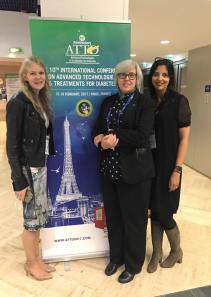
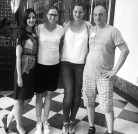
Fabulous Professor Alicia Jenkins with Annie Astle and me.
I walked out of a brilliant session about automated clinical decision support systems. It was morning tea time, so there was a break in sessions and I thought I’d find a quiet corner to try to get my head straight about how I was feeling. I looked up and there was Professor Alicia Jenkins. I knew that she was just the person to help me sort myself out!
Alicia is an Australian endocrinologist. She is a remarkable clinician, researcher and one of the best presenters on diabetes I have ever heard. Plus, she is a lovely, lovely person. Alicia is also the President of Insulin for Life Global.
I mentioned to her how uneasy I was feeling and she agreed, but with typical (and welcome) Alicia reflection, she helped me find some perspective. She reminded me that most people at the conference are very conscious of the divide, and that even while talking about the latest advances, there was still a lot of talk about access and reimbursement. There was acknowledgement that the divide is real and needs to be addressed. I looked at her – someone who is such a huge advocate for, and expert in, technology and new treatments – and realised that, actually, we can be across both aspects of diabetes care; that just because we are excited about the latest (and expensive) technologies doesn’t mean we don’t care and want to do something to help improve access of basic diabetes supplies.
By the end of the conference, on the very long trip home, I kept thinking back to our conversation. I realised that as much as it would make things simpler, I just can’t compartmentalise my own diabetes situation and how I feel about access for others. I struggle with this, because one of the really important things for me to have done all the time I’ve worked in the diabetes space has been to separate my own experience from others’.
But in this instance I can’t just leave it at ‘this is my experience and this is someone else’s’ and I think that may actually be a positive. I do find it uncomfortable. I feel guilty that I can afford and access whatever I need when so many cannot. I feel it in Australia amongst my peers and I feel it when I read about those in other countries. (Really, you should read the brilliant profiles T1 International are sharing at the moment, which give a beautifully (and sometimes harsh) personal perspective to access issues.)
I struggle with my privilege and have a constant feeling that I am not doing enough. But these feelings are a good thing. Because I can always do more. I SHOULD always do more.
I will never stop writing about these issues here and elsewhere, or talking about them. I will keep putting my money where my mouth is, because words are not enough. And I will keep advocating, using my voice and working with people trying to make a difference, until there is no difference at all between what we can all access.
Because it’s still February, I would like to urge you again to please, if you can, make a donation to the Spare a Rose campaign. For the cost of one rose (about AUD$6), you can provide insulin for a month to a child in a developing country. (Also, I should mention that last week, I was invited to join the Spare a Rose, Save a Child team; an invitation I accepted immediately.)
Disclosures
My flights and accommodation costs to attend the Roche Blogger #DiabetesMeetUp were covered by Roche Diabetes Care (Global). They also provided me with press registration to attend ATTD. My agreement to attend their blogger day did not include any commitment from me, or expectation from them, to write about the day or their products, however I will be sharing my thoughts on the event here. Plus, you can read my live tweets from the event via my Twitter stream.
I was rushing around the house getting ready – nothing unusual, nothing strange. I was talking to Aaron and the kidlet, and we were making plans to grab a coffee before really starting our day.
I walked into the bedroom and reached into my bag for my meter. I needed to silence the calibration alarm that had, for about the last hour, been reminding me that it was time to check my glucose level and enter it into my Dex app.
I sat on the edge of the bed, inserted a strip into the port and primed my lancet for use. As I pushed it against the side of my finger, I froze.
My breathing quickened and I could feel my heart rate also speeding up. My hands were slightly trembling.
I put everything next to me on the bed, shaking out my hands, as though I was trying to dry water from them.
I took a deep breath, tried to refocus, and picked up everything again.
Reinserted strip.
Lancet still primed and ready.
Finger waiting for sting.
Nope; couldn’t do it. My right hand, which was holding the lancet, just refused to do what my brain was telling it to do. It was frozen. The thumb was poised on the release button at the side of the lancet, but refused to add the required pressure to fire the needle through my skin.
I suddenly flashed back to a session I had done years ago with first year med students where they were all asked to check their BGL and give themselves a saline injection to their stomachs.
I remembered that there were a small group who seemed paralysed when asked to stab themselves. And I remembered the young person I had sat next to, gently coaxing them to have a go while secretly thinking they were being pathetic and should just bloody well get on with it.
Right then, I felt pathetic. Why couldn’t I just bloody well get on with it? I’ve have jabbed my finger thousands and thousands of times and never, ever frozen up like this – not even the first time I did it almost 19 years ago.
I put down my kit and walked out of the room. I went into the kitchen, grabbed a glass of water and drank it down. I walked out into the back garden, watered the lemon and cherry trees, inspecting all their new growth, proud that we hadn’t killed either of them. Yet.
The dogs were running and jumping around me and I reached down to pat Bella, and then sat down for a moment, raising my face to the sun and letting the sunshine warm my skin. My breathing had returned to normal.
I sat there for a while and then went back inside, continuing to get ready. Once organised, I threw everything I needed for the day in my bag – included my meter – and headed out the door, and we walked to our local for a coffee.
We ordered, and mid-conversation, I reached into my bag and subconsciously readied my meter and lancet again: auto pilot firmly on, brain not fully engaged. I heard a click as the lancet released and saw the drop of blood, quickly squeezing it onto the waiting strip.
I focused. The number came up. I entered it into my phone. And put away all my equipment into my bag. Where it waits for next time. And the next.
And the next.

This is Bella (from a few months ago when she was in need of a haircut).
‘Oi!!!!’
‘Hey!! Hey!! Oi!!’
I have a particular look that I reserve for men who yell at me from passing cars. Admittedly, this look is employed far less frequently than when I was a younger lass, but occasionally, it still does need to be used.
And today, the thunderous look of complete and utter disdain was on my face, and the choice words I was going to use to accompany it were forming on my lips as I turned to the person who was shouting at me from their car which was actually stopped at a set of lights as I crossed the road in front of it.
It took me a moment to realise what was going on, but there was a man, half leaning out the window of the passenger side of the car, flailing his arms around and, once he had my attention, yelling ‘Look!!! Look!!!’
I looked.
And there, on his arm, he was sporting a CGM. Just like me – mine circled by a dark blue RockaDex patch; his with a bright green one.
I jumped up and down (by this time I had safely crossed the road) and yelled back. ‘Oh my god!!!! Hey!!! Hey!!! We are totally best friends now!!!’ I was waving my arms around as well, absolutely not caring how ridiculous I looked.
The lights changed and the car took off. He gave me a last smile and yelled good bye. And I waved at the car, standing there on the side of the road, laughing out loud.

Today, I just want to follow up a little about one of the points I wrote about yesterday in my post about the event I attended on Tuesday evening about diabetes-related foot complications, specifically this point made my A/Prof Ramon Varcoe:
He explored how we make people with diabetes know this technique for saving limbs is available, and said that it is really, really important to inform PWD about it so that they can ASK for it and not just accept a diagnosis of requiring an amputation. He said that this was the group that could really drive change here, by demanding that they have the best treatment possible.
This had me thinking long and hard. I agree with A/Prof Varcoe here, but that is not really a surprise. I am so much about consumer-led healthcare, that I dream about it (sad, but true).
Mostly, I thought about it in context of my own diabetes care and how it has happened that I am such a DTech nerd. I decided after about two years of living with diabetes that I wanted to use an insulin pump. I really just could not get the hang of the MDI situation I had been put on at diagnosis and was the living embodiment of why Protophane was referred to as Protopain.
I went to an information session and heard a women speaking about how much she loved using an insulin pump and what a difference it had made for her quality of life. Afterwards, I spoke with her and by the end of our chat, was convinced. I wanted one of those! (Impressionable little thing, aren’t I? #MarketersDream) This woman would become my pump trainer and the only diabetes educator I have ever seen.
At my next endo appointment, I marched in with the research I had done, the questions I needed answered and an expectation that by the end of the consultation, I would leave with details of how and when and where I would be getting my pump. Ha, the naivety!
My endo was absolutely not keen for me to take the pump road, ‘You’ve not had diabetes long enough,’ he told me, which confused me no end, because it already felt like a lifetime. ‘I think we should talk about this again after you’ve had diabetes for about 5 years. Yes?’
Well, no. That was the last time I saw him. I spent the next six months endo shopping until I found one that (I was promised) would agree to helping me on a way to a pump. I walked in and made it very clear why I was there and he nodded straight away. ‘Yep – we can do that,’ and picked up the phone. And about three months later, I was a pumper. This particular endo and I parted ways not long after because I needed someone who was far more expert in the diabetes and pregnancy track I wanted to embark, but I have always been grateful that I found him and his open attitude to diabetes technology.
When CGM was launched into Australia, I spoke to my diabetes educator and asked her to fill in the required paperwork to get me sensing. She sent the form off the day we spoke.
And the same has happened when I have wanted to change or upgrade diabetes devices.
What I am trying to say is that this has all been led by me. So when A/Prof Varcoe spoke about the importance and value of connecting with PWD and telling them about these new vascular procedures to save limbs and prevent major amputations, it made perfect sense. He urged that we needed PWD to be the ones who, if told they needed to have an amputation, spoke up and asked for a second or third opinion, specifically asking about the very procedure he had just discussed.
This ground swell of action is what causes change, but we need to know exactly what to ask for. It’s far more effective to ask the question ‘Can my artery be revascularised? I understand there is surgery than can do that and may prevent the need for a major amputation.’ rather than just ‘Is there nothing more than can be done?’
So many of the people with diabetes I know are using particular drugs or devices because they have asked for them – not because they were recommended or suggested by their HCP. And this is why PWD need to have all the information. This is why device companies should be going straight to the consumer to share information, not expecting it to happen through HCPs. (I know that there has been discomfort from some HCPs at Abbott’s direct to consumer promotion of Libre – and the fact that PWD can order themselves without needing to see a HCP, but why would that be the case?)
But it is more than just making sure the information is there for PWD to know and see. It is a complete and utter reshaping of a system that a lot of times actually isn’t about empowerment. There are still too many ‘old school’, patriarchal attitudes that dictate care choices to the PWD instead of accepting and encouraging us to lead the way for our own care. I think things are changing, but I also think they are changing far too slowly.
Sometimes, the best diabetes meetups involve a few people with diabetes just sitting around having a chat. Perhaps it’s over dinner, or maybe over a coffee. There’s no formal agenda, there are no official speakers. It’s just people with diabetes catching up and talking.
Now, multiply that by … a lot. In fact, put about 40 diabetes advocates in a room together. Throw in a few HCPs as well. And some people from industry. Hell, there may even be a few people from professional and consumer diabetes organisations in there as too.
Now you have #DOCDAY; a diabetes meetup on steroids!
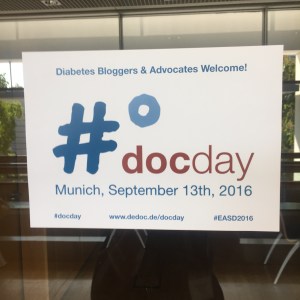
The second annual #DOCDAY event was coordinated and hosted by Bastian Hauck at EASD in Munich. Last year, he had this idea and organised what he thought would be a few people in a café in Stockholm. He underestimated how many people would want to attend, and the room was overflowing with advocates from Europe (and the usual Aussie ring-in).
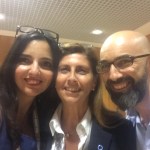
Dr Andrea Orecchio, right, with Danela D’Onfrio from Portale Diabetes (an Italian diabetes peer site).
This year, he got smart. He hired a room at the conference centre which was a genius move because it not only meant it was so simple and convenient to get to, but it also meant a whole heap of HCPs came along too. (Big hat tips to the divine trio from AADE, Hope Warsaw, Deb Greenwood and Nancy D’Houln, Aussie Dr Kevin Lee, and the delightful Dr Andrea Orecchio from Switzerland who impressed me with his ability to speak (and tweet in) four different languages. Perfectly fluently.)
There was no real structure to the meeting, apart from the insistence that all attendees have their photo taken on an old-school Polaroid camera to be placed on the attendee wall. Bastian kicked off the afternoon, saying a few words and he also asked some people to talk about any exciting diabetes initiatives they’ve been involved in. He asked me because he knows that in my jetlagged state I’m likely to say something inappropriate which will lighten the mood.
I was absolutely enthralled and excited to hear of some of the work other diabetes advocates have been up to lately. Here is just a taste:

Cannot wait to see this book published!
I simply cannot wait for the release of this new book from the team at Anna PS. Anna Sjoberg and Sofia Larsson-Stern from Sweden have collected stories from 20 people with diabetes and will share their personal experiences of lives with diabetes. The Swedish version of I Can, Want and Dare will be out in time for World Diabetes Day, and the English-language edition will follow shortly after. You can pre-order here. What a brilliant Xmas stocking filler! (Disclosure – Anna and Sofia invited me to contribute to the book. I have no financial interest in the book.)

Med Angel.
Did you know that 93% of people using temperature-sensitive medications are doing it wrong? Neither did I! Amin Zayani has created a very nifty smart sensor and app to help you know if your insulin is being kept at a safe temperature. This is a super easy device to use and is all about safety. I know I can certainly be accused of being very relaxed about keeping may insulin at optimal temperature and (touch wood) have never had a problem. But just at this conference, I was speaking with someone whose insulin had been affected by temperature and was absolutely not working. At all. This is something that will be very handy for a lot of people! Follow Med Angel on Twitter here.
IDF Europe has introduced a social media prize in diabetes. Quite frankly, the DOCDAY room was full of worthy recipients. Nominate someone now!
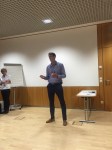
Peer networks in France with Paul-Louis Fouesnant.
I always love hearing about grass-roots diabetes support initiatives, and Paul-Louis Fouesnant from France spoke about Diab’ Mouv peer events he organises regularly.
So what did I speak about?
I spoke about driving and diabetes, specifically the advocacy win we have just had with the launch of the new Australian Assessing Fitness to Drive Guidelines. (More about that later this week.)
I spoke about CGM subsidies, a hot topic everywhere, but particularly in Germany where a reimbursement program had just been announced.
And finally, I spoke about language, because EASD is one of the most challenging conferences when it comes to language. I spoke about why language matters and why the real changes that are being made in this space are driven by people with diabetes. We have been talking about this for years and years now and it is terrific to see it (finally) on the agenda.
By the end of the afternoon, I was overwhelmed by all of these incredibly inspiring folk. For most of them, this is a labour of love with little, if any, financial reward. We blog because we want to share our stories and connect – nothing more. We come together to share our successes and our frustrations because we know that this is a sympathetic group who ‘get it’. Between now and when or if we next get together, we will keep in touch and continue to share our stories because that’s what we do. Thanks to everyone there for being so generous with this bumbling, jet lagged mess.

Just some of the advocates, activists, bloggers and HCPs in the #DOCDAY room!
My disclosures for my attendance to EASD2016 can be found on this post.
Twelve hours after arriving in Munich, I found myself in a beautiful tree-lined side street of the city at a diabetes bloggers event coordinated by Roche Diabetes Care. Fuelled by nothing more than coffee and jet lag, I walked into a beautiful building and found myself surrounded by diabetes advocates from around Europe who were probably trying to work out why an Australian had crashed their meeting.
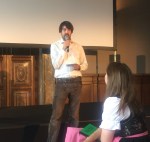
Bastian takes the stage.
Firstly, a little about this group. Roche convened the blogger group a few years ago as a channel to build a relationship with PWD in Europe. (Roche has had a long history of working with consumers. I remember back in 2012 watching the Roche Diabetes Summit in awe and then trying to replicate it here with Australia’s first and only SoMe Summit.) In a very smart move, they engaged DEDOC leader and nice-guy extraordinaire Bastian Hauck to be the liaison between Roche and the community. Bastian has done a stellar job bringing together some absolutely amazing and influential advocates to be part of this work.
The group has now met a few times, and at this year’s EASD, they opened the door to an Australian (slightly less weird now that Australia is part of Eurovision, which, obviously, is the new gold standard measure of inclusiveness. First Eurovision digression.)
The first part of the afternoon session was a demonstration of the yet-to-be-released Roche CGM. A short presentation showed how the device works, with an explanation of the technology. The timeline for release of the product is later this year with launch markets being Sweden, Norway, Netherlands and Denmark.
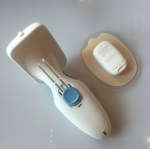
The soon-to-be-released Roche Insight CGM system.
We were then able to have a play with the device, inserting sensors into ‘fake’ skin pads and just getting an idea of the feel, size and look of it. The CGM app is completely customisable. It looks great – super clean and easy to use.
In a room of generally tech-savvy folk, you can imagine that there were a lot of opinions and feedback about the device. Most, if not all, of the participants were wearing at least one medical device – whether that be a pump, CGM or flash GM (and the slightly OTT Aussie who was wearing all three). We are obviously not the norm, but given our knowledge and experience with diabetes tech, we certainly did have a lot to say.

Dexcom and Insight side-by-side comparison.
There were some things that people really liked about the product. Accuracy was outstanding with MARD being comparable to Dex G5. The profile of the sensor was good – about the same as – maybe slightly lower than – the G5 on my arm when compared side by side. Insertion was super-easy and definitely doable with one hand. And the tape holding the sensor in tape is, apparently, better for people with skin allergies.
But as a first generation CGM, there were some limitations that people felt would frustrate them. The lack of integration with the Roche pump, for example, was of concern – however, this will be remedied with future generations. The first gen will only be compatible with an HTC phone (in a room full of very pro-Apple people, this was not particularly well-received) but, again, this will be addressed with future releases.
Also most unwelcome was the factory-set sensor life. Seven days without the possible of restarting is very surprising. There were some murmurings in the room about this setting a new precedent that other sensor makers would follow. Given that I am currently on day 18 of my sensor and the accuracy is spot on, I’d be bloody furious if I’d had to bin it 11 days ago!
Many of us frequently complain about the waste produced with all our device consumables, and there was some concern that the single-use sensor applicator contained a lot of plastic. Look, this is something that I personally struggle with. Every time I change my Dex sensor, or put in a new pump line or cartridge, I look at what needs to go in the bin and wince. It frustrates me each time I rip open the packaging for a new Medtronic Quickset (my preferred line), a bloody little cap falls out, usually to the floor. I have been using these sets since they first were released (maybe eight or ten years?) and never – not once – have I used the cap.
I get it – we need these consumables to be sterile. And safety and avoiding infection is paramount. But still, some of us are very concerned at the landfill we are contributing to!

Crowd sourcing opinion – What does CGM mean to you?
This discussion was very open. We were welcome to tweet, Instagram, Facebook (and blog) everything that we saw in the room, sharing it with the world. Following the demonstration, we all participated in real-time online feedback, where we commented on what we liked and disliked about the device. Our results and remarks were then shared on a screen for all to see.
Can we, for a moment, just consider how novel and out of character this is? Here is a company talking about a device that has not been released yet. And they are talking about it with a room full of over-sharers who all had screens open to various social media platforms ready to tweet, photograph and provide personal commentary. I have never seen such an open and transparent way to get feedback on a diabetes product, and the team from Roche should be absolutely commended on this approach. More please from more companies!
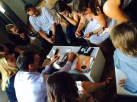
App making. (Photo credit: @Tadorna)
For the second half of the meeting we spent a most fun couple of hours where we played around with app development. My group – obviously the best – created an app that linked our CGM app with a juice machine to respond to low glucose levels. It also turned on bedroom lights if we were low overnight, to help wake us up. And if the wailing alarms of the app were not cancelled within 15 minutes, an ambulance was called to come and make sure we were okay. I know! Brilliant, right?!
Go team! Anna, Steffi, Sascha
Overall, this was definitely a valuable afternoon learning about new product and also being given the opportunity to meet with some very smart and active diabetes advocates. You bet we were there to be told about Roche’s new CGM, but that was only part of the event and no one in the room is so naïve they don’t know it. But the chance to share ideas and projects and plan for truly global work together outside the device company space was also achieved.
POSTSCRIPT and DISCLOSURES
I’m going to ignore the online discussions that seem to pop up at any conference where PWD manage to score an invite…. Actually, who am I kidding, I’m not. Because I am a little sick and tired of the inevitable complaining and suspicion and passive aggressive comments. I’m a huge advocate for PWD being invited to HCP conferences (I may have written about it once or twice here). For us to get here, we need financial assistance because travel is expensive as is conference registration. So when pharma or device companies offer to bring PWD together to engage in a session they are running – and also provide us with access to the conference, then you bet I am going to think it’s a great idea.
Transparency is important and on this little blog, I will always disclose any arrangements, support, funding or product in place with any company.
So…my disclosures? Well in regard to Roche, none really. I don’t use any Roche products at the moment. I have in the past used their meters, which I have funded myself. I have been an invited speaker at the Roche Educators Day at the ADS-ADEA conference two years running now. And I wrote and disclosed all about that at the time here and here.
Roche did not contribute to my travel or accommodation costs at all to attend EASD this year. They did provide me with press registration, but I had already organised my own, as I do for all conferences I attend. Oh – and they did invite me to a dinner after the blogger event, but jet lag had kicked in so I politely declined. There was no expectation from Roche that I would write about the event (or comment during it). They don’t own my words, I do. But I am incredibly grateful that they are engaging consumers in this way. So thank you to Ute and the team so very much!
As for my disclosures for attending EASD? For the third time, they are all here.
The first message came at 7.58pm. I was finishing up a meal of dumplings in the city and about to head into Carlton to see a movie. There on my phone was a call for help from an Aussie friend on holiday in Europe. She had forgotten to pack reservoirs (cartridges) for her insulin pump and she was the first week into a six-week trip.
Help!!
Of course, she had called the local branch of the pump company and, (of course), she had been told that it would take time (as in three days!) to set up an account, before any product could even be sent out. This was not the easy resolution my friend needed in order to simply continue enjoying her holiday.
HELP!!
We sprang into action. As we waited for our bill to arrive, I messaged Annie straight away because if anyone can hook someone up with pump supplies within the UK, she’s the person to do it. She immediately took to Facebook and put out the call, all the while messaging me for details of where and how to get the cartridges to my friend.
As my friend would be leaving the UK and heading to France over the weekend, I also send a couple of Facebook messages to a couple of friends in Paris to see if they could help out. In the car on the way to the movie, I fired out messages and replies.
And finally, I took to Twitter, with a call out to friends in the #GBDOC, with a tweet that was retweeted to reach as many people as possible
My phone was in meltdown with messages (text, Facebook, Twitter) flying in from across the globe.
And then, at 8.25pm, it was resolved, before the movie started. Annie had found someone who had the right cartridges and would pop them in the post to be delivered to London, arriving on Thursday. Plus, back up in France has been organised too – just in case!
It was sorted in 27 minutes. All with a few messages, clicks and tweets. We didn’t worry about setting up accounts or timezones or working within business hours (it was after-hours here and early in the day in the UK!). Continents and business zones didn’t matter either. The only consideration was getting the cartridges in the hands of my friend so her pump would continue to deliver insulin and she could focus on enjoying her holiday.
So, there is no sequel to the Pumpless in Vienna story to be told here, I am pleased to say. Because the DOC did what it does best in these situations. It delivered like a well-oiled machine!
Some more snapshots from this year’s EASD meeting in Munich.
Juvenile no more
All over the internet last week was Miriam E Tucker’s piece for Medscape about the age of diagnosis of type 1 diabetes. Data presented at the meeting suggested that fifty per cent of type 1 diabetes is diagnosed in people older than thirty years of age.
Flying High
I know a couple of commercial pilots who were forced to give up their careers when they were diagnosed with type 1 diabetes (and a few kids who had to give up their dreams of ever becoming a commercial pilot). A new study out of the UK gives hope for a change to the blanket ban found in many countries. Read all about it.
Afternoon naps and type 2 diabetes
I’m a big fan of a power nap, but a new study suggests that long afternoon napping is associated with an increased risk of type 2 diabetes. More here.
MySugr announcements at EASD
The uber-cool team from MySugr keep kicking goals and taming monsters. Two announcements at EASD which further enhance the MySugr app.
Firstly, this: the integration of MySugr with the Abbott Freestyle Libre app (LibreLink, currently not available in Australia)
And this: MySugr now offers live diabetes coaching, working with diabetes educator and author of ‘Think Like a Pancreas’
Also from MySugr is their terrific take on diabetes and language – specifically, writing about diabetes. This was shared by Ilka at one of the DOC satellite events. Love it, love it, love it!
Virtual EASD
Brilliant to see the EASD meeting embracing technology to bring sessions throughout the conference into anyone and everyone’s screen through their virtual EASD platform. This does a couple of things. Obviously, it means that those unable to attend the conference can see what is being presented. But more than that; it allows those people to engage in online discussions. Many were commenting on twitter and joining the dialogue with those actually in the room.
Well done – would love to see this used more widely at more conferences.
Oh, hey again Kaleido!
 Once again, it was the Kaleido stand at EASD that stole the show with sheer colour and cheekiness.
It was great to reconnect with the team and chat about what has happened since I first met them all at least year’s EASD in Stockholm. There was much excitement as they now have CE mark which means they are almost ready to launch.
Most pleasing was to see that their pump now includes a bolus calculator, an addition made after feedback from people with diabetes. (Nice engagement, folks!) It is still a no-frills pump – there is no integration with CGM and none planned. And that is fine. It really is.
Launch details are getting close. Unfortunately, no plans to launch here in Australia straight away, but apparently we are on their radar. (In the meantime, I’ll keep hassling them to come here and colour our world!)
(The Kaleido stand also had a very cool interactive wall asking all about the people visiting. This was the (almost) final product.)

DISCLOSURES
Absolutely none for the things I’ve written about here.
Apparently, I went to Munich. I was away for 6 days, and 60 hours of those days were spent in transit. I believe that, (as I deal with jet lag, hypoglycaemia, and mainlining caffeine), it is fair and accurate to say that I am too old for this shit.
I am also incapable of forming paragraphs. But dot points are fun! Here are some observations and a few silly thoughts from last week. (I’ll write some sensible things when my brain is back in the same country as the rest of me.)
- I am told by people Munich is a lovely city. I will have to take these people’s word for it, ‘cause I saw very little of the city.
- I did not buy a dirndl and for this, I will be eternally sorry. As will my husband.
- The EASD conference itself was, as predicted, very rats and mice-y. I sat in a number of sessions and wished I was a mouse (while wishing my diabetes away). Alas, I am not a mouse. And I still have diabetes. Damn.
- I did not get sick of laughing at the fact that one of the halls at ICM Messe München is called Langerhan Hall. Also, I did not get sick of saying ‘I wonder if my islet cells are in there’ – to everyone within earshot. Even if I didn’t know them.
- Obviously, Grumps was not as amused by this as me.
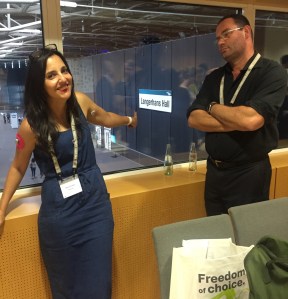
- As was the case at ADA, my arm is more recognisable and famous than me. A barista at one of the exhibition hall stands said, as making me a decent coffee, ‘Oh – I know you. I saw your arm the other day near the station.’ I am a walking billboard for Rockadex! (I am not sponsored by Rockadex and purchase my own patches.)
- Dr Kevin Lee from Queensland is a tweeting machine! In fact, I think the thing I was proudest of at EASD was seeing him tweet! (Actually, probably should say that Professor Mark Cooper’s giving the Claude Bernard Lecture was also a moment of national pride, but Kevin’s tweeting was on another level!)
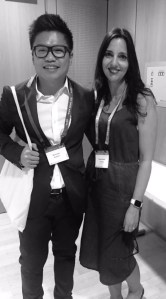
- One of my favourite talks was about diabetes, cardiac health and exercise (go on, laugh….), but that was mostly because presenter Dr Nikolaus Marx, finished up with a discussion about passive exercise and cardiovascular events during the World Cup. If you were in the room, it was me who cheered when he mentioned the increase of cardiac events after Italy beat Germany. (#VivaItalia!). For clarification, I was cheering at Gli Azzuri’s victory, not the number of Germans having heart attacks. (By the way, this was a real study. Published here.)
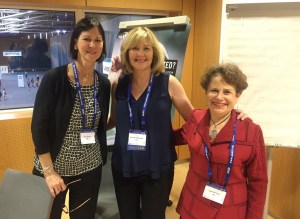
- A HUGE shout out to these three women. AADE presidents elect, past and present, Nancy D’Hondt, Deb Greenwood and Hope Warsaw are absolute advocates for and champions of people with daibetes, and peer support. This is them at the docday blogger and advocate event. This level of commitment by HCPs to consumer engagement is enlightening, and a lot could be learnt from their example here. Thank you. Thank you. Thank you!
- It was wonderful to see quite a lot of discussion about AP. Anytime someone wants to actually get these into market and into the hands of people with diabetes, that would be just great! Thank you.
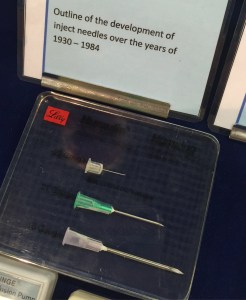
- I may have screamed a little when I wandered through the Association Village to the excellent historical display of diabetes by the German diabetes Association. Terrifying might be the word for these needles. I said a little prayer of thanks to the diabetes angels for modern day tech, and for being diagnosed in 1998.
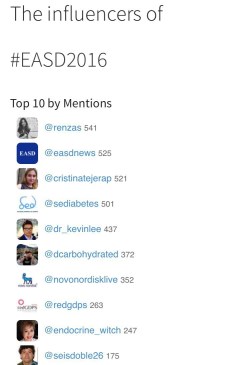
- I need to take a break from twitter. This was the state of play when I said good bye to the conference.
And finally, a word about language, because I am unable to attend a conference and not talk and write about it. (I think it’s actually become a law somewhere.) This probably deserves a post of its own and that may happen, but here we go anyway.
This is the fifth EASD conference I have attended, and going in, I know that it is going to be challenging, language-wise. There often appears to be very little consideration that there could be PWD in the room listening in to how HCPs are speaking of us. In the opening ceremony, I tweeted this at EASD president, Professor Juleen Zierath:
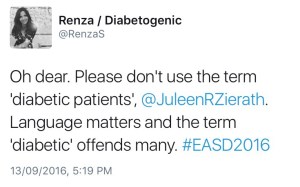
I was a little disappointed at Professor Mark Cooper’s constant use of ‘diabetic’, but it was by no means any more than most of the other speakers. I suppose I just hold Australian speakers to higher account given the work we have been doing here around language and diabetes.
This tweet generated quite a lot of discussion, and came about after I was exhausted and annoyed and mostly frustrated by the way speakers were referring to people with diabetes.
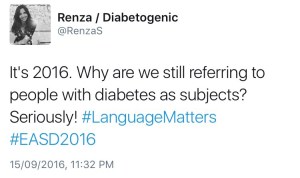 Perhaps the best response was from Nick Oliver:
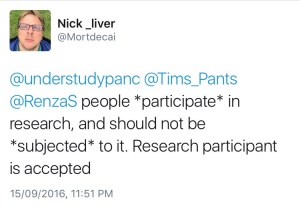
Here’s the thing – and it is something I spoke about during my talk at the DOCDAY event. Language DOES matter. We all know that. It’s completely and utterly disingenuous to say it doesn’t. For some people, it doesn’t bother them and that’s terrific. For others, though, it really does. So why would anyone do something that may offend when it is so easy to avoid that?
DISCLOSE DISCLOSE DISCLOSE
My (economy fare) flights and accommodation expenses were covered by AMSL and J&J. I was attending the EASD conference mainly to attend the J&J DOC exchange meeting which I was involved in preparing and presenting. No one ever expects me to write anything. These are my words and observations only. (And seriously, have you seen what I have just written? No one wants to be associated with that!)