Brutal. That’s the way I’ve been describing my week. It’s been super busy and there is no hint that will change any time soon.

But there is so much stuff out there to read. Here’s just some of it…

CGM

Oh, did you hear? CGM is now funded for children and young people under the age of 21 who meet eligibility criteria. It’s been ALL OVER the interwebs, but for the most up-to-date info, go here!

(And yes, I know, people 21 and over need CGM and need support. This isn’t over yet…!)

A psychologist who knows diabetes? Yep!

A good psychologist is worth their weight in gold. A good psychologist who understands the impact of living with diabetes on our overall wellbeing is like a unicorn – rare and magical.

So, I was delighted when someone from my office who has been a Research Fellow with the ACBRD for a number of years came to tell me that she is starting a private psychology practice. Dr Adriana Ventura’s research has focused on the psychological, social and behavioural aspects of living with type 1 and type 2 diabetes.

Adriana understands that living with diabetes (and other chronic health conditions) can be challenging. And she understands that these challenges can make it tough to take care of our health the way we would like.

Details about Adriana’s practice can be found here. (Adriana works with adults and older adolescents – 16 years and over)

Really? REALLY?

Seems that we’ve all been doing diabetes wrong. That lancet thing that we joke about never changing? This is how you use it according to the pic accompanying a BBC Radio 2 tweet.

Apparently it is really hard to do some decent research. (And if the image wasn’t enough of a deterrent, the article looks shit too, so didn’t bother reading it.)

My maths teacher was right

So, as it turns out, I do use maths every single day. Diabetes has certainly put my algebra skills to good use!

This article from The Conversation is all about how an applied mathematician developed an algortithm to help treat diabetes. As you do.

Words that over-promise

I can’t remember the number of times I’ve heard that a diabetes cure is ‘just around the corner’ or any other version of ‘five years away’.

But how do these promises affect people living with health confitions? This article from Medivisor asks just that.

March for Health

While we were celebrating the CGM announcement on Saturday, I was very mindful that my US friends were getting ready to continue their battle for fair healthcare. March for Health was held across the US on 1 April calling for affordable access to quality health care for all people. I don’t know about you, but that doesn’t sound unreasonable to me.

Check out more at the website here.  

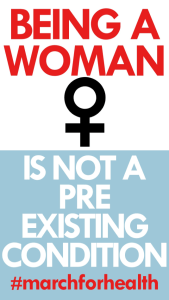
And this, by the way, is possibly one of my favourite promotional posters from the March.
Women’s Health Survey … Quick!!!

And while we’re talking women’s health…There are still a few days left to do the annual Jean Hailes Women’s Health Survey, which identifies gaps in current knowledge when it comes to women’s health.

Click here to do the survey.

College Diabetes Network

There are some really wonderful groups out there supporting people with diabetes, and my friend from the US, Mindy Bartleson emailed me with some really useful information about the College Diabetes Network (CDN). The Network empowers and connects young people with diabetes and their are CDN Chapters on college campuses across the US.

The Network is certainly US based, but some of the information will be relevant to those in Australia (and elsewhere). Their resources provide information about how to prepare for the transition from high school to college or university. Do have a look!

Information for students can be found here.  And information for parents can be found here.

Peanut butter cookies

I made these cookies and jeez were they delicious!

They are gluten free, which I know is important for many people. For me, I need cookies that take no more than 10 mins to mix together and then taste perfect. Honestly, they are possibly the best tasting biscuit/cookie I have ever made… and I bake a lot.

The recipe can be found here. (I used smooth peanut butter as the recipe suggests, but I reckon they would taste awesome with crunchy. Also, do pop the mixture in the freezer before trying to shape the cookies. The dough is mighty-soft and sticky, and this step helps to get the dough from the bowl onto your cookie tray. AND DON’T SKIP THE SALT ON TOP!! This is what ties it all together and makes the magic happen!)

And finally……

… a little New Yorker Cartoons funny, which may not be directed at diabetes, but boy it certainly shows how I feel most days living as a diabetes tech cyborg!

Hi Lady

I was a little snappy to you the other day. But then you were rude, so how about we call it even? I wrote this just after our little encounter and I hope you take it in the spirit in which it was written. That spirit being ‘pissed off’.

I didn’t say anything when you first started making comments directed at me. We were sitting in a busy café. A small, busy café with lots of people and some kids, and a woman trying to juggle a screaming baby and drink her coffee, and quite frankly, I was paying more attention to her to see if she needed any help trying to locate whatever it was she was desperately searching for amongst her gear.

So when you made your ‘Ugh – does she have to do that?’ comment while staring at me – and then pointing, I ignored you. I didn’t say ‘Yeah, I do. I’m checking my BGL to calibrate my CGM. The buzzing on my phone (because I should have already done it) is pissing me off and probably everyone around me. So, yes, I do have to do that.’

And then when you announced to your friend – and everyone else I the café (did I mention it was a small café) that I ‘must have diabetes,’ I ignored that too, even though I didn’t really see how my medical condition was any of your business, or of any interest to the rest of the people trying to have a morning coffee and prepare for the day.

I did throw a death stare at you when you moaned about the crying baby. I know that the kid had a set of lungs on him, and I know that he was loud, but I promise you that he wasn’t doing it on purpose. And no matter how uncomfortable it was making you feel, that’s nothing to how it was making his mum feel. I didn’t say that because that was the moment that I did lean over and offer to pass the mum the dummy she was reaching for in her baby’s pram, and then we had a bit of a chat after her little one settled down.

I looked away, but was listening intently, as you complained about how you’d seen people with diabetes inject in public and that you hate the thought of me leaving blood around the café after I’d finished calibrating my CGM. In no uncertain terms you announced with misplaced authority that ‘diabetics’ (your word; not mine) should use the bathrooms provided to do whatever it is we need to do.

I tried not to listen when you shared the story of someone you knew who had all sorts of nasty diabetes complications, because you were starting to sound like a cliché and I really don’t like to hear about end-stage renal failure before I’ve had at least two cups of coffee. I wasn’t there yet. Not nearly there yet.

But then, when you started your ill-informed rant about diabetes, I couldn’t stay quiet any longer. When you started saying that I probably shouldn’t have just added sugar to my morning coffee because I am ‘diabetic’ and that if only I ate better and did some exercise I’d be cured, I decided that it was time for us to have a little chat.

Could I have been more polite? Yeah, absolutely. But then, so could you. So I’m not actually going to apologise for my manner.

You probably didn’t listen to what I said, so I’ll lay it out for you again:

Yes, I have diabetes. No amount of exercise or different eating is going to change that fact. But that’s not really the point. The point is that it’s not your concern that I have diabetes, and certainly none of your business to suggest how I could better manage my condition – especially when not asked. Diabetes cannot be cured, so you should probably strike that piece of advice off your playlist for good.

It’s not appropriate to chastise someone for doing a task that needs to be done to manage that condition. I’m pretty sure I’m right when I say that no one voluntarily jabs their finger to check their BGL because it’s fun and they’ve nothing better to do. I can also promise you that your claim that I’ve left ‘blood all over the café’ is completely groundless. I generally don’t splatter blood from my tiny finger prick test on every surface nearby.

But this is the message that I really hope got through: It’s not your place to comment, criticise, or appraise someone’s health condition. Nor is it okay to judge someone. We get enough of that – often from ourselves. Really, you should have said nothing. Nothing at all.

After I finished what I was saying, I stood up and went to the counter to pay because I wasn’t interested in hearing your reply. You’d already said more than enough. But I did leave you my card with the address this blog. I’m hoping that you typed in the URL and started to read. (Actually, I hope you’re doing it after I post this, so you can read this letter because you did, after all, inspire the content here today. Thanks for the content.)

And I hope that you click on a couple of other posts and have a read about what it’s like for me to live with diabetes to give you an idea of just how wrong you seem to have the whole diabetes thing.

If you see me again in the café, feel free to come up and say hi and we can have a chat. As long as you have remembered your manners and can be respectful, I promise to be polite in return. I’ll even buy you a coffee and answer any questions you might have.

Best

I’m still getting my head around the #HealtheVoicesAU conference – there was so much that happened over the event that it’s taking time to write about it all and really nut out what I took away from each session. (Previous posts here and here.)

When I looked at the program, I was probably most excited to hear from Nick Bowditch. I knew nothing about Nick other than what the program told us: He is the only person in Asia Pacific to have worked at Facebook and Twitter; he’s an entrepreneur who helps small businesses here and across the globe shape their online presence. And his personal health story is that Nick is a mental health advocate as someone who has lived with depression for many years.

I knew Nick’s talk would have lots to offer, and title of his talk that had me excited: ‘The Art of Storytelling’.

I’ve written before about why I love story tellers and story-telling. And telling my own story. It’s reading and hearing the stories of others with diabetes that helps put in context my own experiences. Others’ perspectives shape my own and I learn so much from how others deal with the clusterfuck that diabetes can be.

The first slide Nick showed us was of the wonderful Jamaa el-Fna in Marrakech. He told us how he spent an evening captivated in the square. There amongst the snake charmers and the men walking around with monkeys on leads and the little girls selling tissues and the vendors hawking fresh orange juice, were story tellers. And although he couldn’t understand a word they were saying, he was enthralled as they animatedly told their stories.

That’s the beauty and magic of a good story teller – you don’t necessarily need to understand the detail; just getting the gist of the tale is enough.

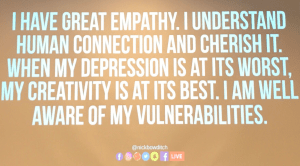
And then, Nick gave us the snapshot of his story. In a nutshell, he told us this:

Slide from @NickBowditch

It’s easy to make assumptions and think that you know what Nick might be living with if you see that list. But you’d probably be wrong. I know I certainly was. My initial ideas of what life must be like for Nick were turned on their heads as he put into context what each of the above aspects of his life actually means to him:

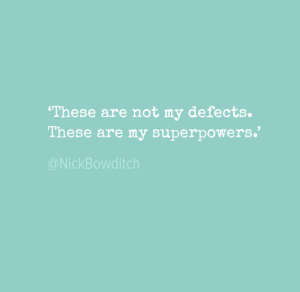
Slide from @NickBowditch

By turning our assumptions on their head and reframing how he lives with mental health conditions shows us that Nick is not ‘just coping’, he’s living. His words were: ‘These are not my defects. These are my superpowers.’ And it challenges us to reconsider our preconceived ideas. I know that those of us who speak about diabetes often challenge what others think.

The image of T1D being all about kids and needles and blood is not really what it’s about for me. And the far-too-easy idea that T2D is all about older, overweight, inactive people is wrong too.

When we tell our stories – and reframe the narrative – the truth comes out.

Possibly the most powerful thing Nick said was this: ‘Telling the truth is not brave. It’s easy. The hard thing is not being authentic.’ We’d come full circle back to the first speaker of the day who implored us to find authenticity in what we were saying. And it reminded me of why I have always been an advocate of having people with diabetes sharing their stories in any forum where people are talking diabetes: the legitimacy of lived experience cannot be found in any other way than actually having someone tell their story.

I see first-hand the power that having a person with a health condition stand alongside a healthcare professional and put into context the theory and research that they have just presented.

There is an art to storytelling. We do it every day that we tell our story. We do it every time we put words on a page for a blog post, or in a diary or in a letter, ot when we stand up and tell it like it is. Some do it far more elegantly and eloquently, but the things is; it doesn’t matter. As long as we’re authentic.

DISCLOSURE

Thanks to Janssen (the pharma arm of Johnson and Johnson) for covering my travel and accommodation costs to attend the #HealtheVoicesAU conference. There was no expectation by Janssen that I would write about the event and everything expressed here (and on Twitter Facebook and other social feeds) is mine and mine-alone! To read more, check out the conference hashtag, #HealtheVoicesAU, on the socials. 

A few people read this blog. I actually checked the stats just before, and was surprised to see that each day a significant number of people check in and read what I have to say.

So, given that people seem interested in what I have to write, I’ve decided I should take advantage of this. With this profile, I am going to do good for the world.   

Just so you know – because I’m all about disclosure – I’m a classically trained flute player. Also, I like to cook. And I’m quite good at air hockey. Also, I write some mindless crap a few days each week and publish it here, so that OBVIOUSLY qualifies me as MORE than suitable to give advice – any sort of advice I’d like, but specifically medical and nutrition advice. In fact, I’d argue that I am probably more qualified than most people who have gone to medical school, because they have been brainwashed by all the evidence and peer-reviewed journals they’ve been forced to study. I haven’t.

I think that it’s fair for me to advise that insulin is actually really poisonous. It’s dangerous and it’s dodgy. Doctors, of course, won’t tell you this. They want to keep you on insulin because they are in the pocket of Big Pharma, and like their holiday houses on the Peninsula, so they won’t tell you what they know.  

Really, you should all be off insulin and use air and water, and maybe some cinnamon, which is NATURAL and can be found in NATURE and is ORGANIC. Because NATURE’S NATURAL ORGANICS are health care. Medicine (such as insulin) is sick care.

Also – if you are ingesting grains, dairy, fruit, vegetables, sugar, protein, carbs, caffeine, flowers, condiments, oils, sauces and/or food (except organic kale) and drink (except organic kale juice), you should stop. Dietitians know this, but they won’t tell you that because they are in the pocket of Big Food and they want you to be sick so you’ll go to doctors who are in the pocket of Big Pharma.  

It’s the circle of life and everyone everywhere is trying to keep you sick. Okay? OKAY?????

And, finally, I’ve seen the way and realise now that vaccines are really dangerous and I wish that I’d never vaccinated my kid and will be cancelling my flu vax appointment for early next month. I’m trying to work out if I can actually somehow withdraw the vaccines I had injected into my kid last week so she doesn’t have those evil pollutants floating around her otherwise perfect self. Vaccines are full of toxins and heavy metals and evil pixies. Plus, vaccines cause frizzy hair, skin tags and bugs to fly into your mouth making you cough. Doctors know this, but won’t tell you because … well, you know why…

Also: kale. Because KALE, KALE, KALE, KALE, KALE!! (Must be organic.) 

I know. I sound like a lunatic, right?

Actually, I sound kinda like Pete Evans. To be honest, I didn’t watch Pete Evans’ interview last night. I’m not interested in seeing him being allowed to spruik his dangerous crap on a television station that employs him (poor form, Channel 7), plus he’s full of shit. Most importantly, we were watching ‘Shut Up and Sing’ in preparation for seeing the Dixie Chicks next Saturday night and needed to bring the kidlet up to speed with her political education. #TeachingMoment

But I did catch up online with some of his rubbish claims and am once again flabbergasted that people actually believe what he has to say and defend his right to say it.

If Pete Evans said ‘You know, it’s always best to eat fresh, healthy, in-season foods and as a chef, I’m going to share some recipes that will show you how to make an easy and healthy dinner’, I’d be ALL over it. I’d love that! I’d make his recipes and then Instagram the shit out of them. Because I care and share.

But that’s not what Pete Evans does. Pete Evans tells you that fluoride is bad and that babies should be fed bone broth and drink camel’s milk and that sunscreen is pointless. He blunders about in a way that is oddly (and frighteningly) similar to fools including Donald Trump and Pauline Hanson who seem to think that just because they have a public profile, they are qualified to give health advice.

And people believe their claims and then blindly follow them.

I (somewhat stupidly) had a look at Pete Evans’ Facebook page today and found this:

I’m not here to debate whether any people are taking medicines they maybe don’t need to take. I’ve no qualifications in health (real or imagined) and it’s not my place.

But this sort of meme is really damaging because it lacks any sophistication at all. It suggests that if a doctor puts you on any drug, they do not have your best interests at heart.

Could our HCPs be more holistic about the way they treat us? Maybe. Do some doctors over- and unnecessarily – prescribe drugs? Possibly. Do ALL doctors do this? Absolutely not. Most doctors – the vast majority, in fact – do not prescribe drugs that people don’t need. (I’ll just let the conspiracy theorists make their ‘ALL DOCTORS ARE IN THE POCKETS OF BIG PHARMA claims for a bit…Done? Okay, let’s move on.)

And, of course, I’m not stupid, and I know that when Evans puts up a meme like this on his Facebook page, he’s not really about people like me who need insulin to stay alive.

But the problem is that not everyone realises that.

Just last week, we heard another case of a child dying after his parents took him off insulin to treat his diabetes using ‘natural methods’. I still have people telling me to try <insert ridiculous and pointless herb> to treat my diabetes. There will always be people who just need a tiny push to stop the drugs they’ve been prescribed, because meds are bad, right? And natural is good, right? No. Not right.

Evans (and his ilk) speak in generalisations and sound bites that make sense to some people. But he fails to in any way address the intricacies of health. And he certainly has no concept of the complexities of living with a chronic health condition and how the drugs we take HELP keep us well (and alive).

This could be because he is a chef and doesn’t need to. And if he stayed being a chef and shut the fuck up about health, I wouldn’t be writing this blog post. Or getting into online arguments with members of his ‘tribe’ who keep offering me unsolicited and wrong medical advice*.

*Also – note to self: You are a fool for voluntarily falling down the rabbit hole and engaging with conspiracy theorists!

There are days where it seems no matter what I do – or how well I think I am doing –  everywhere I turn, I see the efforts of my diabetes self-care being undermined.

As I scrolled my social feeds today, I saw an ad from a diabetes device company promising they would provide better diabetes control. Bullshit. Your pump will help me fine-tune the way insulin is delivered into my body. It cannot control my diabetes. I know this because I have been wearing a pump for over 16 years now, and although most of the time I’m doing okay with my diabetes management, I rarely feel that it’s controlled. (This piece by Riva Greenberg nails the control myth!)

And they promised freedom which is a really odd word to use considering that when wearing a pump, I actually don’t feel free. I feel tethered and connected 24/7 to a device that I need to keep me alive. (Which, incidentally, I don’t really mind and is my preferred way to stay alive. But still, ‘free’ suggests unrestricted, spontaneous, uninhibited – all words that definitely don’t describe diabetes, even when using a pump!)

I stumbled across something else promising that their LCHF diet plan would immediately make me ‘feel better’, ‘control my diabetes’ and ‘easily eat well’. Which sounds brilliant, but it’s not true. There is no acknowledgement of the difficulty and effort that such an eating plan takes. I know it does – I eat pretty much low carb all the time, but it is tough. And it’s not for everyone. And more than anything, it takes time and there are occasions I don’t stick to it.

Why is it that even with these promises, I am not achieving the utopia of their claims? It must be me, right? I must not be good enough. And obviously I’m not trying hard enough. I’m not smart enough; not strong enough; not good enough. My insecurities come to the fore, wrapped in a blanket, and I wonder if I am the only one having such a tough time…

I’ve stopped reading about so-called wellness experts these days. Too much time spent down the rabbit hole that is fools such as Belle Gibson (I noticed last week she is back extolling the benefits of some ridiculous restricting diet plan) or Sarah Wilson or Vani Hari made me realise that nothing good comes from anyone promising to cure anything with sunshine and kale. (Side note: my husband thinks kale was invented five years ago by some hipster in Brooklyn or Brunswick, and before that it didn’t exist.)

As much as I try to avoid these sites, there is an inescapable and constant stream of reminders of the green, clean, super foods I’m not eating, or the stream of data, graphs and algorithms I’m not analysing, feeding my insecurities, telling me that I am not doing enough, not being enough, that I am Simply.Not.Enough.

I don’t ever feel that I am ticking all the boxes I need to for my management to be as good as it could be. I don’t ever feel that I am doing all the things that contribute to me being the healthiest version of myself. I feel that I regularly fall well-short of ‘doing well’, even when I am doing my best and I am doing all I can and I am trying really hard.

Feeling good about diabetes isn’t only about doing all the daily management tasks – it’s also about being strong enough to block out the messages that tell us we’re not doing enough. That is the tough bit – developing a tough skin, wearing blinkers and focusing on what we are doing and making that meaningful. Sometimes, those diabetes insecurities are huge and avoiding the fuel that feeds them is really, really tough.

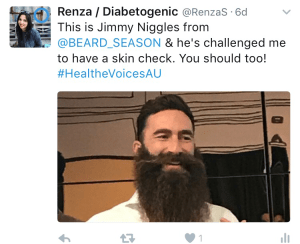
I’m a sucker for a man with a beard. So when Jimmy Niggles was introduced as the second speaker at last weekend’s HealtheVoicesAU conference, I snapped to attention to hear what he had to say.


Jimmy Niggles (not his real name) started Beard Season at the wake of his 26-year-old mate, Wes, who died of melanoma. Each year, 46,000 people lose their life to melanoma making it one of the most lethal cancers globally.

Jimmy wanted to do something to encourage people to have regular skin checks, because (as is often the case) early detection of melanoma is critical to survival. The idea was for blokes to grow a beard in Winter (apparently the season for beards!) and then use their hirsuteness to start a conversation and challenge their friends and family to have a skin check.

One of the great things about this charity is that any bloke can become an ambassador. Grow a beard. Start a conversation. Encourage people to have a skin check. It’s simple, scalable and easily translatable. (And there is something on their website here about how women can get involved too.)

Jimmy is a reluctant advocate in some ways. He says he made himself an expert speaker by starting with one on one conversations, with the belief that every conversation can make a difference. That grass roots approach has grown to him (and his beard) being the face and voice of Beard Season and he has really kicked some major goals!

It was easy to draw parallels between what Jimmy is doing with Beard Season and how it could be adopted for diabetes awareness – both in terms of screening for type 2 diabetes and also complications screening. Those conversations at an individual level have so much potential, and tied together with public health campaigns and media promotions, there is an opportunity to reach lots of people.

Jimmy’s beard is there permanently for now and will be until someone offers him a cool million bucks to shave it off. He’s open to offers, so if you have a spare million under the mattress or in the freezer, he’ll put it to good use.

Want to do something to support Beard Season RIGHT NOW? Check out these beyond fabulous playing cards with some incredibly impressive beards. Be still my beating heart! Each deck of cards contains a lucky card. The idea is that you read the card, do as it says and spread the word. It’s another simple and effective way of getting the word out.

DISCLOSURE

Thanks to Janssen (the pharma arm of Johnson and Johnson) for covering my travel and accommodation costs to attend the #HealtheVoicesAU conference. There was no expectation by Janssen that I would write about the event and everything expressed here (and on Twitter Facebook and other social feeds) is mine and mine-alone! To read more, check out the conference hashtag, #HealtheVoicesAU, on the socials. 


Last Friday, I flew to Sydney to take part in the first Australia HealtheVoices Conference coordinated and run by Janssen (disclosure at the end of this post).

I’d followed along the US versions of this event, which have been running now for a couple of years, always with diabetes health advocates attending. So I was thrilled when I received an invitation to take part.
The event was run on Saturday with a dinner on Friday evening featuring Turia Pitt as the keynote speaker. I’m going to write something about that another time. Today I want to focus on some of the actual conference. This is just the first post – the rest will come over the next week or so.

I was extraordinarily excited about being in a room with advocates from outside the diabetes space. (But also pleased for the safety of the diabetes advocate bubble! We were well represented – four of us seated at the same table, occasionally nodding at each other as we recognised the stories others were sharing, even if their health condition was different to the one we navigate.)

Anytime I am surrounded by health advocates (diabetes and other) I have a weird contraction of feelings: surprise and absolute no surprise. Surprise that experiences are so similar and yet absolutely no surprise that our experiences are different! I read this article from the SMH (written as a follow up to the event) and so much resonated about Luke Escombe’s story, despite his peers not living with diabetes.

The speakers at the conference were diverse and covered a lot of different issues. And holding it all together was journalist and TV presenter Shelly Horton, whose fabulousness I cannot even start to describe! As well as making sure everything ran to time, Shelly shared stories of her own health experiences of living with PCOS.

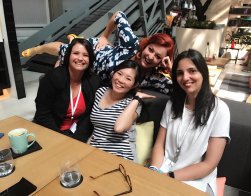
HealtheVoices emcee, Shelly Horton, hamming it up with some diabetes advocates.

We started with Samantha Jockel from Aldi Mum. She was a terrific speaker, however I found that not everything she said sat easily with me, mostly because at times I struggled to see the parallels between what I do (write a rambling little blog about about my own experiences of my health condition) and what Sam is doing (building a community which generates income).

I also realised I’m a crap blogger! As Sam eschewed the benefits of knowing your analytics and stats – she is an analytics ninja! – I realised that I rarely if ever look at the stats on my blog or other social accounts. Facebook sends me a weekly roundup and I categorically ignore the email; Twitter wants me to check the activity of different tweets, but I don’t; Facebook also tells me when I a post is doing better than usual and I get annoyed at the alert thinking that it was someone posting a cute cat meme: LinkedIn tells me how many people are looking at my profile, urging me to go and see who they are, but I’m seldom interested.

I know these are tools that can help me grow my audience and build my following, but I still have this idea that the only people reading are my mum and the guy from Romania who used to message me every day. (Perhaps if I looked at my stats, I’d know that’s not the case…)

Sam also spoke about boosting posts and ‘throwing some money’ at them if they could do better. I’ve never spent a cent on promotion of my blog and can’t see that I ever will. Once I hit publish and share what I have written on my social feeds, I don’t do anything any further. Occasionally I repost the link on Twitter, but only when I remember that there are people living in different hemispheres and were probably asleep when I posted it the first time so may have not seen it.

I guess the difference for me personally is this: My blog is not my job. I make no money from it and I have no intention of it ever becoming a money maker for me. I have a job – this is not it, despite the significant time and energy I spend writing. I blog for very selfish reasons – to find my tribe!

But there was much that did resonate with Sam’s talk and the overarching message that I took away was this: be authentic. As she spoke about the importance of finding our own voice online, she kept coming back to the need to be relatable, honest and real.

That did make sense to me, because I know that the only reason that I write is to tell my story about living with diabetes – the good, the bad, the ugly, the real.  I know that when I read about people living with diabetes, I want to read the genuine experience. The blogs I read – and keep going back to – are the ones that are undoubtedly honest and authentic.  Real life. Real stories. Real people.

DISCLOSURE

Thanks to Janssen (the pharma arm of Johnson and Johnson) for covering my travel and accommodation costs to attend the #HealtheVoicesAU conference. There was no expectation by Janssen that I would write about the event and everything expressed here (and on Twitter Facebook and other social feeds) is mine and mine-alone! To read more, check out the conference hashtag, #HealtheVoicesAU, on the socials. 

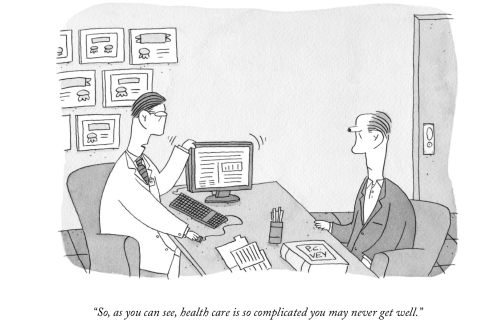
This just came up in my Instagram feed:

(Click for source.)

I wasn’t sure whether it was hilarious or painfully true. Probably both, actually.

Health care is complicated and anyone who thinks otherwise (or has no idea just how complicated it is) has either never needed to use it and / or is a fool. And as confusing and complicated the system is here in Australia, I am so grateful that we are not in the terrifying situation is facing our diabetes friends in the US at the moment.

There are a lot of very impressive advocacy initiatives going on. I’ve been keeping a close eye on March for Health which you can read about here via their Facebook page.

I’m Sydney-bound for the Janssen HealtheVoices Conference. Janssen has run similar events in the US for a number of years now and I’m thrilled to be one of the online health advocates attending first Aussie version. There will be a number of diabetes advocates attending, but this is about far more than diabetes. You can follow along by checking out the hashtag #HealtheVoicesAU

Happy International Women’s Day!

This year, more than ever, it feels like we need this day. In fact, sometimes, it seems that the world is not a great place for women and that rather than advancing and continuing in our quest for equality, we are actually going backwards.

When we have governments – usually led by men – still thinking that they have a say with what women do to and with our bodies, making decisions about, and placing restrictions on our reproductive options and confusing health reform with the limiting of choices, we know that we’re not even close to things being fair for women.

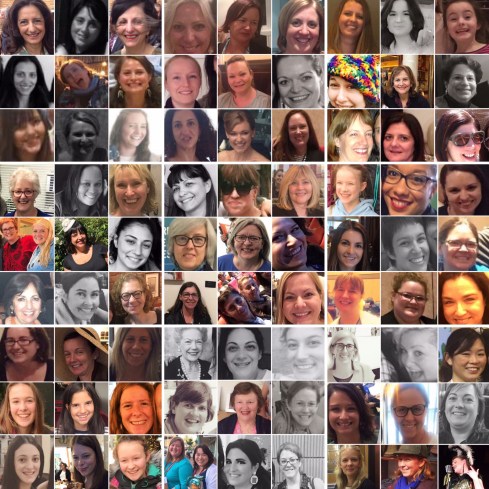
My world is very shaped by women. Exhibit A: just a few of the women and girls who I’m lucky enough to call friends, family and colleagues, many of whom I’ve met through my diabetes life.

Exhibit A

But for me, International Women’s Day is about far more than my own world.

This year, the International Diabetes Federation has decided that the theme for November’s World Diabetes Day will be Women and Diabetes. In an effort to draw attention to the specific challenges faced by women with diabetes across the globe, the IDF will develop a range of materials to support women. There will be an entire stream at the IDF Congress in Abu Dhabi at the end of this year dedicated to women and children’s health.

Currently, there are almost 200 million women across the world living with diabetes and 40% of them are of reproductive age. That is a lot of pregnancies potentially impacted by diabetes. The need for safe, evidence-based, pre-pregnancy care for women with pre-existing diabetes is essential to improve outcomes for women and their babies.  And this needs to start early. With half of cases of hyperglycaemia in pregnancy occurring in women under 30 years, girls and young women with diabetes need to have access to education and information about the importance of pregnancy planning.

Women’s health and diabetes has always been a special interest area of mine. My first big project when I started working in diabetes organisations was to help develop a diabetes and pregnancy booklet.

But pregnancy is not the only health issue for women with diabetes. There are a lot of other concerns and issues that need to be addressed, and I am looking forward to what the IDF do later in the year.

So today I’m celebrating – and saluting – women around the world – especially my own daughter who sent me a clip of the women teachers from her school performing ‘I am Woman’. And checking out some really important women’s health-related sites (some links below). Go get your green, purple and white on and celebrate the day! 

Diabetes Sisters is a fabulous organisation based in the US and run by two of the women who appear in the collage above. It’s led by Anna Norton (CEO) and Sarah Mart (Director of Operations) who are exactly the kind of women you want on your team. I’m lucky to call them friends.

T1 International has this piece about the Sonia Nabeta Foundation.  

And, today is the perfect day to do the The Jean Hailes annual Women’s Health Survey and help shape women’s health in Australia.

In the next couple of weeks, our kid gets to line up for her next round of immunisations. At twelve years of age, that means that she can look forward to chickenpox and Diphtheria-Tetanus-Pertussis boosters, and a three-dose course of the HPV vaccine.

When the consent form was sent home, she begrudgingly pulled it out of her school bag and handed it to me. ‘I have to be immunised,’ she said employing the same facial expressions reserved for Brussels sprouts.

She took one look at me and then, slightly sheepishly, said, ‘I don’t get to complain about it, do I?’

Nope,’ I said to her. ‘You don’t get to complain about needles because…well because…suck it up princess. No sympathy about needles from your mean mamma! And you have to be vaccinated because that’s what we do. Immunisation is safe and is a really good way to stop the spread of infectious diseases that not too long ago people died from. And herd immunity only works if…

‘….if most people are immunised so diseases are not spread,’ she cut me off, finishing my sentence. I nodded at her proudly, signed the form and handed it back to her. ‘In your bag. Be grateful that you are being vaccinated. It’s a gift.’ (She mumbled something about it being a crappy gift, and that it would be better if she got a Readings gift voucher instead, but I ignored that.)

Over the weekend, the vaccination debate was fired up again with One Nation idiot leader, Pauline Hanson, sharing her half-brained thoughts on the issue.

I hate that I am even writing about Pauling Hanson. I despise what she stands for. Her unenlightened, racist, xenophobic, mean, ill-informed rhetoric, which is somehow interpreted as ‘she just says what many of us are thinking’, is disgusting. But her latest remarks go to show, once again, what an ignorant and dangerous fool she is.

Her comments coincided with a discussion on a type 1 diabetes Facebook page about vaccinations preceding T1D. Thankfully, smart people reminded anyone suggesting that their diabetes was a direct result of a recent vaccination that correlation does not equal causation.

I get really anxious when there is discussion about vaccinations, because the idea that this is something that can and should be debated is dangerous. There is no evidence to suggest that vaccines cause diabetes (or autism or anything else). There is, however, a lot of evidence to show that they do a shed-load of good. And if you don’t believe me, ask yourself how many cases of polio you’ve seen lately. People of my parents’ generation seemed to all know kids and adults with polio and talk about just how debilitating a condition it was. And they know first-hand of children who died of diseases such as measles or whooping cough.

This is not an ‘I have my opinion, you have yours. Let’s agree to disagree’ issue. It is, in fact, very black and white.

A number of people in the Facebook conversation commented that their (or their child’s) diagnosis coincided with a recent vaccination. But here’s the thing: type 1 diabetes doesn’t just happen. We know that it is a long and slow process.

Click for reference.

What this shows is that even if onset of diabetes occurs at (correlates with) the time of a vaccination, it cannot possibly be the cause.

When we have people in the public sphere coming out and saying irresponsible things about vaccinations, it is damaging. People will listen to Pauline Hanson rather than listen to a doctor or a researcher with decades of experience, mountains of evidence and bucket-loads (technical term) of science to support their position.

The idea that ‘everyone should do their own research’ is flawed because there is far too much pseudo-science rubbish out there and sometimes it’s hard to work out what is a relevant and respectable source and what is gobbledygook (highly technical term).

Plus, those trying to refute the benefit of vaccinations employ the age-old tactic of conspiracy theories to have people who are not particularly well informed to start to question real experts. If you have ever heard anyone suggesting: government is in the pockets of Big Pharma / the aliens are controlling us / if we just ate well and danced in the sunshine / any other hare-brained suggestion, run – don’t walk – away from them. And don’t look back.

I have been thinking about this a lot in the last couple of days. I have what I describe as an irrational fear that my kid is going to develop diabetes. It keeps me awake at night, makes me burst into tears at time and scares me like nothing else. If I, for a second, thought for just a tiny second that vaccinating my daughter increased her chances of developing diabetes, she would be unvaccinated. If I thought there was any truth at all in the rubbish that vaccines cause diabetes, I wouldn’t have let her anywhere near a vaccination needle.

But there is no evidence to support that. None at all.

Follow Diabetogenic on WordPress.com

Enter your email address to follow this blog and receive notifications of new posts by email.

Read about Renza

Archives