I have been interested in discussions about time in range (TIR) for some time now. It has become a key way that I assess just how I am tracking with Loop and, as I wrote earlier this year, really the only measure I’m interested in. I like it because it can give me real time information about how I am tracking. It shows that when I am at a conference and not eating properly, but doing more activity than I normally would, my TIR is going to be less than if I was at home in a regular routine. It also shows what happens when I’m not Looping for ten hours (thanks to a variety of factors) my TIR plummets!

At ATTD this year, there was a symposium dedicated to the topic and from the standing-room-only crowding of the hall, it’s clear that a lot of others are interested too. In the few presentations I attended about the Medtronic 670G, TIR was frequently referred to (in one study there was a slight increase in TIR after PWD had been using the device for 8 months, although significantly lower than what people using DIYAPS are reporting.)

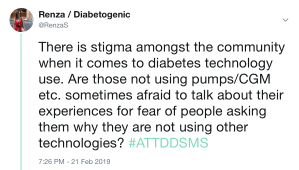
Just as I did while live tweeting the session, I have to address the issue of access to the technology. TIR is all very well, but it takes tools, and those tools are prohibitively expensive. Some places have no subsidies available for CGM or Flash, others have limited reimbursement programs. And, of course, there are places around the world where accessing glucose strips is a near impossibility.

TIR is a measure for a very, very privileged few, and as much as it’s held up as the future of diabetes, it is simply incorrect and misleading to suggest even for a moment that most people with diabetes have this data at their fingertips. (They barely have finger prick data at their fingertips.)

But, this is a conferences about the latest in technologies and treatments, so let’s talk time in range…

Dr Irl Hirsch is an MD from University of Washington, Seattle. His session as listed in the program was: ‘Time in Range vs. HbA1c: Are our patients ready to change?’, but he changed it to a far more suitable ‘Time in Range vs. HbA1c: Are our patients and health-care colleagues ready to change?’

Irl’s short talk was an absolute cracker and started by exploring what we already know – A1c is flawed. We’ve known this for years, but it’s taken having easy access to CGM data to truly appreciate just how flawed. The two points he raised to back this up were A1c levels can’t be compared between two people (and yet that happens all the time!); each A1c comprises a wide median glucose range. In other words, A1c sucks (they were his words, not mine!).

And then the talk got fun as the focus shifted to just how ready different groups were to shift from a focus on A1c to TIR. The three groups were: people with diabetes (and their families), endocrinologists and non-endocrinologists. Irl presented the results from a survey of diabetes HCPs asking their thoughts on the readiness of those three groups to embrace TIR. Here are the results:

The HCPs surveyed all believe that PWD are by far the most ready to change from A1c to TIR. At the same time they believed that no non-endo HCPs were ready. We really have a problem.

The survey participants offered a lot more than just their assessment of the readiness for this shift. They provided extra comments about some of the barriers to the change. This is how some of the HCPs (all working in diabetes) assessed the inclination for PWD to move to TIR:

But perhaps the most unsettling was what they thought about non-endocrinologists willingness to start to talk TIR. (I think that they were mostly referring to primary care physicians.)

As the list was read out, and the audience responded accordingly, my confidence level about how likely it was that TIR would start to become the norm shrank away. This is despite the way that many PWD have already adopted the measure and use it daily.

In the online groups where I spend a lot of time playing, it is clear that we are already very comfortable and committed to talking TIR. People frequently post their Dexcom Clarity data showing the super-nifty image of how much time they have spent in and out of their self-determined range. This is the language we speak.

But despite my unease about just how quickly the shift will happen, it has definitely begun. The International Consensus on TIR was presented which included targets for people with type 1, type 2 and for women during pregnancy. Plus there was evidence presented that showed TIR can predict the likelihood of diabetes-related complications. With all this, and the demand from PWD, we will be hearing about this more and more in coming years.

Looking for more?  This piece by Irl Hirsh, Jennifer Sherr and Korey Hood was just published in Diabetes Care is a really interesting commentary on the issue.

DISLCOSURE

I attended the ATTD conference in Berlin. My (economy) airfare and part of my accommodation was covered by DOCLab (I attended an advisory group meeting for DOCLab), and other nights’ accommodation was covered by Roche Global (I attended the Roche Blogger MeetUp). While my travel and accommodation costs have been covered, my words remain all my own and I have not been asked by DOCLab or Roche Global to write about my attendance at their events or any other aspect of the conference. 

These days, it’s impossible to be at a diabetes conference and not have at least one conversation somewhere about language. Sometimes there are sessions dedicated to the topic on the program, but that wasn’t the case at ATTD a couple of weeks ago – a conference solely devoted to advancements in diabetes technology and treatments.

But despite there not being a session about language, it was still a hot topic. My eagle eye was trained when walking through the exhibition centre for examples where diabetes is misrepresented or the language used stigmatises people living with the condition. And in sessions, I immediately heard terms that suggested that we are misbehaving because the results of treatments aren’t living up to their promise. (A new one: I heard the statement ‘People with diabetes on <therapy> were not performing as expected’ which now makes me think that we are being trained, watched and judged by pageant mums/moms.)

At the Ascensia Diabetes Social Media Summit (more on that another day), there was a discussion about language and diabetes-related complications. This event was a follow on from the one we had at the Australia Diabetes Social Media Summit, and took the initial conversations and expanded it with a new group of PWDs.

Once again, as the discussion unfolded, it was clear to see that the PWD in the room all had experiences where the language they were faced with had impacted negatively and positively. One person commented that early on in their diagnosis, a health professional had addressed diabetes-related complications by saying ‘If you are diagnosed with a diabetes-related complication it will not have been your fault.’ What an empowering way to begin the discussion about complications, care and risk reduction!

I’ve been talking about language for a number of years. Some may call me a one trick pony and, honestly, that’s fine. My appetite for the subject matter has not diminished one bit despite more than a decade of speaking and writing about why language is so important and holds such power.

Language is not a one dimensional issue. Additionally it does not necessarily have a ‘right way’ to do it – especially when looking at it from the perspective of the person living with diabetes. The work I have been involved in has never been about policing the words used by people with diabetes, but rather how words used by others affect us.

It’s why the piece Grumps and I wrote for BMJ  was important – it targeted healthcare professionals, explaining to them why the words and language used around diabetes-related complications needs to not make us feel hopeless. Because that is what can happen and when we feel that way, it is all too easy for diabetes to seem just too big and too hard and too much.

I have frequently written about how diabetes can become so overwhelming, that it can leave us unable to attend to even the most basic and mundane of diabetes management tasks. I myself have been paralysed by the detail and demands of this health condition. I understand that there are times when a conversation about language is not possible, because, quite frankly, there is a lot more to deal with. I know that there have been moments when even though I can hear judgement and blame in the words being directed at me, all I want to do is find a way out of what feels like a hole. I’ve heard others say that they have felt harshly treated by HCPs, but simply didn’t have the capacity to try to deal with that because there were other things higher up on the list.

And I am sure that there are people who simply wouldn’t even know where to begin if the words and language being directed at them were disempowering and negative.

But that is exactly why language matters. It is for the people in those situations – for me when I was in that situation – that we need to get the way we communicate about diabetes right.

I am so sick of people trying to delegitimise the language discussion, or, even worse, reduce it to something that is insignificant. It frustrates me when the discussion returns again and again and again to the diabetic/PWD debate. As I said at the Ascenisa event at ATTD when we were discussing the annoying way some try to redirect meaningful discussion back to this single issue: ‘You can call me Blossom for all I care, language is about far more than this.’

And I think that while it is critical that we acknowledge that sometimes the language issue isn’t going to be a priority for some (by choice or otherwise), it seems unfair – and a little counter-intuitive – to diminish its importance, or criticise those of us trying to keep it on the agenda and actually do something about it.

(Click for original tweet)

DISLCOSURE

I attended the ATTD conference in Berlin. My (economy) airfare and part of my accommodation was covered by DOCLab (I attended an advisory group meeting for DOCLab), and other nights’ accommodation was covered by Roche Global (I attended the Roche Blogger MeetUp). While my travel and accommodation costs have been covered, my words remain all my own and I have not been asked by DOCLab or Roche Global to write about my attendance at their events or any other aspect of the conference. 

It’s March, which means a few things: It’s now Autumn in Australia; Easter eggs are flooding supermarket shelves; and Spare A Rose is over for another year.

I am very, very rarely lost for words. I usually have a lot to say (even if I’m the only one who want to hear it). I can speak underwater. But throughout this campaign there has been moment after moment where I have been rendered speechless as the generosity of people has been on display. No one has made a big deal about it – they have just wanted to contribute to a campaign because they could and they understood its importance.

This year, we really took Spare A Rose back to the community where it all first began. We wanted to use that grassroots support from people who truly comprehend what it would mean to not be able to easily and affordably access insulin and diabetes care. All funds raised by Spare A Rose – every last cent – goes towards Life for a Child to improve access to young people living in places where it is difficult.

Last week at ATTD, every time someone spoke about #SpareARose, those around them listened and then asked how they could help. Individuals with diabetes, diabetes on- and offline community groups, people from other diabetes organisations and industry stepped up to make donations, share information, spread the word.

Our community was stronger and louder than we’ve ever seen for this campaign and as more people got on board, we kept wondering just how close we’d get to that aspirational target we’d set – $50,000. It seemed impossible when first suggested on a conference call – almost as a whisper because it seemed so audacious.

We shouldn’t have underestimated the diabetes community, because not only did they reach it, they smashed it.

We got a wee bit silly and pulled the #SpareAFrown stunt, hoping to get a little attention and a few donations, but actually it blew up. (I think Grumps is a little scared of what he’ll be asked to do next year to encourage donations. Suggestions welcome. Pink tutus have already been proposed.)

The money raised means that nine hundred and thirty nine young people with diabetes will be provided with life-saving insulin for a whole year. When all is said and done, that is all that matters.

Thank you to everyone who supported #SpareARose in 2019. We will be back in 2020 bigger and better. The plans already being hatched have one goal only: more roses spared; and many, many more lives saved.


Let me tell you what is worse than jet lag. Jet lag combined with food poisoning. These are the two extra circles of hell Dante forgot about.

While I am recovering and trying to get my body to accept coffee again, here are some photos from last week’s ATTD conference which was in equal measure amazing, overwhelming, frustrating, intimidating, brilliant and exhausting. I’ll explain more in coming posts, but for now, enjoy the images.

How to deal with jet lag when arriving in Europe #1: night time walk to major tourist site and be amazed.

How to deal with jet lag when arriving in Europe #2: find (half) decent coffee.

How to deal with jet lag when arriving in Europe #2.1: drink all the coffee.

And then drink some more.

#docday is always a highlight. Little dogs called Jamaica make it even better. (Jamaica on the left; Bastian on the right.)

Hello Solo… New pumps headed our way.

MySugr is ALWAYS on message.

Flavour of the conference #1: DIYAPS

Flavour of the conference #2: Time in Range

Vegetables. I craved them.

Because there were so, so, so many dense carbs!

Not that I was complaining. (Especially when mini doughnuts came in Diabetogenic colours!)

Oh – did I say that #SpareARose was mentioned? A lot?

Such as at #docday. (Grumps looking especially grumpy because I’d just announced #SpareAFrown.)

And then? Then there was the smile-a-thon, as we smashed through target after target.

Next week, I’ll go into detail about some of the different sessions, highlights and satellite events I attended. It was a frantic few days – so worthwhile in every possible way. And as always at these conferences, finding those who live diabetes – themselves or with a loved one – provided the necessary grounding throughout the conference. This year, that support was even more pronounced with every single person who was asked to step up to promote #SpareARose doing so in spades. This is all the community. That is what it is all about…

DISLCOSURE

I attended the ATTD conference in Berlin. My (economy) airfare and part of my accommodation was covered by DOCLab (I attended an advisory group meeting for DOCLab), and other nights’ accommodation was covered by Roche Global (I attended the Roche Blogger MeetUp). While my travel and accommodation costs have been covered, my words remain all my own and I have not been asked by DOCLab or Roche Global to write about my attendance at their events or any other aspect of the conference. 

Although Valentine’s Day is over and florists are back selling red roses at a reasonable price, the Spare A Rose, Save a Child campaign is still going. We run until the end of February which means that there are still ten days to go.

The tally for 2019 is already looking strong. We have hit just over $28,000, and we know there is another $8,000 or so pledged from a friend of the campaign, so we’re sitting around $36,000.

And that brings us to today’s blog post which actually begins its story back in August last year, and it goes like this…

One afternoon, I was working from home and an email came in from Scott Johnson. Scott is awesome and I adore him; and was intrigued by the subject title: ‘An idea from my dad’. Scott’s dad (who is clearly as awesome as Scott) did indeed have an idea. He thought that a great way to get people to donate to Life for a Child would be to get a smiling photo of the frowniest of them all in the DOC – The Grumpy Pumper. And I was charged with the task of convincing him to do it.

To be honest, I thought that this was not going to be an easy ask. There are literally hundreds of photos of Grumps online sporting his trademark frown. (See exhibit A) Convincing him to smile – and smile in a photo for all to see – was not probably going to be met with a lot of resistance.

Exhibit A

The conversation went like this:

Me: So Grumps, Scott’s dad thinks that you smiling in a photo should be used as an incentive to get people to donate to Life for a Child.

Grumps: Are you fucking joking? (Pause) Oh, okay. I’ll smile, but don’t get used to it.

We kind of forgot the idea, but with #SpareARose in full swing and the 2019 tally being so close to the $40k mark, we thought that now was the time to bring out this idea and see if it has legs.

Here is the deal. If our tally hits $40K by Friday night (Berlin time), Grumps is going to #SpareAFrown, and get his smile on at the MySugr event that is happening at ATTD.

This is where you come in. #SpareARose is a community initiative. It was started and is run by the diabetes online community. It is owned by us and it is a wonderful example of the community taking care of one another around the world. Grumps is a part of this community, and a part of the #SpareARose family, and he is a grumpy bastard. All good reasons to make a donation.

We’re calling on the community to step and donate to get us to $40K. If you have already donated, thank you. Is there any way you can throw in another $5? If you have been meaning to donate, but haven’t managed to do it yet, please do it now. Share the donation link with everyone you have ever met.

And share the #SpareAFrown idea, to get Grumpy to use muscles in his face that just don’t get a work out and help us get to $40,000, all of which will be donated to Life for a Child to provide insulin to children who would otherwise not be able to access it.

Let’s get Grumps to #SpareAFrown to save a child.

Click on the rose to donate.

DISLCOSURE

I am currently at the ATTD conference in Berlin. My (economy) airfare and part of my accommodation has been covered by DOCLab (I attended an advisory group meeting for DOCLab), and other nights’ accommodation has been covered by Roche Global (I will be attending the Roche Blogger MeetUp). While my travel an accommodation costs have been covered, my words remain all my own and I have not been asked by DOCLab or Roche Global) to write about my attendance at either events. 

I was up bright and early this morning, rushing around to get ready for a flight to Brisbane. ‘Happy Valentine’s Day, babe,’ I said to Aaron as I was pulling a dress over my head, brushing my teeth and checking to see what time the cab was arriving. ‘I didn’t get you anything.’ This announcement isn’t a symptom of twenty years of marriage; it’s not even because we are disorganised; and it’s not because we don’t celebrate Valentine’s Day (although, to be perfectly honest, before getting involved in #SpareARose, we really didn’t even acknowledge this Hallmark day).

These days, Valentine’s Day is a thing in our house, but purely because we’re all about spared roses and empty vases. And this year, Spare a Rose cookies.

Flowers die, children shouldn’t. It’s tragic that we even have to say that in 2019. But we do. Because there are still parts of the world where a type 1 diabetes diagnosis is a death sentence due to lack of access to insulin, and basic diabetes supplies and education.

If you can, please make a donation to #SpareARose. You money will go to Life for a Child and provide insulin to a child with diabetes. Don’t take my word for why this is important; here is Brandon telling his story and sharing how donations such as those raised as part of #SpareARose have helped him to fulfil his dreams. Happy Valentine’s Day.


Queen

Over the weekend, my mum and I took ourselves to see Nigella Lawson in conversation with Gary Mehigan. We were sitting in the first few rows which meant that we would have been within spitting distance of the Domestic Goddess if she were the spitting type. She is not.

Anyone who knows me would be aware that I have a massive crush on Nigella. I love everything about her and, truth be told, I want to be her, or be best friends with her. It’s tragic, but I’m owning it. I fell in love with her because of the way she talks about food with such abandon and passion. I completely understand getting excited at a farmers’ market when it’s suddenly cherry season, or when beautiful fresh asparagus spears are readily available in the supermarket at the start of spring. I get the idea of swooning at the smell and delightful crunch of the crust of a freshly-baked loaf of sourdough, and the desire to immediately slather it in slabs of salted butter.

Her recipe books on the shelf in our kitchen are well used, dog-eared and splattered with whatever ingredients a recipe calls for – the sign of a book that is frequently used and much loved. Her recipes are simple, always turn out as she promises and inevitably taste delicious. Plus, the little blurb she writes to introduce each recipe is always so eloquent and evocative that I can almost taste what I am about to create.

In recent years, I have really come to appreciate that Nigella has stuck to her guns as a food writer and cook, and not swayed into the world of wellness or pseudo-science dietetics. It would be very easy for her to have done that – she would make a killing! After all, who wouldn’t follow – and buy – everything she said if there was a promise of becoming just like Nigella?! She has remained honest to simply cooking food that is unpretentious, delicious and laden with all the things that make food taste good.

On Saturday night, Nigella’s commitment to enjoying food and seeing it as something to be celebrated was clear. She spoke about how food can trigger memories and be the thing that brings family and friends together. She told stories of family recipes and reminisced about where they came from. She spoke of her love of wooden spoons and the stories they can tell.

When asked about introducing a wide-variety of foods to kids she didn’t shame people into insisting they do anything other than do what works for them and their family. She didn’t suggest giving babies bone broth, or telling us that if our children were not eating foie gras and oysters au natural by their first birthday, we were failing them.

Someone asked an innocent enough question about what foods she likes to sneak as a midnight snack (referencing the little clip that ended as number of her TV episodes), and her response was that she doesn’t sneak anything. Food isn’t something that she believes we should feel guilty about and sneaking implies guiltily hiding away what we are doing.

Nigella knows her place is in the kitchen (because that is where she wants to be) and not in the health food aisles of the supermarket, and this is a pleasant and welcome change from the direction that so many others working in food have taken. I am so sick of celebrity cooks and chefs thinking that they are quasi-dietitians and have the right or expertise to tell us what to eat – or what not to eat.

And even more so, I am beyond over Instagram ‘influencers’ and wellness charlatans using words that make food something that sends us to hour-long confessions with the food gods.

Nigella specifically mentioned the term ‘clean food’ and why she doesn’t like it and I may have cheered along. It doesn’t surprise me that someone with as much of an affection for words as Nigella would take issue with language being used to shame the very thing she loves. I was reminded of this post I wrote back in 2014 the other day as I walked by a café near work claiming to serve ‘honest food’. I’ve been perplexed since I saw it and wondering what the hell dishonest food is.

So many people with diabetes have a fraught relationship with food. For some, it is a battle and involves hiding what they are eating, or lying about it. Having to consider and count carbs or fat can give us a distorted view of what we are eating. Our weight is scrutinised, our diets analysed. We are told to restrict certain things. Eating disorders and disordered eating are common and yet so under-researched and not understood.

So, hearing someone speak about food for what it is – a delight, something to be enjoyed, a pleasure, an excuse to spend time with loved ones, a way to nourish our bodies and souls – can put back some perspective. That’s what we got when Nigella spoke.

Before seeing her on Saturday night, I thought it wasn’t possible to love her any more that I already did. Turns out I was wrong. Because as long as she continues to celebrate food and rejoice in it, I will continue to be a groupie.

Last week, the BMJ published a piece I wrote with the Grumpy Pumper. It was part of their ‘What Your Patient is Thinking’ series which includes stories from people sharing their experiences of living with a variety of health conditions, or using health services.

We wrote about the intersection between language and diabetes-related complications and why language matters so much any time this topic is raised. This is our latest piece on the issue (read the PLAID Journal article here, and something we wrote for diaTribe here). We may appear to be one trick ponies, but it seems the appetite for this issue has not in any way diminished – which is good, because there’s lots more to come! (We’re not one trick ponies – I for one can talk for hours about why the fax machine should be made extinct in healthcare.)

It’s been fascinating – and a little overwhelming – to read the responses to the article after it was shared on a variety of social media platforms at the end of last week, and then again over the weekend. It’s also been heartbreaking when people have told stories about how HCPs have spoken about diabetes-related complications in ways that have had negative effects.

It’s refreshing to see many HCPs (including those from outside the diabetes world) sharing and commenting on the article. Much of what we have written is applicable beyond diabetes. It doesn’t matter what health condition someone is diagnosed with; everyone wants to be treated with kindness and compassion and to not be blamed or shamed.

A couple of HCPs have said that after they read the article, they will now consider changing the way the speak. I love this piece from a CDE in the US who said that she honestly thought the words she was using when discussing diabetes-related complications were reassuring until she read our perspective, and now understands that there are better ways to frame the conversation. We only hope that this will lead to PWD feeling less judged and more supported, and not afraid to talk about what is still a taboo topic for so many.

The diabetes and language landscape is broad. I know that there are many who roll their eyes and say that actually, language doesn’t matter, and perhaps we should be focusing on more pressing issues, but I wonder if they are perhaps focussing on issues that they don’t think are really important.

But there is a lot more to this issue than, for example, the debate between being called ‘a person with diabetes’ or ‘diabetic’ – or if it even matters. Regardless of what the specific issue is, we are hoping is that people understand that words really do matter; they have far-reaching consequences; they determine how people feel about their diabetes; and that the right words have the potential to make people feel better equipped to manage their diabetes as best they possibly can.

Please read the BMJ article – it is freely accessibly – and share it with your networks. If you have diabetes, take a copy to your next HCP appointment and leave it for them to read. The way that we make real, sustainable change is to keep pressing a point, and explain why it is important. Hopefully this piece has gone some way to doing that.

The illustration that was commissioned for the print version of the article. Artist Rose Lloyd did such a great job of getting across the messages in the article!

When I was diagnosed with diabetes, I was told about hypos. I was told about a whole heap of things, and hypos was just one of them. To be honest, I can’t really remember the exact way hypoglycaemia was described to me, other than it being a very matter of fact part of my overall introduction to type 1 diabetes.

There was other stuff that terrified me. If I close my eyes, I can still picture the images I was shown about diabetes-related complications. That discussion has had a long-lasting effect and I am still haunted by those photos.

But hypoglycaemia was explained as something that is likely to happen, that must be treated immediately and that there were certain things that increase the chance of it happening.

Diabetes-related complications sounded as though they had the potential to limit my life forever. Hypos on the other hand sounded just like a huge inconvenience. And an excuse to eat Nutella. (I was never advised to treat lows with Nutella. I just decided that myself.)

So with that introduction to it all, when did I start to fear hypos?

It certainly wasn’t after the first one. In fact, that was a just a little episode of curiosity. ‘Ah…so this is what that hypo thing is all about,’ I thought as I live commentated it for my poor mother.

For at least the first ten of living with diabetes, I had all my hypo symptoms. I’d woken at night time when I was low, treated and went back to sleep. Sure there were some lows that seemed to take longer to manage and to get over, but I always did so without any real issues. I worked out that there were different types of hypos with different personalities. When I was pregnant with our daughter I passed out from a hypo, and another time had a seizure in my sleep. But there was a direct line I could draw from pregnancy to low glucose level, so I just moved on.

So when did I get to the point of fear?

I don’t have any answers for this, and I can only speak of my own diagnosis experience. Hypoglycaemia was not presented to me as something that should terrify me.

Night time lows were also never presented as something scary. There were times I was advised to check overnight, but there were always reasons for that: when I started pumping, I was asked to do a 2am check for the first week. When I was pregnant I was told that if I woke up to go to the loo, it may be a good idea to check and bolus if I was high (not because there was concern about being low). When I have been playing around with basal checking, I might set an alarm to check overnight.

Where did the fear come from? I have no idea.

There are so many What if…?’questions woven into the tapestry of diabetes. With hypos, especially after a nasty one, I would spend a lot of time asking those questions. I have read posts I wrote after one of those lows and the terror is palpable, even though it’s been so long since I last actually had one. But despite the current absence of those difficult hypos, there is still a part of me that feels terrified.

Anxiety and fear about hypoglycaemia is obviously not only an issue for the person likely to experience the lows. (I wrote here about fear of lows from people with diabetes and how that can impact on us.) Perhaps that goes some of the way to fuel the fear, but it doesn’t explain where their fear comes from.

There are other aspects of diabetes that I don’t fear. I don’t fear highs even though I know they can be dangerous. I’ve had DKA and it was honestly one of the most awful experiences I’ve had. Yet I don’t fear it.

Somewhere, somehow, at some point I leant to fear lows. I moved from hypoglycaemia being an inconvenience to being something to fear. I don’t know when or how. But it happened.

Full disclosure: here I am eating Nutella to celebrate World Nutella Day earlier this week. Not because I was low.

When we find something in diabetes that works for us, we can become a little evangelical. In the past, I’ve been guilty of this.

I have really tried to tone it down; I know that just because something works for me doesn’t mean it will work for others. But even more than that, it’s none of my business how someone chooses to manage their diabetes. And none of anyone else’s how I choose to manage mine.

So, I’m revisiting this little post from last year as a reminder that we are lucky to have choices. And to not shove ours down others’ throats.

____________________________________

Pumps. Pens. Syringes.

Patch pump. Pod.

Share your data. Don’t share your data.

Blood glucose monitors. Continuous glucose monitors. Flash glucose monitors.

Low carb. High carb. Low(er) carb. No carb. ALL the carbs.

Private diabetes team. Public clinic.

#WeAreNotWaiting. #WeAreWaiting.

Apps for recording data. Scribbling down numbers on the back of an envelope. Making up numbers as you go along.

Online peer support. Face to face peer support. No peer support.

How fortunate we are to have choices – to have choices we can make for ourselves for our own brand of diabetes.

I’m feeling a little burnt out at the moment by the zealots online who think it’s their way or the highway. Do what works for you and share it, by all means. But attacking someone else for doing something different is just being a dick. Don’t be a dick. There’s really no need.

Follow Diabetogenic on WordPress.com

Enter your email address to follow this blog and receive notifications of new posts by email.

Read about Renza

Archives