Often when we talk or read about technology it is very much about the latest, newest, shiniest devices. And yes, I wrote about those last week. There’s nothing wrong with learning about latest tech releases, or desperately wanting to get your hands on them. 

But the devices are only ever half the story. And that’s why it was so great to see that in amongst all the data and the new things, was a presentation that reminded everyone watching the technology symposium at ADC that the data belongs to people and the devices are worn on the bodies of those people. 

This is the whole warm hands, cool tech concept that is often missing when we hear about technology. The devices are not inanimate, they need human interaction to make them work for … well … for humans.

I despair at some of the stories we hear about technology and people with diabetes. Some talk experiences that have left them feeling like a failure when the tech has simply not been right for them. Because that is the way it is posed. If we decide the tech doesn’t suit us, hasn’t worked for us, hasn’t helped us achieve our goals, we’ve failed it

The truth is, it’s more likely that the failure – if we need to frame it that way – is not the PWD at all. It’s more likely that the tech is not right for the person, and there wasn’t enough assistance to help navigate through to choose the right tech. Or the education was insufficient, or not tailored for the PWD, or not interesting, or not relevant (more on that soon, from Dr Bill Polonsky’s opening plenary from the conference). It is possible that the timing wasn’t right, the circumstances were not optimal, not enough conversations about cost or effort required … whatever it is, none of the blame for something not being right should be placed on the PWD.

When we look at diabetes education, or engagement with healthcare professionals, the stories that are celebrations or considered successes (from the perspective of the PWD and, hopefully, the HCP) show the right recipe. The ingredients will all be different, but the method seems to be the same: the person with diabetes is listened too, time is taken to understand what is important for them, the PWD’s priorities are clear, and goals are realistic and checked along the way. The end results are not necessarily based on numbers or data points, but rather, just how well the person with diabetes is feeling about their diabetes, and if anything new has added to their daily burden. Reviews are focused on successes more than anything else. 

My favourite ever diabetes educator, Cheryl Steele, gave an outstanding presentation on how HCPs can best work with people with diabetes to ensure we get the most from our technology. 

I spoke with Cheryl after her talk (you can watch the video of our chat for Diabetes Australia at the end of today’s post), and she laughingly said that she could have said the most important things she wanted to say in 2 minutes, and with one slide that basically just said that HCPs need to be truly person-centred and listen to PWD.

But thankfully, she spoke a lot more than that and covered a number of different topics. But the thing that got to me – and the thing that I hope the predominantly HCP audience would take home and remember – was Chery urging her colleagues to focus on the positives. 

Cheryl said, ‘The emphasis has to be on what you’re doing well’ and I feel that is a wonderful place to start and end healthcare consultations. I think about experiences where that has happened to me. Such as the time I went to my ophthalmologist after a few years of missing appointments and his reaction to seeing me was not to tell me off for not showing up previously, but instead to welcome me and say it was great I was there. I’ve never missed an appointment since. 

How many PWD reading this have stories to share of times when they went into an appointment with data and all that was focused on was the out-of-range numbers? There are countless stories in online diabetes groups where HCPs have concentrated on the 10% out of range numbers rather than the 90% in range. Actually, even if only 10% of numbers were in range, that is 10% that are bang where they need to be!

Perhaps that’s what’s missing from diabetes appointments. Gold stars and elephant stamps!

There is something devastating about walking into an appointment and the first, and sometimes only, thing that is on the HCPs radar is numbers that are below or above the PWD’s target glucose range. I’ve sat in those appointments. I know the feeling of walking in and feeling that I’m tracking okay, only to have none of the hard work I’ve managed acknowledged and instead, only the difficulties addressed. 

But then, I think about one of the first experiences with the endocrinologist I have been seeing for twenty years. Without judgement, she acknowledged that I wasn’t checking my glucose much, and asked if I felt that I could start to do one check every Wednesday morning when I woke up. I said that it seemed like such a pathetic goal to set, but she gently said, ‘One is more than none’. The focus was not on what I wasn’t achieving. It was on what I could.

What a wonderful motivator that is. 

Disclosures

Thanks to the Australian Diabetes Society and Australian Diabetes Educators Association, organisers of the Australasian Diabetes Congress for complimentary registration to attend the conference. This gave me access to all the sessions.

I work for Diabetes Australia and the video shared is part of the organisations Facebook Live series. I am sharing here because is relevant to this post, not because I have been asked to.

As usual, no one has reviewed this piece before I hit publish (which is unfortunate because I could really do with an editor).

This week, I’ve been at the Australasian Diabetes Congress. By ‘at’ I mean ‘sitting in my home office in lockdown, watching sessions on my MacBook’, because that is what ‘at a conference’ means in the time of COVID.

Today is the final day, and I spent a couple of hours in the technology session, listening to news about the latest and greatest in diabetes technologies, as well as the best way to work with people with diabetes who are using these technologies. I’ll be writing about the latter next week. 

Today is all about shiny new stuff!

Big tech news from the Congress was the announcement from Insulet Australia that Omnipod DASH will be available this month, which is fabulous because it means that there is another choice added to the pump market for Aussies with diabetes – and a tubeless pump at that!

The not-so-great news is that Insulet has been unable to successfully negotiate a reimbursement model with the Department of Health. Pumps in Australia are generally covered through private health insurance, and pump consumables subsidised through the NDSS. 

This has worked perfectly well to date because pump products have been easily divided into devices (the actual pump) and consumables (infusion sets and reservoirs/cartridges). The Omnipod system is different – it comprises a tubeless pod which is, essentially the pump and consumables. The pod is worn for three days before being discarded. There is a touchscreen ‘personal diabetes manager’ which is used to drive the device. This system simply doesn’t easily slide into the funding model that has worked for the last thirty odd years. 

The latest notice from Insulet Australia is that they will now have to go through another submission process, and that will take a further 8 – 12 months. There is no guarantee of reimbursement at the end of this process, but Insulet – and Aussie PWD – are hopeful there will be good news.

Frustratingly, this means that anyone who decides that they really want an Omnipod and want it now needs to purchase it out of pocket, with no subsidy scheme on offer. The price that was announced at the Congress is AUD$400 for a one-month supply. There will be discounts for two- or three-month orders.

In other new tech news, Abbot’s new flash glucose monitor, Libre 2, is very much now available in Australia, and the positive here is that it is already listed on the NDSS for those eligible for the CGM Initiative. Those of us who need to pay out of pocket, the price is the same as for the first-generation Libre. It’s a small win.

Libre 2 has been out and about in Europe for some time now (and Libre 3 is out in limited release in some markets), and has recently received approval for use in the US. 

The main difference with Libre 2 is that it alarms when glucose levels are out of range. The wearer will still need to scan over the sensor (either with a mobile phone or reader device0 to see the actual reading, but they will have been alerted to any numbers that are either too high or too low. The great thing is that the alarms are optional, which is great for PWD who prefer their diabetes to be silent. 

It’s been described as an evolution rather than a revolution, which is not a negative. We don’t necessarily need every new generation to be a complete and utter overhaul with all new bells and whistles, but it’s always great to see improvements – especially when they are improvements PWD have recommended! I haven’t tried the Libre 2 yet, but will be doing so in the next week or so. 

You can find more information about these two new technologies by clicking on the images below. 

Omnipod (there is currently very limited information on the site, however that should change in coming weeks.)

Libre 2

Disclosures

Thanks to the Australian Diabetes Society and Australian Diabetes Educators Association, organisers of the Australasian Diabetes Congress for complimentary registration to attend the conference. This gave me access to all the sessions.

I hosted the Australian launch of the Omnipod DASH for diabetes advocates back in May this year, and was paid an honoraria for my time. 

Abbott Diabetes Australia has provided me with a Libre 2 sensor to use.

All words here are mine and I have not been asked or paid to write anything you’ve just read. 

This oldie from the archives is making an appearance (with a few changes from the original) because today in my inbox I received an email suggesting that I could do a three week online course to become a diabetes expert. For the low price of US$799 (plus tax), I could have access to modules that are a veritable treasure trove of diabetes details. So, I thought about it for a bit, and was just about to hit ‘add to cart’ when I remembered this post.

Turns out, there is already a simple way to find out if you are an expert in your diabetes. You can take it here for free. You’re welcome. 

_______________________________________________

Take this quiz to find out if you are an expert in your diabetes.

1. How long have you had diabetes?
Long enough.
Too long.
No idea. I’m drinking to forget.
3,456 days; 22 hours; 3 minutes; 14 seconds….15 seconds….16 seconds….

2. Complete this sentence: Diabetes is like….
A rainbow. All bright colours and a pot of gold at the end.
Disneyland. The happiest place on earth!
The best thing that has ever happened to me!
It sucks. It just plain sucks.

3. A unicorn walks into a diabetes support group meeting. You…
Call it Pricker and make it the group’s mascot.
Collect tears from it and cure your diabetes. That will work, right?
Find out if it knows anyone from the Forbidden Forest in Harry Potter.
Check my BGL.

4. Can you eat that?
F*ck off
No; I hate tripe.
Yep; pass me a spoon.
Should you be asking that?

5. Water is to sieve as XX is to diabetes?
Money
Money
Money
Money

6. How many people with diabetes does it take to change a light globe?
Get over yourself. I use the word ‘diabetic’.
I use candlelight. I can’t afford a light globe; my CGM costs are too high.
Fifteen. Any excuse for a diabetes support group get-together!
Not sure. Let me call my endo and I’ll get back to you.

7. You see another PWD in a café. What do you do?
Enough with the PWD crap!
Squeal, leap across the table, tell that you will be friends forever – whether they like it or not! (Wait…that could
just be me….)
Nothing, but keep a close eye on them to check out their gear.
Make a big deal of pulling out your pump/meter/pens hoping they will notice and start talking to you.

8. Complete this sentence: An insulin pump is….
A little device that delivers insulin.
A nightmare to try to accommodate when wearing a tight frock.
More demanding that a new puppy – all the beeping & alarms drive me crazy.
No idea? What is it?

9. Do you know other people with diabetes
No; I avoid them like the plague.
Yes.
There are other people with diabetes?
Yes. I moved house so I could have one as a neighbour. (Wait – that could just be me….)

10. Complete this sentence: Nutella is….
A chocolate, hazelnut spread
The work of the devil. (FYI – If you select this, we can never be friends.)
The. Greatest. Thing. Ever.
The solution to all the world’s problems.


 RESULTS

Well done – you are an expert in your diabetes. All answers are correct. Or incorrect! Frustrating right? Just like diabetes.

Yesterday, the Australian vaccine rollout was expanded to include children. This follows the TGA approving the use of the Pfizer COVID-19 vaccine for children in the 12 – 15 year age group. ATAGI responded by including children with diabetes in that age group into Phase 1B, meaning they are eligible right now for a jab (provided, of course, they can find one…!).

Already I’m seeing in diabetes online discussions some parents of kids with type 1 diabetes saying their child will not be getting the vaccine, stating that the reason for that decision is because their type 1 diagnosis came shortly after one of their childhood vaccines.

And so it seems a good time to revisit this post that I wrote back in 2017. It has a very long title that could have been much more simply: correlation ≠ causation.

It is understandable to want to find a reason for a health issue. Being able to blame something means that we can, perhaps, stop blaming ourselves. I imagine that for parents kids with diabetes that desire to find something – anything – to point to would come as somewhat of a relief. But there is absolutely no evidence to suggest that vaccines are that reason.

Unfortunately, the idea that vaccines are the root of all evil and cause everything under the sun is a myth that is perpetuated over and over in antivax groups; groups where science, evidence and logic goes to die. Vaccines save lives and they are safe. Anyone who says otherwise is lying.

My sixteen year old is not in a priority group and cannot be vaccinated just yet, but she is ready to go as soon as her phase has the green light. All the adults nearest and dearest to her – her parents, grandparents, aunts and uncle, friends’ parents – are fully vaccinated now, and she knows what a privilege it is to be in that situation. She understands that with that privilege comes responsibility to do what you can to protect vulnerable cohorts in the community. And she also understands that vaccines are safe and they save lives.

If you are feeling unsure about getting a COVID vaccine – for you or your child – please speak with your GP. Don’t listen to someone in a Facebook group. And that may come as a surprise to anyone who knows how important I consider peer support and learning from others in our community, but to them I say this: I listen to and learn from people in the diabetes community because they don’t suggest anti-science approaches. They talk about support, and provide tips and tricks for living with diabetes. If anyone tells me to ignore doctors (because all they care about is getting rich), or to stop taking my insulin (because there is a natural supplement that will do the trick), I would block them as quickly as I could. Science works. Science is why people with diabetes are alive today. Science is why we have vaccines. Trust science. THAT’S what makes sense.

__________________________________________________________________________

In the next couple of weeks, our kid gets to line up for her next round of immunisations. At twelve years of age, that means that she can look forward to chickenpox and Diphtheria-Tetanus-Pertussis boosters, and a three-dose course of the HPV vaccine.

When the consent form was sent home, she begrudgingly pulled it out of her school bag and handed it to me. ‘I have to be immunised,’ she said employing the same facial expressions reserved for Brussels sprouts.

She took one look at me and then, slightly sheepishly, said, ‘I don’t get to complain about it, do I?’

Nope,’ I said to her. ‘You don’t get to complain about needles because…well because…suck it up princess. No sympathy about needles from your mean mamma! And you have to be vaccinated because that’s what we do. Immunisation is safe and is a really good way to stop the spread of infectious diseases that not too long ago people died from. And herd immunity only works if…

‘….if most people are immunised so diseases are not spread,’ she cut me off, finishing my sentence. I nodded at her proudly, signed the form and handed it back to her. ‘In your bag. Be grateful that you are being vaccinated. It’s a gift.’ (She mumbled something about it being a crappy gift, and that it would be better if she got a Readings gift voucher instead, but I ignored that.)

Over the weekend, the vaccination debate was fired up again with One Nationidiot leader, Pauline Hanson, sharing her half-brained thoughts on the issue.

I hate that I am even writing about Pauling Hanson. I despise what she stands for. Her unenlightened, racist, xenophobic, mean, ill-informed rhetoric, which is somehow interpreted as ‘she just says what many of us are thinking’, is disgusting. But her latest remarks go to show, once again, what an ignorant and dangerous fool she is.

Her comments coincided with a discussion on a type 1 diabetes Facebook page about vaccinations preceding T1D. Thankfully, smart people reminded anyone suggesting that their diabetes was a direct result of a recent vaccination that correlation does not equal causation.

I get really anxious when there is discussion about vaccinations, because the idea that this is something that can and should be debated is dangerous. There is no evidence to suggest that vaccines cause diabetes (or autism or anything else). There is, however, a lot of evidence to show that they do a shed-load of good. And if you don’t believe me, ask yourself how many cases of polio you’ve seen lately. People of my parents’ generation seemed to all know kids and adults with polio and talk about just how debilitating a condition it was. And they know first-hand of children who died of diseases such as measles or whooping cough.

This is not an ‘I have my opinion, you have yours. Let’s agree to disagree’ issue. It is, in fact, very black and white.

A number of people in the Facebook conversation commented that their (or their child’s) diagnosis coincided with a recent vaccination. But here’s the thing: type 1 diabetes doesn’t just happen. We know that it is a long and slow process.

Click for reference

What this shows is that even if onset of diabetes occurs at (correlates with) the time of a vaccination, it cannot possibly be the cause.

When we have people in the public sphere coming out and saying irresponsible things about vaccinations, it is damaging. People will listen to Pauline Hanson rather than listen to a doctor or a researcher with decades of experience, mountains of evidence and bucket-loads (technical term) of science to support their position.

The idea that ‘everyone should do their own research’ is flawed because there is far too much pseudo-science rubbish out there and sometimes it’s hard to work out what is a relevant and respectable source and what is gobbledygook (highly technical term).

Plus, those trying to refute the benefit of vaccinations employ the age-old tactic of conspiracy theories to have people who are not particularly well informed to start to question real experts. If you have ever heard anyone suggesting: government is in the pockets of Big Pharma / the aliens are controlling us / if we just ate well and danced in the sunshine / any other hare-brained suggestion, run – don’t walk – away from them. And don’t look back.

I have been thinking about this a lot in the last couple of days. I have what I describe as an irrational fear that my kid is going to develop diabetes. It keeps me awake at night, makes me burst into tears at time and scares me like nothing else. If I, for a second, thought for just a tiny second that vaccinating my daughter increased her chances of developing diabetes, she would be unvaccinated. If I thought there was any truth at all in the rubbish that vaccines cause diabetes, I wouldn’t have let her anywhere near a vaccination needle.

But there is no evidence to support that. None at all.

I know diabetes, and not much else. I have a few other health conditions that are no more than niggling, requiring minimal effort and engagement with healthcare professional. But they still do need some sort of attention and treatment. The stark difference between that treatment and the treatment for diabetes is that I never have to jump through hoops to get treatment for them. 

The other day, I had to go and have imaging on my elbow because said elbow hurts, the doctor thinks it’s tennis elbow which is now being referred to as latte elbow around here because the last time I picked up a tennis racket, Yannick Noah was ranked in the top 10. 

I went to the GP, told him what was wrong, and he wrote a referral straight away for an ultrasound and Xray and sent me on my way. Three days later, I had the scans done and today I’m waiting for a telehealth appointment to discuss treatment. There was no ‘let’s wait and see’ if it gets worse.

Diabetes seems to be a lot about waiting and seeing. Or use of arbitrary numbers to determine if something can be used. Or bargaining: you may have <x device/treatment>, but you must do <y intervention> first, even if <y intervention> is not want the PWD is remotely interested in. 

When I wanted to start on a pump twenty years ago, I had to go doctor shopping until I could find a doctor who would agree to filling out the requisite forms so my private health insurance would cover the cost of the pump. This was twenty years ago, and while pumps had already been around for a number of years by then, there really weren’t all that many Australians using them, so finding an endo comfortable with the whole thing was not easy.

My first endo told me I hadn’t had diabetes long enough to consider using a pump. Subsequent shopped doctors told me a) my diabetes wasn’t serious enough to warrant a pump, b) my A1c wasn’t high enough to use a pump, and c) my A1c was too low to use a pump. 

It took a while before I found a doctor whose response to my ‘I want to use an insulin pump’ was ‘Sure, where do I sign?’

When CGM came out I’d already found myself the sort of doctor who was more than happy to be guided by what I wanted, because she understood that I knew my diabetes best and therefore was the best person to decide what I wanted in my management arsenal. She’s still my doctor. There’s a reason for that!

Last week, I tweeted this:

Click to go to Twitter to read replies

The replies and discussion that this tweet started are really not a great snapshot of person-led care. In fact, it’s more like example after example of PWD being told no for not especially great reasons. 

It seems that there are two main barriers which are intertwined in some ways. 

The first is that HCPs continue to act as gatekeepers of diabetes technologies, deciding who is allowed to access what particular devices and when that can happen. This is problematic and harks back to a time when people with diabetes were mere patients, gratefully accepting what care was doled out to us without question. 

Some might think that this sort of archaic attitude is no longer around, but a glance through the replies shows that, sadly, that isn’t the case. 

The other barrier seems to be a whole heap of rules that seem to have no purpose other than expecting the person with diabetes meet them before they are deemed worthy of whatever it is they want. 

Some of the rules seems arbitrary, others probably come from a sensible place, but are not what person-centred care is about. Many don’t seem to be based in any kind of evidence at all. Regardless, all they do is promote a one size fits all process that must be met before a PWD can proceed, verifying our merit along the way.  

The very idea that we need to prove ourselves worthy of a diabetes treatment is offensive. We didn’t need to prove ourselves worthy to be diagnosed with diabetes, so why should we need to do so to have access to the technologies that are there to help us manage it? Why should we need to have diabetes for a certain about of time first, or do an education course that is not necessarily directly related to what we are searching for, or reach a certain A1c to earn our right to access and utilise a piece of diabetes tech?

(There is a third barrier unique to US DOC friends, and that is insurance requirements…. I don’t know all that much about insurance in the US, but I guess it is HCPs employed by, or advising the insurance who set up the ridiculous hurdles and hoops people with diabetes are expected to navigate.)

Now, obviously, there is the (not by any means insignificant) issue of cost. I understand that there is never an endless pot of cash to support people with diabetes. But even in places where there is funding available, or cost is to the individual – not the health system – there are still barriers in place. 

Living with diabetes is a constant, tough gig. If we are searching for something to help us through, and we have made the decision that we want to try something new, surely the role of our HCPs is to work with us rather than stand in our way. The holy grail for so many people with diabetes that I speak to is to make diabetes easier. And yet, all these barriers just make it more difficult. That hardly seems fair. 

More on this:

Damned if we do; damned if we don’t

Who’s in charge around here?

Old and New

Today is the day. The centenary of what remains one of the greatest medical discoveries ever. Here is a reworked post (first published here). There is not a day that I am not grateful for this discovery. And not a day goes by when I am not aware that the diabetes life I live and the access I have is not the same for everyone around the world.

And so today seems a really good day to make a donation to a charity that supports people with diabetes who need it. For me, when deciding which diabetes charities I’ve decided to donate to, it’s been important that the support is tangible. And that’s why I have repeatedly written about Life for a Child, and Insulin for Life on this blog, and supported them with regular donations for a number of years. Their works provides on the ground support, medications, diabetes supplies, education, as well as doing research. They also have an advocacy function, raising awareness of not only the work they do, but the people they support.

If you are able to make a donation it’s a great day to do it. In amongst the celebrations it’s important to remember not everyone will be able to do that today. Remembering them on this important day in diabetes history is very fitting.

Donate to Insulin for Life

Donate to Life for a Child

______________________________________________________________

There has been lots of discussion about what happened 100 years ago today – on 27 July 1921. University of Toronto scientists Fredrick Banting and Charles Best successfully isolated the hormone insulin. Today, that means that I am alive and kicking, 20 years after my islets stopped making any.

It means that type 1 diabetes treatment moved from being a starvation diet and not much else, to injecting a drug that was life giving and life saving.

It means that I take a drug that while giving me life, is also lethal and if not dosed carefully and with great consideration can cause terrible side effects.

It means that people with diabetes don’t die terrible, agonising deaths simply because they were diagnosed with diabetes.

It means that I need to be able to do crazy calculations to ensure what I put into my body completely and utterly imperfectly mimics what those with functioning islet cells do completely and utterly perfectly.

It means that there is a treatment therapy that gives us hope and life and allows us to live – sometimes very long, long lives.

It means that each and every day I feel fortunate to have been born when I was and not 100 years earlier.

It means I take for granted that I have access to a drug that keeps me going.

It means that there are far too many people around the world who still do not have access to the drug I take for granted. And 97 years later, that is not good enough.

It means that it was 97 years ago – 97 years ago – since the discover of insulin to treat diabetes and we are still without a cure.

And it means that I wonder when there will be the next breakthrough that is as significant and meaningful and life changing and life saving as what those two Canadian scientists discovered 97 years ago.

But mostly. It means that I live with hope. Hope that those scientists are somewhere working away, and perhaps – just perhaps – are about to find that next big breakthrough.

This stunning print is by Alex Durussel-Baker, a designer living in Edinburgh (click on print to be taken to her e-shop).
I’ve just placed an order so I can have this print in my office at home.
Alex is donating 20% of all sales of this print to Type 1 International, another charity I have written about a number of times, and supported financially.
You can see more artworks by Alex at her website, Diabetes by Design.

A week out from National Diabetes Week, and this piece has been sitting in my ‘to be published’ folder, just waiting. But the post-NDW exhaustion coupled with lockdown exhaustion, plus wanting to make sure that all my thoughts are lined up have meant that I haven’t hit the go button.

In the lead up to NDW I wrote this piece for the Diabetes Australia website. That piece was a mea culpa, acknowledging my own contribution to diabetes-related stigma and owning it. I also stand by my thoughts that the stigma from within the community is very real and does happen. 

But what I didn’t address is just where that stigma comes from. Those biases that many people with type 1 diabetes (and those directly affected by it) have towards type 2 diabetes come from somewhere, and in a lot of cases that is the same place where the general community’s bias about diabetes comes from. It is all very well for us to expect people with type 1 diabetes to do better, but I’m not sure that is necessarily fair. I think that we should have the same expectations of everyone when it comes to stamping out stigma. 

And so, to the source of stigma and, as I’ve said before, it comes from lots of places. As someone who has spent the last twenty years working in diabetes organisations, I know that the messaging my orgs like (and including) those that have paid my weekly salary has been problematic. I still am haunted by the ‘scary’ campaign from a few years ago that involved spiders, clowns, and sharks. (If you don’t remember that campaign, good. If you do, therapy works.)

For me personally, I don’t think much stigma I have faced has come at the hands of other PWD. Sure, there’s the low carb nutters who seem to have featured far too frequently on my stigma radar, however, the most common source of stigma has undoubtedly been HCPs. 

It’s not just me who has had this experience. The majority of what I have seen online as a response to experiences about stigma involves heartbreaking tales of PWDs’ encounters with their HCPs. 

While I will call out nastiness at every corner, and no stigma is good stigma, it must be said that there is a particular harm that comes when the origin of the stigma is the very people charged to help us. Walking into a health professional appointment feeling overwhelmed, scared, and frustrated only to leave still feeling those things, but with added judgement, shame and guilt is detrimental to any endeavours to live well with diabetes. In fact, the most likely outcome of repeated, or even singular, experiences like that is to simply not go back. And who could criticise that reaction, really? Why would anyone continually put themselves in a situation where they feel that way? I wouldn’t. I know that because I didn’t.

It’s one thing to see a crappy joke from a comedian who thinks they’re being brilliantly original (they never are) or the mundane, and almost expected, ‘diabetes on a plate’ throwaway line in a cooking show, but while these incidents can be damaging, they are very different to having stigmatising comments and behaviours directed at an individual as is often the case when it is from a HCP. 

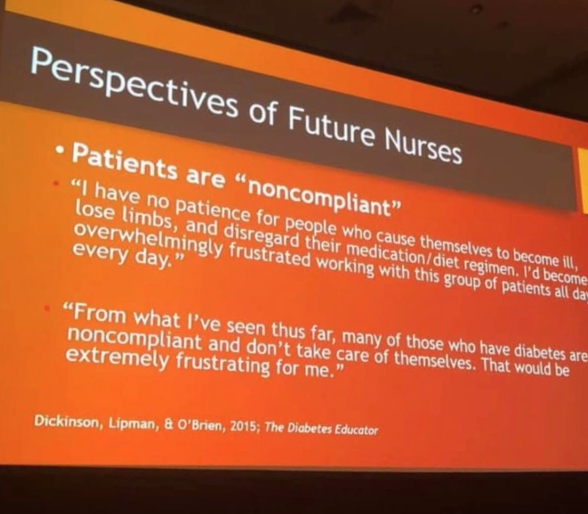
Of course, HCPs aren’t immune to the bias that forms negative ideas and opinions about diabetes. In the same way that people with type 1 diabetes form these biases because those misconceptions are prevalent in the community, HCPs see them too. Remember this slide that I shared from a conference presentation? 

Slide from Jane Dickinson’s talk at ADA in 2019.

This came from student nurses. Just think about that. Students who were training to be HCPs who would inevitably be working with people with diabetes. A I wrote at the time:

‘They hadn’t even set foot on the wards yet as qualified HCPs. But somehow, their perceptions of people with diabetes were already negative, and so full of bias. Already, they have a seed planted that is going to grow into a huge tree of blaming and shaming. And the people they are trusted to help will be made to feel at fault and as though they deserve whatever comes their way.’

Is it any wonder that, with these attitudes seemingly welded on, that people with diabetes are experience stigma at the hands of their HCPs?

The impetus can’t only be on PWD to call this out. And the calls to fix stigma can’t exclusively rest on the shoulders of PWD – we already have a lot of weight there! It must come from HCPs as well – especially as there is such a problem with this group. Perhaps the first step is to see real acknowledgement from this group of their role here – a mea culpa from professional bodies and individuals alike. Recognising that no one is immune to the bias is a good step. Owning that bias is another. And then doing something about it – something meaningful – is how we make things better for people with diabetes. I really hope we see that happening. 

More about this:

Becoming an ally – how HCPs can show they’re really on our side. 

Ask a group of people with diabetes about their experiences of stigma, and for examples of the sorts of things they’ve heard and before long you’ll be able to compile a top ten list of the most commonly heard misconceptions that have contributed to diabetes having an image problem. When I’ve asked about this recently, the main perpetrators of these seemed to be healthcare professionals. More on that later this week. 

This year, in the Diabetes Australia National Diabetes Week campaign about diabetes-related stigma, two videos have been produced and they’re almost like a highlight reel of some of the stigmatising things people with diabetes hear. 

Let me tell you something I found really interesting. As part of the testing of these, I showed them to a heap of people with diabetes and a heap of people without diabetes. The reaction from people with diabetes varied from sadness (including tears), to anger and frustration, and mostly, recognition in everything they saw. 

The reaction from a number of people without diabetes was disbelief that this really happens. They simply couldn’t believe that people would be so insensitive; so cruel, so shaming. 

However, for so many people with diabetes, this is our reality. 

Here’s one of the two videos we produced. (You can watch the second one here.) Already, this is being shared widely in our own diabetes community. I’ve lost count of the places online I’ve seen this shared. Keep doing so, if you can. Because clearly, we need to get the message out to those without diabetes so they understand that not only is this sort of stigmatising behaviour harmful, but it is also horribly common. And it needs to stop. 

DISCLOSURE

I work for Diabetes Australia, and I have been involved in the development of the Heads Up on Diabetes campaign. I’ve not been asked to share this – doing so of my volition, because I think the messaging is spot on. The words here are my own, and have not been reviewed prior to publication.   

The current COVID-19 situation in Australia is not great. We seem to be on the cusp of a major outbreak, centred on a growing wave of new diagnoses out of NSW. Watching it all unfold from Victoria is somewhat triggering, and eerily familiar. The difference in 2021, of course, is that we now have vaccines to help combat the virus. Admittedly, our vaccine rollout is nothing short of a disaster, and that’s a massive problem when there is an outbreak like the one we’re facing right now. 

And so, that brings us to last night’s latest throw-shit-at-the-wall-and-hope-something-will-stick approach that seems to be the method preferred by the Australian Government. And the latest shit is a new advertisement with the aim of encouraging people to get vaccinated. For the record, it hasn’t stuck.  

I’m not going to share the ad because it is traumatising. The general gist is that it shows a woman who appears to be under forty years of age in hospital with COVID struggling to breath. She is intubated. 

It is terrifying. 

Setting aside the fact that the woman in the ad probably couldn’t have been vaccinated even if she desperately wanted one (our rollout is still being managed by age, and under 40 year olds are certainly not anywhere near at the top of the queue yet), or that, according to healthcare professionals, there is no way that she would have been left untreated if she was struggling to breathe in that way, the way this advertisement has missed the mark is outrageous for a number of reasons:

It blames the individual for not doing the right thing rather than looking at the systemic issues that have hampered the rollout, which includes precuring enough vaccines, starting the rollout late, blundering the messaging, messing up distribution … and everything in between. 

It terrifies people and is likely to not illicit a response other than fear. 

There is no consideration for people who have COVID right now. How would family of someone currently in hospital feel seeing this? How traumatising would it be?

I watched the ad – once only and with the sound down after the first 4 seconds – and felt a ginormous sense of déjà vu. A fear-based ad campaign has been the basis of diabetes campaigns for many years, despite pleas from the diabetes community to do something better, and a realisation that the general community wasn’t bothering to pay attention. 

Thankfully, in recent years here in Australia, we’ve moved away from scary ads, understanding that we can provide a hard-hitting message without using scare tactics. Diabetes Australia has absolutely nailed that in recent years, firstly with a three-year campaign raising awareness about the signs and symptoms of type 1 and type 2 diabetes. And we are now in year two of a campaign looking at the mental health aspects of diabetes. (As ever – my disclosures are important. I work at Diabetes Australia and have been involved in all these campaigns.)

Advertisements based on fear and blame don’t work. Last night, I kept seeing people online harking back to the Grim Reaper campaign that was launched in the 1980s to raise awareness of AIDS, some claiming that it was brilliant because they still recall it. I remember the TV ads. But what I know now, but didn’t know then, was that one of the major flow-on effects from this campaign was stigma directed towards gay men – added stigma, I should say. This stigma took many years to turn around. Notoriety doesn’t not equal an effective campaign. 

But jeez, it sounds familiar! 

Here we are this week talking diabetes-related stigma and how we undo it, and part of that stigma – the misunderstandings about diabetes – came from campaigns being run by diabetes organisations. While I’m thrilled that here in Australia we’re doing a better job at moving away from that (albeit with a hiccough here and there), not all people working in diabetes organisations got the memo. It was just eighteen months ago that I sat on a panel with the incoming IDF President and had to address his idea that ‘fear arousal’ was worth considering as a way to raise awareness of the seriousness of diabetes. 

No. 

Just. No. 

And so, back to the disaster of the COVID vax ad. If only instead of terrifying, there was a focus on incentivising. If only instead of putting all blame on the individual, there was a celebration of communities coming together. If only instead of finger pointing at people desperately ready to get a jab there was acknowledgement of how difficult and confusing it’s been. 

If only…

This was my response to Professor Andrew Boulton’s suggestion that we use ‘fear arousal’ in diabetes campaigns. I wasn’t having any of it. Footage from the International Diabetes Congress in Busan, December 2019. Thanks to Georgie for the video, which was first shared on in this tweet.

I don’t know too many people living with diabetes who haven’t experienced stigma. I know I certainly have. In twenty-three years of living with diabetes, it’s come from all directions: the media, healthcare professionals, work colleagues and even family and friends. That’s because people outside the diabetes community often have pre-conceived ideas about what diabetes is all about, and a lot of those ideas are plain wrong.

But stigma doesn’t only come from outside the community. In fact, for some people with diabetes, some of the most harmful and hurtful experiences of stigma has actually come from other people with, or affected by, diabetes. [Click here to read more…]

DISCLOSURE

This piece was published today on the Diabetes Australia website, and I wrote it as part of the organisation’s National Diabetes Week campaign on diabetes stigma. I work for Diabetes Australia, and am sharing this because I’ve chosen to – not because I’ve been asked to. The words here are my own, and perhaps the only thing missing from the published text is some of the decorative language I often use when speaking about diabetes-related stigma. Bottom line – all stigma sucks. Let’s #EndDiabetesStigma now.

Follow Diabetogenic on WordPress.com

Enter your email address to follow this blog and receive notifications of new posts by email.

Read about Renza

Archives