
You are currently browsing the category archive for the ‘World Diabetes Day’ category.
What a week. World Diabetes Day (WDD) is over for another year, but there is still lots going on in the diabetes space and in my life in general. Here are just some of the things making my brain a minestrone soup of dot points.
Mayo Clinic in Oz
I was lucky enough to win a scholarship to attend the Healthcare and Social Media Summit run by the Mayo Clinic earlier this week. I haven’t even started to pick apart all the amazing things I learnt during those two days, but there will be more to come soon.
Crown
Downtime is bloody hard to come by these days (because: November). BUT!!!! Binge watching a new show helps with some mindless entertainment and winding down at the end of the day. And Netflix has come to the rescue with The Crown. I admit that this is just a space filler until the REAL EVENT…But in the meantime, it will do and is actually super enjoyable.
Talking diabetes without being rude
We often see ‘Things to not say’ lists. I wrote one here where I suggested the only thing to say to someone living with diabetes was to offer them a Nutella cupcake.
I still stand by that advice, however thought I’d use WDD as an opportunity to write a more comprehensive list and it was published on the Mamamia Women’s Network. You can read it here – and may want to consider sharing it widely.
One of the things that we need to aim for is talk diabetes OUTSIDE our diabetes world. This article was not written for people affected by diabetes – we already know to not say most of these things. It is for those who say the annoying things because they don’t really understand diabetes.
So – have a read. And then share it around. And add your own ideas in the comments section on the Mamamia page. Let’s see just how far this can go to stopping some of the comments we hear over and over and over again!
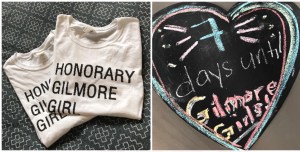
Gilmore Girls
One week to go. We are ready!
WDD Twitter Marathon
The force of nature that is Cherise Shockley managed to pull off (once again) a 24 hour tweetchat for World Diabetes Day that included moderators and participants from all over the globe with an impressive variety of topics.
There was a bit of national Aussie pride in there with 4 hours of the chat being moderated by advocates from Down Under. I moderated an hour – with a focus on diabetes stigma – at 5pm ET which was 9am (Wednesday 15 November) AEDT, meaning I was into hour 27 of WDD when it was my turn to ask the questions.
Blue fatigue
My hand is a pretty damn good indication of how I am feeling right now. Still hanging in there with the whole ‘go-blue-diabetes-awareness-rah-rah-rah’ thing, but only just. Half way through Diabetes Awareness Month; World Diabetes Day is over and I am really feeling a lot of blue fatigue.

It seems that I am not the only one. Kerri wrote this on Six Until Me the other day and it resonated with a number of people, me included.
But the people; the people!
I was lucky enough to spend World Diabetes Day with some great diabetes people. We had house guests from Germany with us and my neighbour Jo popped in for a bit too. And my Amazing family were also there and, you know what, we hardly spoke diabetes at all!

It reminded me that my diabetes world is about people – those I’ve met; those who support me through it all; those I connect with online and in real life. And I know that I couldn’t do this without them to help me through.
#IFLGseesawchallenge
And finally, diabetes is such constant balancing act, and I don’t know about you, but I rarely manage any semblance of equilibrium!
So, I love the Insulin for Life Seesaw campaign – as both a metaphor for diabetes and also as a way to raise funds for an important cause.
Get involved by uploading your photo depicting the seesaw challenge of living with diabetes. Add the tag #iflseesawchallenge to your pic and Medtronic Australia will donate $1.25 to Insulin For Life Global. $1.25 is the amount it costs to transport a week’s worth of insulin to someone in need in a developing country.

Yesterday, I went to the fridge and pulled out a fresh vial of insulin. I used it to refill my insulin pump and then placed the mostly-full vial in my bag. As it was the second to last vial from my current prescription, I called my local pharmacy and asked if they could order me in a repeat of my prescription.
And then I wandered to a favourite café for breakfast and didn’t think about it again. I knew that the following day I’d receive a call from the pharmacist telling me that my insulin was waiting for me and I’d go in on my way home from work, fork over $40 and be set for another three or so months.
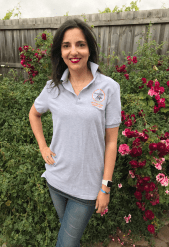
Rocking my new Insulin for Life Global tee. So honoured to be an ambassador for this worthy cause.
That’s not how it works in a lot of other places around the world. And it’s why when I was contacted by Joanna Sader from Insulin for Life Global asking me to be an Ambassador for the organisation, I didn’t hesitate before answering ‘Of course!’
Insulin for Life has been around for a long time. I remember when I was very new to the diabetes organisation world hearing all about it from the organisation’s founder Ron Raab. And then, a couple of years ago, I saw a wonderful documentary, Sweet 16, about the program, made by a young woman from Canada.
The organisation has continued to expand over the years, and today, on World Diabetes Day, is launching Insulin for Life Global (IFL Global). The organisation contributes to international efforts providing insulin to people unable to afford or access insulin or diabetes supplies in developing countries.
IFL Global, through its country affiliates, collects in-date and unneeded insulin and diabetes supplies, distributing them to developing countries, where they are distributed free of charge. It also fundraises to support transport costs, which is the biggest barrier to keeping the operation going.
You can learn more about the program by going to their new website and by watching the video below.
How can you help? Glad you asked! There are many ways you can get involved including making a one-off or regular donations, promoting their work through your networks or donating unused, in-date insulin and diabetes supplies. Details about how you can contribute to IFL Global can be found here.
I write a lot about remembering to look outside our bubble of privilege. Insulin for Life Global is another player in the space reminding us that diabetes drugs and supplies are not a right for all. And we can – and should – do something to help. Our diabetes brothers and sisters around the world do not deserve to die because they cannot access the life-saving drugs so many of us take for granted.
November is a big month in diabetes. For those of us living in Australia, the main event is World Diabetes Day on 14 November, but I’m certainly happy to be swept up in the USA’s Diabetes Awareness Month.
For the next four weeks, there will be a lot of diabetes awareness about and it’s a great opportunity to speak about real life with diabetes, dispel some myths and set the record straight when someone tells you to increase your cinnamon consumption to cure your diabetes.
Get your blue on…
Blue is the colour of diabetes and, this month, it’s my colour of choice! (Including this potentially misguided nail colour. My manicurist actually said ‘Are you sure?’ when I picked it our yesterday.)
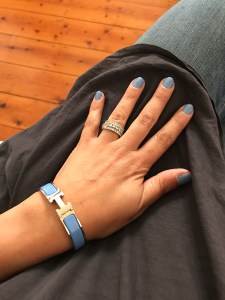
I’m stuck with these nails for a couple of weeks now, but plan to accessorise with a lot more blue (including the blue mascara and eye liner I bring out just for November!)
And a throwback to 2011 (seriously!) when Cherise got a few DOC folk together to make this video. Wear blue!
Diabetes is not about numbers. Until it is.
JDRF has this nifty calculator on their website that (somewhat scarily) adds up the numbers to show just how many diabetes tasks we’ve undertaken in our diabetes lives. Here’s mine (as of yesterday).
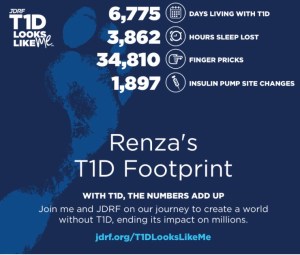
I am the first to say that diabetes is not all about numbers, but I do love this because it shows the magnitude of this condition and its relentlessness. You can get yours here.
(And JDRF UK has their own here.)
What is diabetes awareness month all about anyway?
In fact, what are ALL awareness months about? This beautiful and throughtful post from Jessica Apple from A Sweet Life (online magazine) is definitely worth a read.
And this take from a Diabetes Dad…
And Tom Karla (AKA Diabetes Dad) has this to say about just who this whole month is for. (Spoiler: it’s not for those of us already living with diabetes!) As I said on Twitter yesterday – I spend a week every July (during National Diabetes Week in Australia) trying to explain this. Will be forwarding Tom’s post far and wide from now on!
7 day online peer support…
Did you know that there is a free online Peer Diabetes Mentoring Summit running right now (until 7 November). Diabetes Dominator, Daniele Hargenrader, has coordinated this fab event and you can claim your free ticket here. So many terrific sessions with great speakers to follow!
Photo challenge
There’s a fun photo challenge for the month from Project Blue November. Using the prompts they’ve provided, post a photo each day to your SoMe feeds to share your life with diabetes, tagging the pic with #ProjectBlueNovember. Here are the prompts:

What I’d tell myself at diagnosis..
Lovely piece from the team at Diabetes Forecast where some PWD share the wisdom they would give their newly diagnosed self. Read it here.
And here’s the letter I wrote to my newly diagnosed self a few years ago. It still holds pretty true!
Circled
The International Diabetes Federation’s WDD selfie app (download for free at the app store) allows you to add a blue circle – the international symbol for diabetes – to any photo you’d like.

Big Blue Test
And of course, November means that it is time once again for the Big Blue Test, brought to us by Diabetes Hands Foundation. Over 125,000 BBTs have been logged since the program started in 2010. Easy peasy lemon squeezy instructions are:
 Get logging for good karma. There’s even an app you can use to make it super easy. (And yes – I’ll be logging before and after I take the pups for a walk!)
Keep in perspective.
It’s really easy to get overwhelmed by everything diabetes that’s going on this month. If your SoMe feeds are anything like mine, they will be overtaken by diabetes and there really does seem to be no escape.
Which is why it’s important to remember that we are about so much more than diabetes and find time in the month to do things that remind us of that. We have a couple of birthdays to plan and an upcoming trip to New York to think about – all things that will hopefully keep the whole month in perspective. Plus there is always baking…maybe some cookies…

I frequently say that diabetes takes a back seat to other things in my life. Often, they are gorgeous and pleasurable and fun things – like birthdays and holidays and hanging-out-with-the-people-I-love-days.
Other times it’s because I am too busy and running around, life, work and everything else means that diabetes gets attended to when and where I can manage it.
And, of course, other times it is because I just can’t – my headspace will barely allow it.
But with World Diabetes Day, we are pretty much guaranteed that diabetes – our own and on a larger scale – will be attended to. There will be focus, there will be fuss, there will be attention.
Not this year. This year, for terrible and horrible and heartbreaking reasons, diabetes took a back seat. Because it had to. My heart bleeds, not only for Paris – a city that means so much to me and my family, a city Aaron and I visited only last month, a city where we have spent some of our happiest days – but also for the world where this happens all too regularly.
I have no more words about World Diabetes Day this year. Other than to say, it is over and felt that way, almost before it started.

Jean Julien’s ‘Peace for Paris’ sketch gets the WDD treatment.
Today, Australia has a new National Diabetes Strategy. I would be lying to you if I said that I had read every single word of the document (but, hey, knock yourself out and have a read here). I have had a skim. Now, every part of this Strategy is important – of course it is – but today I want to highlight type 1 diabetes in the document.
A lot of the Strategy crosses the boundaries of all types of diabetes, for example in the priority groups such as ATSI peoples, CALD communities, and those living in rural and remote areas. Attention to complications screening, recommending mental health screening at diagnosis as well as including regular monitoring in the Annual Cycle of Care, including diabetes-specific education and training to hospital staff. Services for women with pre-existing (types 1 and 2) diabetes planning and during pregnancy are considered with particular emphasis on pre-pregnancy planning and access to expert education.
While this is understandable – and there are many similarities in the way that these issues are addressed – there does need to be attention to the complexities type 1 diabetes brings. (Equally, the complexities of type 2 need to be tackled!)
But how is type 1 addressed?
Firstly, yay for a concise and accurate definition of type 1 diabetes. In fact, these 50 or so words could be used by any media outlet next time they need to define the condition! Also, well done to Sussan Ley (and her advisors) at this morning’s media briefing for giving such an articulate and well-informed summary of the diabetes situation in Australia.
 Very pleasingly, early diagnosis of diabetes is one of the key goals (Goal 2), and type 1 diabetes is given its own treatment, including potential areas for action and measures of this progress. The Strategy acknowledges that 20 % of people newly diagnosed with type 1 diabetes present to hospital in DKA. This needs to change. Better awareness and recognition of type 1 symptoms to improve early detection are flagged as potential action areas.
Type 1 diabetes in the school setting is mentioned, specifically looking at better supporting families, and children to participate fully and safely at school.
In the piece about transition from adolescent to adult healthcare settings, access to psychological services is emphasised.
Could there be more? Well, of course there could. Diabetes is such a huge issue; there can always be more. So, what would I like to see that hasn’t made the cut?
Well, I would have loved there to be something about diabetes technology, specifically around pathways for approval and access of emerging technologies, as well as sorting out issues with access to currently-available tech.
I would have loved for the early diagnosis topic to be broken down a little more. It’s an issue at all stages, but poses a particularly significant challenge for adults with type 1 who are often misdiagnosed based on their age. It can take a lot of time – and a long period of poor health – before they are correctly diagnosed and treated as necessary.
More attention to structured education programs (such as DAFNE and DESMOND) and their value. And how new programs, such as the valuable POSH program (addressing impaired hypo awareness), could be funded.
Breaking down the section on healthcare access for Australians in rural and remote areas and focus on particular problems faced by those with type 1 in those areas. Specialist diabetes care in these areas is minimal; type 1 specialist care is even harder to find
The same could be said when addressing the management and treatment of type 1 in hospital and aged care setting. Type 1-specific education is essential so we stop hearing people getting lousy treatment.
Of course, this is a high level document and the detail is simply not in there. No dollars have been allocated to the strategy. The devil is in the detail – and we just have to see how that plays out.
Finally, I’m not surprised to say that already the naysayers are out complaining about the Strategy. It’s the usual thing with the usual suspects complaining amongst each other and not offering any suggestions or looking at the positives. I wonder how many of the people complaining actively participated in the consultation stages of the development of the Strategy. I am just stating this here because really, it’s tiresome hearing the same complaints about the same issues. I have some concerns too but I am also willing to acknowledge this as a progress and a step in the right direction.
Happy World Diabetes Day to everyone for tomorrow. Shine a (blue) light on diabetes.
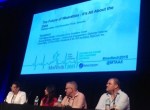
Panel at MedTech
I’m in Sydney today for the MedTech conference (follow along at home #MedTech2015) and also swamped with the usual World Diabetes Day happenings. Which I love, because it is a chance to speak about diabetes more than usual.
On my flight up here today, I re-read some of the things I’ve previously written about World Diabetes Day – and, more broadly, Diabetes Awareness Month – and thought I’d revisit some of them today.
Like this from the first year of writing Diabetogenic. (Contains lightsabers.)
And this, where I admit to wearing blue mascara, but thankfully the photographic evidence is poor!
This post tells of a crazy 2 days which kicked off with research awards, moved on to a very early morning flight to Sydney so I could do some diabetes myth-busting on a morning television show and ended with me participating in a 24 hour tweet chat. With lots more in between!
With so many different World <insert cause here> Days, explaining why we need one for diabetes (or anything else) can be tough. But here, I justified the need, sharing my own story of a hypo that wouldn’t quit and the advocacy that came after it.
And one of the proudest mum moments I’ve had is in this post when I wrote about how our daughter became my favourite diabetes advocate with her impromptu awareness raising activities at school on World Diabetes Day.
It’s always a busy, blue-tinged time.
I was driving to pick up my daughter from school last Friday afternoon, and could feel the pressure of the previous week lifting. World Diabetes Day was all but over. There was, of course, the matter of a 24 hour tweetathon organised by the clever Cherise from DCAF, but that would be fun and interactive. The official things were over. Done and dusted for another year.
The thought of picking up the kidlet and chatting about her day, and things we had planned for the weekend made me smile. I’d been distracted with the craziness of the week and we’d not had our usual long, meandering conversations. I was looking forward to hearing what she’d been up to and NOT talking about WDD.
She ran out of her classroom to greet me, a big smile on her face, her bag hanging from her back and her latest book in her arms. And off she went filling me in on the day she’d had.
After telling me who she’d played with and what she had done in PE and reminding me that on Monday her Italian Choir was rehearsing for an upcoming concert at a neighbouring school and that she would really like to go cherry picking soon and how Sooty would like a run in the park, she said, ‘I told Mr D that it was World Diabetes Day today. I wrote it up on the board at the beginning of the day.’
I looked at her, surprised at the direction her stream of consciousness conversation had just taken.
‘What’s that, darling?’ I asked.
‘This morning. When I got to school. I told Mr D that it was World Diabetes Day and he said I could write it up on the board. Then we had a discussion about it.’
‘Really? What did you talk about?’
‘Mr D wanted to know if there was anyone who knew someone with diabetes. Of course, I said I did. And so did A.’ She was referring to my beautiful neighbour Jo’s gorgeous boy who is in the same class. ‘And S – her grandmother has diabetes. Type 2 diabetes. She checks her blood sugar like you do.’
‘I was surprised that Mr D knows so much about diabetes. But then he said that one of his friends has type 1 – that’s why he knows about it. We spoke about the different sorts of diabetes. A and I were saying that type 1 is because the body stops making insulin. And we talked about pumps. Hey mum – can we go get iced chocolates for afternoon tea?’
Subject changed, we headed to our local café, sat outside and enjoyed the sunshine.
I looked across the table at my nine year old as she slurped at her iced chocolate. World Diabetes Day is about raising awareness of diabetes to people in the community. In her own little way, she had done that in her classroom. Just because she could. Just because mum has diabetes. I had a little advocate on my hands. And I couldn’t have been prouder.

The kidlet and her side kick.
It’s World Diabetes Day and everyone is talking diabetes. Or so it seems.
Do we need another awareness-raising day?
Yep. We do.
We know the numbers. We know that diabetes is serious. We know that prevention is the key – prevention of type 2 diabetes (where possible) and of complications in those already living with diabetes. I could write how World Diabetes Day can draw attention to these facts.
But instead, I’ll tell you why I – a person living with diabetes – need World Diabetes Day.
I need today because it gives an opportunity to talk about real life with diabetes.
On Wednesday, (also known as ‘I hate diabetes day’) I spoke at the Austin Hospital’s Grand Rounds. Most hospitals have Grand Rounds – it is a learning opportunity for doctors and other healthcare professionals to hear presentations and ask questions about different medical conditions – sometimes outside their area of specialty.
Wednesday’s session had a World Diabetes Day focus – the lecture theatre was adorned in blue balloons and just about everyone in the room was wearing an item of blue clothing.
I gave my talk which consisted a discussion of the consumer-focused program we run at Diabetes Australia – Vic; how healthcare professionals can use social media to interact with people with diabetes and how PWD use social media to connect.
At the end of my planned talk, I looked around the room. I think my talk had been well received – I know that I am certainly different to the usual healthcare professional presenting and I also knew that the next speaker – the wonderful Professor Joe Proietto – was giving a talk on type 2 diabetes medication.
‘Just before I go, I want to say something,’ I said. I took a deep breath. ‘I hope you have enjoyed my talk. I hope that it has given you a better idea of some of the programs and activities available to be people with diabetes. I hope you are thinking about what your Twitter handle is going to be because I really want to see ALL of you in the Twittersphere next week!! But I just want to add something.’
I moved away from the lectern and stood in the middle of the stage.
‘I look okay today, right?’ I saw heads nodding around the room. ‘My dress is neat, my hair is clean. I have make up on and I know I have matching shoes on – I checked before I left the house. My lipstick is on straight. I just gave you a twenty minute talk, and I think it all made sense….I think? The words did form coherent sentences, right?’ More nods from the people in the theatre.
‘I look okay.’ I paused again.
‘But let me tell you how I am feeling. I had a terrifying hypo overnight and was awake for a good part of the night. I needed help to deal with it, and my daughter, when she woke up this morning, had to see me feeling pretty damn crap. My dad is sitting over in the corner there because I was just too tired to drive here from Brunswick, and he kindly offered to chauffeur me so I wouldn’t need to take a cab.’ I looked over at my dad and smiled. And then kept going.
‘Why did this happen? Well, I guess if we want to find a reason, we could say it was because before I went to bed last night, I didn’t check my blood sugar. You see, I just couldn’t be bothered. Now, before you think ‘how stupid’ or ‘serves her right’ or start to judge me, know that I had already checked my BGL about 15 times throughout the day and the thought of doing another BGL check was just too much for me. And I thought that I was okay based on the previous check and knowing that I had no insulin on board.
‘But you know what? It doesn’t matter why it happened and if I wasn’t telling you this now, you would never know. You wouldn’t know that I really would like to curl up under one of the seats and fall asleep; you wouldn’t know that I am still dealing with the hypo-rebound and my BGL is sitting somewhere in the mid-teens. You wouldn’t know that my arms and legs are heavy from being post-hypo-exhausted. You wouldn’t know that I kind of want to cry because today, my diabetes is other people’s problems. Not just my own.
‘Now, I’m not telling you this because I want you to feel sorry for me. I’m not telling you this because I want you to pity me because I have diabetes. It’s crap and that’s all there is to it. I’m telling you this because I want you to remember this story next time you are sitting opposite one of your patients who is living with diabetes – or any other medical condition for that matter – and they look all great. Don’t assume. Don’t ever assume that everything is all fine. Because I can tell you for sure that while I will be blogging about this to share with other people with diabetes, I certainly won’t be sitting in my next appointment telling my endo about it.’
I stopped again. The room was silent – no one moved.
‘Thank you so much for having me here today. And happy World Diabetes Day for Friday.’
I walked off the stage.
I love Joni Mitchell. And I love this song – Blue – which is, of course, perfect for today.
Today I hate diabetes.
I am completely and utterly sick of the World Diabetes Day messages that are scrolling through my screen. I am over looking at posters and diabetes empowerment messages and I cannot be bothered being involved in the activities that are all around me. I don’t want to talk about it – which is actually really unfortunate as I am giving a Grand Rounds talk at the Austin Hospital today about life with type 1 diabetes.
This morning I am hypo-fucked after dealing with a low that would not quit. This is the sort of low that mocks and teases and is just plain cruel. And when it finally passes, glimpses and flashbacks plague my mind for the coming days, reminding me how vulnerable and scared I feel.
I needed help to manage it – and I absolutely hate making my lows someone else’s problem. Eventually, after a jar of jelly snakes, raisin toast and two glasses of milk, my BGL started to resemble something respectful and I was able to change out of my sweat-soaked PJs. Despite being in something dry and under a warm doona, I was chilled to the bone and shivered for an hour before finally falling asleep.
Today, diabetes made me break a promise I’d made to my daughter – a walk to school with the puppy. But what made me feel even worse was the way she nodded her head in acceptance – and understanding – of why I was breaking the promise. I hate that diabetes is part of my daughter’s life because of me. I hate that she understands diabetes. I hate that she ‘gets it’ when I tell her that I can’t do something because of my stupid blood sugar.
Today I hate diabetes.
Today, I feel defeated. Today, I desperately want to not be living with this condition.
Yesterday, I took part in Diabetes Queensland’s WDD social media campaign that asks people to share what ‘type 1 diabetes for me is….’ (#T1D4MeIs). Here is what I came up with:
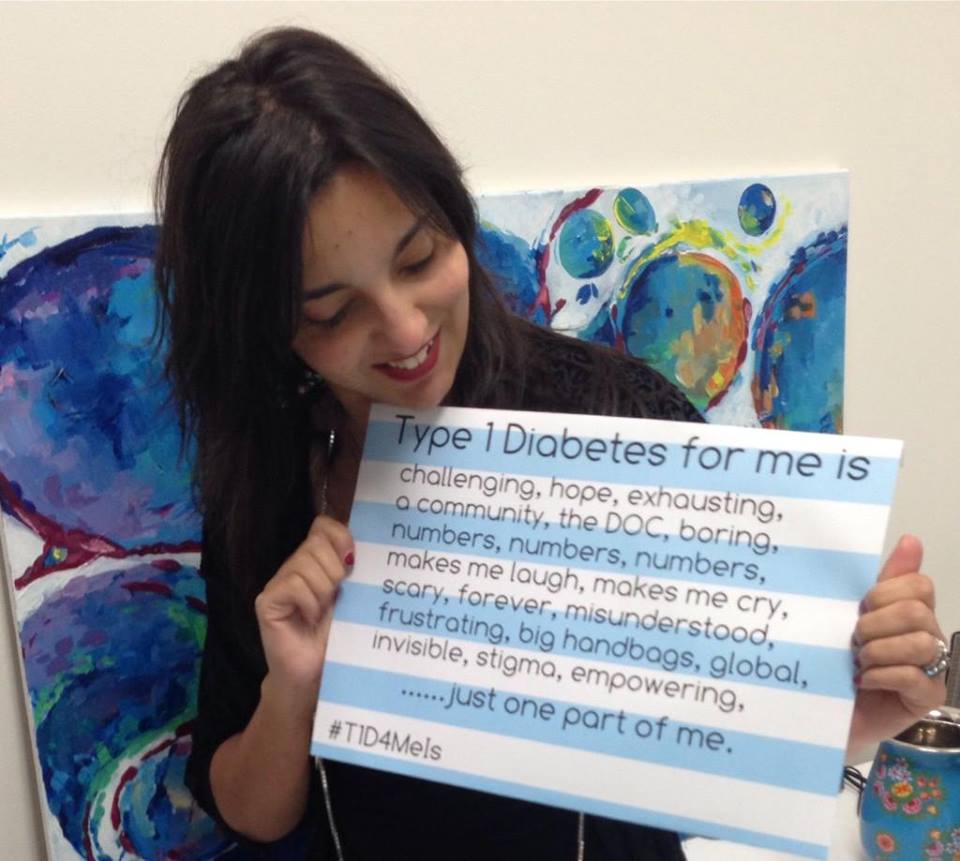
Today, my poster would look a lot different. It would have just one word.
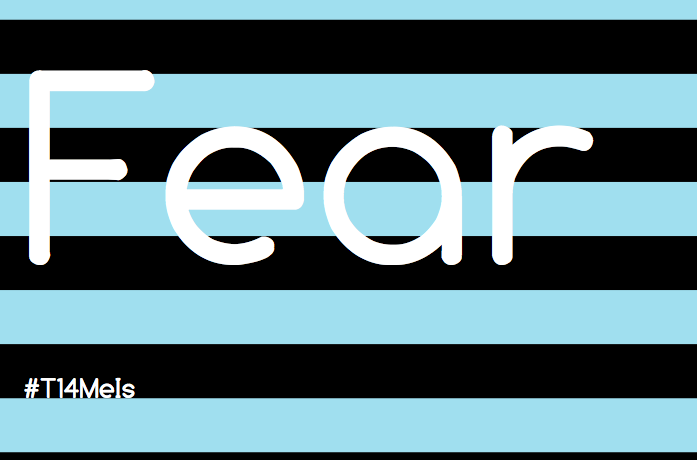
Today I hate diabetes. I don’t feel empowered. I don’t feel ‘in control’. I just feel sad. And scared.
My Facebook and Twitter feeds are full of diabetes awareness campaigns and it is only going to get busier in the next few days. World Diabetes Day is a global event, and around the world there is much going on to help get people talking and thinking about diabetes.
My favourite campaigns are those that strive to shoot down diabetes myths and one that is getting some well-deserved traction this week is Walk With D.
The aim of Walk with D is to help people without diabetes understand what life with diabetes is all about. But more than that, it hopes to address the misconceptions within the diabetes community too.
Diabetes myths are rife. Every day, I hear things that are simply not right about what diabetes is all about. It frustrates me; it angers me; it infuriates me – never more so than when it is coming from within our own community.
I am filled with despair when I see people with type 1 diabetes perpetuating myths about type 2 diabetes with incredibly destructive ‘type 2 bashing’. I don’t know how many times I’ve said the words ‘No one asks to get ANY kind of diabetes’, but believe me when I say if I had a dollar every time I’d uttered that sentence, I’d be wearing a new pair of Manolos almost every week!
‘Even within the diabetes community, there are levels of misunderstanding, misrepresentation, and mistaken messaging, often creating a divide where there should be a bridge.’ – Walk With D website
Help stop the stigma!
As with any successful social media campaign, it’s easy to get involved with the Walk With D campaign. Share your story and use the #WalkWithD hashtag. Make it personal and make it real. Visit the Tagboard on the Walk With D website to see what others are saying about their real life with diabetes. And share. Share. Share.
And if you need more of an incentive to get on board, Lifescan Inc will donate 100 BGL strips to Life for a Child every time the #WalkWithD hashtag is used during November. Get tagging, good people!
Everyone’s diabetes story is going to be different – the diversity of our community is actually one of its strengths! But we can surely unite in our aim to have diabetes spoken about respectfully and with courtesy. Surely we can bond over the fact that diabetes just plain sucks. Surely we can walk together with diabetes, united, with our heads held high and our arms linked.





 Diabetogenic