You are currently browsing the category archive for the ‘Wellbeing’ category.
Today, I am feeling particularly giving, so I am going to give you some advice that may help you cure or prevent diabetes. Or both.
Here goes:
- Eat yoghurt
- Sleep naked
- Love yourself
- Eat cinnamon
If you are a multi-tasker, I suggest eating cinnamon flavoured yoghurt in the nude while telling yourself how awesome you are.
Or.
You can ignore all the ridiculous claims, phoney promises, snake oil, COCONUT oil (I am so looking at you and your activated nuts right now, Pete Evans) and do the following:
- Follow your management plan that has been put together by you and your healthcare professional/s. And for the purpose of this, we are going to say that a healthcare professional is someone who has studied for a number of years and gained some sort of qualification – as in a Bachelor degree – not a certificate they have printed themselves after doing a six week online course. A healthcare professional is not someone who writes a blog / is a TV personality / is a personal trainer / has ever appeared on a reality TV program / thinks they understand ALL health conditions because they have one themselves etc. etc. (Hence – I am not a healthcare professional. I am not even professional when push comes to shove. But then, I’m not telling you to eat Nutella while naked to cure your diabetes, (you can trust me on this one – it doesn’t work…). BUT, if I tell you to go eat some chocolate, you should. Because it tastes good.)
- Be nice to yourself. Because you are an awesome person and having a health condition does not diminish who you are or your self-worth in any way.
- Food doesn’t have a moral compass, so if you want to eat a doughnut, knock yourself out. Or don’t eat a doughnut if you don’t want to.
- Remember that you did nothing to cause your condition. No one deserves to be diagnosed with any crap condition. No one is to blame. No one asked for it. (Really, no one writes in their letter to Santa ‘This year for x-mas I would really like an incurable autoimmune condition. I have been super good, so if you could give me two that would be great.’ Seriously. Santa never received that letter!)
- You can look for things to blame because I know how great it would be to point at something and say ‘damn you for screwing up my pancreas’ but that isn’t going to make diabetes go away. Perhaps you could consider using your energy for doing something that makes you feel good. Like patting a puppy dog or eating a piece of cake. Or go cherry picking.
- Surround yourself with people who make you feel good about life – not people who suck the life out of you and make you feel worthless.
- Accept that it is absolutely, positively, completely and utterly okay to feel crapola sometimes about having a health condition that you didn’t ask for. It’s your diabetes and you can cry if you want to.
- If you have the energy, put on some music and dance around your kitchen. I promise when I tell you it will make you feel good. Plus, you can claim it as exercise (quick – log a Big Blue Test – extended until today!) which will make you feel even better about yourself.
- Read something by David Sedaris. Aloud if you can.
- Stand in the sunshine for 10 minutes
- Or, stand in a downpour and get totally soaking wet – a bit of Belinda Carlisle will make you feel fabulous! (Ideally, do this in your back or front yard so you can go inside and dry off. By all means, do it at work, but you will get strange looks from co-workers if you squelch back to your desk looking like a drowned rat, leaving a puddle in your wake).
- If you are the hugging type, find someone to hug (ask first; it’s polite).
Now, none of these things is going to cure or prevent diabetes. I could claim that they will, but I’d be lying. Because nothing – NOTHING – will cure your diabetes. But doing whatever you can to make you feel good is a worthwhile thing to do.
Any other ideas? Go!
It’s World Diabetes Day and everyone is talking diabetes. Or so it seems.
Do we need another awareness-raising day?
Yep. We do.
We know the numbers. We know that diabetes is serious. We know that prevention is the key – prevention of type 2 diabetes (where possible) and of complications in those already living with diabetes. I could write how World Diabetes Day can draw attention to these facts.
But instead, I’ll tell you why I – a person living with diabetes – need World Diabetes Day.
I need today because it gives an opportunity to talk about real life with diabetes.
On Wednesday, (also known as ‘I hate diabetes day’) I spoke at the Austin Hospital’s Grand Rounds. Most hospitals have Grand Rounds – it is a learning opportunity for doctors and other healthcare professionals to hear presentations and ask questions about different medical conditions – sometimes outside their area of specialty.
Wednesday’s session had a World Diabetes Day focus – the lecture theatre was adorned in blue balloons and just about everyone in the room was wearing an item of blue clothing.
I gave my talk which consisted a discussion of the consumer-focused program we run at Diabetes Australia – Vic; how healthcare professionals can use social media to interact with people with diabetes and how PWD use social media to connect.
At the end of my planned talk, I looked around the room. I think my talk had been well received – I know that I am certainly different to the usual healthcare professional presenting and I also knew that the next speaker – the wonderful Professor Joe Proietto – was giving a talk on type 2 diabetes medication.
‘Just before I go, I want to say something,’ I said. I took a deep breath. ‘I hope you have enjoyed my talk. I hope that it has given you a better idea of some of the programs and activities available to be people with diabetes. I hope you are thinking about what your Twitter handle is going to be because I really want to see ALL of you in the Twittersphere next week!! But I just want to add something.’
I moved away from the lectern and stood in the middle of the stage.
‘I look okay today, right?’ I saw heads nodding around the room. ‘My dress is neat, my hair is clean. I have make up on and I know I have matching shoes on – I checked before I left the house. My lipstick is on straight. I just gave you a twenty minute talk, and I think it all made sense….I think? The words did form coherent sentences, right?’ More nods from the people in the theatre.
‘I look okay.’ I paused again.
‘But let me tell you how I am feeling. I had a terrifying hypo overnight and was awake for a good part of the night. I needed help to deal with it, and my daughter, when she woke up this morning, had to see me feeling pretty damn crap. My dad is sitting over in the corner there because I was just too tired to drive here from Brunswick, and he kindly offered to chauffeur me so I wouldn’t need to take a cab.’ I looked over at my dad and smiled. And then kept going.
‘Why did this happen? Well, I guess if we want to find a reason, we could say it was because before I went to bed last night, I didn’t check my blood sugar. You see, I just couldn’t be bothered. Now, before you think ‘how stupid’ or ‘serves her right’ or start to judge me, know that I had already checked my BGL about 15 times throughout the day and the thought of doing another BGL check was just too much for me. And I thought that I was okay based on the previous check and knowing that I had no insulin on board.
‘But you know what? It doesn’t matter why it happened and if I wasn’t telling you this now, you would never know. You wouldn’t know that I really would like to curl up under one of the seats and fall asleep; you wouldn’t know that I am still dealing with the hypo-rebound and my BGL is sitting somewhere in the mid-teens. You wouldn’t know that my arms and legs are heavy from being post-hypo-exhausted. You wouldn’t know that I kind of want to cry because today, my diabetes is other people’s problems. Not just my own.
‘Now, I’m not telling you this because I want you to feel sorry for me. I’m not telling you this because I want you to pity me because I have diabetes. It’s crap and that’s all there is to it. I’m telling you this because I want you to remember this story next time you are sitting opposite one of your patients who is living with diabetes – or any other medical condition for that matter – and they look all great. Don’t assume. Don’t ever assume that everything is all fine. Because I can tell you for sure that while I will be blogging about this to share with other people with diabetes, I certainly won’t be sitting in my next appointment telling my endo about it.’
I stopped again. The room was silent – no one moved.
‘Thank you so much for having me here today. And happy World Diabetes Day for Friday.’
I walked off the stage.
I love Joni Mitchell. And I love this song – Blue – which is, of course, perfect for today.
The other day, I was in a beautiful shop looking for a card to attach to the wedding gift we were giving my cousin and his bride when I saw this one:
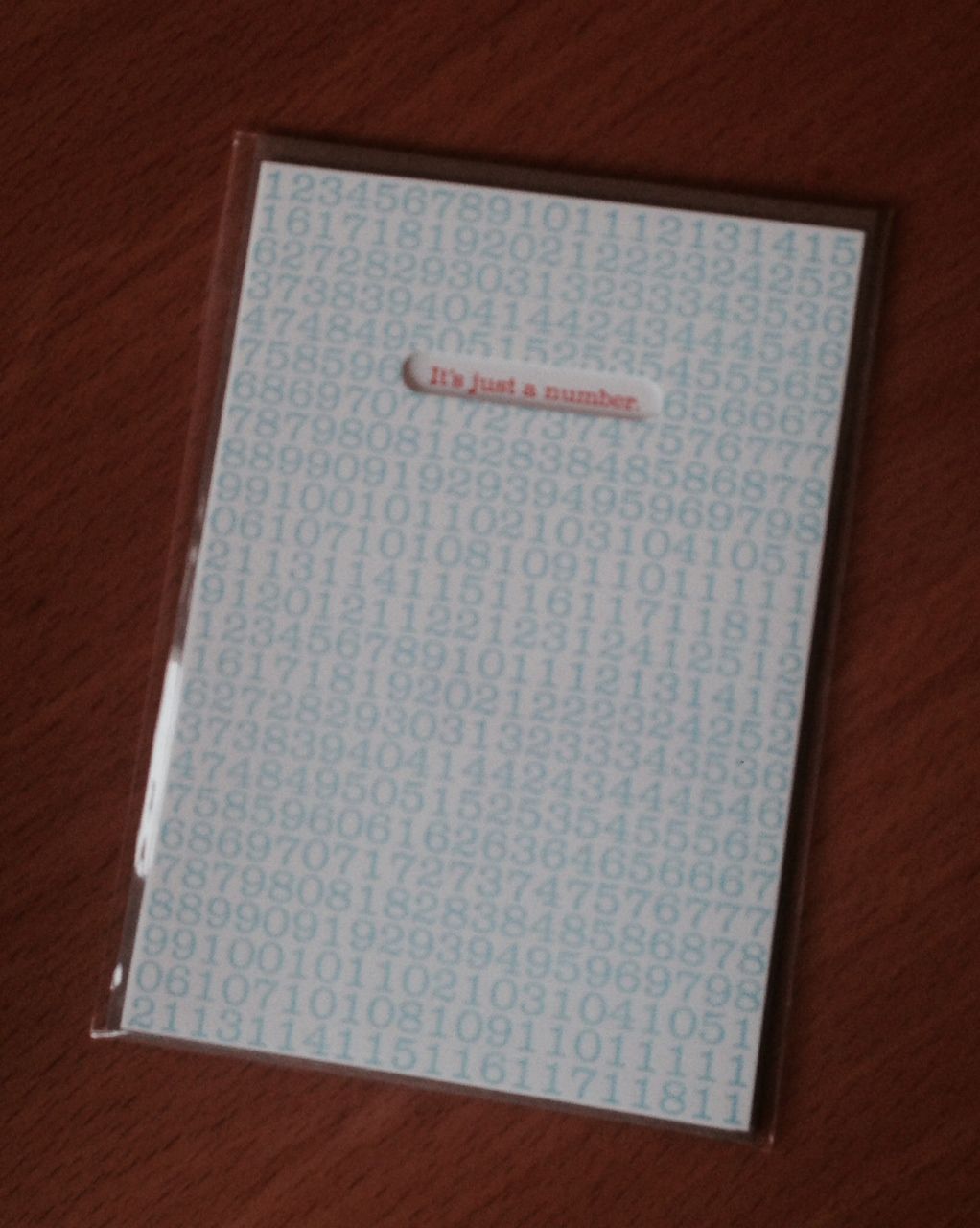
Obviously, not appropriate as a wedding card – the artist had surely designed it with birthdays in mind – but I couldn’t help buy it for myself. Despite being one of the world’s loudest ‘It’s only a number’ advocates when it comes to diabetes numbers, sometimes I need a gentle reminder to not be so hard on myself.
This card is now pinned up in my study at home amongst all the other cards and postcards and photos and drawings and paraphernalia that I have accumulated over the years. And just like those other things, it reminds me to keep things in perspective.
The card is from Eggpress– have a look; they have some gorgeous stuff!
Who do you write your blog for? The question came after one of my recent presentations about how healthcare professionals can use social media to connect people living with diabetes.
My flippant answer to that question is ‘Oh, me and my mum. And some weird guy in Romania who seems to be really interested in my life…..’
The easy question – which is also frequently asked of me is WHY I started a blog. The answer to that one is simple. I hoped it would help me connect with others sharing my story. Because every single time I told of one of my experiences at least one other person – and usually many more – said ‘oh, me too’.
It was exactly the same as when I heard others with diabetes speaking about their lives. I wanted to jump up and down and yell out to them that it was the same for me. (And if I’m being truthful, I actually did do that a couple of times!) These sorts of connections made me feel less alone.
I considered writing a blog an extension of a lot of the work I was already doing: being the ‘here’s-one-we-prepared-earlier’ case study at meetings and information sessions. This, however, would be writing it down. I did this while I was pregnant with our daughter – I kept a weekly online diary that was published on a diabetes site. It was therapeutic and reassuring for me. An ongoing blog would give me the chance to write about and examine my real life with diabetes, and hopefully connect and share with similar folk around the world.
People tell me they like the candid, raw and honest way I tell my story; they feel they can relate. I try to inject a little humour and sometimes that works, other times it falls flat. I have been told to tone things down (I had to stop telling my ‘I will hunt you and all your family down and hurt you all if you steal my pump’ story because my husband said that with my Italian heritage and (falsely) assumed mafia connections that people would get scared*).
I decided when I started writing my blog that there were certain things I would not write about. I would not share others’ stories and I would never, ever write about things told to me in confidence.
I occasionally write about my family and friends, but it is usually incidental to the real issue I’m writing about – sometimes it helps illustrate the experiences and give context.
But what you see is very much what you get. I am conscious that loved ones and people who actually know me and my family read this and sometimes that makes it difficult to write about the more challenging things I’m facing. I don’t want to worry people, but equally, I don’t want to sugar coat things either.
Everything I write, though, whether it is about a particular experience or my circumstances, it is all honest. Sometimes too honest. There have been times that I’ve written something and then the phone calls have started as friends and family check in with me to make sure I am okay.
So who do I write this blog for? I guess it’s actually the same reason as why I write this blog. Mostly – and selfishly – for myself. To connect and find support. And I’m really lucky, because that has been exactly what’s happened!
*I may have stopped telling the story, but that doesn’t make it any less true!
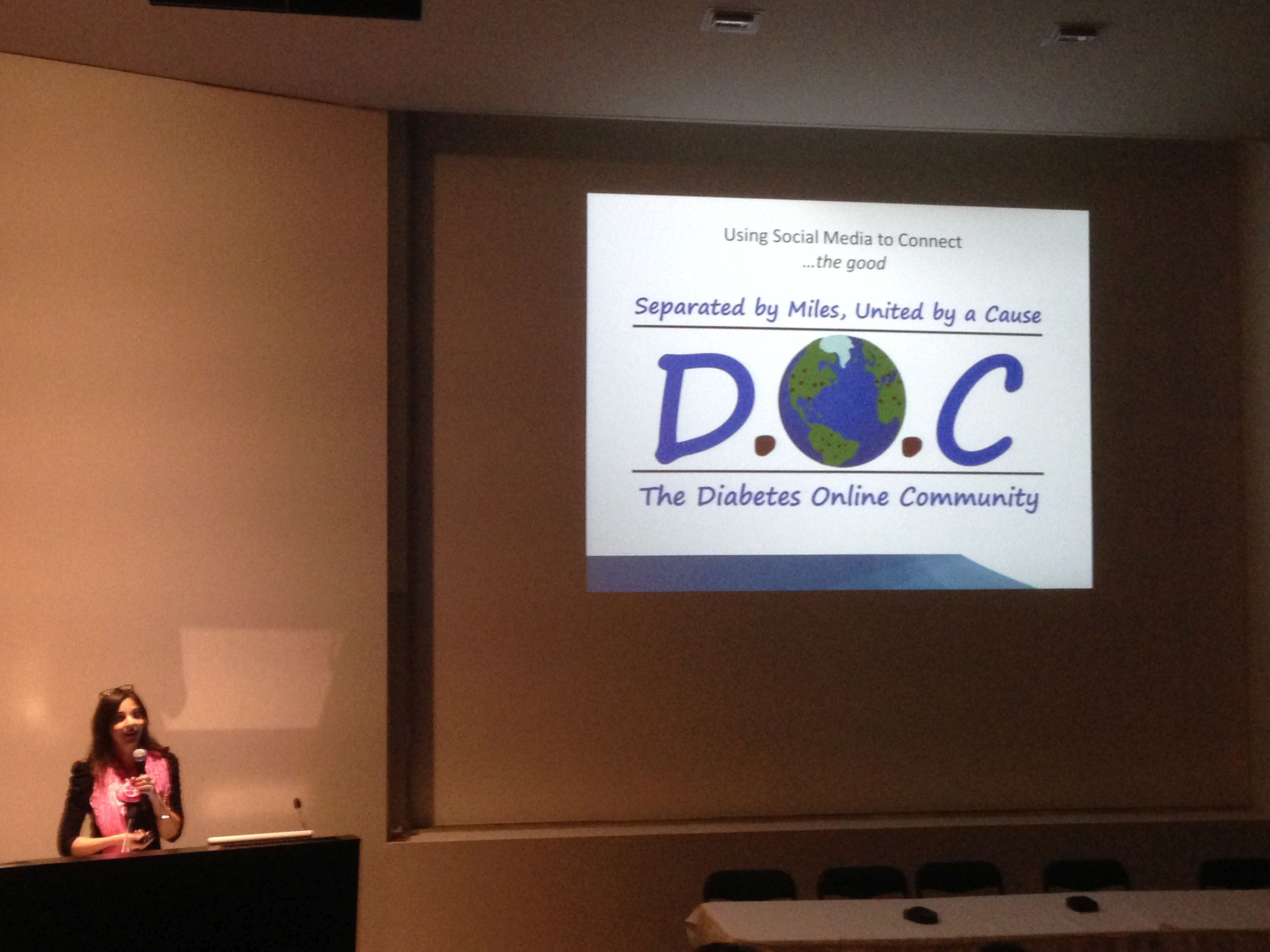
Presenting at yesterday at the Royal Melbourne Hospital’s Grand Rounds.
I’m Paris-dreaming at the moment. The gorgeous Belle du Berry and the rest of Paris Combo are providing the soundtrack. Happy Friday!
There is much known about the progression to the development of type 1 diabetes, but a lot still remains a mystery. We are told there is a two-pronged process, which involves genetic predisposition and a trigger.
But what is the trigger?
Some say it was a virus or a period of particular stress. Others believe it’s environmental. For me, I’ve no idea. I wasn’t unwell with a cold or flu or stomach bug. It was a stressful year with planning our wedding, looking for a house to buy and running my own business. But more stressful than usual? I’m not really sure.
We hear the word ‘trigger’ a lot in health. I know that for me there are triggers that can see me in a downwards spiral leading to diabetes distress, and its good mate, diabetes burnout. Others say they can identify the trigger that resulted in their first anxiety attack. There are triggers that result in ‘attacks’ for those living with coeliac disease or triggers that can cause flare-ups for people with lupus or rheumatoid arthritis, or triggers leading to seizures.
I’ve always wondered about the word. It implies a fully loaded gun that is about to go off – quite an appropriate description really. But what happens for the trigger to be pulled?
Is there, in fact, a ‘trigger point’ as such or is it the moment that we stop and acknowledge that there is something that needs attention?
I can rarely signpost the exact moment that results in diabetes distress. It’s never ‘an event’; it sneaks up on me. Sometimes – though not always – I can see that it is approaching. Does this mean I do something to stop it getting to the point where I am so distressed that I stop my diabetes self-care? Ha – no!
While I may have become better at recognizing that I am on the road to diabetes distress, I’m not so good at identifying the things that send me in that direction. Simplistically, I could say it’s just me getting sick and tired of doing this day in day out, and I am sure that is part of it.
But when I am being particular self-aware and intuitive I know that there are other things that contribute. When I wasn’t feeling good about myself earlier this year, diabetes self-care was the last thing on my mind – possibly because it couldn’t fit in there with all the feelings of sadness.
And I wonder how much of it is also about feeling that my broken body doesn’t deserve looking after. ‘My pancreas is hopeless – so the rest of me may as well be too.’
The one thing that does come out of this all for me though is a renewed sense about what living with diabetes is all about. When I start to see the light and start to feel better about myself and, slowly, slowly, start to reintroduce my self-management tasks, I am able to refocus. I remember that the numbers which scared me and pointed to being a failure are just moments in time. I remember why I deserve to be well and look after myself.
Being able to identify triggers and then respond is a really useful tool in managing health conditions. It’s just finding a way to do that. BEFORE the trigger is pulled. Because no matter what John Lennon says, happiness is NOT a warm gun.
About two months ago, I realised something. It came as a bit of a shock because I have had some pretty difficult and dark times over the last couple of years.
I realised that I am okay with who I am.
I know that it sounds kinda clichéd and like I’ve been reading a book of inspirational quotes (which I’ve not!) but it was a little of a revelation. Because for some time now, I’d felt like I really didn’t like who I was.
This all happened one afternoon as I listened to my daughter and a couple of her friends playing outside. They were sprawled out on the front veranda, lying on their stomachs, drawing, looking up occasionally to see what our new puppy was up to. In between such busy-ness, they were speaking about what they liked about each other and what they liked about themselves.
I love this about kids. Before they develop the ‘I must hate and criticise myself lest people think I am up myself’ gene, they feel free to say that they are pretty damn great. Because they are.
My daughter is really lovely when people compliment her. She smiles and says ‘thank you’. And sometimes, she says ‘I know’. It’s beautiful and honest.
‘You’re a great reader,’ I told her the other day when she told me she wanted to read Anna Karenina (seriously – no idea, but she’s six chapters in and loving it). ‘I know. I love to read,’ she answered. She didn’t sound boastful or conceited. She was acknowledging what I said as the truth. Because, it is!
When someone compliments me, I make up every reason to discredit their comment which, when you think about it, is actually very rude.
Having a chronic health condition makes it really easy to think that we are not enough or that we are broken. Add to that any other health concerns and suddenly, we can start to think of ourselves as hopeless. And when we start to add feelings of distress and a significant reduction in our emotional wellbeing, things get worse and worse.
Supplement that with other things that are getting us down and it is only a little hop, step and jump away from feeling hopeless, desperate and desolate. It’s hard to see anything good in ourselves.
The bottom line is that I stopped liking myself. I stopped being able to see the good or the positives and I simply could not be proud of anything that I was doing – even though during that time I knew I was doing some pretty amazing things.
I’m not sure what it was that jolted me out of this. I’d like to think it was ‘bolt-of-lightening’ like, but I don’t think it was. Perhaps it is the robustness that comes with age that reminds us that actually, through the shit, there is good. And a rather Pollyanna-ish attitude that ‘this too will pass’.
I listened to the kidlets and smiled. And then I remember thinking ‘Actually, I’m okay too. I really do like myself. I deserve to have good things happen to me, because I am worthy and good.’
I stopped thinking about my health problems as things that made me fragile and shattered, instead conceding that they are part of the sometimes fragile fabric that when put together makes up me.
I stopped thinking that the things that had been upsetting me where a reflection of the person I was and accepted that many of those particular things were out of my control and had nothing to do with me.
And just like a patchwork quilt, when you look at the pieces alone they don’t make sense and they are not really useful or beautiful or amazing or wonderful.
But when you put them together, they work.
I like myself. And it’s a really, really, really amazing place to be.
‘What’s the hardest thing about living with diabetes?’
I was asked this question the other day by someone who is not in any way connected to diabetes. He does not have it himself, does not have a family member with diabetes and doesn’t work in the area.
‘The fear’. I blurted out. I didn’t think my response through; it just came out.
I backtracked and gave my usual answer, where I become a little glib because I’ve said it and written it down so many times. ‘Oh – and you know – it never ends. It’s there all the time. There is no rule book. It changes for no reason.’
I smiled at him. I was back on message.
But later on that day, I realised my initial reply was true. I am scared. We constantly hear that we shouldn’t take our health for granted. I always did. But diabetes has robbed me of that.
What I am scared about isn’t the day-to-day living with diabetes. As much as I complain about it and feel it is a pain in the arse, the truth is that I actually can deal with it. The infusion set changes and sensor insertions and BGL checks are annoying disturbances. Counting carbs makes my head hurt and scheduling in doctors’ appointments far more than I’d like are all really annoying. But I just do them. Begrudgingly.
But I don’t find these things hard.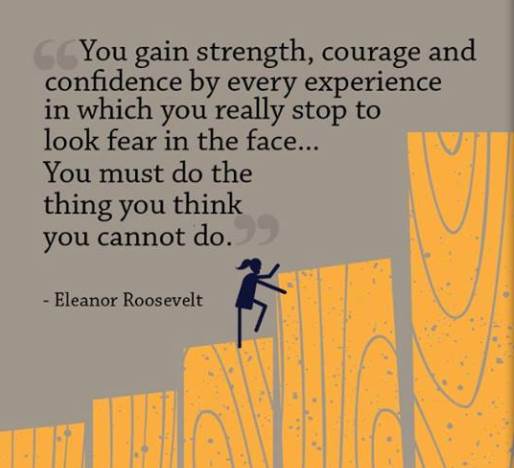
I am scared about the stuff I don’t know about. I’m scared about complications developing. I’m scared about what might happen and I am scared that these things are going to happen soon.
I’ve come to realise in recent times that the things I fear are becoming more and more a part of my emotional self. Where they used to be a passing thought that I could dismiss with a flick of mental power, now they appear and are harder to deal with.
I find myself having these thoughts more and more – often completely out of the blue. And I can’t just acknowledge them, tell myself it will be okay and move on. They settle in, get comfortable and are there a lot now.
Overwhelming. Paralysing. Frightening. Today these are words I use when thinking about diabetes.
And I fear that the fear is going to actually become unmanageable. I fear that the fear is going to make me stop doing things and stop wanting to do things. And I fear that the fear is going to change who I am and make diabetes a thing that suddenly has moved from being an inconvenience to something more. To something bigger. To something ugly and shameful and devastating. I. Am. Afraid.
It’s time for me to do something about my internal dialogue about diabetes. I don’t want to be afraid of diabetes because then it wins. And while this is not a competition (because believe me, there really is no winner) I have to find the way back to feeling better about diabetes. And I will. I have to.
The diabetes online community is a truly global network. We see that every week in tweetchats and anytime we log onto social media. We know that connections are made that are life changing and, (as in the case of my dear friend’s ‘Pumpless in Vienna’ story – to be told here soon), life saving.
For the last three years, I have been privileged to attend the European Bloggers Summit, which is a satellite event run alongside the EASD Scientific Meeting. This event is a chance to really look at ways that consumer advocates can work together and support each other to make significant change to living with diabetes.
It was sobering to be reminded several times yesterday that those of us sitting behind our laptops, participating in the dialogue of the community are already very lucky. We looked at programs out there that are providing insulin to people who would not otherwise have access. Again – life saving.
The beauty of these events is that they are not simply a day or two of navel gazing and patting ourselves on the back for the work we do. We challenge ourselves and each other to do more, do better and reach more people. We plan for what we want to achieve and then hold ourselves accountable for what we have said we want to deliver.
The issues that we have in Australia and that I frequently write about right here are so often universal. Hearing friends from Europe say that the language of diabetes is an issue, or access to technology or medicines is prohibitive for some, reminds me that it is worth continuing to be in this space. When I hear about the frustrations experienced by others when it comes to consumer representation, I know that every time I say ‘nothing about me without me’ it is echoed around the world.
There are some amazing things going on, and over the coming weeks I’m going to write about some of the things I learnt about because I not only want to share this work, I also want to encourage others to get involved.

DISCLAIMER
The 2015 European Bloggers Summit was sponsored by Johnson & Johnson. I was invited by Johnson & Johnson to attend the event and did not receive any funds from Johnson & Johnson to cover travel or accommodation costs to Vienna or to attend the EASD conference. These costs were covered by my employer, Diabetes Australia – Vic.




 Diabetogenic