You are currently browsing the category archive for the ‘Wellbeing’ category.
Things I know to be true:
- It’s February already.
- Melbourne seems to have misplaced its Summer.
- As much as I loved being in New York and had the best holiday ever, it’s always swell to come home.
- And having Melbourne coffee running through my veins is making me a happy chicken.
- Being at work is not the worst thing, especially when there is a year of really exciting things on the horizon.
- I am confused that my computer does not recognise the word Nutella and wants to correct it to Nigella. Which is equally awesome and sexy.
Also – the internet never disappoints.
Frocking brilliant
Sometimes it’s tough for a dame to find a place for her insulin pump. Bra? Good in theory, but what if you’re not wearing a bra? Or your bra is being uncooperative? Thigh strap? Again, great idea, but not great if the thigh strap comes loose and starts rolling down your leg and you end up in the Ministry of Silly Walks. Also, it can look like you are packing heat. Or you end up using ugly (although effective) Tubigrip. Pocket? Usually produces an unsightly bulge that may have people searching for a matching Adam’s apple.
What’s the solution?
Read here about some clever folk who have come up with a rather dashing frock with a secret little place to hide a pump.
And who doesn’t love a LBD? Can’t wait to get my hands on – and body into – one of them! Available soon – keep an eye out here.
Two spreads in one
There are many tough decisions in life. Lennon or McCartney? Coffee or tea? Jaffas or Malteasers? (Both, obviously.)
And the most difficult: peanut butter or Nutella? Can’t decide? Then have both! In domestic goddess mode on Sunday (full skirt, frilly apron, high heels and tiara) I made these.
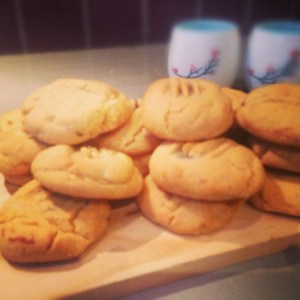
And they are were good. And totally bolus worthy!
Here’s the recipe. (And here’s a tip. When freezing the Nutella before making the biscuits, do half on one baking sheet and half on another. Take out one baking sheet, make half the biscuits. THEN take our the second baking sheet and make the second half. Otherwise the Nutella starts to melt and ends up all messy and all over your fingers and you have to lick it off your fingers and then freeze more.)
Oh, and while we’re talking Nutella, let me introduce you to my happy place:

Support DA-Vic and enjoy the Melbourne Food and Wine Festival (WIN WIN!!)
This year, Diabetes Australia – Vic (disclaimer: my place of employment, but I am writing about this because I want to, not because I was asked. Also it is about food. And wine. So there’s that too.) is the charity partner for the Melbourne Food and Wine Festival. Some people may think that this is an odd partnership, but actually, the messages of both DA-Vic and MFWF are strongly aligned. It’s all about people taking an active role in managing their health – regardless of if they are living with diabetes or not. And having a good understanding of the food we choose to eat is part of this.
It’s also a great opportunity to raise awareness of diabetes, reaching people we may otherwise not reach.
Now, everyone knows that I am not really an exercise fan. However, I can definitely get on board this. It’s literally a moveable – well moving – feast where participants take a walk around the Tan, stopping at stations for a delicious five course brekkie. And better yet, 5 per cent of ticket/registration fees will be donated to DA-Vic.
Noteworthy connections
Many of you may not know that in a former life I was a classically-trained musician. That ship sailed a long time ago and I no longer play music. However, my husband is a musician and music is a huge part of my family’s life.
I have always been interested in the link between music and health. The Greek God, Apollo, was God of both healing and music, so the connection has been around for a long time!
Music has been used as therapy in a variety of medical conditions from Parkinson’s Disease to recovery from stroke. I am not going to say the healing powers of music can cure diabetes (although I’m pretty sure some fool will tell you that). But, music can be a stress reliever. And for me, reduced stress means less erratic BGLs.
There are also strong links between music having positive effects on mental health as discussed in this information sheet from ReachOut.
I love this so much
I’ve shared this blog before here, but this post from Annabel over at The Understudy Pancreas is one of the most beautiful pieces of writing. Full stop.
I can’t begin to imagine what parenting a child with diabetes would be like, but Annie does such a wonderful job of explaining how her family do it.
The thing that I probably admire most is how Annie never, ever makes her daughter’s (Pumplette) diabetes about herself. She supports her daughter in the best ways possible, encouraging her independence, and being there for her – with what Pumplette needs. Great parenting advice all ‘round, really.
I wish I could reach into my computer and give you a huge hug, Annie. Your darling girl is so great.
Radio Deluxe
When we were in New York, we spent a very pleasant evening at Birdland listening to John Pizzarelli and Jessica Molaskey perform. It was a gorgeous gig, made even more wonderful when they dedicated a song to the ‘family from Australia’.
Each week, John and Jessica have a syndicated radio show (they claim it is ‘live from high above Lexington Avenue in the Deluxe Living Room’, and while I suspect it is actually recorded in a studio, I like to think of them in their living room at home, gazing out over the New York skyline, casually chatting into a couple of vintage microphones) and it is an absolute treat to listen to.
Check it out here. It makes a great soundtrack to the workday!
What do ‘patients’ really think? (Maybe stop using the word ‘patient’ to begin with…..)
British medical journal The BMJ has started a fascinating new series called Do you know what your patient is thinking? This is part of their patient partnership strategy and will hopefully help HCPs better understand all aspects of life with a chronic health condition – not just what …..
The first in the series, Why there’s no point telling me to lose weight, can be read here. New submissions will be published monthly.
Living Vertical
Steve Richert has lived with diabetes for 17 years. A couple of years ago, Steve wanted to show that diabetes hasn’t stopped him from doing what he wants, so he and his wife, Stefanie, travelled across North America and climbed for 365 consecutive days. Just like with diabetes, there were no days off.
I absolutely love the catalyst for this project. This is what Steve writes on the Glu website:
‘In 2011, I had lived for almost 13 years with type 1 diabetes, and despite the normal ups and downs, seasoned with occasional close calls, it had never stopped me from being me. In fact, it made me who I was. When I was on a trip to visit friends, Stefanie and I drove past a billboard aimed at fundraising for diabetes research. It made my blood boil.
It was a smattering of grim statistics and stock imagery geared to promote the idea that life with diabetes was no life at all—that we are weak and helpless victims of this condition. Before this point it hadn’t ever occurred to me that the message of being empowered had any place in diabetes. I didn’t know anyone else with type 1 diabetes and I assumed everyone just came to terms with it as I did. Seeing this billboard made me aware for the first time of how we are portrayed—and how that can impact someone.’
A film has been made of Steve and Stefanie’s adventure. You can read about and watch Living Vertical: Project 365 here.
Save a child…..
Thinking about Valentine’s Day? Don’t forget to Spare a Rose, Save a Child.
No four words sum up this campaign better than this ‘Flowers die. Children shouldn’t’.
Please donate. Remember the equation: One rose = insulin for one month. Multiply as many times as you can.
That’s all for now, folks. Happy Tuesday.
We know there are many factors that come into play when it comes to managing life with a chronic health condition. Our attitude, outlook, strength and mindset all play an important role.
But what about our personality? Do our personality traits affect the way we deal with living with diabetes?
Well, of course!
If our personality defines the sort of person we are then it stands to reason that our personality traits will play a part in how we view and respond to everything – including the day to day living with diabetes.
The Big Five personality traits in psychology are openness (to experience), conscientiousness, extraversion, agreeableness and neuroticism, all of which I believe, in my very non-scientific approach, impact on our attitude to and way we live with diabetes.
I consider myself to be pretty open to experience, not especially conscientious (I have so little self-discipline it’s not funny…pass me another doughnut. Thank you.), extraverted, agreeable and not particularly neurotic or anxious (unless talking about eye complications and a worry that the world Nutella supply may be in threat).
The way the cards have fallen to determine my personality is not necessarily useful when it comes to managing diabetes. Surely having a high level of conscientiousness is king when it comes to managing something like diabetes! (I’ll use this as the reason that I have never, ever kept a regular BGL diary….)
However, being open to new ideas has definitely been of use when it comes to being an early adopter of diabetes technology or considering an out of the box way to manage a difficult diabetes problem. And extraversion and seeking the company of others to crowd source information and learn about others’ experiences and learnings with diabetes has been nothing but positive in my diabetes management. Being secure and confident in my decision making and abilities rather than neurotic and second guessing myself definitely helps in making decisions, sticking to them and owning how I choose to manage things.
These traits determine how I see and how I live with diabetes each and every day.
But could our personality have something to do with actually developing health conditions? (No – this has nothing to do with lack of self-love causing auto-immune conditions. ‘Cause that’s a load of C R A P.)
This study looked into a link between personality and health, specifically how different personality traits impacted biological immune responses. (This article breaks it down nicely for simpleton folk like yours truly to understand.)
One of the findings of the study is that people defined as have an extroverted personality have more pro-inflammatory genes which means that we may be better at fighting off illness. The negative side of this is that ‘over-alert’ pro-inflammatory genes can also result in an increased incidence of autoimmune conditions.
In my highly non-scientific study of n=1, this rings true. I am overall pretty healthy and manage to avoid catching (most) everyday viruses. Good work, autoimmune system!
I also collect autoimmune conditions (last count – I have three). Not such great work, immune system!
As with many studies, there are still lots of questions to be answered. In a chicken/egg type scenario, there is no answer to what is causing what? Is it our personality that determines our immune system or is it the other way around?
Trying to piece together the puzzle of autoimmune conditions is a long road. I will never ever understand how it is that I developed diabetes at the exact point that I did. Whist I understand the genetic predisposition component, the trigger aspect has me scratching my head to this day.
But this is another little piece slotted into place in what is looking to be a one bazillion piece puzzle.
Click
The sound the applicator of my CGM made as the introducer needle pierced the sensor through my skin made me wince. It’s an involuntary response and not because of pain. The little pinch I feel as the needle shoots in is so insignificant it doesn’t really warrant a response.
My last sensor fell out in bed on one of the first nights of our holiday. The next morning as I removed the spent sensor from the transmitter, I decided that I wouldn’t put in another sensor straight away. And then after a few days of enjoying having one fewer device stuck to my skin, I decided that because I was spending so little time alone, I really didn’t need the safety net of a CGM. Plus I had no plans to try to tighten up basal rates or make any other adjustments.
More than five weeks and no CGM.
But the afternoon after we returned from New York, as Aaron was getting ready to go to a gig, I realised that jet lag would possibly be sending me to sleep before he got home. And I’d been chasing hypos all day – continually going low just as I thought I had managed to get on top of things.
I knew that it was time to get hooked up again to my CGM. I needed my safety net back.
So, I pulled out a fresh sensor, swabbed the back of the transmitter and with a click, the new sensor was attached firmly to me.
The clicking sound hit me with a force that surprised me. I actually felt it in the pit of my stomach – a sinking feeling. I felt my breathing quicken. What’s going on? I thought. I checked the site where the sensor had gone in and where I had fastened the transmitter. It looked fine. There was no pain.
I stood in the mirror, my top tucked under my chin and there, staring back at me, was the reason for this sudden unease. Two medical devices. My cannula on my right side, the pump tubing snaking its way up my chest to the middle of my bra where my pump was neatly tucked away, and my CGM sensor and transmitter just to the left side of my belly button.
I could suddenly feel the numbers, I could feel the data, I could sense the information that would soon be available to me. I could feel the vibrating of the alarms.
And the feeling of burnout – that darkness that lives at the pit of of my stomach – sprang to life after having lived quite dormant for a few weeks.
I felt overwhelmed and my sensor wasn’t even transmitting data yet! In fact, I hadn’t even hit the ‘start sensor’ button on my pump yet.
I sat on the bed and breathed deeply before grabbing a piece of paper and pen. I started to make a list of reasons to not get overwhelmed and distressed about reconnecting to my CGM.

I re-read the list and started to feel calmer. But I was surprised at just how sudden and intense the reaction was. I couldn’t really make sense of it either. I love this technology. I love the information it gives. I use a device that is incredibly accurate and reliable. I do feel safer when I have a sensor attached. And I know that, given the cost of running a CGM, I am very fortunate to be able to use it.
So why was I feeling dread instead of reassurance?
I’m not sure; I’m really not.
Later that night, I crawled into bed. It was still light outside – jet lag had indeed hit me! The kidlet was reading in her room getting ready to sleep. Aaron wasn’t home yet and still wouldn’t be for a while.
I started to read and before long, my eyes felt heavy and just as I was about to put my book down, my pump, lying loose in the bed beside me started to vibrate. I looked and saw the two arrows pointing down. I wasn’t low, but would be in about 30 minutes. I reached over and pulled two jelly snakes from the jar on the side table.
As I started to doze, I felt calm and relaxed, looking forward to a good night’s sleep, and woke on Australia Day feeling refreshed. I located my pump amid tangled sheets, and saw the CMG’s straight line. My hand moved to touch my CGM, sitting comfortably on my stomach. Doing its job. Nothing more. Nothing less.
I love food. Yesterday’s post which outlined all the eating we’ve been enjoying while in New York probably points to that. As would many other posts.
And it is the truth. I love food. I enjoy it. I celebrate it. I cook it. I read about it. I share it.
Food is a joy. When I think about different periods in my life, there is always a soundtrack of the music I was listening to, and the meals I’d cooked with love, or shared with family and friends.
There are meals that I have had that are still spoken about – years later. ‘Hey, remember that first meal we had at that gorgeous little place in Venice? I had incredibly gnocchetti with seafood?‘ I might say, to which Aaron would reply ‘Yes! And I had the four cheese gnocchi. God that was good. So good.’ That meal was consumed in 2001.
And our daughter recalls fondly the taste of the plums that would fall from the tree in the back garden of our old house, and how we would sit out there in summer and gorge on the fruit, the juice dripping down our chins.
This is the language of food.
So when I read this the other day in my Facebook feed, I was just shocked. I read it with complete and utter disbelief.

Why, why, why would anyone deliberately make food taste terrible, bland or boring?
There is nothing – NOTHING – in this piece of so-called advice that is useful. There is nothing that provides smart advice for how to eat healthfully or listen to your body for hunger cues. There is nothing that says food can be a part of life that is enjoyable, fun, non-threatening and delicious.
This advice makes food sound like it is something to be feared. It makes food sound like the enemy. But worse, it does not explain how food can be part of a healthy way of life. It does not talk about portion sizes, or balanced eating, or how to incorporate a little of everything into an eating plan.
It is restrictive. It is scary and it makes me feel so sad.
When I was first diagnosed with diabetes, I had no idea what it would mean to my diet. Would I suddenly have a list of restricted or banned foods that I could never enjoy again? Would I need to completely change the way I ate? Would food become a source of stress rather joy?
I have learnt that the joy of food is not lessened at all because of diabetes. I still can eat whatever I want. And I do. My diet is healthy, balanced, full of fresh foods, fun, enjoyable and never, ever boring. And there is no such thing as a taboo food.
I am just so glad that the advice I have taken – as a person with diabetes, but even more so, as a person who loves food – is that there is no need to fear food. I am so glad that what I eat – and what my family eats – is based on what we like to eat, what we want to eat and what works for us. It may not work for you, but it works for us. (The kidlet could probably do without Brussels sprouts, but I am convinced that I will win her over on this one!)
This blog is NOT about advice. Nothing that I write should be considered as something to follow or as advice. So I am going to give you some. Don’t take the dietary advice of a celebrity personal trainer. If you need some help working out what to eat that makes you feel happy and content, see an accredited practising dietitian. If you have problems with your relationship with food, speak with your GP, and ask for a referral to a psychologist.
But whatever you do, enjoy what you eat. Life is too short to eat over-cooked chook.
By the way, here is an awesome way to cook Brussels sprouts: finely slice them, then sauté in a fry pan with a little olive oil and garlic. After about 1 minute (absolutely no longer), toss in some toasted pine nuts (or walnuts, almonds, whatever you have handy). To be fancy, add some bacon cut into thin strips. (To be EXTRA fancy, make it candied bacon by crisping up the bacon in a little maple syrup first.)
Four weeks into a family holiday, away from the mundanity of every day, away from schedules, away from stresses, and I can see just how much better I feel – emotionally as well as diabetes-wise.
After writing an extremely raw account of the diabetes burnout I have been experiencing for some time, I have spent time wondering just how I was going to get diabetes back to a place that would stop causing me so much concern and guilt and stress and anxiety. Because that’s the thing with the way I do diabetes burnout – I don’t just burnout, I then focus on the burnout. Which makes me more burnt out. And then I focus on how much bigger the burnout is getting. You get the picture.
But here, in New York, surrounded by my family and visits from friends, I am feeling that things are slowly, but surely, balancing out again.
Diabetes management has gently snaked it’s way back into my life – just as a regular part of my routine. I’ve found myself checking my BGLs with more frequency – and less frustration – than had been the norm at the end of recent times.
I don’t get to the end of the day and find a pressing feeling on my chest because I have been suppressing the guilt of not checking my BGLs. I don’t ignore high BGLs that I know to be the result of a pump line that really needs to be changed. Diabetes tasks like these just happen; far more effortlessly.
But I am taking things slowly and easily. Baby steps.
I decided not to reconnect my CGM after the sensor fell out during the first week here. I’m spending most of the time with my family, so not feeling I need it as my safety net as I do when either travelling alone or at home at night while Aaron is out doing gigs.
I know that this isn’t reality – as much as I wish it really were – but I am absolutely savouring this time. This somewhat alternate existence is such a privilege – I feel lucky. I feel happy, actually. For the first time in a very, very long time, I feel truly content.
And of course, that makes the overall shitty-ness of diabetes a little easier to manage. But (make no mistake) it doesn’t make it less shitty overall…
I came to this realisation the other day as I was pushing in a new infusion set. I packed away the waste and tucked the freshly-primed pump into my bra, thinking about how much I really dislike diabetes tasks. Because I do. I don’t want to check my BGL or shove a sharp introducer needle into my side to re-site my cannula. But I just do it.
When I am burnt out, one of the reasons I don’t want to do these things is because I hate them. But even when I am just getting on with things and all is ticking along okay, I still don’t enjoy these tasks.
And you know what – that’s perfectly okay!
Perhaps for me what comes after burnout isn’t just getting back on track. Perhaps every episode of burnout – however long or debilitating – ends with a realisation that diabetes is still a shit. There’s just a little more acceptance.
And a tangible sigh of relief to find myself seeing some light for the first time in a very, very long time.
In New York City, the streets are full of people. With only hours until the ball drops, there are people everywhere and more police than I have ever seen trying to control the flow of people and traffic. We just fought the crowds to get back to our apartment where we plan to spend a couple of hours before braving the cold and heading out again to catch some fireworks and see in 2015.
Never one for resolutions, I don’t have a list of things I plan to achieve. As tough as 2014 was, I’m not swearing to leave it behind with promises of new starts. I’ve tried that the last couple of years only to find more difficult times ahead. I have learnt that a clock ticking over to 1 January does not promise anything new. It really doesn’t.
But that doesn’t mean I am not hopeful.
Today, as we spent a most wonderful afternoon in what could be the most beautiful place in NYC, I saw this card:
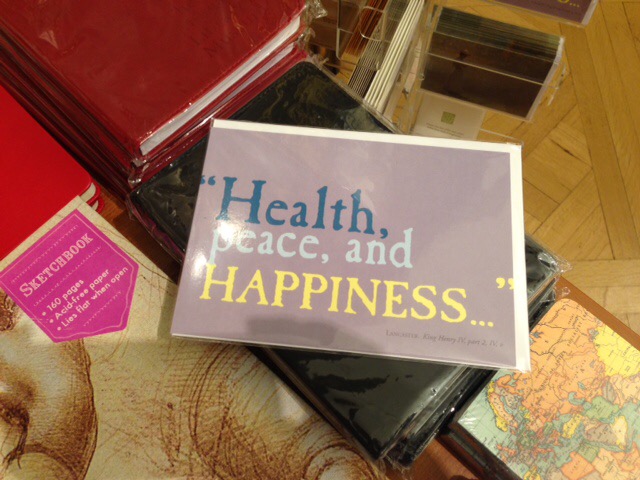
And then I realised that as much as I don’t care for resolutions, I do care for these things. And it is with pleasure, and a hopeful heart, that I can say that right here, right now, I have all these things. I am healthy – despite diabetes; and I am happy and at peace with who I am.
And in all honesty, that is a really good way to see in the New Year.
This week, I wrote a personal piece about an extended bout of diabetes burnout. (Whoa – that’s a lot of words with ‘…out’ in them….)
I have been overwhelmed by love and support from the diabetes online community, and people outside the community as well. Seriously, completely and breathtakingly overwhelmed – and wish I could reach out to every single one of you who has reached out to me to thank you and give you a Nutella cupcake.
I wrote about this for one simple reason – it is my real life with diabetes, and that is what this blog is meant to be all about. Sugar-coating (ha ha – whatever) life with diabetes does no one any good and there is no point pretending it is all fun and games.
Talking about the times things are going well is really easy. Being humorous and looking at the bright side is easy too – and as a person who really does usually see her (champagne) glass/coffee cup as being half full, it is easy for me to seem positive about things all the time.
But the problem with that is that we don’t talk enough about the tough things. And that leads to feelings of shame, which, in turn contributes to stigma.
One of the reason I am such a huge supporter of the Australian Centre for Behavioural Research in Diabetes (ACBRD) is because, apart from being a bunch of fabulous, smart, funny and lovely people, their work means we are talking about the emotional wellbeing side of diabetes. Thanks to the immense body of work they are doing, diabetes is being seen as far more than a numbers game. The quality of life implications of living with this chronic condition are being considered and we are getting a better understanding of distress, anxiety and depression that is related to diabetes. Even more importantly, we are talking about it. And even more importantly, there are strategies being developed to address these things.
I’ve been writing about mental health and diabetes – and wellbeing and diabetes – for some time now because we need to be able to discuss it freely, free from judgement, devoid of stigma.
It’s the same reason that I have written so openly about my miscarriages. I don’t do it because I want people to feel sorry for me or pity me. I do it because it is part of my story. And I do it so that others can see that it is a perfectly normal thing to happen and that there is no shame in it. After I had my second miscarriage, my mothers’ group met. We were sitting around in someone’s living room with our young kids toddling around, playing quietly. It had been a while since we’d caught up and we were going around saying what we’d been up to.
‘Oh, things are their usual crazy self,’ I said. ‘But I had a miscarriage last month, so have been dealing with that too.’ It was the first time I had told anyone, apart from my immediate family and very close friends.
One of the other mums looked up sharply. ‘What? Why didn’t you say something? Why didn’t you let us know? I had a miscarriage three weeks ago. I don’t know anyone else who’s had one. I really need to talk about it, but didn’t know who to turn to. I really wish I had known.’ And she burst into tears, coming over to give me a hug. We sat there and discussed our experiences and how we were feeling and how we were dealing with things. We both felt guilt and shame. We both felt we had somehow failed ourselves and our partners and our families. We both felt the same way – yet were telling each other that we were wrong to feel that way.
It was at that point, I decided that I would no longer hide my story. Because hiding it – when I am usually such an open person – suggests it is something to be ashamed about. Because that’s what happens when issues go underground, we feel shame. I don’t want any woman to feel ashamed because she has had trouble carrying a baby. I don’t want any person to feel ashamed because they are feeling overwhelmed or depressed or in distress because of their diabetes.
There is no ‘fault’. And there should be no guilt. So when we open up and talk about the not-so-good things, we see and accept that this is part of life. It normalises things. It allows for open and easier discussion. And it helps us connect with others who are sharing the same experiences.
Because I can promise you, my story of burnout is not unique. Absolutely not.
I’ve decided that my two favourite words in the world are not ‘coffee, please’ or ‘shoe sale’. No. They are ‘me too’.
Apparently, it’s snowing in New York! So the Brian Setzer Orchestra, live at the Rockefeller Centre with ‘Winter Wonderland‘ seems more than a little appropriate today!
I’ve been thinking a lot about diabetes burnout lately. A lot.
I have been burnt out for a long time now – it’s been 18 months. I can see how it started – I know the trigger. I miscarried in terrible circumstances and, after the constant monitoring and intense management that comes with trying to get pregnant and then conceiving, losing the baby allowed me to ‘take a break’.
I’ve not come back from that break.
My question is this: When does it stop being ‘diabetes burnout’ and become something more? And what is the ‘more’?
We use the term burnout so much in diabetes; I feel that I’ve become a little desensitised. It’s the norm – most people go through periods where they are so unmotivated that they can’t deal with their diabetes, or pay less attention than they typically would. But how long is ‘normal’? How long can we go on like this?
My burnout is scaring me because it has been going on for so long. I fear I’ll never get my mojo back and actually get to a point where I am able to care for my diabetes in a capable way.
I go through periods of so few BGL tests that my meter resets itself. I have not seen my endo for far too long and I’m way behind in my complications screening. The only thing I am up to date with is eye screening because I had cataract surgery in the last twelve months.
A button on my pump has been playing up for over 3 months – half the time taking three or four attempts to get it to work – and instead of getting straight on the phone to the company’s customer service team and organising a replacement, I let it slide until Monday, when I realised that next week I am getting on a plane and going away for 6 weeks and if I don’t get it sorted I’ll end up with a dead pump while overseas.
I’m taking my insulin, although haven’t basal tested for a long while and know that the rates need adjusting. I ‘blind bolus’ a lot of the time. Wearing a CGM is useful because it gives me an idea of my glucose levels, but I don’t actually do anything constructive with the data I am receiving.
I keep in touch with the online community which is my link to seeing and hearing how others are coping. While I don’t participate in every week’s OzDOC chat, when I do get there I feel supported and know that I have people to turn to if I need them. I guess I’m not completely disengaged.
A nasty hypo often gives me a shock and I get a few days of decent and frequent monitoring out of it, but this is short-lived and I fall back into minimal self-care pretty quickly.
And I feel totally and completely shit about the whole thing. And guilty. Of course I feel guilty.
In a couple of years of some pretty difficult stuff, diabetes is the thing that I can let go of. At least, I feel I can. I mean, I can’t stop being a mum. I can’t stop being a wife, daughter, sister, friend. I can’t stop coming to work. I can’t stop doing the things I need to do to be a functioning human. But I can stop with the self-care.
And because I am an idiot, or in denial, or just plain over it, I can’t see just how short-sighted this thinking is. I may be getting through the day and doing all those things that I tell myself I can’t stop doing. But how is all that going to work if something actually does happen as a result of my minimal self-care?
I honestly don’t know where to go from here. I feel paralysed and unable to make decisions that I know may help me start with some baby steps to get back on track. Is it a matter of re-engaging with my HCPs and talking to them for strategies? Do I try to set myself tiny goals, like a morning BGL check each day – or even every second day – that is achievable and will start to give me some data to work with? Do I go back to seeing a psychologist again and discuss ways to get back on track?
I don’t know.
It all seems too exhausting. It all seems too damn hard.
Is this burnout? Or is it something more?
I really don’t know.
This isn’t really a Christmas song, but I still think it’s a good song for this time of year. The wonderfully gorgeous Joni Mitchell and River.
Do you think of diabetes as a struggle? In my ongoing (frequently failed) attempt to spin positivity into life with diabetes, and my love of language, I keep coming up with different words to use: challenge, undertaking, effort, opportunity, experiment, endeavour, complete and utter shitness…
But I guess when push comes to shove, at the end of the day and what it all comes down to is (cliché, cliché, cliché!) there are days when it just really is a struggle. Sometimes I think that living with something that is just so damn difficult and unpredictable all the time means that we just start to accept it. We accept the struggle. The struggle becomes our norm.
I saw this little poster on a friend’s Facebook page the other day and straight away, it resonated:

I got very ‘rah rah’ about the sentiment on the poster, thinking that I should get it on a t-shirt. I do feel that living with diabetes has made me realise my strength.
But when I re-read it a couple of days later, I read the second word.
Thankful.
Am I thankful for my struggle, if my struggle is diabetes? I don’t know. I’m not sure.
Has diabetes made me a stronger person? Has diabetes made me understand my strength – just how tough and resilient I can be?
Perhaps it has. Perhaps it has made me realise that I can deal with pretty much anything that is thrown at me. If I can deal with the ‘never-ending-ness’ that is diabetes, the short term stuff – the things that are not chronic – seem more manageable.
So with that in mind, maybe it is not so much the diabetes that is the struggle. Maybe living with something that never ends, but never giving up; continuing to plug along and deal with it is the real struggle. And the real strength is in accepting it.
We don’t have Thanksgiving here in Australia. At this time of the year, we’ve just escaped from the craziness that is the Spring Carnival and we’re on the downhill slide to Summer, holidays, Christmas and long, sunny, lazy days.
But my social media feeds have been full of my US friends and their Thanksgiving celebrations, which is always lovely. The lists of what people are thankful for are beautiful and thoughtful and make me smile. I love that people are thankful for such different things. I love that people feel loved and grateful for what they have. I love that people are acknowledging those around them who make their life special.
I started to wonder what happens when we are not thankful for anything. What happens when we can’t – or are unable to – think of anything to be grateful for?
There was a time in my life – a number of years ago – when I was really unwell. I had problems with my stomach and experiencing constant and terrible pain. Eating caused pain. Not eating caused pain. Food started to scare me – which, in itself, terrified me, because my life has always been so focused on food as a means of celebration. Food for me was only ever associated with love and family and friends and sharing and fun times.
Not anymore. Suddenly, it was all about pain.
And at that time, I really struggled to feel thankful for anything.
I started spiralling because when I was unable to feel thankful for anything in my life at that particular moment, I started to struggle seeing anything to feel thankful for in the future. I think that’s the thing that gets you through tough times – the promise of ‘this too shall pass’ and believing that there are better things to come. I didn’t feel that way. I only saw darkness.
There was one night when I was in hospital where I just could not stop crying. The pain was terrible and nothing was helping. The pain killers that had provided some relief stopped working and I was starting to feel that this would never end.
And I wanted it to. I really, really wanted it to.
I felt that at that moment, there was nothing good; nothing worth feeling happy about. But even more, I wasn’t sure that I ever would again. JK Rowling’s Dementors are perhaps a perfect explanation of how I felt. In fact, I remember when I read Harry Potter and the Prisoner of Azkaban, and came across Harry’s first encounter with the terrible creatures that I thought ‘I have felt like that.’
That night remains one of the darkest in my life, and today when I think of it, I still can feel the blackness and the emptiness. I can remember how it enveloped me and threatened to capture me forever.
When I think of it now, the thing that stands out most is how my family must have felt seeing me like that. I feel such guilt that I put them through that – they could see how desperate I was; how awful I felt. And they were unable to do anything to help me. Helplessness when a loved one is going through such a terrible time is awful.
In that moment, when I couldn’t see out of the darkness, I honestly felt that I had nothing to feel grateful or thankful for. Of course, this wasn’t the case. I had so much in my life at that moment, and the promise of so much more.
I’ve never ever felt that way again. That’s not to say there have not been tough times. When I miscarried I was probably the saddest that I ever felt, but I never felt the hopelessness.
I’m not going to write my list of things I’m thankful for – it is a long list! But I will indeed think about it. Today and frequently.
Today’s Friday music was sent to me yesterday by my wonderful friend Biagio who I met in Berlin at the first EASD Bloggers Summit. Biagio, who is involved in the diabetes online community in Italy, is joy personified and knowing him is certainly one thing for which I am very grateful. Enjoy!




 Diabetogenic