
You are currently browsing the category archive for the ‘technology’ category.
How’d your day start? Mine has been a blur of low blood sugar since the early hours. My head is in a fog, and I am confused at the insulin sensitivity that seems to have moved in and made itself at home. I am also slightly buzzy, (and more than a little bloated!), thanks to the 1750milliliters of juice I have consumed since just after 2am. That’s right: a litre and three quarters of pine-orange juice to keep my BGLs above ridiculously low levels and silence my Dex alarms.
It played out like this:
2.30am – After sleeping through 30 minutes of low alarms, I woke with a start and downed a whole juice box, not even thinking that I’d try for half and then see how I was going – because, really, I just wanted to get back to sleep. But with my alarms still screeching, my Dex still sitting below 3mmol/l and the obvious hypo fog settling it, I downed another box quickly. And, after 60 mins of low alarms, another box.
I spent 90 minutes or so desperately watching the Dex app on my iPhone, waiting for the trace to rise, (and wondering how the hell two adults with perfectly good hearing could sleep through the alarms!), all the while engaging in what this morning appears to be a most bizarre Twitter conversation with some UK friends. (Not sure what’s their excuse for the odd and slightly inappropriate exchange; their glucose levels were apparently fine.)
Eventually fell back asleep around 4.00am with three juice boxes spent on my bedside table and my Dex line sitting comfortably and arrow-less in the mid-fives.
7.00am – Morning alarm coincided with Dex screeching at me with an urgent low alarm, which had been going for about 15 minutes. More juice – this time just one box – before gingerly starting the day, keeping a very close eye on my CGM numbers, which refused to go above 4.7mmol/l. But at least they were staying steady and not dropping. Until…
8.50am – As the kidlet was loading herself into the car and I was speaking to my neighbour from two doors down on the street, another alarm. This time, the fall rate alarm showing a BG that was dropping quickly from 4mmol/l. Kidlet unloaded from my car into neighbours car for school run, neighbour shouting at me to stop talking and go get some sugar, me heading inside for another two juice boxes because one wasn’t cutting it.
Each juice box has 27.5 grams of carbs. I’ve had seven of them this morning. That’s a shedload of sugar and I feel nauseous, foggy and exhausted.
This is not the first time I’ve had a day like this. In fact, I’ve had a few.
And I have done the checklist for what it could be:
Lost weight? – Nope.
Weather warmed up? – No; it’s freezing!
Exercising more? – Don’t be ridiculous.
Other health issues? – No (except a head cold and that would not make me hypo).
CURED? – Well, maybe… although probably not.
There is no rhyme or reason to this at all. There is nothing I can point to change or fix. I just lower my basal rates, under-bolus and have stopped pre-bolusing for meals. I also am very cautious with correction boluses because most of the time, they are just not necessary. This is just a weird period of extreme insulin sensitivity. It’s happened before, lasted a month or so and then things went back to normal.
I expect that will be the same here too, although the complicating factor is that on Thursday I am heading to New Orleans, where the heat, conference hypo syndrome and the fun of travelling WILL be a factor in making me go low a lot.
I’ve made some changes to my low alarm thresholds so I am notified of impending lows sooner. I’ve made a couple of little tweaks to my basal rates. I’m making sure my phone is NEVER out of sight so the chance of a Dex signal loss is almost impossible. And I’ll just wait. Because sometimes that’s all there is to do.

A far too familiar sight at the moment.
The other night, I drove through the pouring rain to Geelong to speak at an information session for healthcare professionals about CGM technology. The event was run by AMSL, the distributors of Dexcom here in Australia (the disclosure song and dance can be found at the end of this post).
I sat on the panel with Dr Natalie Harrison, a terrific local endocrinologist (oh – how’s THIS for a bit of disclosure – we went to kindergarten together!!) and paediatrician and diabetes technology champion, Dr Peter Goss. I was there to bring the overall IQ of the panel down, share the ‘living with CGM’ story and be the point of difference between the glossy information presented by the CGM company.

On the left – the numbers of all readings in the glossy propaganda (it’s about 6.2 in our language). On the right – real life.
Both presentations by the doctors on the panel were enlightening. They clearly showed how CGM could be used in a number of different scenarios. The thing I particularly enjoyed was how both speakers are using this tech as tools of empowerment for the adult or child with diabetes – not for any other reason. Both repeatedly said that although in most of the cases they presented, there was a reduction in HbA1c, the biggest benefits to the PWD was improved quality of life. (I may have done a little fist pump each time they mentioned that!)
Examples included shift workers, tradies working on construction sights, exercise nuts, kids, adults, teens – demonstrating a terrific cross section of the diabetes community who may – and indeed have – benefitted from the technology. There was also a discussion about how CGM is useful in specific target groups and situations, with a considerable time of the discussion being about low carb diets and CGM. (And can I say just how refreshing it was to have this discussed with little judgement from the speakers. Too often LCHF or just LC is dismissed by healthcare professionals without any willingness to accept that there are many people who are using this as part of their diabetes management and achieving excellent results.)
Dr Goss also mentioned how useful CGM tech can be for families where ‘dead in bed’ is a real concern because it can show families just how stable glucose levels usually are overnight, and therefore may help reduce a lot of the anxiety parents feel. (There was also a discussion about the significant emotion around DIB and how it is frequently overplayed. This is really important because while one person dying from DIB is one person too many, it is thankfully a very, very rare occurrence (as shown in all local and international literature). The fear and the risks need to be in perspective and unfortunately, that is not the case at all times, and the anxiety it is causing is unnecessary.)
After the official, smart speakers finished, I stood up. At this stage, the AV equipment had called it a night, so I put aside the few slides I had developed, and shared a few things.
I spoke about why I love this technology and why I choose to use it pretty much all the time. But I also spoke about its limitations – specifically the emotional and psychological barriers that are of concern. I raised the point that reluctance to use CGM by PWD could be for myriad reasons and to never assume what that reason is (this was in direct response to the suggestion from one of the speakers that often PWD refusing to wear CGM have something to hide). I suggested that for some, it is a huge step to agree to wear something attached to one’s body all the time – something that provides a lot of confronting information, beeps, alarms and can be downright annoying. This is not a small consideration – it is big!
I also spoke about the necessity to customise just how PWD use the technology. I explained how I turn alerts on and off, depending on how engaged I am with my care. I could see that didn’t sit well with everyone so I tried to explain that being able to deal with – and respond to – a couple of alerts, is better than having the all on and doing nothing because it is too overwhelming. Or simply not wearing the technology at all.
And I also spoke about how what I do to make CGM work for me, even if it is against the direct advice of the company – and HCPs. Case in point, my sensor and transmitter are on my arm at the moment. I have found that recently, I get better readings and the sensors last longer if that’s where I site them. I also leave the sensors in for a lot longer than the suggested 7 days. (Peter Goss concurred with both those statements saying that most of the children and adolescents he sees prefer to wear sensors on the upper arm. And there was a bit of a ‘who leaves their sensor in the longest’ discussion, with Dr Goss sharing that the record in his clinic is 26 days. I did disclose that while I have a mental block about going beyond 21 days, I know people who have doubled that!)
This is why it is important to hear directly from people who use the technology. While both doctors shared case studies, the focus was really on how CGM helped smooth out glucose lines. And of course that’s important. But equally important is the way we manage the technology in our life, because if we can’t find a way to get it to work for us, we won’t wear it. After the presentations, a couple of HCPs thanked me for being there and said that I had raised a number of things that they just had not considered before – all things that are usually missed when a PWD is not part of the discussion.
And it served as a reminder again that even though it is terrific to have people with diabetes represented in some ways in presentations at these sorts of events (or conferences, meetings etc.), the only way to hear the real story is to hear it from someone living it.
Thanks to AMSL for inviting me to speak, but more so, for putting a person with diabetes up there on the panel. We belong there.
Disclosure
I was invited to speak at this event by AMSL Diabetes, Australian importers and distributors of Animas and Dexcom. I was provided with product to speak at this event…. The team from AMSL did not hear or see my presetantio prior to the evening and the only direction I was given was to share my experience of using Dexcom. Which I did – the good, the bad and the ugly.
(For the record, although not really relevant, but I’m disclosing the crap out of everything here, I also use an Animas pump. That was wholly paid for by my private insurance company whose premiums I pay each fortnight through clenched fists of frustration as their premiums continue to rise. I also pay for the ongoing consumables needed to drive said pump.)
I am not the sharpest tool in the shed sometimes. In fact, there are many times that I wonder how I have managed to get to this stage of my life without doing some permanent damage, or embarrassing myself so monumentally that I could never leave the house again without wearing a disguise.
But even though I am sometimes a sandwich short of a picnic, I am still able to decipher between high and low blood glucose levels and understand what constitutes in range, below range, above range, stratospherically-above-range-so-do-something-now and about-to-plummet-to-new-depths-if-you-don’t-mainline-glucose (the last two are highly technical terms).
Yesterday morning, I woke up with a start and within 2.1 milliseconds, realised I was low. Really low. I reached over to my bedside table and scanned the Libre reader across my arm to this:

There is some really useful information on that screen. The large font-size numbers confirmed my ‘I.Am.Low’ predicament. The graph is also useful (perhaps not while my glucose is sitting at 2.3mmol/l, but later on I was able to look at it and try to work out the reason for the rapid drop from 1am). The red line below my target range is also useful because it shows how long I had been floating around there before I woke.
The piece of not so useful information is the alert in the top left hand corner. A warning sign with the words ‘Low Glucose’
This is not only on the Libre. If I try to bolus on my Animas pump when my BGL is above range, the delivery steps are interrupted so that I can be told that I am high. I know, Sir Pump-a-lot. That’s why I am pressing buttons. I need you to do your thing and give me some insulin. It makes absolutely no sense to halt the process right now to remind me I am high.

I know I sound like I am whinging for the sake of it. I could just ignore the messages and focus on the fact that this great tech is helping me manage my diabetes is a really useful way.
But the problem with these little messages is that they are a constant reminder of how frequently I am out of range. It’s not enough just to see the out of target number, but my devices then do a little ‘ner ner ni ner ner’ song and dance about it too.
It makes me feel that a lot of time I am messing up and failing – because a lot of the time my numbers are not where they need to be. The last thing I need is to feel that my bloody diabetes tech is judging me. There is already enough of that in diabetes.
I have now been wearing the Freestyle Libre flash monitor for ten days and have some initial thoughts to share.
I wasn’t sure what to think of the Libre before using it. I had heard stories of people absolutely loving it and other tales of people not really being all that impressed. I was certainly excited to try it, as I am with any new technology and was interested to see how my experience compared with friends who had already had a go.
I went in with a very open mind, albeit a mind that has been completely and utterly won over by Dexcom and CGM technology.
Overall, I love this device and can see why, where and how it would be brilliant for some people and now, after a week and a half, have a better idea of where it fits in my diabetes management.
The Good
The insertion was simple. I could go into a whole lot of detail about how it works and what it looks like, but a very clever young lady has made a very cool video of it and she is far cuter than me. You can see it at the end of today’s post. (The caveat to this is that Ms Pumplette in the video is under 18 years and, at this stage, the Libre only has TGA approval (i.e. in Australia) for adults.)
I will just add that it was completely painless for me. As in: Did. Not. Feel. It.
The device is discreet. I have mine attached just under my upper arm, so it is completely hidden, even when wearing a short-sleeved shirt. This placement also means less likelihood of ripping it off on a doorframe or similar. The profile of the Libre sensor is fabulous – tiny, flat and completely unobtrusive. (But if you would like to pimp it, of course there is a cottage industry making lovely patches to stick either over the top of the white disc, or to augment the tape around it.)
I have found the device to be incredibly accurate – when compared with both my BGL meter and Dex. We were warned that new sensors could take up to 24 hours to start to read accurately, however I found the new Libre sensor to sync with my devices as soon as the 60 minute warm up period was over.
Obviously, one of the biggest selling points of the Libre is its convenience and there is a lot to be said for the incredible ease of just scanning a device over my arm rather than doing a BGL check.
I had a couple of Dex-less days and found that the Libre was brilliant, especially considering that within 2 hours of my last Dex sensor dying, I had a horrid hypo that left me feeling vulnerable and scared and more than a little fragile. I had the Libre scanner in my back pocket (replacing my iPhone as the reader for my Dex) and was scanning every 30 minutes or so which was very reassuring.
The less good (I am reluctant to use the word bad here)
The cost is going to prove prohibitive, with sensors coming in at $95 each, which is above both Medtronic and Dex sensors. Being factory set, there is no possibility of extending the 14-day sensor-life. I’ve not used Medtronic sensors for a while now, but from what I read, most people get a max of 14 days out of theirs. I get about 21 days from a Dex sensor – at which point I rip it out because I start to get a little grossed-out. (But I do know people routinely leave theirs in for longer.)
The reader/scanner for the Libre is $95 and is rechargeable. This is certainly a point of difference when comparing with CGM transmitters, which have a battery life of either 3 or 6 months (depending on the product you use), and cost significantly more. (Add a CGM receiver to the cost and the price goes up a whole lot more.) This is where the affordability of the Libre runs rings around the CGM devices.
I just want to quietly flag supply issues which I hope will not be a problem here in Australia. The Libre is not quite available for purchase here in Australia, but is only weeks away. At DX2Sydney, I asked if there are any supply concerns similar to those that plagued the product’s release in the UK and EU and was assured that there really should not be here in Australia. I suspect that part of the reason the launch was not immediately after TGA approval was to make sure that there would be product available.
The verdict for me
So, is this a product I would continue to use? Well, yes. And no.
I really like and I trust the Libre. Accuracy for me is THE most important measure when it comes to any diabetes device (whether that be measuring my glucose levels or delivering insulin). From that perspective, I found this to be a winner.
But the lack of alarms is a problem for me. As someone with impaired hypo awareness, being able to catch those lows is important and I can’t do that without a system that warms me. The Libre doesn’t do that.
HOWEVER – this is not a CGM device and therefore, I understand I need to frame it in that way. This is a replacement for BG monitoring and BG monitors do not alarm and I have no expectation that it will. Despite being a sensor, the Libre is meant a substitute for finger pricks and meters. Currently, I check my BG twice a day to calibrate my Dex. If I was not wearing CGM, I would absolutely use Libre over a BGL meter any day.
Pumplette talks Libre
DISCLOSURE (again!!)
DX2Sydney was being coordinated and run by Abbott Diabetes Care. The costs for me to attend the two day event (travel, accommodation, meals and transfers) were covered by Abbott. All attendees received Freestyle Libre products (one scanner and two sensors) so we could trial the new device.
There was no expectation that I would write about the event or my thoughts of the device. Abbott may have paid for me to attend, but they did not pay for my words on this blog, social media activity or anywhere else. I like to share, so that’s why I decided to write about my experience.
Day two of #Dx2Sydney is about to kick off. Yesterday was about getting to know just who is in the room, as well as getting an idea about the product and yes, we all did get to trial it last night and most of us are now sporting little white discs on our arms. I am slowly, but surely, making my transition to droid with three medical devices stuck on my body.

The droid you’ve been looking for…
Some of us have been commenting on our SoMe feeds already about the event, so I thought I’d quickly put together a list of who is here so you can follow along. There are eight Australian bloggers here and I’d encourage you to support our local talent and have a read (not only about this event – which they may or may not write about).
Ashley at Bittersweet Diagnosis
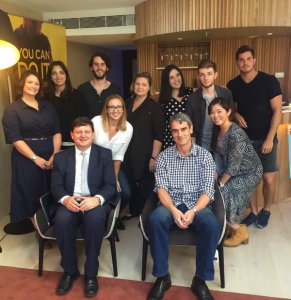
There have been a fair bit of tweeting throughout the couple of days, so you might want to jump on Twitter and check out #DX2Sydney.
Also, lots of people are asking about launch details (including costs) of the Freestyle Libre. The Abbott website has all the information you need.
DISCLOSURES
As explained in yesterday’s post, travel, accommodation, meals and transfer costs have been covered by Abbott. And all attendees have also been given two Freestyle Libre sensors and the reader.
I may write about my thoughts of using the Libre device after I’ve trialled it for a while. I might not. Abbott have no input to the words I may write.
 I’m in Sydney for the next couple of days for the Diabetes Exchange (DX) program hosted by Abbott Diabetes Care. The event which runs over two days is part of Abbott’s global DX initiative which aims to bring together diabetes bloggers from all over the world. The Sydney event follows on from the initial meeting in Berlin, and next month, there will be an EU event, this time in Stockholm. (How’s your French? Google translate may be able to help you with this wrap up of the Berlin event from my dear friend Andrea.)
I am terribly excited about the Sydney event for a few reasons. Firstly, it’s all about the tech. Make no mistake, we’re here to talk about the Abbott Freestyle Libre monitoring device which (finally) received TGA approval earlier this year and will be launched into the Aussie market in the very near future. It’s exciting technology – and how clever are Abbott in bringing together a group of bloggers who may just share their experience (of both the event and the device) with others?
I am also excited because I will be surrounded by my peers – others who also live with diabetes. I will be with old friends, others that I only know in the 140-characters-or-fewer world of Twitter and others that I have never met (in real like or online) before. I am especially excited that it is an Australian event because it is always fascinating to see and hear the close-to-home perspective and just how different it can be even though we are accessing the same health system while living with same health condition. (I’m also thrilled to be in a room full of Aussies because it means I won’t spend a significant part of the day asking ‘Does that translate?’ as I try to explain something that makes absolutely no sense to anyone from Europe, the US or the UK.)
I have been very fortunate to sit around tables around the world at similar events and the power and value is not because we all agree with each other. In fact, the real magic happens when there is respectful and robust discussion where everyone is given the opportunity to safely share their experience and perspective. I so hope that is the outcome of the DX2Sydney meeting.
I am facilitating DX2Sydney, which is terrific because it means I don’t have to say much. I mainly get to listen and hear others’ thoughts. The agenda is packed full of interesting topics and there is plenty of time for tangents and questions. Well done to Abbott for bringing us all together. This is a terrific opportunity for us as bloggers, but it is also such a brilliant opportunity for Abbott to get some valuable insight into working with PWD. We have a place at this table; there is no issue with industry and PWD talking, engaging and sharing. I’m so pleased to be here to do that!
Our Aussie blogging community may be small – and this may be only the second time that a group of Aussie diabetes social media influencers have been allowed in a room at the same time (the first time being Diabetes Victoria’s innovative Diabetes SoMe Summit back in 2012), but I am so pleased that we are being given the opportunity to lend our voice to the global DX initiative.
You can follow along on Twitter at #DX2Sydney. And I’ll be linking to any blogs or commentary from the other attendees in later posts.
DISCLOSURE
DX2Sydney is being coordinated and run by Abbott Diabetes Care. The costs for me to attend the two day event (travel, accommodation, meals and transfers) have been covered by Abbott. All attendees will also receive Freestyle Libre product so we can trial the new device.
There is no expectation that I will write about the event or my thoughts of the device. Abbott may have paid for me to attend, but they have not paid for my words on this blog, social media activity or anywhere else. I do, however, promise to try to keep myself nice and not swear. (But that could go pear-shaped any moment!)

DX2Sydney is being held in the ACDC suite of the hotel. Who said diabetes isn’t rock ‘n’ roll?
I’ve always been a bit of a numbers nerd. I actually find maths quite beautiful – there are patterns to be found and I love how there is a solution to be found. I also love how we apply maths to many everyday activities. It’s something that I have revisited in the last few years with the kidlet, who unfortunately hasn’t inherited my love of maths. She’s actually really quite good at it all, but is clearly more drawn towards literary things rather than the numerical.
I learnt my times table as a kid and have never forgotten them, and it is possibly one of the reasons that I have never found the maths that comes with diabetes particularly bothersome.
However, today, I realised that whilst I know up to my 12 times tables without batting so much as an eyelid, I am lousy at my 18s. I can get up to 18 x 5 and then I need to start using an abacus or my fingers and toes to count. Or a calculator.
But I really need to learn them!
Why? Because today, this is happening:
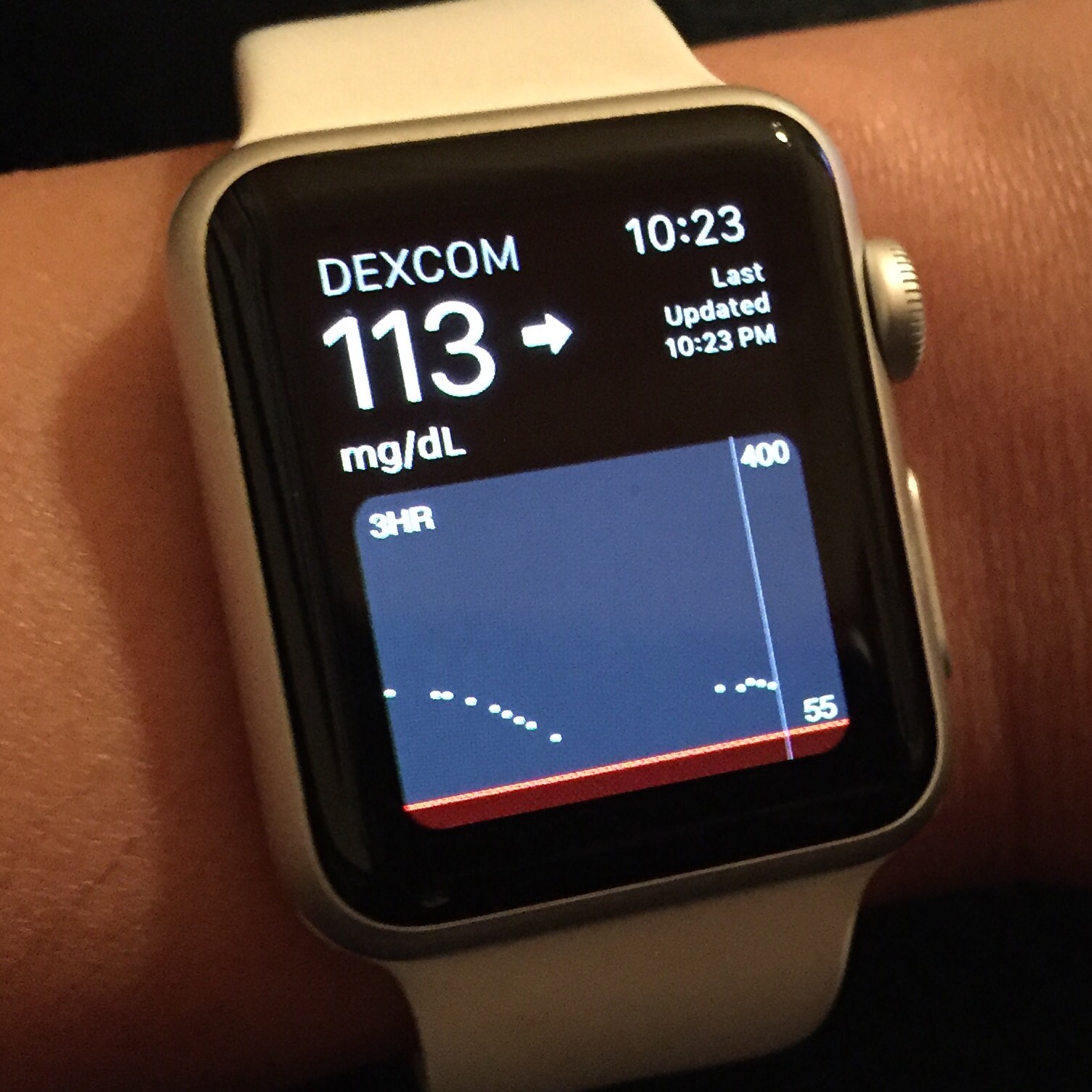
Yes, my Apple Watch is finally doing what it was intended for. (By me. Probably not by the clever folk at Apple who invented it. I’m sure that their thought process was not exclusively ‘Let’s make this a tool for people with diabetes to see what their glucose levels are doing.’)
Anyway, I spent some time yesterday morning with a couple of very clever blokes, one of whom is possibly the smartest techy person I have ever met, and within the time it took to drink a couple of coffees, he had hooked me, and my Apple Watch, up to the US Dexcom app.
Of course, being an app for the US market, it is reading in mg/dL, instead of the far cuter sounding mmol/l so my head is slightly being done in when I look at it and see numbers that, in a diabetes sense, make no sense. Right now, I am at 91 and I know that I am fine, but I feel like I should be panicking and doing something. Anything!
I have no idea when the app will be launched in Australia – hopefully it will be very soon. But in the meantime, I am simply going to have to learn my 18 times tables. Which is probably going to be all okay until I am low and then I can’t even remember what one plus one equals. Actually, this could be a disaster!
The way that we manage diabetes is certainly changing. Wearable tech means that our diabetes management tools are integrated into our…well…living life tools. At the moment, I can check my glucose levels, my heart rate and see how many steps I have done for the day all on my watch.
Is this a good or a bad thing? Well, for me, I want my diabetes management to be as smooth sailing as possible and as unobtrusive as possible. Being able to quickly and quietly see how my glucose is tracking by simply looking at my wrist is brilliant. I love it! Integrating diabetes into life is wonderful and having to cart around fewer devices is a huge win as far as I am concerned!
While I have never had a problem ‘doing diabetes’ wherever I am, not everyone is comfortable pricking their fingers and drawing blood, or injecting themselves while there are others around. Perhaps they have been made to feel uncomfortable by others around them, or perhaps they feel self-conscious.
For those people, having discreet tools available – tools that are built into everyday technology such as phones and watches – may mean that the ease with which they are able to go about their diabetes tasks equals more doing of those tasks.
So, today, I am happily checking my watch every now and then to see how I am tracking and marvelling at the simplicity of it all. If only I didn’t need to be some sort of maths genius to interpret the number!

For the last few weeks, I have been trialling the new Dexcom G5 Mobile CGM. (And you bet there are disclosures about that. See the end of this post!)
I am very lucky. I get to travel quite a bit for my job and that means seeing what others are using to manage their diabetes. The G5 had been launched in other markets last year, so I knew all about the G5 after seeing it in action at the World Diabetes Congress in February last year.
I had also read a few reviews of it online and, as a result of the generally positive feedback, was ready to try it myself.
I have been using Dexcom CGM since it was launched in Australia three years ago. I haven’t used it for the whole of those three years, but it’s the only CGM I have used in that period.
In the last three months, I have been wearing CGM full time. I have come to rely on it but refuse to see that as a negative. This is simply a tool I use to manage my diabetes. End of story.
The G5 has a few new features which sets it apart from the earlier generation Dex. Possibly the most interesting is that the G5 is the first CGM which doesn’t require confirmatory BGL meter checks before responding to glucose levels. Basically, what that means is that apart from the twelve-hourly (required) calibrations, your meter can stay tucked away for the rest of the day.
(You can decide yourself if that is as exciting as the shiny brochures state. And you can read my thoughts on it in a previous post here.)
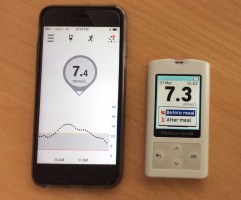
The other fancy-pants thing is the nifty (free) app that displays the CGM’s readings (via Bluetooth from the transmitter). So now, instead of needing to pull my pump from my bra to see what is going on with my glucose, I look at my iPhone. This took me a little while to get used to, but not needing to reach down my shirt, grope around and bring out my pump is actually quite nice.
The app also shows lovely (sometimes) graphs and alarms (which you can customise) for low and high BGLs and also fall rate. It looks like this:

Ugh!
Or this:
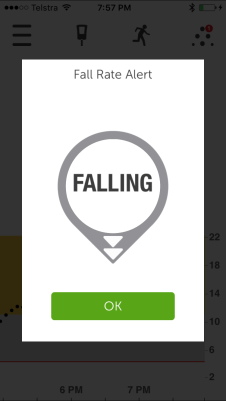
Also, the app has the ‘Share’ function, which means that I can share my CGM data with anyone I want! (Well, up to five people.) At this stage, I am not using this functionality; however definitely will when I am travelling solo. It has a lot of appeal for parents of kids with diabetes, many of whom love the fact that they can see what their kids’ glucose levels are doing during school hours of when they are not together.
Because the ‘receiver’ is now my iPhone (rather than my Vibe pump), the G5 must be sold with a separate receiver. This definitely affects the price of the start up kit (which you can read all about here). I have never used a Dex receiver before – I started using a Dex at the same time as starting on the Vibe, so used the integrated system from day one. And technically, I don’t really need to use it now. But I have been throwing it in my bag in the morning in case my iPhone dies, gets lost, or is eaten by aliens. (Yay for contingency plans!)
The G5 uses the same sensors as the G4, so there was no real learning curve there for me, with sensor insertions being second nature these days.
All of this is great. The app looks wonderful, the data is easy to read, it’s convenient.
But none of this really matters unless the results are accurate – especially now that we can dose directly from those numbers.
So is it accurate? I have always found the G4 to be incredibly precise. I was actually blown away when I started using the device at just how accurate it was. And the G5 delivers the same accuracy and then some.
Habits are hard to break and even if I had been known to dose directly from G4 results, I still would frequently check my BGL throughout the day – other than for just the required calibrations. For the first week of using the G5, I continued to do that, just because I wanted to check the accuracy. (I was, however, only entering the two calibrations into the system.)
The biggest difference between the Dex and my meter was 0.3mmol/l. Yeah – it’s accurate.
So – are there any negatives? Making sure my phone was in ‘Bluetooth range’ at all times took some getting used to – and this is from someone who is ALWAYS on her phone for some reason or another! I was actually surprised at the number of times that I would hear the ‘signal loss’ alarm because I was out of range. I have become a lot better at making sure my phone is in my pocket or by my side all the time.
I did find that there were some other ‘signal loss’-es early on, which I found very frustrating, but, again, that was most frequently to do with positioning of my iPhone. Or not drinking enough water one day!
The cost of the G5 system is going to be more than the G4 and that will definitely factor into decision making about which device to use. The G5 transmitter has a three month battery-life, meaning that four transmitters will be required throughout the year. Deciding whether or not the extra cost of the G5 is worth it will be made in coming months when I need to purchase the next transmitter.
But overall, I have to say that I really do love this tech. I do love the convenience of the app and I do love the idea of the share capability. But mostly, I love the accuracy and the peace of mind that gives me.
DISCLOSURES
The Dexcom G5 Mobile is distributed in Australia by Australian Medical and Scientific Limited (AMSL). I was contacted in February by AMSL and offered product to trial the Dexcom G5. I was kindly provided (free of charge) with a G5 transmitter, a G5 receiver and four sensors. I have not been paid any money to use this product.
There was no expectation that I would write about my experience of using the G5. I’m just sharing ‘cause I’m the sharing type.
More information about the Dexcom G5 Mobile in Australia can be found here.
Some mornings are tough. The alarm goes off and I hit the snooze button, for what I know full well will not be the first time. Eventually I tumble out of bed and make my way to the bathroom, only to stand under the shower-head forgetting what it is I am meant to be doing there. And then I stand in my underwear for ages unable to make the (what in my exhausted mind is a) critical decision of what to wear for the day.
By the time I walk out of the door – late – I am flustered, disorganised and completely unready to face the day.
Now add diabetes in there and you might understand why the day started so badly.
The hypo at 2am made the 7am alarm downright cruel and jumping out of bed very difficult.
The ripping out of the sensor because I wasn’t paying attention as I was drying myself after the shower was just frustrating. And I was running too late to even contemplate putting in another.
So the result of all of that is that today, for the first time in about 3 months, I am not wearing a sensor. And I feel like I am flying blind.

Spent strips. Used since lunchtime. It’s now just before 3pm…
I have no concept of…well, anything. Melbourne is sweltering, so I am already at a loss with hypos, despite having lowered my basal rate and cautious blousing. I have been checking my BGL what feels like very ten minutes (slight – but only slight – exaggeration) to try to get some idea of what my glucose levels are doing, but the absence of alarms, alerts and arrows is making me feel very anxious. I am not sure if any feelings of light-headedness are due to needing a drink of water or impending low. And then, is the sudden thirst due to dehydration or an impending high?
I have become so reliant on my CGM and the information it gives me every second that I have no idea about the cues my body is sending out anymore.
I am not sure what to make of this. To begin with, I thought I should feel worried about the reliance that I have developed on this piece of tech. But how is dependence on a CGM any different to reliance on a BGL meter? Isn’t it just newer technology? We would never suggest someone who felt lost because they had left their BGL meter at home had an unhealthy reliance on that device, would we? We wouldn’t say that they should be expected to work out what was going on with their BGL with nothing more than stick to pee on, would we?
Perhaps it stems back to the thinking (by some) that CGM technology is a luxury, which it is not. It is a medical device that I use to manage my diabetes as best I can.
I am counting down the hours until I can get home and shove in a new sensor, wait for the two hour calibration period and then get back sense of knowing what the eff is going in. Because right now, I have no idea….
This week, I find that I have been using an insulin pump for fifteen years. That is just under 5,500 days and over a third of my life. I can’t imagine my life without this technology and the thought of not having an external pancreas is a little scary.
I have spent a bit of time in the last week or so thinking about how far technology has come in the last fifteen years.
Back in February 2001 when I was admitted as an overnight patient into the Epworth Hospital in Melbourne, there really wasn’t much choice when it came to insulin pumps. In fact, there were two and two only – the Medtronic 507C and the Disetronic D-Tron. There were pros and cons to both of them – I had done a lot of research – and I decided that the smaller size of the Medtronic would suit me more, so that is what I used.
This was before the advent of ‘smart pumps’. There was no such thing as a bolus calculator and there was no capacity to even enter BGLs into the pump. It was simply a device that delivered insulin. (Kind of like old mobile phones that did nothing other than make a phone call. Ah, they were the days…Life seemed so much simpler then…)
My second pump was a Deltec Cozmo and this was my first foray into the ‘smart pump’ zone. It was a great little pump and the new bolus wizard technology was terrific. Having said that, I was always pleased that I actually knew and completely understood how to count carbs, and this was particularly important to me at first, or at least until I trusted the technology.
Today, I use a sensor-augmented pump – it’s the latest technology available and it makes my diabetes manageable, more so than any other way I know.
In fifteen years, I’ve never taken a pump holiday. I’ve never even considered it. There have been maybe a couple of times that accommodating the pump has been a pain, but I have managed it with a little lateral thinking. It’s possible that the reason I haven’t switched back to injections when it may have been easier is because I am lazy and the thought of trying to work out long-acting insulin made me weep inside.
(Speaking of long-acting insulin, I have always had some in the fridge, or with me when travelling, in case of pump malfunction. This diligence has resulted in regularly having dispose out-of-date insulin.)
So, when I started on a pump, did I think that I would still be using the same technology – albeit a little more sophisticated – fifteen years later? Probably not. There was no cure back in 2001 and there isn’t one today in 2016. Am I upset about that? Well, I guess that I would really like to not have to think about diabetes as much as I do, (or at all). But no. And not really surprised either.
I see my pump as being as much a part of me as my arm or my leg. It is a pseudo-organ. It keeps me going, it keeps me alive. I’d be lost without it. Is it perfect? No, (as evidenced by my current CGM stream that resembles a rather scary mountain range). Is it what works for me? Yes. At least for now.
Happy pumpiversary!