You are currently browsing the category archive for the ‘technology’ category.
Last night, Aaron and I joined a group of friends at the beautiful Sun Theatre in Yarraville for a ‘cinematic experience’. Harking back to the ‘good ol’ days’, we saw a film shot in 70mm Ultra Panavision with an overture at the beginning, an intermission of exactly 13 minutes in the middle and a souvenir program to take home at the end. (We’ll ignore the fact that rather than watching Ben Hur, introduced by Bill ‘Golden Age of Hollywood’ Collins, we were watching Quentin Tarantino’s eighth movie, ‘Hateful Eight’ (H8ful Eight??? Hateful 8???) with all the gore and violence – yet surprisingly still so much grace and beauty – one has come to expect in a Tarantino film.)
Often, there is much chatter about the ‘good ol’ days’. I get it. It was a time where things seemed simpler: kids were kids, adults were adults and everyone knew where they belonged. Milk came in bottles with cream on top….And I walked ten miles to school and twenty miles home, all uphill.
We can look back nostalgically at different periods in history. And it’s funny how history repeats itself. I remember hearing my father telling me how lousy the 1980s music I loved was compared to the music he loved. And yet his favourite music – the Beatles, Frank Sinatra, Simon and Garfunkel – would have had the same said about them. I try to catch myself before I criticise the trash music daughter is listening to now, because I remember how annoying it was (and how distressed I was) when my dad criticised Morten Harket.
Last week, Aaron got into a Facebook discussion that started off being about music and somehow ended up not being about music. The person he was ‘speaking’ with was saying that everything was better in the ‘olden days’.
‘Everything?’ asked Aaron
‘Yes,’ she replied. ‘Everything!’ She then went on to explain what she included in her ‘everything’ – music, food, medicine…
He quickly jumped in and pointed out that thanks to advances in medicine, his wife is still around. The olden days were really not all that great for those living with a health condition such as type 1 diabetes.
Perhaps because I am a beneficiary of all that the ‘modern era’ has to offer, I have no nostalgia or desire to go back in time. Because for me, along with sentimental thoughts of kids playing in the streets until dusk – and playing meant being outside, not sitting in front of a console – and cooking meant making foods from scratch and a telephone call was something made from a phone with a chord, there would be the practicalities of boiling syringes and sharpening needles and an inability to accurately measure BGLs and a life without diabetes technology. Bygone era? No. Be gone!
I would take the modern era and all its so-called short comings in a heartbeat over the ancient era of medicine! Through our rose-coloured glasses we forget that there were days before vaccines and days when life expectancy was shorter. We forget that there were not tests or screening to identify different conditions, that mental health was rarely, if ever, discussed. We forget that only 94 years ago – not that long ago – there was no medication to treat someone with type 1 diabetes.
So with all this in mind, read what is coming next. Here is an update on a couple of the many artificial pancreas projects happening today.
I want a cure as much as the next person. But in the meantime, keep the DTech coming. Please.
I made a commitment to do the #30DaysOfDex challenge at the beginning of the year. Actually, I have been wearing a sensor continually since the beginning of December; so really, I am at about day 45 now.
I have a love/hate relationship with CGM technology. I adore it far more than I dislike it, but still, there have been times that when I simply can’t face wearing it. But that actually has nothing to do with the actual tech. I wear a device that I truly believe I can rely on – and I know that because calibrations are spot on. Even though I’ve been using this particular type of CGM for about 3 years now, I am still surprised at just how accurate – just how often – the results are.
No, the reason I don’t wear it all the time is because I have found it too burdensome when headspace is not right. When there is too much else going on or I am feeling overwhelmed, I just can’t face alarms and numbers and a machine that demands I be responsive to it.
But through some trial and error, I have found ways to lessen those demands, yet still use the device effectively.
Firstly, I’ve had to identify what I hope to achieve from wearing a CGM. Really, there are two aims: have fewer wild BGL swings and pick up hypos as early as possible with a hope of avoiding.
I also identified what I didn’t really care about and that included having a BGL sitting at 5.5mmol/l the whole time. In fact, I am not even aiming for BGLs between 4 and 8 the whole time. I raised the upper limit to avoid some alarms. I don’t want to hear screeching every time I hit 7 or 8mmol/l. At this stage, I am not interested in that. I don’t mind if I hit 10 or 11 after a meal, as long as it doesn’t sit there all day.
It’s not about the number values – for me it’s about fewer variables, because when I am all over the shop, I feel like crap.
So what have I found after a month and a half with this attitude? By and large, it’s been a successful experiment – am far more responsive to the alarms that sound now and I don’t feel frustrated. And I am able to find patterns. It is incredible how I was low or high at the same time each day without knowing it. Or rather, I probably did think it was the case, but with the data and graphs, there is no way of hiding it. I don’t log – it’s been a long time since I had – so I was relying on memory. ‘Was I low at 3pm yesterday as well? Maybe…. Was I? Or was I high?’
The thing that I have come to understand about CGM (and I may be a little slow to the party here) is that the ability to customise it means that I can find a way to benefit from it, even when I am feeling totally burnt out and can’t be bothered with the minutiae of my diabetes.
I don’t need to have a perfectly straight line for CGM to be considered successful. It’s not a waste of a sensor (and therefore a waste of money) if my BGLs do hit and play around at 10 or 11 for a while. This is kind of a breakthrough for me – I’m feeling quite proud!
Something else that has become clear while wearing CGM is that my BGLs are actually not as unstable as I think they are. Oftentimes, I am sure that I am really high, or moderately high or really high. I know that if I wasn’t wearing CGM and was feeling unmotivated, I would use that as an excuse to not check. ‘I know I am high. I don’t want to see a high number because it will make me feel worse. So I am going to bury this head of mine in this sand over here and forget about diabetes.’ Diabetes? What diabetes? Let’s build a sandcastle!
The reality is that of course my numbers are not perfect, but they are actually, most of the time, okay-ish. And I am generally okay with okay-ish! Okay-ish keeps me sane and keeps me happy.
CGM makes me think about my diabetes more. It makes me in tune with it more and it does make it easier for me to manage. Perhaps I have taken a long time to work out how CGM works for me – maybe I have wasted some time or not worn it when I could have benefitted. But for now this is what works really well. And it’s a really good way to start the year.
I discreetly signalled to the drinks waiter making his rounds.
‘Would it be possible to have an orange juice, please?’ I asked him quietly. He nodded and returned shortly after with a tall glass.
‘You’re not fun!’ said one of the people I was speaking with at the time. ‘This is way more enjoyable.’ He held up his glass of bubbles.
‘I agree,’ I said to him. ‘And I’ll have one soon. I just need this to get my BGL up. I’m a little low.’ I was actually a lot low, but I had everything in hand, so there was not need to alarm anyone.
‘You’re hypo?’ he asked. ‘Well, what’s the use of that thing if you are hypo?’ He pointed to the CGM sticking out of my arm.
He had a point. Here we were, standing around the Mural room at Parliament House, pleading our case for the value of CGM technology in the management of diabetes.
‘Ah,’ I said to him, smiling. ‘The technology is only as smart as the user. And this user has spent the last half hour running around getting things ready for tonight and ignoring the alerts and alarms on said technology. Clearly, this user is not smart!’ I drank half the juice and gently placed the rest on a table nearby.
And there lies the problem with people’s perception of diabetes technology. It doesn’t fix things; it doesn’t cure our diabetes. It is not a ‘set and forget’ situation where we no longer need to think about our diabetes. Had I been smart, I would have stopped when I first felt the alarm. At that point, I would have changed the basal rate, or temporarily stopped the pump, or had a couple of the glucose tabs that were in my bag.
But instead, I had disregarded it, and the next alarm and the one every three or five minutes, silencing them with a quick push of a button, while in my head, I said ‘In a minute; in a minute.’
In the same way that insulin is not a cure, pumps and CGMs and smart meters are not a cure. They are devices. They make things easier or better or more in line with how we want to live our life. But they are not a cure.
Diabetes technology certainly does make me feel safer. But it is wrong to say that it manages my diabetes. It helps ME manage my diabetes, but it is still all me doing it all.
And when I am ignoring what the tech is telling me, it can’t do its job. I know that. I have known that for the almost-fifteen years I have been using a pump and the over eight that I have been using CGM. These devices are only as ‘smart’ as the user…and sometimes, I am pretty bloody dumb about diabetes!
I am all about facts. So when writing to the Commonwealth Health Minister, Sussan Ley, asking her to make CGM available to Australians living with type 1 diabetes choosing to use this technology, I left the emotion behind and concentrated on the realities. I can’t say that it has saved my life, because I don’t know that is the case. I do know it makes my life easier, better, happier and healthier. And that has to count for something. This is my letter about my real life with diabetes and how I choose to use CGM. I urge anyone else who believes this technology should be available more broadly to write to the Minister and share your story. My post on the Diabetes Victoria Blog from last week has some tips about what – and how – to write.
_________________________________________
Dear Minister Ley
On Tuesday, I attended an event at Parliament House about type 1 diabetes and new technologies. The aim of the night was to highlight the importance of developing pathways to ensure that new technologies make it onto the Australian market in a timely manner (in the first instance) and, once approved, are available and affordable to as many people as possible.
Unfortunately, you were unable to attend; however, I did spend some time speaking with one of your advisors and shared a little about my experience of using CGM.
This is not new technology. It has been available in Australia for the better part of the last decade. And yet, it is still out of the reach of most people living with diabetes. This needs to change.
Availing this technology to people with type 1 diabetes who want it is well overdue. Please understand, however, there will be a lot of people not interested in using CGM. But it should be a choice for everyone.
I have worn a CGM on and off for the last eight or so years. There are many reasons I don’t use it all the time. Fortunately for me, I can afford the $5,000 or so it takes each year to use CGM. The reasons I don’t use the technology continually include not feeling like I need the constant data feed, or simply not wanting to use the technology all of the time. Sometimes, I feel it won’t benefit my diabetes management.
Other times, however, I wouldn’t be without it. If my BGLs are more variable than usual (such as when I have an infection or am particularly stressed) or if I am travelling alone, having a CGM provide me with information is very important to me. It keeps me safe, it improves how confident I feel about my diabetes and it means that I stay as healthy as I possibly can.
For me, wearing a CGM is not so much about saving my life. It is about living my life the best I possibly can – despite diabetes; it is about being able to identify, react to and remedy impending high or low blood glucose levels; it is about having information that means diabetes impacts far less than it otherwise would.
Minister, we need sensible pathways that ensure diabetes technology is available equitably. But even more so, we need consistent and transparent processes that expedite the release of new and emerging diabetes technologies onto the Australian market.
I am grateful to use CGM alongside my insulin pump. I believe that it has certainly assisted me to live a healthy and productive life. It is not a luxury. It is a necessity in my arsenal of living well with type 1 diabetes – in the same way that insulin, other devices and their consumables, access to healthcare professionals, and support from my friends and family are necessary.
Minister Ley – it is time to make this technology available to any Australian child or adult with type 1 diabetes who chooses to use it.
Thank you
Renza Scibilia
‘How’s that working for you?’
‘Sorry?’
I’m at Parliament House in Canberra preparing for a type 1 diabetes and technology event being held later today. Walking through security, three security staff honed in on my upper arm.
‘Your patch, is it doing the trick?’
I was confused. ‘I’m sorry. Excuse me?’
‘Are you an ex-smoker?’
‘Oh! This? It’s not a nicotine patch. It’s a continuous glucose monitor. I have diabetes.’
I don’t know if they believed me. I gathered my bag and moved on through the security area. ‘Diabetes,’ I said again. ‘It checks my blood sugar.’
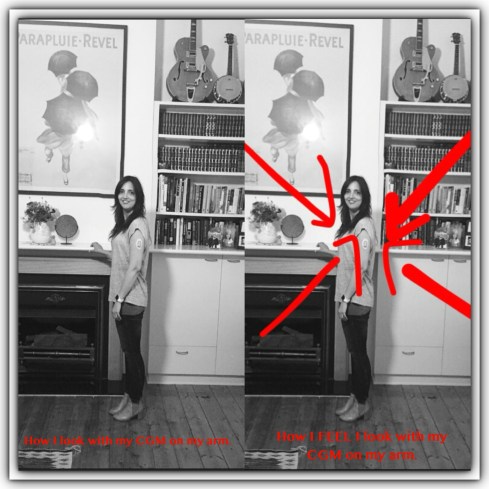
My invisible illness is pretty visible today.
I made the decision yesterday morning to site my sensor on my upper arm rather than my stomach. The last two sensors I have worn left my skin slightly irritated, so I though I would give the skin around my belly a rest. I also haven’t been thrilled with how long the sensors have lasted – the last two survived a mere 10 and 12 days which is not great when I have been known to get closer to three weeks. (I know, I know, they are meant to work for 7 days. But at over $80 a pop, I do everything in my power to make sure they last as long as bloody possible!)
Before I got to work yesterday morning, three different people had asked what the thing on my arm was. Once I got into the office, another couple of people asked (…don’t even want to remind you all that I work for a diabetes organisation…)
Waiting for a coffee at my local this morning, the barista asked about it and yesterday, at the cafe near work, I could see the people around me looking at my arm and heard them guessing what it was.
At the airport today, a security guard asked if it could be removed and then wanted to engage in a conversation about it, and the woman sitting next to me also asked about it.
It’s been very confronting.
I have never hidden my diabetes. I used to inject at the dinner table before starting pump therapy. And since using a pump, I pull it our from under my clothes to bolus, or see my CGM graph without a second thought. I check my BGL whenever and wherever I want.
But while these diabetes chores occasionally attract a comment, it is nothing like the last two days.
I found myself sitting at lunch today with my right arm cupping the transmitter and sensor to hide it from view. I’ve been cursing the beautiful weather that means I don’t need to wear long sleeves to cover the device. And I’m terrified that people think I am wearing it on my arm to attract attention.
I have always been able to see the pros and cons of having an invisible health condition. Sometimes, the fact that there are no obvious signs of diabetes means that people don’t understand how significant a role it plays in day to day life. But the flip side is that it can be neatly packed away; it can be private. I actually love that about it.
But right now, I don’t have that luxury. Right now it is out, loud and proud for all to see. And I am not comfortable with it at all.
‘So, how many of you have patients who make treatment decisions based on their CGM?’
This was the question posed by one of the healthcare professionals speaking at this afternoon’s Dexcom symposium at ISPAD.
A few hands were raised. Not many; only a few in the packed room. Two of the hands that shot up the fastest belonged to a colleague and me, both of us referring to ourselves as the ‘patients’ – or perhaps each other.
We looked at each other and half smiled, shaking our heads. We knew the answer – we knew what the truth was. The response in my head was ‘Of course we do. Of course. I treat based on arrows telling me I am heading for a low without checking my BGL – I did it just before walking into the session.’
The question came after the announcement that treatment decisions could be made based on sensor readings from the new (yet to be released in Australia, but launched already in the US and in some European markets) Dexcom G5 CGM.
There has been much excitement from HCPs presenting about this new development in CGM – both at this conference and at EASD. It has huge implications because essentially, it is removing the need to do finger prick BGL checks, apart from the required twice-daily calibrations.
But it has been presented as if people using this technology have never, ever thought before to treat based on what their CGM data is displaying.
I doubt that any person using CGM has found this announcement particularly startling or surprising in any way.
But this is often the case. The release of new evidence or new guidelines or new data heralds a shift in ‘approved’ diabetes management or techniques and suddenly, there it is on all the shiny brochures and in all the shiny presentations.
And the people with diabetes who have been doing this, or have known this or understood it to be true from some time, look at each other slightly puzzled at what all the excitement is about.
I understand the importance of a strong evidence base. And I understand the need to be safe – especially as part of regulatory and approval processes. But sometimes, I can’t help but wonder why it takes so long for the evidence to catch up with what is already known, and match the anecdotal experiences that we hear and share.
It was great to have the speaker acknowledge that the show of hands after her question was probably not accurate of what was really happening.
‘You know your patients are probably doing it and just not telling you, right? They don’t want to be reprimanded for not doing what they are supposed to, but they probably are making treatment decisions based on their CGM data.’
It was probably the most frank thing we heard in that session – the twofold acknowledgement that PWD are already doing something that works but is ‘off label’, but are afraid to tell our HCPs about it, lest we get told off.
This time, when my colleague and I looked at each, we smiled widely. And we nodded. Because we knew it to be true.
I accidentally bought an Apple Watch last week.
It was the day before we left for Friends for Life and we were in the Apple Store so Aaron could buy one and then I tried one on and thought about how awesome the Dexcom Share thing is (even if we don’t have it in Australia yet) and convinced myself that the watch was pretty much a medical device and got a little indignant that I couldn’t claim it on my health insurance and justified the purchase by considering the tax I could claim back before heading to Orlando. And then I breathed. (Need help justifying a purchase? Just ask me!)
The Apple Genius pointed out all the features to us and kept focusing on the health apps. I smiled and nodded and stopped listening, because: exercise. I just kept thinking about how cool it would be to take calls on my watch. Like Inspector Gadget.
I set up my watch to do the things that I thought I would use, and decided that I would also set up the activity and health tracker stuff. Gender, weight, height, activity level (low) etc. etc.
Monday was the first day that I actually bothered to check the data. By midday, I was surprised to see that I had done almost 10,000 steps. Somewhere in a part of my mind that is rarely accessed, I remember that we should aim for 10,000 steps a day. I was nearly there! By the end of the day, I had completed nearly 20,000 steps.
I need to admit at this point, that Monday was a travel recovery day for us and we spent it at Disney’s Animal Kingdom, wandering the park and being terrified on roller coaster rides. There was a lot of walking. A. Lot.
The next day, MasterLab kicked off and I spent most of the day sitting in a conference room, walking the long halls to refuel on coffee. My watch started reminding me to move. Every so often, I would feel a gentle pulse on my wrist and this message would flash up:
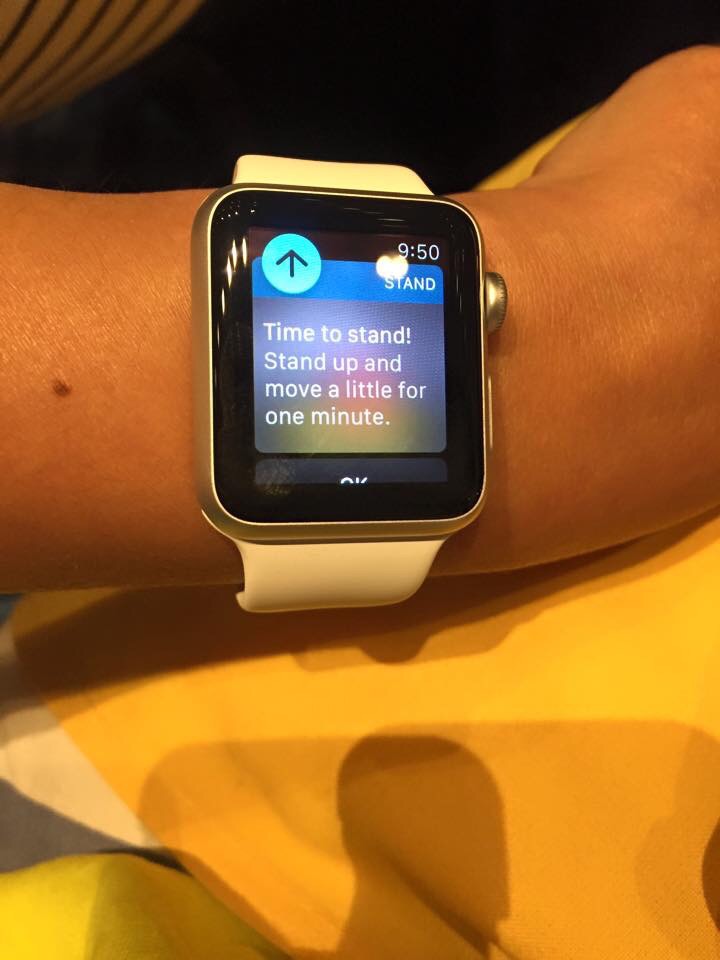
‘Great,’ I thought. ‘Now my watch is judging me.’
I got to the end of the day and found myself disappointed to see a total of only 9,000 steps – nowhere near the previous day’s activity.
The rest of the week in Orlando saw me regularly checking my steps and doing all I could to make sure that I hit at least 10,000 steps a day; a goal, I am pleased to say, I smashed.
I certainly didn’t get an Apple Watch with the intention of using it as an activity tracker (I have a Fit Bit lying unopened in a cupboard somewhere at home which I could have used had I wanted to do that), but it is a feature that I probably will use sporadically.
But the feature is a good way to check in and see just what I am doing. I’ll be interested to see what my activity is when I get back home and return to normal programming.
And in the meantime, I am waiting, waiting, waiting for Share to be launched in Australia. Because that is a tracking app I am ALL over.
A couple of years ago, when CGM was first launched into Australia, the typical thing happened. The device company took their shiny new product to health professionals around the country, showing off their wares. There were dinners and events and showcases, all highlighting the new technology.
Now, obviously with a product like CGM which requires HCP initiation, it is important to promote the product to the people who will be getting consumers hooked up. I understand that.
Nonetheless, it was with much envy that I saw HCPs being given a trial of the product. They were connected to a CGM and given an empty pump for four days – the number of days a sensor was meant to be worn.
I was desperate to get my grubby hands on one of these. I had read all about CGM and how much people with diabetes living overseas loved it. I read about how it made people feel safer and less frightened about hypos. I learnt that it helped to level out …well…levels. It sounded exciting. I wanted to try it myself.
The HCPs on the trial I spoke to were incredibly dismissive about this technology. Over the few days they were wearing it, I heard comments such as ‘It’s making me obsessive’ or ‘I can’t stop looking at the pump and watching what’s going on’ or ‘When I calibrate it, the numbers don’t match exactly’ or ‘The infusion set insertion process is terrible. I bled everywhere!’
I heard them say repeatedly that the technology was rubbish, that it wasn’t worth the cost, and that all it would do for people with diabetes is make them more distressed and anxious about their diabetes. Plus, it hurt.
Not one of them had diabetes themselves.
I started to get annoyed. I recall sitting with one of them after hearing this pronouncement yet again, feeling quite angry. ‘You know,’ I said. ‘You don’t get to say these things. You don’t get to write off this technology after a few days of wearing it, making claims that it is pointless. This is the latest technology that we have to manage our diabetes. It’s first generation so of course it’s not perfect. The second, third and probably even fourth gen products probably won’t be perfect either. But it is a new and worthwhile tool to help us manage our condition. It is exciting. We are hopeful. You don’t get to trash it.’
I remembered this whilst siting in a session on the first day here at the American Diabetes Association Scientific Meeting. It was a ‘Meet the Expert’ session and the topic was about personal experiences of the artificial pancreas.
Kelly Close (she’s amazing – read all about her here) was talking about her experiences of being involved in trials for a couple of different artificial pancreas projects. It was fascinating hearing about the AP and her excitement about the current technology being trialled – and about what is still coming.
Her enthusiasm was obvious. In fact she actually commented on why enthusiasm and excitement need to be employed when talking about advances in technology. We need to create a buzz and have people talking and asking questions and going on trials and writing (and blogging) about our experiences.
On the panel with Kelly was Chris Aldred (better known as The Grumpy Pumper) whose role in the session was to be the one challenging all the hype. He immediately explained that he had not used the AP, and had some questions. He was skeptical about a few things.
Being skeptical is absolutely okay. We shouldn’t ever blindly accept any new treatment without asking questions, but that actually adds to the buzz. It forces people who have experience with the device to talk about the good things and its limitations. It also helps alleviate a lot of the concerns people may have.
I thought back to my experience with the launch of CGM back home. When the HCPs who were privileged to try the then-new tech were trashing the product, I wish that there had been a voice to be able to respond to those concerns. I wish that the trial of the product had been extended to people with diabetes who could see it for what it was and how its application worked in the real world. And who could share their experiences – absolutely the good and the bad – with other PWD.
That’s exactly what I did when I finally got to try CGM. You bet the first gen was clunky. It did have accuracy problems and I did bleed a little most times the sensor was inserted. But whoa! It was amazing technology for the time and made a huge difference to me. When I understood how the trends worked, I knew how to respond to them. I could address things before they became problems.
I left the AP session on the first day pretty excited and inspired. And wanting to be part of the buzz – either as a trial participant or as someone on the periphery talking about it, reading about it, hearing people speak about it.
Read more at diaTribe where Kelly shares her AP trial experiences.
I had a lovely dinner last night with a colleague and friend. We ate great food, drank terrific cocktails and didn’t shut up except for when the waiter was telling us the evening’s specials (and even then we ‘oohed’, ’aahed’ and ‘yummed’ our way through that).
At one point, my friend reminded me of a beautiful part of the book Captain Corelli’s Mandolin, a book I read when it first came out back in the mid-1990s.
As soon as I got home from our dinner, I searched for it so I could read the words again. Here they are:

When I first read the book, these words kind of washed over me. I was hearing them quoted a lot, and in the coming years I heard them read at weddings. They are beautiful words; read aloud it is beautiful prose.
But it wasn’t until last night that I read it and felt really understood it. The poem is an ode to enduring love, but that’s not what struck me. At least, not necessarily the love bit. But the endurance bit certainly did.
Over the last couple of years, things have been difficult. When I look at how I have been managing my diabetes, it has been a series of fits and starts. There are spurts of focus, then dips of almost denial. There are times of desperation and exhaustion and then periods of energy. It’s uneven. New devices see me get enthusiastic and motivated, but only for a short period. Then I return to the slump.
It’s not the exhilarating times that matter. Of course they are wonderful and enjoyable and sustaining and thrilling. Having a new pump or a new meter or a new CGM is a sure-fire way to get me thinking more about diabetes. But this doesn’t last. And it also doesn’t really count.
Equally, it’s not the slumps that matter.
What really matters is actually what you might call the boring times. It’s what comes before and after the flurry of interest of a new toy. Or the times around the ‘nosedives’. I feel best about my diabetes management not when I am stressed about how little I am doing or happy because I am so focused. It is actually the time when it is just there, plodding along, being considered at an ‘appropriate’ level. It’s not sexy. It’s not dramatic. But it’s so good because I feel relaxed and comfortable about it. It just is.
I am sure that there is something to be said about the fast-paced world we live in and this idea that we always need to be thrilled by something new. It’s too easy to get complacent and comfortable. That’s probably one of the reasons that I embrace new and emerging technologies with such zealousness.
However, if I was relying only on the new stuff to sustain me, it would never last. A new pump becomes just a pump very quickly. A new meter stops being new and shiny after a while and becomes just a meter. And a CGM may be magical and brilliant and life-changing until it become just another tool in the diabetes tool kit. That doesn’t make them any less important or valuable. But if I was relying on the excitement of the new, I would need a new toy every week or so!
The endurance of ‘just being’. That’s the sweet spot. That’s when I know I am getting it right. I just wish I could work out how to be there a whole lot more!
I am lucky that Aaron is always listening to new music. This CD was a recent purchase. Sometimes I hear something that makes me just so delighted. Like this live performance of my favourite track from the CD.
Last week, I tweeted/Instagrammed/Facebooked this:

Because it is the best cartoon ever. Ever. Ever.
My iPhone could, in some ways, be considered my primary-care physician. It has the ability to manage everything about my diabetes. All in one little hand-held device with a cute Kate Spade cover.
It has the contact details of my real-life (i.e. non-iOS) healthcare team. I don’t even need to dial – I just have to ask Siri to connect me! And she does. Or else she connects me to the Japanese restaurant from where we frequently get Friday night takeaway. Either is good.
It has apps that can do all sorts of things – produce pretty graphs, tell me the time of day that my BGL is the highest (and therefore showing the time of day that I am most likely to have eaten doughnuts) and remind me that I’ve been doing hardly any BGL checks. Judgemental little thing.
It keeps appointment times and, if I was the organised type, could remind me when I need to fill a prescription or am overdue for something. (Note to self: book in pap smear.)
It has all my different social media platforms, easily accessible, so that I can see what is going on with everyone I have ever known and not known, see photos of what people are eating, and get links to videos of dogs and cats being cute. Which make me smile and feel happy which is good for my mental health.
It connects me to people with diabetes at all times of the day. It’s a 24 hour, 7 day a week, 365 day a year peer support group full of people who are able to provide reassurance, humour and love. And teach me to swear at high or low BGLs in all the languages of the world!
It contains vital information including my pump basal rates. Which is good because I am sure that information will come in handy one day.
Dr Google lives in there and she is able to give me information about pretty much anything whenever I like. For example, at 3am when I wake up with a headache and need a diagnosis of the likelihood of some sort of tumour.
Everything I need. Doctor, counsellor, friend and comic. No wonder I start hyperventilating when it’s not in sight!

Consultation time