You are currently browsing the category archive for the ‘technology’ category.
I went to TV Land today to do an interview on a morning show about the artificial pancreas. I am always excited to see type 1 diabetes in the spotlight. Actually, I am always excited and pleased to see any diabetes in the spotlight, provided the reporting is accurate and the information devoid of any myths. And they don’t use the word ‘sufferer’.
I was a little anxious to speak about the artificial pancreas. It was being hailed as a ‘diabetes breakthrough’, which is a little misleading given that the trials for this technology have been underway for some time now. I am always very careful when talking about research and emerging technologies, making sure whatever I say is in context – I don’t ever want to be accused of promising something will be here, available for all, in ‘five years time’. In fact, I had made it really clear when speaking with the producer prior to the interview that this is NOT a cure and that it would probably be better that the word ‘cure’ not even be mentioned.
So, I was asked about how the AP would change things for people and what it would mean and gently speculated (based on a few things I’d read recently about current trials) as to when it would be available. I was a little hesitant at the ‘and what will it cost?’ question, because 1. Who knows? and 2. The answer is most likely ‘Out of reach for most people. Which sucks!’ and I didn’t think that would be a good thing to say on TV when I was doing my best to sound professional.
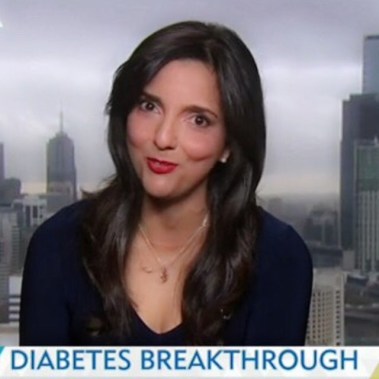
Big hair. Big make up!
I’ve not seen the clip from this morning yet. Trying to focus on a camera, and listen to people I can’t actually see (they were in Sydney, I was in a dingy box of a room in Melbourne) and not wipe my Bold and the Beautiful-esque make up off whilst flattening my big hair was really not ideal for coming across as poised and professional. But I didn’t giggle uncontrollably. And managed not to swear. So, I think (hope) it was okay!
I got into a cab outside the studio when it was all over and the driver asked me if I was famous. (I would suggest the need to ask that question would also provide the answer, but whatever.) ‘Ha! Ah, no. Really. No,’ I said to him. ‘I was interviewed about diabetes research.’
‘About a cure? My son has type 1 diabetes,’ he turned around to look at me.
I looked back at him. I looked at the desperate look on his face. I know that look – I’ve seen it thousands of time. I’ve worn it thousands of time.
‘No. I’m sorry.’ I said. ‘It was about a potential breakthrough in technology – a new device that may be available in coming years. It will make things easier. But it’s not a cure.’
He looked away, disheartened.
‘I’m sorry. Really. I’m sorry.’
I looked out the window as the cab sped through the city, the buildings all shiny from the rain. And right at that moment, I felt as despondent as my cab driver looked.
UPDATE – You can watch here.
I have always known that stress affects my diabetes. Stressful situations – particularly prolonged ones – have the potential to send my BGLs into the stratosphere. Regardless of constant rage-bolusing or the complete avoidance of any food containing a scrap of carbohydrate, getting numbers in range when feeling stress is almost impossible.
The thing though that surprises me is how even small stresses can affect BGLs. Wearing a CGM gives great insight into this. Often, I see sudden rises in BGL that almost as suddenly drop back to within range.
After a day with a few unexplained (or unexplainable) spikes on my CGM graph, I decided to see if I could work out what was going on. These spikes didn’t seem to correlate with meal times, so I knew it had nothing to do with food intake.
As explained previously, I was wearing CGM under some duress, really. Aaron was away for work and it was on only for my peace of mind. To minimise feeling overwhelmed, I basically had my settings so that the only alarms and alerts I’d receive would be when I was dropping too quickly or when I was low. The high alarms were effectively turned off.
But after seeing spikes, I started to wonder what was happening. I turned the high alarms back on the next day and started paying attention to when I was starting to go high. Each and every time, it was because I was in a situation with some element of adrenaline-causing stress.
One time it happened when I was caught in traffic and I wasn’t sure I would make to school before the bell rang. I started getting more and more anxious that I would be late.
Another time, I was in a meeting that was running overtime and I needed to move my car before the parking meter expired.
And then, there was the time that I walked in the door to find the letter from VicRoads informing me that my medical review was fine and that my license wasn’t being suspended. And that I did not need to provide an eyesight report. (The outcome here was good, but before I read the letter, just seeing the logo on the front of the envelope, thinking about the difficult phone calls to VicRoads staff and taking a few minutes to consider what could be inside had my stress levels increasing.)
The adrenaline response is so clear on the graph. In all of these instances, there was a spike (not always huge, but definitely visible) that only lasted a short while. Often the blip would be only half an hour or so.
Stress isn’t always bad though. Had I been wearing a CGM when I jumped out a plane last year, I am sure that the stress response – from the excitement, the anticipation and the outright fear! – would have been reflected on the graph.
Excitement – from all sorts of things – may make you feel great, but it can still cause a spike. Managing stress-causing situations – especially those out of your control is sometimes impossible. And sometimes, you want to do things that are going to cause that blip. Some adrenaline-releasing activities can be very, very fun!
Keeping an eye on the leaps and bounds of my CGM graph reminded me (yet again) of the complexity of diabetes and how pretty much everything impacts on it in some way. I turned the high alarms off after a couple of days. I was starting to get concerned about the number of uncontrolled stress-inducing situations that I was having that particular day and the alarms themselves were starting to stress me out. So off they went. Because that was ONE thing I could control!
Yesterday, I woke up to this tweet from the fabulous health psychologist, Dr Katharine Barnard (who, apart from being quite brilliant is also incredibly lovely and fun to have a cuppa with!):
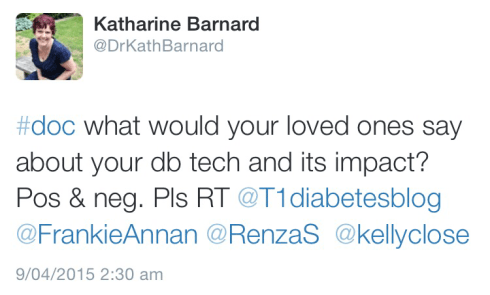
I didn’t have to think about it. I immediately replied with this:

I am very lucky when it comes to having a supportive network around me to help me manage my diabetes. Ultimately, the decisions are mine, but that doesn’t mean that my family is excluded from the discussions.
And it also doesn’t mean that I don’t consider my family when making decisions. This has been especially true when considering technology that costs a lot of money.
When I first started on a pump, there were no subsidies for consumables. As such, I needed to think about where the $300 per month ongoing costs would be coming from. It was 14 years ago; we were newly married with a mortgage. $300 each month was (and still is!) a lot of money to find in the household budget.
We worked out that we would be able to afford it (the pay off was fewer shoes for me), but we were also really lucky to have been told by both our families that they would help out if there were months that we couldn’t afford the supplies.
In later years, the same issues needed to be considered with CGM consumables. Again, with no subsidies, could we find the money to cover the costs of the consumables.
But the financial is not the only thing that impacts on family. What about the impact of having a loved one constantly attached to medical equipment?
When I first started pumping, I wondered what it would mean having a device stuck to me all the time. Would it be a constant reminder to me of my diabetes (not that diabetes is something that is easily forgotten)? But even more than that, I was also worried about how other people would see me. What would my friends and family think when they saw this little box permanently attached to my belt, or shoved down my top? What would they think when they saw me pull it out to press a few buttons? Would it change anything? Would they think differently of me? Would they think of me as ‘sick’?
I worried about how my husband would react to the infusion set taped at all times to my stomach.
In my case, it turned out that none of this mattered. In fact, no one made a big deal out of it; instead everyone was really supportive of me using the technology to manage my diabetes and congratulated me on my decisions.
So it surprised me a couple of years ago when I trialled the Dexcom CGM. I had been wearing CGM for a number of years already without feeling particularly self-conscious.
But the Dexcom sensor, with its different shape to other CGMs flung me back to the uncertainty and insecurity about wearing a(nother) device on my body. As I put in the first sensor and pushed on the transmitter, I felt queasy in the pit of my stomach. Again, I worried about what people with think of the thing protruding through my clothes. And would Aaron start to think that his wife was turning into a cyborg in front of his very eyes, with more and more buttons and beeping machines keeping me running?
As it turned out, I was, again, worrying for nothing. No one said anything. My parents and in-laws show only kind concern and support; my sister hasn’t made any comments about any of the tech (which is a little disappointing because I am sure that she would come up with some brilliantly hysterical snipe that would have me doubled over laughing – this is, after all, the woman who gave me this birthday card for my 40th); my friends ask general questions about how things are going. And Aaron and the kidlet just take the tech of what it is – life saving.
All of their support and encouragement of my diabetes will never, ever be taken for granted – I will be forever grateful. And accepting me for who I am – robot parts and all – is a gift they give over and over and over again. I was reminded of that with Kath’s tweet to me yesterday.
It absolutely doesn’t matter if you are a fan of Coldplay or not (I’m not) but this cover of ‘Yellow’ is possibly the most beautiful thing I have heard in a long time. I can’t stop listening to it. We were lucky to see Petra Haden and Bill Frisell play when we were in New York in an absolutely stunning gig. Enjoy – and check out their other stuff too.
It takes me somewhere between 12 and 25 minutes to drive to work in the mornings. I drive down a terribly busy road which carries trams, cars, trucks and bikes. People dash across the road whenever they can. It is hectic!
Yesterday morning, I was sitting in traffic, mentally counting down how long it would be before I got to my morning café for my take away coffee.
I yawned. ‘Need coffee,’ I thought. I yawned again. And again. ‘Oh, shit,’ I thought. Even though I felt fine, the incessant yawning gave it away. I was low.
I reached into my handbag and pulled out the pink and red Marimekko purse and, taking advantage of the banked up traffic, pushed a strip into the bottom of the meter, pricked my finger and wiped the drop of blood across the strip.
2.8mmol/l.
I swore. Loudly. So loudly that the woman in the car next to me looked over at me. We both had our windows closed.
The road is a clearway in the mornings; I couldn’t pull over. I put on my indicator, silently begging the traffic to move so I could turn left into the street ahead.
I grabbed a handful of jellybeans from my bag, and shoved them down my throat, chewing furiously as the cars in front of me inched forward.
Finally I could turn left. I pulled into the side street and parked. Turning off the engine, I sat there chewing and gulping.
How had this happened? I scrolled back through my meter and saw that less than 20 minutes earlier, just before I left the house to drop the kidlet at school, my BGL was 5.9mmol/l.
My eyes filled with tears at this point – typical response when I think about how diabetes impacts on those I love. I swiped my hand across my eyes, cursing (again) as I saw my mascara had run.
Involuntarily, my hand moved to my stomach where my CGM was fastened. As I was rushing around getting ready that morning, my pump pulsed and squealed, telling me that the sensor was dead after having been in for seven days. I knew I just needed to reset it – it was still reading beautifully.
But I didn’t. I didn’t restart it. I just shoved my pump away, thinking that I’d maybe, maybe, not sure, perhaps start it later in the day. If I felt like it.
I swore again – this time at myself.
I need this. At the moment, I need this. I am already feeling so lousy at diabetes – second guessing everything – I need whatever help I can to help me.
I looked at myself in the rear-view mirror. ‘I need this,’ I told myself, tears welling again.
After about ten minutes, I rechecked my BGL and it was back up over five. I was good to drive and make my way to work.
I went to start the car and stopped. I pulled my pump out from my bra and scrolled through the menu until I found what I was looking for. ‘Start CGM Sensor Session’.
I pressed start.

Once up on a time (July 2014), in a land far, far away (Vienna), there was a beautiful young woman. We will call her Jo (because that is her name). Jo was visiting Vienna to present at a conference because as well as being beautiful, she is smart and well-respected in her chosen field.
In addition to being beautiful and brainy, Jo also has diabetes (which only increases her beauty and braininess). Her insulin pump is her trusty friend, and together they had made the long trek to Vienna. (On a plane, they didn’t really walk there. Let’s not romanticise this story too much!)
But on their first day in Vienna, her pump went ‘kaputt’, which is German for ‘You’re on your own, I’m not working anymore.’
Jo was, understandably, distressed. A faulty pump would mean reduced intake of crisp apple strudel and schnitzel with noodles. Immediately, Jo got on the phone and called the pump company to let them know what was going on and organise to get a working pump to her.
Of course, it was the middle of the night in Australia, so there was no one at the pump company and she was put through to their international call centre. She was assured that someone would be in touch with her as soon as the Australian office opened the following day.
In the meantime, Jo wondered what else she could do. Who could she call that just might be able to help in the middle of the night? So she pulled out her phone, and in 140 characters or less put out this call for help.

And just like a fairy godmother waving her wand, the DOC came to the rescue!
The next day some DOC people sent tweets, Facebook messages, emails and possibly, but probably not, carrier pigeons to put out the call. Who could help? Who could save this damsel in distress kickass, sassy chick and get her back on a pump?
Enter the team at MySugr who are all too clever and aesthetically blessed for their own good, (seriously – they all look like poster children for….poster children), and the wonderful Marlis, who offered to lend Jo a pump.
Jo jumped on a cream coloured pony in a taxi and took herself to the MySugr HQ, hidden away in the streets of Vienna. She climbed the stairs to meet the woman with whom she’d been connected to help her…get reconnected. Marlis handed Jo a brown paper package tied up with string her spare pump.
This is the moment where Jo and Marlis met.

And at this point, Jo was no longer pumpless in Vienna.

She continued her trip – next stop presenting at a conference in Lisbon. Where she was not pumpless. Where she could eat all the Portuguese tarts she wanted without worry.
And she lived happily ever after.

Now, this is all lovely and the outcome was, indeed, wonderful. But what was going on behind the scenes was not. Time zones are a pain in the behind to manage at the best of times; being in a different country to the one where a pump was issued is going to add a degree of difficulty to getting a replacement pump.
However, Jo faced obstacle after obstacle after obstacle from the people she expected would help her. Because this was not a tick-the-box-cookie-cutter problem, they were unable to provide her a satisfactory solution – a working pump delivered to Vienna. Diabetes is never tick-the-box-cookie-cutter easy. It is difficult, messy, crazy, all over the place!
Jo called Euro offices of the pump company – she was not necessarily expecting the Australian office to courier a new pump to the other side of the world. But everywhere she turned, she was faced with a brick wall.
Except when she turned to the diabetes online community which is made up of wonderful people living difficult, messy, crazy, all over the place diabetes lives.
I have told this story dozens of times and have presented it at conferences both here and overseas. People stop me in conference halls to ask me about it.
And the reason that I share this story – which is not mine, – is because it shows (yet again) the value and power of our community. And it shows that social media can be used to connect people in such meaningful – life saving! – ways.
Last night, I rather smugly put this picture up on my Instagram:
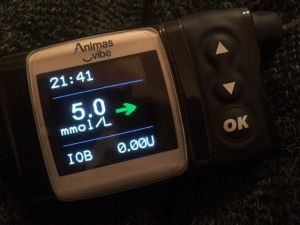
‘Look at me,’ the picture screams. ‘I am winning at diabetes!’
And then, this morning, after eight hours of uninterrupted sleep, this was how my pump screen looked:

W.I.N.N.I.N.G.
So, riddle me this, why did I wake – after eight hours of uninterrupted sleep – feeling so completely and utterly exhausted? I wasn’t up overnight to go to the loo or let the dog out or deal with a low blood sugar. I just slept. Peacefully.
There was no explanation.
Until I looked at this:
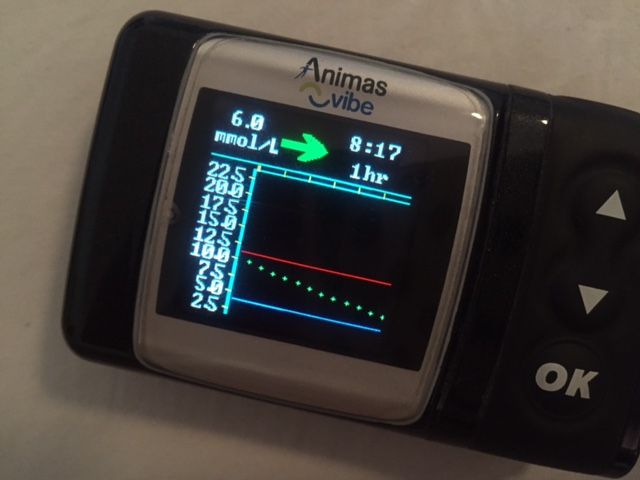
And this:
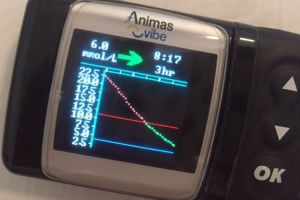
And this:

And then it all made sense. Except it didn’t. How had that happened? Had I sleep-walked into the kitchen, sleep-baked a pavlova and sleep-eaten it? Had I reached over in my sleep and eaten some of the jelly snakes on my bedside table?
The answer is no. All I had done in those eight hours was sleep.
Without my CGM on, I would have had that pre-bed BGL and the morning BGL as the only pieces of information. And it would have looked damn pretty. I would have spent all day thinking about how lovely and pretty and stable by BGLs had been overnight.
But with my CGM on, I know a lot more.
Which is great, except I’m not sure that I want to know. Because now I feel like I have to do something about it and quite frankly, I am still not in the headspace to be analysing glucose levels and making basal changes and being all diabetes-smart.
My CGM is on this week as a security measure. I really didn’t feel like putting it in, but I knew that I needed to. I am counting down until I can rip it out on Friday morning, which is a far cry from trying to get as many days as possible out of each sensor as a cost-saving measure.
I now know why I am not feeling particularly rested, but I feel even less rested with all this information at hand. THIS is when data is paralyising – when we just don’t have the ability – for whatever reason – to do anything with it and all it does is overwhelm us. Ever more.
Without opening my eyes – without really waking up – I reached under the covers, searching. It wasn’t there.
I ran my hand ran across my abdomen. Right…over my bellybutton…left. There it was. I found what I was looking for. Or rather, I didn’t find it.
My eyes flew open and I sat up.
Where was my pump? It wasn’t attached to me. I felt the little knob of my infusion set, but the smooth disc that connects it to my pump was absent.
There was a dry feeling in my mouth and my head was fuzzy. I continued searching amongst the tangled bed sheets until I located my pump. It was lying on the very edge of the bed, almost falling off. I reconnected it and started to assess the damage.
How long had I been unconnected? Disconnected? Not attached?
It was about 3am. We’d had a late night and by the time sleep came, it was well after midnight. I guessed that I’d been separated from my pump for about two hours. Not as bad as it could have been, but long enough.
I checked my BGL and discovered it was creeping up into the mid-teens, which explained the dry mouth. ‘Oh,’ I thought ‘And the need to pee.’
I got up, threw on a t-shirt and, pump in hand, went to the bathroom and then stopped by the kitchen to chug two long glasses of water.
Cherry, our cat, wound her way around my bare legs, pleased for company, as I stood over the sink, looking out the window into the dark garden. A wave of nausea rushed over me. Breathing deeply, I contemplated taking an anti-nausea tablet, but the feeling had passed. I stumbled back to bed after giving myself a correction bolus.
By the time I woke up in the morning, my BGL was in range and the dry feeling had gone, my head was clear. Crisis averted.
I am usually really diligent about reconnecting my pump if, for whatever reason, I remove it. I am particularly conscientious about it at bedtime because I am a notoriously heavy sleeper and the likelihood of me sleeping through climbing BGLs is high (as will be my BGL by the time I eventually do wake!). This is especially an issue when not wearing my CGM and there are no warning alarms to wake either me or (more typically) my husband.
This was the case last night. No CGM (I don’t want to talk about how I accidently ripped out my last senor AFTER ONLY 6 DAYS as I was getting dressed), no alarms. Just a pump lying dormant; dripping insulin onto the mattress instead of into me.
This week marks 14 years of wearing a pump. For over 5,000 days I have had this device attached to me for pretty much 24 hours a day. You would think that I simply would never fall asleep without it safely attached to me
And yet, I did. Because as much as having diabetes is part of my DNA, robot parts are always extra.
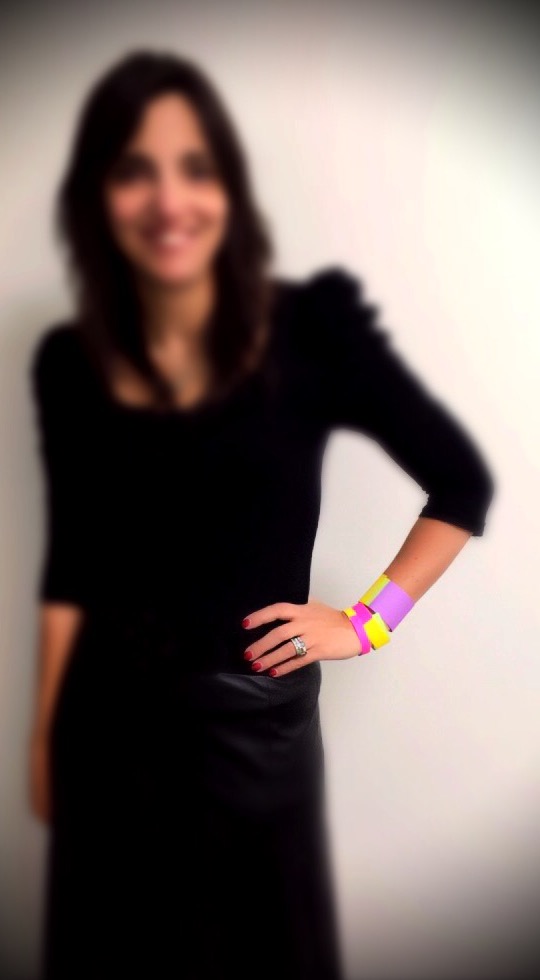
I got up and ready for work, and as I was driving in I realised that I’d forgotten to put on a couple of the enamel bangles I wear most days – especially when I am in all black, as I am today. Perhaps I’m just having a forgetful day, I thought, and weighed up the option of turning the car around. I decided that having forgotten my life-saving medical device at home would probably be accepted as an excuse for being extra late, however forgetting to accessorise would probably not. I proceeded to work, my arms unadorned.
One of my lovely and clever work colleagues came to the rescue though, and, MacGyver-ed me up a solution using nothing put coloured post it notes and sticky tape.
Once again, crisis averted.
Last week, Australian social and mainstream media was abuzz with exciting news of a diabetes breakthrough. This filtered through to international media.
Labelled as an artificial pancreas, the new device was covered in online and print newspapers, as well as television news bulletins. The reason for the excitement at home was because Australia is the launch market for this new technology.
Exciting stuff!
Well, yes and no.
The device in question was not really an artificial pancreas. Rather, it is the next generation integrated pump/CGM system to be launched globally.
Technology advances are really important and we should get excited about them, and their promise of improving the lives of people with diabetes.
But reporting honestly and correctly is also really important.
Let’s be clear about the device that was launched last week. It is a pump with a CGM. The real advance is that together they have the potential to predict hypos and turn off insulin delivery, thus (hopefully) preventing hypos.
This is, indeed, an advance in technology.
This is not, however, an artificial pancreas.
There are a number of problems when diabetes advancements are not communicated effectively and correctly. Firstly, the way the reports read last week, this technology would eradicate hypos completely. As far as hopes for diabetes go, living hypo-free is surely something we would all dearly love.
But while this tech MAY help in reducing hypos, it’s certainly not going to eradicate them.
There are still problems with sensor accuracy that need to be addressed before we can be comfortable in saying that CGM technology (whether purely as a ‘warning system’ for impending hypos or being combined with a pump that will switch of insulin administration) removes the risk (and associated fear) of low blood sugar.
Whilst this technology is a step in the right direction, it is not an artificial pancreas. It is not the holy grail.
Diabetes still needs attention, still needs research, still needs funding, still needs donations. We are not there yet, and any report that even suggests that is, I believe, detrimental to continued efforts looking to further improve diabetes management.
All of us who are communicating in any way about diabetes have a responsibility to be truthful, honest and, as much as possible, devoid of sensationalism.
Get it right when we are taking about it and hopefully the mainstream media – who, let’s be honest, have an incredibly rudimentary knowledge base when it comes to diabetes – will hopefully follow suit.
I am really excited about the potential of this new pump and GGM combination and I am fully aware that it may be of significant benefit to many people living with diabetes. I know just how beneficial CGM technology is.
But tell it like it is. Report responsibly. And keep the understanding of what living with diabetes – and the technology we use – real.
This is just so beautiful! Enjoy for your Friday and have a great weekend.
Click
The sound the applicator of my CGM made as the introducer needle pierced the sensor through my skin made me wince. It’s an involuntary response and not because of pain. The little pinch I feel as the needle shoots in is so insignificant it doesn’t really warrant a response.
My last sensor fell out in bed on one of the first nights of our holiday. The next morning as I removed the spent sensor from the transmitter, I decided that I wouldn’t put in another sensor straight away. And then after a few days of enjoying having one fewer device stuck to my skin, I decided that because I was spending so little time alone, I really didn’t need the safety net of a CGM. Plus I had no plans to try to tighten up basal rates or make any other adjustments.
More than five weeks and no CGM.
But the afternoon after we returned from New York, as Aaron was getting ready to go to a gig, I realised that jet lag would possibly be sending me to sleep before he got home. And I’d been chasing hypos all day – continually going low just as I thought I had managed to get on top of things.
I knew that it was time to get hooked up again to my CGM. I needed my safety net back.
So, I pulled out a fresh sensor, swabbed the back of the transmitter and with a click, the new sensor was attached firmly to me.
The clicking sound hit me with a force that surprised me. I actually felt it in the pit of my stomach – a sinking feeling. I felt my breathing quicken. What’s going on? I thought. I checked the site where the sensor had gone in and where I had fastened the transmitter. It looked fine. There was no pain.
I stood in the mirror, my top tucked under my chin and there, staring back at me, was the reason for this sudden unease. Two medical devices. My cannula on my right side, the pump tubing snaking its way up my chest to the middle of my bra where my pump was neatly tucked away, and my CGM sensor and transmitter just to the left side of my belly button.
I could suddenly feel the numbers, I could feel the data, I could sense the information that would soon be available to me. I could feel the vibrating of the alarms.
And the feeling of burnout – that darkness that lives at the pit of of my stomach – sprang to life after having lived quite dormant for a few weeks.
I felt overwhelmed and my sensor wasn’t even transmitting data yet! In fact, I hadn’t even hit the ‘start sensor’ button on my pump yet.
I sat on the bed and breathed deeply before grabbing a piece of paper and pen. I started to make a list of reasons to not get overwhelmed and distressed about reconnecting to my CGM.

I re-read the list and started to feel calmer. But I was surprised at just how sudden and intense the reaction was. I couldn’t really make sense of it either. I love this technology. I love the information it gives. I use a device that is incredibly accurate and reliable. I do feel safer when I have a sensor attached. And I know that, given the cost of running a CGM, I am very fortunate to be able to use it.
So why was I feeling dread instead of reassurance?
I’m not sure; I’m really not.
Later that night, I crawled into bed. It was still light outside – jet lag had indeed hit me! The kidlet was reading in her room getting ready to sleep. Aaron wasn’t home yet and still wouldn’t be for a while.
I started to read and before long, my eyes felt heavy and just as I was about to put my book down, my pump, lying loose in the bed beside me started to vibrate. I looked and saw the two arrows pointing down. I wasn’t low, but would be in about 30 minutes. I reached over and pulled two jelly snakes from the jar on the side table.
As I started to doze, I felt calm and relaxed, looking forward to a good night’s sleep, and woke on Australia Day feeling refreshed. I located my pump amid tangled sheets, and saw the CMG’s straight line. My hand moved to touch my CGM, sitting comfortably on my stomach. Doing its job. Nothing more. Nothing less.
I am terrified of birds. As in, irrationally scared to the point where I scream when I see a bird flying anywhere near my general direction. Walking through places like St Mark’s in Venice causes panic, and the thought of feeding pigeons so they land on my arms and legs is enough to induce hyperventilating.
This fear was borne out of an incident where a blackbird flew at me and hit me – with its beak – just above the eye and drew blood. This happened about fifteen years ago and since then, I have had a theory that the avian world is conspiring to hurt me. There have been many other occurrences, all of them chilling and disturbing. This phobia is a source of great amusement to my family, who mock me every time I wail and bury my head in fear when there are birds around.
The Hitchcock film The Birds is more documentary rather than a work of fiction, as far as I am concerned.
So, birds and me: not great mates.
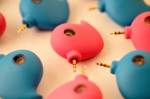
Gorgeous design!
But, I have found a little bird that I think I am going to love and it’s called Diabeto.
Diabeto is a soon-to-be-launched hardware device which wirelessly transmits BGL readings from a meter to a smartphone. Using a specially designed app, data can then be analysed and, being cloud based, is securely stored and can be accessed by HCPs for analysis. Other data – insulin doses, physical activity, carb intake, mood etc. can also be tracked and stored.
Diabeto is currently compatible with 25 meters (with more being added all the time) which means that most people with diabetes will be able to use this technology.
There is lots to like about this little bird, and for some it’s a great way to keep track of the multitude of numbers that are part of diabetes management. On the Diabeto management team is Shreekant Pawar whose parents have had diabetes for 25 years. He GETS diabetes, which means that this is a product that works and makes sense. (Plus, Shreek has really good taste in music and is fun to converse with on SoMe!)
Diabeto is now available for pre-order and this stage is actually part of their crowd-funding strategy. The hope was that the Indiegogo campaign launched last week would provide the cash needed to enter the manufacturing stage.
The great news is that the $10,000 target was reached after only a few days, suggesting that there are a lot of people willing to invest $59 (or $49 if you get in quickly!) to get their hands on one of these cute little birds.
You can read all about Diabeto here and support the campaign by pre-ordering your little birdie here. (Most important information – it comes in blue and pink. If, like me, you’re having trouble deciding, order both.)
Need more of an incentive to check this out? From 27 January to 3 February, $5 from each Diabeto sold will be donated to T1 International.