You are currently browsing the category archive for the ‘technology’ category.
There is so much around at the moment that I wanted to write about properly. But it’s holidays and there is champagne and my kid made brownies with toffee popcorn on top and the neighbours came over for drinks and didn’t leave and I need to pack to go to New York.
So here are some links for some holiday reading.
THIS piece
The title of this piece sure seems to have riled up some people, but bloody hell, just read it. Anna Floreen, who is pretty damn awesome, has written this fabulous piece, sharing her experiences of going through the teen years with diabetes. A must read for parents of kids with diabetes to get some insight into what young people think about dealing with diabetes.
THESE biscuits
These have become my holiday favourites this year and I’ve made about 4,326 batches of them! Four ingredients, super-dooper easy, delicious and look impressive. Plus, they are gluten free, so great as a gift for friends with coeliac disease. What more could you want?
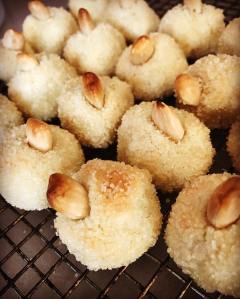
I’ve had the recipe for them scrawled in my recipe book for years – I can’t remember where I first copied it down from – and this from the New York Times is pretty much how I have been making them.
THIS news
Great update about the work Ed Damiano is doing on the Bionic Pancreas just published in The Lancet. The study has shown some pretty exciting results. It’s getting close – really close – and that is just so damn exciting! Maybe we can out one on our Xmas lists next year…
THIS study
If you are a young woman (aged between 16 and 25 years) living in Victoria, Australia, you can take part in a women’s health study, which is looking at the relationships between lifestyle behaviour, physical health and mental wellbeing.
You’ll be reimbursed for your time, so get involved! All the details are here.
THIS poorly worded sign
For the love of all that is good: proof read, people. Please, proof read!

THIS good news
Great news from the Australia Diabetes Society who has just released a new position statement about scuba diving and diabetes, recognising that motivated individuals with well-controlled diabetes (both insulin-requiring and non-insulin requiring), may be able to safely participate in recreational diving.
THIS story
You know, there are some people in the DOC world who are worth their weight in gold. Lou Vickers is one of them. Read her story here.
THIS (slightly old) article
This piece, from Dr Katherine Barnard and Dr Jill Weissberg-Benchell, was published just after ATTD this year (back in Feb) and provides comment on the relationship between diabetes technology and psychosocial aspects of diabetes. A very interesting read, especially considering the way DTech is moving!
THIS position statement
The National Health and Medical Research Council and the Consumer Health Forum of Australia have released a revised statement about the involvement of consumers in health and medical research.
THIS time of year
So, we’re heading off for a couple of weeks and I’ll occasionally be checking in, but probably not much as we’ll be spending a lot of time trying to keep warm on the cold streets of New York.
Thank you so much for reading, commenting and sharing Diabetogenic this year. The love and support I constantly am afforded by people who read posts here is astounding and makes living with diabetes that little bit easier. I wish I could adequately say just how grateful I am.
I’m looking forward to an exciting 2017 – there is already so much on the horizon with exciting projects, collaborations, activities and plans being hatched. It’s shaping up to be a very busy year, so I’m looking forward to a little downtime over the holiday time.
Season’s greetings to you all. I hope you manage some rest, relaxation and quiet reflection in the coming weeks. I’ll see you in the New Year.

Season’s greetings from my clan to yours.
Today, I gave a talk to healthcare professionals at a hospital in outer Melbourne. I was invited months ago after the organisers heard me speak at another event, and they wanted me to speak about living with diabetes.
As I said in the introduction to my talk, I am dead boring. Plus, I am only one voice. So, to create some balance and some interest, I reached out through Facebook and asked this:

As usual, the online community didn’t disappoint. I had over forty responses and weaved them into my presentation, adding real impact to what I was saying, reinforcing my comments with the comments of others walking a similar path of life with diabetes.
I started by asking the audience a question…
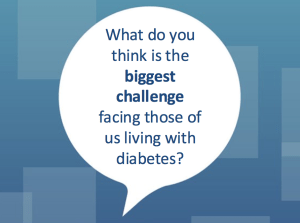
And then I said that I would be talking about life with diabetes. Except, I reminded the audience that life with diabetes was very different depending on where in the world you were diagnosed and that my story is about my ‘first world diabetes’ and I checked my privilege almost as a disclaimer.
I used that point in my talk as an opportunity to speak about those who cannot access or afford insulin and how this is simply, not okay. I could sense the surprise in the room as I said that people are dying because of lack of access.
Then I spoke about what diabetes is to me and here is what I said:
It’s boring and tedious and frustrating.

It’s made me an expert. And that we need our HCPs to acknowledge the hours and hours and effort we put into managing our own brand of diabetes and the expertise we develop from living so closely with this condition.

It’s about humour – because laughing is a tool I use to get through this and that’s okay.
 It’s about words, because language matters and sticks with us forever.
It’s about stigma. I asked if they could think of another condition that was so stigmatised and surrounded by blame – and that while we experience it with type 1 diabetes, I said that I believed my brothers and sisters with type 2 diabetes have it so much worse.

It’s invisible – despite the bright blue patch surrounding my Dexcom, most of the time it is hidden away and not on show for all to see.
It’s about people and community and the DOC and the people that are like the air I breathe – without whom I would not be managing at all.

It’s about my family. And then I explained, fighting back tears, that this is the hardest part of life with diabetes for me. I’ve written about it a lot, spoken about it often. But thinking about how diabetes impacts on Aaron and the kidlet breaks – absolutely shatters – my heart into pieces. The worry I cause my parents makes me feel guilty and resentful. And every day I regret the time I told my sister that my life expectancy had been cut thanks to my type 1 diagnosis because I will never forget the look in her eyes indicating the pain I had just caused her.
I answered a couple of questions and then my talk was done. I thanked the audience for listening, stepped down from the stage, took a deep breath. Someone came up to me as I was gathering my bags and said that she learnt more about real life with diabetes in that talk than in all her years nursing.
This is the power of story telling. The comments I read out and shared have so much power in them. We need to keep telling our stories, turning the way we talk about diabetes on its head. It’s not about the numbers, the tools or anything else. It is about people.
Thank you so much to everyone who shared their comments with me on my Facebook post yesterday and today.
‘Oi!!!!’
‘Hey!! Hey!! Oi!!’
I have a particular look that I reserve for men who yell at me from passing cars. Admittedly, this look is employed far less frequently than when I was a younger lass, but occasionally, it still does need to be used.
And today, the thunderous look of complete and utter disdain was on my face, and the choice words I was going to use to accompany it were forming on my lips as I turned to the person who was shouting at me from their car which was actually stopped at a set of lights as I crossed the road in front of it.
It took me a moment to realise what was going on, but there was a man, half leaning out the window of the passenger side of the car, flailing his arms around and, once he had my attention, yelling ‘Look!!! Look!!!’
I looked.
And there, on his arm, he was sporting a CGM. Just like me – mine circled by a dark blue RockaDex patch; his with a bright green one.
I jumped up and down (by this time I had safely crossed the road) and yelled back. ‘Oh my god!!!! Hey!!! Hey!!! We are totally best friends now!!!’ I was waving my arms around as well, absolutely not caring how ridiculous I looked.
The lights changed and the car took off. He gave me a last smile and yelled good bye. And I waved at the car, standing there on the side of the road, laughing out loud.

Today, I just want to follow up a little about one of the points I wrote about yesterday in my post about the event I attended on Tuesday evening about diabetes-related foot complications, specifically this point made my A/Prof Ramon Varcoe:
He explored how we make people with diabetes know this technique for saving limbs is available, and said that it is really, really important to inform PWD about it so that they can ASK for it and not just accept a diagnosis of requiring an amputation. He said that this was the group that could really drive change here, by demanding that they have the best treatment possible.
This had me thinking long and hard. I agree with A/Prof Varcoe here, but that is not really a surprise. I am so much about consumer-led healthcare, that I dream about it (sad, but true).
Mostly, I thought about it in context of my own diabetes care and how it has happened that I am such a DTech nerd. I decided after about two years of living with diabetes that I wanted to use an insulin pump. I really just could not get the hang of the MDI situation I had been put on at diagnosis and was the living embodiment of why Protophane was referred to as Protopain.
I went to an information session and heard a women speaking about how much she loved using an insulin pump and what a difference it had made for her quality of life. Afterwards, I spoke with her and by the end of our chat, was convinced. I wanted one of those! (Impressionable little thing, aren’t I? #MarketersDream) This woman would become my pump trainer and the only diabetes educator I have ever seen.
At my next endo appointment, I marched in with the research I had done, the questions I needed answered and an expectation that by the end of the consultation, I would leave with details of how and when and where I would be getting my pump. Ha, the naivety!
My endo was absolutely not keen for me to take the pump road, ‘You’ve not had diabetes long enough,’ he told me, which confused me no end, because it already felt like a lifetime. ‘I think we should talk about this again after you’ve had diabetes for about 5 years. Yes?’
Well, no. That was the last time I saw him. I spent the next six months endo shopping until I found one that (I was promised) would agree to helping me on a way to a pump. I walked in and made it very clear why I was there and he nodded straight away. ‘Yep – we can do that,’ and picked up the phone. And about three months later, I was a pumper. This particular endo and I parted ways not long after because I needed someone who was far more expert in the diabetes and pregnancy track I wanted to embark, but I have always been grateful that I found him and his open attitude to diabetes technology.
When CGM was launched into Australia, I spoke to my diabetes educator and asked her to fill in the required paperwork to get me sensing. She sent the form off the day we spoke.
And the same has happened when I have wanted to change or upgrade diabetes devices.
What I am trying to say is that this has all been led by me. So when A/Prof Varcoe spoke about the importance and value of connecting with PWD and telling them about these new vascular procedures to save limbs and prevent major amputations, it made perfect sense. He urged that we needed PWD to be the ones who, if told they needed to have an amputation, spoke up and asked for a second or third opinion, specifically asking about the very procedure he had just discussed.
This ground swell of action is what causes change, but we need to know exactly what to ask for. It’s far more effective to ask the question ‘Can my artery be revascularised? I understand there is surgery than can do that and may prevent the need for a major amputation.’ rather than just ‘Is there nothing more than can be done?’
So many of the people with diabetes I know are using particular drugs or devices because they have asked for them – not because they were recommended or suggested by their HCP. And this is why PWD need to have all the information. This is why device companies should be going straight to the consumer to share information, not expecting it to happen through HCPs. (I know that there has been discomfort from some HCPs at Abbott’s direct to consumer promotion of Libre – and the fact that PWD can order themselves without needing to see a HCP, but why would that be the case?)
But it is more than just making sure the information is there for PWD to know and see. It is a complete and utter reshaping of a system that a lot of times actually isn’t about empowerment. There are still too many ‘old school’, patriarchal attitudes that dictate care choices to the PWD instead of accepting and encouraging us to lead the way for our own care. I think things are changing, but I also think they are changing far too slowly.
Sometimes, the best diabetes meetups involve a few people with diabetes just sitting around having a chat. Perhaps it’s over dinner, or maybe over a coffee. There’s no formal agenda, there are no official speakers. It’s just people with diabetes catching up and talking.
Now, multiply that by … a lot. In fact, put about 40 diabetes advocates in a room together. Throw in a few HCPs as well. And some people from industry. Hell, there may even be a few people from professional and consumer diabetes organisations in there as too.
Now you have #DOCDAY; a diabetes meetup on steroids!
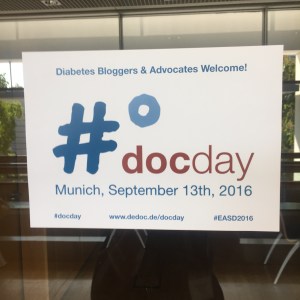
The second annual #DOCDAY event was coordinated and hosted by Bastian Hauck at EASD in Munich. Last year, he had this idea and organised what he thought would be a few people in a café in Stockholm. He underestimated how many people would want to attend, and the room was overflowing with advocates from Europe (and the usual Aussie ring-in).
Dr Andrea Orecchio, right, with Danela D’Onfrio from Portale Diabetes (an Italian diabetes peer site).
This year, he got smart. He hired a room at the conference centre which was a genius move because it not only meant it was so simple and convenient to get to, but it also meant a whole heap of HCPs came along too. (Big hat tips to the divine trio from AADE, Hope Warsaw, Deb Greenwood and Nancy D’Houln, Aussie Dr Kevin Lee, and the delightful Dr Andrea Orecchio from Switzerland who impressed me with his ability to speak (and tweet in) four different languages. Perfectly fluently.)
There was no real structure to the meeting, apart from the insistence that all attendees have their photo taken on an old-school Polaroid camera to be placed on the attendee wall. Bastian kicked off the afternoon, saying a few words and he also asked some people to talk about any exciting diabetes initiatives they’ve been involved in. He asked me because he knows that in my jetlagged state I’m likely to say something inappropriate which will lighten the mood.
I was absolutely enthralled and excited to hear of some of the work other diabetes advocates have been up to lately. Here is just a taste:

Cannot wait to see this book published!
I simply cannot wait for the release of this new book from the team at Anna PS. Anna Sjoberg and Sofia Larsson-Stern from Sweden have collected stories from 20 people with diabetes and will share their personal experiences of lives with diabetes. The Swedish version of I Can, Want and Dare will be out in time for World Diabetes Day, and the English-language edition will follow shortly after. You can pre-order here. What a brilliant Xmas stocking filler! (Disclosure – Anna and Sofia invited me to contribute to the book. I have no financial interest in the book.)

Med Angel.
Did you know that 93% of people using temperature-sensitive medications are doing it wrong? Neither did I! Amin Zayani has created a very nifty smart sensor and app to help you know if your insulin is being kept at a safe temperature. This is a super easy device to use and is all about safety. I know I can certainly be accused of being very relaxed about keeping may insulin at optimal temperature and (touch wood) have never had a problem. But just at this conference, I was speaking with someone whose insulin had been affected by temperature and was absolutely not working. At all. This is something that will be very handy for a lot of people! Follow Med Angel on Twitter here.
IDF Europe has introduced a social media prize in diabetes. Quite frankly, the DOCDAY room was full of worthy recipients. Nominate someone now!
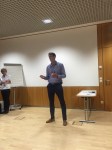
Peer networks in France with Paul-Louis Fouesnant.
I always love hearing about grass-roots diabetes support initiatives, and Paul-Louis Fouesnant from France spoke about Diab’ Mouv peer events he organises regularly.
So what did I speak about?
I spoke about driving and diabetes, specifically the advocacy win we have just had with the launch of the new Australian Assessing Fitness to Drive Guidelines. (More about that later this week.)
I spoke about CGM subsidies, a hot topic everywhere, but particularly in Germany where a reimbursement program had just been announced.
And finally, I spoke about language, because EASD is one of the most challenging conferences when it comes to language. I spoke about why language matters and why the real changes that are being made in this space are driven by people with diabetes. We have been talking about this for years and years now and it is terrific to see it (finally) on the agenda.
By the end of the afternoon, I was overwhelmed by all of these incredibly inspiring folk. For most of them, this is a labour of love with little, if any, financial reward. We blog because we want to share our stories and connect – nothing more. We come together to share our successes and our frustrations because we know that this is a sympathetic group who ‘get it’. Between now and when or if we next get together, we will keep in touch and continue to share our stories because that’s what we do. Thanks to everyone there for being so generous with this bumbling, jet lagged mess.

Just some of the advocates, activists, bloggers and HCPs in the #DOCDAY room!
My disclosures for my attendance to EASD2016 can be found on this post.
Twelve hours after arriving in Munich, I found myself in a beautiful tree-lined side street of the city at a diabetes bloggers event coordinated by Roche Diabetes Care. Fuelled by nothing more than coffee and jet lag, I walked into a beautiful building and found myself surrounded by diabetes advocates from around Europe who were probably trying to work out why an Australian had crashed their meeting.
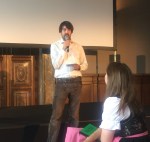
Bastian takes the stage.
Firstly, a little about this group. Roche convened the blogger group a few years ago as a channel to build a relationship with PWD in Europe. (Roche has had a long history of working with consumers. I remember back in 2012 watching the Roche Diabetes Summit in awe and then trying to replicate it here with Australia’s first and only SoMe Summit.) In a very smart move, they engaged DEDOC leader and nice-guy extraordinaire Bastian Hauck to be the liaison between Roche and the community. Bastian has done a stellar job bringing together some absolutely amazing and influential advocates to be part of this work.
The group has now met a few times, and at this year’s EASD, they opened the door to an Australian (slightly less weird now that Australia is part of Eurovision, which, obviously, is the new gold standard measure of inclusiveness. First Eurovision digression.)
The first part of the afternoon session was a demonstration of the yet-to-be-released Roche CGM. A short presentation showed how the device works, with an explanation of the technology. The timeline for release of the product is later this year with launch markets being Sweden, Norway, Netherlands and Denmark.
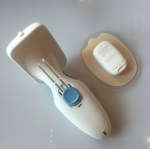
The soon-to-be-released Roche Insight CGM system.
We were then able to have a play with the device, inserting sensors into ‘fake’ skin pads and just getting an idea of the feel, size and look of it. The CGM app is completely customisable. It looks great – super clean and easy to use.
In a room of generally tech-savvy folk, you can imagine that there were a lot of opinions and feedback about the device. Most, if not all, of the participants were wearing at least one medical device – whether that be a pump, CGM or flash GM (and the slightly OTT Aussie who was wearing all three). We are obviously not the norm, but given our knowledge and experience with diabetes tech, we certainly did have a lot to say.

Dexcom and Insight side-by-side comparison.
There were some things that people really liked about the product. Accuracy was outstanding with MARD being comparable to Dex G5. The profile of the sensor was good – about the same as – maybe slightly lower than – the G5 on my arm when compared side by side. Insertion was super-easy and definitely doable with one hand. And the tape holding the sensor in tape is, apparently, better for people with skin allergies.
But as a first generation CGM, there were some limitations that people felt would frustrate them. The lack of integration with the Roche pump, for example, was of concern – however, this will be remedied with future generations. The first gen will only be compatible with an HTC phone (in a room full of very pro-Apple people, this was not particularly well-received) but, again, this will be addressed with future releases.
Also most unwelcome was the factory-set sensor life. Seven days without the possible of restarting is very surprising. There were some murmurings in the room about this setting a new precedent that other sensor makers would follow. Given that I am currently on day 18 of my sensor and the accuracy is spot on, I’d be bloody furious if I’d had to bin it 11 days ago!
Many of us frequently complain about the waste produced with all our device consumables, and there was some concern that the single-use sensor applicator contained a lot of plastic. Look, this is something that I personally struggle with. Every time I change my Dex sensor, or put in a new pump line or cartridge, I look at what needs to go in the bin and wince. It frustrates me each time I rip open the packaging for a new Medtronic Quickset (my preferred line), a bloody little cap falls out, usually to the floor. I have been using these sets since they first were released (maybe eight or ten years?) and never – not once – have I used the cap.
I get it – we need these consumables to be sterile. And safety and avoiding infection is paramount. But still, some of us are very concerned at the landfill we are contributing to!

Crowd sourcing opinion – What does CGM mean to you?
This discussion was very open. We were welcome to tweet, Instagram, Facebook (and blog) everything that we saw in the room, sharing it with the world. Following the demonstration, we all participated in real-time online feedback, where we commented on what we liked and disliked about the device. Our results and remarks were then shared on a screen for all to see.
Can we, for a moment, just consider how novel and out of character this is? Here is a company talking about a device that has not been released yet. And they are talking about it with a room full of over-sharers who all had screens open to various social media platforms ready to tweet, photograph and provide personal commentary. I have never seen such an open and transparent way to get feedback on a diabetes product, and the team from Roche should be absolutely commended on this approach. More please from more companies!
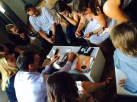
App making. (Photo credit: @Tadorna)
For the second half of the meeting we spent a most fun couple of hours where we played around with app development. My group – obviously the best – created an app that linked our CGM app with a juice machine to respond to low glucose levels. It also turned on bedroom lights if we were low overnight, to help wake us up. And if the wailing alarms of the app were not cancelled within 15 minutes, an ambulance was called to come and make sure we were okay. I know! Brilliant, right?!
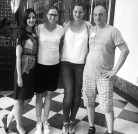
Go team! Anna, Steffi, Sascha
Overall, this was definitely a valuable afternoon learning about new product and also being given the opportunity to meet with some very smart and active diabetes advocates. You bet we were there to be told about Roche’s new CGM, but that was only part of the event and no one in the room is so naïve they don’t know it. But the chance to share ideas and projects and plan for truly global work together outside the device company space was also achieved.
POSTSCRIPT and DISCLOSURES
I’m going to ignore the online discussions that seem to pop up at any conference where PWD manage to score an invite…. Actually, who am I kidding, I’m not. Because I am a little sick and tired of the inevitable complaining and suspicion and passive aggressive comments. I’m a huge advocate for PWD being invited to HCP conferences (I may have written about it once or twice here). For us to get here, we need financial assistance because travel is expensive as is conference registration. So when pharma or device companies offer to bring PWD together to engage in a session they are running – and also provide us with access to the conference, then you bet I am going to think it’s a great idea.
Transparency is important and on this little blog, I will always disclose any arrangements, support, funding or product in place with any company.
So…my disclosures? Well in regard to Roche, none really. I don’t use any Roche products at the moment. I have in the past used their meters, which I have funded myself. I have been an invited speaker at the Roche Educators Day at the ADS-ADEA conference two years running now. And I wrote and disclosed all about that at the time here and here.
Roche did not contribute to my travel or accommodation costs at all to attend EASD this year. They did provide me with press registration, but I had already organised my own, as I do for all conferences I attend. Oh – and they did invite me to a dinner after the blogger event, but jet lag had kicked in so I politely declined. There was no expectation from Roche that I would write about the event (or comment during it). They don’t own my words, I do. But I am incredibly grateful that they are engaging consumers in this way. So thank you to Ute and the team so very much!
As for my disclosures for attending EASD? For the third time, they are all here.
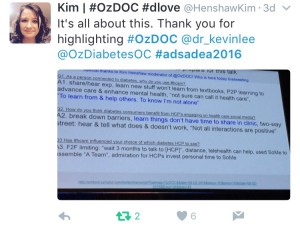
I’d already returned home to Melbourne on Friday morning when Dr Kevin Lee gave his talk on on healthcare social media. I wrote about his planning for the talk here after Kevin engaged OzDOC for some advice on important topics to cover. I’m really sorry I wasn’t there to hear his presentation, although felt there in spirit after I saw this! (Thanks, Ash!)
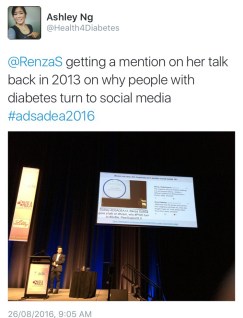
I reckon that this is the fourth or fifth year the ADS ADEA have spoken about social media and how healthcare professionals can use it safely. I remember seeing diabetes educator Natalie Wischer give a great talk back in 2012 highlighting the different social media platforms available and how they are being used in diabetes. This was just after we launched the weekly #OzDOC tweetchats and I stood up and gave a plug for our weekly online get-together, urging the HCPs in the room to have a look – to lurk – and see what we were so excited about.
I gave a talk the next year (that’s the photo Dr Kevin Lee used in his talk), encouraging HCPs to engage with the online community. And last year at the Roche Educators Day, I ran two practical workshops about how HCPs could use SoMe to connect, enhance and support diabetes care.
It has been on the agenda for a few years, and now it is time to stop talking about it and actually do it.
As mentioned last week, Symplur highlighted just who was talking online at the conference. As usual, the ACBRD team was doing a stellar job live tweeting sessions and promoting their excellent work. And, of course, advocates on the ground were doing their (our?) best to share and engage. There were over 2.7 million impressions on Twitter for the duration of the conference, which is certainly an increase from previous years.
I would really love the ADS and ADEA to be proactive about encouraging social media. I would love for them to look at what happened a couple of weeks ago at the American Association of Diabetes Educators conference and see how meaningful social media interaction between people with diabetes and healthcare professionals can and does happen. Safely. The real engagement and collaboration between the organising professional body and advocates saw impressions on Twitter of over 17.5 million, and over 860 people engaging online.
So, how do we go here in Australia about increasing online presence and discussion? In the room for Dr Kevin Lee’s talk were two of Australia’s most prolific and well-known patient advocates – both high-level users of HCSM. I’m referring to Kim Henshaw and Ashley Ng. I wasn’t in the room, yet was actively participating, re-tweeting and engaging – as were many others during sessions that I was sitting in earlier in the week. Having more consumers in sessions provides that connection with PWD not at the conference to hear and see what is going on.
I also think there was, perhaps, a missed opportunity at the session speaking about social media use. Having an advocate on the panel or chairing the session (and remember: Kim and Ashley were in the room!) would have added significant value to the discussion. Dr Kevin Lee went straight to the source when he was putting together his talk. Think about how great it could have been had one or two of those who helped him pull together his information were on the stage elaborating on their comments. Perhaps next year.
This morning, I sat in a restaurant in New Orleans with three of my favourite people and diabetes advocates. If anyone could bottle the tenacity, passion, determination, guts and cheekiness of these three women, they would make a fortune and be able to solve all the problems of the world.
I listened to Anna, Christel and Melissa – who I am lucky enough to call friends – talk about their work and we discussed the US health system which made me shake my head in disbelief and confusion. I don’t understand it; I doubt I ever will. But these three not only navigate the system themselves, they are doing it for others as well as they trying to improve things.
All week I have been around people who are involved in important and life-changing work in diabetes care. From those who are developing smarter devices, using data better, improving access and doing reseach, the dedication and commitment to improving the lives of people with diabetes has been very visibly on show at this conference.
And I have been reminded that at a conference where there are ground breaking announcements made and new and exciting tools launched, it is not the flashy conference centre and the lights of the Exhibit Hall that tell any of the story. It is years and years and years of work, of people plugging away and just doing what needs to be done, until the excitement of telling the world.
This morning, I walked around New Orleans with a delicious, embargoed secret in my head that I was bursting to shout from the rooftops. Some of the exciting work I have been involved in over the last few years has started seeing results and today’s announcement from ALP health spokesperson, Catherine King (no longer under embargo, hence me writing about it….and shouting it from the rooftops) is an example of what happens when people do the hard yards.
Australians now have bipartisan support for CGM funding. The ALP pledge goes further than the Coalition’s, with access under its scheme being based on clinical need – not just age. This mirrors the submission made by Diabetes Australia, JDRF, ADS, ADEA and APEG in our joint proposal. (Disclosure: I worked on the this submission as an employee of (initally Diabetes Victoria and) Diabetes Australia and am acting as spokesperson for Diabetes Australia in any media.)
Today, there will be press and a media launch and lights and excitement as there should be. This is worth celebrating! And as I sit in my hotel room 33 levels above Canal Street in New Orleans, speaking with Australian news radio staff about the announcmenet and I am incredibly proud of what we have managed to achieve in Australia. This is a slow burn. It takes time, it takes commitment and it takes dedication. I love being surrounded by people who have it in spades.
More?