
You are currently browsing the category archive for the ‘Social media’ category.

There are some very clever people in the diabetes world and today I want to write about the incredibly astute and hip crew from mySugr who look for innovative and fun ways to help ‘tame the monster’ that is diabetes.
I met Fredrik Debong from mySugr at the first EASD Blogger Summit where I heard about his diabetes-focused start-up and saw first-hand some of the things they were developing. Fredrik kept saying that we need to bring sexy back to diabetes – he and his team do it incredibly well! (Seriously – have a look at them all!)
Since then, I’ve been fortunate enough to meet others from the team – including Marlis Schosser, (who will forever be known as the saviour in the Pumpless in Vienna story I keep sharing in conference talks), and Ilka Gdanietz who has been at all three Blogger Summits. (Ilka is wonderful for a number of reasons, one of which is she shares my love of Nutella!) This year, Ilka gave us a sneak preview of some of the exciting things happening at mySugr headquarters. mySugr launched in the US last year and the team there is headed up by Kyle Rose and Scott Johnson.
The mySugr Companion app has been around for a few years now and I would really encourage you to have a look at it. As far as a logbook app goes, it is pretty damn perfect, and the version for kids is adorable! I guess that’s what happens when you have real people with diabetes creating tech for real people with diabetes. It just works!
But wait! There’s more.
Just this week, mySugr has launched their new initiative: mySugr Academy. The Academy will offer online training programs for people with diabetes and the curriculum has been developed by healthcare professionals and people with diabetes. The first course to be offered has been designed specifically for people with type 2 diabetes. Have a look at this teaser clip to give you an idea of what to expect.
Coming courses will be for people with type 1 diabetes.
mySugr is all about diabetes education and information, but it does it in an incredibly fun, interesting, accessible and cheeky way. It is groups like this – with a first-hand understanding of real life with diabetes – that make products that I want to use. Great, great stuff!

Monster-taming at mySugr HQ in Vienna.
My Facebook and Twitter feeds are full of diabetes awareness campaigns and it is only going to get busier in the next few days. World Diabetes Day is a global event, and around the world there is much going on to help get people talking and thinking about diabetes.
My favourite campaigns are those that strive to shoot down diabetes myths and one that is getting some well-deserved traction this week is Walk With D.
The aim of Walk with D is to help people without diabetes understand what life with diabetes is all about. But more than that, it hopes to address the misconceptions within the diabetes community too.
Diabetes myths are rife. Every day, I hear things that are simply not right about what diabetes is all about. It frustrates me; it angers me; it infuriates me – never more so than when it is coming from within our own community.
I am filled with despair when I see people with type 1 diabetes perpetuating myths about type 2 diabetes with incredibly destructive ‘type 2 bashing’. I don’t know how many times I’ve said the words ‘No one asks to get ANY kind of diabetes’, but believe me when I say if I had a dollar every time I’d uttered that sentence, I’d be wearing a new pair of Manolos almost every week!
‘Even within the diabetes community, there are levels of misunderstanding, misrepresentation, and mistaken messaging, often creating a divide where there should be a bridge.’ – Walk With D website
Help stop the stigma!
As with any successful social media campaign, it’s easy to get involved with the Walk With D campaign. Share your story and use the #WalkWithD hashtag. Make it personal and make it real. Visit the Tagboard on the Walk With D website to see what others are saying about their real life with diabetes. And share. Share. Share.
And if you need more of an incentive to get on board, Lifescan Inc will donate 100 BGL strips to Life for a Child every time the #WalkWithD hashtag is used during November. Get tagging, good people!
Everyone’s diabetes story is going to be different – the diversity of our community is actually one of its strengths! But we can surely unite in our aim to have diabetes spoken about respectfully and with courtesy. Surely we can bond over the fact that diabetes just plain sucks. Surely we can walk together with diabetes, united, with our heads held high and our arms linked.
This Friday is World Diabetes Day which is a chance for diabetes to get some much-needed mainstream attention and awareness.
There is an absolute plethora of activity this week in the lead up to the big day and, as usual, there is much online activity. Social media has the potential to reach a lot of people quickly, easily and cheaply. I’ve been involved in several campaigns in recent years and am always keen to see what clever ideas people come up with to raise awareness of diabetes around the world.
 This year, one of my favourites is about access to insulin. The Access Alliance has created a Tumblr to draw attention to the fact that many people do not have easy access to insulin and other management tools, diabetes education and support. It breaks my heart that in 2014, almost 100 years since the discovery of insulin, there are still many, many people who cannot afford the insulin needed to manage their diabetes. This campaign is asking people to remember diabetes is a global issue and for some, accessing the things many of us take for granted – insulin, test strips, BGL meters – is a huge struggle.
I think about this often – in fact, every single time that I walk out of the pharmacy with my 5 x 10ml vials of insulin to load into my insulin pump. For less than $40, I have the next three month’s supply of insulin in my hands to take home, and keep safe and cool in the fridge. I feel guilty when I bitch and moan about the fact that I had to make a phone call to order in the insulin because the pharmacy doesn’t keep it in stock. Really? That’s the burden I deal with when I need insulin? I have to make a phone call and wait 24 hours before popping in to get my prescription filled. 
No one in this day and age should find accessing insulin – or any life-saving drug – a struggle.
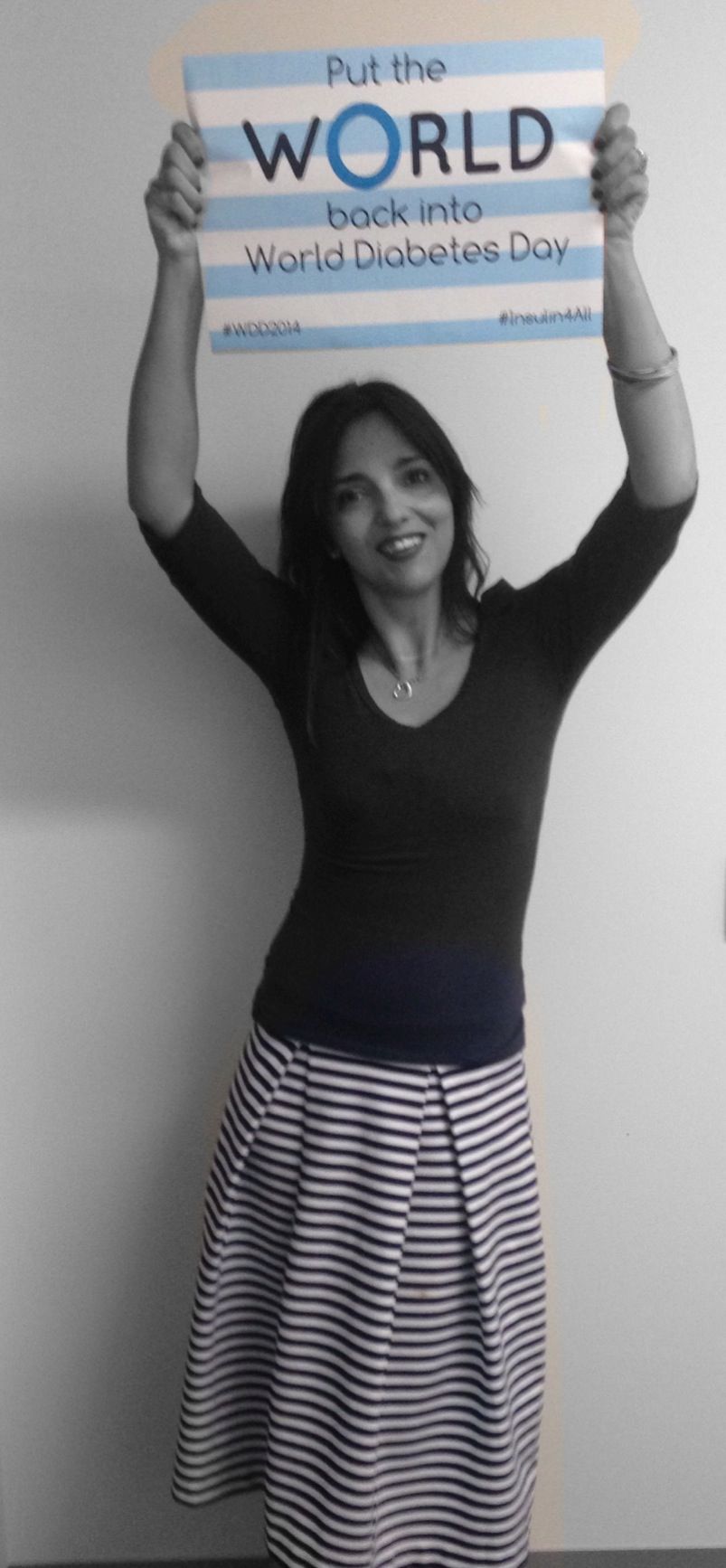
So, get creative and make a poster. Take a photo and upload it to the #Insulin4All Tumblr. And then share it with everyone you know – not just people with diabetes. Preaching to the converted is really important because it strengthens the numbers of people advocating, but reaching out to the general community, making people aware of the issues, getting others angry at the inequity of access to healthcare is important if we are going to make change.
Who do you write your blog for? The question came after one of my recent presentations about how healthcare professionals can use social media to connect people living with diabetes.
My flippant answer to that question is ‘Oh, me and my mum. And some weird guy in Romania who seems to be really interested in my life…..’
The easy question – which is also frequently asked of me is WHY I started a blog. The answer to that one is simple. I hoped it would help me connect with others sharing my story. Because every single time I told of one of my experiences at least one other person – and usually many more – said ‘oh, me too’.
It was exactly the same as when I heard others with diabetes speaking about their lives. I wanted to jump up and down and yell out to them that it was the same for me. (And if I’m being truthful, I actually did do that a couple of times!) These sorts of connections made me feel less alone.
I considered writing a blog an extension of a lot of the work I was already doing: being the ‘here’s-one-we-prepared-earlier’ case study at meetings and information sessions. This, however, would be writing it down. I did this while I was pregnant with our daughter – I kept a weekly online diary that was published on a diabetes site. It was therapeutic and reassuring for me. An ongoing blog would give me the chance to write about and examine my real life with diabetes, and hopefully connect and share with similar folk around the world.
People tell me they like the candid, raw and honest way I tell my story; they feel they can relate. I try to inject a little humour and sometimes that works, other times it falls flat. I have been told to tone things down (I had to stop telling my ‘I will hunt you and all your family down and hurt you all if you steal my pump’ story because my husband said that with my Italian heritage and (falsely) assumed mafia connections that people would get scared*).
I decided when I started writing my blog that there were certain things I would not write about. I would not share others’ stories and I would never, ever write about things told to me in confidence.
I occasionally write about my family and friends, but it is usually incidental to the real issue I’m writing about – sometimes it helps illustrate the experiences and give context.
But what you see is very much what you get. I am conscious that loved ones and people who actually know me and my family read this and sometimes that makes it difficult to write about the more challenging things I’m facing. I don’t want to worry people, but equally, I don’t want to sugar coat things either.
Everything I write, though, whether it is about a particular experience or my circumstances, it is all honest. Sometimes too honest. There have been times that I’ve written something and then the phone calls have started as friends and family check in with me to make sure I am okay.
So who do I write this blog for? I guess it’s actually the same reason as why I write this blog. Mostly – and selfishly – for myself. To connect and find support. And I’m really lucky, because that has been exactly what’s happened!
*I may have stopped telling the story, but that doesn’t make it any less true!
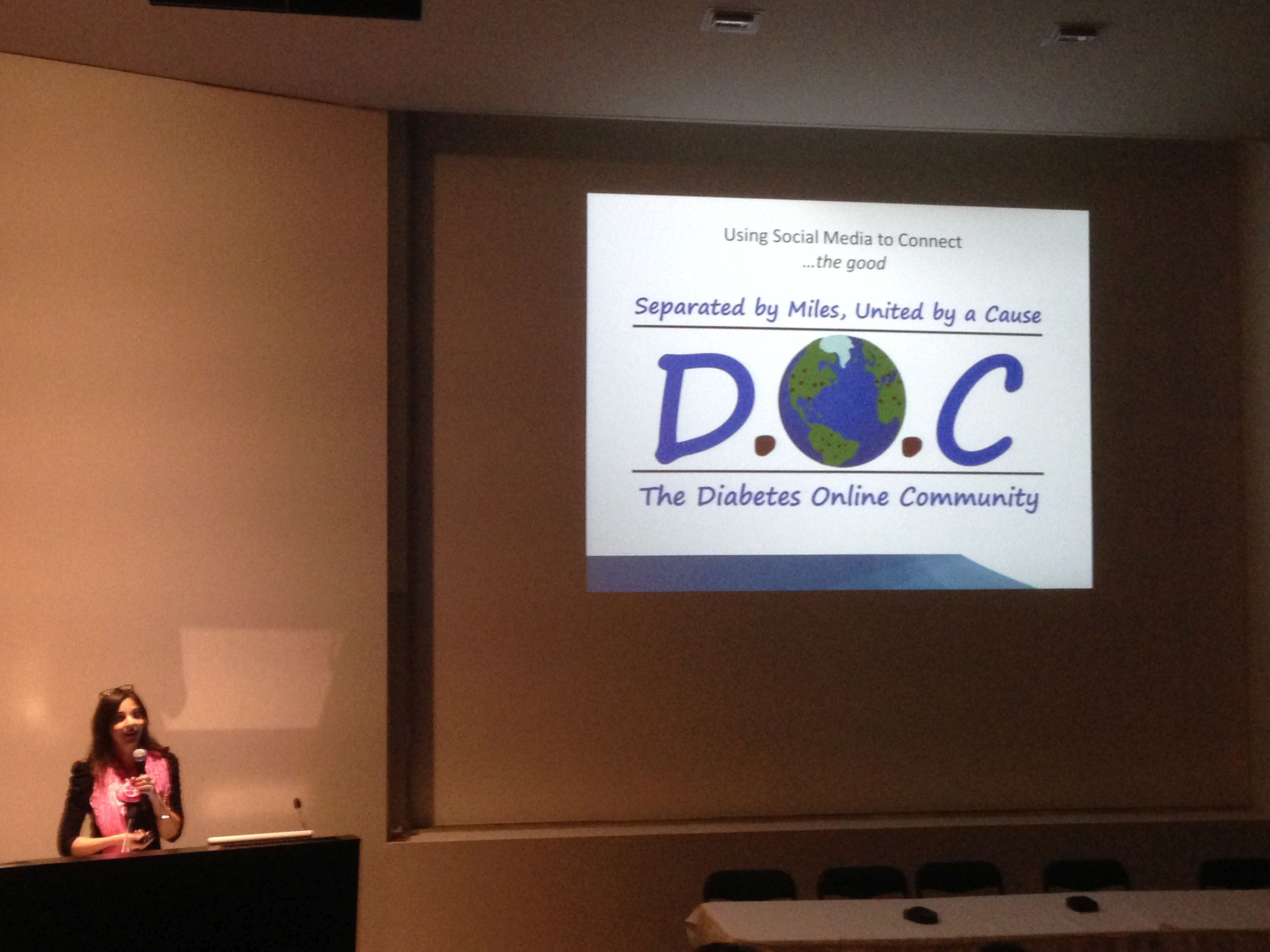
Presenting at yesterday at the Royal Melbourne Hospital’s Grand Rounds.
I’m Paris-dreaming at the moment. The gorgeous Belle du Berry and the rest of Paris Combo are providing the soundtrack. Happy Friday!
Stop for a moment and imagine that the cost of buying insulin for a month was financially crippling to you and your family.
 Think about having to make the choice between buying insulin or buying food.
Think about rationing insulin and taking the smallest quantity possible – just so you are taking something, but not what you need.
Think about how terrible you would feel. Think about the thirst and the exhaustion and the fuzziness.
Think.
I don’t do emotive and I don’t do scare campaigns, but this is the reality for many children – and adults – living with insulin-requiring diabetes.
It’s unfair and it’s terrible.
And now think about doing something about it that is actually quite simple.
Many of you will be aware of the ‘Spare a Rose, Save a Child’ campaign that has been run over the last two years around St Valentine’s Day. The basics are – instead of sending a dozen roses to your loved one, send eleven. And with the five bucks you’ve saved, make a donation to the International Diabetes Federation’s Life for a Child Program. That fiver has just provided insulin for a month to a child whose family could otherwise not afford it.
There are many, many reasons to love this campaign; but for me, I adore it because it is simple and tangible. One rose = one month of insulin. Two roses = two months of insulin. I’m a simpleton – this sort of maths works for me!
I know that it’s not Valentine’s Day right now, but it will be in a mere 137 days. Which means that you have 137 days to plan to see how you could possibly contribute to this great initiative.
Contributing doesn’t necessarily mean making a donation – although it is wonderful if you can. You can blog about it, spread the word on Facebook and Twitter, ask your workplace or school to get behind it. You can just TALK to people about it.
Oh – by the way, this was set up by a few do-gooders in the DOC. Yep, that’s right, with nothing but the internet, their contacts and 140 characters or less (and some blogs, Facebook pages and other social media things) they managed to get this up and running. The first year, they raised about $3,000. The second year, they made close to $30,000. (You can use this the next time someone tells you that social media is the work of the devil and nothing good will ever come of it!)
The ‘Spare a Rose, Save a Child’ campaign was discussed at the 2014 Euro Bloggers Summit (disclaimer-y bits on this page). Kerri Sparling spoke about how the campaign came about and how people could get involved. One of the aims of the Summit is to share great work being done by people in the diabetes community. If you have something you would like others to know about, pease feel free to comment below.
The diabetes online community is a truly global network. We see that every week in tweetchats and anytime we log onto social media. We know that connections are made that are life changing and, (as in the case of my dear friend’s ‘Pumpless in Vienna’ story – to be told here soon), life saving.
For the last three years, I have been privileged to attend the European Bloggers Summit, which is a satellite event run alongside the EASD Scientific Meeting. This event is a chance to really look at ways that consumer advocates can work together and support each other to make significant change to living with diabetes.
It was sobering to be reminded several times yesterday that those of us sitting behind our laptops, participating in the dialogue of the community are already very lucky. We looked at programs out there that are providing insulin to people who would not otherwise have access. Again – life saving.
The beauty of these events is that they are not simply a day or two of navel gazing and patting ourselves on the back for the work we do. We challenge ourselves and each other to do more, do better and reach more people. We plan for what we want to achieve and then hold ourselves accountable for what we have said we want to deliver.
The issues that we have in Australia and that I frequently write about right here are so often universal. Hearing friends from Europe say that the language of diabetes is an issue, or access to technology or medicines is prohibitive for some, reminds me that it is worth continuing to be in this space. When I hear about the frustrations experienced by others when it comes to consumer representation, I know that every time I say ‘nothing about me without me’ it is echoed around the world.
There are some amazing things going on, and over the coming weeks I’m going to write about some of the things I learnt about because I not only want to share this work, I also want to encourage others to get involved.

DISCLAIMER
The 2015 European Bloggers Summit was sponsored by Johnson & Johnson. I was invited by Johnson & Johnson to attend the event and did not receive any funds from Johnson & Johnson to cover travel or accommodation costs to Vienna or to attend the EASD conference. These costs were covered by my employer, Diabetes Australia – Vic.
Last week, there was a very interesting infographic doing the rounds on social media sites about where people donate as compared with the diseases that kill us.
It looks like this:
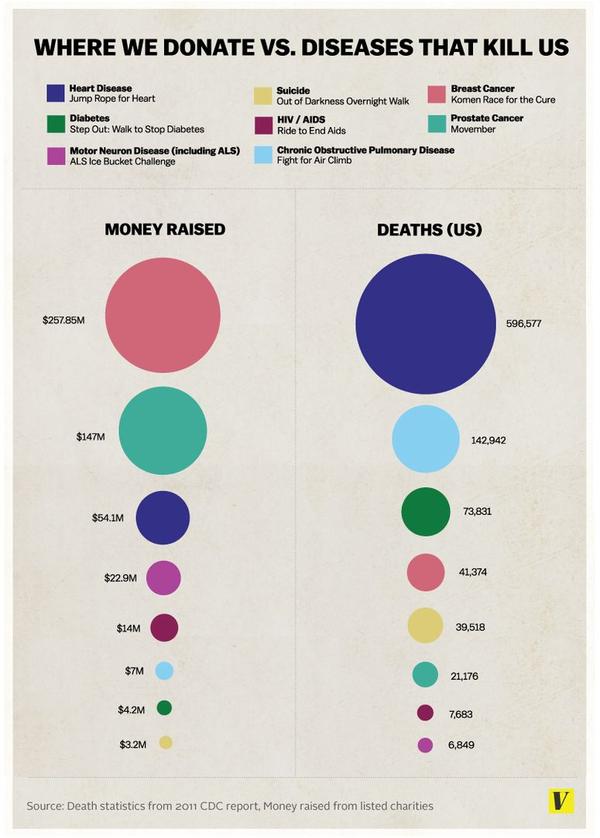
As you can see, diabetes is credited with causing the third most deaths, yet it accounts for relatively little money raised.
Firstly, this isn’t a game of ‘my health condition is worse than yours’. As someone most eloquently wrote on a Facebook status the other day: ‘all diseases suck’. Equally, every single condition is worthy of people’s donations. There simply isn’t enough money to go around to do the research, run the programs and assist people dealing with whatever health condition they have.
But I think unpacking why some conditions attract more donations than others is worthwhile.
Despite being responsible for many, many deaths and affecting millions of people both here in Australia and around the world, diabetes just doesn’t seem to be the ‘disease of choice’ when people reach into their wallets to make a donation.
Why is this? Why is diabetes not at the top of people’s minds when they want to do some good?
I’m just going to say this.
Diabetes isn’t sexy. It’s really not. It’s chronic; there’s no cure; and while there is the cute factor when we’re talking about little kids with type 1 diabetes, they grow up. And then it’s just boring adults with boring diabetes.
But there’s more than that.
The media does a great job of stigmatising this condition. Plus, there’s the ‘you did this to yourself’ misconception that means it’s okay to blame people for developing (type 2) diabetes in the first place and ‘…why the hell should I donate to you. Get off the couch and go for a walk’. Helpful. Really, really helpful.
Diabetes needs a makeover. Plain and simple. We need people in the general community to change the way that they currently think about diabetes so when it’s time for a little generosity, they consider making a donation to diabetes research or consumer organisations.
The neat little packages we seem to have about diabetes are misleading. Tying up type 1 with kids means that adults with type 1 have no voice at all. Blaming all people with type 2 diabetes for ‘doing this to themselves’ completely forgets the facts that genes play a significant role in developing type 2 diabetes. Calling diabetes ‘a touch of sugar’ ignores the seriousness of everyday life with diabetes. In fact, the very idea that this is all about eating sugar results in such misunderstanding about diabetes that people think the solution is as simple as not eating cake. The misconception that insulin is a cure ignores the multitude of factors that are involved with the daily management of this condition. And by thinking it is just about sticking needles into our bodies negates the distress and anxiety life with diabetes can bring.
I don’t know what the answer is. But I do know that what we’re doing at the moment isn’t working. Our messaging is wrong. How do we get it right?




 Diabetogenic