
You are currently browsing the category archive for the ‘Social media’ category.
Who do you write your blog for? The question came after one of my recent presentations about how healthcare professionals can use social media to connect people living with diabetes.
My flippant answer to that question is ‘Oh, me and my mum. And some weird guy in Romania who seems to be really interested in my life…..’
The easy question – which is also frequently asked of me is WHY I started a blog. The answer to that one is simple. I hoped it would help me connect with others sharing my story. Because every single time I told of one of my experiences at least one other person – and usually many more – said ‘oh, me too’.
It was exactly the same as when I heard others with diabetes speaking about their lives. I wanted to jump up and down and yell out to them that it was the same for me. (And if I’m being truthful, I actually did do that a couple of times!) These sorts of connections made me feel less alone.
I considered writing a blog an extension of a lot of the work I was already doing: being the ‘here’s-one-we-prepared-earlier’ case study at meetings and information sessions. This, however, would be writing it down. I did this while I was pregnant with our daughter – I kept a weekly online diary that was published on a diabetes site. It was therapeutic and reassuring for me. An ongoing blog would give me the chance to write about and examine my real life with diabetes, and hopefully connect and share with similar folk around the world.
People tell me they like the candid, raw and honest way I tell my story; they feel they can relate. I try to inject a little humour and sometimes that works, other times it falls flat. I have been told to tone things down (I had to stop telling my ‘I will hunt you and all your family down and hurt you all if you steal my pump’ story because my husband said that with my Italian heritage and (falsely) assumed mafia connections that people would get scared*).
I decided when I started writing my blog that there were certain things I would not write about. I would not share others’ stories and I would never, ever write about things told to me in confidence.
I occasionally write about my family and friends, but it is usually incidental to the real issue I’m writing about – sometimes it helps illustrate the experiences and give context.
But what you see is very much what you get. I am conscious that loved ones and people who actually know me and my family read this and sometimes that makes it difficult to write about the more challenging things I’m facing. I don’t want to worry people, but equally, I don’t want to sugar coat things either.
Everything I write, though, whether it is about a particular experience or my circumstances, it is all honest. Sometimes too honest. There have been times that I’ve written something and then the phone calls have started as friends and family check in with me to make sure I am okay.
So who do I write this blog for? I guess it’s actually the same reason as why I write this blog. Mostly – and selfishly – for myself. To connect and find support. And I’m really lucky, because that has been exactly what’s happened!
*I may have stopped telling the story, but that doesn’t make it any less true!
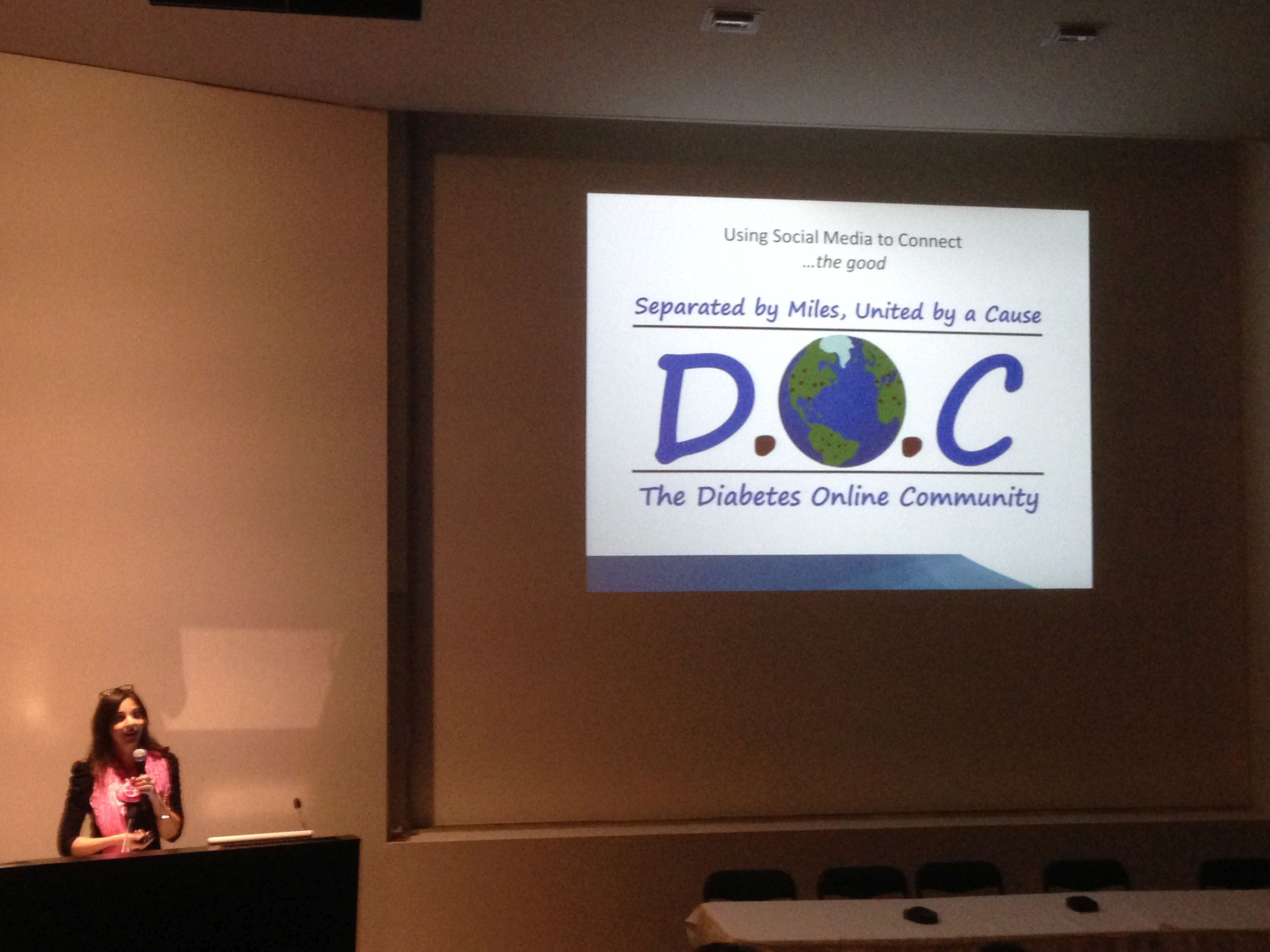
Presenting at yesterday at the Royal Melbourne Hospital’s Grand Rounds.
I’m Paris-dreaming at the moment. The gorgeous Belle du Berry and the rest of Paris Combo are providing the soundtrack. Happy Friday!
Stop for a moment and imagine that the cost of buying insulin for a month was financially crippling to you and your family.
 Think about having to make the choice between buying insulin or buying food.
Think about rationing insulin and taking the smallest quantity possible – just so you are taking something, but not what you need.
Think about how terrible you would feel. Think about the thirst and the exhaustion and the fuzziness.
Think.
I don’t do emotive and I don’t do scare campaigns, but this is the reality for many children – and adults – living with insulin-requiring diabetes.
It’s unfair and it’s terrible.
And now think about doing something about it that is actually quite simple.
Many of you will be aware of the ‘Spare a Rose, Save a Child’ campaign that has been run over the last two years around St Valentine’s Day. The basics are – instead of sending a dozen roses to your loved one, send eleven. And with the five bucks you’ve saved, make a donation to the International Diabetes Federation’s Life for a Child Program. That fiver has just provided insulin for a month to a child whose family could otherwise not afford it.
There are many, many reasons to love this campaign; but for me, I adore it because it is simple and tangible. One rose = one month of insulin. Two roses = two months of insulin. I’m a simpleton – this sort of maths works for me!
I know that it’s not Valentine’s Day right now, but it will be in a mere 137 days. Which means that you have 137 days to plan to see how you could possibly contribute to this great initiative.
Contributing doesn’t necessarily mean making a donation – although it is wonderful if you can. You can blog about it, spread the word on Facebook and Twitter, ask your workplace or school to get behind it. You can just TALK to people about it.
Oh – by the way, this was set up by a few do-gooders in the DOC. Yep, that’s right, with nothing but the internet, their contacts and 140 characters or less (and some blogs, Facebook pages and other social media things) they managed to get this up and running. The first year, they raised about $3,000. The second year, they made close to $30,000. (You can use this the next time someone tells you that social media is the work of the devil and nothing good will ever come of it!)
The ‘Spare a Rose, Save a Child’ campaign was discussed at the 2014 Euro Bloggers Summit (disclaimer-y bits on this page). Kerri Sparling spoke about how the campaign came about and how people could get involved. One of the aims of the Summit is to share great work being done by people in the diabetes community. If you have something you would like others to know about, pease feel free to comment below.
The diabetes online community is a truly global network. We see that every week in tweetchats and anytime we log onto social media. We know that connections are made that are life changing and, (as in the case of my dear friend’s ‘Pumpless in Vienna’ story – to be told here soon), life saving.
For the last three years, I have been privileged to attend the European Bloggers Summit, which is a satellite event run alongside the EASD Scientific Meeting. This event is a chance to really look at ways that consumer advocates can work together and support each other to make significant change to living with diabetes.
It was sobering to be reminded several times yesterday that those of us sitting behind our laptops, participating in the dialogue of the community are already very lucky. We looked at programs out there that are providing insulin to people who would not otherwise have access. Again – life saving.
The beauty of these events is that they are not simply a day or two of navel gazing and patting ourselves on the back for the work we do. We challenge ourselves and each other to do more, do better and reach more people. We plan for what we want to achieve and then hold ourselves accountable for what we have said we want to deliver.
The issues that we have in Australia and that I frequently write about right here are so often universal. Hearing friends from Europe say that the language of diabetes is an issue, or access to technology or medicines is prohibitive for some, reminds me that it is worth continuing to be in this space. When I hear about the frustrations experienced by others when it comes to consumer representation, I know that every time I say ‘nothing about me without me’ it is echoed around the world.
There are some amazing things going on, and over the coming weeks I’m going to write about some of the things I learnt about because I not only want to share this work, I also want to encourage others to get involved.

DISCLAIMER
The 2015 European Bloggers Summit was sponsored by Johnson & Johnson. I was invited by Johnson & Johnson to attend the event and did not receive any funds from Johnson & Johnson to cover travel or accommodation costs to Vienna or to attend the EASD conference. These costs were covered by my employer, Diabetes Australia – Vic.
Last week, there was a very interesting infographic doing the rounds on social media sites about where people donate as compared with the diseases that kill us.
It looks like this:
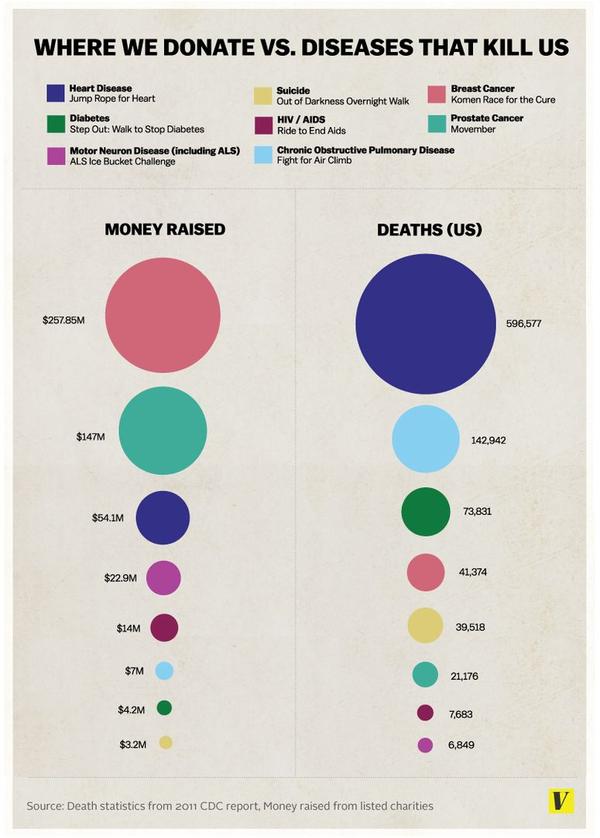
As you can see, diabetes is credited with causing the third most deaths, yet it accounts for relatively little money raised.
Firstly, this isn’t a game of ‘my health condition is worse than yours’. As someone most eloquently wrote on a Facebook status the other day: ‘all diseases suck’. Equally, every single condition is worthy of people’s donations. There simply isn’t enough money to go around to do the research, run the programs and assist people dealing with whatever health condition they have.
But I think unpacking why some conditions attract more donations than others is worthwhile.
Despite being responsible for many, many deaths and affecting millions of people both here in Australia and around the world, diabetes just doesn’t seem to be the ‘disease of choice’ when people reach into their wallets to make a donation.
Why is this? Why is diabetes not at the top of people’s minds when they want to do some good?
I’m just going to say this.
Diabetes isn’t sexy. It’s really not. It’s chronic; there’s no cure; and while there is the cute factor when we’re talking about little kids with type 1 diabetes, they grow up. And then it’s just boring adults with boring diabetes.
But there’s more than that.
The media does a great job of stigmatising this condition. Plus, there’s the ‘you did this to yourself’ misconception that means it’s okay to blame people for developing (type 2) diabetes in the first place and ‘…why the hell should I donate to you. Get off the couch and go for a walk’. Helpful. Really, really helpful.
Diabetes needs a makeover. Plain and simple. We need people in the general community to change the way that they currently think about diabetes so when it’s time for a little generosity, they consider making a donation to diabetes research or consumer organisations.
The neat little packages we seem to have about diabetes are misleading. Tying up type 1 with kids means that adults with type 1 have no voice at all. Blaming all people with type 2 diabetes for ‘doing this to themselves’ completely forgets the facts that genes play a significant role in developing type 2 diabetes. Calling diabetes ‘a touch of sugar’ ignores the seriousness of everyday life with diabetes. In fact, the very idea that this is all about eating sugar results in such misunderstanding about diabetes that people think the solution is as simple as not eating cake. The misconception that insulin is a cure ignores the multitude of factors that are involved with the daily management of this condition. And by thinking it is just about sticking needles into our bodies negates the distress and anxiety life with diabetes can bring.
I don’t know what the answer is. But I do know that what we’re doing at the moment isn’t working. Our messaging is wrong. How do we get it right?
Last week, I spent three days attending and giving presentations at the annual Australian Diabetes Society-Australian Diabetes Educators Association (ADS-ADEA) Scientific Meeting, here in sunny Melbourne. It was a huge week with record attendance and the conference ‘felt’ big. I’m being a little lazy here, but I think that the best way to capture everything I want to share is to use dot points. Here goes:
- Congratulations to the ACBRD team for their symposium on day 1 – Diabetes Distress and Depression – Facing Challenges, Bringing Solutions. Special shouts out to Professor Jane Speight and Dr Christel Hendrieckx who were able to really focus on the ‘solutions’ part of this session.
- Overall, it was really pleasing to see an increased focus on mental health and behavioural research at the conference. Finally, the message that diabetes is absolutely not just about numbers seems to be getting through.
- And for that reason, it’s terrific to see presenters giving really practical advice about how to address mental health issues. Huge, huge points to Christel (again), Jane (again) and Dr Carol Silberberg for not only stating what the issues are, but actually providing take-home tips for clinicians to actually use. Mental health can be a tough topic to broach – especially if HCPs feel they don’t have the tools to deal with it – but thanks to presentations by these three, there was some really hands-on advice that has the potential to help HCPs change their practise.
- I called it when it was launched, and I’ll say it again: The Enhancing Your Consulting Skills resource developed by ADS is going to change the face of educating HCPs (endocrinology trainees) about diabetes. The ADS Symposium on the Thursday morning highlighted again just how valuable this resource will be. I was honoured to be invited to present at this session, and once again would like to thank the team responsible for considering the ‘consumer perspective’ throughout the development of the resource, and continuing to do so.
- Further to that, I hope I wasn’t too rude to the GP who informed the panel that we had forgotten ‘the most important person in the team – the GP’. I was trying to be respectful when I reminded him that actually that title goes to the person with diabetes. I may have failed.
- We need to talk about Dr Silberberg’s slides about clinicians not liking their patients. It was so, so interesting and gave such an insight into the clinicians’ minds. But that’s a whole other blog post! (Stay tuned…..)

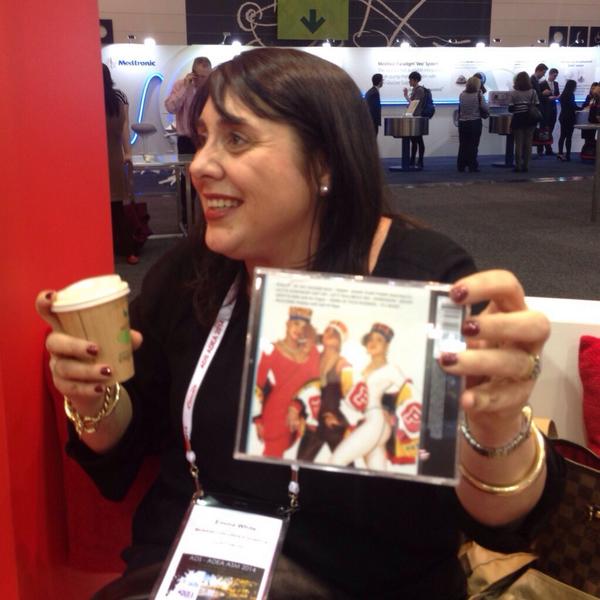
- Great presentation from Emma White and Jesuina Noronha from Monash Children’s about some research they’ve conducted on sexual health knowledge, attitudes and beliefs in adolescents and young adults with type 1 diabetes. Some very interesting findings were presented. And Emma finished off with a bit of Salt n Pepa’s Let’s Talk About Sex. That girl rocks.
- I was a little disappointed that at the Technology 101 session on the final day, there was not a single consumer presenting. I understand the importance of discussing how HCPs use technology in their practice and applications for e-health. But many consumers are way ahead of the curve here and could have provided some very interesting insights about how technology can be used to connect (with other PWD as well as our HCPs), communicate, and gather, collate and share information.
- Even though the Consumer Outreach day was held on the final day of the conference, this is really the first time that I have felt that there has been a real consumer presence for the entire conference.
- While we’re on this topic, a special shout out to OzDOC guru Kim Henshaw for her outstanding tweeting throughout the conference. I was unable to get to nearly as many sessions as I would have liked due to meetings, but following her tweets gave me a pretty good insight into what was going on in the sessions I missed.
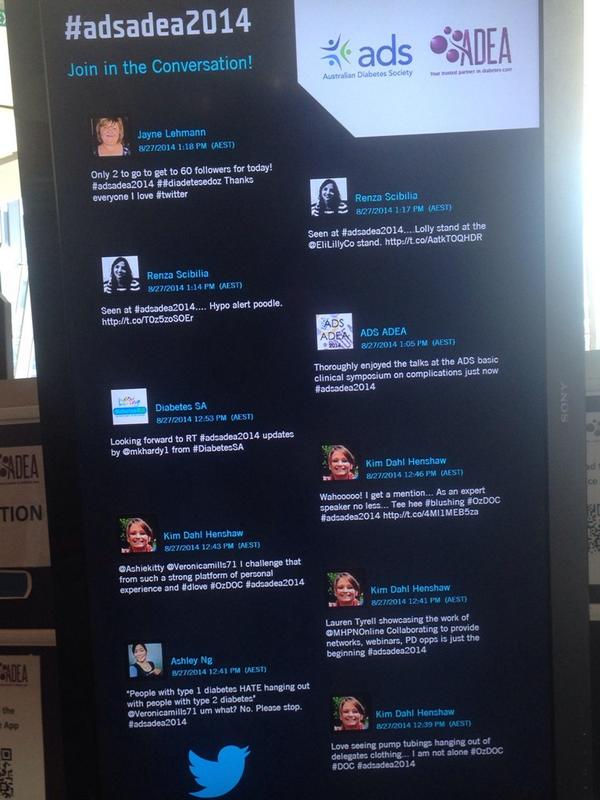
- Congrats to the organising team for stepping up this year with social media exposure. It was great that in the lead up to the event, there was a section on the website about using SoMe at the conference, a dedicated hashtag that was promoted throughout and twitter walls around the conference facilities (usually showing the faces of the consumer advocates in attendance who were busy tweeting).
- It would, however, be great to see more HCPs tweeting. Most came from consumer advocates and the ACBRD team. Perhaps a couple of ‘tweeting 101’ sessions over lunchtime would work to get some more people on board?
- Why is this important? Because the reality is, if it wasn’t for the few of us tweeting at the conference, most people would not have a clue about the sessions. How many people with diabetes have time in their appointment to ask if their HCP attended the conference – and what they learnt?
- A tiny suggestion to the organising team that they look at programming. Frequently, there were two or three sessions on at the same time that I would have loved to attend, and then sessions where there was nothing of particular interest. I heard this complaint from quite a few people (so it’s not just me!!). Perhaps some more consideration about spacing of sessions and spreading out the topics of interest to attendees.

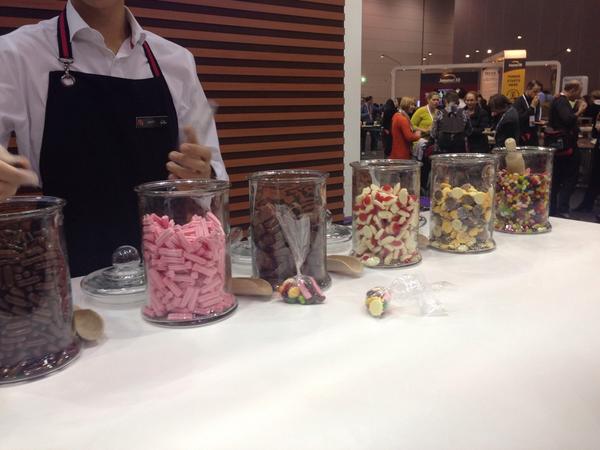
- The Exhibition Hall at conferences is always a treat. This year, the battle for most enticing exhibit (in my books, anyway) went to the Lilly team who not only had the best (free) coffee, but also a sweets stand where they were dishing out little cups of lollies to attendees who stopped by. Very useful for those of us experiencing Conference Hypo Syndrome.
- Also seen in the Expo hall were people handing out nuts . They got angry at me when I said I wouldn’t write about their product. ‘But they’re just nuts’, one of their reps said to me. Indeed they were.

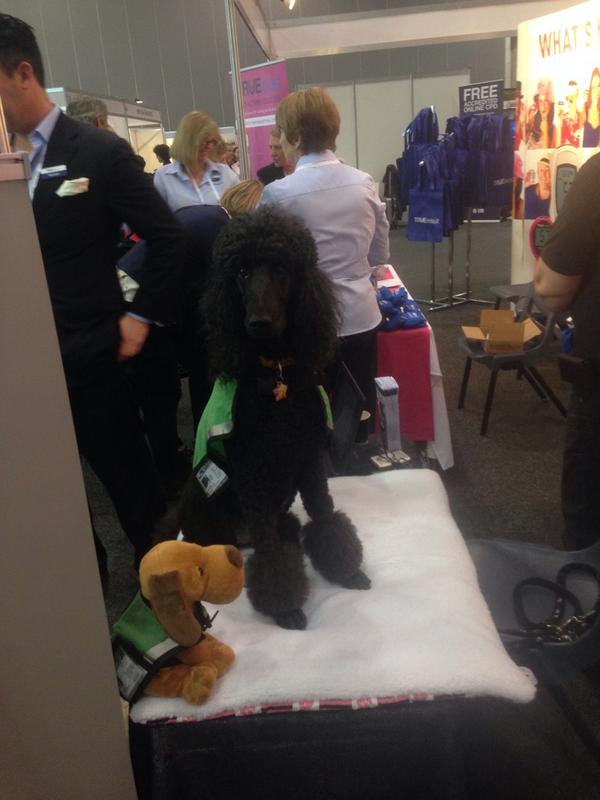
- But the bestest thing of all in that hall was not the free coffee or free lollies. No. It was a French poodle called Gabrielle who was there with the Paws for Diabetics team. More on that to come too.
- Weirdly, on the first day I found myself in the wrong Expo hall looking at tractors. Not relevant at all; just weird.
Well. that’s ADS-ADEA for another year. I’m going to finish up with this slide that Dr Jennifer Conn used in her presentation during the Type 1 Diabetes Consulting Skills symposium where she used this perfect quote from Elliot Joslin.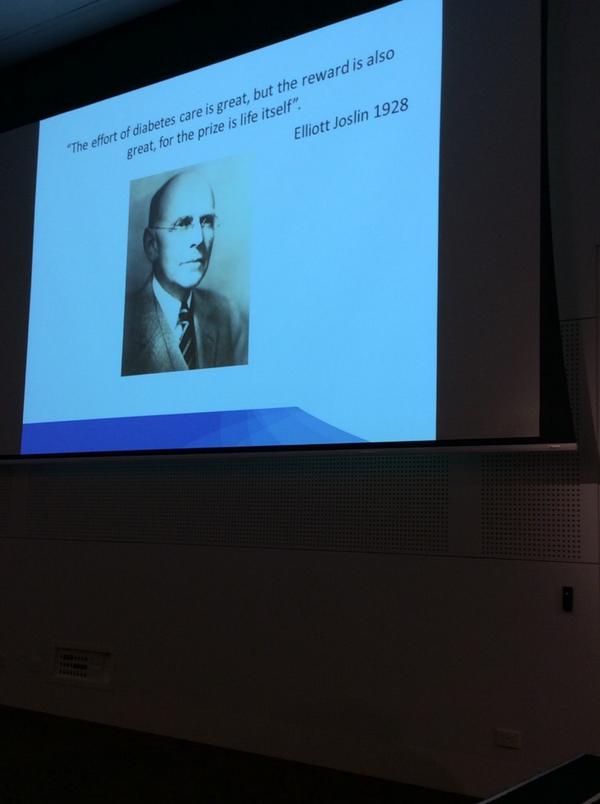
If you jump on Twitter and search #ADSADEA2014 you’ll find all the tweets from the conference. GO!
Apparently there is more to write about than diabetes. (The photo is blurred, but the book’s title is 642 Things to Write About.)

After a busy #dblogcheck day, I’m not sure I believe that….
Totally irrelevant, but this was taken on a cold Friday night in Readings, Carlton at an in-store performance by local guitarists Paul Carey and Julian Scheffer. Check them out here, just jamming in the kitchen….As you do.
On the fifth day of #NDW I’m shouting #SHOWMEYOURPUMP. Well, maybe not shouting it out to random people – that would be weird – but I’m certainly getting very excited about it.
Last week, the interwebs were on fire with a photo of Bethany Townsend who lives with Crohn’s Disease. Whilst on holiday, she posed in a bikini with her colostomy bags clearly visible. In a campaign of solidarity and Crohn’s awareness, other people with the condition started posting photos online showing their colostomy bags, which are usually hidden away.
Not to be outdone (not that it’s a competition) the diabetes world has our own advocacy queen this week with the newly-crowned Miss Idaho, Sierra Anne Sandison who stood on stage this weekend in a bikini with her insulin pump clipped to her bikini bottoms. Just like that!
And with it came a call for people with diabetes to be just as out and proud by posting photos of themselves with their pump, using the tag #ShowMeYourPump
By last night, the photo of Sierra and her pump had been retweeted nearly 2,000 times and there were hopes that the #ShowMeYourPump tag would trend on Twitter. Today, both my Facebook and Twitter feeds are full of pictures with the tag.
This is an easy, fun and far-reaching advocacy and awareness campaign that (once again) shows how social media can be used for good.
So, for a bit of fun, take a photo of you and your pump. There’s no need to pop on a bikini to do it, but knock yourself out if you want to. For my money, it’s Melbourne black – and far too cold for bikini craziness!

Showing our pumps in the office today. #ShowMeYourPump
Sara from Moments of Wonderful has left a comment below reminding me of this great awareness campaign from a couple of years ago. Pumps and glasses! I thought I’d share it here too.





 Diabetogenic