
You are currently browsing the category archive for the ‘Real life’ category.
Part of my work involves attending diabetes conferences both here and around the world. Sometimes I have a speaking gig, other times I’m there for meetings, and always I’m there to learn as much as I can about the latest in diabetes.
I love this part of my job in equal measure with not loving it. The ‘love it’ part is because I get to meet with and hear from some absolute superstars in diabetes research and get front row preview seats to what they’re working on. And I love it because I get to see other advocates who are there for the same reasons I am.
The ‘not love it’ part is because I spend a lot of time away from my family and ‘real life’. I feel enormous mother guilt (this time I missed the kidlet’s Winter Music Concert) and feel lousy for leaving lists of plans and schedules for people other than me to manage. Plus jet lag. I talk about jet lag so much because these days it is absolutely kicking my arse as it turns me upside down and into a bumbling, confused, unintelligible mess.
I realised when I was at ADA in Orlando that all my overseas DOC friends have only ever seen me at my jet lagged, time-travelling worst. They get exhausted, grumpy, vague, annoyed me. And they get me doing weird things like falling asleep in front of them only to suddenly get a second wind and become almost hyperactive where I speak a lot – and really quickly – about weird things such as Australian-isms that I believe they absolutely must start to use in their day to day vernacular. (Only click on this tweet if the eff word and spiders don’t offend you…)
And then, I reach a point where I abruptly stand up and say ‘That’s it!’and just leave and head to bed, often mid-conversation. Why they still want to talk and hang out with me is actually a mystery!
But I am glad they do want to spend time with me, because sometimes, being at a diabetes conference is really hard going emotionally.
We sit there listening to some pretty tough stuff; scary stuff. We hear ourselves being spoken about as ‘subjects’ in research which takes away our ‘human-ness’ and makes us sound like rats in a lab.
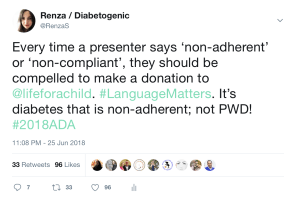
We are referred to with words that make us sound like petulant children (‘non-compliant/non-adherent/failed’ etc.) and all we can do is tweet our frustration (and language positions statements) begging that presenters be considerate in the words they use.
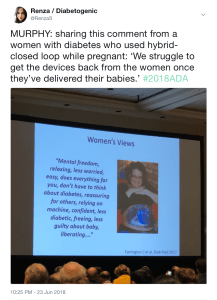
We hear scary, scary tales of all the things that can go wrong with diabetes in a variety of different situations. I reluctantly walked into an 8am session on diabetes and pregnancy, and even though that ship sailed a few years ago for me now, I still brace myself for the research showing that diabetes can and will impact on our developing babies, and children once they are born. That mother guilt I spoke of early is gets turned into mother-with-diabetes guilt which is a monster of proportions all to itself. (Of course, the wonderful Helen Murphy’s talk at 8am was not scary or mother-with-diabetes-guilt-inducing. Instead it was full of interesting facts about how APS impacts positively on diabetes pregnancies. Hurrah!)
Diabetes-related complications are spoken about in matter-of-fact ways that zone in on specific parts of our body and suddenly we stop being whole. ‘The diabetic foot/eye/kidney’ is still attached the rest of us, and yet whole sessions dissect them from our bodies and focus solely on that part of us, forgetting how connected we are to them (literally and figuratively!)
We are told about how diabetes increases the risks of so many, seemingly unrelated problems that can only make me feel as though the cards are stacked so against us that, sometimes, diabetes just isn’t fair. (See also – or maybe don’t – this released today…)
We sit there listening to advice on how things could be improved and sometimes, shake our heads at the disconnect between what is reality to those of us actually living diabetes and the ideas from researchers and clinicians. We wonder what – if any – engagement there has been with the people this advice is meant to serve.
It can be – it is– emotionally draining, exhausting, frustrating.
Those moments when a friend’s sideway glance, or eye roll, or a snarky comment in response to yet another kick in the gut because diabetes is all bad news, is a reprieve from feeling a little shaken. (Of course, it’s not all like this. Often we sit in sessions and feel that those presenting are truly championing our efforts and we do high five through those presentations.)
And those evenings when the sessions have finished, and the official dinners are over and we simply sit together, debrief, refocus and put diabetes back in perspective, make me whole again. It’s the same at every conference. The people may change depending on the location of the conference, but there are always people there. And I’m grateful for that, because I may return home exhausted and jet lagged, but I’m not overwhelmed at what I have seen and heard. Which I fear is how I would be if it wasn’t for the caring, smart, understanding, wonderful people in this tribe .
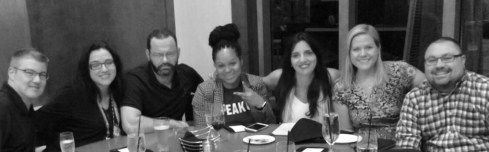
Tribe at ADA
I don’t get hit for six by diabetes much anymore. (Before we go on, please applaud that sport-ish reference there. I really must be growing as a person.)
Those days that would almost be a write-off thanks to a hypo that moved in, set up house and then wouldn’t clear out for hours, or hypers that made me think my insulin had turned to water and made my head so foggy and cloudy and stormy (all the weather analogies), just don’t seem to happen these days. I don’t have nights spoilt by erratic glucose levels and I don’t feel the hangover of lows and highs the way I once did.
This is all good news.
The daily impact of diabetes – both physically and emotionally – has diminished considerably and for that, I am eternally grateful to the magicians who have made Loop available to technology-fools like myself.
But this week? This week, diabetes has reared its ugliest of heads and I have been hit for six. My post the other day was called ‘Waking the beast’ and I think perhaps that is what has happened here. Except the once familiar beast is different now. It’s mutated into something I don’t recognise, and don’t know how to manage.
I don’t even have a word for what it is that is going on right now and if I’m perfectly honest, I don’t understand it. I thought that after my appointment with my endo and my ‘all is well’ complications screening conversation I’d be back to feeling less burdened and less fraught.
Yeah; about that. I was wrong. I certainly did feel lighter as soon as I left my endocrinologist appointment the other day…at least, I did for a few hours. (I even wrote about it!) And then I didn’t.
This week, I’ve found myself lying awake late into the night, thinking about diabetes and the scary things that I really don’t like to think about. During the day mind wanders to that dark place in my conscience, and I feel my breath catching and my heartbeat quickening for no reason.
As I lie awake at night, or am alone in my car driving to work, or standing in the kitchen preparing dinner, I suddenly feel diabetes in my body, flowing through my veins, being absorbed into my bones, twisting itself into my brain. And it’s been winding itself into my dreams when I finally do fall asleep.
What is this? It’s not burnout. To be honest, I do so few diabetes tasks these days that it’s not about being overwhelmed by daily diabetes. I am not ‘over’ diabetes. I don’t even feel that I hate it.
Perhaps the reason that it doesn’t make sense to me is because I can’t point to something and know what I need to fix. This isn’t a matter of needing to do some basal tweaking, or adjust what I am eating, or pre-bolus a little sooner. This has nothing to do with day-to-day diabetes. This is beyond that. This is deeper than that.
I feel diabetes – in, around and through my body and mind. This is within the very core of my diabetes. And the very core of me.

This photo I took at MONA last month of Pat Brassington’s ‘Cornerstone’ seemed a perfect image to accompany this post. (Click for more details of the artist.)
A few years ago, I wrote this piece about why I am uncomfortable with the term ‘carer’. (I’m sharing it again below.) I often think about the word around Kellion Medal time, because there is a certificate given to ‘carers’ of medallists.
This is a lovely part of the ceremony, and acknowledges that diabetes can indeed take a village. Usually, the ‘carer’ is the partner of the person receiving the medal. Sometimes, it is a parent, sibling or other close relative. Other times, it is a healthcare professional.
Carer is a word with a broad meaning. It encompasses a wide range of situations and responsibilities.
As I said in the original blog post, I don’t believe that I have a carer. Aaron certainly supports all my efforts with my diabetes, is a wonderful cheer squad and knows when to mutter ‘Diabetes Sucks’ when I am feeling a little over the whole thing. I feel very fortunate to have him do that.
But carer? Nope.
It got me thinking to what I would want if (when?) I stand up to receive my Kellion medal. In thirty years’ time, I hope to proudly stand up there and appreciatively receive my medal. And in the room, I would want those near and dear to me, celebrating the milestone. I would certainly want to thank them for having lived alongside me as I lived with diabetes for so long.
But the word carer does not really adequately describe that role. And yet, I don’t know the word that does – or even if there is a word…
Words matter – so what is the right word?
So, please help me out! If you are an adult with diabetes, do you have a word you use to describe the people who support you? Are you comfortable using the word carer? Do you prefer to use something else? Or nothing at all? (Fifth option: Never even thought of it. Get over yourself with your language palaver, Renza!)
__________________________________________
I am lucky when it comes to my diabetes support network. I know this and I will say it several times in this post. I also know that I am likely to come off as being ungrateful which is not the case at all. Today, I want to explore the idea of how these support people are identified, either by themselves or by people living with diabetes. Specifically, I want to talk about the term carer.
The Oxford Online Dictionary defines carer as:
a family member or paid helper who regularly looks after a child or a sick, elderly, or disabled person.
I don’t have a carer. I am the person responsible for living with my diabetes, but I do not have a disability and I certainly don’t consider myself sick. And, although I’m pushing a ‘significant age’ I am not yet elderly.
I understand and completely believe that there are people who are really and truly carers. There are people who are responsible for feeding, toileting, bathing, communicating for another who is unable to do it themselves. I am not referring to instances like this. I am referring to, I guess, diabetes.
I don’t consider my husband, who is involved in my life with diabetes to be my carer. He’s my husband, my partner.
Living with diabetes is not a solo game for most and this is a truly wonderful thing. We get support and help from people and I for one feel very fortunate to know that I have people (family, friends, healthcare professionals), I can rely on if I need them.
But I don’t consider any of them my carer. I would refer to them as my support network. In the case of my HCPs, they’re paid to help me with the things I need.
My husband would never say that ‘we’ are a family with diabetes. He would say that I (his wife) have diabetes. Not for one moment would he consider himself to be living with this condition even though he regularly is part of it. But as far as ‘ownership’ goes, it’s mine. He will step up as much or as little as I ask and in the few times it’s been necessary, he’s taken over, done what’s needed to be done and then, when safe, stepped back.
My independence and confidence in my ability to self-manage comes from being given the space from those around me to do what it is I need to do. I know there have been times when Aaron would like to sit me down and force feed me glucose because he can see that I am low. As I stand at the open fridge and in my hypo-fog state try to calculate the carbs in a cucumber (yes, I know!) he has had to just step back and let me work it out myself, stepping in if asked.
I see this like watching my daughter do something in a way that is frustrating to me. I would love to jump in, show her how to do it far more effectively (or do it myself) and then move on. But her self-confidence and her ability to trust her decision making process needs to be encouraged, not overshadowed by a parent who insists on taking over all the time which suggests that she cannot do anything herself.
To me, the term carer implies helplessness. I get that diabetes is a lifelong condition and that there are stages in a person’s life when they may need extra care. For example, children with diabetes are reliant on their parents for the day-to-day management tasks. But is that being a carer or is that called parenting albeit with an incredibly extra degree of difficulty? Or what about an adult with diabetes who is having a period of hypo unawareness and their partner is required to, at times, inject them with glucagon? Is this being a carer or is this just doing what partners do – look after each other at a time of illness or need?
What about when I am lying in bed, unable to move because my BGL is high, I have mild ketones and am vomiting? As I decide whether or not I need to take myself off to A&E, my husband is holding a bucket in one hand and my hair in the other. I don’t consider him to be my carer, any more than I considered myself to be his carer when he hurt his back and I was warming up a heat pack and giving him pain killers every four hours.
I don’t in any way want to undermine the importance, help or value of the support I receive. I don’t for a minute want to say that I don’t need it or resent it. But equally, I don’t want to be considered as being helpless. The relationships I have with people where diabetes is sometimes considered are based on incredible respect – from both parties. They respect that I am the one who is living with this and dealing with it and I respect the way they allow me to do that.
__________________________________________
Thanks to Ash for chatting with me over coffee about this today.
I had an endo appointment yesterday. It was my first in over six months, but this was by choice, rather than inattention. Last November, I decided that I really didn’t need a three month follow-up appointment, and my endo agreed. So, after settling my account for the visit, I made an appointment for May this year. A work trip to Copenhagen via London necessitated a reschedule and this was the first appointment time available that worked for me. The six month follow-up timeframe was pushed out to eight months.
Early last week, I called for a pathology request to be sent to me so I could have a blood draw before heading in. While I had a list almost as long as my arm of things I wanted to discuss, I really am trying to stay on top of having regular screenings so that we can compare results year to year.
Clearly, I am in a really good headspace about my diabetes and, in particular, diabetes HCP care, at the moment. I am happy to attend appointments. Even though I needed to cancel the May appointment, I made a follow up and kept it. I had all my bloods done beforehand. This is a far cry from how I was just a couple of years ago … when actually, I was crying just thinking about it all.
So, last Thursday, I made my way to a local pathology clinic, my request slip scrunched tightly in my hand. And I realised that even with my generally low level of worry about all-things-diabetes, I felt my anxiety levels going up in the days leading to, and the day of, the blood test.
‘I’m nervous about having my A1c done,’ I said to someone last week, and, puzzled, she asked why. It was a sensible question to ask, because truthfully, of all the things I was being checked for, that was the one that I had a pretty good idea what the result would be.
I estimated my A1c and got it right to 0.2 percentage points. The truth is, I am totally ambivalent about A1c. I couldn’t care less about the number because my TIR is where I want it, and I knew this would be reflected by a way-in-range A1c number. (I take no credit for it – it’s all Loop.)
But my kidney function? My cholesterol? My thyroid function? Coeliac screening? Everything else? I have no idea how they are tracking. There is no app on my phone to remind me how I going with those, or helping me guess what they me be. I have no Loop for my kidneys!
I realised that was the source of the anxiety, not my A1c, even though that’s where I was pointing. I guess that makes sense: feeling nervous about A1c results is expected and easy to explain. But the truth is that wasn’t my I was feeling uneasy.
Those complications screenings that I am diligently trying to make sure I have annually still terrify me. Both in the lead up to having the checks done, and then as I wait for the results.
The beast of diabetes that lives within our very core behaves in different ways. Often it is slumbering, lying almost dormant, lulling us into a false sense of all is well. I guess that is how I have felt since I started looping. I say that I am the least burdened I’ve ever been my diabetes because my diabetes is not thrashing around and making itself known so much. But this last week, it has started to wake, reminding me of its presence. I have felt diabetes more in the last week than I have in the last ten months.
I tried to describe this to a close friend the other day – a friend who has seen me live through some pretty horrid diabetes times, and celebrate some damn fine ones. She asks sensible questions and is always listening and learning. She gets it. But she struggled to understand how I could move from saying I’ve felt the best I have ever felt in relation to my diabetes to suddenly speaking of the anxieties that I hold so deep; especially when nothing had changed.
It’s the unknown. It’s the waiting. It’s the fear of what I may be told. That is the beast.
Today, the lightness in my step and in my heart as returned. The appointment went well, the results showed little, if any, change from the last screening checks. I am back to feeling the way I was before last week. After stirring, and stretching, the diabetes beast has curled up and resettled, and is hibernating again. At least, for now…

Waiting with diabetes
Yesterday an article was published across Australia detailing a new report showing that Australians with diabetes are missing out on the recommended levels of diabetes care. Most of these people receive their diabetes care in general practise.
A couple of things before I go on:
- The article was behind a paywall, but Diabetes Australia shared an image of a portion of the it, and that can be accessed here. If you have access to a News Ltd. account, you can read the article here.)
- I want to say that in writing this post today I do not want to be seen to be doctor-bashing. I don’t believe that is constructive in any way whatsoever. However, I do think that there needs to be acknowledgement that the level of diabetes care in general practise is not ideal for a lot of people.
- The language of the article was atrocious. It appeared first under the heading ‘How diabetes sufferers are dicing with death’ Seriously, journos, ready the freaking Diabetes Australia Language Position Statement.
Onwards…
There was some discussion online after the article was shared, with a few doctors believing the article wasn’t all that helpful and feeling that it was unfairly unfavourable towards GPs. Someone also commented on the language used. (I’m not sure if they meant on Twitter or in the article. The language in the article was strong and very critical of GPs.)
The report is damning, and it shows that the results for people with diabetes are not good at all with only one in three people diagnosed with diabetes receiving expected standards of diabetes care. Only half had their A1c checked, and of those, only half again were in range.
This is despite there being a documented diabetes annual cycle of care (for which GPs receive funding). If completed fully, the annual cycle of care includes: annual A1c, cholesterol, and kidney checks, weight and blood pressure checks, as well as two-yearly eye and foot checks.
For me, it shows yet again how stacked the decks are against so many people with diabetes. We don’t receive the level of care recommended and then, when we don’t meet expected outcomes, or develop diabetes-related complications, we get blamed.
If we want to talk about things that are unhelpful and not constructive, let’s begin with that.
We seem to forget that most people don’t innately know what is required to manage diabetes, or what screening checks are required – especially people newly diagnosed with the condition. A lot of people rely on their healthcare professional – in the case of diabetes, usually their GP – for this.
I’ve written before that in my case, my GP is not in any way involved in my diabetes care. This is a deliberate decision on my part. I understand it is also a privileged decision – I have easy access to my endocrinologist, and other diabetes specialists for all my diabetes healthcare needs.
But that’s not the case for everyone, and a lot of people are reliant on their GP for all their diabetes clinical care.
People with diabetes are being let down.
Even though pointing fingers and appropriating blame is not necessarily helpful, it’s what we seem to do. We can blame the system. We can blame a lack of funding. We can blame a lack of continuity of care. We can blame the fact that there are no coordinated screening programs. We can blame the need for more specialist care. We can blame a lousy and ineffective electronic records system.
But what we can’t do is blame people with diabetes. No one asks to get diabetes. No one asks to get diabetes-related complications. So how is it possible that in a system that is letting us down, we are the ones blamed when it happens?
Also, this week, we have heard story after story of missed type 1 diabetes diagnoses with people reporting that despite seeing their GP (often repeatedly) about their symptoms, they were not checked for type 1 diabetes.
It is undeniable that some GPs simply do not know enough about diabetes to diagnose it in the first place, and then to treat it in an ongoing and effective way, and this is leading to those of us living with it not receiving an adequate level of care to live as well as possible with diabetes.
While there may be some hard truths in the report, hopefully the result will be better care for people with diabetes. Because, surely, that is all that matters.

As National Diabetes Week activities began, I kept a close eye on the Twittersphere to see just how the week was being received. Pleasingly, there were a lot of mentions of the #ItsAboutTime campaign, and I set about retweeting and sharing activities by others involved in the week.
One tweet, from Edwin Pascoe, caught my attention:

Edwin Pascoe is a registered nurse and credentialled diabetes educator in Victoria. He is currently undertaking a qualitative study as part of a PhD at Victoria University into the lives of gay men and type 2 diabetes in the Australian context. Data is collected but analysis is underway.
I read Edwin’s tweet a few times and realised that he is absolutely right. I can’t think of ever seeing anything to do with any diabetes campaign that addresses the specific issues faced by LGBTI people with diabetes. So, I reached out to Edwin and asked if he would like to write something for Diabetogenic. I’m so pleased he did.
One of the criticisms of diabetes representation in the media is that it lacks diversity. I completely agree with that sentiment. Because while we certainly may share stories, we also need more voices and more perspectives, and come to understand that there are different, unique and varied experiences and issues faced by different groups.
I’m thrilled to feature Edwin’s post today, and am so grateful that he took the time to write it.
__________________________________________________

CDE, Edwin Pascoe
Diabetes is a chronic condition that is managed in the context of people’s lives and this fact has been increasingly recognised by peak bodies in diabetes within Australia such as Diabetes Australia, Australian Diabetes Society, Endocrinology Society of Australia and The Australian Diabetes Educators Association.
Diabetes education has therefore become not just about defining diabetes and treatment for people but exploring how people with diabetes manage these things in context. Creating the freedom and space for people to speak their truth will allow health practitioners to explore appropriate solutions that are congruent with the person with diabetes needs.
The following will cover some of this context and how sexual orientation may influence diabetes.
Context is everything
The context of lesbian, gay, bisexual, transgender and intersex (LGBTI) persons has not been recognised formally by these same peak bodies in diabetes specifically. Arguments shared informally have suggested that what people do in bed does not affect diabetes and considering we have full equality under the law why would it matter. Further to this health care professionals (HCPs) have suggested none of this worries them as all people are treated the same, but herein lies the problem as:
- Not all people are the same.
- LGBTI people are still not fully recognised under the law in Australia despite the recent success in Marriage Equality. For example religious health care services and schools are permitted under law to fire or expel anyone that does not follow their doctrines. In some states gay conversion (reparative therapy) is still legal despite the practice having been shown to cause significant psychological harm. It is also important to note that it was only quite recently that the last state Tasmania decriminalised homosexuality in 1997 so this is in living memory.
- The law is not the only determinant of social acceptability but is entrenched in culture (we know this from numerous surveys that have seen the up to 30% believe that homosexuality as immoral (Roy Morgan Research Ltd, 2016)). Law changes have only meant that in part hostilities have gone underground.
- The focus on sex or what people do in bed fails to see people as whole and often lead to false claims of promiscuity in LGBTI people. There are also assumptions in relation to what people do in bed for example anal sex is one of these stigmatised practices. In reality not all gay men practice this and a significant percentage of heterosexual people do engage in anal sex.
Reports from the Centre for Disease Control and Prevention in the USA identified that 44% heterosexual men and 36% of heterosexual women have engaged in anal sex (Chandra, 2011). Mild displays of affection such as holding hands and leaning into each other engaged routinely by heterosexual couples are heavily criticized when observed in same sex attracted people causing LGBTI people to self-monitor their behaviour. If they choose to engage in this behaviour it is often considered and calculated rather than conducted freely.
The result of this is that there is a lot of awkwardness around the topic of sexual orientation for both the HCP and LGBTI person, something not talked about in polite company. This means that rather than talking about their health condition in context there is tendency to talk in general terms if they are recognised as LGBTI, or they are assumed heterosexual until the person outs themselves during the consultation.
However outing oneself can be an extremely stressful experience as, despite good intentions by HPCs, LGBTI people may still be fearful and remain silent to the point of even creating a false context (a white lie to keep themselves safe). It has been a known practice among some LGBTI people that some engage in the practice of ‘straightening up’ the house if they know HPCs or biological family members are coming to their homes, to again keep themselves safe. This is not to say that all situations are this bleak but that for some at least it is. Does this prevent people from seeking help in the first place when required?
Studies on rates
In the USA Nurses’ Health Study, it was noted that the rates of diabetes in lesbian and bisexual women was 27% higher (Corliss et al., 2018). Anderson et al. (2015)examined electronic records for 9,948 people from hospitals, clinics and doctors’ offices in all 50 states (USA). Data collected included vital signs, prescription medications and reported ailments, categorised according to the International Classification of Diseases diagnostic codes (ICDs). They found that having any diagnosis of sexual and gender identity disorders increased the risk for type 2 diabetes by roughly 130 percent which carried the same risk as hypertension. Wallace, Cochran, Durazo, and Ford (2011), Beach, Elasy, and Gonzales (2018)also looked at sexual orientation in the USA and found similar results.
However one must consider the country in which this data was collected as acceptability of diverse sexualities and differences in health care systems do make a difference. In a study within Britain the risk for type 2 diabetes was found to be lower than the national level (Guasp, 2013). In Australia the rates of diabetes in a national survey came out as 3.9% in gay men in 2011 (Leonard et al., 2012)and this was the same as data collected by Australian Bureau of Statistics (2013)for that year (they did not differentiate between types).
Life style factors
Life style factors such as exercise and food consumption are important to consider as these are tools used to manage diabetes. Studies have found significant level of homophobia in Australian sport that prevents participation(Erik Denison, 2015; Gough, 2007)and that there are elevated levels of eating disorders including binge eating disorder in LGBTI people (Cohn, Murray, Walen, & Wooldridge, 2016; Feldman & Meyer, 2007).
Qualitatively, a study was conducted in the UK/USA by Jowett, Peel, and Shaw (2012)exploring sex and diabetes, and in this study one theme noted was that equipment such as an insulin pumps put participants in a position to have to explain and the fear they were being accused of having HIV.
Stories
The following two stories may help give context to how sexual orientation has influenced these two people’s lives.
The first story is regarding a gentleman who came to see me for diabetes education for the first time who had lived the majority of his life hiding his sexual orientation due to it being illegal. During the consultation I was trying to explore ways to increase his activity levels in order to improve blood glucose levels, strength and mental health. He advised he didn’t like going for walks even if it was during the day in a built-up area as it was dangerous. When asked to explain this he said he feared being attacked due to his sexuality as he felt he looked obviously gay, but I didn’t see that.
A second story later on was from an elderly lesbian woman who was showing me her blood glucose levels. I noted her levels were higher on Mother’s Day, so I obviously asked what was going on there. She bought out a picture of her granddaughter from her purse which immediately bought a tear to her eye. She said her daughter had a problem with her sexual orientation and so stopped her from seeing her granddaughter, and that it had been two years since she had seen her.
It’s only the start
It is important to note that each letter of the LGBTI acronym has their own unique issues with regard to diabetes. I have mainly talked about gay men here as this is what my study covers but there are studies on transgender people (P. Kapsner, 2017), increased rates of diabetes in people with HIV (Hove-Skovsgaard et al., 2017)and of course many others. In Australia we don’t routinely record sexual orientation, only in areas of mental health and sexually transmitted diseases, and as such data is lacking in this area. It’s time to be counted and there is a need to learn new ways to improve engagement for LGBTI people with diabetes.
References
Anderson, A. E., Kerr, W. T., Thames, A., Li, T., Xiao, J., & Cohen, M. S. (2015). Electronic health record phenotyping improves detection and screening of type 2 diabetes in the general United States population: A cross-sectional, unselected, retrospective study.
Australian Bureau of Statistics. (2013). Australian Health Survey: Updated Results, 2011-12. from http://www.abs.gov.au/ausstats/abs@.nsf/Lookup/by%20Subject/4338.0~2011-13~Main%20Features~Diabetes~10004
Beach, L. B., Elasy, T. A., & Gonzales, G. (2018). Prevalence of Self-Reported Diabetes by Sexual Orientation: Results from the 2014 Behavioral Risk Factor Surveillance System. LGBT Health, 5(2), 121-130. doi: 10.1089/lgbt.2017.0091
Chandra, A. (2011). Sexual behavior, sexual attraction, and sexual identity in the United States [electronic resource] : data from the 2006-2008 National Survey of Family Growth / by Anjani Chandra … [et al.]: [Hyattsville, Md.] : U.S. Dept. of Health and Human Services, Centers for Disease Control and Prevention, National Center for Health Statistics, [2011].
Cohn, L., Murray, S. B., Walen, A., & Wooldridge, T. (2016). Including the excluded: Males and gender minorities in eating disorder prevention. Eating Disorders, 24(1), 114-120. doi: 10.1080/10640266.2015.1118958
Corliss, H., VanKim, N., Jun, H., Austin, S., Hong, B., Wang, M., & Hu, F. (2018). Risk of Type 2 Diabetes Among Lesbian, Bisexual, and Heterosexual Women: Findings From the Nurses’ Health Study II. Diabetes care, 41(7). doi: https://doi.org/10.2337/dc17-2656
Erik Denison, A. K. (2015). Out on the fields.
Feldman, M. B., & Meyer, I. H. (2007). Eating disorders in diverse lesbian, gay, and bisexual populations. International Journal of Eating Disorders, 40(3), 218-226. doi: 10.1002/eat.20360
Gough, B. (2007). Coming Out in the Heterosexist World of Sport: A Qualitative Analysis of Web Postings by Gay Athletes. Journal of Gay & Lesbian Psychotherapy, 11(1/2), 153.
Guasp, A. (2013). 2013Gay and Bisexual Men’s Health Survey. Retrieved 09/07/2018, 2018, from https://www.stonewall.org.uk/sites/default/files/Gay_and_Bisexual_Men_s_Health_Survey__2013_.pdf
Hove-Skovsgaard, M., Gaardbo, J. C., Kolte, L., Winding, K., Seljeflot, I., Svardal, A., . . . Nielsen, S. D. (2017). HIV-infected persons with type 2 diabetes show evidence of endothelial dysfunction and increased inflammation. BMC Infectious Diseases, 17(1), 234-234. doi: 10.1186/s12879-017-2334-8
Jowett, A., Peel, E., & Shaw, R. L. (2012). Sex and diabetes: A thematic analysis of gay and bisexual men’s accounts. Journal of Health Psychology, 17(3), 409-418. doi: 10.1177/1359105311412838
Leonard, W., Pitts, M., Mitchell, A., Lyons, A., Smith, A., Patel, S., . . . Barrett, A. (2012). Private Lives 2: The second national survey of the health and wellbeing of gay, lesbian, bisexual and transgender (GLBT) Australians.
- Kapsner, S. B., J. Conklin, N. Sharon, L. Colip; . (2017). Care of transgender patients with diabetes. Paper presented at the European Association for the Study of Diabetes, Lisbon Portugal http://www.abstractsonline.com/pp8/#!/4294/presentation/4612
Roy Morgan Research Ltd. (2016). “Homosexuality is immoral,” say almost 3 in 10 Coalition voters [Press release]
Wallace, S. P., Cochran, S. D., Durazo, E. M., & Ford, C. L. (2011). The Health of Aging Lesbian, Gay and Bisexual Adults in California. Policy brief (UCLA Center for Health Policy Research)(0), 1-8.
I am a master outsourcer. I outsource as much as I possibly can – from cleaning our home, doing our garden, washing the car and grooming our dogs. I used to feel guilty about this. Then I realised that doing these sorts of things make me irritable and bad-tempered, and it’s better for everyone – mostly and especially me – to just get someone in to do them so I don’t need to a) do them myself and b) get shitty because they are not getting done. (I should add that Aaron feels exactly the same way. He has no desire to do any of those things either, so the outsourcing is a joint decision and one that makes for a far more harmonious home.)
The other day, a new outsourcing device made its way into our home. Despite having someone frequently come and give our place a thorough clean, three dogs and a cat make for grotty floors. Most days, the timber floorboards need a quick going over to gather the dust bunnies and pet hair that collects in corners. Not anymore! This little helper is going to take care of that from now on!
Outsourcing makes sense. And as I have become older, wiser – and some may say lazier – I continue to look for ways to help with the more mundane things in life.
Hello, diabetes…
Many years ago when my diabetes – and I – were not in a great place, I mentioned to an endocrinologist (not my current endo), that I was so overwhelmed by, and over diabetes and I wished that there was a way that someone could do it for me for a week or so. ‘You can’t outsource your diabetes to me,’ she snapped. I’d not suggested her being the one to step in and take over, but she was adamant that it wasn’t going to happen – just in case I was considering asking. (She was promptly sacked after that comment.)
I frequently hear people (myself included) say that the most relentless thing about living with diabetes is not being able to take a holiday from it. It’s true. Even if you have someone helping with caring duties, the toll of having this unwelcome visitor using your body as a guesthouse is unyielding. And even when we manage to find a way to share the load, (for example, partners doing night-time glucose checks, or being responsible for keeping hypo stores replenished, or scheduling HCP appointments, or making sure that insulin prescriptions, glucose strips, pump consumables, sensors etc. are all ready and available at home), there is no sharing or removing the load of the emotional toll of having diabetes.
So with all this in mind, I was a little surprised to hear myself say that I had ‘outsourced my diabetes’ when, at a recent presentation I was giving, a HCP asked me about Loop. I’ve been thinking about that comment quite a lot since I made it. Is it really accurate an accurate thing to say.
I guess that to an extent, it is partially true. I spend less time thinking about diabetes and less time ‘doing’ diabetes. Loop takes over a lot of the things I used to do. This was reiterated in Justin Walker’s talk at Diabetes Mine’s DData Exchange event on day one of ADA last week.

Loop doesn’t make diabetes go away. It doesn’t even take away all the tasks – I still am responsible for making sure that my pump cartridge is loaded, cannula is in working order, sensor is reading. But thanks to the automation, it does take away some of the responsibilities. I guess that the reduced burden comes from the positive results I see every time I look at my Loop app – jut knowing that it is doing its thing and will let me know if something is wrong – takes away some of what I once had to do myself.
Outsourcing is about sharing the load. It’s about handballing some of the tasks and responsibilities of life to someone – or something – else. Loop is the very definition of that!
I met someone the other day – a friend of a friend – who had recently been diagnosed with type 2 diabetes.
Within the first 15 minutes of our casual conversation standing in the street as the Saturday morning rush happened around us, I heard these words from their mouth:
‘It’s my own fault. I should have gone to the doctor sooner.’
‘I am not a good diabetic at all.’
‘I am doing a really bad job checking my bloods.’
‘I’m not sure how long I need to keep checking my bloods. Or how often, really.’
‘I was told if I didn’t look after myself I’d need injections. I’m terrified of needles.’
‘I have a list of foods that I should and shouldn’t eat.’
‘I’ve never been sick before. And now I feel as though people think I am sick. But I feel fine.’
‘The doctor said I don’t have diabetes too badly, but then told me all the things that could go wrong.’
‘I am scared. I don’t know anything about diabetes, but I am scared that I am going to go blind. I was told that’s what would happen.’
Here was an incredibly confident, capable and clear thinking person, not much older than me. Until now, their contact with HCPs had involved annual flu jabs (kudos for that!) and a trip to the GP for the occasional virus. They told me they’d never spent a night in hospital.
The diabetes diagnosis came about after their GP suggested routine blood checks on the day they went in for their flu shot. The following week, they were told they had diabetes. This was just last week. So far, this person had spent about fifteen minutes with their GP and 45 minutes with the diabetes educator who works out of the clinic.
And look at how diabetes has been presented in that time. Already, this person feels as though they are a ‘bad diabetic’ and failing in their treatment. And they are scared.
I responded to some of those comments gently:
‘You DID go to the doctor – for your flu shot. And when they suggested you have a blood check, you did it there and then.’
‘You are doing a great job. There is no such thing as a bad person with diabetes. We do the best we can with the information at hand.’
‘This is all new. You are checking your blood sugar and that’s amazing. Well done. You didn’t have to even think about that two weeks ago!’
‘Do you have a follow up appointment? When you go back, as why you are being asked to check at the times they’ve suggested. And if this is something you’ll need to do for the next week…or month…or longer.‘
‘It’s perfectly understandable to be afraid of needles. I don’t know anyone who likes them. And you may need insulin one day. But not yet. And if you do, that’s not because you have failed. It’s because diabetes needs to be treated and sometimes with type 2 diabetes, (and always with type 1 diabetes) insulin is that treatment.’
‘Have you been referred to a dietitian? It’s really hard to change the foods you’re eating if you’re not sure about diet. Ask for a referral.’
‘I don’t really think of having diabetes as ‘being sick’, so I understand what you mean. But you will need to think about your health differently. That doesn’t make you a sick person, though.’
‘It’s perfectly, perfectly understandable to feel scared. If you think that having a chat with a psychologist or counsellor will help with that, ask your GP.’
‘Also … find some other people with diabetes and talk with them. Here’s my number. Call me any time.’
Imagine, if instead of feeling the way they were feeling, this person felt empowered, confident and assured – even if there was a bit of fear and uncertainty in there.
On the day we are diagnosed, we walk into the GP’s surgery not having diabetes. And walk out with a diagnosis.
It starts early. Those messages at diagnosis can impact how we feel about our diabetes for a very long times – indeed the rest of our lives.
It never fails to surprise me – that instant connection you make with a diabetes peer.
Today, I had the pleasure of meeting Amira who has lived with type 1 for over 20 years. I flew to Sydney to oversee some filming for a work-related project, and Amira was being interviewed.
I listened to her tell her diabetes story (one I really hope she will write about for here!) and afterwards, we had a coffee and chatted. And there it was: that connection that goes far beyond our lazy beta cells, and far beyond both being diagnosed around Easter.
Amira is one of those dynamic, passionate, smart and funny people who helps to make the lives of people with diabetes better. I listened as she explained to me how she works with people with diabetes and instantly I knew she was one of those people I would want as part of my HCP team.
We spoke about every day things that I would speak with any other woman about. But diabetes adds layers and complexities and frustrations and fears. We nodded at each other as we shared those thoughts. Because they resonated straight away. And I was reminded again: the power of peers. That connection of diabetes that goes so deep that it must somehow be built into the DNA of those first encounters.
A new diabetes buddy makes for a good day. Today was a good day!
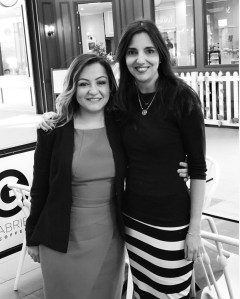
Today’s mood:

…Of course this tee is from the awesome Casualty Girl, and you can get your very own by clicking here. (Not sponsored – I happily purchased this myself!)





 Diabetogenic