
You are currently browsing the category archive for the ‘Real life’ category.
I am old enough and smart enough to understand the way women are meant to respond to the lies of advertising. We are constantly told – and meant to believe – we are not enough. Our bodies are not slim enough, our skin is not taut enough, our thighs are not firm enough, our hair is not shiny enough, our arms are not toned enough.
At my current age, I’m meant to be trying to erase the signs of ageing, willing wrinkles away with an assortment of lotions, potions and minor (and major!) cosmetic surgery, plus trying somehow to regain the body I had twenty years ago.
Thanks to a mother who pointed out the deception of advertising from when I was a young girl, refusing to allow us to buy into the spin, plus a healthy dose of political and feminist teachers at school, all combined with much reading as a teen of Naomi Wolf, Susie Orbach, Gloria Steinem and Betty Friedan, and then later on, Kaz Cooke’s Real Gorgeous, I manage to not be too overcome with my body image issues and feelings of inadequacy. Mostly
My body is forty-four years old. I’m okay with looking in the mirror and seeing a reflection that reminds of me that.
I see the lines around my eyes and am not too startled because I know they have formed thanks to many years of laughing so hard that I can barely breathe, cried so hard because of loss that has rocked me to my core, walked for miles through cities while the sun has shone brightly (and I didn’t reapply my sunscreen).
I’m okay with my body not looking the way it did when I was twenty. I quite love the evidence that I carried and delivered a healthy baby – there is a lot of evidence of that! My far-less-than taut stomach points to that as much as the scar along my lower abdomen from where she escaped.
Surgery would be the only way to return to the pertness destroyed after twenty months of breastfeeding. But quite frankly, I’m kinda proud of the signs from that, because initially it was such a challenge for me to learn to breastfeed, and then manage the subsequent hypos. There should be some proof of the effort that all took!
I can deal with my skin not glowing as it did when I was younger, and the signs of a late night being far more visible than when I was in my early twenties. Those days I could manage being out until the early hours, and then be up bright and early for work the next day with nothing more than a coffee and a slick of my signature red lipstick to deal with the lack of sleep.
And the occasional grey hairs that appear around my hairline are met with acceptance – and gratitude that I can vainly still pluck them out because they are so intermittent that it’s easy to do.
I once wrote that ageing is a privilege. Not only do I believe that, but each and every additional year I live with diabetes, I believe it even more.
I just wish that while I acknowledge the miracle that is my life today – because had I been diagnosed with diabetes a mere seventy-seven years earlier, I would not be alive today – I could be more comfortable and accepting with how I wear diabetes on my body and in my mind.
It makes no sense that I am still uncomfortable of the visible signs of diabetes on my body. But that is how I react most days. The devices I wear still make me wince at their sight. I try to avoid looking at the scars and marks and signs of those devices on my body – all over my stomach and hips. I notice myself more aggressively washing those parts of my skin, and wonder if I am trying to scrub away the signs of diabetes.
In the mornings when I get dressed, I hide my pump and RileyLink away as fast as I can, tucking them into my bra and throwing on something over the top so they are not in my line of vision as I stand at the mirror applying my makeup. I’m not ever going to be one of those people who wears her pump on her hip, proudly showing it to anyone who asks.
And even though my Dexcom is on my upper arm, I prefer the cooler months when I can hide it away from sight under layers of Melbourne black.
Today, I spoke with a mother of a teenager who wanted to know how she could convince her daughter to agree to wearing her pump again. ‘She hates how it looks on her,’the mum said to me. ‘When will she get over it and just realise it’s the best way for her to manage her diabetes?’And I didn’t know what to say because I am a woman in my mid-forties and I am not ‘over it’, seventeen and a half years after first attaching an insulin pump to my body.
The only thing I could say was that it can be a difficult thing for some people to accept – and that I too struggle with it. But that the compromise for me is that as much as I hate seeing diabetes on my body, I’ve accepted that the devices make me feel and manage my diabetes better with them there. But understanding that takes time. Maybe age helps too.
My ageing body is something I can wear with pride because it tells the story of my life and what my body has managed to do. Whereas my diabetes body points to parts of me that are broken. And can’t be put back together, no matter how hard I try, or how hard I try to convince myself otherwise.
Have you seen Body Posi Betes? It’s the brainchild of my darling friend Georgie Peters who is doing everything she can to promote body positivity in the diabetes space. You can join the Body Posi Betes Facebook page here and follow the Insta feed here. I’m going to binge through all the posts again right now, because truthfully, I need a bit of diabetes body positivity right now.
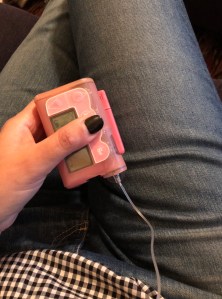
Usually hidden from (my) sight.

Click to be taken to Daisy Natives store.
I bought a new t-shirt the other day. I saw it on Instagram and decided that I just had to have it. I’m not sure if it was growing up in a mostly female household; or the six years I spent in an all-girls school; or perhaps it’s the friends I am fortunate enough to be around a lot; or maybe the fact that most of the people I work with are dynamic women; or raising a daughter in 2018. Whatever it is, girls supporting girls, and women supporting women is the approach I have always tried to take in both my personal and work lives.
I guess my thinking is that we need to look out for and support each other because we know that outcomes for girls and women around the world are not always that great. And also, when women build each other up, and support and encourage each other, we are unstoppable!
I was thinking about this last night as I followed a Twitter conversation that all started after a somewhat sensationalist article in a newspaper about a bloke (sportsperson?) who, as it turns out, seems to have some diabetes-related neuropathy. As people shared the article and spoke about it, there were a couple of comments from people with diabetes about this person – another person with diabetes – ‘not looking after himself properly’.
When I started reading, I almost pinched myself to make sure that I hadn’t been sucked into some sort of void, and been dragged back to another time. Because this conversation has happened before – countless times. (A search through Twitter and this post pointed me to just a couple of those times.)
Diabetes-related complications and stigma. Diabetes-related complications and language. They go hand in hand. And along for the ride is judgement.
The complexity between diabetes, and developing diabetes-related complications is far too much for my little brain to comprehend. But I do know that there are no guarantees in diabetes. And I know that blaming people for whatever path their diabetes travels is not helpful in any way.
When someone suggests that another person with diabetes is ‘not looking after themselves properly’ there is a lot packed into that. It may not be intended, but that comment is so loaded with blame and shame and judgement that it becomes agonisingly heavy and, quite frankly, terrible.
To suggest that someone’s diabetes-related complications are the result of them ‘not looking after themselves properly’ means that essentially what is being said is that the person intended for this to happen. That they ‘brought it on themselves’. That they deserve to now have to face a future of diabetes-related complications.
To that, I say bullshit!
And, somehow, it is even worse when a comment like that comes from another person with diabetes, because if anyone should understand how harmful judgement can be, surely it is others with diabetes.

Supporting each other doesn’t mean just patting each other on the back and saying ‘good job.’ It is far more than that. It is acknowledging that we are doing the best we can at that moment time with what we have. It’s accepting that there are myriad ways of managing diabetes, and that people should have the right and the ability to choose the way that is right for them – even if we don’t think it is right for us. It is encouraging others’ efforts, cheering their successes and standing alongside them when things are tough. It is being happy for other PWD when they are doing, or being invited to do, great things.
It is not saying ‘You are not doing enough’.
We would be quick to say that it’s not okay for a healthcare professional to suggest that we are not trying hard enough. We don’t accept it when the media make claims that people aren’t looking after ourselves properly. We push back and say it is not okay when those without diabetes suggest that we are not doing our very best.
And in exactly the same way, it is not okay for other PWD to criticise one of our own because, honestly, we should know better. We should be on the same side. We should be building each other up.
It is completely unreasonable to expect that people with diabetes are going to agree on everything, and actually, who would want that anyway? Diversity of opinions is as important as diversity of experience. We all have our own ideas and ways to live with diabetes and there will be times that we completely disagree. That is all fine, as long as it is done with respect.
But even with those differences – differences that we can celebrate – the commonality of messed up beta cells should be what brings us together to be on the same side.
I could be Pollyanna-ish about it all and say that we should just be kind to each other, and that may be a good place to start.
Living with diabetes is fucking hard. We never, ever get a break from it. No matter how manageable our diabetes seems or how cruisy things may be at a particular moment, it is still always there. It doesn’t matter if we are scaling mountains or running marathons. Or living our dreams or travelling the world. Or getting up in the morning and going to work or school. Diabetes does not take a break.
Diabetes doesn’t take a break. But we can give each other one. No blame. No shame. Just an acknowledgement that we are doing the best we can. PWD support PWD. That’s what makes us stronger. That what makes US unstoppable!

P.S. If you really don’t agree with what someone is doing with their diabetes, you can say nothing at all. You don’t have to be critical.
Last week, I spent a busy week at Australasian Diabetes Congress. I spent a lot of time with work colleagues, health professionals, the event organisers and researchers.
And I was fortunate because most of the time, I was around at least one of my peers. Between the #DAPeoplesVoice team, (Mel, Frank and David), other diabetes friends from home, (Ash, Kim, Gordon and Cheryl), and away (Grumps), there was always someone nearby who I could rely on to ‘get’ diabetes. (This is important always, but conferences have their own special challenges where diabetes mates are certainly appreciated to help keep some perspective!)
I have written countless times before about the power of peer support. I have also written that my peers have been the ones to have truly helped me through some of the most difficult diabetes situations I’ve faced – not necessarily with advice, but simply a knowing look, a nod of the head, or the words ‘me too’. Our peers help us make sense of what we are dealing with, provide us with endless support and help make us feel connected to others. And that’s important with a condition such as diabetes, because it is all too easy to feel that we are on our own.
Which is why I was so pleased to learn about ConnecT1ons, a new initiative from Diabetes Vic, which is looking to provide that support to another group within the diabetes world – parents of kids with diabetes.

It is undeniable that parents of children living with diabetes have their own brand of challenges. This was brought home to me again last week during the Diabetes and Schools Forum when parent of three children with type 1 diabetes, Shannon Macpherson, spoke about some of the difficulties she and her family have faced with her children in the school setting.
And again this morning, when I was speaking with a parent who is having a very tough time with her young, kindergarten-aged child. ‘Renza,’ she said to me, as she explained what was going on. ‘You have no idea. Having a child with diabetes is impossible because we cannot be with them when they probably need us the most.’ She’s right – I have no idea.
But other parents of children with diabetes would and do understand. And as they shared their empathy, they would also probably share some of the things they’ve done to help them through similar tricky situations.
Diabetes Victoria is looking to bring parents like this together for an event where they can meet other parents of children with diabetes. Plus, it’s a few days of respite from looking after their child with diabetes, while knowing their kid is safe (and having an absolute ball) at diabetes camp. What a brilliant idea all ‘round!
You can watch a video explaining the project here, and hear from Jade, the mum of a young boy with diabetes share some of her experiences – and how parents just like her will benefit from ConnecT1ions.
As is always the case, finding funds for initiatives like this is a struggle, so today, Diabetes Victoria launched a crown funding campaign and is seeking to raise $15,000 to run ConnecT1ons. If more is raised, they can run additional events. The crowd funding is only open for a week, so please do consider making a donation – and doing it now! Click here to be taken to the Pozible page.
Congratulations to Diabetes Victoria for acknowledging that parents of kids with diabetes are a specific group that need support amongst their own peers. Extra huge congrats to Kim Henshaw who has spearheaded this project as part of her role as Children and Families Coordinator.
Please do donate. I returned home last week after spending time with my peers feeling refreshed, energised and connected. Parents of kids with diabetes deserve to feel the same by spending time with each other.

Not a functioning beta cell amongst us.
Disclosure
None! I was sent information about ConnecT1ons from the Communications Manager at Diabetes Victoria last week, but she did not ask me to write about it. I don’t work for Diabetes Victoria (I left there back in Jan 2016) and have had nothing to do with this new initiative. But you have to admit it’s a good one. Hence, this post.
It takes effort to look at diabetes in a positive light. And sometimes, we need other people to shine that light for us. My husband changed a negative thought I had about an aspect of diabetes with one comment. And to this day, something that once filled me with sadness and dread, now makes me feel grateful and fortunate.
__________________________________________
Living well with diabetes. That’s how I like people to think of me. And how I like to think of myself.
But there are occasions – rarely, although sometimes more frequent – where I do feel living with a life-long health condition that is there every minute of every day start to creep over me and a sense of dread and worry plant themselves at the back of my mind. For me, this is part of diabetes burnout. It’s a feeling of being overwhelmed by what diabetes is right now but even more, what diabetes could be in the future. How will my faulty pancreas and my autoimmune problems play out in my life?
And is there any point worrying? At the moment, things seem to be tracking along well. Annual complications screenings tell me that I am doing okay and I’ve read some research that shows people with diabetes are living longer and longer.
So why the dread and anxiety and is there any point? And even more, is it possible to change the way that we think about diabetes?
When I was first diagnosed, the smell of insulin would fill me with dismay. The very scent would remind me of the horrid, scary photos the doctor showed me within the hours of being told I have type 1 diabetes. An invisible force would reshape me from the vibrant 24-year-old I was at the time to a withdrawn, sick, shell of the person I really was. For months I felt this way and every time I gave myself a shot, it was like I was slowly drowning.
But that all changed one day. I drew up two units to squirt through the air before jabbing myself and said ‘Urgh. I hate the smell of insulin. It’s everywhere – I feel like it’s what I smell of now.’ Aaron who was sitting next to me looked up and said simply and matter-of-factly, ‘I don’t hate it. It’s the smell that keeps you alive.’
And just like that, the smell of insulin went from being a death sentence to life saving. It never bothered me again. Keeping the perspective of diabetes in its rightful place is not easy and there will always be times that we feel like it is heading in the wrong direction. We just need to find ways – and people – to say things to help us get back on track.
This is an edited reblog (with a few new bits!) of a post from the old, now defunct, WordPress version of the Diabetes Victoria blog. I may live with diabetes and diabetes may live inside me. But I don’t do diabetes alone and I have always been emphatic about acknowledging the support I am fortunate to have. I couldn’t live with diabetes as well as I do without the people living in the village around me.
__________________________________________
I have type 1 diabetes… And the people I know with type 1 diabetes – in fact, all types of diabetes – who appear to manage best, do so with the support of many people, a veritable village made up of loved ones, friends, colleagues, extended families, health professionals. And the odd village idiot.
I have type 1 diabetes. Although my husband doesn’t, he knows a terrible lot about it. I’ve never seen anyone fly across a room to grab a jar of jelly beans the way he does when he sees that glazed look come over me. Or when I start to giggle uncontrollably for no apparent reason. Or when I begin to tear up for no apparent reason. Or when I start to act irrationally (he would perhaps suggest more irrationally) for no apparent reason. Aaron not only identifies when I am hypo before my meter has told me, he can also interpret my different hypo personalities, of which there are many. This, quite frankly, makes him brilliant. But the most wonderful thing Aaron does for me and my diabetes is that he recognises how crap it is sometimes. I love how he has learnt that trying to ‘fix’ a diabetes situation isn’t what I need; instead a nod of his head, a hug and the words ‘Diabetes sucks’ will more than suffice.
I have type 1 diabetes. Although my daughter may not, she understands just how it impacts on me. From when she was tiny to now, she has come to know that diabetes does impact on me at times and that will affect her. But she has never complained. Her advocacy efforts make me proud and pain me in equal measure, because diabetes has become her cause in may ways when I really wish it hadn’t.
I have type 1 diabetes. Although my endocrinologist may not, she has an uncanny ability to pinpoint the exact information I am looking for (often before I’ve asked). She knows about the dark side of diabetes and offers help working through it. And she listens, listens, listens.
I have type 1 diabetes. Although most of my friends don’t, (even though I seem to have a statistically significant number of friends with diabetes), they know that diabetes sometimes really pisses me off and that the way to offer help is not with unsolicited advice. However an offer to meet me for coffee, prosecco or chat or walk where I can vent about diabetes – or ignore it – will always be met with gratitude. And those friends who do share my pancreatically-challenged existence offer support, humour, understanding – often without words.
I have type 1 diabetes and my parents don’t. My mother also lives with a life-long condition and although it’s different to mine, we have an unspoken understanding of the boredom and sheer frustration of such an imposition in our lives. And when she sees that I am going through a difficult period, she helps – but never, ever makes it about her. I was diagnosed as an adult, so my parents were never responsible for making diabetes decisions for me. But I know that they walk alongside me, keenly feeling my frustrations and anger, as well as the moments I celebrate. I’ve come to learn that’s what parents do for their kids – even when their kids are in their 40s.
It takes a village to raise a child and it takes a village to deal with diabetes. When we try to do it all on our own, it can be overwhelming. My village supports me, assists me, and reminds me that they are there to help. Not only in the times things are becoming too hard, but also in the times when everything is going well. They are part of the reason that the good times happen. They didn’t choose to live in this village and they could have moved anytime they wanted. But they haven’t. I don’t think they will never know how grateful I am to them, but I will try to tell them and explain how important they are.
Of course, the village idiots will always feature – those who think they found a cure in herbs they picked up in their recent travels. Or those who think that the best way to deal with me having diabetes is to pity me. But the village idiots can be a source of humour too, (see here). And laughing is important, so in their own little way, the village idiot is helping and I say thanks to them, too!

I was in Sydney last Friday for a day of meetings, and once they were done, I met up with a new diabetes friend, Amira, who I met only a couple of months ago, but had instantly connected with in that way that only those dealing with messed up beta cells do.
I met her at work and then we walked to have a coffee and a chat. After a while, our conversation turned to her work as an optometrist. Amira told me about the camera she uses to do retinal scans.
I mentioned that I’ve never had a retinal scan as part of my eye checks. My ophthalmologist always dilates my pupils and spends a good amount of time looking at the back of my eyes for any changes. This is how my eye care has been managed and I have always been happy with it (and by ‘happy’, I mean: ‘it makes me cry just thinking about it, but I do it anyway’).
‘Would you like me to take a photo of your eyes?’ Amira asked me. ‘You can send the images to your ophthalmologist to keep on file.’
I thought about it for a moment and took a deep breath before answering. ‘Sure,’ I said. ‘Let’s do that! Thank you!’
We walked back to her office and Amira explained how the camera worked and how I needed to position my eyes. After scanning both my eyes, she sat with me and explained exactly what she could see. She pointed out each part of the eye and what she was looking for and patiently answered my questions. She showed me how she could see the artificial lens that had replaced my own when I had my cataracts removed. (And she clarified that the black spot that I was the first thing I saw was actually a mark on the camera – not my eye.)
She told me exactly the same thing I’d heard back in May when I most recently saw my ophthalmologist: ‘Looks great. There’s nothing to be concerned about.’
I wish that THIS was the first time I had ever seen the back of an eye of someone with diabetes, instead of the frightening image shown to me less than eight hours after being diagnosed, when my first endo showed me a photo of an eye with – apparently – diabetes-related retinopathy. I say ‘apparently’ because I had no idea what I was looking at and had no idea what anything meant.
But that image, accompanied by the words ‘This is what happens with high blood sugars,’ has resulted in years and years of seeing an out of range number on my glucose meter and automatically imagining my retina decomposing…behind my very eyes.
This, combined with other scary images used as part of diabetes awareness campaigns, not to mention the occasional poster in the waiting rooms of various HCPs, is why I am so terrified about anything to do with eye care.
And when we also add the blame and shame that inevitably accompanies discussions about complications, using language that disempowers, it is no wonder that my response to Amira asking if I wanted a photo of my eye was to automatically panic.
Despite twenty years of regular checks, with positive outcomes and a supportive ophthalmologist, the legacy of that initial encounter and subsequent frightening images have taken their toll.
Amira emailed me the images of my eyes, and I’ve spent a long time looking at them – because I know what I am seeing (plus, my eyelashes look awesome!). This is information. It is a snapshot in time and, thanks to Amira’s explanations, I understand what is going on .
‘Come and have another scan next year,’ Amira said. I might just do that. While it will be great to have annual images as a comparison, the best part will be I get to spend time with my awesome new diabetes friend!

Amira has provided me with this explanation of the camera she uses and what it does:
‘Ultra Wide Daytona Plus provides contrast and both red-free and green-free filtering, as well as autofluorescence modalities (so we can see layers in front and behind the retina and assess which part is affected).
Photo documentation means we can monitor and track overtime, allowing for early detection. 200 degree retinal scan compared to a standard scan that often gives around 45 degree view.’
Every second Saturday morning, I can be found at my favourite café having a very important date. Aaron has a rehearsal at that time each fortnight, so it’s become habit for me and the kidlet to traipse to the café for coffee, breakfast and a chat. (Judge me all you like – I gave in to the thirteen year old after a coordinated campaign from a number of people, including one of the owners of this café and the kidlet’s grandparents. Apparently it’s a birthright of kids with Italian heritage to be provided with legal stimulants from when they are children. At least, that’s the story they sold me…while they reminded me that I was drinking the dregs from my dad’s evening espresso before I could talk. Anyway, the outcome of their campaign is the kidlet sits there with her latte feeling all grown up while I silently remind myself caffeine is not crack in an effort to not feel like a completely negligent mother. But I digress…)
The kidlet and I spend quite a bit of time alone together. I often drive her to school or collect her afterwards, as her school is halfway between home and work. And we have a lot of evenings together while Aaron is playing a gig somewhere around town. But those car trips are rushed and usually involve checking off what is happening that day/homework requirements after school and those nights at home usually see us snuggled in front of the TV watching a favourite movie. I love these times, but they’re not really built for detailed conversations.
Our Saturday mornings are leisurely and free of screens. Other than greeting the staff at the café (one who has appointed herself as the kidlet’s ‘other mother’ – something our daughter is more than happy to endorse, because Jo is far cooler and more fun than me!) and said hi to the other regulars, we sit down and focus just on each other.
It is these Saturday morning catch ups that are the most revealing, and provide me with great insight into what ‘s going on in her life. With no need to rush and the comfort of being somewhere safe, she shares things that just wouldn’t be shared in the rushed car trip to school in the morning.
My job on these dates is simple. Listen. Nod my head so she knows that I am paying attention. Don’t impose my ideas on to her. Try not to be shocked when she says anything I wasn’t expecting. And when she asks questions, I try to frame my answers in a way that hopefully helps her feel supported and encouraged to make her own decisions, rather than trying to foist my own onto her.
A few weeks ago when I was seeing my endo, I realised that she takes the same approach with me that I do with the kidlet. I always feel that I have her complete and utter attention and I never feel judged by her. While she may want to just tell me what to do and have me follow it to the letter, she doesn’t do that. When I ask questions, she helps guide me to an answer that I feel comfortable with.
I really believe that my endo’s style has meant that I am far more confident about the diabetes decisions I make each day. Knowing that I have been able to troubleshoot, or make a choice after weighing up all the options gives me conviction and assurance that my decision-making skills are sound, all the time knowing that she is there if I need to ask something.
I am sure it’s no accident that I am this way with my kid. I’ve seen how effective it is in helping me do better with diabetes…and it’s certainly translatable to parenting a teen!
Recently when I was preparing a talk for practise nurses about the way for both HCPs and PWD to get the most out of healthcare appointments, I came across this:
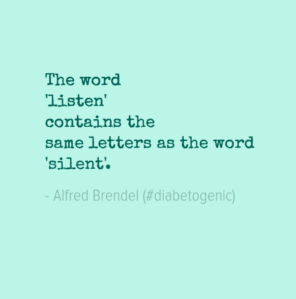
Listening doesn’t seem to come easily or naturally to a lot of us. We want to jump in and interrupt. We want to offer our suggestions (because of course we know best!). We want the person to listen to us and do what we say. And we want to fix things. We so want to fix things!
But the best thing we can do in a lot of cases is to just shut up. I frequently employ the WAIT (WhyAm I Talking?) approach as I have found it is the best way to truly gauge what is going on and find out things that are too easily missed.
Those Saturday morning catch ups are illuminating for me. As well as seeing how my daughter is dealing with the sometimes tricky trials and tribulations of teenage-hood, I am being allowed a front row seat to a lot of what is going on in her life – things I may otherwise miss. Most of the time these days, she doesn’t need me to tell her what to do as she is working out stuff. She needs to feel safe, comfortable and not judged as she bounces her ideas off me; and to be given the space to learn how to weigh up options, make errors in judgement and work out what is best for her.
And that sometimes, making a decision that isn’t necessarily the best may not be the worst thing in the world. (At least – that’s what I’m telling myself when I see the look on her face as she takes her first sip of coffee for the day, and I know I have been complicit in her teenage caffeine addiction…)
I may have mentioned before that I use an app called Timehop. It cleverly collects photos and posts from Facebook, Instagram, Twitter and other social media platforms, and serves them up to me as an account of what I was up to on this day over the last ten or so years.
Mostly, Timehop is a source of great joy. It shows photos of lovely family and friends moments, exciting things happening at work and our travels. Or it shares tweets that make no sense in isolation, but if I click on link, am taken back to long-forgotten discussions that made complete sense at the time. It’s fun and each day, makes me smile a I remember some pretty great moments.
But around this time each year, I am reminded of what was going on a the end of July 2013. And I don’t smile fondly. Because it remains one of the most difficult times of my life, and remembering it so clearly stirs up a lot of sadness.
This time five years ago, I had miscarried a much-wanted baby. The miscarriage (and D & C) happened while we were on holidays in New York, but I needed another surgery once I returned home.
Had the pregnancy gone to plan, there would be a little four year old in our life. I can’t really imagine it, to be honest. I think of everything that has happened since July 2013 and wonder how different life would be today if there was a little one running around. We’d be thinking about a school start in the new year and all that comes with it.
But, life doesn’t always go to plan. This particular derailment can’t really be explained – it was just one of those things. Twenty years of diabetes has taught me that there will be occasions where I will face curve balls. Sometimes over and over again. But even with the understanding that diabetes brings about expecting the unexpected, there is little solace in dealing with pregnancy loss.
It’s five years ago now. It feels as though a lifetime has passed. And at the same time, it feels no more than a baby’s heartbeat ago.
I like to celebrate anniversaries. Diaversaries are given the fanfare they deserve around our place, with high fives and pats on the back as another year of dealing with diabetes is ticked off an imaginary calendar.
This anniversary doesn’t get celebrated. But it does get acknowledged. This week, I’ve been imagining four year olds who remind me of our darling girl when she was a cheeky four year old. But I know this one would have had a personality all of its own, and been a force to reckon with in different ways. And I am thinking about what life would like with two kids, and how our daughter would have adjusted having a younger sibling following her around. I wonder how our house would breathe differently, reflecting a little one’s existing, picture books that have been put up on high shelves once again scattered around the floor.
These thoughts do make me smile.
But my smile when I think of these things is not a happy smile. It is a smile of regret, loss and grief.
I will buy some white flowers for the kitchen table today, and watch them as they bloom. And remember. Remember the time when I thought that we would be bringing home the baby growing inside me to add to – and complete – our little family. And how sad I am that we never did get to meet.

So after two recent posts about back up plans (one from me about why we should be offered latest technologies at diagnosis, provided we are taught the basics in case the tech fails, and one from Grumpy Pumper about the weight he gives back up plans and basic tech to ensure he’s never left high and dry), you would think that I have this whole fall-back situation thing sorted.
Alas…
‘Hi, I’m Renza and I’m not good at diabetes.’
I generally carry around two small purses in my handbag. (I should point out that the purses change because I am addicted to Shop Casualty Girl pouches and keep ordering more.)
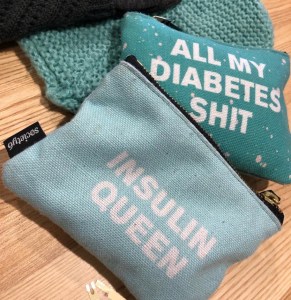
Click on image to go to Casualty Girl’s e-shop
Purse one holds my glucose meter, which means that I can calibrate my CGM as required and, if for any reason my CGM stops, I can still keep an eye on my glucose levels.
Purse two is my spares bag and in there I have all I need to completely swap out my pump cannula and cartridge, refill my cartridge with insulin, replace my pump battery and, if for any reason my pump stops, I have a back-up plan for my back-up plan with a baby syringe in there to continue the (manual) infusion of insulin until I get home and hook up my spare pump.
I feel pretty damn supercilious just writing about this, because, honestly, I am so freaking organised that I should be given some sort of organisation badge. (I never did Girl Scouts…is there a badge for this? Can someone make me one?)
And, it means that I confidently feel that whatever happens, I can keep doing diabetes – albeit not my preferred way – until I get home and return to normal broadcasting with the tools I like to use.
There is one thing required for this to all work: actually having those two purses with me at all times.
Today, I have neither of them.
Today, I am the living embodiment of a Robert Burns poem.

Now look, I’m not really panicking because I actually do have a back-up plan for my back-up plan for my back-up plan. I work a grand total of about fifteen minutes from home. If everything completely turned to pot, I could get in my car and head home to fix the situation. Also – I can literally see the Royal Melbourne Hospital from my office window, so if getting home wasn’t an option (not sure why that would be the case, but let’s pretend there was a hurricane, or a pack of wild monkeys suddenly took over the city) I could wander over there and beg someone to give me the supplies to get my external pancreas working again.
So, all in all, apart from feeling a little like a disorganised, shambolic mess, it’s really not going to impact on me all that much. But it has reminded me that complacency isn’t something that we can do with diabetes.
Diabetes doesn’t give us the space to do that. It demands vigilance and attention at all times. Shame I’m neither vigilant nor attentive.
Final word to Effin’ Birds…

Click image to go to Effin’ Birds’ Instagram. You should follow for daily sweary birds updates.
I have always loved shoes. I have a killer collection that ranges from perfectly comfortable and sensible flats, to impractical, not all that sensible – but damn gorgeous – heels. My boot collection is enviable – current faves are the animal print stacked heel ankle boot, and tan coloured knee highs that wouldn’t be out of place in an ABBA revival band. Shoes can be works of art – the elegant black suede pumps with stunning bright coloured embroidered flowers now sit on a bookshelf, too worn to wear anymore, but too beautiful to throw out.
 I remember the shoes I was wearing at important times in my life – they mark significant moments, sending memories flooding back to me. My wedding shoes were white satin pumps, comfortable enough to walk in all day long and dance in all night long. They are decorated with beads from my mum’s wedding dress and are still one of the prettiest pairs of shoes I have owned.
I dread being told by the podiatrist on my not-frequent-enough visits that I need to start to think about wearing more sensible shoes all the time. But so far, that’s not happened. She tells me that I can continue to go about wearing what I have, as long as I remember to regularly check my feet and get anything unusual checked out as soon as I notice anything.
I get to keep walking in my shoes, and not worry that the heel could be lower or less stiletto-y, the base slightly wider and orthotic-friendly.
I frequently hear cries for others to ‘walk a mile in our shoes’ as a way for them to get an idea of what living with diabetes is all about. It often happens after a particularly lousy piece of journalism that just gets diabetes wrong, or when yet another comedian makes yet another lousy diabetes joke. These days, it happens a lot when politicians say ridiculous things about why they won’t fund diabetes products, services or programs.
I guess the idea is that if someone walks in our (diabetes) shoes, they’ll know what diabetes is like.
I have no interest in people walking a mile in my shoes (or boots, more likely at the moment in freezing cold and wet Melbourne) because really, how effective is this idea in getting people to truly know what diabetes is like? What will someone learn in that mile, especially with the knowledge that they can take off my diabetes shoes once they’ve walked that mile…something that those of us living with diabetes can’t do.
Just like puppies, diabetes shoes are for life…not just a mile.
It’s for this reason that I have always questioned the value of hypo simulators. (I wrote contributed to a piece for Diabetes Mine a few years ago after first seeing – and sitting in – a hypo simulator at the first EASD I attended, and pointed out how absurd they are in my talk at the HypoRESOLVE kick off meeting earlier this year.) Anyone using the simulator can get out at the end of the demonstration and they’re done. There isn’t the thought of another simulator hanging over their head forever, or doing whatever is possible to avoid them – which is what living with diabetes and the threat of hypoglycaemia is like. Or suddenly becoming immune to actually seeing a hypo simulator until they find themselves in one, like what happens with impaired hypo awareness.
And it’s why I’ve questioning exercises where people are asked to wear diabetes devices for a few days. (Such as the time I was highly critical of a doctor who, in a piece about wearing a pump for a few days, declared she understood the frustrations of living with diabetes.) I remember standing in a room of first year med students explaining diabetes and as part of the talk, they were asked to do a blood glucose check and inject saline into their stomachs to get an idea of what we go through. Some of them refused, so perhaps the value of that session was explaining to them that those of us required to do such tasks don’t have the privilege of choosing not to because we don’t like needles.
My criticism of these sorts of activities is not to make people feel bad. I’m simply attempting to bring some perspective to what they can actually achieve. Suggesting diabetes is about merely wearing devices (or wonky vision when hypo) is reducing it to a condition that can and should be easily managed, and is easy to live with.
I don’t want anyone to walk in my shoes. I can do that for myself. But I’m always happy to have people walking alongside me. There is always room for that. Especially if we’re going shoe shopping!
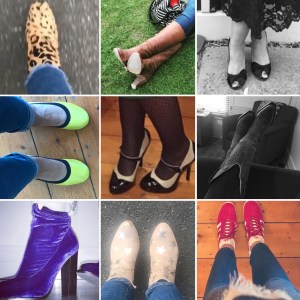





 Diabetogenic