
You are currently browsing the category archive for the ‘Devices’ category.
Hi, my name is Renza and I never update software, operating systems, apps or anything that needs updating on anything. If I needed some sort of personal software update each year upon my birthday, I’d still be running whatever I was using when I was seventeen. I don’t have auto updates set up because 1. I’m an idiot and, 2. I used to, and once that caused problems with…something. Can’t even remember what, but obviously it left some deep scar somewhere and now I won’t do it again.
Most days, this apathy makes no difference to anything at all. I eventually get around to updating and on I go. No big deal.
Except for when it becomes a big deal. Because then I find myself #LooplessInMelbourne.
On the morning of Good Friday, my Riley Link died. Let me set the scene here by saying my RL had been dying for some time. This was not something that ‘just happened’. It had started needing a charge around mid-afternoon as well as the overnight charge it had been getting since I started using it in August 2017.
But on Good Friday, it decided that was it. No more charging. My Loop turned red and that was it. RL dead. Done. Gone. Finished. Just as it had been warning me was likely to happen for a few weeks.
Now, someone smart would have thought this through as soon as the RL started to need extra charging, and understood the following: 1. RL needs replacing, 2. make sure back up is available, 3. double check Loop docs for how to swap out old RL for new one, 4. follow instructions.
I got as far as step 2, and that was it. I was supercilious in my back-up planning skills and took my spare RL out of my diabetes cupboard, leaving it on my desk as though that was enough to miraculously sort everything. Idiot, thy name is Renza.
On that (not so Good) Friday I put all thoughts of sorting it out of my mind and set about my day. It was a public holiday, so I figured I’d fix it all later. I also thought it would be just a matter of switching RLs over.
Not so much.
Around midday, I sat down and read the Loop docs and immediately realised that I needed to update my Loop app to use the new RL. I’ve rebuilt the app before and I know it is a simple process.
I scanned through the docs and saw that I needed to make sure that all operating systems and apps were up to date. Suddenly every single update notification that had popped up in the last year flashed before me. So did every post, plea, warning to update everything from Katie DiSimone on the Looped Facebook page.
I set to updating my Macbook, iPhone and Apple Watch. Easily done. Then, I came to Xcode. And the wheels fell off. (Xcode is an app and needed to build Loop.)

I don’t think I’ve updated Xcode since I loaded it onto my Macbook, back when I first built Loop. I do remember it taking FOREVER to upload and install. The update took longer. The first time I tried to update, it took almost three hours to not work. The second time, it took four. By this stage it was late on Friday. Clearly, I was paying no attention to what was going on because when I saw that it had finished updating, I assumed that all was good and off I went to rebuild my Loop app.
Building Loop is simple because the instructions have been written for people like me in mind. Technologically hopeless, but eager to understand. They are step by step and, honestly, if you follow every step as laid out, you cannot go wrong.
So, off I went. Step by step. And then…
Red error message.
I read the errors page and tried all the suggestions, but the same error message came up. It was getting late and I was exhausted, so at 1 am, I went to bed. I was over it and figured that fresh eyes in the morning would do the trick.
I woke on Saturday and with those fresh eyes I realised straight away that Xcode had not updated. That’s right – the second attempt had failed too, and I had been trying to rebuild Loop using an outdated version.
As it turns out, third time’s a charm and while eating Easter lamb at my in-laws, Xcode updated successfully.
After lunch, I opened the new version of Xcode and followed the instructions to build Loop. That took under 5 minutes and no brain power or tech know-how (from me, that is – a lot of people had used a lot of brain power and tech know-how to make it so easy for me).
Shortly after, the Loop app appeared on my phone. I entered all my relevant info (another 3 minutes work from me) and then almost straight away my Loop turned green.
And I’ve been happily Looping ever since.
So, here’s the take home: Keep everything updated. If I had done that, the rebuild of Loop would have taken a total of 15 minutes. And most of that would have been sitting and waiting for Loop to re-install on my phone.
I was telling someone about this whole (actually rather boring) story the other day and a little smugly they said ‘That’s why I won’t use a DIY system. Sounds like a nightmare. They can’t be relied upon.’
But actually, that’s not the case at all. What is unreliable is me and my inability to do the basic updates that all our devices require. Our commercially available apps (such as Dexcom) require us to update occasionally. In twenty months of using Loop, I’ve updated the app once (when I got a new iPhone).
Being #LooplessInMelbourne wasn’t really a big deal. It did, however, remind me why I am a huge fan of DIYAPS as the right tool for me right now. And it also reminded me that I really am not much of a fan of DIYDiabetes. That’s really not for me at all!

Loop’s back, baby!
Last year, I was invited to the Australian launch events of two insulin pumps. Within a month of each other, the YpsoPump and Cellnovo pump were introduced into the Australian market: a market with a huge appetite for something new. Although Cellnovo had launched softly the previous year, the Australian distributor seemed to be increasing their business and had the pump’s inventor, Julian Shapley, in the country to give a presentation and answer questions.
At both events, we were wined and dined, and the latest bells and whistles of these two new offerings were confidently and excitedly shared with us. I listened carefully, keen to hear not only about the technical specifications, but also about the customer service that would be offered to those choosing these devices and their plans for the future. I’ve learnt over the years that reading glossy brochures only gives one part of the overall picture of using a particular device, so I was looking forward to asking those questions that give a much better idea of what is going on.
At some point during each of the events’ proceedings, I asked the same question. I wanted to know how these companies were safeguarding from these devices being launched on the market with great fanfare only to see them disappear after people had started using the very products in front of us.
Of course, I was assured and reassured that the companies were here for the long-haul and that they were future-proofing themselves by insuring they were preparing for the technology we all expect. Closed loop systems were coming; integration with CGM was an almost done deal; their algorithms would be better, smarter than anything we had seen before. And yes, they absolutely understood the concern I was expressing at the thought that just as quickly as their device had won our hearts and minds, it would disappear from market altogether. Of course, of course, of course that was not going to happen and I shouldn’t for a minute even think that was how things would turn out.
I listened. And I believed them.
Last week we heard that Cellnovo was ceasing production of its pump and all current users would be transitioned onto different devices. This played out over a couple of days. The first announcement was that Cellnovo was going into administration, but I wasn’t ready to shut the coffin lid just yet – we’d seen that happen before. But then, a mere day or two later, the announcement came that all manufacturing and commercial activities would cease, and that no new PWD would be started on Cellnovo products. Coffin. Nailed Shut.
Let’s put aside any opinions of the Cellnovo pump, because that’s not what this is about. I know there were some people who really weren’t fans of the device. My limited interaction with it left me interested, but not keen to slap one on my upper arm and call it my new pancreas. But I know some people who love it and have found it to be the right insulin delivery device for them. My diabetes; my rules and all that.
I also know a number of people who started using Cellnovo as their first pump. In Australia it was the closest thing we had to a ‘patch pump’ and they liked the idea of not having to deal with centimetres of tubing. When I wrote that Cellnovo would be launched here, I had a number of people reach out in great excitement. With Omnipod repeatedly stalling getting through our funding model, this was as good as they were going to get to the device they thought would be best for them.
And so, Cellnovo has won the heart and minds of some people. Just as mine were won over by the Cozmo and Animas pumps. And when they are taken away from us, our hearts break a little.
We learn to tolerate and accept – and sometimes even love – these devices. I wear mine as close to my heart as I possibly can, hearing it gently whir as it delivers insulin, sometimes in perfect time with my heartbeat. We do what we can to make them fit with us seamlessly. We know they will never really be part of our body; but we do what we can to work with and around them.
There is nothing and there is no one who I have ever been as literally attached to as the devices that are connected to my body 24/7 for the last eighteen years. I have loved them and hated them in equal measure as each day I try to accommodate them as best I can while at the same time appreciating and acknowledging what they do for me. And I hear this from others who have been wearing insulin pumps (and other diabetes devices) – some for years, some far more recently.
So, with this in mind – and this is something many of us have written and spoken about – and what played our last week, the almost cavalier attitude to my question at the event last June has left a sour taste.
Let me be clear here: this isn’t directed to the team at Medical Specialties Australasia (the Australian distributors of Cellnovo). They have been nothing but professional, friendly and approachable, and from the first time I met with Aaron Crook, it was clear that they were keen to make a success out of things and were pleased to be offering more choice to PWD in Australia. It’s possible they only found out about all of this a short time before the announcement was made. And really, it isn’t necessarily about Cellnovo. They are just the latest in the casualties of medical devices, and now join the ranks of Cozmo, Animas and Asante pump and the Navigator CGM. I am sure that they never wanted this to happen.
And yet, it has.
Of course, the closure of a business leaves a mess, and many casualties in its wake, but perhaps those that will feel this the most personally is PWD – the people who have come to rely on these devices to survive. We are already doing all we can to live with a condition that demands so much. We struggle to find what works for and alongside us and when we do, we want to keep it forever. Our own pancreas already decided to stop working; having to contend with the one we chose as its replacement disappearing as well seems more than just a little cruel and unfair.
Disclosures
I have none that are relevant to this post. My travel and accommodation for both launch events were covered by MSA and Ypsomed and were declared at the time.
Last month, I clicked over eighteen years of wearing an insulin pump. Every day in those 18 years – that’s over 6,500 days – there has been a cannula inserted into the skin on my stomach, sides or thighs. And for pretty much all of those days, a pump has been housed down my bra. (When I first started pumping I used to wear it on my waistband, but tired of the attention that drew so shoved it away. Out of others’ sight; out of others’ minds.)
Add to that there is the CGM I have worn on and off for the last eleven or so years – and for the last five, it’s been there pretty much every day. Oh – and about 18 months ago, a RileyLink also became a permanent fixture, also shoved down my bra. It’s an out-and-out diabetes tech party down there.
So you would think that after all this time, it is no big deal seeing, feeling, or acknowledging these devices and how they are housed on this body of mine. You would expect that I would be completely and utterly accepting of the devices by now, and how to accommodate them on my body.
And yet, I’m not.
Now, I need to say that I love my diabetes technology. I understand that it makes my life with diabetes much easier. I also understand – and never forget for a moment – just how lucky I am to have it. I absolutely wouldn’t be without it and I know that for me it is the best possible way to manage my own diabetes.
But thinking for a moment that I forget that I’m wearing these devices is wrong.
I find it fascinating when I hear people say that for their child/partner/friend (or for HCPs, PWD they see) that their diabetes device is just part of their life, it’s normal, it’s just part of them.
No. It’s not. My devices are additions because a bit of my body is broken and doesn’t do what it is supposed to do. We may not make a fuss about it or just seem to tuck them away (or leave them out on show), but do we really consider them just ‘part of our body’?
I don’t think I will ever be fully comfortable with how they feel or look on me. There is some serious body image stuff going on when I see the tape gripping these devices on to me. When I throw on a bathing suit for a day at the beach, the devices I need to consider and the way they are on show make me feel painfully awkward.
They are a reminder every time I see them – every time the tubing nearly gets ripped out when I go to the loo or catch it on a doorknob; every time I get too close to the doorframe and knock my CGM; every time I’ve put on a bra that doesn’t really work and my RL falls out; every time my pump and RL shift a little and become starkly obvious – that it is not normal to wear a pancreas on the outside of one’s body.
It’s a reminder every time my kid snuggles into me when she is sitting on my left side and leans her head on my arm. ‘Your diabetes is sharp’, she says to me and we have a little giggle as she wriggles around until her head finds real estate not taken up by Dexcom. Or in bed at night, as I go to roll over and find I can’t move because my pump has found its way under my husband. It turns out that it’s not just me needing to accommodate my external pancreas, making me even more conscious of its presence.
The beeps and buzzes and vibrations that these devices emit means I make noises different to others. The way that sometimes it’s just impossible to ignore the constant reminders and just accept it all as ‘part of me’.
Perhaps the only time I get close to not feeling the constant reminders of my tech is when the people around me are also wearing these devices. We spy a CGM on someone’s arm, pump tubing winding its way out from under someone’s top or hear the tell-tale beep of some sort of diabetes technology and we can ignore it because it’s not our own and everyone else is doing it too!
We do a lot to normalise the realities of diabetes. We do that for our own benefit, but I know that I also do it a lot to limit concern of those around me. This is one of those things I do to minimalism how diabetes affects me and to normalise something that is…well, not normal. I would never make a big deal about how I feel about wearing this technology because I sound whingy and precious, (possibly the alternate title for this blog post). But don’t for a minute think that you can dismiss it as not a big deal or just part of us. Because it’s not and never will be.
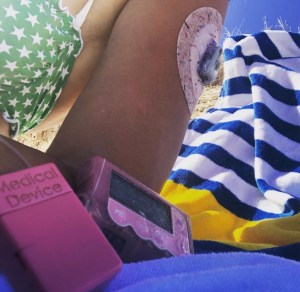
Devices on the beach.
We all do a good job at undermining ourselves at times. We use a four letter word that diminishes what we are doing, and limits the value of our experience and expertise. That four letter word is ‘just’.
In diabetes, we hear it all the time: ‘Oh, I just have type 2 diabetes’ as though it is insignificant and doesn’t have any challenges. ‘I’ve lived with diabetes for just a couple of years’ because we think there is only currency in decades of living with the condition, when really any length of time with diabetes is meaningful.
And we are all about minimising our experience when it comes to the treatment of our diabetes. ‘I just use diet and exercise to manage my type 2 diabetes’ or ‘I’m just on tablets’ or ‘I’m just on injections twice a day’ or ‘I’m just on MDI’. The list goes on and on. And on.
I realised just how ridiculous we have become with this when I heard myself, during a conversation with a fellow Looper, ‘Oh, I just use Loop’. (More on that later…)
At the Ascensia Social Media Summit at ATTD we spoke about this, specifically how there is almost a stigma within the diabetes for those seen to not be using the shiniest and brightest and newest of technologies. It seems that some people almost feel embarrassed if they are not constantly updating their technology toolkit with the most recently launched product.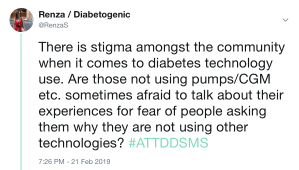
The idea that anything that we are using today is ‘yesterday’s technology’ is wrong. Blood glucose monitoring can’t be ‘yesterday’s tech’ if it is what most people are using to track their glucose. And syringes and pens can’t be considered the ‘old way to deliver insulin’ when that is how the vast, vast majority of inulin-requiring people with diabetes get insulin into their bodies. Plus, every single one of us using a pump must be able to deliver insulin this way because machines break.
Somewhere in discussions about our treatment technologies, we seem to have forgotten that, actually, not everyone wants to be using the latest kit. And that is okay. There is a spectrum of diabetes technology, and as long as we are on it somewhere and managing our diabetes the way that works best for us, then elephant stamps all around!
There is clearly an over-representation of people at one end of that spectrum dominating on and off line conversations. Spend a couple of hours in a diabetes Facebook group and it would be a reasonable assumption that most people are wearing pumps and CGM. But that’s not true.
And it could appear that DIYAPS is the way to go for most people with T1D, when the fact is that numbers are relatively low. It’s hard to estimate exactly, but there may be somewhere between 2,000 and 3,000 worldwide how have ‘built their own pancreas’. That is just a drop in the type 1 diabetes ocean.
It’s fantastic for those of us interested in this technology to be able to (virtually) congregate and talk amongst ourselves. I learn so much from my peers in these groups – just as I have with all aspects of life with diabetes. The lived experience continues to trump any other way of learning about diabetes.
Of course, that doesn’t mean that we shouldn’t be talking about technology used by limited numbers. Of course we should. We want others to know about it so they can make an informed choice about whether it may be right for them. We want our HCPs to know about it and to support those of us using all sorts of technologies and treatments.
Where it becomes problematic is when there is the misconception that this is the norm. Or when those not using the newest technology feel that they are wilfully doing diabetes the ‘old way’. It’s unfair to think for a moment that those who are not using the tech ‘don’t care’ enough about themselves – especially when decisions are made based on a very good understanding of what is available and what they have decided works best for them.
So, back to my ‘Oh, I just use Loop’ comment. It was directed to someone far more technologically advanced than me; someone who runs all sorts of other programs alongside their DIYAPS. They generate lots of reports and make lots of changes and seem to have far more bells and whistles than I even knew were available.
I nodded as they told me all they were doing and then, when they asked me how I manage my diabetes, I answered that I just use Loop. I heard myself saying it and stopped and corrected myself. ‘I mean…I use Loop. It works for me. Perfectly.’
We don’t need to make excuses for doing diabetes our own way. If we truly have choice (which I know is not always the case), and we have made the choice based on what we believe to be the best possible treatment and technology for us at that moment, then surely that’s a great thing. We shouldn’t ever be made to feel less committed to our own health and wellbeing. That’s not how it works.
DISLCOSURE
I was invited by Ascensia to co-chair the Diabetes Social Media Summit at ATTD (#ATTDDSMS). I did not receive any payment or in-kind support from them for accepting their invitation. I have co-written a piece for the blog, however this was not edited (apart from inevitable jet-lag-induced typos) and all words are those of mine and the piece’s co-author. You can read that piece here.
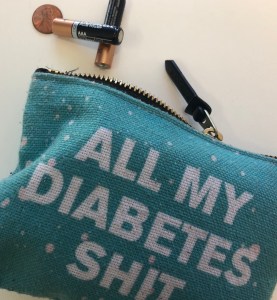
I never thought I’d be one to think about back-up plans the way I do now. A few years ago, I remember being extraordinarily proud of myself as I wrote this post about my diabetes spares bag. And then a couple of years ago, I thought I was remarkable and quite brilliant at being able to easily manage when I got to work and realised my insulin pump hadn’t made it with me. I thought I had every contingency sorted and was fabulously good at diabetes. Give me a medal, please.
But in the last six months or so, I’ve come to see I’m not quite as prepared as I thought. I probably should point the finger right now at David ‘Bionic Wookiee’ Burren for this. He has highlighted holes in what I thought was a well-planned strategy a number of times (‘What’s your RileyLink Bluetooth address, Renza? You don’t know? You should.’), shaming me into wanting to do better, and really making me question all my life choices at the same time.
Back-up planning has been covered in both the Australian and European Social Media Summits hosted by Ascensia (disclosure at the end of this post) and it is interesting to see that the level of organisation and preparation varies so much in those of us living with diabetes.
Some people have thought out every possible contingency and have a plan for each one. Others have a fixed idea about what might go wrong and have made accommodations for those (that’s me). And others figure that it will all work out and the diabetes gods will sort it out.
I guess that personality type comes into how well-equipped we all may be. Some of us have a far more lackadaisical approach to planning for the apocalypse than others. But I do agree that it never hurts to be prepared or to consider things that may never have entered your mind before.
So here are some things that I have learnt in recent times that have completely changed the way that I think about my back-up planning.
It’s not just about kit (1). It’s all very well to have back up for what happens if (for example) your pump dies, but if that means returning to MDI until a replacement can be delivered, actually knowing how to do MDI is important. (Bless my endo who always asks if I need any long acting insulin ‘just in case’. She gave me some in-date long acting insulin and we had a discussion about what doses would look like after I proclaimed ‘It’s been 18 years since I gave myself a dose of long acting insulin. And it was Protophane. I have no idea what I am doing.’Lovely endo didn’t even roll her eyes at me when she walked me through exactly what I’d need to do to ensure my basal dose was right and the timing of the injections.)
It’s not just about kit (2). Look – my back up plan to my pump dying is another pump. I have a couple in the diabetes spares cupboard and always travel with one. But I don’t carry one around with me on a day-to-day basis. If I was a couple of hours from home and my pump died, I’d need to know what to do in the meantime. Again – it’s been 18 years since I was on MDI, but I always have a spare syringe and insulin with me so I can bolus until I get hooked up again to a working pump. My injection technique is scratchy – very scratchy, but in a pinch, I can manage it. There’s nothing wrong with asking for some re-education on something for which you may be a little out of practise.
Apparently my long-held belief that the DOC is my back-up plan is not actually adequate, because who is going to be able to provide me with insulin/pump consumables/spare pump/battery/RileyLink at 3am when things like to go wrong. (This is despite the success of the whole Pumpless in Vienna story.)
Equally, having a neighbour with type 1 diabetes two doors down is great when I need a Dexcom sensor at breakfast time. But it would probably stretch and test the neighbourly spirit if I woke her and her family in the middle of the night because I desperately wanted my loop to turn back to green and needed a sensor to do that.
I need a back-up of EVERYTHING I use if I want to be able to seamlessly manage any issue that comes up. With Loop that means a spare Loopable pump, a spare Riley Link, a spare G5 transmitter as well as all the necessary consumables. That takes expense as well as organisation.
CABLES!! They need to be part of my back up plan. I was at a conference last year somewhere (can’t remember where) and remembered as I was about to sleep that I’d forgotten the charger to my RileyLink. And just last month didn’t charge it overnight, meaning that my Loop turned red while I was at work and I was unable to do anything until I got home. Carrying the right charging equipment for all devices is important.
But! If I don’t have all these things, I need to ensure that I have a suitable, easy and fully ready-to-go option that will get me through until I can assemble all required to return to normal service.
When your back up plan becomes someone else’s back up plan, you need to do something about it. Case in point: at the DOCDAY event at ATTD, a friend leaned across the table and asked me if I had a spare battery for her Loopable pump. Of course I did, because there is always at least one in my spares bag. I handed it to her and made a mental note to pick up some more AAA batteries next time I passed a convenience store. Of course, I forgot all about it until Loop started complaining and that the battery was running low. Down to 4% battery and starting to feel a little nervous, I found a tiny little store in a backstreet in Brussels, crossing my fingers as I walked in that there would be a stash somewhere of what I needed. There was and I changed the battery just as my Loop app was showing 0% battery.
Beating ourselves up about our perceived or real lack of planning is unnecessary. As Sophie, one of the participants at #ATTDDSMS, said: ‘Life gets in the way.’ And it does. I challenge anyone not living with diabetes to do their normal life, live with diabetes and not only think about all the ‘just-in-case’ scenarios, but also prepare for each and every one of them.
But mostly, what I have come to see is that the point of a back-up plan is for it to be smooth and simple, with as little disruption to our day as possible. A plan that requires a cast of thousands, hours of travel, is insanely complex and relies on a number of external factors that are potentially beyond our control is not really going to make executing our plan all that easy, or give us peace of mind. And that’s a big part of what this is all about – feeling confident that we can manage whatever gets thrown at us.
That is, after all, the nature of this condition we live with.
DISLCOSURE
I attended the ATTD conference in Berlin. My (economy) airfare and part of my accommodation was covered by DOCLab (I attended an advisory group meeting for DOCLab), and other nights’ accommodation was covered by Roche Global (I attended the Roche Blogger MeetUp). While my travel and accommodation costs have been covered, my words remain all my own and I have not been asked by DOCLab or Roche Global to write about my attendance at their events or any other aspect of the conference.
I was invited by Ascensia to co-chair the Diabetes Social Media Summit at ATTD (#ATTDDSMS). I did not receive any payment or in-kind support from them for accepting their invitation. I have co-written a piece for the blog, however this was not edited (apart from inevitable jet-lag-induced typos) and all words are those of mine and the piece’s co-author. You can read that piece here.
My third ATTD, and as soon as I started reading through the program, flagging the sessions I planned to attend and the technology I was keen to get my hands on and learn more about, a familiar feeling started to settle over me. It was there the first time I attended the conference and again last year.
And that feeling is that this conference, more than any other, reminds me just how unlevel the diabetes landscape is. With the shiniest of the shiny and newest of new technology and the most impressive treatment options available to people with diabetes on show, the vast gap between the haves and have nots is stark.
I was not the only person to acknowledge this. My first full day in Berlin saw me in an advisory committee meeting with diabetes advocates from across Europe, and when asked about the most pressing issues in diabetes, access was at the top of the list for every single one of us. Most (if not all?) of us in that room live in places with outstanding funding and reimbursement programs for diabetes drugs, technology and education – having to go without or ration insulin isn’t something we have ever needed to consider. Even those of us self-funding CGM are in a position of extreme advantage to be able to cover the significant out of pocket expense. But we all know that for millions of people across the world, this is not the case.
And then, later in the week at the Ascensia Diabetes Social Media Summit, another issue that came up again and again was choice. Choice refers to range of factors in diabetes. Choice of the type of technology we use, including the different brands; choice of the healthcare setting we feel best suits our brand of diabetes; choice of the specific healthcare professionals we see. It is also the freedom to be comfortable with our choice of technology, not feeling we need to conform to what others believe is the right thing.
But just how real is the whole idea of choice in diabetes? And when it comes to technology, how much of the decision about what we are using and how we are managing our diabetes is truly our own?
When access to basic education and treatments is severely limited, there is rarely any choice at all. In some places, a diabetes diagnosis is life and death, and surely in those cases all that people are choosing is life. How they manage that is probably not contemplated at all. In countries where diabetes does actually equal a death sentence, no one is debating whether TIR and A1c is how they would like to track their diabetes management.
But we don’t need to look to countries where outcomes are still so desperate to see lack of choice. Just this week, a very distressed mother of a young child with diabetes called me because they had just been told they were not permitted to use the pump they had chosen after careful deliberation and research.
This isn’t uncommon. Diabetes clinics across Australia make it difficult for PWD to be able to use the technology we have decided is the best choice for us. Sometimes that means not being able to use the specific technology we want (i.e. refusing to sign the necessary paperwork for a pump), or it could mean not being given the right to choose the brand of device we prefer.
At ATTD, I frequently heard about how healthcare is being transformed, and that may be true for those of us not disadvantaged by the country where we live and are trying to access care. We should celebrate the advances being made and the better outcomes so many of us have seen. But at the same time, we need to find a way to not get so far ahead of ourselves that we leave the most vulnerable further and further behind.

Click for original tweet.
I have been interested in discussions about time in range (TIR) for some time now. It has become a key way that I assess just how I am tracking with Loop and, as I wrote earlier this year, really the only measure I’m interested in. I like it because it can give me real time information about how I am tracking. It shows that when I am at a conference and not eating properly, but doing more activity than I normally would, my TIR is going to be less than if I was at home in a regular routine. It also shows what happens when I’m not Looping for ten hours (thanks to a variety of factors) my TIR plummets!
At ATTD this year, there was a symposium dedicated to the topic and from the standing-room-only crowding of the hall, it’s clear that a lot of others are interested too. In the few presentations I attended about the Medtronic 670G, TIR was frequently referred to (in one study there was a slight increase in TIR after PWD had been using the device for 8 months, although significantly lower than what people using DIYAPS are reporting.)
Just as I did while live tweeting the session, I have to address the issue of access to the technology. TIR is all very well, but it takes tools, and those tools are prohibitively expensive. Some places have no subsidies available for CGM or Flash, others have limited reimbursement programs. And, of course, there are places around the world where accessing glucose strips is a near impossibility.
TIR is a measure for a very, very privileged few, and as much as it’s held up as the future of diabetes, it is simply incorrect and misleading to suggest even for a moment that most people with diabetes have this data at their fingertips. (They barely have finger prick data at their fingertips.)
But, this is a conferences about the latest in technologies and treatments, so let’s talk time in range…
Dr Irl Hirsch is an MD from University of Washington, Seattle. His session as listed in the program was: ‘Time in Range vs. HbA1c: Are our patients ready to change?’, but he changed it to a far more suitable ‘Time in Range vs. HbA1c: Are our patients and health-care colleagues ready to change?’
Irl’s short talk was an absolute cracker and started by exploring what we already know – A1c is flawed. We’ve known this for years, but it’s taken having easy access to CGM data to truly appreciate just how flawed. The two points he raised to back this up were A1c levels can’t be compared between two people (and yet that happens all the time!); each A1c comprises a wide median glucose range. In other words, A1c sucks (they were his words, not mine!).
And then the talk got fun as the focus shifted to just how ready different groups were to shift from a focus on A1c to TIR. The three groups were: people with diabetes (and their families), endocrinologists and non-endocrinologists. Irl presented the results from a survey of diabetes HCPs asking their thoughts on the readiness of those three groups to embrace TIR. Here are the results:

The HCPs surveyed all believe that PWD are by far the most ready to change from A1c to TIR. At the same time they believed that no non-endo HCPs were ready. We really have a problem.
The survey participants offered a lot more than just their assessment of the readiness for this shift. They provided extra comments about some of the barriers to the change. This is how some of the HCPs (all working in diabetes) assessed the inclination for PWD to move to TIR:
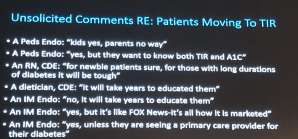
But perhaps the most unsettling was what they thought about non-endocrinologists willingness to start to talk TIR. (I think that they were mostly referring to primary care physicians.)

As the list was read out, and the audience responded accordingly, my confidence level about how likely it was that TIR would start to become the norm shrank away. This is despite the way that many PWD have already adopted the measure and use it daily.
In the online groups where I spend a lot of time playing, it is clear that we are already very comfortable and committed to talking TIR. People frequently post their Dexcom Clarity data showing the super-nifty image of how much time they have spent in and out of their self-determined range. This is the language we speak.
But despite my unease about just how quickly the shift will happen, it has definitely begun. The International Consensus on TIR was presented which included targets for people with type 1, type 2 and for women during pregnancy. Plus there was evidence presented that showed TIR can predict the likelihood of diabetes-related complications. With all this, and the demand from PWD, we will be hearing about this more and more in coming years.
Looking for more? This piece by Irl Hirsh, Jennifer Sherr and Korey Hood was just published in Diabetes Care is a really interesting commentary on the issue.
DISLCOSURE
I attended the ATTD conference in Berlin. My (economy) airfare and part of my accommodation was covered by DOCLab (I attended an advisory group meeting for DOCLab), and other nights’ accommodation was covered by Roche Global (I attended the Roche Blogger MeetUp). While my travel and accommodation costs have been covered, my words remain all my own and I have not been asked by DOCLab or Roche Global to write about my attendance at their events or any other aspect of the conference.
Let me tell you what is worse than jet lag. Jet lag combined with food poisoning. These are the two extra circles of hell Dante forgot about.
While I am recovering and trying to get my body to accept coffee again, here are some photos from last week’s ATTD conference which was in equal measure amazing, overwhelming, frustrating, intimidating, brilliant and exhausting. I’ll explain more in coming posts, but for now, enjoy the images.
How to deal with jet lag when arriving in Europe #1: night time walk to major tourist site and be amazed.

How to deal with jet lag when arriving in Europe #2: find (half) decent coffee.
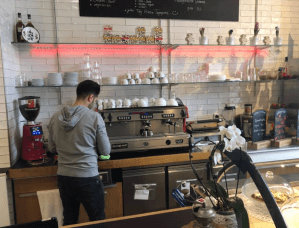
How to deal with jet lag when arriving in Europe #2.1: drink all the coffee.

And then drink some more.

#docday is always a highlight. Little dogs called Jamaica make it even better. (Jamaica on the left; Bastian on the right.)

Hello Solo… New pumps headed our way.

MySugr is ALWAYS on message.

Flavour of the conference #1: DIYAPS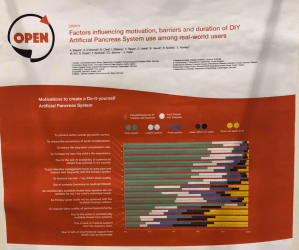
Flavour of the conference #2: Time in Range

Vegetables. I craved them.

Because there were so, so, so many dense carbs!

Not that I was complaining. (Especially when mini doughnuts came in Diabetogenic colours!)

Oh – did I say that #SpareARose was mentioned? A lot?
Such as at #docday. (Grumps looking especially grumpy because I’d just announced #SpareAFrown.)

And then? Then there was the smile-a-thon, as we smashed through target after target.
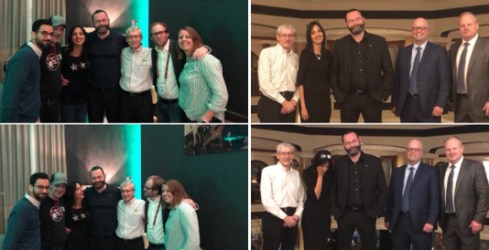
Next week, I’ll go into detail about some of the different sessions, highlights and satellite events I attended. It was a frantic few days – so worthwhile in every possible way. And as always at these conferences, finding those who live diabetes – themselves or with a loved one – provided the necessary grounding throughout the conference. This year, that support was even more pronounced with every single person who was asked to step up to promote #SpareARose doing so in spades. This is all the community. That is what it is all about…
DISLCOSURE
I attended the ATTD conference in Berlin. My (economy) airfare and part of my accommodation was covered by DOCLab (I attended an advisory group meeting for DOCLab), and other nights’ accommodation was covered by Roche Global (I attended the Roche Blogger MeetUp). While my travel and accommodation costs have been covered, my words remain all my own and I have not been asked by DOCLab or Roche Global to write about my attendance at their events or any other aspect of the conference.
It’s hot in Melbourne today and it’s going to get warmer over the next few days. I’m loving the bone-warming sun that just makes everything look so sparkly and bright. So, I’m spending as much time as possible soaking up the rays (and adding to the ridiculous tan mark around my Dex), because the cooler weather will be here before I know it. I’m trying to build up those vitamin D stores to last me for when winter hits here and I’m reliant on quick trips to the northern hemisphere for work to see the sunshine and warmer temperatures.
Anyway, diabetes doesn’t take a break over the summer. Or winter. Which means, there is always lots to read and see about it. Here are some of the things I’m catching up on now.
Hospital life in pictures
This piece from the guardian will break your heart. Explained pictorially, it’s easy to see that the medical system is broken, medical education is broken, hospitals can be incredibly cold and anxiety inducing places, doctors are at breaking point. And patients in the system are left to deal with the fallout from the disarray.
IDF comps
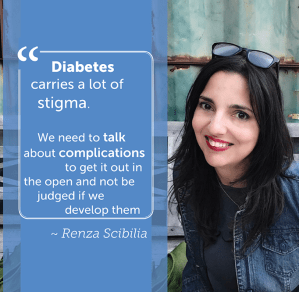
The International Diabetes Federation is working to reduce the stigma association with diabetes-related complications, with a focus on how the language used can make people feel judged and stigmatised. Last year, they launched the #DiabetesComplicationsTalk Facebook page, encouraging people with diabetes to share stories and support each other.
It’s really great to see the IDF in the #LanguageMatters space, encouraging people to openly speak about diabetes-related complications to help reduce the stigma associated with them. More here.
Diabetes Voice
Still on news from the IDF, the organisation’s quarterly magazine is now available electronically. The first edition is an absolute cracker. Start with this incredibly powerful piece from editor, Elizabeth Snouffer, about diabetes-related stigma. Read it. Share it.
Patient Revolution
If you’ve not checked out the Patient Revolution website, now is a great time to have a look.
Start with this page, which is a library of stories you can click through, finding any specific topics that you are interested in.
Also, there is a Patient Revolution chat which uses the hashtag #WhyWeRevolt. To keep up to date with their chats, and to take part, follow @PatientRev on Twitter.
1,200 mason jars
Do you ever find yourself in the midst of a Twitter thread, wishing, in equal measure, that you hadn’t started, but can’t get enough of it? Sometimes these threads are diabetes-related; sometimes they’re not. Go here for one that is definitely not.
I have spent far too much time in the last week invested in this bizarre tale. There is a lot to take away from the whole saga – maybe starting with: don’t pay USD$169 to hear someone ‘teach’ you how to ‘be you’. And there are a lot of unanswered questions, such as what the hell is going to happen to the mason jars.
Happy reading. (You may need a drink …)
Diabetes in the US
I will never understand the US health system. My head and heart hurt as I hear the struggles of friends with diabetes, and the difficulties they have accessing insulin, and diabetes tech and supplies.
This piece from the New York Times talks about non-medical switching, where insurance companies decide which drugs (and devices) they will cover and subsidise. In Australia, the government decides which drugs will be listed on the PBS (Pharmaceutical Benefits Scheme). If a drug is on there, it is the same price for everyone who has a prescription. There are some drugs that require a special prescription to be provided at the subsidised price. But there is no extra negotiating or pleading, or any involvement, with insurance companies.
In a system that is broken beyond measure, this seems like one more roadblock to make just surviving with a condition such as diabetes impossible.
Going beyond
Beyond Type 1 has grown to include a new platform for people with type 2 diabetes. Check it out!
Real life Loop stories
The team at diaTribe has a new series of personal stories of people who have been using DIYAPS solutions. Adam Brown’s story was first, and Kelly Close has now offered her experiences. Such a great idea to get a number of different insights into what has worked, what hasn’t and hopes for the future of DIYAPS.
Sharing and caring
Also from diaTribe, this great piece from Kerri Sparling which provides her own and others’ perspectives on sharing of CGM data. There is no one way to share data – it is personal, individual and can change over time, depending on circumstances. Some choose to; others don’t. I love this piece because it is balanced and offers some interesting thoughts.
Ascensia and CGM
More tech choices for people with diabetes is always great to hear, so Ascensia’s recent announcement of their move into the CGM market has been met with enthusiasm from the community. Read their release here and Diabetes Mine’s take on the announcement here.
SoMe at conferences
I believe social media engagement and use at all health conferences is a critical and necessary part of any communication strategy. There is no better, easier or more effective way to share details of the conference that by encouraging the people attending to broadcast using their own social media networks.
This article explores that, referencing the ridiculous photo ban at ADA in 2017 (which thankfully was changed in 2018).
Menopause and T1D blog
Sarah Gatward is a blogger from the UK and she is writing a series sharing her experiences of living type 1 diabetes and going through menopause. Yes! And thank you, Sarah. Start here.
NDSS reminder
Now is a good a time as any to make sure your NDSS details are up to date. Remember – the NDSS is not just about subsidised diabetes supplies. It also provides information and support for people affected by diabetes.
Go here to make sure your registration details are correct.
Bin the fax
All my dreams came true when I read this article in the Limbic today! Finally calls to get rid of the archaic fax machine in health care. Halle-bloody-lujah!
Yes, we know that diabetes is a so-called invisible condition. I’ve written about it a lot both here (and here, and here, and here) and other places as well. And I’ve also grappled with how I feel when I realise that my carefully and deliberately shrouded condition actually becomes visible without me knowing it.
Our diabetes does not wear a cast or make us immediately look different in any way. We are not identified as someone with diabetes until we tell someone that is the case. Even when diabetes is impacting on us in the moment physically – for example if we are actively dealing with a low or a high – and there are around others, most people would not automatically think ‘diabetes’.
As a condition that can be hidden, diabetes is referred to as invisible. But lately, I’m not sure how comfortable I am with this idea, because I think it is a little murky when thinking about just whothe condition is invisible (or visible) to.
So I decided to ask a few people what they thought: people I know well, family members, work colleagues, friends and acquaintances. Just about everyone I spoke to said that they thought diabetes was invisible. They said that rarely would they think diabetes when around me, unless we were specifically talking about it, or they noticed me ‘doing diabetes’. Someone I asked actually said ‘Oh, I forgot you have diabetes,’ which I guess points to just how invisible some people see (or rather don’t see) my diabetes.
The only people who said they didn’t think diabetes was invisible were friends with diabetes. ‘How could I think that?’ someone said. ‘No one living with diabetes thinks it’s invisible. It’s always in our face.’
That’s exactly how I feel. When we say diabetes is invisible, what we are saying is that it is invisible to others. The invisibility cloak only applies to people looking at us, not those of us whose diabetes is under that cloak. For us, it reminds blindingly visible and present. It’s the devices on our bodies (even if we hide them under our clothes); it’s the scars from puncture wounds; it’s the always-present glucose meter; it’s the blood stains from pricking our fingers or removed CGM sensors or pump lines; it’s the glucose strips that get into every crevice of our homes, our cars, our pockets, our bags, or workplaces; it’s the alerts and alarms that sound from our phones and devices; it’s the pop up reminders of medical appointments or to fill repeat prescriptions or pick up NDSS supplies. And they’re just the things we can see and hear, not taking into consideration the constant presence of diabetes in our minds, our hearts, our souls…our very being.
To a degree, we can control just how visible we want diabetes to be to others. Personally, I like that I can chop and change how noticeable the physical signs of my diabetes are. Today, I am walking around in a tank dress and the Dexcom on my arm is obvious for all to see. But throw a denim jacket over it and it disappears, sending my diabetes incognito.

For some people, making diabetes invisible is important. Others like it to be front and centre. There are myriad reasons for making decisions around this, and those decisions and choices will be different for everyone.
I do wonder how much of that decision is made exclusively by the person living with diabetes, and how often we change the level of visibility based on what we believe others may expect. Are we wearing our diabetes loudly because we feel we have to or because we feel we should? I know I have been the loud, out there advocate because I’ve felt I should be.
Or is there something about the shame and stigma of diabetes that makes people want to hide it away? Or are we trying to minimise the visual, or audible signs of diabetes to protect others? Or to stop others from feeling burdened, bored or worried about our diabetes? I also know I do that a lot.
But try as we might, for those of us living with diabetes, we cannot conceal it from ourselves. It lives with us, in us, around us. And it is always visible.