
You are currently browsing the category archive for the ‘Devices’ category.
I woke up this morning with that unpleasant and disagreeably familiar feeling. Ever-so-slight nausea, furry mouth and a desperate need to go to the loo. Why was I high? I grabbed my meter and a lovely number in the low 20s appeared for me. ‘Eff you, diabetes’ I thought.
I rushed to the loo, brushed my teeth, drank two glasses of icy-cold water. And grabbed my pump to see a completely dead, black screen. ‘What the eff?’ (Second f-bomb for the morning and I’d been awake for a total of five minutes. It was shaping up to be a good day.) I pressed buttons, trying to wake my pump up. Maybe it was having trouble getting the week started too. Nothing. Completely and utterly blank and unresponsive.
I rummaged around for a spare battery and located one in my diabetes supplies bag (seriously, every contingency is catered for in that bag!) and changed batteries. It responded with a lovely sounding ‘Boo-beep!’ and fired into action.
I primed, bolused, checked for ketones (too little to be too concerned about), drank more water and started my getting-ready-for-work routine.
Crisis averted, but how long had my pump been dead? And did it alarm? And if it did, how did the whole household not get woken by it? (And the neighbours for that matter. Living in inner-city Melbourne means we almost live on top of each other!) The alarm on the pump is loud, constant and downright annoying until it is silenced with a button push (or new battery). It wakes everyone – people and pets alike.
There was no low battery alarm before bedtime last night, so I had no warning this was going to happen and I slept like a log, not waking for anything until the alarm went off this morning. Is it possible that my pump had died just after I went to bed and I was insulin-free for 8 hours? Surely not, given the negligible ketones in my blood this morning.
I’m putting in a call to the pump company today because I don’t think that this is okay. There needs to be a much longer warning period for a dying battery.
Now I’m at work and I have that slightly fuzzy-head feeling that comes from high sugars. I’m guzzling water and checking my sugars (and ketones) regularly, trying not to over-bolus in a desperate attempt to get by BGLs back into single figures.
A dead pump. In 13 years of pumping that’s never happened. Diabetes – and diabetes therapies – have a way of making sure you never get complacent. Effing diabetes. (That’s number three…..)

It’s the fifth annual Diabetes Blog Week, with thanks to the lovely Karen Graffeo from Bitter~Sweet Diabetes. Today it’s diabetes in pictures. Come back tomorrow for the last instalment, and in the meantime, check out #DBlogWeek and follow along!
It’s Saturday and this morning, I had to work for a short while at a diabetes event. And when I was done, there was only one way to celebrate the real start of the weekend. With these:
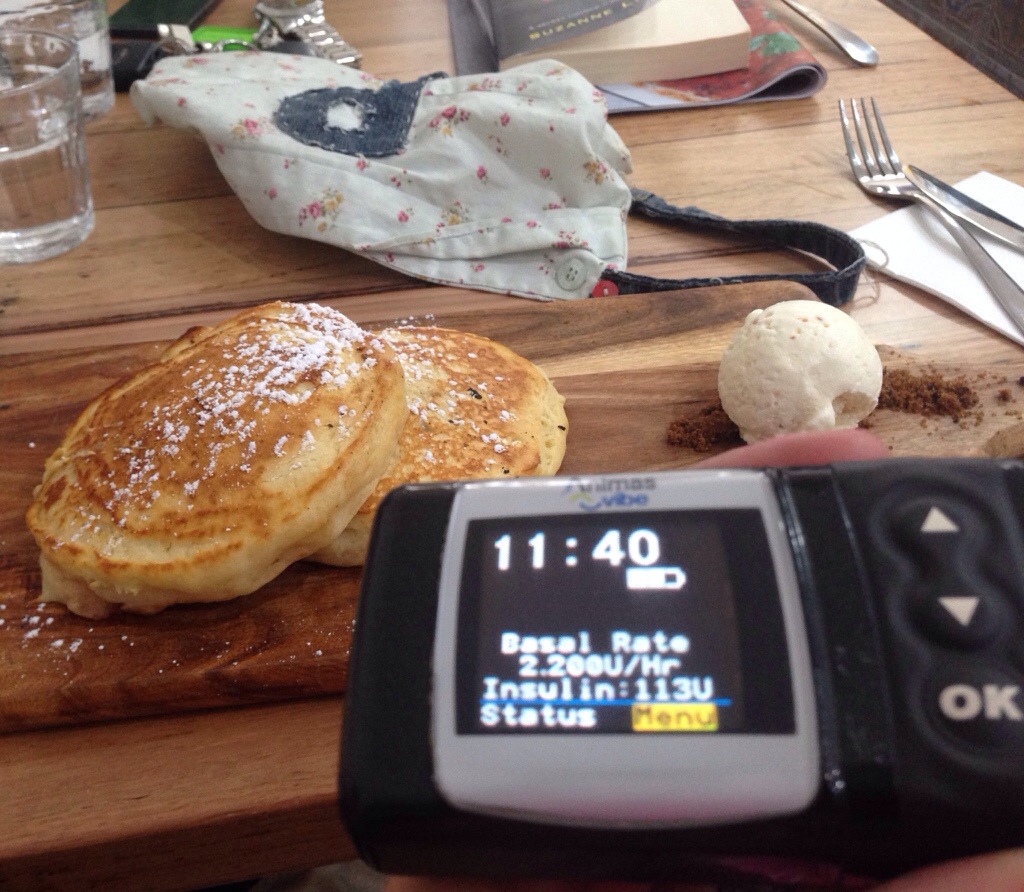
A new cafe has opened up in my ‘hood serving amazingly good coffee and this fabulous dish. Yes – the doughcakes are delicious. They’re fluffy and light and filled with strawberry jam, which oozes out onto the serving board in a most pleasing way. But the most exciting thing? The bacon ice cream. Yes. Bacon. Ice. Cream.
Has there ever been a better nod to the DOC than this very dish? The only way it could be better if it was served up by unicorns.
So yes. I can eat that, and thanks to that nifty little pump thing, insulin takes care of all the carbs.
There seems to be a little bit of a theme to my Saturday Snaps for Diabetes Blog Week. Last time this was the prompt, I wrote (and snapped) about cupcakes. Apparently, when it comes to pictures of diabetes, it’s all about the food for me!
I stood in the bathroom this morning as I got out of the shower and stared at myself in the mirror. I don’t like what I see. There is a pump infusion set, probably almost ready for a change due to the slightly turned up edge of the tape holding it in place; a new-ish sensor makes me feel like a cyborg and tiny red and black dots covering my middle.
There are so few days when I get to step in and out of the shower truly unencumbered by some sort of diabetes device being stuck to me. All my planets have to be aligned for a day where I am changing my CGM sensor and pump line at the same time and I get to rip them out before stepping into the shower, spending the time actually aware that there is nothing attached to me. Truly nothing. Ridiculously, it’s the only time I feel truly naked.
Diabetes has left its mark all over me. Fully clothed, I can hide it, but undressed, there is no getting away from what it has done. There are scars all over my abdomen and hips from old infusion sets and Dexcom sensors. There’s a nasty red and black bruise from a failed infusion set change three days ago which resulted in blood spurting everywhere. No matter how much I scrub away the residue from tape, there is usually still some clinging desperately to my skin. My fingers have tiny marks all over them from where I jab in a lancet several times a day.
On days where my BGLs have been higher than I’d like, my skin looks slightly dehydrated. On nights where I have been awakened by hypos there are dark circles under my eyes.
There are scars and marks and bruises there to remind me of how invasive diabetes is in a literal as well as figurative sense.
The only scar I look at with any fondness is the caesarean scar across my lower belly. I trace the line and am taken back to the operating theatre the day my baby was delivered from me. Some scars form the basis of beautiful memories.
While the diabetes scars are many they do disappear. They heal. They vanish. Only to be replaced by more. Many more.
On April 15, 1998, I was inducted into the world of diabetes. I had no idea what lay ahead of me and it was a year where I really didn’t have time to be diagnosed with a chronic health condition. At the time, I was 24 years old, in the middle of wedding-planning, trying to buy a house, changing careers and moving. Diabetes wasn’t part of the plan. It still isn’t, come to think of it, but I don’t really have a say in the matter now.
Today, I’m reposting a letter I wrote to my 24 year old self about what I could expect. I’ve made a few little changes (you can read the original post here) , and the reworked one below:
Dear 24-and-a-half-year-old-me
Oh, sweetie. Diabetes sucks. You don’t know that yet, but let’s clear that up from the beginning. It sucks. It’s not fun and it is a pain in parts of you that you didn’t even know could hurt. But figuratively more than literally.
Right now, you are overwhelmed, stressed, anxious, scared and terrified. In a couple of weeks you’re going to get angry. Really angry! It’s OK to be feeling all these things.
You will be fluent in a new language within the next few weeks. Words that you’d never heard of become part of your vernacular, and you become incredibly conversant in anagrams. BGL, CSII, HbA1c, DA-Vic, CGM, ADEA…. And you will delight in the fun way mmol/l rolls of your tongue. (I promise – that will make sense!)
Believe it or not, you are going to be absolutely fine about sticking a needle into your skin four times a day. And you’ll find that actually, it doesn’t hurt. You won’t be quite as comfortable about the jabbing your fingers what feels like a million times a week to find out what your blood sugar is doing.
But things get better. The lancet device you have now is pretty horrendous and in a couple of years, you’ll get a new one that doesn’t make quite as nasty a clunking sound, and will hurt less. Also, the first meter you have will take 20 seconds to count down to tell you your BGL. Wait until you get one that takes five seconds! You won’t know what to do with all that extra time in your day! And one day you’ll get a meter that plugs into your iPhone. (And one day, you’ll know what an iPhone is!)
Find out everything you can about insulin pumps. Speak with people using one. In three years you will have one and it will change your life. I want you to hold on to that over the next couple of years when things are not going as you’d like with your diabetes management and you think that you’ll never work it out. You do. And your pump is a huge help. Technology that you have no idea about is going to become an integral part of your life. Don’t be afraid of it – embrace it. But remember that these tools are there to help YOU manage your condition. Don’t become a slave to the data and don’t feel that you can’t take a break and go back to basics if that’s what you need.
(Also, perhaps tone down the evangelical pump attitude you develop. You become a little zealot-like. Yes, it worked for you, but it may not be for everyone. BUT INSULIN PUMPS ROCK!!!! As for CGM – let’s just say that your mind will be blown!)
Can we just talk about guilt for a minute? Diabetes comes with a lot of it and you’re going to learn that really quickly. Here are some things that you absolutely should not feel guilty about:
- The fact that you don’t change your lancet EVERY time you check your BGL
- Ditto goes for pen needles, and after three years, pump changes
- What you eat. Food does not have a moral compass.
- When you feel overwhelmed and completely ‘over’ having diabetes
- Not wanting to be a diabetes advocate ALL THE TIME
- Accepting that saying ‘that’ll do‘ when it comes to your diabetes doesn’t make you a bad person; in fact, it makes the whole diabetes palaver more manageable!
As you are in the middle of your wedding plans, here are some things I want you to know about that day so you can relax a little. It is a fantastic day. Your dress is stunning, your hair looks fine and you find the shoes you have been searching for. Diabetes comes along for the ride, but it’s in the background and no one mentions it on the day except for your mum asking quietly if your BGL is OK. When you think back to your wedding day, look at the photos and watch the video, you won’t be thinking about diabetes. You’ll remember the song that was played as you walked down the aisle and the faces in front of you. You’ll remember dancing the tango at the reception and the band playing Stevie Wonder as ‘gli sposi; were introduced to their friends and family.
(Also, the cars will be running late, but they’ll get there; and deliver you to the church inside Aaron’s ‘you’ve-got-fifteen-minutes-or-I’m-heading-to-the-pub’ timeframe.)
Oh, and when you meet your endocrinologist for the first time, he is going to tell you that diabetes will not stop you from having babies, as long as you have finished having your family by the time you are thirty. And you are going to wonder how it will be possible for you in the next five and a half years to fit in all the things you planned AS WELL as have a couple of kids. Don’t stress. Soon, you will find an endocrinologist who sets you straight. And when you are three days shy of thirty-one you will have a daughter. She’s a delight.
He will also show you some scary pictures of amputated limbs, kidney failure and tell you that you may go blind. Please, please, please don’t be shocked by what he says. The scare tactics that are used on you by him and other diabetes health professionals you will meet in the next couple of years will actually make you angry and determined. This is a good thing. As you seek out information, you will learn that complications are not inevitable and you will do everything possible to minimise your risk. And you will also come to understand that the guilt associated with complications is not fair.
You are going to meet some incredible people in the next few years – some of them become some of your best friends. Having a support network of people living with diabetes will inspire you, help you. Seek them out! And you have no idea what this means, but when, in 2011, you decide to get on Twitter, embrace it like there’s no tomorrow. Your mind will be opened up to a world of amazing, inspiring, caring, funny people all over the world who, like you, live and love with diabetes. You will call these people your friends and you will be part of a global community that makes you feel accepted and safe.
So 24-and-a-half-year-old me. The future isn’t as grim as you think it is right now. Your life isn’t life with diabetes. Diabetes isn’t the central part of it and I know that right now you wonder how it can be anything other than that. But it’s not. There will be times where you feel that it is all consuming and taking over everything, but by and large you manage to keep it in its place. You will get to forty and be healthy and surrounded by the people who love and support you and while you will have encountered some of the most difficult times, you will also have encountered some of the most wonderful. Diabetes is only part of your life.
Also, go and eat a cupcake today – just because you want to. It’s what I am going to do right now!
Much love from your much wiser, 40 year old self.
Technology in diabetes has come a long way in recent times. In the almost-sixteen years I’ve had diabetes, we’ve seen the advent of ‘smart’ pumps, CGMS and even trials of closed-loop systems that make the artificial pancreas seem a real possibility in the not-too-distant future.
BGL meters are smarter too, with new ones having built-in wizards to help keep track of insulin on board to avoid stacking-induced hypos. Carb to insulin ratios and insulin sensitivity factors can also be programmed to help calculate the amount of insulin required, taking into account how much insulin is still active, the carbs in what you are about to eat as well as your current BGL. These calculations, once the domain of pumps only, can now be used by all people with diabetes with minimal training.
There are aggregate apps that pull together data, make them into pretty graphs and assist with finding patterns, highlighting problems and allowing the user to send the information to their HCPs for online discussions (or follow up at your next face-to-face appointment).
There is data everywhere and we can track, estimate and predict our BGLs, insulin doses, carb intake. It’s all there for the taking.
And it can be overwhelming.
If information is power, then with this much information at our fingertips, we should all be incredibly powerful! But sometimes rather than power, instead I find it’s information overload. I stop responding to the data because there is just too much of it. In the same way that we are bombarded with social media updates so we stop listening, the never-ending data stream become white noise, too hard to distinguish anything of any real meaning.
I mentioned that in an endeavour to keep things simple, I stopped wearing my CGMS. There was no point in attaching an $80 sensor if I wasn’t going to be doing anything with the numbers it was constantly giving me. Instead, it made sense to do whatever BGL checking I felt I could manage and actually respond to the information in a meaningful way.
I’m still enjoying this lower level of data collection and am finding that it has contributed to be staying on track, rather than contributing to a season of burnout. Tailoring the information I can deal with is a smart way for me to ‘cope’ without being the data nerd I am at other times.
You will never hear from me that the technology available in helping manage our diabetes is a bad thing. You will never hear me say that it is a waste of time or pointless or an unnecessary expense. But I will say that I think there needs to be an acknowledgement and understanding that sometimes it’s just too much and can result in feelings of desperation, exhaustion and a sense of it all being just too much!
If you are finding that all the data is excessive and paralysing you into inactivity, think about cutting back the information you are collecting to the basic minimum. This, of course, will be different for everyone and there is no right amount of data for everyone. Being safe, feeling satisfied and being able to cope with what you are getting is key.
It’s Friday! So here are the Pogues.
Also – would you vote for me in the Australian Best Blogs 2014 Competition? Click here to be taken to a short survey and select Diabetogenic (half way down the first page) as your blog of choice. Thank you!!
There have been many phases in the nine year old kiddo’s time, some more enjoyable than others. The Yo Gabba Gabba time was definitely not a favourite, however I was sad to say goodbye to the Charlie and Lola stage.
Now, the beautiful work of Hayao Miyazaki and Studio Ghibli is on high rotation and this is one stage that I am more than happy to live through. There is much to love about these beautiful films and their often challenging themes make for very interesting conversations afterwards.
A couple of weeks ago I treated the kidlet to tickets to the Melbourne premier of the latest Studio Ghibli film, The Wind Rises. It was gorgeous – as expected – with breathtaking scenes (clouds! The clouds are always so beautiful) and an aviation theme that was captured beautifully. Without giving too much away, one of the lead characters has tuberculosis. It got me wondering if there were any anime characters with diabetes.
If I was the creative type and could draw an anime character, I would create a girl or boy with diabetes and tell their story with this beautiful artform. But I can’t. However, there’s an app for that – or at least an anime generator.
So today, I did this! And there, hanging from her waist is her insulin pump. She’s thinking about eating a cupcake, by the way.

I’m addicted to a new app on my iDevices. It’s called Fotoffiti and it’s probably best I don’t think about the time I’ve wasted spent on it since I uploaded it last week.
Cleverly, the app turns photos into stencil art – all Banksy-esque. For someone with my considerably lacking artistic talent, this is nothing short of brilliant! The kidlet has been having a great time using it too, with our cat being stencilled to within an inch of her nine-lives.
So, today, I give you the diabetes edition. Here are some of my everyday diabetes things all Blek-le-Rat-cool.

Also, here is a non-diabetes thing (to be printed and stretched onto a canvas for the kitchen):
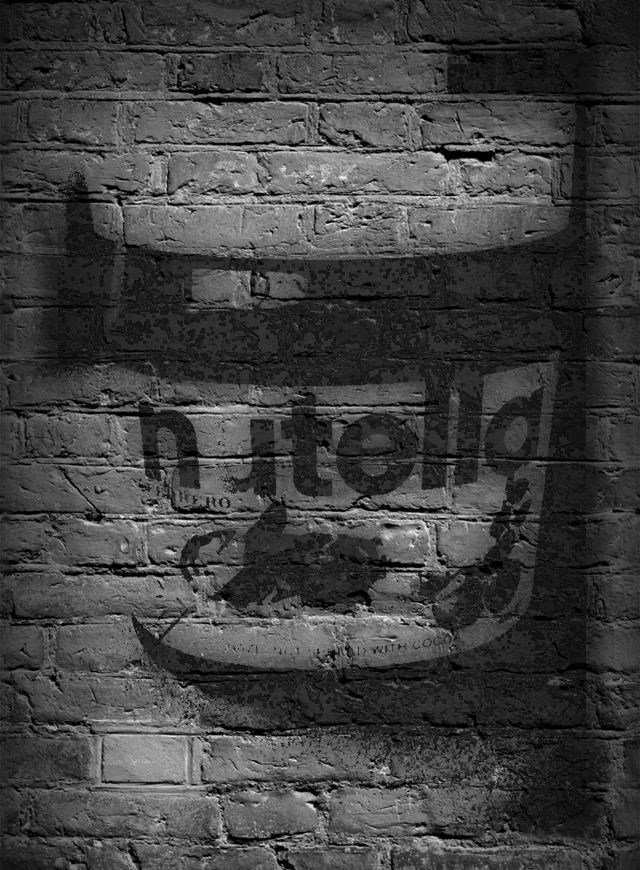
And this is what I look like as a stencil:

Okay – I’m going to stop now….
Fotofitti can be downloaded from the iTunes store. But be prepared to lose hours of your time if you fork out the $0.99.
Swimming, breakfast, shopping: a typical Saturday morning.
A waking BGL only slightly higher than usual reminded me it was time to change my pump line, so after my shower, a shiny new line went in and the day started. Diabetes task one done for the day and in the frantic manner of Saturday mornings, I didn’t think about it again.
When I finally stopped to get something to eat, I didn’t check my BGL. Rookie mistake number one, except I’m not a rookie – just a busy person who, in all honesty, couldn’t be bothered seeing a number on a machine. I bolused for the carbs in the milky coffee and toast and ticked off another diabetes task for the day. Off I went.
I was standing at the register of a store in the city when the nausea hit. It wasn’t a wave so much as a tsunami. I knew I had to get out into the fresh air as quickly as I could.
I got into the car, found my meter and checked my BGL to see a lovely number in the mid-twenties staring at me. Still thinking clearly at this point, I grabbed the emergency syringe I keep in my diabetes kit and drew up some insulin and jabbed it into my stomach.
I got home before the vomiting started.
And then, I attended to the cause and went through the mental checklist trying to find something – anything – to make sense of the sudden spike. I was sure I’d bolused for the food I’d eaten which my pump bolus history confirmed; I was coming down with a cold, but surely there was no way that could have sent my BGLs so high so quickly; I checked for ketones and saw a number that didn’t startle me too much; I looked down at new line….and there it was. The tell-tale red at the top of the where the canula entered my skin. I ripped it out and blood gushed everywhere. Blood in the line, I thought to myself, as I tried to stem the flow. I thought about how dramatic it sounded.
New line in; a temp basal rate set; glasses of water; an hour of sleep; extra BGL checks through the rest of the day to avoid the plummet. And the feeling of being hit by a bus.
It was a typical Saturday morning. With diabetes in the mix.
Within a two week period, I was dealing with the same issue on opposite ends of the world. Firstly, I ranted wrote about a child being told that his pump would be ‘taken away from him’ because his A1c was too high.
Then the following week at a conference far, far away, I was speaking with someone who can’t access a pump because her A1c is too low.
So apparently, if your A1c is high, you get your pump snatched away from you and if your A1c is in target, you’re not eligible for one.
Can you see what’s wrong with this picture? In both instances the decision as to whether or not a particular treatment option is being advised is based purely on a number. No consideration is given to things like quality of life, a desire for more flexibility, a desire to try something new or a love of gadgets. Or the simple ‘Because. I. Want One. Dammit’.
No – a number that provides nothing more than an average is being deemed the criteria for recommending (or removing) a therapy option.
Also, the decision for which management therapy will be utilised is being made not by the person living with diabetes, but their healthcare professional.
How do we win here?
I will never stop advocating the rights of people with diabetes to be THE person who gets to choose the way they manage their condition. But sometimes I feel the uphill battle gets harder and harder with more and more obstacles being put in the way and more and more hoops for us to jump through (metaphor much?).
There are days I really feel like throwing my hands in the air and admitting defeat. The more stories like this I hear, the more disheartened I become. When and how will the person with diabetes be put front and centre in the decision making process about their own diabetes? When will numbers stop being criteria to assess success or determine appropriate management? When will the threats stop and the judgement end and true collaboration begin?It’s time for us to say: Diabetes – my condition; my rules!
Each and every day I make dozens of diabetes decisions. I decide how many carbs I will eat and how much insulin I need to inject to cover those carbs; I decide how much glucose I need to treat a low BGL; I decide if it’s the day to change my pump line (or try to get an extra day out of it); I decide whether or not to eat something before taking a walk. All of these decisions impact on my BGL and my diabetes management.
And I prick my finger up to 10 times a day and based on the number displayed on my little machine I often decide how much of a potentially lethal drug I will inject into me.
That is the reality of life with diabetes. I say it not to be dramatic. It’s just part of what I do.
And I say it because if you ever think that the numbers displayed on that little machine are not important, think again. Close enough is not good enough.
In talks I give, I often say that how our diabetes paraphernalia looks is important and anyone who thinks that we are being shallow or vacuous because we want a pink pump or a pretty meter case doesn’t understand the monotony of life with diabetes. The fact that my meter case is pink and red and has poppies all over it and is from a Finnish design company makes me less pissed off every time I have to reach for it to stab my finger and check my BGL.
BUT! The most important thing of all is that I can trust what the meter and strips housed in that bright case tells me. Because I make regular decisions based on the number on the screen. I treat low BGLs if the number is below 3.5mmol/l; I decide if I’m happy to go to bed and sleep without any carbs if the number is at or around my bedtime target; I decide if I need to eat some carbs before I exercise; I decide if I’m happy to get behind the wheel of my car and start to drive. I decide if I am going to give myself a correction dose of insulin. All of these things have the potential to go wrong if that number isn’t accurate.
I may want my new meters to come with a gorgeous case or to have a light where the strip goes in for ease of use for night-time testing. I like the idea of meters that tell me of daily BGL patterns or those that use cartridges of strips to help avoid the inevitable strip detritus that decorates every room I’ve been in. I like that it takes only 5 seconds to give me a result and that less and less blood is needed on the strips. All of these things are great, but pointless – completely pointless – if I can’t trust the result. Accuracy. THAT’S what’s important. Most important.
Have a look at what’s going on in the USA with the fabulously named Strip Safely campaign.