
You are currently browsing the category archive for the ‘Devices’ category.
‘Why do you use a pump?’ someone asked me the other day. I’ve been pumping for so long now that I’m not sure I can really answer that anymore. I use a pump because I have type 1 diabetes and I need insulin. I know that there are other ways to administer insulin, but at this stage of the game, I’m not even willing to contemplate them. Been there; done that. So I suppose the answer is I use a pump because I need insulin and this is the way I choose to administer it.
It got me thinking about the other tools I use for my diabetes management. I use a CGM because it gives me information about changes to my blood sugar and (frequently, but certainly not always) allows me to act before I end up really high or really low. It’s how I choose to try to keep myself in range.
And I use a BGL meter because I like the ability to know my real-time blood sugar. I also use it as a way to confirm what my CGM is telling me. I check my BGL a certain number of times a day – a number that changes and a number upon which I decide – because that number of times gives me a good snapshot into what’s going on. I choose to check with this regularity because it gives me the information I need.
Together, these things work for me and for my diabetes. Would these things work for you? Maybe. But I’m not the person to say. I’m not you and I don’t know your life and I don’t know what you expect from your diabetes management devices and tools. I’m pretty clear about my expectations – I want things that are as simple to use as possible; give me the information I need when I want it and allow me to react in as-close-to-real-time as possible so as to prevent high and/or low blood sugars.
There is no one size fits all when it comes to diabetes and anyone who has any idea of life with this condition knows that. We don’t need people telling us what the best thing to do is because that ‘best thing’ may, quite possibly, be the ‘worst thing’ for you.
Also what works today may certainly not be right tomorrow. There will be times in our lives that we need more from our diabetes tools. There will be times that we want to keep an especially close eye on what’s going on and other times that we can take a small step back and just get the basic information. There will be times in our life that we really can’t deal with any more than simple, uncomplicated, straightforward data because we are too overwhelmed or just plain over it.
Working out what’s right for you may take time and effort. There could be trial and error and starting on one thing and finding it’s terrific or deciding it’s not right and ending up exactly where you started. And that’s okay. Take the time; think about what you want and what you need; see how you can go about getting it. And then choose. Choose what’s right for you.
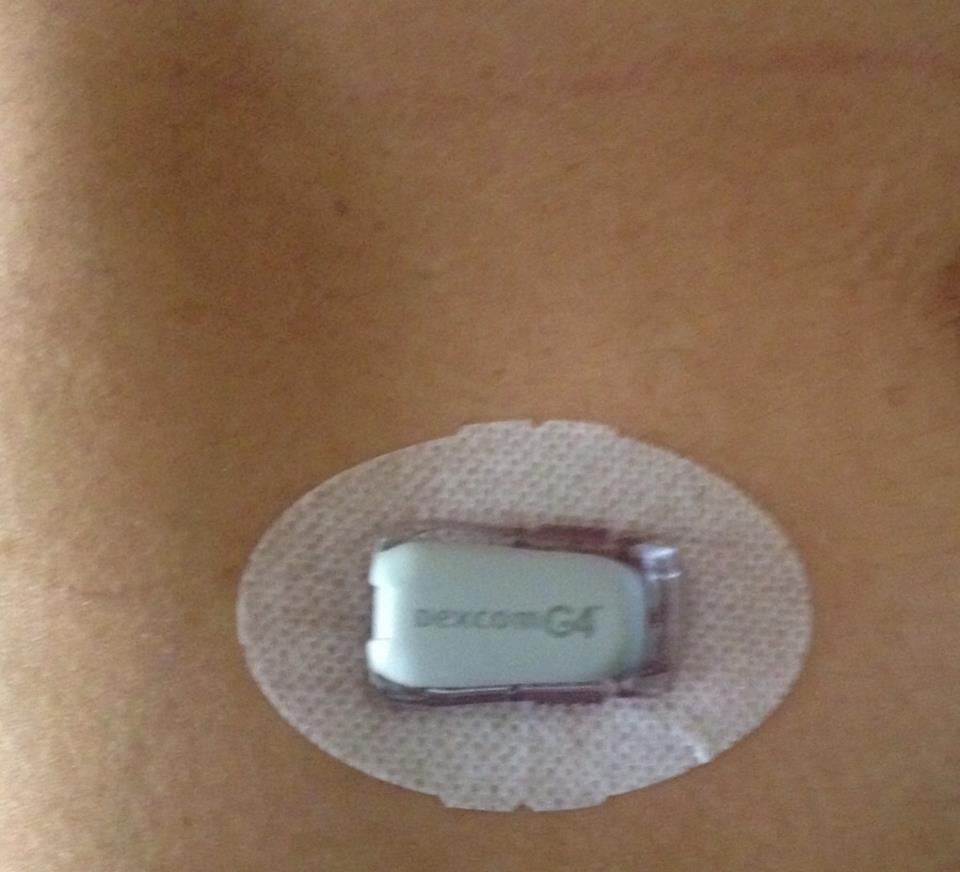
The Dexcom G4 attached sitting pretty on my abdomen.
So, I’ve been trialling the Dexcom G4 CGM using an integrated Animas Vibe pump. This is week 7 of the trial and I am gutted that I only have one sensor left before I have to hand it all back.
To say that I love this CGM is an understatement. Actually, let me back up a minute. I love CGM full stop. Since being introduced into Australia about five or six years ago, I’ve used CGM sporadically. And there have been periods where I’ve used it full time. I love this technology for the information it provides me and the way it helps me fine-tune my diabetes management. It makes me feel safer about living with a condition that takes great delight in throwing a curve ball. Frequently. (Actually, I have no idea what a curve ball is. Sporting analogies and me = pffft. But I digress….)
But this CGM has blown me away. I’d heard great things about the Dexcom/Animas integrated system when I was in Berlin at the Euro Bloggers Summit at EASD last year. I hadn’t seen the system in real life, so it was great to hear from real people about everyday real living with it. Really. Overwhelmingly, they loved it.
Knowing that it was on its way to Australia, I couldn’t wait to see it in action for myself, so I was thrilled when I was asked to trial it for a couple of months.
Here’s the good stuff:
- The accuracy is incredible. This is, of course, the biggest criticism of CGM. The lag time drives people nuts. We all know that it’s not about the actual number, it’s about trends. I get that. But to have a CGM with less lag time means that what we’re seeing is far closer to what is actually going on. The biggest difference I’ve had between the Dexcom and my meter has been 2.5mmol/l. That, my dear friends, is bloody impressive!
- I can calibrate it at any time, no matter what my BGL is doing. Heading up, up, up or plummeting? Doesn’t matter – calibrate and away I go!
- The alarms are sensible. I adore the ‘BGL dropping too fast’ alarm which has allowed me to catch more hypos that I can count. Love it, love it, love it!
- Did I mention the accuracy?
- The colour screen on the pump (or receiver if that’s what you are using) is brilliant. Honestly, I thought this was a bit of a gimmick until I actually realised how much easier it is to read the screen in low light, bright light, at the movies, when I wake up in the middle of the night and can barely register anything etc.
- The sensors are meant to be used for 7 days. I got thirteen days out of the first one – which fell out because I didn’t use anything to reinforce the tape; 17 days out of the second and third died today on day 20.
- And, oh, I know, the accuracy.
What don’t I like? Well, not much. I’m not overly keen on the inserter for the sensor. It looks like a giant syringe and the automatic spring-loaded bit doesn’t kick in until the needle has already made contact with the skin. I have absolutely no needle phobia whatsoever, but I wish I’d been told to push the plunger hard so as not to feel the tip of the inserter needle hit my skin before the automatic part does its thing.
The tape definitely needs reinforcing if you’re planning on getting more than 7 days out of each sensor. But, a quick Facebook post out to the DOC and I was using Opsite to secure the little thing to me. No problems, now. (Although, I was going to consider toupee glue as an option thanks to this blog from the clever and funny Scott Johnson.)
The cost. More on that in a minute.
The alarms don’t wake me up. And they don’t wake my husband up either. I have the pump on vibrate during the day, but at night turn on the sounds. Unfortunately, even when turned up as loud as possible, I still sleep through (a couple of mornings of three plus hours of 3.5mmol/l can attest to that).
I have a decision to make – my pump is out of warranty and it’s time for me to upgrade. I’ve been pumping for 12 years now and have tried every pump on the market (whether as a trial or as my own). The only feature that I insist on is that the pump must have CGM integration as an option, which obviously narrows the choice down to two pumps.
The main negative with the Dexcom is the cost. According to AMSL (distributors of Dexcom and Animas) the introductory cost of the transmitter is $595 and a box of four sensors is $396. However, a fifth sensor is thrown in. Prices rise by about 10% after the introductory offer ends on 1 April 2013 at which time, a box of 4 sensors (plus bonus one) will be $440 – $88 per sensor. Even if I manage to stretch out each sensor to two weeks, it’s still expensive – more expensive than its competitor.
My worry is that Dexcom is going to be priced out of the market. I know that the sensors are absolutely not this expensive overseas, so it is disappointing that the Australian consumer is getting slugged such a premium price. I understand that we’re a long way away and I also understand that there are distribution costs. But I still think that the cost we’re being charged is exorbitant and, frankly, that pisses me off.
But the accuracy really has blown me away. And made me realise that when it comes to diabetes management tools that this is, without a doubt, the most important consideration. I have one sensor to go before the trial is up and in that time will decide whether I can budget for the extra costs of this system. In my mind, it is worth it. I just need to decide if I can do with a couple of fewer pairs of boots this year to fund it.
Disclaimer
I have been on a trial sponsored by AMSL, distributors of Animas insulin pumps and Dexcom CGM in Australia. As part of the trial, I have had use of an Animas Vibe pump and a Dexcom G4 transmitter. I was also supplied with 4 sensors for the Dexcom and a limited number of consumables for the pump. I have no arrangement with AMSL to write about my experiences on the trial or review the devices. I’m just doing it because I’m happy to share my experiences of this new device on the Aussie market. Feel free to ask questions and I’ll answer them if I can. For information about this product, contact AMSL on 1300 851 056.
Last week, on Melbourne’s 40 plus degrees (Celsius) day, I put on a pair of bathers and went to the beach. Big deal, I hear you all sigh. But it is! I can’t remember the last time that I wore bathers. I’ve written about my body image issues before, but this year, I decided to bite the bullet, buy a gorgeous new pair of togs and wear them to the beach or pool.
So, in my new, stripy bathers, on the beach, I frolicked and splashed in the water with my family. It was gorgeous and the ideal way to cool down from the scorching weather which, at 9.00pm was still sitting around 36 degrees.
I was having a fantastic time and feeling more than a little proud of myself for not being self-conscious and just having fun. The kidlet was having a ball and couldn’t get enough of splashing her parents. Fun. Fun. Fun. And then I have no idea what happened. No idea at all.
The next thing I remember is sitting on the sand with my daughter next to me. She was building a sand castle and smiled at me. ‘Where’s daddy?’ I asked her. ‘He’s gone to the car to get jellybeans. He’ll be back soon.’ ‘Okay,’ I said. I watched her.
‘Where’s daddy?’ I asked her. ‘Mummy! I just told you. He went to the car. He’ll be back soon.’
At that point, Aaron returned with jellybeans. He looked so concerned. ‘I didn’t know if I was doing the right thing. It was so hard to get you out of the water, I thought there was no chance getting you to the car. You were talking to me, so I thought it best if I quickly go’. ‘I don’t remember getting out of the water,’ I said to Aaron. Apparently I walked, but it took some time for me to agree to get back on the sand.
How this happened, I have no idea. I made the decision before I left home to leave my new pump on the kitchen table and pack a syringe and insulin with me for bolus top ups as necessary or if we decided to get an ice-cream. Before I disconnected my pump, the Dexcom was reading (on my pump) 8.2mmol/l with a nice flat arrow and a flat line preceding it. We’d eaten a low-carb meal, so there was only 0.6 units of insulin on board. I figured that I’d check my BGL when we got to the beach to see if I needed to top up. But I forgot to do that.
Most likely, it was a combination of the heat and the activity in the water (but let’s be honest; I was standing there splashing, not swimming against a current) or doing anything that would warrant the 1.5 mmol/l reading I discovered when I finally checked my sugar after downing a bag of jellybeans in record time.
These hypos make me hate diabetes like nothing else. And they make me hate myself for not doing the things that may have helped me avoid the situation. If only I’d checked my BGL before getting out of the car I would have known that I was dropping and dropping fast. If only I hadn’t left my pump at home, the Dexcom would have picked up my plummeting BGL and warned me. If only I’d packed jellybeans in the beach bag. If only my body did what it was meant to. If only I didn’t have diabetes. If only.
I wonder if my body image issues have anything to do with the fact that I feel like my body fails me constantly. Why would I think of my body as anything other than broken and why would I want to show that to anyone? Is that part of it, or is it just a matter of me being plain shallow, needing to get over it?
There will be many more beach days before now and the end of the sweltering season – a heat wave is on its way. I pushed away the thoughts of never putting on my new bathers again and not going to the beach again with my family. I can’t let diabetes dictate what I do. But I guess I must let it dictate how I do it. If only I’d remembered that before I walked onto the sand last week.

It’s early evening and a light breeze is coming in through the open window in our study making the sheer curtain flap gently. The occasional car drives by, birds are chirping (plotting against me) and I can hear kids playing in the streets. And there goes the gelati van that does its round about this time each night.
Yep – it’s holidays. I still have a couple of weeks before I return to work. This has always been my favourite time of the year when I’m not working. The craziness of Christmas and New Year is over; the streets are pretty empty as a lot of people are still away. The weather is gorgeous and I have nothing – absolutely nothing – on my calendar. I can’t remember the last time I was spending early January like this. We are often overseas at this time and miss out on the January shutdown. Or I return to work as soon as the New Year’s fireworks are finished.
My holiday is going to get exciting tomorrow when I start on a new pump and CGMS system. I am taking part in a trial of the new-to-Australia Animas Vibe/Dexcom system. I’m more than a little excited because, as mentioned before, I love new gadgets. Also, I had a lot of opportunities to speak with people using this system when I was in Berlin at the European Diabetes Bloggers Summit. Many from the Italian contingent were using it and had very positive things to say.
Apparently, a change is as good as a holiday. Given that I am on holidays I guess this means the next two weeks will be extra holiday-y (totally not even close to a real word). Having the time to actually get to know how the new system works, its quirks and tricks is a real luxury and I’m looking forward to seeing how different it is to the terrific system I’m already using. Also, it means another player on the Australian market, which means more choice for people with diabetes. This is a huge win for consumers as far as I’m concerned.
For those of you on holidays – enjoy and make the most of it. I know that I certainly am!
DISCLAIMER
The trial is funded by AMSL – distributors of the Animas pump and the Dexcom CGMS in Australia. The pump and CGM are being loaned to me whist on the trial and I am being provided with some consumables for the pump and 2 months of consumables for the Dexcom. I am not receiving any payment for taking part in the trial. There is no arrangement for me to write about my experiences using this system, although I probably will. ‘Cause it’s how I roll.
I live in Melbourne, so I’ve been led to believe that the Holy Grail has something to do with winning this:

However, my limited interest in Aussie Rules football (althoughthis may change by September if the Blues start winning, when I’ll suddenly become a die-hard fan) means that for me, the Holy Grail looks more like this:

or this:

Whatever!
When it comes to living with type 1 diabetes, what is the Holy Grail? Many would say it’s a cure. The day when we no longer need to medicate, consider the impact of food on our blood sugar, worry about complications and our future. That could be it.
For me, a cure is actually not my Holy Grail. And I say that because in all honesty, I don’t think that in my lifetime there will be cure for this condition. You may call me negative or a pessimist. I call myself a realist.
Someone asked me the other day if I had to choose, where I would want my research money going. The choices? Dedicated cure-focussed research or management-focussed research. Each and every time I would say the latter. I want lots of money and support directed to the people who are working at making the lives of those of us already living with this condition a little easier!
Think about it. If this sort of research hadn’t been done in the past there wouldn’t be insulin pumps or long-acting insulins or super-fast, super-small BGL meters. We wouldn’t have drugs that can prevent, reverse or halt the progression of complications. CGMS would not exist and no one would be talking about the need for psychosocial interventions when it comes to living with the chronic condition we call diabetes. (Actually, more needs to be done on that last one, but at least we’re talking about it now. Shout out to the Australian Centre for Behavioural Research in Diabetes team.)
Lucky, it’s not an ‘either/or’ situation. There is research into both finding a cure and improving the lives of us living with the condition. And there’s also work being done looking at preventing type 1 diabetes, too. But for me, I get excited when new technologies are announced – and even more excited when they are available for use. (Counting down the days until I get my hands on an iBGStar!)
I wonder if this is a preservation tactic on my part. Like many, I was assured at diagnosis that a cure was a mere ’five years away’. Well, it’s been over 14 years. Those five years have lapsed almost three times now. I have friends who have had diabetes for over 25 years and they too were promised a cure. And I know this is the rhetoric continuing to be sprouted. The hope this instils in people worries me. I see parents with a newly diagnosed infant who desperately, urgently hold on to that number, counting down the five years. Waiting for that cure. But it isn’t here. And when we look at what’s being done, a cure – an end to diabetes – is not ‘just around the corner’.
But rather than defeat me, it does give me hope. Because I know how much is being done. And I regularly see new advancements that actually help people who are living with diabetes here and now. Those advancements could be a new drug that reduces the risk of retinopathy, it could be a CGM that accurately and without fail can warn you that you are 10 minutes away from a hypo, so TREAT NOW! It could be each step we get closer to the closed loop.
There’s a lot going on. Put all your eggs into the cure basket and I think that you may be disappointed. Do we deserve a cure? Of course we bloody do! But I’m really, really glad that as clever people are working towards that particular goal, there are a lot of others working towards improved management.
Holy grail? Here’s a bit of Hunters and Collectors for you! I dare you not to dance along!
In Fantasy Diabetes (Is)land (you should visit – it’s awesome!), there are wonderful, wonderful things. There are cupcakes stores giving away their baked goods on every corner, little gatherings of the DOC in cafes and everyone’s BGL is 5.5mmol/l ALL THE FREAKING TIME.
OK – there’s no such place. But today, we’re talking about fantasy diabetes devices. Here’s what I want in my diabetes life: I want simplicity and I want streamlining. I want devices to communicate to each other. And above all, I want devices I can trust – accuracy is critical.
My dream device would be a fully integrated pump and CGM that automatically transmits all my data to an App on my smartphone. The CGM wouldn’t need calibrating at all (thus removing any need to jab my fingers with a blunt lancet EVER AGAIN). And at the end of each day, the data would be sent to me in an easy to interpret graph, and the clever boffins living in the App would point out patterns (using previous days’ data) and make suggestions about dose changes. And tell me what a good job I’m doing, because it knows that back patting is important!
The App would also be able to accurately tell me the carb content of any cupcake (or other food – there is other food. Apparently.) by simply pointing my phone at the plate. And then relay this information to my pump, which would then bolus accordingly.
And finally, this magic App would send me a message to remind when it was time for the weekly DSMA tweet chat. Helpful!
Of course, this would be available to all and would be free, so there wouldn’t be the inequality in health care that makes me angry and sad.
Righty-o. Who do I need to speak with about getting this produced? And now?

This is my Thursday entry into this year’s Diabetes Blog Week. For information, click here. And I really recommend you do. Over 200 diabetes bloggers from all over the world are participating and it’s a great way to see what others with diabetes are talking about. Come back tomorrow for Friday’s entry.