
You are currently browsing the category archive for the ‘Communication’ category.
A few weeks ago, I saw this tweet:

(click to be taken to original tweet)
Clinical psychologist, Dr Rose Stewart, was giving a presentation where she highlighted that the power imbalance we experience between HCPs and PWD carries through to online spaces. (Thanks to Mark Guyers for live tweeting Rose’s talk.)
The diabetes online community (DOC) was a space created by people with diabetes for people with diabetes. It’s been around for many years. Australian-based site, Reality Check, had an active online forum back in the 1990s. Diabetes blogs led by DOC pioneers such as Kerri Sparling and Scott Johnson (and others) were around in the early 2000s. I wrote a weekly pregnancy blog for a diabetes peer site when I was expecting our kid in 2004 (which I republished a number of years later on Diabetogenic here).
Twitter chats (starting with #DSMA) followed. The chatter of the community goes where the community congregates; different groups use different forums to meet and chat. Kerri wrote this brilliant report on the history of the DOC. It’s a great read to learn from those who were instrumental in bringing together the community online.
I agree with Rose: Our community is better because it includes stakeholders from all corners of the diabetes community including HCPs and researchers. Jane Speight and the ACBRD team; Deb Greenwood, Hope Warsaw and other shining stars from the AADE; and clinicians and researchers from projects such as HypoRESOLVE contribute to DOC discussions and make them far richer and more rounded. That’s just the way it is when we hear the perspectives of all people living with, affected by, working in, and researching diabetes.
Some of the great outputs of these collaborative efforts include research projects, conference presentations and, of course, the development and production of this wonderful #LanguageMatters video.
Our community is not better when PWDs’ personal experiences or feelings are challenged, and unfortunately, that seems to be the default of some non-PWD and HCPs in the community. I’m not for a moment suggesting that PWD don’t challenge each other’s ideas and opinions. (Yes, I’ve read Bernstein. I’m just not that into him, but you do you.) But it is undeniable that there is a difference when it is PWD challenging each other as compared with when HCPs challenge us. There is power at play in the latter. And that is important to remember.
The spectrum of this is from the downright abusive (such as a doctor’s now-deleted response to this twitter thread I shared), to defensive: what I call the ‘Yes, but…’ response. In some ways, it is this particular reaction that is more difficult to deal with.
I find it really problematic when someone speaks about a horrible situation only to be challenged by HCPs. Responses such as ‘Yes, but we’re trying,’ or ‘Yes, but things are better than they used to be,’ or ‘Yes, but we’re not all like that,’ are defensive and don’t acknowledge or respect the experience being shared by the PWD.
When HPCs make these sorts of comments in response to someone sharing their less than ideal experience, it shifts the discussion from the PWD (and that experience) to broader interactions between HCPs and PWD. At its very worst, the discussion moves to how HPCs are challenged by ‘misbehaving PWD’. Live tweeting from the sex and diabetes session at the IDF Congress got messy when it skidded into commentary about how difficult ‘patients’ were and that if only they did what they were told, HCPs would have a much easier job. It was clear from the online commentary that HCPs’ agendas are more important than PWD, and sure, sex and sexual health is one of the things that isn’t addressed, but what of it? HCPs are already too busy doing other things (things, incidentally, that they have deemed important).
So, what happened? Well, in this instance at IDF2019, I shut down and stopped engaging, as did other PWDs. We shouldn’t need to argue and fight to defend what we think is important in diabetes care. And we shouldn’t be made to feel that our thoughts and feelings about diabetes need justifying. Or that we are the problem in a health system at breaking point.
The power imbalance – and yes, that is very, very real, even for bolshy advocates like me – comes to the fore when this sort of thing happens. It can feel as though we are being reprimanded or told off or tone policed for the way we are telling our own story or for daring to suggest that we have experienced troubles and distress in healthcare.
I have recently taken a couple of breaks from SoMe because of this sort of stuff. I don’t feel that I should ever need to rationalise my own experiences or how I feel as a person with diabetes. And yet, there have been numerous times where HCPs have made me feel that I do, or that my thoughts are not as valid or significant as theirs. I’m getting far better dealing with these situations. I’ve started using the unfollow and mute buttons in a way that is constructive and results in a far gentler Twitter feed!
So, back to Rose Stewart’s presentation. She is certainly right. That power imbalance does travel from the clinic environment to the online space and it can be damaging to PWD. HCPs are part of the fabric of the DOC and their contributions are important. But not ever at the expense of the comfort and safety of PWD.
P.S. No, I am not saying PWD get free rein to say and do whatever we want just because the DOC is by and for us. Basic manners don’t get thrown out the window just because it is our space. Being rude, nasty, aggressive, dismissive or impolite to anyone online is not okay. Being angry when we write about crappy situations is not being rude, and it is a perfectly understandable and acceptable response to what we have all faced at one time of another living with diabetes. (And that’s got nothing to do with #LanguageMatters – that’s just basic courtesy that we should all know and understand!)
My first endocrinologist was a really nice man. He was very kind in the way that he acknowledged that I was dealing with something quite scary – a new diagnosis of type 1 diabetes.
I remember he was nice. In fact, when people asked me what my new doctor was like, it is highly likely that I actually used that word to describe him.
What I remember more was the way that he told me about diabetes-related complications, and the way that he told me that if I didn’t look after myself, and follow his instructions to the letter, that I would get those complications. If I was a good girl and did as I was told, I would be right. If I didn’t, every one of those terrifying, horrible, distressing complications would occur and it would be my fault.
Now, he didn’t say this in an ‘un-nice’ way; he wasn’t mean, he wasn’t cruel, he didn’t yell. He was saying it as if it was an absolute, and I quickly came to understand that being compliant was what was expected, and that there was a good and bad way to behave in diabetes, and that resulted in good and bad numbers. If I did what he said, I was good; if I didn’t, I was bad. And if I was bad, terrible things would happen and I would have no one to blame but myself.
That was twenty-one and a half years ago, and I can still hear those words in my head. The language he used set me on a course of not coping with my diagnosis and feeling intense fear about my future – a fear that sometimes paralysed me into inaction.
This week, there has been discussion on Twitter about what the #LanguageMatters movement is all about. It started with this tweet from a diabetes consultant in the UK, which suggests that it is ‘..mostly about being nice…’.
Eight years ago, when Diabetes Australia launched the first language position statement, the response from many was that this was not an important issue and that perhaps we should put our efforts into other things; things that matter. This was seen as a little bit of fluff that was a waste of time. It’s political correctness gone mad, was the reaction from many.
We’ve become smarter at showing the evidence to support just how destructive words and language can be. We hear stories from people who explain how damaging language resulted in them not seeking help when needed, and how the fear of being blamed kept them away from their healthcare team. We can show that diabetes gets fewer research dollars; that it’s harder to get people to put their hands in their pockets to donate to a diabetes charity, and that the general community does not understand just how serious diabetes is.
The timing of things is interesting, and it seems that last night someone on the TV show The Great British Bake Off referred to a dish as ‘diabetes on a plate’. The host’s reference to the sugary confection in that way wasn’t about him not being nice. It was about him using a phrase that has been thrown around by many for years, because it is accepted that diabetes is something to make fun of.
Now sure, the way people responded to this incident could be termed as nice and not nice. Nice would be ‘Please don’t refer to my health condition like that’; not nice would be ‘Don’t be an arse’. Obviously, I lean towards the latter. (Also, not especially nice is using an example like this to explain the different types of diabetes, because it is not relevant to the discussion and only adds stigma to type 2 diabetes. Don’t do that!)
As I read the tweets responding to this tired ‘joke’ from people in the diabetes community, what I saw was not people urging the TV host to be nice. It was for him to understand the seriousness of diabetes, to stop shaming people with diabetes, to not fuel the misconception that sugar causes diabetes, to not make diabetes a punchline.
People make diabetes ‘jokes’ because the words and language used around diabetes for years has given them permission to do so. And with that, attitudes were formed and the construct that diabetes is self-inflicted and free game for comedians and TV hosts became accepted.
And that’s where we are now and what we have to undo.
Perhaps part of the problem is that we don’t have an ‘ist’ or ‘ism’ word that we can attach to the language matters movement. We understand that when we challenge racist or sexist conduct, we are not asking people to simply ‘be nice’. We are trying to make a culture shift away from such damaging attitudes and to change behaviours. When I call out a bloke for making a sexist comment, I’m asking him to reconsider the way he thinks about women, change his behaviour and be respectful. I’m not asking him to ‘be nice’. I’m asking him to stop being sexist.
When someone makes a comment about someone based on the colour of their skin or the country they were born, we don’t dismiss it as them not being nice. We (rightly) expect them to stop that rhetoric because it is wrong and no acceptable.
So, I’m making up a word (and I hate made up words…). If you use words and language that judges, shames, blames, and stigmatises people with diabetes, you are being diabetesist. Diabetesism is not okay and should not be tolerated, and we need to challenge people behaving in that way. Perfectly nice people could still be diabetesist; their attitudes are long-held and seemingly socially acceptable. It’s what they have heard all their lives. We need them to stop doing that.
Here’s the thing: I don’t actually consider myself as being a particularly nice person a lot of the time. Nice people are agreeable, and don’t challenge others or their ideas; they accept them. They don’t call people out on Twitter. They’re not the person who rocks the boat. I am the boat rocker, and I do that because I believe that there are institutional, systematic problems that need to be changed in diabetes and diabetes care, and one of those is the way that the language used around diabetes.
So, back to where this all began and this tweet. I agree that berating HCPs is not the way to get the message through. #LanguageMatters is not only looking at HCPs attitudes and behaviours, anyway. My strongest criticism has been aimed squarely at the media and industry. I also believe that it works best when all stakeholders are involved.
But while I accept that there are different approaches, I don’t accept – and really don’t appreciate – that all the work, the research, the education and the efforts about this issue can be distilled into the concept of good manners and niceness.
I also believe in taking a harder line. That doesn’t mean haranguing or being aggressive. But it does mean understanding that there is a (real or perceived) power imbalance in healthcare, and those with influence should be held to account when it comes to the way they speak to and about people with diabetes. It means calling out HCPs and researchers when they stand up at conferences use language that hurts us by reinforcing wrong attitudes; correcting the media when they get it wrong, and calling out industry when their marketing teams misfire.
And I also believe that this is personal. Living with diabetes is not a bit of ‘fun stuff’ or something that we chose to do. It is incredibly personal for me and every single person with diabetes who has been made to feel not enough, or blamed or shamed, or judged or mocked due to beliefs about diabetes – beliefs that have been formed and accepted over time because of the language and attitudes about our health condition. The concepts of non-compliance, of good and bad numbers, of ‘bringing this on myself’, of ‘diabetes on a plate’, of grading A1cs have all been thrown at me, and affected me in ways, varying from feeling a little annoyed right through to deciding diabetes care was an exercise in futility so I was simply not going to bother anymore.
That is why #LanguageMatters and I would ask – and urge – everyone working in this space to listen to those of us living with diabetes, hear us. And sit down and learn. Sure, we can all be nice, because being nice is a good thing to aim for (and I promise that I will endeavour to do better there, too), but accept that language matters much, much, much more than that.

I’m back from two-and-a-half days in Copenhagen where I was invited to give a talk about diabetes and language matters, and to run a couple of workshops about creating social media content for the 2019 DEEP Summit (please see my disclosures at the end of this post). Lots and lots and lots to write about and share once I’ve been back on Australian time for more than 18 hours, and my brain is less jet lagged and more focused.
But I wanted to share this slide from one of the other presenters because it resonated in more ways than one. I’m interested to know others’ thoughts on this, because mine keep flipping back and forwards.
I’ll be writing about this next week (hopefully), and about how I went from my initial reaction of wanting to cheer #NothingAboutUsWithoutUs, to being a little more considered at just what it is saying when we see it through a lens of inclusion and diversity of voices of lived experience.
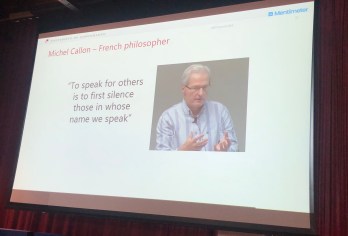
Slide shared by Anna Birna Almarsdottir in her talk about about what it means to be person-centric from the viewpoint of a researcher.
DISCLOSURE
I am a member of the DEEP Program and was invited to participate in the 2019 DEEP Summit. My flights, three nights’ accommodation and other costs were covered by Novo Nordisk. As ever, I have not been asked to write or share about my experience at the DEEP Summit or as a DEEP member. The decision to do so is my own, as are the jumble of words above this disclosure.
Once or twice in the years I’ve been working in the diabetes advocacy space, I have spoken and written about diabetes and language. And by once or twice, I mean rarely a day goes by when I don’t hashtag language matters somewhere on some social network.
You can call me a one trick pony (or Blossom), but I don’t mind, because I think that trick is pretty bloody important, and for the last eight years, I have been more than happy to highlight why the words we use when speaking about diabetes is critically important.
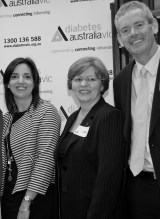
The first time I spoke about this was at the launch of the Diabetes Australia position statement, ‘A New Language for Diabetes’. I stood on stage at the Victoria State Library alongside Diabetes Australia CEO, Greg Johnson and ACBRD Director, Jane Speight as we started what has become a movement, supported by the diabetes community around the world. This was in September 2011 and this photo is from that day.
Now, eight years later, it’s time to revise the statement the started the #LanguageMatters juggernaut, and that’s where you come in.
Diabetes Australia is inviting people living with diabetes, their friends and families and HCPs to complete a survey about to have their say about the words and language used when speaking and writing about diabetes. This is your chance to share what is important to you, what really matters and what doesn’t really bother you at all. We know that the way we communicate about diabetes does matter, but we need your help to shape our revised survey.
Click on the word cloud below to be taken to the survey, and please share in all your networks. We need to hear from you to help build the evidence for why this continues to be a critical issue in diabetes care and communications. Please help us do that!

DISCLOSURE
I work for Diabetes Australia and am on the working group reviewing the Language Position Statement. I was also involved in the development of the initial statement. I have not been asked by Diabetes Australia to share details of the survey which will be used to inform the revision, but of course I am, because how could I not?!
Sometimes, something happens at a diabetes conference that I need to sit on for a while before I can write or talk about it. At ADA this year (almost six weeks ago now), there was a moment that has stuck with me and I think it’s time to talk about it.
I was sitting in the front row of the language session – because, of course I was – eager to hear from the all-star panel that was going to be looking at the language issues from the perspective of the PWD and HCP, as well as look at the role HCPs play in addressing diabetes stigma and how they can improve communication. I loved the well-rounded approach the session was taking, and settled in for a couple of hours of discussion.
The line-up was a veritable A-list of the best voices in the space. We had ‘Jane squared’, with Dickinson and Speight book-ending the program, Joe Solowiejczyk giving the consumer side and Kevin Joiner providing strategies for dismantling stigma.
Jane Dickinson has been an absolute champion of the diabetes #LanguageMatters movement in the US. And it was in her introductory session that the moment of today’s post happened. Jane was speaking about how HCPs see diabetes and people living with the condition. And she showed this slide:

I can’t remember if Jane read out the quotes. But I do remember how I felt as I read them and took in what they meant. I felt beaten.
As people living with diabetes, so many of us have firsthand experience of hearing these sorts of comments directed to us. Or we have had friends with diabetes tell us their tales. Or we have heard passing comments from HCPs expressing similar sentiments. The idea that we don’t care, have brought it all on ourselves, deserve what we have coming – and conversely, don’t deserve care – us pervasive through the diabetes landscape.
This is how diabetes and those of us are living with it are perceived. And it is heartbreaking.
There is no consistency as to who is making these comments – healthcare professionals from all different disciplines, at different stages of their careers, with different experiences. Some work in tax-funded settings, others in private settings. They are considered the best in their field, they are held up as examples of excellent care. Other HCPs refer PWD to them.
Often, I hear people say that these attitudes are really only ever the thoughts of ’old school’ HCPs who have been around for a long time; it’s a throwback to the patriarchal attitudes of healthcare – to days when doctor or nurse knows best and ‘patient’ does what they are told, and if they don’t, they get told off, while being written off as not caring for themselves.
But that assessment is actually not true at all. Some of the most sensitive and tuned-in HCPs I know have been working in diabetes for many, many years.
And some are yet to have even started their career. In exactly the same way that diabetes doesn’t discriminate, it seems that these horrid attitudes and stigmatising comments can come from people at every stage of their career.
Here is the whole slide.

That’s right. These comments came from future nurses. They hadn’t even set foot on the wards yet as qualified HCPs. But somehow, their perceptions of people with diabetes were already negative, and so full of bias. Already, they have a seed planted that is going to grow into a huge tree of blaming and shaming. And the people they are trusted to help will be made to feel at fault and as though they deserve whatever comes their way.
This – THIS – is why I am not stopping banging on about language and diabetes. THIS is why I get frustrated when someone responds to – and reduces – a discussion about this issue with ‘But I/my kid is happy to be called (a) diabetic’. THIS is why I constantly highlight when people or organisations or people in the media are using stigmatising or negative language.
The words we use shape the attitudes we have, and the attitudes held by many about diabetes are disgraceful. Imagine if instead of mindsets like this, HCPs came out of their training with the idea that people with diabetes need support, education, information, compassion and skills to best manage a condition that no one, but no one, ever asked for Just think about how different – and better – that could be.
The ADA session ended perfectly – with Jane Speight (my personal diabetes #LanguageMatters hero) playing the Mytonomy ‘Changing the Conversation’ video. So, here’s that video again. Watch it. Share it.
Let’s imagine, just for a moment, that a television program or newspaper claimed that there was a cure or treatment for type 1 diabetes that you could brew in your kitchen with a few pantry items.
It’s not really all that hard to pretend that this scenario is real: almost every week there is something somewhere that claims to be a way to treat diabetes, and sometimes, this mythical treatment is for type 1 diabetes.
What happens when we see this? Well, usually, it starts with some low level ranty outrage from a first responder who caught the piece and feels that they need to share it with the diabetes world (hashtag – DOC).
Then, as it gains momentum, others get onboard, because we all love a little SoMe outrage. Inevitably, there will be some comments about how ‘This might work for type 2 diabetes, but I/my child has type 1 diabetes, and I/they did nothing to cause it and this is the serious type of diabetes so stop it now.’ (Because adding some ‘type wars’ to the discussion is always helpful.)
There will be blog posts written about it (possibly/probably by me) and someone will demand an audience with the reporter, so they stop perpetuating myths about type 1 diabetes.
Right?
The outrage can be exhausting, but I do get it. We don’t want people to simplify our condition, of have people thinking that there is an easy fix. We want people to understand that it is hard work to manage diabetes and that every time there is a claim that it can be easily treated, people move further away from what it is really like. We want people to know that, so we talk about it loudly and everywhere.
So, after watching the ridiculous claims from Medicine or Myth the other night, I turned to Twitter to see what people were saying about the idea that hemp kombucha was miracle cure or to hear the criticisms about the poor study design of the trial.
Was there a barrage of people questioning the idea that simply drinking 100ml of a fermented drink a day could possibly be all it is going to take to treat the incredibly complex health condition that is type 2 diabetes? Or tweet after tweet probing whether the ‘trial’ that decided that we’re on a winner with Kombucha would pass any sort of test? Was there a choir suggesting that this was really all a lot of hocus pocus and it was undermining just how serious type 2 diabetes is – and how hard it is to treat it?
There was now tweet from Jane Speight…

…and that was pretty much it. (It is a very fine tweet, and that #sciencefiction hashtag deserves accolades!)
And there was no one up in arms about the way the merry band of doctors was talking about type 2 diabetes in such sensationalist and stigmatising ways. If they had been talking about type 1 diabetes, our response would have been swift.
What we saw on this program this week is actually dangerous. We can’t dismiss it as yet another ridiculous claim from a nut like Pete Evans, or Sarah Wilson, or the latest footballer’s wife. We can’t attribute it to an Instagram wellness guru. Instead, we saw three qualified healthcare professionals – a neurosurgeon, a GP and an immunologist; healthcare professionals that people trust with medical advice.
And – showing some bias here – perhaps it would have been easier to dismiss and discredit the whole show if it was broadcast on a more traditional tabloid program such as A Current Affair. An SBS show, with three Australian practising HCPs? People will think this is legitimate.
The way Medicine or Myth whitewashed type 2 diabetes was a disgrace. And as diabetes advocates, we should be calling out this sort of garbage, the same way we would ludicrous claims about type 1 diabetes treatments.

Totally unrelated, but I live in the most hipster street in the most hipster suburb of Melbourne and there is a place on my street that brews and sells seventeen different types of kombucha.
I have some illuminating discussions with healthcare professionals. After I’ve had an in-depth conversation, I find myself going over things they have told me and discover that I have always learnt something new about what it means to work in a system that is, in many ways, broken. I learn how their approach to healthcare changes year by year as they try to do their best for the people they see each day. And I realise that I never, ever could do their job.
Other times, I shake my head a little because I wonder how their understanding of the day-to-day challenges of living with a chronic health condition is so far removed from reality. In these cases it’s almost as though we are speaking different languages.
Recently I spoke to a group of HCPs about those differences. I focused on how we manage to fit diabetes into our busy lives in ways that HCPs never can imagine and how the neat text book description of life with diabetes is very different from the mess that we are trying to tame each day. I spoke about how what they say can be read in a multitude of different ways by those of us on the other side of the consultation, and to think about words carefully. And I spoke about how although some education of HCPs about diabetes suggests that there is a one size that somehow fits us all, the truth is that we require our education to take into consideration every size and shape possible and for it to be delivered accordingly.
A doctor came up to me afterwards and thanked me for my talk. ‘Thanks for making me think differently about some things,’ she said. I loved that she said that, and I told her so. ‘Actually, that’s always one thing that I hope to get when I hear someone speak about diabetes – a new perspective or way of thinking about something that I think I have all worked out.’
We chatted a little about what she’d heard that had surprised her and would she would now be thinking about in other ways. I may have high fived her when she said that she would now be taking a lot more care with the language that she uses. ‘I had no idea that what I was saying had such stigma attached. I honestly thought I was saying the right things. I never meant for people to feel blamed, but I can see now how I could have come across that way.’
That’s been one of the challenges of the #LanguageMatters movement in diabetes. As we’ve tried to bring HCPs along for the ride, we’ve had to do it in a way that doesn’t make it sound like we are berating them. I do and will continue to call out language that impacts on PWD negatively because it does matter. Language has the power to make us feel like we can take on diabetes or be defeated by it; it can make us feel like we are doing all we can and that is enough, or that we are failing and will never do enough. Again, for those down the back – language does matter. But I truly have never believed that HCPs use language with any malice or intent of harm. It’s often just because they repeat the words and phrases that have always been used.
I explained this to the doctor and we spoke about how to get the message across in a way that highlights and promotes collaboration. After we’d been speaking for about 10 minutes, she said ‘I have a question for you,’ I nodded, eager to hear what she wanted to ask. ‘What’s the best kept secret in diabetes?’
I was startled. What an interesting – and frankly brilliant – question. I’d never been asked that before and I wanted to think about it a lot. Poor woman – I’m sure that she just wanted some sort of quippy response and to be done with it so we could go home and eat dinner.
‘Wow!’ I started, excitedly. ‘I love this. Are there any secrets to diabetes?’ I started a checklist, going through some ideas. ‘Is it peer support? For some reason, a lot of people don’t know just how widely available this is. Or maybe it’s how people can drive their own healthcare by setting the agenda. I frequently have people tell me that they just do what their doctor tells them (or rather, say they will) because they didn’t realise that healthcare could be an open and joint dialogue. In diabetes, maybe it’s all the clandestine DIY stuff that is going on which is so apparent to those of us who play on Facebook and Twitter, but maybe not to those who are not online as much. I know it’s NOT cinnamon. Actually – maybe it’s the whole thing about how when living with diabetes, or other chronic condition, our mental health is rarely taken into account, so perhaps understanding that and being referred to relevant services is the secret. It happens to so few of us…’
I stopped, because I could sense that there was so much I wanted to say, but I truly didn’t have an answer. ‘I don’t really know,’ I sighed. ‘I wish I did. I wish there was one…’
We said our good byes and I started to walk away before the doctor called after me: ‘You know what the best kept secret in diabetes is?’
I spun around. ‘What?’ I asked. I admit that I was hoping for a key that was going to unlock the mysteries of diabetes and suddenly make it a lot easier to live with.
‘You,’ she said. ‘And others like you. If only doctors like me took the time to listen to you all we would know a lot more and probably do a much better job.’
I smiled at her. ‘We’re not really a secret,’ I said. ‘We’re actually quite out there. You’re just not looking in the right places. Or asking the right questions.’
I gave her a little wave and left the room.

This post marks one thousand posts here on Diabetogenic*. That’s a lot of senseless rambling, ragey-moments, times celebrating and despairing about diabetes, and links to brilliant ideas and post… or to things that have either amused, frustrated, delighted or annoyed me.
A thousand posts in and diabetes is still a constant in my life (damn it). And I remain not good at diabetes…and I have many of those thousand posts to prove it.
There are clearly some recurring themes that I write about. I say that I am a one trick pony, but perhaps that’s not completely true. I seem to have a few tricks up my sleeve, really. And now I’m confused, because ponies don’t usually have sleeves and my metaphors are very, very mixed.
Here are the things that seem to have taken up a lot of writing time and words over these thousand posts…
 Most of the time, I am pretty positive about living with diabetes. Let me be clear: that doesn’t mean I love it, or even like it. But I feel that generally, I know where it belongs in my life and it seems to fit in that place as well and happily (begrudgingly) as it can.
I know that one of the reasons that I feel this way is people in the diabetes world I am lucky enough to call friends and peers. Online friends, in real life friends and those who cross both boundaries are a critical part of my living-well-with-diabetes strategy. Knowing that there are only a very few places around the world where I couldn’t find someone from this community to have a coffee/tea/prosecco/mojito with gives me an incredible sense of comfort. (And reassurance in case of diabetes emergency…)
I say that my peers with diabetes help me make sense of my own diabetes and that’s true. Knowing people who understand innately what it is like to share a body with diabetes means that I never feel alone. Diabetes is so isolating at times – even for those of us surrounded by great people who support and encourage us. As much as I need those people and am grateful for them, it is others living with diabetes that help me realise that I am never, ever alone in dealing with the ‘diabetes things’.
The diabetes online community is made up of lots of people and not all have diabetes. We each bring our own experience and perspective to it. I’ve learnt so much from those living arounddiabetes and how they incorporate it into life, because it comes with its own set of challenges and victories. That is why the community is so valuable – its diversity and range of experiences and perspectives.
I regularly talk about the value of community and diabetes peers and finding our tribe. It can take time to settle into just who and what that looks like, and it changes because there are always new people around. But it is so worth it. My tribe? I love them so hard.
 I am not the tattooing type but if I was, I think that I would have this phrase inked on my body somewhere (or maybe I’d be really pretentious, and have it written in Latin: Nihil de nobis sine nobis, according to Google translate.) It remains a frustration of mine that this isn’t the starting point for pretty much anything and everything to do with diabetes care. The fact that we still need to fight for a seat at the table – or a ticket to a diabetes conference – is, quite simply, not good enough. Having others speak for us, on our behalf thinking they know what we need, is offensive. It should never be the case that non-PWD voices speak for us or over us. Ever. Our stories are powerful, but they are ours and we should have the platform to tell them in our own way; in our own voice. Tokenism is rife and sometimes, that frustrates me even more than when we are completely excluded. The delusion of inclusion is, I think, worse. Whilst there may have been some strides made to true co-design and inclusion, we have not come far enough and until we get this write, I’ll have a lot of content fodder for this blog.
I like food. I write about it a lot. And I want to be Nigella. That’s really all I have to say about it right now…

Waffles in Brussels. Both were excellent.
 Apparently, stating the obvious is still necessary in diabetes. We are more than numbers; our A1c does not define us; our worth is not wrapped up in our glucose levels. We have been saying these things for years…decades…and yet there are still times that this is what we are reduced to.
New treatments, devices, drugs, education programs are measured in reduction of A1c. Perhaps this is because it can be measured, but talk about only getting part of the story. I can’t help but think that if PWD were part of establishing research protocols, there may be far more than numbers to assess the success of a treatment or therapy. (See also: nothing about us without us…)
 In recent years I’ve written about the issues specific to women, health, sex and diabetes a number of times because there is so little out there about it. And it seems it resonated with a number of women who wrote to tell me (and the HCP who saw me in the fresh produce section at my local Woolies and yelled how she loved my idea of giving lube in diabetes event bags).
Anyway…talking about the stuff that may not be the easiest is important. It’s the only way we get remove stigma and encourage people to share their stories. Which helps others. That’s why I have openly written and spoken about miscarriages and infertility. And eating disorders. (I know – not an exclusively women’s health issue.) There is nothing shameful or embarrassing about these topics. Other than we don’t speak about them enough.
Learning from and supporting others
 The Interweb Jumbles I write are my favourite (and cheat’s) way of pulling together all the things I’ve seen that have interested me and leaving them in future place for (my) future reference. Plus, I love sharing what others in the diabetes community and world are doing.
I have always benefited from the generosity of others in this community who have shared my work and I pay that back whenever and wherever I can. Supporting each other is critical.
There’s so much going on in the diabetes world all the time and I highlight the things that resonate because I think that if they mean something to me, they may mean something to someone else, too.
 From pseudo-science rubbish, to ridiculous made-up diabetes cures to anti-vax delusions. How much writing material have they provided!
I live in hope that one day – and may that day be soon – we won’t still have to read about these charlatans trying to convince us that all that ails us can be cured with fairy dust and positive thought, or that vaccines are evil and cause diabetes, or that ‘wellness warriors’ are the true experts and professionals when it comes to diabetes.
While a lot of what I write is spent mocking these fools, there is an underlying seriousness to it all. Who can forget little Aiden Fenton who died after his parents stopped giving him insulin, instead leaving him to be treated by a ‘slap therapist’?
Anyone who is sprouting any treatment that is not based in science when it comes to diabetes or perpetuating anti-vax rubbish is as barbaric as the man who was charged with Aiden’s death.
 Diabetes happens because of something not working properly with our pancreas. But it affects every single part of us – something that astoundingly still seems to surprise some people.
Considering our mental health and emotional wellbeing is critical when assessing just how diabetes impacts on our every day. For some, diabetes seeps into every single part of us and for others, we keep it at bay and manage around us. For most of us, there is an ebb and flow of just how that works.
And while we’re talking about the whole person, diabetes-related complications may be specific to a particular body part, but those body parts remain connected to the rest of us.
For so long, we get metaphorically chopped up with as only bits of us get attention and focus. But nothing in diabetes is ever in isolation. That’s just not how it works.
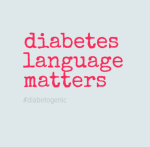 The trick this (however-many-trick) pony is most known for is #LangaugeMatters and you know what, I’m happy to wear that. I really am. If I was to stop this blog today (thought about it…1,000 has a nice rounding off feel to it), and never spoke about diabetes ever again (oh, if only), I would not be disappointed if this was what people thought of when they thought of me and this blog.
Language matters. It does and I refuse to, for a moment, believe that it doesn’t. I am certainly not the only person playing in this space and I am so grateful to have a tribe of language matters peers and colleagues can rise above the small details to understand just why this issue does really matter.
___________
Thanks to everyone who has read one or more of these thousand posts. Thanks especially to the people who keep coming back. I can’t promise that there are going to be a thousand more posts. And I can’t promise that I will learn any new tricks other than the ones that I seem to have on repeat at times. These issues remain important to me and perhaps to you too.
* At EASD, my mate Bastian Hauck gave me a head’s up that I was getting close to publishing the 1,000 post on this blog. I’d not have had a clue otherwise. Thanks, Bastian!
Here’s the deal. Changing one word for another that means exactly the same thing is not addressing the whole #LanguageMatters issue. Acknowledging that one word doesn’t work and may not be especially empowering and positive for people with diabetes only to replace it with another that is equally problematic is not really helping.
Case in point: more and more healthcare professionals and researchers have accepted that the word compliant, (and its friends non-compliant and compliance) are out. So, they replace them with adherent, and non-adherent and adherence.
No. Just no. And stop it.
They mean exactly the same thing and do the same thing: rap people with diabetes over the knuckles for not following an often-imposed plan about how we should manage the condition we live with. (‘Should’ is also a dirty word as far as I’m concerned, but we’ll deal with that another day.)
I am frequently asked what words would be better, but I prefer to give an explanation about the reasons these words are problematic. Because I think if people have an understanding of why these words set some of us off, perhaps they may be less likely to simply swap out one tricky word for another.
Let me refer to the Diabetes Australia Language Position Statement for a moment:
‘Use of the terms ‘(non-) compliant’, ‘(non-) adherent’ is particularly problematic. Such terms characterise the individual as cooperative or uncooperative, especially when used as adjectives to describe the person rather than the behaviour. Using these labels can mean opportunities are lost to ask relevant questions, develop collaborative goals, tailor treatment regimens and make referrals that actively support the person to manage his or her diabetes. Attempts to increase ‘compliance’ and ‘adherence’ generally involve persuading the person with diabetes to change his or her behaviour to fit the health professional’s agenda.’
There is a lot of judgement attached to these terms.
I think back to when I was diagnosed with diabetes and the first inkling I had that I was going to struggle to follow directions was when the dietitian I saw the day after diagnosis showed me a rubber mould representing the quantity of mashed potato I should eat in one sitting. I was twenty-four years old and knew just how much food I liked on my plate and that was not it. In fact, it looked more like the quantity I would eat over a week – not one meal.
I mentioned that to the dietitian. I explained how I love food, but I eat until I am full and then stop because I’d learnt that listening to my body was a really important to me. (That sounds all Zen-like, but truthfully, it is just so I don’t get the revolting over-full feeling when I don’t listen to my body’s signals!) Surely there had to be a way that I could still do that even with diabetes along for the ride. Right?
She just looked at me and told me that I had to eat that amount because of my insulin dose. ‘Can I take less insulin then?’ I asked. ‘No. That’s not how it works,’ she replied, without explaining why.
So, I nodded and promised to eat thirteen kilos of potatoes at every meal. And within a week I had worked out how to eat less, dose less and still listen to my body. Oh – and I learnt how to lie to HCPs and tell them what they wanted to hear. And that I never, ever wanted to sit in a room with another dietitian.
Was I being ‘non-compliant’? Well, I certainly wasn’t following what I had been instructed to do. But I was eating what made me feel good and dosing insulin accordingly. Surely that had to count for something? Yet, when I returned to see the dietitian for the follow up appointment that I diligently (compliantly?) kept, she tut-tutted me for not following the eating plan she had given me – an eating plan into which I’d had no input.
This is a recurring theme in diabetes. We hear of people being ‘told off’ for not following treatments, but we are not given the opportunity to help shape those treatments.
Being ‘compliant’ in diabetes suggests that we are doing what we are told. It means that we don’t question, we just willingly follow directions without considering whether or not they work for us. It also suggests there are rules and that if we follow them – if we ‘comply’ with them – we can expect the outcomes to always be the same. Diabetes doesn’t work that way.
I think back over the two decades I’ve lived with diabetes and know that time and time and time again I have been thought of as ‘non-compliant’ simply because I didn’t do what a HCP thought was the best thing for me, instead working my way around and finding what worked. Diabetes isn’t fun, so you bet I have looked for ways to do things that take less effort, less time, less brainpower, less burden. That’s not because I don’t care. It’s because when I find a way that works better for me, I’m more likely to do it.
Every single one of those times that a HCP has thought of me as ‘non-compliant’ was a missed opportunity for us to work together to collaboratively come up with treatment plans, strategies and goals that worked for me.
When we are accused of being ‘non-compliant’ with medication, activity or eating plans, attending appointments, filling in glucose records or anything else that we are expected to do in diabetes, it’s not because we are being wilfully naughty. It is because whatever we have been asked to do is not right for us – we simply cannot do it, or don’t understand why. Sometimes of course we don’t want to do it, but there is usually a reason why we then don’t act.
Compliant (and non-compliant) are dirty words in diabetes. And replacing them with adherent (and non-adherent) doesn’t make it any better because they mean the same thing.
If you are a healthcare professional and use these words when referring to PWD, I suggest that you stop and start again. Think about what you are saying. The person in front of you is not a naughty child, waiting for your approval or rebuke. They do not need to be told that they have failed at meeting (what were probably unrealistic) expectations. They certainly don’t need to feel ashamed and judged by you.
What we need is something quite simple, really. We need to be asked what matters to us and what will work for us. We may need to be asked that a few times. If you are talking about a course of treatment, make sure that we understand that it is just a suggestion and that we can alter it to fit us. Remind us that if we can’t follow it that doesn’t mean we’ve failed. It probably means that together we need to tweak things so that we can follow.
Until the language that we see routinely in diabetes is about supporting, encouraging people with diabetes and positively influencing the broader community discussion about our condition, I will continue to call out any time I hear these words being used. I accept that there is no quick fix. And while I accept that healthcare is incredibly traditional in its communication, I refuse to accept it as a reason to continue to use language that is so damaging. ‘Because we always have’ or ‘Because they’re the words we use that make sense’ is not an excuse to refuse make change for the better.
Postscript
It’s not only in diabetes where we see this sort of language. See this tweet from The Grumpy Pumper about flaws in using the word compliant when it comes to those living with dementia.
Postscript two





 Diabetogenic