
You are currently browsing the category archive for the ‘Communication’ category.
When people have asked me how I am feeling throughout the COVID-19 pandemic, they will usually receive a reply that varies from ‘All good’, to ‘Pushing through’, to ‘It’s been a tough week’, and everything in between.
What they won’t hear is how I have been feeling alongside these things. I have felt expendable.
It started early on with the first reports of the new virus that we knew nothing about. ‘It only affects people who are older and those who already have a health condition.’
In one of the first posts I wrote about how I was feeling as we entered this new world, I wrote these words ‘…the other day, I found that I was fighting back tears as, yet again, some politician somewhere promised that people who were diagnosed with the virus would most likely be okay – as long as they were not old or chronically ill.’
That was on 13 March. It’s now 11 September. For the last six months, I have continued to fight back tears and deal with lumps in my throat because one of the few constants through all of this is the lack of care and compassion directed at people who are older and those of us living with health conditions It’s a rather laissez-faire attitude: let’s not worry because we are all going to die anyway.
Being made to feel that I don’t matter is grinding. The accompanying stories from places with over-stressed medical departments, which show the people who this was ‘only’ meant to affect are being denied treatment because care and hospital beds are being prioritised for younger, ‘healthier’ people, are heartbreaking (and I’m sure impossible for the HCPs who have to make these decisions).
Add to that the bullshit reporting, manipulating data (and the truth) to suggests that many people who have had their deaths attributed to COVID-19 didn’t actually die FROM the virus, but rather WITH it, as if that makes it all okay and we are all just minutes away from dropping dead anyway, so who cares. It’s fun watching a discussion about how, if I was to get COVID and die, it would be the fault of the condition that I have worked so fucking hard to manage so that I can be healthy and contribute to the world around me, rendering that effort a waste of time.
It is a lot. It feels heavy. It feels that I don’t matter. But I do, don’t I? My friends with diabetes do too, don’t they? My parents and others’ parents and grandparents, and friends and family and colleagues who are older matter, don’t they?
Feeling expendable is a terrible way to feel, but it has been nestled in a corner of me for over six months now. That’s a really long time to feel pretty crappy and I honestly think it’s time to be better about the underlying messages when talking about COVID-19. I really want to stop feeling this way, so please, think about what you are saying when you mention people like me.

For more information (all Australian sites):
This blog has been quiet for the last couple of weeks because, honestly, there is nothing that I had to say that was of any value. Instead, I’ve been listening, learning, talking with friends and family, crying with friends, having difficult conversations with people. And feeling uncomfortable. I’m learning to not fight that discomfort, but instead examine it and work out how I can be involved in change.
Today, I’m dipping a toe back in slowly, and sharing this from New Yorker Cartoons (maybe this blog really is going to become nothing more than an appreciation page of New Yorker Cartoons and Effin’ Birds). This cartoon spoke to me. Because: tone policing.

Recent New Yorker Cartoon by Jason Adam Katzenstein. (Click for source)
I write about being tone policed in the healthcare space, and that is what I am writing about today. It’s happened for as long as I’ve spoken up about my experiences of diabetes and my thoughts and ideas about healthcare. I’ve been called aggressive so many times by HCPs who have not liked it when a mere ‘patient’ has suggested that they are being damaging to people with diabetes in the words they are using to talk to and about us.
The bolshie nuns who taught me at secondary school taught me that when women are accused of being aggressive (or strident), it is usually because we are being assertive. I’ve come to learn that it’s not just women. It’s anyone who has, for too long, been expected to just take what is dished up – and to accept it with gratitude.
Being assertive, being aggressive, being challenging and saying enough is enough should not result in being told to tone down. Or to be excluded from discussions unless we agree to be more moderate. Or more respectful. When that respect is truly a two-way street, then let’s talk about that. But for as long as power imbalances are at play, and HCPs insist on speaking on behalf of us, or only agreeing to speak with us if they like what we are going to say; or when HPCs feature more in diabetes campaigns because they insist on centring themselves rather than actual people living with the condition…well, then we don’t have true two-way respect.
Our diabetes community is not immune from tone policing each other. It’s happened to me. I continue to listen to type 2 diabetes voices because I can never expect to understand what they are experiencing in our community unless they tell me. It may be uncomfortable for me to hear – but that discomfort comes from a place of my complicity. It is not my place to tell them to moderate the way they are speaking about their experiences, just because it makes me feel prickly. But it does happen. In the timeline of my involvement in the diabetes world, I know that when I was first diagnosed, I contributed to the stigma many people with type 2 talk about, and then, as I learnt more, I moved to being quiet about it when I saw and heard it – even though I disagreed with it. Now I am trying to be a better ally and calling it out when I see it. And shutting up and listening and accepting what people with type 2 say.
We learn when we listen. We learn when we are open to accepting that we do not have all the answers. We learn when we stop being so centred on our own experience and try to turn the spotlight onto ourselves when instead we should be shining it on others.
We learn when we don’t tell people how they should feel or how they should speak.
By the weekend, after last Friday’s post expressing the terror I felt reading headlines regarding death rates, diabetes and COVID-19, I’d moved from scared and sad to angry. Diabetes reports in the media are always fraught, and this was no exception.
I took to Twitter, because it’s as good a place as any to scream into the void and lighten my chest from what was weighing heavily on it. You can read that thread here. Or you can just keep reading this post. I wrote about the processes that I have been involved in for getting a story about research from the lab/researcher’s desk out into the general sphere.
So today, I am going to address a number of different stakeholder groups with some ideas for your consideration.
To communication and media teams writing media releases about diabetes research:
I know that you want your story in the press. Many of you have KPIs to meet, and measures of success are how frequently you get a headline in a well-known publication. I know that you often are the ones trying to make dry numbers and statistics compelling enough to get the attention of health writers and journalists.
But please, please don’t tell half stories. Don’t only present the scary stuff without an explanation of how/what that means. And when you provide explanatory information in the hope that the journo you’re pitching to will pick up your story and run, don’t revert to lazy, over-simplistic explanations that have the potential to stigmatise people with diabetes.
To health writers and journalists:
You have a tough job. I get that. Pages need to be filled, angles found and content that will grab the attention of a news-hungry public must be written. But remember, if you are writing about diabetes, it is highly likely that a lot of people reading what you write are people affected by diabetes. Your words are personal to us. When you talk about ‘diabetics dying’, we see ourselves or our loved ones. Please write with sympathy and consideration. Don’t use language that stigmatises. Don’t use words that make the people you are writing about feel hopeless or expendable. Don’t forget that we are real people and we are scared. Are your words going to scare us more?
To anyone asked to comment from an ‘expert’ perspective. (I am not referring to PWD asked to comment from a lived-experience perspective here, because no one gets to tell you how to talk about how you are feeling. Tone policing PWD is never okay, especially when it comes to having a chance to explain how your emotional wellbeing is going…)
Thank you for trying to break down what it is that is being discussed into a way that makes sense to the masses. If you are asked to be the expert quoted in a media release, ask to see drafts and the final version of the release before it goes out. Consider how your words can be used in an article. It’s unlikely that you will be called for clarification of what you have said, or to elaborate, so be clear, concise, non-stigmatising and factual. Also, and I say this delicately, this isn’t about you. You are providing commentary from a professional perspective on a news story about the people who this IS about . The fallout may be tough, and the topic may be contentious, people may not like what you say, but when that becomes a focus, the story shifts away from the people who really matter here. I am begging you to not do that.
I am frequently asked to provide comment for media releases, sometimes as a spokesperson for the organisation where I work, other times from a lived experience perspective. I always insist on seeing the final draft of the release. And yes, this has been my practise since I was burnt with a quote I’d approved being used out of context and painting my response in a different light to how it was intended. I also insist on seeing the words that will be used to describe me. For me personally, that means no use of the words such as suffered, diabetic, victim, but as PWD we can choose those words to suit ourselves.
I am also more than happy to be the bolshy advocate who clearly lays out my expectations about overall language used. I send out language position statements. I know that comms, media and writers don’t always appreciate this, but I don’t really care. It’s my health condition they are writing about, and the readers will not be as nuanced about those affected with diabetes. If they see something, they take it at face value. I want that value to be accurate and non-judgemental!
And finally, a point on language (because, of course I am going here). Many pieces that have been written in the last week have dehumanised diabetes, and people with diabetes.
Words such as fatalities, patients, sufferers, diabetics, ‘the dead’ have all been used to describe the same thing: people with diabetes who have lost their lives. Break that down even further and more simplistically to this: PEOPLE. People who had friends and family and colleagues and pets. People who had lives and loves and who meant something to others and to themselves.
I refuse to reduce the #LanguageMatters movement to the diabetic/person with diabetes debate, but here…here I think it is actually critical. Because perhaps if ‘people with diabetes’ was used by the media (as language position statements around the world suggest), it might be a little more difficult to divorce from the idea that those numbers, those data, those stats being written about are actually about PEOPLE! (Of course, PWD – call yourself whatever you want. Because: your diabetes, your rules and #LanguageMatters to us in different ways.)
People. That’s the starting, middle and end point here. Every single person with diabetes deserves to be written and spoken about in a way that is respectful. Those who have lost their lives to this terrible virus shouldn’t be reduced to numbers. Data and statistics are important in helping us understand what is going on and how to shape our response, but not at the expense of the people…
Today, my social media feeds are full of this screaming headline:
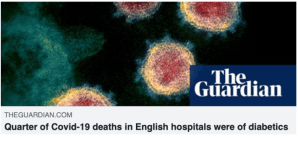
(Click for article)
As soon as I saw this, I threw my phone away from me and put my head back under the doona. Aren’t Fridays meant to be about celebrating a week well done and looking forward to the weekend?
Instead, I woke to far too many notifications about diabetes and death – words I really don’t like to see together, especially not so early in the morning. Fortified with coffee, I took a deep breath and in I went, reading the article from top to bottom.
I’ve had a knot in the pit of my stomach all week. It moved in and made itself comfortable when the Australian PM started talking about easing lockdown restrictions. I’ve spent the last few days trying to work out how I can manage this anxiety in a sensible way, and not do what I really want, which is to build a cellar under our house, stock it with coffee, prosecco and Nutella, and move in there until sometime in 2030.
This article and the subsequent commentary twisted that knot tighter and pushed it in deeper. ‘I live here now,’ it seemed to be saying. And then added, ‘Get better WIFI; it’s patchy in here.’
The fact that the article raises more questions than it actually answers hasn’t helped. More details – details that may help to better understand exactly what is going on – won’t be published until next week. And so, without enough content to provide explanations, advice and information that might help PWD feel that perhaps it’s not all hopeless. Instead, The Guardian offered some throw-away lines about the associations and causes of type 1 and type 2 diabetes:
‘NHS England’s breakdown, published for the first time on Thursday, did not specify how many of the 5,873 diabetics who died had type 1 diabetes, an autoimmune condition not related to lifestyle, and type 2 diabetes, which is closely linked to being overweight. Fuller details will be published in an article in a medical journal next week.’
This just seems like an opportunity for people to appease people with type 1 diabetes, and point the finger and further stigmatise people with type 2 diabetes, instead of acknowledging that people with ALL types of diabetes might possibly find this news confronting. What is the relevance here to being overweight? If there is a correlation, please let us know and does it impact people with type 1 diabetes who are also overweight?
I am not for a moment saying that this sort of information should be hidden away or swept under the carpet. Of course, I want to understand how diabetes and COVID-19 interact. But there has to be a better way to get information to the masses without adding to the anxiety and worry. And definitely in a way that doesn’t sensationalise, point fingers and add to social stigma.
The article goes on to highlight the link between Alzheimer’s disease and deaths due to COVID-19, and as I read the quote from Alzheimer’s Research UK’s director of policy and public affairs, Samantha Benham-Hermetz, I wanted to reach into my MacBook and give her a metaphoric, and therefore socially distant, hug. She said:
‘This shocking news will no doubt bring even more worry and fear to people affected by dementia and their loved ones, during an already challenging time.’
I know that I and so many of my friends living with diabetes, and their loved ones, have been feeling worried and scared since this all started, and this article has the potential to add a lot more. The fact that this response was acknowledged out loud (and I think it’s fair to say that people affected by diabetes would be feeling the same as those affected by dementia) made me feel so grateful and heard.
Statistics are statistics, and data are important; I know that. But sharing data with the masses only works if it is done effectively and communicated in a way that doesn’t leave people feeling hopeless, but rather empowers us to make decisions that contribute to minimising risk.
My heart breaks for my friends with type 2 diabetes, and their families, who not only have to digest this headline and information, but also need to consider how the cavalier and simplistic definition of type 2 diabetes will now be interpreted by the general population who already are so quick to blame and stigmatise.
I live with diabetes, and I understand that I am high risk of complications, and so it seems, death if I get COVID-19. But mostly, more than anything else, I am a person trying to make sense of all of this and stay safe, healthy and sane – just like everyone else.
P.S. Hey – Guardian UK – I fixed this para for you:
‘NHS England’s breakdown, published for the first time on Thursday, did not specify the type of diabetes with which the 5,873 people who died were diagnosed. Fuller details will be published in an article in a medical journal next week.’
Tuesday last week, I woke up to find this message in my Twitter DMs. I read it and read it again. It accompanied a tweet or two to me about my blog post from the previous day.
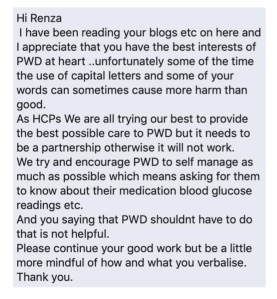
I debated about whether or not I should share this publicly. I wrote some words, walked away, came back to them, walked away, asked a few friends their thoughts, walked away, wrote a bit more and walked away again. I posted it to my closed Facebook page to get some feedback from others and wondered if that was enough.
But then remembered this blog post. #StandUP.
So, here I am, standing up. Because I am upset and angry.
I am not upset and angry that someone didn’t like or disagreed with what I wrote. It would be frightfully boring if we always all agreed with each other and loved the same things.
I am not upset and angry that this message was unsolicited. I believe that people don’t need an invitation to comment when I write and publish things on a public forum. I invite all feedback – good and not so good.
I’m not even upset or angry that I don’t understand what was being referred to in the message. I re-read and re-read and re-read my post, and I can’t see where I ever, ever said that people with diabetes shouldn’t self-manage, or know what meds they’re taking or what their glucose readings are. I couldn’t find it in there. But, people interpret things differently and perhaps my writing wasn’t as clear to them as I thought it was.
I’m not here today to defend the content in that blog post, because that’s not what this is about.
I am upset and angry that I was being told to ‘be mindful of what and how I verbalise’. This is called tone policing. It is telling me that I should moderate the way that I talk and think about my own diabetes. This was an opinion piece. My opinion. People don’t need to agree with it – and they can tell me they don’t. But telling me to moderate the way that I communicate is a very different thing.
I will forever call out and stand up to anyone who tells me, or others with diabetes, to restrain our feelings or opinions, and that is why I am writing this post. Because more than anything, I believe that we have a right to express how we feel about diabetes, in the way we want to, especially when we are sharing our own opinions or experiences. When we are told to be mindful of what and how we are writing/speaking it is a step on the way to censoring and silencing us. We already do that enough.
Often, in clinical settings, we moderate the way we speak. We might minimise how tough things are, or don’t speak out about the way we are treated or the judgement we face. When we are told that we’re not doing enough and are failing, we look down, afraid to stand up for ourselves.
And so, we created spaces where we could be free to share and rant and cry in a way that gave us some comfort. We turned to others who are likely to have had similar – if not identical – experiences. We share our opinions, some of them unpopular, thought-provoking and challenging of the status quo because we feel we have the liberty to do just that.
We have had to be quiet for too long. But that should never be the case in our own space.
The diabetes online community is that space. Twitter, when we use our #xxDOC (or #DSMA) hashtags is that space. Other online and offline support opportunities and groups we have created is that space.
And this blog (and others written by PWD) is that space.
So, back to the message I received last week. I did ask for clarification, and for examples of where I’d used capital letters or words that could be considered harmful, but I didn’t get a response.
Just this message:

No answers, just a threat to mute me. To silence my voice. Sure, it is only being silenced on this one person’s twitter stream, but that was the response to me refusing to be ‘compliant’ and agree with a healthcare professional’s demands that I tone down the way I write about my own opinion. I had not been aggressive, abusive or rude. I had just shared my own opinion and thoughts in my own voice. In my own space.
Recently, the Australian of the Year was announced. This year, the gong was awarded to Dr James Muecke, an eye surgeon from South Australia, who was acknowledged for his work raising awareness of type 2 diabetes and its links to preventable blindness.
I didn’t really know of Muecke before the announcement, but clearly, he is very accomplished, and his work reaches beyond Australia’s borders. He co-founded social impact organisation, Sight for All, which raises funds to deliver vision-saving programs and eye health projects to people in under-resourced countries.
However, it is Muecke’s work in linking type 2 diabetes and blindness that received the majority of the media coverage, with (as can always be relied upon) some pretty average reporting. Interviews with and soundbites from the newly crowned Australian of the Year did focus on a simple and incorrect equation of sugar equalling diabetes, and this certainly did seem to concern a lot of people responding to what they were seeing online.
I sighed as I read through a lot of that commentary, dismayed as the calls to differentiate between the types of diabetes drowned out Dr Muecke’s award, with repeated bleats that ‘Sugar didn’t cause my/my child’s type 1 diabetes’.
Sugar didn’t cause anyone’s diabetes – it’s just not that simple. I appreciate wanting people to understand that drinking too much Coke isn’t why type 1 diabetes develops. But equally, I want people to understand that it isn’t why type 2 diabetes develops either.
Asking for clarification of the different types of diabetes isn’t always necessary because it doesn’t always matter. You bet that it does matter at times, but other times, it really doesn’t.
We see this time and time again. Think about the time that café in Sydney thought they were being cute by calling a dessert ‘Diabetes’, or the time that guy on that UK cooking show referred to something as ‘Diabetes on a plate’. Was this really the time to get all uptight because the difference between type 1 and type 2 diabetes were not specified? Were the calls to stop stigmatising type 1 diabetes by not clarifying that ‘our’ diabetes isn’t because we ate that dessert? Does it matter in these moments if the person stigmatising and misrepresents diabetes doesn’t point out which sort of diabetes?
It really doesn’t. If the dessert was called ‘type 2 diabetes’ or the recipe was ‘type 2 diabetes on a plate’, it still would have been wrong. It still would have been stigmatising.
And yet, every time another lousy comedian, or celebrity or chef makes a diabetes joke, or the media gets diabetes wrong, or the Australian of the Year explains diabetes in the wrong way, the predictable cries, and rapid soundbite responses only feed into the stigma, prejudices and misconceptions of type 2 diabetes.
We can do better – we need to do better. And we can, by being more thoughtful in our response to correct people getting diabetes wrong.
I should point out that this goes beyond people with (or parents of children with) type 1 diabetes. Lots of other diabetes stakeholders get into it too. Some health professionals trip over themselves in their endeavour to speedily demand clarification of type, (even when it is not necessary). This has always left me somewhat befuddled and wonder if they think this will win them brownie points with the cool kids on Twitter. Surely HCPs working in diabetes understand that sometimes putting ‘type 2’ before diabetes is not actually rectifying what is factually incorrect in the original statement. And that should matter, a lot more than the ‘likes’ from the type 1 diabetes Twitterati they seem so eager to impress!
We can get it right, and get it right quite easily. When the Australian of the Year announcement was made, the comms team at Diabetes Australia absolutely nailed the messaging, striking a balance between commending Dr Meucke for his award, acknowledging how wonderful it was to see the Australian of the Year platform being used to highlight the link between diabetes and diabetes-related eye disease (with a plug for KeepSight!), and adding a note to clearly and eloquently explain the complexities of type 2 diabetes, the role that genetics and other non-modifiable risk factors play in its diagnosis, and reminding people that type 2 diabetes is not caused by eating sugar.
I think the team got it right – the information was correct and accurate and did not in any way add to the stigma of diabetes. (Disclaimer: I work for Diabetes Australia and I’m talking about my colleagues. Whilst I sometimes work with the comms team, they are all far smarter and better at communicating than I could ever hope to be. Which is possibly why they won’t let me near any of our socials. That, and they worry I’ll swear, or share an Effin’ Birds cartoon…)
Each type of diabetes – and there are many! – has its own complexities and some of the time we need to make sure that it is clear which diabetes we are talking about. But next time you find yourself about to take to the keyboard to correct some misinformation, ask if you are actually adding to that misinformation. And if you see someone demanding such clarification, ask them if they are aware they are contributing to type 2 diabetes stigma. Because I think a lot of the time that is exactly what is happening.

Complete digression, but the title of this post reminded me of these books, which anyone who has been around kids in the last 15 or so years would know about!
I wrote a post a while ago called ‘You Do You’, (and revisited and expanded on it here). It’s where I wrote about how everyone should have the freedom to do diabetes whichever way they see fit. I’m pro-choice in all aspects of life*, especially when it comes to PWD choosing their own management tools.
And I think that people with diabetes should have the choice to BE the people we need to be. And the people we are. I touched on this on my post on Monday when I spoke about how I felt intimidated online because my opinions and thoughts, and the way I addressed issues, were not everyone’s cup of tea. I felt that I was being called out for being myself. And that wasn’t okay.
No two people with diabetes are the same; no two people with diabetes will have precisely the same management ideas and preferences, and no two people with diabetes will react and respond to situations in exactly the same way.
THAT IS OKAY.
Diabetes is messy, frustrating, weird, annoying, amusing (rarely, but sometimes), scary, boring and a whole lot of other adjectives. And how we react and respond to it is our own business and no one else’s. You BE you, because you have the right to do that.
You have the right to be as loud or as quiet as you want.
You have the right to be as bitter and angry as you need to be in the moment.
You have the right to celebrate and be joyful about your diabetes.
You have the right to call out things that upset you just as much as you have the right to commend the things that make you satisfied.
You have the right to step away from groups, situations, people who upset you.
You have the right to disagree with others. Having an opposing view does not mean that you are attacking another person.
You have the right to have an opinion on what you see in the world of diabetes – even if it is happening on the other side of the world. I was incredulous when it was suggested that I shouldn’t question something happening in a healthcare system of which we are not a part. (I may not use the healthcare system in the US or the UK or Italy or anywhere other than Australia, but I am allowed to comment on what I see being done in those places.)
You have the right to be passionate and not be told that is a character flaw.
You have the right to be emotional because diabetes is real in a way that only makes sense to those of us who are living with it or have a loved one living with it. I don’t know how to take the emotion out of this, so you bet I will be emotional at times. I don’t get to clock off at the end of the work day and not think about it.
You have the right to use the words and language that works for you when talking about your own diabetes and if anyone tells you that #LanguageMatters is actually preventing PWD from doing that, tell them to fuck right off. It’s not. It never was. It never will be, and anyone who says it is has missed the point of the whole movement.
You have the right to use the word ‘fuck’ or whatever else you want to use. Profanity helps some people and we shouldn’t be told to wash out our mouths if others don’t like us using those words. (Sorry, dad.)
You have the right to be the sort of advocate you want to be. Or to not be an advocate.
You have the right to share your experiences – even the ones that don’t shine a particularly positive light on health systems or HCPs. No one – NO ONE – should silence us when we turn to our peers to seek support, or talk about what is going on in our diabetes lives.
You have the freedom to talk about your own diabetes, especially in the diabetes online community which we created for this very reason – to be able to share our experiences, learn from each other, support our peers and build each other up.
So, this? This is me being me. This is me standing up and not going quietly. This is me saying that I will be the person with diabetes I need to be, because it’s the only way I can be true to myself and true to my community.
*Except vaccinations. I don’t believe in choice there.
Each year, as we stop, look back and take stock, the reason that we are feeling so tired becomes apparent. This year is no different for me; my work travel calendar was the most intense it has ever been, with nine long haul trips, some for only a day or two. Combined with regular domestic travel, I can truly say that I have seen the inside of airports far too much. I stopped adding up the trips I did once I passed 100 walks down airbridges to board planes because it was making me weepy.
But on top of the usual exhaustion this year, there seems to be an extra element of fatigue that goes beyond what I’ve experienced before.
But first, let’s talk highlights, because there have been many of them.
The year kicked off with Spare A Rose and whoa, did we start the year with a bang! With the true philosophy of SaR at the forefront (an initiative for the community, by the community), we not only reached our rather audacious target, we smashed it! A cheeky and opportunistic little extra push saw a smiling Grumpy Pumper unleashed to the whole world for just a moment The DOC didn’t break, but the final tally of for the campaign meant that 939 kids in under-resourced countries would be receiving insulin for a year. Amazing!
My favourite issue, #LanguageMatters, only went from strength to strength, and the publication of this piece in BMJ, followed by this podcast, was a brilliant way to get it outside of the diabetes echo chamber. The importance of language featured on the programs of major conferences such as ADA and #IDF2019 with stellar panels speaking about why it really does matter.
My diabetes turned 21 and tied up in all the emotion of that, my pancreas’ performance review didn’t go all that well. Maybe next year? (Unlikely.)
Possibly the most exciting, heart-warming, rewarding and humbling thing I did this year was co-facilitate a workshop in Manila with some of the most dynamic, compassionate and enthusiastic young diabetes advocates I have ever met. I’m thrilled have had a chance to catch up with a couple of the people from this meeting and can see the wonderful work they are doing in more than trying circumstances.
Peer support was never far away. One of my favourite digital campaigns came from Diabetes Australia (remember – I work there so consider my bias) with our The Lowdown campaign. What a brilliant way to showcase how a digital campaign can reach and connect people from all over the world, and encourage them to safely speak about a topic that doesn’t seem to get anywhere enough coverage. I spoke about the campaign’s success in a number of places this year.
My own personal peer support experiences happened all around the globe at conferences, advisory board meetings and other opportunities to see friends and colleagues with diabetes. These moments ground me and help me make sense of what I am seeing and hearing, and are critical for keeping me balanced.
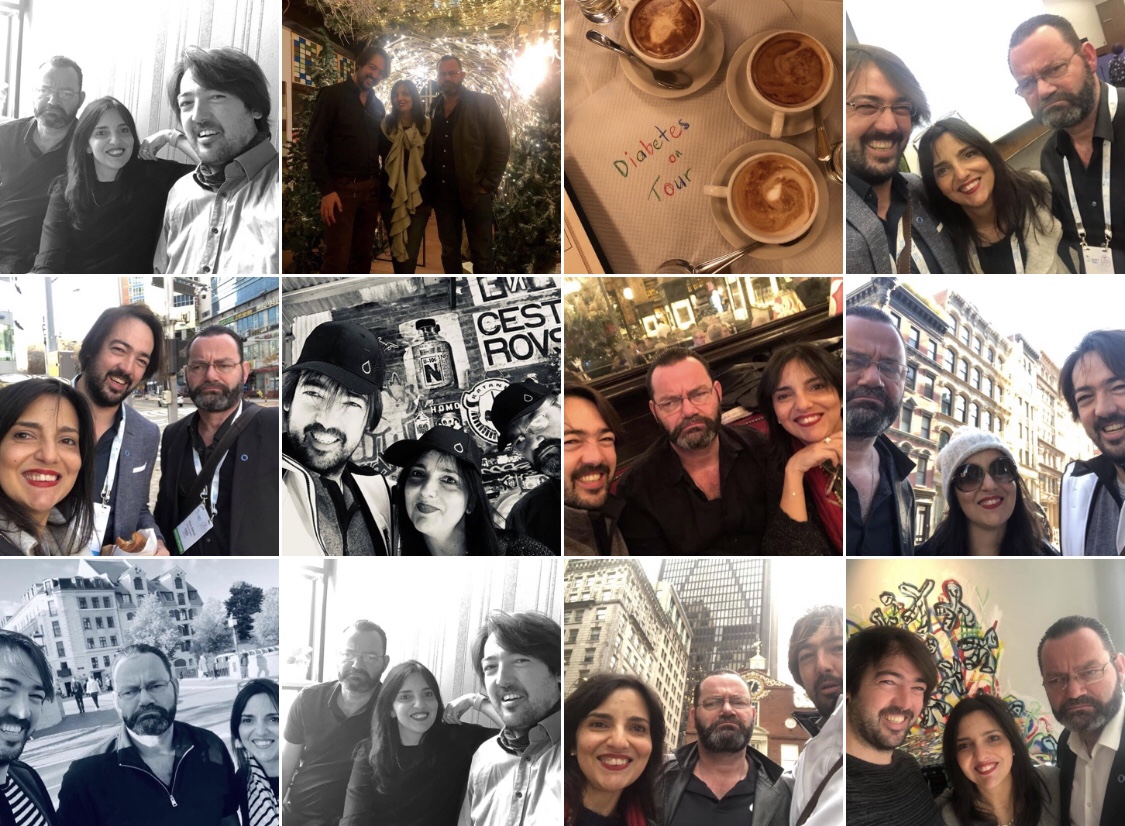
A special shout out to these two peers and dear, dear friends: Bastian and Grumps. We saw each other an inordinate number of times this year, literally all over the globe, travelling on planes, trains and automobiles for our #DiabetesOnTour. I do think we should launch a calendar of the 2020 pics. (Admittedly, we may be the only ones remotely interested in that idea.) When I talk about my diabetes tribe, it’s friends like these two. We’ve celebrated through some pretty amazing things this year, stood up to elevate the lived experience over and over, and also counselled each other through the tough bits. We’ve held post-mortems of long days, sitting in hotel foyers and bars, trying to make sense of what has happened, working out how to always improve, and plotting and planning more and more and more. I am so grateful to them for being the scaffolding holding me up when I’m away from home and feeling overwhelmed.
So, now the reason for that elevated exhaustion…
When I first wrote about advocacy burnout back in January this year, I had no idea at the time that it would set the scene for a difficult and sometimes troubling theme for the year. I get tired and overcome at times throughout the year, but 2019 was different and I’m not really sure why.
There were moments this year where I did honestly wonder how much more energy I have to stand up over and over again to a lot of what I was seeing. I don’t like using war and battle analogies in diabetes, but I did feel that I was fighting a lot of the time. Diabetes advocacy is a tough gig to begin with. Adding burnout on top of it makes it seem shattering.
Being attacked by HCPs for daring to voice my thoughts and challenge their behaviour, or getting it from certain, more confrontational parts of the diabetes community, or having industry reps tell me I don’t know what I’m talking about for daring to suggest that maybe their lame attempts to simulate diabetes in gameshow-style gimmicks at conferences could be better directed at actually engaging and listening to PWD all added up.
Or perhaps it was the repeated examples of ‘diabetes for laughs’…and realising that we are a long way away from HCPs truly being allies in our daily encounters with stigma.
Or perhaps it was feeling that we needed to justify just how important the #LanguageMatters movement, and the decade of work we’ve done really is. I can’t even begin to tell you how upsetting this little incident was.
It added up and several times I’ve felt overcome. I feel like that today. Which is disappointing because on measure, the highlights, the positives and the amazing community should overshadow the negative encounters.
And that is why I’m taking a break from Diabetogenic. I need some time away from feeling as though I want to analyse what is going on and comment on it. I have a wonderful holiday planned with my gorgeous family where we will see friends and wander wintery streets, rugged up in pompom hats. And then, will warm up once back in Australia to finish recharging my seriously diminished batteries, ready for a new year that’s already shaping up to be so, so busy.
Until then, I hope you have a wonderful holiday season, celebrating however you see fit. Thanks for popping by. And I’ll see you in 2020, clapping my hands and raring to go!





 Diabetogenic