
You are currently browsing the category archive for the ‘Communication’ category.
When I talk about the highs and lows of diabetes it’s not just the rollercoaster of numbers. I wrote yesterday about feeling a little low and overwhelmed after a particularly gruelling day. Today, however, I’m on an absolute high after a busy night, or rather, early morning, giving two talks at the ISPAD conference.
docday° was a little different this time, in a truly brilliant way. It was the first time that the event was on the scientific program of a conference, meaning that it was easier for conference registrants to attend. Having a program session that is truly led and designed and features PWD, elevates the standing of lived experience.
The docday° program highlighted some of the topics very close to the hearts of many people with diabetes. Emma Doble from BMJ spoke about working closely with the docday°voices team to publish stories written by individual and groups of people with diabetes. How fantastic to see the words and lived experience feature in such a prominent medical journal!
I touched on language and diabetes – the first talk on the topic for the conference for me. Steffi Haack gave a beautiful talk about peer support and touched on what we get from being in a community of others with diabetes can offer. Steffi managed to perfectly capture the essence of what the community can offer, while also discussing why it’s not necessarily perfect. And we finished with Tino – Tinotenda Dzikiti – from Zimbabwe talking about access and affordability of diabetes medications and treatments. Tino has been a standout advocate in the dedoc voices program, and I make sure to take any chance I get to listen to him.
After docday°, I was an invited speaking in the Psychosocial Issues in Diabetes Symposium which involved an incredible panel of speakers including Rose Stewart from the UK and Korey Hood from the US. Rose spoke eloquently about the importance of integrating psychologists into diabetes care teams, and Korey provided some terrific tips about dealing with diabetes burnout. I followed the two of them (not daunting at all…!) to talk about the language matters movement in diabetes, starting with a reminder that we are talking about more than language – and it’s certainly more than just specific words. It’s about communication, attitudes, images used, and behaviours.
The way that I speak about language these days is different. I think that at first, I spent the majority of the time explaining what it was all about. These days, there seems to be enough ‘brand awareness’ in the community about language matters and that means being able to home in on some of the more nuanced aspects of it.
And so, while I still talk about words that I (and from research we’ve done, others) consider problematic (‘compliant’ is the one that I like to highlight), I spend more time talking about the image problem diabetes has, and about the trickle-down effect language has had on shaping that image.
I point out that there are people who think that language is not all that important in the grand scheme of things, and that there are more important things to worry about in the diabetes world and I very much understand that. I also understand that people have different focuses. But when I ask people what those important things are, they include issues such as research for a cure and better treatments, better access, more education. And then I can’t help but see and think about how research is less because of the image problem about diabetes. That treatments and a cure need governments to prioritise diabetes when it comes to their research dollars and individuals need to give generously when there are funding drives.
But because diabetes is seen as something not serious, and that people are to blame for their own health condition, we are not seeing those dollars coming our way.
It never is and it never was about picking on certain words; it has always been about changing attitudes. Because that is what will change diabetes’ image problem.
I am an advisor to the #dedoc° voices program. I do not receive any payment for this role.
As an invited speaker at the #ISPAD2021 annual meeting, I was given complimentary registration for the conference.
I am helping organise the Diabetes Australia Global Language Summit, and will be hosting the panel discussion.
I’m a huge fan of New Yorker cartoons, (clearly – they’re littered throughout this blog!), and the artists that make real life situations come to life using humour, satire and more than a little cynicism.
Sometimes I hoot out loud at the sheer brilliance of what I am seeing. Other times I smile wryly. This time I gasped in absolute shock and horror. And familiarity.
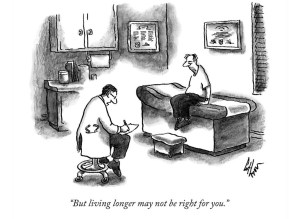
It’s from February 2016, and seems to have been frightfully prophetic for our COVID times. As ‘underlying conditions’ has become barely-concealed code for ‘half dead anyway’, artist, Frank Cotham seems to have had a futuristic glimpse into the 2021 minds of conservative politicians and commentators.
Stay strong, my friends with diabetes and other underlying conditions. You matter. We all do. And living longer absolutely is right for us.
I probably should stop thinking of my job as ‘my new job’. I’ve been at Diabetes Australia now for well over five years. But for some reason, I still think of it that way. And so do a lot of other people who often will ask ‘How’s the new job?’
Well, the new job is great, and I’ve enjoyed the last five years immensely. It’s a very different role to the one I had previously, even though both have been in diabetes organisations.
One thing that is very different is that in my (not) new job I don’t have the day-to-day contact with people with diabetes that I used to have. That’s not to say that I am removed from the lived experience – in fact, in a lot of ways I’m probably more connected now simply because I speak to a far more diverse group of people affected by diabetes. But in my last job, I would often really get to know people because I’d see them at the events my team was running, year in, year out.
Today, I got a call from one of those people. (I have their permission to tell this story now.) They found my contact details through the organisation and gave me a call because they needed a chat. After a long time with diabetes (longer than the 23 years I’ve had diabetes as an annoying companion), they have recently been diagnosed with a diabetes-related complication. The specific complication is irrelevant to this post.
They’ve been struggling with this diagnosis because along with it came a whole lot more. They told me about the stigma they were feeling, to begin with primarily from themselves. ‘Renza,’ they said to me. ‘I feel like a failure. I’ve always been led to believe that diabetes complications happen when we fail our diabetes management. I know it’s not true, but it’s how I feel, and I’ve given myself a hard time because of it.’
That internalised stigma is B.I.G. I hear about it a lot. I’ve spent a long time learning to unpack it and try to not impact how I feel about myself and my diabetes.
The next bit was also all too common. ‘And my diabetes health professionals are disappointed in me. I know they are by the way they are now speaking to me.’
We chatted for a long time, and I suggested some things they might like to look at. I asked if they were still connected to the peer support group they’d once been an integral part of, but after moving suburbs, they’d lost contact with diabetes mates. I pointed out some online resources, and, knowing that they often are involved in online discussions, asked if they’d checked out the #TalkAboutComplications hashtag. They were not familiar with it, and I pointed out just how much information there was on there – especially from others living with diabetes and diabetes-related complications. ‘It’s not completely stigma free,’ I said. ‘But I think you’ll find that it is a really good way to connect with others who might just be able to offer some support.’
They said they’d have a look.
We chatted a bit more and I told them they could call me any time for a chat. I hope they do.
A couple of hours later, my phone beeped with a new text message. It was from this person. They’d read through dozens and dozens of tweets and clicked on links and had even sent a few messages to some people. ‘Why didn’t I know about this before?’, they asked me.
Our community is a treasure trove of support and information, and sometimes I think we forget just how valuable different things are. The #TalkAboutComplications ‘campaign’ was everywhere a couple of years ago, and I heard from so many people that it helped them greatly. I spoke about it – particularly the language aspect of it – in different settings around the world and wrote about it a lot.
While the hashtag may not get used all that much these days, everything is still there. I sent out a tweet today with it, just as a little reminder. All the support, the connections, the advice from people with diabetes is still available. I hope that people who need it today can find it and learn from it. And share it. That’s one of the things this community does well – shares the good stuff, and this is definitely some of the good stuff!
Want more?
Check out the hashtag on Twitter here.
You can watch a presentation from ATTD 2019 here.
Read this article from BMJ.

There are two boxes on my desk today because I am recording a little video for a new series at work. In my diabetes store cupboard, there are lots of boxes from currently using and past diabetes devices and products.
These boxes all contain promises and hope – promises to make diabetes easier and the hope that some of the significant time dedicated to something that no one really wants to dedicate time to is gained back.
Burden is very personal. One person’s significant diabetes burden is another’s mild inconvenience. Some look at a CGM and see life changing and lifesaving technology and others see a nagging device of torture. I vacillate between the two trains of thought.
No diabetes device is perfect and does all things. Most rarely even do what they promise on the box.
And yet when we look online often all we see is the perfect stuff. With diabetes tech companies getting smart and becoming all social media savvy, they have looked to the community to see how we communicate and share. It’s not a silly thing to do. Many of the decisions I’ve made about diabetes tech choices have been based on what my peers have to say. But I’m selective about who I search for when looking for those personal experiences and testimonials. I look either for people I kind of know, or people who have a history of being open and honest and real about their experience.
I’d make a lousy ambassador, even though I am asked almost daily to either become an ambassador for a company or promote their product, with lots of free stuff thrown in. Some offer payments. Sometimes I agree to try something, but there are never any strings attached, and while I will accept the product, I will never be paid for using it, or for writing about it. (You can see that in my disclaimers when talking about product. I always say that I’m sharing because I want, not because it’s part of the arrangement for me to use gifted or discounted product. I’ve never done that.) That’s not to say that I have not had arrangements with different companies and been paid an honorarium for my time and expertise, but that is always in the capacity of being an advisor, or consultant.
I’m too honest about the challenges of different diabetes technologies – you bet I love Dtech, but not everything about all of it! It’s why I am always wary of anyone spruiking any diabetes product who has only positive things to say. In the last 20 years, I’ve used or tried pumps from Medtronic, Cozmo, Animas, Roche and Ypsomed. I have loved them all. And hated them all. I’ve never had only good things to say about any of them – even the Cozmo which remains my favourite ever pump, and anytime I see one, I have strong happy feelings of nostalgia…but despite that, it still had its failings that I spoke about often when I used it.
I’ve used CGM products from Medtronic, Dexcom and Libre and had few good things to say about some generations, better things to say about others, but never loved every single aspect of any of them. Because there is always something that isn’t perfect, or even almost perfect.
And finally, I’ve used countless blood glucose monitors from every brand in Australia and some I’ve picked up on travels, and it’s the same deal: love some things, drop the f bomb about others.
The times I have been gifted products, I have always been honest when talking about them, highlighting the pros and cons. Even though I always write about the positives and negatives, I’ve always urged people to read or listen to whatever I have to say understanding that there is a lens of bias with which I see them through. Of course there is, and others should consider that. I also know I have never consented to having anything I’ve said or written reviewed or amended by the company who has kindly gifted product, or have I promised to do a certain number of posts or tweets or Insta pics about them. The sharing I do is always on my terms as are the words in those shares.
I have, however seen many contracts these days that are very prescriptive when it comes to the expectations and commitments of the people being given product. I don’t have an issue with that; I couldn’t care less really. But I don’t think that simply putting the words #Ad on a post gives people the true picture behind the arrangement in place, which is important for the reader if they are to consider just what bias could be at play when reading someone’s opinions.
I am always pleased when I see that industry is engaging with PWD. There should be clear lines of communication, and hearing what PWD say is critical – far more so, in my mind, than what the shiny brochures have to say. But just as I read what the company’s PR messaging has to say with some scepticism, I do the same when I am not clear of the pact between the company and the PWD.
Diabetes devices rarely, in fact, I’d go so far as to say NEVER, do all that they promise on the box. I think I’ve known that all along, but it wasn’t until I started using something that doesn’t come boxed up in sparkly, fancy packaging that I truly realised just how much that wasn’t true.
Those promises to do less diabetes – to reduce that burden – was only ever true to a small degree. And sometimes, there was added burden that you could only truly learn about if you knew where and how to access others with diabetes, in particular those that didn’t sound as though they were simply regurgitating what the brochures said.
Using an out of the box diabetes tech solution isn’t all perfect. There are somethings about DIYAPS that annoy me. A red loop on my Loop app can be frustrating – even if it’s a simple fix. Needing to carry around an OrangeLink and making sure it’s in range gets irritating. Not having a dedicated 1800 number that I can call 24/7 and handing over any concerns to someone else means that the troubleshooting burden falls squarely on my shoulders – even if there is a community out there to help me through.
And yet, even with all that, it is the first time ever that I have been able to say that I do less diabetes. How much less? Well, I think that Justin Walker’s assessment from a presentation at Diabetes Mine’s DData event back in 2018 is right. He said that using a DIYAPS has given him back an hour a day where he no longer needs to think about diabetes.
Last week, I hit four years of Looping. That’s 1,460 hours I’ve clawed back. Or over 60 days. If DIYAPS came in a box (and with a PR machine and marketing materials) and it promised me that, I wouldn’t believe it based on previous experience. But I guess that’s the thing. There is no box, there is no marketing juggernaut. It’s just the stories of people with diabetes who have worked through this and worked it out for themselves.
An out of the box marketing solution for an out of the box diabetes technology solution. I’ve never trusted anything more.
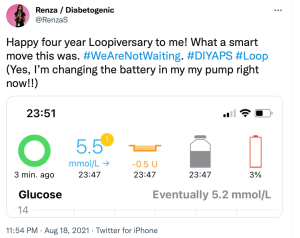
Often when we talk or read about technology it is very much about the latest, newest, shiniest devices. And yes, I wrote about those last week. There’s nothing wrong with learning about latest tech releases, or desperately wanting to get your hands on them.
But the devices are only ever half the story. And that’s why it was so great to see that in amongst all the data and the new things, was a presentation that reminded everyone watching the technology symposium at ADC that the data belongs to people and the devices are worn on the bodies of those people.
This is the whole warm hands, cool tech concept that is often missing when we hear about technology. The devices are not inanimate, they need human interaction to make them work for … well … for humans.
I despair at some of the stories we hear about technology and people with diabetes. Some talk experiences that have left them feeling like a failure when the tech has simply not been right for them. Because that is the way it is posed. If we decide the tech doesn’t suit us, hasn’t worked for us, hasn’t helped us achieve our goals, we’ve failed it.
The truth is, it’s more likely that the failure – if we need to frame it that way – is not the PWD at all. It’s more likely that the tech is not right for the person, and there wasn’t enough assistance to help navigate through to choose the right tech. Or the education was insufficient, or not tailored for the PWD, or not interesting, or not relevant (more on that soon, from Dr Bill Polonsky’s opening plenary from the conference). It is possible that the timing wasn’t right, the circumstances were not optimal, not enough conversations about cost or effort required … whatever it is, none of the blame for something not being right should be placed on the PWD.
When we look at diabetes education, or engagement with healthcare professionals, the stories that are celebrations or considered successes (from the perspective of the PWD and, hopefully, the HCP) show the right recipe. The ingredients will all be different, but the method seems to be the same: the person with diabetes is listened too, time is taken to understand what is important for them, the PWD’s priorities are clear, and goals are realistic and checked along the way. The end results are not necessarily based on numbers or data points, but rather, just how well the person with diabetes is feeling about their diabetes, and if anything new has added to their daily burden. Reviews are focused on successes more than anything else.
My favourite ever diabetes educator, Cheryl Steele, gave an outstanding presentation on how HCPs can best work with people with diabetes to ensure we get the most from our technology.
I spoke with Cheryl after her talk (you can watch the video of our chat for Diabetes Australia at the end of today’s post), and she laughingly said that she could have said the most important things she wanted to say in 2 minutes, and with one slide that basically just said that HCPs need to be truly person-centred and listen to PWD.
But thankfully, she spoke a lot more than that and covered a number of different topics. But the thing that got to me – and the thing that I hope the predominantly HCP audience would take home and remember – was Chery urging her colleagues to focus on the positives.
Cheryl said, ‘The emphasis has to be on what you’re doing well’ and I feel that is a wonderful place to start and end healthcare consultations. I think about experiences where that has happened to me. Such as the time I went to my ophthalmologist after a few years of missing appointments and his reaction to seeing me was not to tell me off for not showing up previously, but instead to welcome me and say it was great I was there. I’ve never missed an appointment since.

How many PWD reading this have stories to share of times when they went into an appointment with data and all that was focused on was the out-of-range numbers? There are countless stories in online diabetes groups where HCPs have concentrated on the 10% out of range numbers rather than the 90% in range. Actually, even if only 10% of numbers were in range, that is 10% that are bang where they need to be!
Perhaps that’s what’s missing from diabetes appointments. Gold stars and elephant stamps!
There is something devastating about walking into an appointment and the first, and sometimes only, thing that is on the HCPs radar is numbers that are below or above the PWD’s target glucose range. I’ve sat in those appointments. I know the feeling of walking in and feeling that I’m tracking okay, only to have none of the hard work I’ve managed acknowledged and instead, only the difficulties addressed.
But then, I think about one of the first experiences with the endocrinologist I have been seeing for twenty years. Without judgement, she acknowledged that I wasn’t checking my glucose much, and asked if I felt that I could start to do one check every Wednesday morning when I woke up. I said that it seemed like such a pathetic goal to set, but she gently said, ‘One is more than none’. The focus was not on what I wasn’t achieving. It was on what I could.
What a wonderful motivator that is.
Disclosures
Thanks to the Australian Diabetes Society and Australian Diabetes Educators Association, organisers of the Australasian Diabetes Congress for complimentary registration to attend the conference. This gave me access to all the sessions.
I work for Diabetes Australia and the video shared is part of the organisations Facebook Live series. I am sharing here because is relevant to this post, not because I have been asked to.
As usual, no one has reviewed this piece before I hit publish (which is unfortunate because I could really do with an editor).
A week out from National Diabetes Week, and this piece has been sitting in my ‘to be published’ folder, just waiting. But the post-NDW exhaustion coupled with lockdown exhaustion, plus wanting to make sure that all my thoughts are lined up have meant that I haven’t hit the go button.
In the lead up to NDW I wrote this piece for the Diabetes Australia website. That piece was a mea culpa, acknowledging my own contribution to diabetes-related stigma and owning it. I also stand by my thoughts that the stigma from within the community is very real and does happen.
But what I didn’t address is just where that stigma comes from. Those biases that many people with type 1 diabetes (and those directly affected by it) have towards type 2 diabetes come from somewhere, and in a lot of cases that is the same place where the general community’s bias about diabetes comes from. It is all very well for us to expect people with type 1 diabetes to do better, but I’m not sure that is necessarily fair. I think that we should have the same expectations of everyone when it comes to stamping out stigma.
And so, to the source of stigma and, as I’ve said before, it comes from lots of places. As someone who has spent the last twenty years working in diabetes organisations, I know that the messaging my orgs like (and including) those that have paid my weekly salary has been problematic. I still am haunted by the ‘scary’ campaign from a few years ago that involved spiders, clowns, and sharks. (If you don’t remember that campaign, good. If you do, therapy works.)
For me personally, I don’t think much stigma I have faced has come at the hands of other PWD. Sure, there’s the low carb nutters who seem to have featured far too frequently on my stigma radar, however, the most common source of stigma has undoubtedly been HCPs.
It’s not just me who has had this experience. The majority of what I have seen online as a response to experiences about stigma involves heartbreaking tales of PWDs’ encounters with their HCPs.
While I will call out nastiness at every corner, and no stigma is good stigma, it must be said that there is a particular harm that comes when the origin of the stigma is the very people charged to help us. Walking into a health professional appointment feeling overwhelmed, scared, and frustrated only to leave still feeling those things, but with added judgement, shame and guilt is detrimental to any endeavours to live well with diabetes. In fact, the most likely outcome of repeated, or even singular, experiences like that is to simply not go back. And who could criticise that reaction, really? Why would anyone continually put themselves in a situation where they feel that way? I wouldn’t. I know that because I didn’t.
It’s one thing to see a crappy joke from a comedian who thinks they’re being brilliantly original (they never are) or the mundane, and almost expected, ‘diabetes on a plate’ throwaway line in a cooking show, but while these incidents can be damaging, they are very different to having stigmatising comments and behaviours directed at an individual as is often the case when it is from a HCP.
Of course, HCPs aren’t immune to the bias that forms negative ideas and opinions about diabetes. In the same way that people with type 1 diabetes form these biases because those misconceptions are prevalent in the community, HCPs see them too. Remember this slide that I shared from a conference presentation?
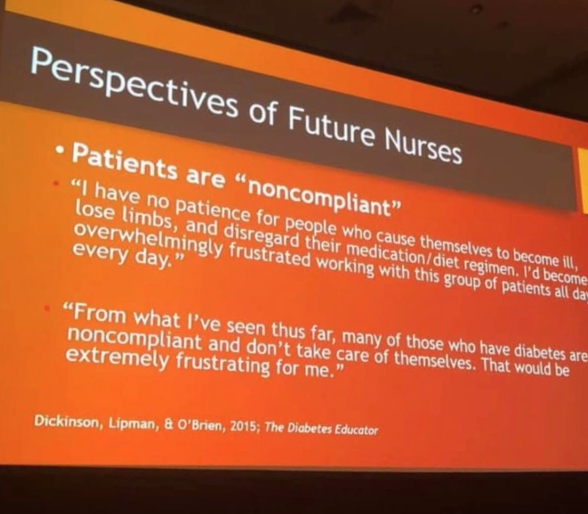
This came from student nurses. Just think about that. Students who were training to be HCPs who would inevitably be working with people with diabetes. A I wrote at the time:
‘They hadn’t even set foot on the wards yet as qualified HCPs. But somehow, their perceptions of people with diabetes were already negative, and so full of bias. Already, they have a seed planted that is going to grow into a huge tree of blaming and shaming. And the people they are trusted to help will be made to feel at fault and as though they deserve whatever comes their way.’
Is it any wonder that, with these attitudes seemingly welded on, that people with diabetes are experience stigma at the hands of their HCPs?
The impetus can’t only be on PWD to call this out. And the calls to fix stigma can’t exclusively rest on the shoulders of PWD – we already have a lot of weight there! It must come from HCPs as well – especially as there is such a problem with this group. Perhaps the first step is to see real acknowledgement from this group of their role here – a mea culpa from professional bodies and individuals alike. Recognising that no one is immune to the bias is a good step. Owning that bias is another. And then doing something about it – something meaningful – is how we make things better for people with diabetes. I really hope we see that happening.
More about this:
Becoming an ally – how HCPs can show they’re really on our side.
As someone who spends far too much time sharing far too many things across far too many online platforms, this Hartley Lin cartoon for the New Yorker hits far too close to home. (But it made me laugh all the same.)

Today I’m talking menopause, because for fuck’s sake, why don’t we do that more?
Actually, I know why. It’s because it’s considered an exclusively ‘women’s issue’ and has been the butt of jokes from male comedians and talk show hosts, and really, who gives a fuck anyway?
This post is likely to continue being sweary, because as I’ve tried to find information on diabetes and menopause it seems that the road is similar to pretty much any other issue about diabetes and women’s health. Sure, there’s quite a bit out there about pregnancy – and you bet I take some credit for that because back in 2001 when I started working in diabetes organisations the very idea of lived experience-led information about diabetes and pregnancy was not typical at all, but we wrote a resource and it is still (in a very updated format) still available) – but it’s up there with trying to find details about women with diabetes and sexual function and sexual health.
I am literally counting down the days until Dr Jen Gunter’s new book, The Menopause Manifesto, makes its way to our bookshelves, because I know it is going to be an absolute wealth of no-bullshit, evidence-based, straight-talking information. Her previous book, The Vagina Bible, (known in our house as ‘The Vible’) delivered that in spades as it busted myths, is easy to read and matter of fact, and suggested just where Gwyneth Paltrow might like to shove her $300 jade eggs (spoiler: not up her, or anyone else’s vagina). I was so pleased that when she mentioned diabetes a few times in her book, the information was spot on. In fact, I think that her explanation as to why women with diabetes may experience yeast infections more commonly was one of the clearest I’ve ever read.
Now, Jen Gunter has turned her full attention to the issue of menopause. This great piece is an excerpt from the book (due out at the end of the month and available for pre-order now), and the part that stood out for me was the bit where she said that often, menopause gets blamed for everything any time a ‘woman of a certain age’ has symptoms they take to their HCP.
Sounds a little familiar, doesn’t it? I guess I’ll have to add ‘Sometimes it’s not menopause’ to my lexicon, right there alongside ‘Sometimes it’s not diabetes’. How easy, and convenient, it is to simply dismiss someone’s concerns simply because there is something easy (and perhaps obvious) to blame it on.
Of course, with diabetes and menopause, there is the bit I have learnt where some of the symptoms of aspects of menopause look very much like the symptoms of aspects of diabetes. Looking into patenting a game called Hypo or Hot Flush in the coming years. I think it might be popular with PWD of a certain age. The winner gets a cold compress and a jar of jellybeans.
Here’s the thing. I’m not actually menopausal. I don’t even know that I’m necessarily peri-menopausal yet. But in the same way that I wanted to know all there was about diabetes and pregnancy before I was ready to get pregnant, I’m trying to prepare myself as much as possible for the somewhat mythical period of menopause. Forewarned is forearmed or whatever that saying is. The problem with that is that there is so little info out there that arming myself is proving a little difficult. And it appears that I am not alone in my thinking.
In much the same way as speaking about sexual health when I’ve found myself in a room with a few of my female diabetes friends (and wine), it seems that once we hit our mid-40s we start wanting to talk about menopause as well, searching out any titbits of information that may just help us know what we need to get ready for. We’re desperate for tips and tricks and a glimpse into what we have in store. And it seems that very few of us is having these conversations with our healthcare professionals.
Lucky for me, my endo has spoken with me about it a little – after I’ve asked. She tells me that the mean age of the start of menopause is 47 years, which is smack bang my age, so I’m expecting to have some firsthand experience soon. And when it comes to sharing that experience, I am already committed to writing about it in a way that moves from the focus on loss that seems pervasive in most of what I’ve read about it – the loss of fertility, the loss of libido, the loss of vitality. #LanguageMatters in menopause too, and the idea that we are writing off those going through it when it’s possible they still have half their life ahead of them sounds a little grim.
So, my question is, what do people with diabetes need to advance discussions around this? What do we want to know? And when and how to we want that information? Is it a matter of just starting to talk about it more in public forums? Do we routinely start asking our HCPs for information so that slowly (because everything in healthcare takes time) it is on their radar? Do we need more research? (Yes, the answer to that is a resounding yes.) Do we need a snappy hashtag? Is that hashtag #HypoOrHotFlush? (No, I think not.)
If you’d like to join the conversation, please respond to this tweet. Or to this post. Or send me a message privately. And I’ll follow up with another post in a few weeks.
Looking for more?
Great post here by DOC legend, Anne Cooper.
Sarah Gatward has written a terrific series of her experiences of menopause on her blog here.

I want to acknowledge that not only women experience menopause. Thanks to this brilliant website, Queer/LGBTQIA+ Menopause, that I kept referencing today, which provides fantastic advice for how to speak about menopause to capture the experience of people who are not cisgender and/or not heterosexual.
Back when I first started writing and talking about diabetes language matters, it didn’t seem to be all that contentious an issue. I had been following with great interest how this discussion played out among people with diabetes, and it was super clear to me back then that there wasn’t a one size fits all approach or way of thinking. Some people were interested, some couldn’t have cared less. It was accepted that there would be different opinions and attitudes with different people. I know, how completely unexpected, because in every other way, people with diabetes are a tidy, identical, homogenous group who agree on EVERYTHING! #SarcasticFont
Many, many, many years down the track, more and more people are buying into this topic of conversation, which leads me to think that language does, in many ways, matter. To lots of folks.
Which is why it’s frustrating – and problematic – how fixated this discussion can become on specific words. That, I believe, is the problem with #LanguageMatters.
When I think about why I became so interested in this issue, I’m really clear why it mattered to me. It wasn’t about manners. It certainly wasn’t about suggesting that people with diabetes (that’s my preferred terminology, but you do you!) be told how to speak about the health condition we own.
To me, it never was about individual words. It was about words, broadly. It was about images used to accompany diabetes discussions. It was about attitudes. It was about behaviour. It was about addressing the image problem that diabetes (still) has. It was about changing the mindset that it’s okay to use diabetes and those of us living with it as a punchline. It was about shifting the public perception about diabetes. It was about people with diabetes not feeling ashamed to do their diabetes tasks in public. It was about elevating our health condition to the same level as other health conditions. It was about people with diabetes being respected. It was about stopping blame and shame and stigma. It was about people with diabetes deciding and directing how their own brand of diabetes would be discussed by those around them.
It was always about communication as a whole – communicating to and about people with diabetes.
And yet, with all that in mind, so many online discussions that I see still want to reduce this big body of work to: ‘But I want to call myself a diabetic.’ If someone said that to me, which some people certainly have, my response has been, ‘Okay, cool. You should definitely do that then!’
So why does THIS seem to be the particular tiny, infinitesimal, microscopic, miniscule part of the whole language discussion that some people keep coming back to?
I’ve started to wonder what are their motives behind focusing on this issue? When I see someone, especially someone who’s been around for a couple of years and who everyone knows has been part of these discussions before, start with the PWD vs diabetic debate, I wonder if they’re trolling. They know it will get a response. They know it’s likely there will be disagreements. There are some super savvy people on social media out there who know that asking this question, or even just mentioning it will get a reaction – every single time – and it might even add to their follower count. I guess that some people think that’s currency.
But really, all it seems to do is narrow and diminish the broader discussion. These days, when I am asked to give a talk on language and diabetes, I dedicate one slide and about 45 seconds at the beginning of my talk to get the diabetic / PWD issue over and done with, and then focusing on what I want people listening to the presentation to take away with them.
I don’t know how or when the diabetes #LanguageMatters hashtag started. It wasn’t the name of the first language position statement, but it certainly has been used for a very long time, and been associated with the global movement that has its foundations very firmly rooted in the diabetes community – even before the advent of the DOC, because this discussion has been happening for long before our community moved into online spaces.
The problem with using #LanguageMatters is that it is too often drawn into being about one tiny part of the whole big issue. But it seems that #LanguageMatters is here to stay with a whole lot of material and dialogue and debate behind it – a lot of which is making a huge difference to the way people feel about their own diabetes. So, what a shame that it so often gets minimised to something that is only one little part of it. What a shame that some people knowingly fuel the fire and the arguments that ensue by bringing up diabetic/PWD again. What a shame that this really important, really BIG issue is reduced to something quite tedious.
Perhaps we should have gone with #CommunicationMatters to signpost that it wasn’t about specific words. Perhaps we should have gone with #AttitudesMatter to bring in how language adds to attitudes of stigma and blame Perhaps #BehavioursMatters would have addressed how body language and other behaviours can be just as important as verbal language.
Or perhaps we should have used all of them because, really, #ItAllMatters.

You can read read more on my frustration about this issue in this post (and frequently on my Twitter feed).





 Diabetogenic