
You are currently browsing the category archive for the ‘Awareness’ category.
Today, I gave a talk to healthcare professionals at a hospital in outer Melbourne. I was invited months ago after the organisers heard me speak at another event, and they wanted me to speak about living with diabetes.
As I said in the introduction to my talk, I am dead boring. Plus, I am only one voice. So, to create some balance and some interest, I reached out through Facebook and asked this:

As usual, the online community didn’t disappoint. I had over forty responses and weaved them into my presentation, adding real impact to what I was saying, reinforcing my comments with the comments of others walking a similar path of life with diabetes.
I started by asking the audience a question…
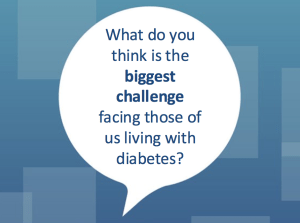
And then I said that I would be talking about life with diabetes. Except, I reminded the audience that life with diabetes was very different depending on where in the world you were diagnosed and that my story is about my ‘first world diabetes’ and I checked my privilege almost as a disclaimer.
I used that point in my talk as an opportunity to speak about those who cannot access or afford insulin and how this is simply, not okay. I could sense the surprise in the room as I said that people are dying because of lack of access.
Then I spoke about what diabetes is to me and here is what I said:

It’s boring and tedious and frustrating.

It’s made me an expert. And that we need our HCPs to acknowledge the hours and hours and effort we put into managing our own brand of diabetes and the expertise we develop from living so closely with this condition.

It’s about humour – because laughing is a tool I use to get through this and that’s okay.
 It’s about words, because language matters and sticks with us forever.
It’s about stigma. I asked if they could think of another condition that was so stigmatised and surrounded by blame – and that while we experience it with type 1 diabetes, I said that I believed my brothers and sisters with type 2 diabetes have it so much worse.

It’s invisible – despite the bright blue patch surrounding my Dexcom, most of the time it is hidden away and not on show for all to see.
It’s about people and community and the DOC and the people that are like the air I breathe – without whom I would not be managing at all.

It’s about my family. And then I explained, fighting back tears, that this is the hardest part of life with diabetes for me. I’ve written about it a lot, spoken about it often. But thinking about how diabetes impacts on Aaron and the kidlet breaks – absolutely shatters – my heart into pieces. The worry I cause my parents makes me feel guilty and resentful. And every day I regret the time I told my sister that my life expectancy had been cut thanks to my type 1 diagnosis because I will never forget the look in her eyes indicating the pain I had just caused her.
I answered a couple of questions and then my talk was done. I thanked the audience for listening, stepped down from the stage, took a deep breath. Someone came up to me as I was gathering my bags and said that she learnt more about real life with diabetes in that talk than in all her years nursing.
This is the power of story telling. The comments I read out and shared have so much power in them. We need to keep telling our stories, turning the way we talk about diabetes on its head. It’s not about the numbers, the tools or anything else. It is about people.
Thank you so much to everyone who shared their comments with me on my Facebook post yesterday and today.
What a week. World Diabetes Day (WDD) is over for another year, but there is still lots going on in the diabetes space and in my life in general. Here are just some of the things making my brain a minestrone soup of dot points.
Mayo Clinic in Oz
I was lucky enough to win a scholarship to attend the Healthcare and Social Media Summit run by the Mayo Clinic earlier this week. I haven’t even started to pick apart all the amazing things I learnt during those two days, but there will be more to come soon.
Crown
Downtime is bloody hard to come by these days (because: November). BUT!!!! Binge watching a new show helps with some mindless entertainment and winding down at the end of the day. And Netflix has come to the rescue with The Crown. I admit that this is just a space filler until the REAL EVENT…But in the meantime, it will do and is actually super enjoyable.
Talking diabetes without being rude
We often see ‘Things to not say’ lists. I wrote one here where I suggested the only thing to say to someone living with diabetes was to offer them a Nutella cupcake.
I still stand by that advice, however thought I’d use WDD as an opportunity to write a more comprehensive list and it was published on the Mamamia Women’s Network. You can read it here – and may want to consider sharing it widely.
One of the things that we need to aim for is talk diabetes OUTSIDE our diabetes world. This article was not written for people affected by diabetes – we already know to not say most of these things. It is for those who say the annoying things because they don’t really understand diabetes.
So – have a read. And then share it around. And add your own ideas in the comments section on the Mamamia page. Let’s see just how far this can go to stopping some of the comments we hear over and over and over again!
Gilmore Girls
One week to go. We are ready!

WDD Twitter Marathon
The force of nature that is Cherise Shockley managed to pull off (once again) a 24 hour tweetchat for World Diabetes Day that included moderators and participants from all over the globe with an impressive variety of topics.
There was a bit of national Aussie pride in there with 4 hours of the chat being moderated by advocates from Down Under. I moderated an hour – with a focus on diabetes stigma – at 5pm ET which was 9am (Wednesday 15 November) AEDT, meaning I was into hour 27 of WDD when it was my turn to ask the questions.
Blue fatigue
My hand is a pretty damn good indication of how I am feeling right now. Still hanging in there with the whole ‘go-blue-diabetes-awareness-rah-rah-rah’ thing, but only just. Half way through Diabetes Awareness Month; World Diabetes Day is over and I am really feeling a lot of blue fatigue.

It seems that I am not the only one. Kerri wrote this on Six Until Me the other day and it resonated with a number of people, me included.
But the people; the people!
I was lucky enough to spend World Diabetes Day with some great diabetes people. We had house guests from Germany with us and my neighbour Jo popped in for a bit too. And my Amazing family were also there and, you know what, we hardly spoke diabetes at all!

It reminded me that my diabetes world is about people – those I’ve met; those who support me through it all; those I connect with online and in real life. And I know that I couldn’t do this without them to help me through.
#IFLGseesawchallenge
And finally, diabetes is such constant balancing act, and I don’t know about you, but I rarely manage any semblance of equilibrium!
So, I love the Insulin for Life Seesaw campaign – as both a metaphor for diabetes and also as a way to raise funds for an important cause.
Get involved by uploading your photo depicting the seesaw challenge of living with diabetes. Add the tag #iflseesawchallenge to your pic and Medtronic Australia will donate $1.25 to Insulin For Life Global. $1.25 is the amount it costs to transport a week’s worth of insulin to someone in need in a developing country.

Yesterday, I went to the fridge and pulled out a fresh vial of insulin. I used it to refill my insulin pump and then placed the mostly-full vial in my bag. As it was the second to last vial from my current prescription, I called my local pharmacy and asked if they could order me in a repeat of my prescription.
And then I wandered to a favourite café for breakfast and didn’t think about it again. I knew that the following day I’d receive a call from the pharmacist telling me that my insulin was waiting for me and I’d go in on my way home from work, fork over $40 and be set for another three or so months.
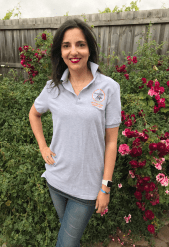
Rocking my new Insulin for Life Global tee. So honoured to be an ambassador for this worthy cause.
That’s not how it works in a lot of other places around the world. And it’s why when I was contacted by Joanna Sader from Insulin for Life Global asking me to be an Ambassador for the organisation, I didn’t hesitate before answering ‘Of course!’
Insulin for Life has been around for a long time. I remember when I was very new to the diabetes organisation world hearing all about it from the organisation’s founder Ron Raab. And then, a couple of years ago, I saw a wonderful documentary, Sweet 16, about the program, made by a young woman from Canada.
The organisation has continued to expand over the years, and today, on World Diabetes Day, is launching Insulin for Life Global (IFL Global). The organisation contributes to international efforts providing insulin to people unable to afford or access insulin or diabetes supplies in developing countries.
IFL Global, through its country affiliates, collects in-date and unneeded insulin and diabetes supplies, distributing them to developing countries, where they are distributed free of charge. It also fundraises to support transport costs, which is the biggest barrier to keeping the operation going.
You can learn more about the program by going to their new website and by watching the video below.
How can you help? Glad you asked! There are many ways you can get involved including making a one-off or regular donations, promoting their work through your networks or donating unused, in-date insulin and diabetes supplies. Details about how you can contribute to IFL Global can be found here.
I write a lot about remembering to look outside our bubble of privilege. Insulin for Life Global is another player in the space reminding us that diabetes drugs and supplies are not a right for all. And we can – and should – do something to help. Our diabetes brothers and sisters around the world do not deserve to die because they cannot access the life-saving drugs so many of us take for granted.
A couple of weeks ago, I spent a very uncomfortable hour talking to someone who was telling me that the very idea of sending any sort of health aid to another country was horrendous because the situation here in Australia is so dire. They went on to say that the refused to support programs helping people in other countries access insulin and diabetes supplies because that was the responsibility of the government of that country.
I’ve thought about the conversation a lot. And then today, on my TimeHop app, this post from last year came up. I wish I had remembered these words then because I sat there mute after trying to explain why it’s important that we help others who are not as fortunate as we are here in Australia and being cut off and told I didn’t know what I was talking about. I decided that there was simply no point in trying to argue.
So today, I thought I’d share the post. Remembering to look outside our own bubble is always important, And today -especially today – it seems even more critical.
_____________________________________________________________________________________
I speak a lot about the challenges of living with diabetes. Sometimes, the challenges don’t directly relate to me, but I can still see and understand that the diabetes experience is different to anyone and one person’s easy-peasy-lemon-squeezy is another person’s anxiety- and stress-inducing concern.
One of the things that perplexes and annoys me is people who are unable to see diabetes outside of their own bubble. Frequently these people fail to see that just because they don’t need information about <insert topic here> that doesn’t mean everyone has access to or an understanding of it.
Sometimes, when I was involved in running an activity or speaking about a topic at an event, people say that they have never had any problems with that, so why would we speak about it – completely ignoring the fact that for lots of people living with diabetes this is an issue that is of concern.
I ‘work in diabetes’ (which sounds ridiculous, but you know what I mean) and the last person’s diabetes that gets considered when I am at work and thinking of developing programs is my own. If I thought, for one minute, that my experience of living with diabetes mirrors most others, then I’d be utterly naïve and not doing my job. That’s why working and engaging with, and listening to as wide a range of people affected by diabetes as possible is critical to delivering services that are of use.
(Because, let’s be honest, if it really were all about me, I’d spend lots of time and effort working with the leather crafters at Hermes to help me design a perfect diabetes bag. Because: shallow. And lots of stuff.)
And you know if you just rolled your eyes at that last comment because you have found (or designed) the perfect bag and think it is waste of time to speak about it because it doesn’t affect you, then a) stop it, and b) can you tell me where to get one? Thanks.
With World Diabetes Day next week, it’s a great time to think about how others deal with diabetes, what they know, what they don’t, what their concerns may be.
If I only cared about what was going on in my diabetes bubble, I wouldn’t write so much about campaigns like #Insulin4All. You can read all about the campaign here, and my post about it during the lead up to 2014’s WDD.
I have never had trouble accessing insulin. But that doesn’t mean that I don’t care about those who do.
It’s day four of Diabetes Awareness Month and I am feeling a little burnt out. Already.
My social media feeds have been washed in blue; it’s Friday and I am in head-to-toe blue, and my kid went off to school today wearing blue pom poms in her hair and a blue circle pinned to her school shirt.
My inbox is full of requests to promote a new awareness initiative or to fund a new campaign, and I am preparing for talks I am giving throughout the month where I will be speaking about real life with diabetes, or the importance of including people with diabetes in the development and running of programs and services for us.
Buildings will be lit up in blue, the media will be (mis)reporting diabetes and there will be blue everywhere. Blue. Blue. Blue.
Yeah. It’s Diabetes Awareness Month.
I’ve been thinking back to my diagnosis and how I thought my life with diabetes was going to turn out. I was promised a cure when I was diagnosed eighteen and a half years ago: ‘There will be a cure in five years – ten at the most.’ I believed it. I really believed it. And I figured that I could manage this diabetes palaver for five years – ten at the most.
Where is my cure?
I write about progress and my excitement at diabetes technology and how it has absolutely changed my life. In my (relatively short) time with diabetes I have been the beneficiary of these new technologies, of better insulins, of smart devices, of support programs, of outstanding education. I am one of the lucky ones.
And yet my cure seems as elusive today as it did when I was diagnosed – in fact more so, because now…now I don’t believe it will be here in five years – ten at the most.
I feel ungrateful even asking for it – I have access to everything I need to manage my condition. My life with diabetes is good. I even had a kid with this stupid condition doing everything in its power to stop that happening. And, let’s be honest, I’ve made a career out of it too.
I write here about the trials and tribulations of this condition, but I know that I am mostly preaching to the converted – those who know what I mean when I write words of daily frustrations, celebrations, victories and annoyances. And that’s okay. You are my tribe and I love you hard – I really do.
But those outside our world don’t know it, and they see me and think it is all okay.
It’s not. It’s not okay for me in my ridiculously privileged diabetes world. And, even more so, it is not okay for people who die because they can’t access insulin. It is not okay for people who struggle so much with the daily tasks of this condition that they can barely raise their head from the pillow. It is not okay for those who feel so stigmatised by diabetes that they refuse to tell anyone about it for fear of retribution and shame. It is not okay that diabetes is a punchline for every piss-poor comedian.
And it’s not okay that there is no cure. I can close my eyes and instantly be transported back to the room where I had my first insulin injection, and I can see the endocrinologist and hear his voice and the words I no longer believe. ‘There will be a cure in five years – ten at the most.’ No. No there won’t.
I have written (frequently) before about T1 International and I am going to do it again this Diabetes Awareness Month.
Because the team at T1International have a new initiative: they are urging people to sign their Type 1 Diabetes Access Charter which outlines five rights that all people with diabetes should have:
- The right to insulin
- The right to manage your blood sugar
- The right to diabetes education
- The right to healthcare
- The right to live free from discrimination
None of these things are luxuries. These are basic human rights that should be afforded to every single person diagnosed with diabetes – not just those of us lucky to be born in a country such as Australia. Insulin is not a new-fangled, fancy drug. It has been around for 95 years. When talking about the right to the tools required to manage bloody sugar, we are not talking latest technology such as continuous or flash glucose monitoring or hybrid-closed loop systems that are entering the market. We are talking about basic blood glucose meters and strips.
The reality is that around the world, many people cannot access or afford insulin or diabetes supplies. Education is sporadic at best. People with diabetes are being forced to choose between buying insulin and buying food or other essentials. How do you make the decision between putting food on the table or buying the life-saving drug you – or your loved one – needs to stay alive? It’s a decision that most of us in Australia never have to even contemplate, but it is a reality for many, many people around the world.
I messaged T1 International founder, Elizabeth Rowley, yesterday to let her know I would be writing about the charter today, but I also wanted to comment on a Facebook post she had just shared.
Elizabeth had used the JDRF diabetes stats calculator (as discussed in yesterday’s post) and shared her results. She had a very different take to how many others responded.
She reminded us that she is the one of the lucky ones because in her almost 25 years as a PWD, she has been able to access whatever she has needed to manage her condition.
When I did my diabetes numbers, I looked at the terrifying number of BGL checks I have done over the last 18 years: 34,749 (although Aaron did suggest that during pregnancy alone I would have done that many!). Not once have I ever had to wonder from where I would be getting my next box of strips. Not once have I thought about rationing strips or pump consumables for fear that I could not afford more when I ran out. Not once have I had to consider taking less insulin that I need.
The scary thing about the numbers generated by the JDRF calculator is not the huge numbers many of us are seeing tallied up. In fact, it is actually the small numbers in those people with diabetes who can’t access what they need to manage their diabetes.
T1 International is doing some amazing things – just as they have done since they started a yea few years ago. Please check out their website, click below to sign the charter and get your friends and family to sign too, and if you can, make a donation to this really important cause.

November is a big month in diabetes. For those of us living in Australia, the main event is World Diabetes Day on 14 November, but I’m certainly happy to be swept up in the USA’s Diabetes Awareness Month.
For the next four weeks, there will be a lot of diabetes awareness about and it’s a great opportunity to speak about real life with diabetes, dispel some myths and set the record straight when someone tells you to increase your cinnamon consumption to cure your diabetes.
Get your blue on…
Blue is the colour of diabetes and, this month, it’s my colour of choice! (Including this potentially misguided nail colour. My manicurist actually said ‘Are you sure?’ when I picked it our yesterday.)
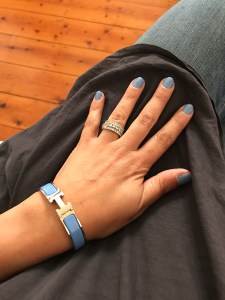
I’m stuck with these nails for a couple of weeks now, but plan to accessorise with a lot more blue (including the blue mascara and eye liner I bring out just for November!)
And a throwback to 2011 (seriously!) when Cherise got a few DOC folk together to make this video. Wear blue!
Diabetes is not about numbers. Until it is.
JDRF has this nifty calculator on their website that (somewhat scarily) adds up the numbers to show just how many diabetes tasks we’ve undertaken in our diabetes lives. Here’s mine (as of yesterday).
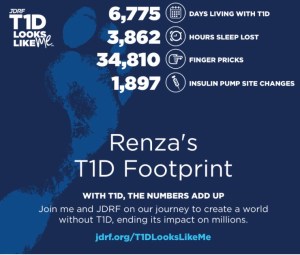
I am the first to say that diabetes is not all about numbers, but I do love this because it shows the magnitude of this condition and its relentlessness. You can get yours here.
(And JDRF UK has their own here.)
What is diabetes awareness month all about anyway?
In fact, what are ALL awareness months about? This beautiful and throughtful post from Jessica Apple from A Sweet Life (online magazine) is definitely worth a read.
And this take from a Diabetes Dad…
And Tom Karla (AKA Diabetes Dad) has this to say about just who this whole month is for. (Spoiler: it’s not for those of us already living with diabetes!) As I said on Twitter yesterday – I spend a week every July (during National Diabetes Week in Australia) trying to explain this. Will be forwarding Tom’s post far and wide from now on!
7 day online peer support…
Did you know that there is a free online Peer Diabetes Mentoring Summit running right now (until 7 November). Diabetes Dominator, Daniele Hargenrader, has coordinated this fab event and you can claim your free ticket here. So many terrific sessions with great speakers to follow!
Photo challenge
There’s a fun photo challenge for the month from Project Blue November. Using the prompts they’ve provided, post a photo each day to your SoMe feeds to share your life with diabetes, tagging the pic with #ProjectBlueNovember. Here are the prompts:

What I’d tell myself at diagnosis..
Lovely piece from the team at Diabetes Forecast where some PWD share the wisdom they would give their newly diagnosed self. Read it here.
And here’s the letter I wrote to my newly diagnosed self a few years ago. It still holds pretty true!
Circled
The International Diabetes Federation’s WDD selfie app (download for free at the app store) allows you to add a blue circle – the international symbol for diabetes – to any photo you’d like.

Big Blue Test
And of course, November means that it is time once again for the Big Blue Test, brought to us by Diabetes Hands Foundation. Over 125,000 BBTs have been logged since the program started in 2010. Easy peasy lemon squeezy instructions are:
 Get logging for good karma. There’s even an app you can use to make it super easy. (And yes – I’ll be logging before and after I take the pups for a walk!)
Keep in perspective.
It’s really easy to get overwhelmed by everything diabetes that’s going on this month. If your SoMe feeds are anything like mine, they will be overtaken by diabetes and there really does seem to be no escape.
Which is why it’s important to remember that we are about so much more than diabetes and find time in the month to do things that remind us of that. We have a couple of birthdays to plan and an upcoming trip to New York to think about – all things that will hopefully keep the whole month in perspective. Plus there is always baking…maybe some cookies…

Today, I just want to follow up a little about one of the points I wrote about yesterday in my post about the event I attended on Tuesday evening about diabetes-related foot complications, specifically this point made my A/Prof Ramon Varcoe:
He explored how we make people with diabetes know this technique for saving limbs is available, and said that it is really, really important to inform PWD about it so that they can ASK for it and not just accept a diagnosis of requiring an amputation. He said that this was the group that could really drive change here, by demanding that they have the best treatment possible.
This had me thinking long and hard. I agree with A/Prof Varcoe here, but that is not really a surprise. I am so much about consumer-led healthcare, that I dream about it (sad, but true).
Mostly, I thought about it in context of my own diabetes care and how it has happened that I am such a DTech nerd. I decided after about two years of living with diabetes that I wanted to use an insulin pump. I really just could not get the hang of the MDI situation I had been put on at diagnosis and was the living embodiment of why Protophane was referred to as Protopain.
I went to an information session and heard a women speaking about how much she loved using an insulin pump and what a difference it had made for her quality of life. Afterwards, I spoke with her and by the end of our chat, was convinced. I wanted one of those! (Impressionable little thing, aren’t I? #MarketersDream) This woman would become my pump trainer and the only diabetes educator I have ever seen.
At my next endo appointment, I marched in with the research I had done, the questions I needed answered and an expectation that by the end of the consultation, I would leave with details of how and when and where I would be getting my pump. Ha, the naivety!
My endo was absolutely not keen for me to take the pump road, ‘You’ve not had diabetes long enough,’ he told me, which confused me no end, because it already felt like a lifetime. ‘I think we should talk about this again after you’ve had diabetes for about 5 years. Yes?’
Well, no. That was the last time I saw him. I spent the next six months endo shopping until I found one that (I was promised) would agree to helping me on a way to a pump. I walked in and made it very clear why I was there and he nodded straight away. ‘Yep – we can do that,’ and picked up the phone. And about three months later, I was a pumper. This particular endo and I parted ways not long after because I needed someone who was far more expert in the diabetes and pregnancy track I wanted to embark, but I have always been grateful that I found him and his open attitude to diabetes technology.
When CGM was launched into Australia, I spoke to my diabetes educator and asked her to fill in the required paperwork to get me sensing. She sent the form off the day we spoke.
And the same has happened when I have wanted to change or upgrade diabetes devices.
What I am trying to say is that this has all been led by me. So when A/Prof Varcoe spoke about the importance and value of connecting with PWD and telling them about these new vascular procedures to save limbs and prevent major amputations, it made perfect sense. He urged that we needed PWD to be the ones who, if told they needed to have an amputation, spoke up and asked for a second or third opinion, specifically asking about the very procedure he had just discussed.
This ground swell of action is what causes change, but we need to know exactly what to ask for. It’s far more effective to ask the question ‘Can my artery be revascularised? I understand there is surgery than can do that and may prevent the need for a major amputation.’ rather than just ‘Is there nothing more than can be done?’
So many of the people with diabetes I know are using particular drugs or devices because they have asked for them – not because they were recommended or suggested by their HCP. And this is why PWD need to have all the information. This is why device companies should be going straight to the consumer to share information, not expecting it to happen through HCPs. (I know that there has been discomfort from some HCPs at Abbott’s direct to consumer promotion of Libre – and the fact that PWD can order themselves without needing to see a HCP, but why would that be the case?)
But it is more than just making sure the information is there for PWD to know and see. It is a complete and utter reshaping of a system that a lot of times actually isn’t about empowerment. There are still too many ‘old school’, patriarchal attitudes that dictate care choices to the PWD instead of accepting and encouraging us to lead the way for our own care. I think things are changing, but I also think they are changing far too slowly.
Last night, I heard the most amazing talk about diabetes-related foot complications. (There are words I never thought I’d write.)
Because actually, the talk was about PREVENTION of amputations. Now, I’m not talking about prevention in the sense of ‘Check your feet daily, see a HCP regularly for a foot check or if you identify problems, and wear sensible shoes’, advice I have always taken selectively. (Happy to check my feet, happy to have a HCP check my feet. But I just bought these boots…so I guess two out of three ain’t bad.) This talk was about prevention of major amputations, thanks to different surgical techniques that can save limbs.
A/Professor Ramon Varcoe, a vascular surgeon from Prince of Wales Hospital in NSW, is my new hero. I listened to his talk absolutely enthralled and amazed. Let me count the ways I adored what he said last night:
- He didn’t show gory pictures. (Thank you. Thank you. Thank.You.)
- He acknowledged that diabetes is a really difficult condition to live with.
- Furthermore, he acknowledged that those who have needed diabetes-related amputations face a really tough future.
- He explained in terms this pinhead could understand the techniques he uses to save legs from needing to be amputated. In VERY basic terms it is a technique similar to the surgery used to open arteries in the heart… a fine wire is inserted into the artery and a ‘balloon’ is used to open the artery. (He concluded his explanation by saying ‘Bob’s your uncle; we can ‘revascularise’ the limb’, making it sound so simple that anyone could do it in their kitchen on a rainy afternoon. For the record, maybe don’t do this in the kitchen on a rainy – or sunny – afternoon.)
- One way he framed his thinking was to say ‘Think of this as a ‘foot attack, the same as a heart attack’.
- He also (almost regretfully) told the audience that very few vascular surgeons perform this surgery and then went on to list the barriers: diabetes foot disease is not sexy; there is limited expertise in the filed now and learning the techniques requires retraining and great skill and there is no kudos (unlike heart surgery which does draw glory!)….Another example of the image problem that diabetes has!
- He explained that this technique is less invasive, far, far cheaper to perform, hospital stays are less, the PWD recovers much quicker, and – GET THIS! – the results are outstanding. In fact, reducing major amputations by 62%.
- He explored how we make people with diabetes know this technique for saving limbs is available, and said that it is really, really important to inform PWD about it so that they can ASK for it and not just accept a diagnosis of requiring an amputation. He said that this was the group that could really drive change here, by demanding that they have the best treatment possible. (I nearly stood up and applauded at that, but glad I didn’t because the event was at Parliament House and there were a lot of MPs and senators in the room and I was trying to behave).
- He called on better training of clinicians and campaigns to raise awareness of the procedure directly to PWD (you know – an amputations prevention initiative?!) which is exactly what we need. EXACTLTY.
- And he finished by saying: ‘My vision is for there to be no more major amputations. I hate this operation. Major amputations destroy people and destroy families. And it’s preventable.’
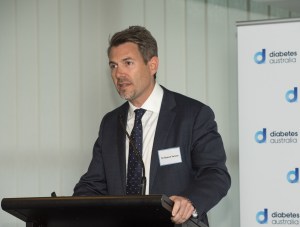
A/Professor Ramon Varcoe
This event was coordinated by Diabetes Australia in association with the Parliamentary Friends of Diabetes Support Group, co-chaired by Rowan Ramsey MP and Graham Perrett MP. I work for Diabetes Australia.
Just gently leaving this here today.
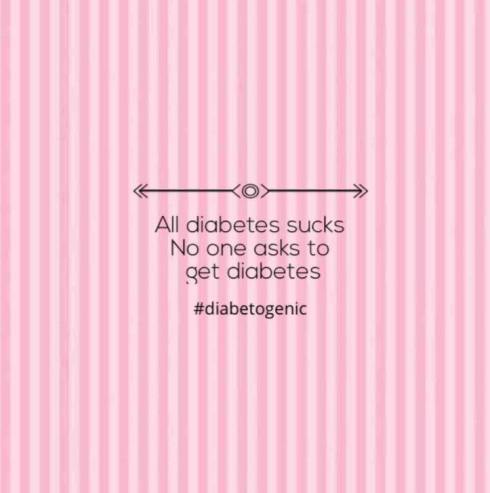




 Diabetogenic