
You are currently browsing the category archive for the ‘Awareness’ category.
I am very fortunate to have a job that I truly love. But it could not be described as a particularly sexy job. At least, not the regular-day-to-day-this-is-what-I-do-when-I-am-in-the-office side of things.
I worked in recruitment for a while and the constant buzz and thrill of the game was intense. We had an old-fashioned bell in the office that would be rung when we made a particularly lucrative placement. Working on commission meant that there were dollar signs in front my eyes all the time, and I measured success in thousand dollar increments. It was sexy because it was quick, constant and there were constant wins.
Now I have a job that is what I refer to as a slow burn. Things take time, advocacy efforts are often long and drawn out, and the wins are rare. But jeez are they meaningful and worthwhile when they happen! They shoot an injection of momentum right when and where we need it, and it means we very quickly acknowledge the win and then focus on the next issue.
Sometimes people don’t realise just how long things take. When the pre-election announcements about CGM subsidies were made, a number of people commented that we’d had a busy few months to make it happen. I couldn’t help but laugh. And correct them. That particular win had been over four years of hard work.
But we take the wins were we can and this week, we’ve had a win!
The revised Assessing Fitness to Drive guidelines have been released by AustRoads and the National Transport Commission, and it’s a good news story for people with diabetes.
You may recall that there were some real issues with the previous guidelines after the completely misinformed and confusing inclusion of a definition of ‘satisfactory control of diabetes’. An HbA1c of over 9% was defined as ‘unsatisfactory control. Whilst the Commission stated that the A1c value was intended as nothing more than a guide and a trigger to seek professional care, the reality is that many people with diabetes had their licences suspended with their HCPs taking the value as a cut-off point.
As Diabetes Australia consistently argued, there is no evidence to suggest that an elevated A1c makes a person with diabetes more dangerous on the roads. In fact, this focus on an elevated A1c was actually detracting from hypoglycaemia, which is something that does need to be considered.
In the new guidelines, the number has been removed which is an excellent outcome for PWDs. And added to the document is far more focus on impaired hypoglycaemia awareness and keeping safe on the roads.
This change didn’t happen because we asked nicely. In fact, it took four years – from when the last guidelines were launched and we started to hear of people with diabetes having troubles – for the change to be made.
It took a lot of advocacy: letter writing, speaking with people who had been negatively impacted, meetings and teleconferences, and revising documents.
This is what I mean when I say that my job is unsexy. All of the work that was done behind the scenes – the slow burn – is decidedly unsexy! But it has to be done to get the wins.
I’ll admit to doing a very quick victory dance when I heard about this particular win. But the celebrating didn’t last long.
Because there is so much more unsexy work to do. Until people with diabetes are no longer discriminated against; until diabetes stigma is something we only speak about in the past tense; until kids with diabetes in schools are freely given all the same opportunities as their peers who make their own insulin; until access – to drugs, technology, healthcare – is available to all, the unsexy stuff will keep happening. You probably won’t hear about it until there is good news, but the wheels keep turning and the fire keeps burning slowly. As I said in this post here, it’s the reason I do what I do.
The new Assessing Fitness to Drive guidelines can be downloaded here.

Four years ago in Rome, I made Aaron take a photo of me with just about every old Fiat Cinquecento we saw. There are a lot of photos of me with tiny cars!
Disclosure
I was a representative on the Diabetes Working Group revising the diabetes chapter of the new Guidelines. This was part of my role at Diabetes Australia.
Sometimes, the best diabetes meetups involve a few people with diabetes just sitting around having a chat. Perhaps it’s over dinner, or maybe over a coffee. There’s no formal agenda, there are no official speakers. It’s just people with diabetes catching up and talking.
Now, multiply that by … a lot. In fact, put about 40 diabetes advocates in a room together. Throw in a few HCPs as well. And some people from industry. Hell, there may even be a few people from professional and consumer diabetes organisations in there as too.
Now you have #DOCDAY; a diabetes meetup on steroids!
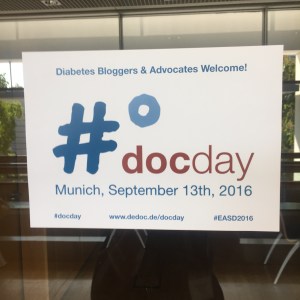
The second annual #DOCDAY event was coordinated and hosted by Bastian Hauck at EASD in Munich. Last year, he had this idea and organised what he thought would be a few people in a café in Stockholm. He underestimated how many people would want to attend, and the room was overflowing with advocates from Europe (and the usual Aussie ring-in).
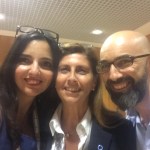
Dr Andrea Orecchio, right, with Danela D’Onfrio from Portale Diabetes (an Italian diabetes peer site).
This year, he got smart. He hired a room at the conference centre which was a genius move because it not only meant it was so simple and convenient to get to, but it also meant a whole heap of HCPs came along too. (Big hat tips to the divine trio from AADE, Hope Warsaw, Deb Greenwood and Nancy D’Houln, Aussie Dr Kevin Lee, and the delightful Dr Andrea Orecchio from Switzerland who impressed me with his ability to speak (and tweet in) four different languages. Perfectly fluently.)
There was no real structure to the meeting, apart from the insistence that all attendees have their photo taken on an old-school Polaroid camera to be placed on the attendee wall. Bastian kicked off the afternoon, saying a few words and he also asked some people to talk about any exciting diabetes initiatives they’ve been involved in. He asked me because he knows that in my jetlagged state I’m likely to say something inappropriate which will lighten the mood.
I was absolutely enthralled and excited to hear of some of the work other diabetes advocates have been up to lately. Here is just a taste:

Cannot wait to see this book published!
I simply cannot wait for the release of this new book from the team at Anna PS. Anna Sjoberg and Sofia Larsson-Stern from Sweden have collected stories from 20 people with diabetes and will share their personal experiences of lives with diabetes. The Swedish version of I Can, Want and Dare will be out in time for World Diabetes Day, and the English-language edition will follow shortly after. You can pre-order here. What a brilliant Xmas stocking filler! (Disclosure – Anna and Sofia invited me to contribute to the book. I have no financial interest in the book.)

Med Angel.
Did you know that 93% of people using temperature-sensitive medications are doing it wrong? Neither did I! Amin Zayani has created a very nifty smart sensor and app to help you know if your insulin is being kept at a safe temperature. This is a super easy device to use and is all about safety. I know I can certainly be accused of being very relaxed about keeping may insulin at optimal temperature and (touch wood) have never had a problem. But just at this conference, I was speaking with someone whose insulin had been affected by temperature and was absolutely not working. At all. This is something that will be very handy for a lot of people! Follow Med Angel on Twitter here.
IDF Europe has introduced a social media prize in diabetes. Quite frankly, the DOCDAY room was full of worthy recipients. Nominate someone now!
Peer networks in France with Paul-Louis Fouesnant.
I always love hearing about grass-roots diabetes support initiatives, and Paul-Louis Fouesnant from France spoke about Diab’ Mouv peer events he organises regularly.
So what did I speak about?
I spoke about driving and diabetes, specifically the advocacy win we have just had with the launch of the new Australian Assessing Fitness to Drive Guidelines. (More about that later this week.)
I spoke about CGM subsidies, a hot topic everywhere, but particularly in Germany where a reimbursement program had just been announced.
And finally, I spoke about language, because EASD is one of the most challenging conferences when it comes to language. I spoke about why language matters and why the real changes that are being made in this space are driven by people with diabetes. We have been talking about this for years and years now and it is terrific to see it (finally) on the agenda.
By the end of the afternoon, I was overwhelmed by all of these incredibly inspiring folk. For most of them, this is a labour of love with little, if any, financial reward. We blog because we want to share our stories and connect – nothing more. We come together to share our successes and our frustrations because we know that this is a sympathetic group who ‘get it’. Between now and when or if we next get together, we will keep in touch and continue to share our stories because that’s what we do. Thanks to everyone there for being so generous with this bumbling, jet lagged mess.

Just some of the advocates, activists, bloggers and HCPs in the #DOCDAY room!
My disclosures for my attendance to EASD2016 can be found on this post.
I want to try something new and I need your help. I am trying to work out just how different it is around the world when it comes to paying for a vial of insulin. Here in Australia, a 10ml vial of Humolog costs me just under eight Aussie dollars. What about you?
So, I’m asking for you to post a photo of yourself, with whichever insulin you use (penfill or vial) and tell me how much your out of pocket cost is in whichever currency you use. For some, it will be nothing. For others, a lot more.
Post your photo on the Diabetogenic Facebook page, or tweet it using the hashtag #InsulinPlayingField. And on World Diabetes Day, I’ll share the results.
So go! And share this around. Let’s see how far we can get this going and how different the playing field is across the globe.

If you have not caught up with what happened in the opioid session at MedX this week, please do. ePatient, Britt Johnson, who blogs at Hurt Blogger wrote this outstanding piece about her experience on the panel in a session titled ‘The Opioid Crisis’ where she was pretty much ignored by the moderator of the panel. I read her piece in dismay because Britt’s experience is all too common.
As I wrote on Facebook yesterday, it is these twelve words of Britt’s post that are, for me, most telling:
‘The plan had been to feature me in the final five minutes.’
This was the response from the moderator of the panel when she was challenged as to why Britt has been ignored whilst on stage.
The final five minutes.
That’s right. After the healthcare professional experts got to say what they wanted; after the moderator directed the discussion in a direction to get what she wanted; after everyone but the patient was given an opportunity to speak. Then, and only then, would Britt have been given the opportunity to say what she wanted.
The final five minutes.
It’s the equivalent of being given a completed resource, almost ready to go to print and being asked to provide feedback. It’s the same as being a perfunctory consumer on an advisory board, often added at the last minute to tick a box.
This token and downright insulting attitude about where ‘patients’ fit into the healthcare puzzle is toxic.
We have become accustomed and too accepting of the status quo. We feel humbled when we are added to a panel discussion when, really, we should be the main event. We are honoured to be asked to provide feedback on an already developed service that we are meant to use because we mistakenly believe our opinion is being sought and matters even though it’s too late for our feedback to be taken on board. We believe we are doing well when a consumer is added to an advisory board made up predominantly of clinicians and researchers because, hey, it’s a start.
A start is not good enough anymore.
I am angry. I am so angry about this. I am angry about what happened to Britt at MedX. I am angry that there was not a single person with diabetes on the program at this year’s ADS ADEA conference. I am angry that it is 2016 and we still have to beg for a place at the table, on the panel, on the Board. I am angry that conversations ABOUT us are happening AROUND us. I am angry because there’s never a hesitation then it comes to convening a clinical advisory group, but a struggle with how and where to engage and appoint a consumer advisory group. I am angry because too many think ‘focus testing’ means engaging at the end, and that it is enough.
But mostly, I am angry at myself. I am angry for this post I wrote last year where I pathetically felt grateful because people with diabetes were quoted at a conference – not actually handed a microphone, not actually invited to sit on a panel, not given an opportunity to lead the discussion. We were quoted and I thought that was enough.
It was our final five minutes. And, actually, it wasn’t enough.
We are more than the final five minutes.
We are more than that; we are so, so very much more.
Apparently, I went to Munich. I was away for 6 days, and 60 hours of those days were spent in transit. I believe that, (as I deal with jet lag, hypoglycaemia, and mainlining caffeine), it is fair and accurate to say that I am too old for this shit.
I am also incapable of forming paragraphs. But dot points are fun! Here are some observations and a few silly thoughts from last week. (I’ll write some sensible things when my brain is back in the same country as the rest of me.)
- I am told by people Munich is a lovely city. I will have to take these people’s word for it, ‘cause I saw very little of the city.
- I did not buy a dirndl and for this, I will be eternally sorry. As will my husband.
- The EASD conference itself was, as predicted, very rats and mice-y. I sat in a number of sessions and wished I was a mouse (while wishing my diabetes away). Alas, I am not a mouse. And I still have diabetes. Damn.
- I did not get sick of laughing at the fact that one of the halls at ICM Messe München is called Langerhan Hall. Also, I did not get sick of saying ‘I wonder if my islet cells are in there’ – to everyone within earshot. Even if I didn’t know them.
- Obviously, Grumps was not as amused by this as me.
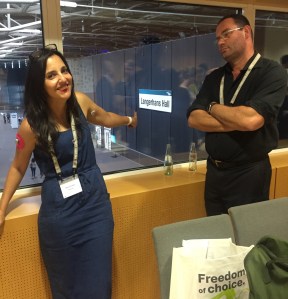
- As was the case at ADA, my arm is more recognisable and famous than me. A barista at one of the exhibition hall stands said, as making me a decent coffee, ‘Oh – I know you. I saw your arm the other day near the station.’ I am a walking billboard for Rockadex! (I am not sponsored by Rockadex and purchase my own patches.)
- Dr Kevin Lee from Queensland is a tweeting machine! In fact, I think the thing I was proudest of at EASD was seeing him tweet! (Actually, probably should say that Professor Mark Cooper’s giving the Claude Bernard Lecture was also a moment of national pride, but Kevin’s tweeting was on another level!)
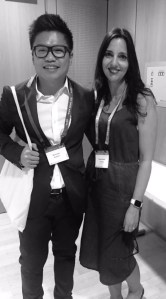
- One of my favourite talks was about diabetes, cardiac health and exercise (go on, laugh….), but that was mostly because presenter Dr Nikolaus Marx, finished up with a discussion about passive exercise and cardiovascular events during the World Cup. If you were in the room, it was me who cheered when he mentioned the increase of cardiac events after Italy beat Germany. (#VivaItalia!). For clarification, I was cheering at Gli Azzuri’s victory, not the number of Germans having heart attacks. (By the way, this was a real study. Published here.)
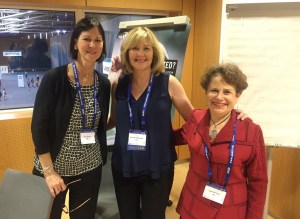
- A HUGE shout out to these three women. AADE presidents elect, past and present, Nancy D’Hondt, Deb Greenwood and Hope Warsaw are absolute advocates for and champions of people with daibetes, and peer support. This is them at the docday blogger and advocate event. This level of commitment by HCPs to consumer engagement is enlightening, and a lot could be learnt from their example here. Thank you. Thank you. Thank you!
- It was wonderful to see quite a lot of discussion about AP. Anytime someone wants to actually get these into market and into the hands of people with diabetes, that would be just great! Thank you.
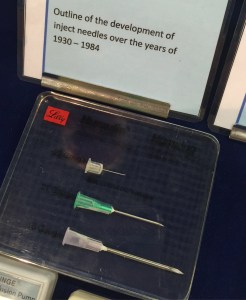
- I may have screamed a little when I wandered through the Association Village to the excellent historical display of diabetes by the German diabetes Association. Terrifying might be the word for these needles. I said a little prayer of thanks to the diabetes angels for modern day tech, and for being diagnosed in 1998.
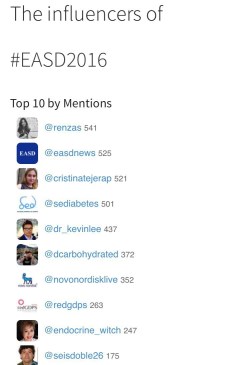
- I need to take a break from twitter. This was the state of play when I said good bye to the conference.
And finally, a word about language, because I am unable to attend a conference and not talk and write about it. (I think it’s actually become a law somewhere.) This probably deserves a post of its own and that may happen, but here we go anyway.
This is the fifth EASD conference I have attended, and going in, I know that it is going to be challenging, language-wise. There often appears to be very little consideration that there could be PWD in the room listening in to how HCPs are speaking of us. In the opening ceremony, I tweeted this at EASD president, Professor Juleen Zierath:
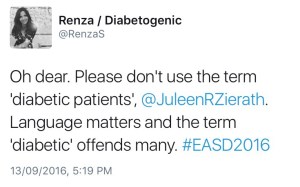
I was a little disappointed at Professor Mark Cooper’s constant use of ‘diabetic’, but it was by no means any more than most of the other speakers. I suppose I just hold Australian speakers to higher account given the work we have been doing here around language and diabetes.
This tweet generated quite a lot of discussion, and came about after I was exhausted and annoyed and mostly frustrated by the way speakers were referring to people with diabetes.
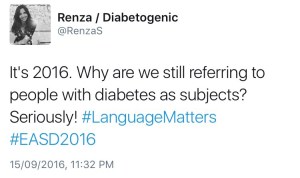 Perhaps the best response was from Nick Oliver:
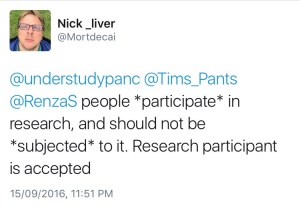
Here’s the thing – and it is something I spoke about during my talk at the DOCDAY event. Language DOES matter. We all know that. It’s completely and utterly disingenuous to say it doesn’t. For some people, it doesn’t bother them and that’s terrific. For others, though, it really does. So why would anyone do something that may offend when it is so easy to avoid that?
DISCLOSE DISCLOSE DISCLOSE
My (economy fare) flights and accommodation expenses were covered by AMSL and J&J. I was attending the EASD conference mainly to attend the J&J DOC exchange meeting which I was involved in preparing and presenting. No one ever expects me to write anything. These are my words and observations only. (And seriously, have you seen what I have just written? No one wants to be associated with that!)
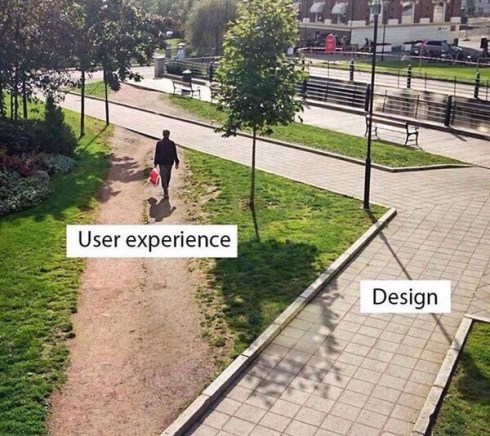
This photo* sums up why I do what I do, and why many people think I sound like a broken record, with a vocabulary of a mere seven words. Specifically, these seven words: ‘Have you spoken to people with diabetes?’
Because so often, the answer is ‘No’. Or ‘No – we’ll be doing that after we have had some meetings.‘ Or ‘Yes – we spoke to you‘ at which point I remind them that I pointed out when they did indeed speak to me that they should find other people with diabetes to speak with. Because I am but one person and speak for no one other than me. (Or, perhaps, another woman in her 40s who loves Nutella, boots, coffee, lives in inner-Melbourne, waves her hands around madly while speaking reallyreallyreallyreally fast, can recite Marx Bros movies from start to end, has what some would call an irrational fear of birds (and butterflies), can sing (badly) pretty much any song from the 1980s, has over 25 striped t-shirts in her cupboard and is battling an eleven year old daughter who has decided that she too loves stripes and wants to borrow all her mother’s clothes.)
Most people are not like that. (Fortunately.)
Anyway, this picture also demonstrates that those who have the privilege of designing services, activities, programs, settings for people with diabetes often miss the point – perhaps not by much, but nonetheless, they miss it. It’s usually because they forgot to ask us, or asked as too late, or didn’t keep coming back and asking and checking in. And then, when we don’t use what they design, we are branded ‘non-compliant’ or ‘disengaged‘ or ‘not interested in our health’, when the truth of the matter is that their design (without our input) just doesn’t fit our needs.
I have given so many talks and written so many pieces about this. But perhaps all I need is this on a t-shirt, tattooed to my arm (forehead?) and on the back of my business cards. Don’t design before speaking to the user. It’s actually really easy!
(*I don’t know the source of this photo, but if anyone does, please let me know so I can credit appropriately.)
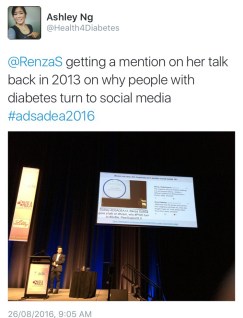
I’d already returned home to Melbourne on Friday morning when Dr Kevin Lee gave his talk on on healthcare social media. I wrote about his planning for the talk here after Kevin engaged OzDOC for some advice on important topics to cover. I’m really sorry I wasn’t there to hear his presentation, although felt there in spirit after I saw this! (Thanks, Ash!)
I reckon that this is the fourth or fifth year the ADS ADEA have spoken about social media and how healthcare professionals can use it safely. I remember seeing diabetes educator Natalie Wischer give a great talk back in 2012 highlighting the different social media platforms available and how they are being used in diabetes. This was just after we launched the weekly #OzDOC tweetchats and I stood up and gave a plug for our weekly online get-together, urging the HCPs in the room to have a look – to lurk – and see what we were so excited about.
I gave a talk the next year (that’s the photo Dr Kevin Lee used in his talk), encouraging HCPs to engage with the online community. And last year at the Roche Educators Day, I ran two practical workshops about how HCPs could use SoMe to connect, enhance and support diabetes care.
It has been on the agenda for a few years, and now it is time to stop talking about it and actually do it.
As mentioned last week, Symplur highlighted just who was talking online at the conference. As usual, the ACBRD team was doing a stellar job live tweeting sessions and promoting their excellent work. And, of course, advocates on the ground were doing their (our?) best to share and engage. There were over 2.7 million impressions on Twitter for the duration of the conference, which is certainly an increase from previous years.
I would really love the ADS and ADEA to be proactive about encouraging social media. I would love for them to look at what happened a couple of weeks ago at the American Association of Diabetes Educators conference and see how meaningful social media interaction between people with diabetes and healthcare professionals can and does happen. Safely. The real engagement and collaboration between the organising professional body and advocates saw impressions on Twitter of over 17.5 million, and over 860 people engaging online.
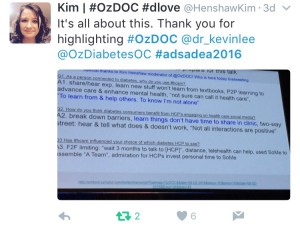
So, how do we go here in Australia about increasing online presence and discussion? In the room for Dr Kevin Lee’s talk were two of Australia’s most prolific and well-known patient advocates – both high-level users of HCSM. I’m referring to Kim Henshaw and Ashley Ng. I wasn’t in the room, yet was actively participating, re-tweeting and engaging – as were many others during sessions that I was sitting in earlier in the week. Having more consumers in sessions provides that connection with PWD not at the conference to hear and see what is going on.
I also think there was, perhaps, a missed opportunity at the session speaking about social media use. Having an advocate on the panel or chairing the session (and remember: Kim and Ashley were in the room!) would have added significant value to the discussion. Dr Kevin Lee went straight to the source when he was putting together his talk. Think about how great it could have been had one or two of those who helped him pull together his information were on the stage elaborating on their comments. Perhaps next year.
I’m back home after three days on the Gold Coast for part of this year’s Australia Diabetes Society – Australian Diabetes Educators Association conference. More to come next week, when I’ll try to pull together my very messy notes.
For today, here are some pictures!

As I took the stage to chair one of two sessions at the Roche Educators Day in Tuesday, I realised I had already been up for seven hours. It was only 11am. Sentences were difficult until my fourth coffee of the day kicked in!

On the job. Professor Steven Boyages’ talk: A connected ecosystem for healthcare professionals & their patients’ was full of practical tips about using technology to support people with diabetes.
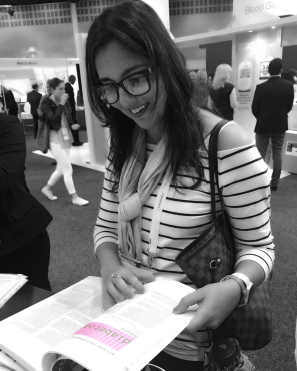
This was the moment I opened the new NDSS Diabetes and Emotional Health Handbook (for health professionals supporting people with diabetes) and I saw Diabetogenic on page 24! Thanks for capturing, Professor Jane Speight!
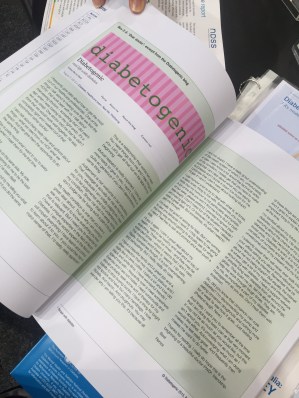
Proud moment!
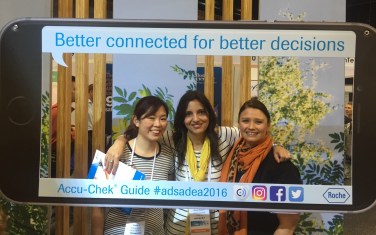
Advocates running amok. We actually behaved ourselves quite well. Mostly.

Although, we were mighty busy! Three of the top four influencers at the conference happen to be consumer advocates, sharing information from the conference specifically with the intention of reaching other PWD who could not be in the room.
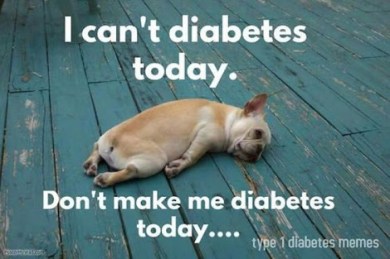
Martha Funnell used this in her talk on day one. Sums up many, many days!
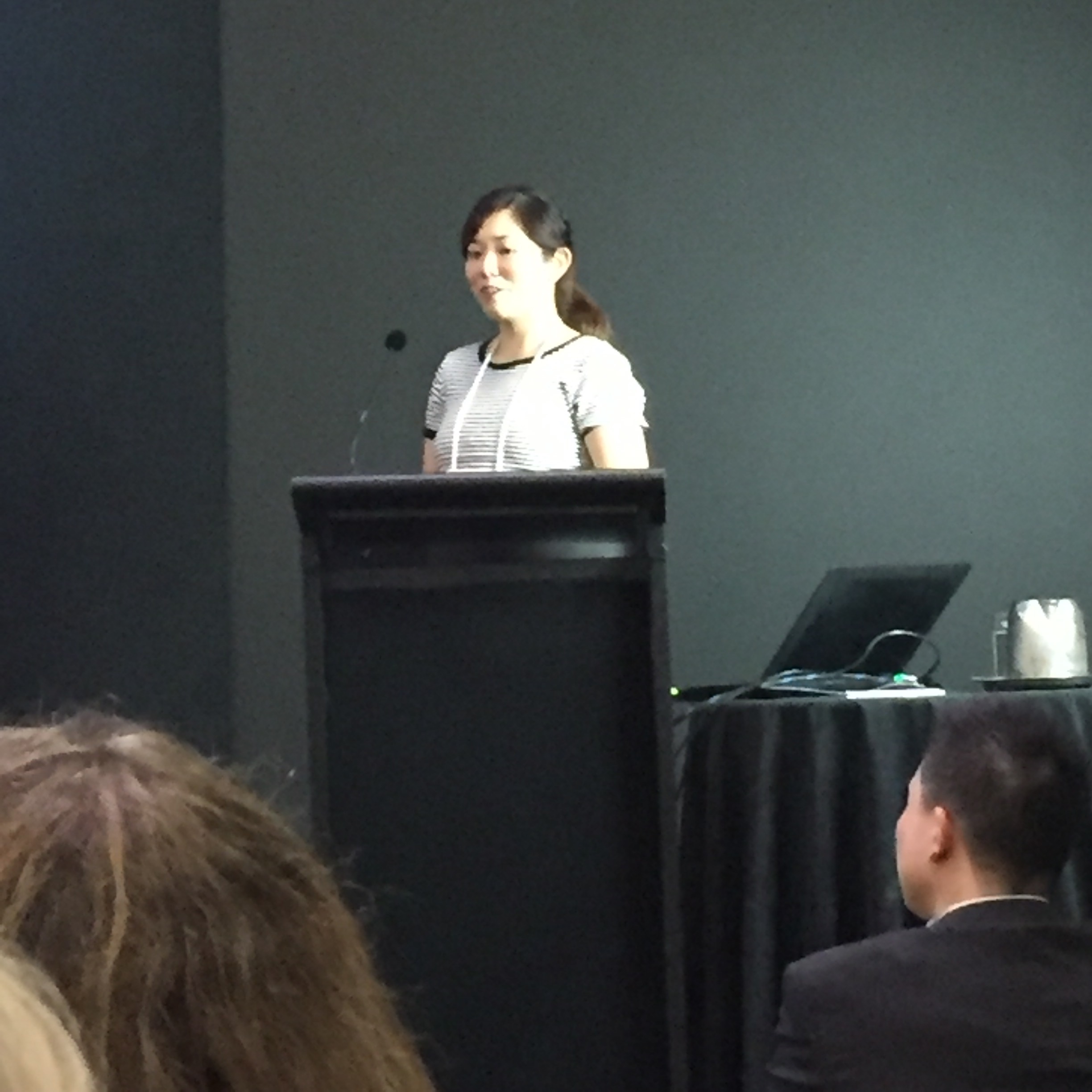
Rather proud of this special young lass. Here’s Ashley presenting on her work focussing on the needs of young people with type 1 diabetes.
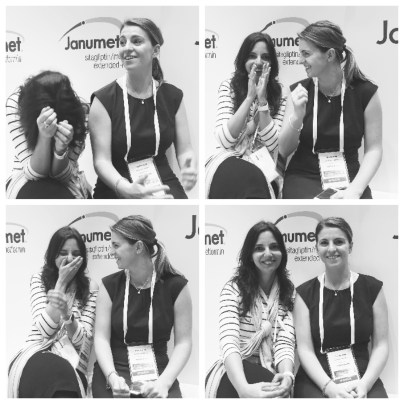
This is a combination of jet lag and exhaustion. (Jet lag belonged to Harriet.)

The NDSS stand looked very bright thanks to these beautiful resources from the Young People with Diabetes Program.
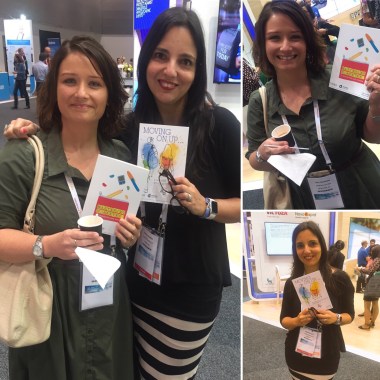
And another proud moment. Kim’s outstanding work on the national roll out of Mastering Diabetes means this resource is in the hands of those who need it most: children with type 1 diabetes, their families and schools. Well done, Kim! (And I’m holding Moving on Up which I am equally proud of!)
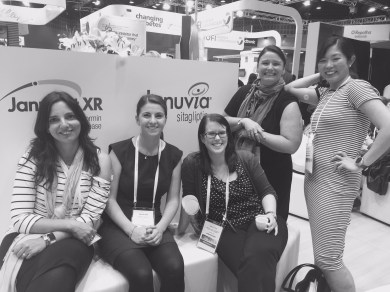
Spot the diabetes devices….

Gold Coast.
Proper wrap up coming next week. Enjoy your weekend. I know I certainly will! (But you can play catch up by checking out all the #ADSADEA2016 tweets.)
Last night, I was the ‘here’s one we prepared earlier’ on a panel discussing CGM technology. The audience was all healthcare professionals – mostly DEs, but some dietitians, RNs and also a GP-in-training (so much yay to him for coming along!).
I love being in the room for these events! I wrote about my last experience giving the same talk here. I cannot speak highly enough of the two experts on the panel last night. Dr Peter Goss – who spoke at the last one of these events – is what I would call a disrupter in the diabetes healthcare space and, honestly, all the power to him. He may ruffle some feathers with his sometimes unorthodox approach, but it is undeniable that he is a champion for kids and teens (and young adults) with type 1 diabetes. Also on the panel was A/Professor David O’Neal who is best described as a truly awesome endo (I have heard that from every single person I know who sees him as their endo) and an absolutely brilliant mind. His expertise in diabetes tech is second to none and he is genuinely interested in how the technology can safely, efficiently and effectively be incorporated into the lives of people living with diabetes.
I know that all sounds rather effusive. But I need to point out that they are remarkable. And that they are the sorts of HCPs you want on your side if you are a person with diabetes.
Because now I am going to talk about language and why I pulled them up a little bit after we all did our presentations and sat on the stage ready to answer questions from the audience.
As happens frequently when I am in the room with a group of healthcare professionals, the conversation turned to language. Okay, I made that happen. In fact, the words I used were ‘I’m going to hijack this conversation because we really need to talk about language here.’
One of my biggest pet peeves is the jokey, and somewhat snide, comments made about people with diabetes making up numbers in their diabetes log books. Because, it’s not a joke. It’s not something for HCPs to roll their eyes over and dismiss as ‘non-compliant’ behaviour.
The word that was used for PWD who make up numbers in their books was ‘fakers’. I cringed the moment I heard the word. And cringed even more at the audience’s response – laughter, heads shaking from side to side and knowing looks. I looked around the room and knew that we would be talking about this later on in the evening!
As I pointed out when the panel was seated on the stage, I absolutely did this. And I was incredibly good at it – different coloured pens, splotches of blood on the pages, dog-eared corners of the book. Once, I even splattered a few drops of juice, because on that particular page, I was having a lot of lows and I thought the juice would make it look more authentic.
Now, let’s all just remember for a moment that I was diagnosed as an adult. This wasn’t insolent teenager behaviour. This was a woman in her mid-twenties who was terrified of disappointing and being judged by the HCP to whom she would be handing the grotty book and its made up numbers.
I told the room my story of this last night and there was laughter – because the way I spoke about it was amusing. It was a cheeky anecdote. But at the time, it wasn’t funny. I was scared, I hated checking my BGL, I was paralysed by numbers that didn’t make sense and I didn’t know what to do about it. So I lied. Of course my HCPs knew that. And I knew my HCP knew.
But the question is about WHY people do this. The discussion needs to stop being about diabetes at that point, because really, managing BGLs and most other diabetes tasks is not the issue here. The issue is distress, anxiety, fear. And, in my case, I felt desperate.
One of the panellists made the point that the reason that he brought it up was because HCPs need to know what to do when someone is ‘faking’ their numbers. He’s right. I completely agree. And then there needs to be understanding of how to approach it, which is likely to be different with each PWD.
For me, it took until I found a HCP who I felt I could trust – one who wouldn’t judge the numbers that were out of range (which one HCP always circled in red pen, making me feel even more like a delinquent adolescent) – and was interested in knowing what was stopping me from feeling able to check my BGL.
When we worked through that, I was better equipped to not only regularly check my BGL, but also to deal with the numbers and act upon them. I came to understand that a number was nothing more than a piece of information that I could use to make a treatment decision – not an indication of me being a good or bad person.
Language does matter. And words count for a lot. Using the word ‘faker’ in this context is loaded with judgement and accusation, and even if that is not the intention, it made me – a person with diabetes – feel very uncomfortable. But mostly, it fails to consider the real problem at hand which is not that a PWD is making up numbers in a book. It is why they feel the need to do that.




 Diabetogenic
