
You are currently browsing the category archive for the ‘Awareness’ category.
This week has been brutal. I arrived home from the IDF Congress very late on Saturday night after a very long journey from Abu Dhabi and since then, my body clock has had no idea where I am, despite my actual body being very much in the midst of Melbourne’s sometimes sweltering summer. My mind is all over the shop, sleep is something that happens if it wants (which it doesn’t really) and, for some inexplicable reason, I’m off coffee.
So, yes, I am a delight to be around right now. Want to hang out?
My time at the Congress, however, was one of those weeks that makes me feel so fortunate and privileged to do the job I do and have afforded to me the opportunities that come with it. Apart from a very full schedule of outstanding talks from leaders in the diabetes world, the congress was packed with advocates from around the world. I was totally with my tribe.
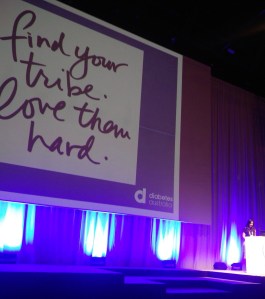
That’s me talking about diabetes and peer support!
There is lots to write about the Congress and I’ll do so in bits and pieces over the coming few weeks, but there were some stand out moments that I wanted to touch on and thought I’d try to do that now. (I’ve already started this blog post about four thousand, three hundred and twenty-eight times, so who knows how we’ll go here…)
Dot points – because they seem to take less energy and mental bandwidth…
- This is the only diabetes conference primarily aimed at healthcare professionals that has a stream completely and utterly dedicated to ‘living with diabetes’ (LWD). This is, in equal measure, brilliant and problematic. It’s brilliant because it means that there is a real opportunity for people with diabetes to be on the speaker program, have their accommodation, travel and registration funded, and be part of the conversation at the actual meeting. But it can be problematic because it means that often, there are not all that many HCPs in attendance at the LWD sessions. I believe that one way to improve this situation is to include PWD in other sessions as well as have an exclusive stream. More on that another time, perhaps.

Click image to see tweet.
- So with that in mind, if your HCP was at the Congress, I’d be asking them which LWD stream sessions they saw and have a stern talking to them if they reply with ‘not a one…’ Hopefully they will be more like UK Consultant Diabetologist, Reza Zaidi who not only attended a number of the LWD sessions, but also tweeted throughout them and asked questions.

(Click image to see tweet)
- I patted a falcon (not a euphemism). There were falcons at the Congress. I am not sure why they were there. But obviously, I was terrified. I tried to overcome my fear of birds by being brave and patting one. I am still scared of birds.

- There was a language session in the LWD stream (of course), but it was clear that a few of the exhibitors, presenters and those putting together posters for presentation could do with a refresher course on not using the word ‘compliant’. Call me, folks. I can help.
- There was a fascinating discussion during the language session when it was explained by someone asking a question that the word for ‘diabetes’ in Japanese is literally translated as Sugar Urine Disease. And yes – you bet that adds to the stigma of diabetes…
- And one final language point. There was a lot of talk about needing to ‘battle’, ‘fight’, ‘combat’ and ‘challenge’ diabetes as though this is a war. I’m not sure that this is a particularly useful way to think about it all.

Click image to see tweet.
- Getting a break from the Congress proved almost impossible. So I was so grateful to the diaTribe Foundation for forcing us out of the conference centre and into an Art Gallery with one of their Art Walk series events. We got a guided tour of the brand new (as in, open for less than a month) Abu Dhabi Louvre. Stunning!

The amazing Abu Dhabi Louvre at sunset
- For some reason, the IDF put me up in the middle of nowhere on a golf course. Perhaps they were hoping I would take walks. Or improve my swing. I did neither of these things.
- I am more than used to getting asked about the ‘thing’ on my arm. My Dexcom sensor and transmitter are quite obvious and people are curious. I almost have come to expect it and I am happy to answer questions as long as they are asked respectfully. I don’t, however, expect this at at a diabetes conference. And yet, that happened over a dozen times. But possibly, the most surreal experience was stepping onto the Dexcom stand in the exhibition hall and having a few of the sales reps nearly tripping over themselves to ask what it was, how it worked, what it felt like and why it was on my arm. And then they wanted to see the iPhone and Apple Watch app and ask more questions, suggesting that Congress attendees visiting the stand ask questions of me and another person sporting one of their devices. Obviously, I should be on commission…
- Diabetes conference exhibition halls can be confusing places. There are stands offering products that seem to be so far removed from diabetes that surely the exhibitors have accidentally turned up the wrong week for the wrong conference. I’m still confused by what the fluffy dolphin (pictured here with Annie, Georgie, Grumps and me) has to do with diabetes or what was happening on this stand.
Dolphins and diabetes… join the dots.
- The Abu Dhabi National Exhibition Centre (ADNEC) might look like pretty much every other conference and exhibition centre I’ve ever been to (they all do), but jeez, it was certainly the largest I’ve ever been to. It was, in fact, quite cavernous and a lot of the time seemed quite empty, despite there being over 8,000 attendees. All that space, and still nowhere to get a decent coffee.
- I chaired a really important session about diabetes complications. It was great to have an open, frank and honest discussion about living with complications and how they impact on the lives of people with diabetes. (Although, I could have done without the clip from Steel Magnolias to introduce the session on complications in pregnancy.)
- Finally, it was so lovely to see the wonderful Wim Wienjen’s legacy on show during the hypoglycaemia talk. The book he authored alongside Daniela Rojas Jimenez is due for publication soon.

That’s it in dot points for today. I’ll be back soon writing more about the Congress. (I guess four thousand, three hundred and twenty-nine is a charm….)
Disclosure
I was the Deputy Lead for the Living with Diabetes Stream, and an invited speaker at the 2017 IDF Congress. The International Diabetes Federation covered by travel and accommodation costs and provided me with registration to attend the Congress.
Towards the end of last week, I got a little rant-y at all the ads from Australian-based and owned companies filling up my social feeds, and my inbox, inviting me to shop up big in the Black Friday sales.
My understanding of Black Friday sales is that they happen the day after Thanksgiving. We don’t have Thanksgiving in Australia. And therefore, we don’t have Black Friday. I actually had to do a bit or reading up to find out the history of the whole Black Friday sale thing, because I’ve always associated the term (as do many Aussies) with bushfires from back in 1939 – not a fire sale of bed linen or mascara.
After Friday was done, it wasn’t over! By Saturday, suddenly, Black Friday ads morphed into Cyber Monday ads. And details of more sales flooded every online channel. Cue more ranting from me (who probably should get a hobby and stop complaining about crap).
Today, with all the consumerism over, it appears that it’s time for another catchy day: Giving Tuesday. But this time, I’m all over it and happy to get involved and will be making a couple of donations to charities supporting people who are unable to access basic diabetes supplies.
Diabetes is just such an un-level playing field. Some of us are in Facebook groups trying to work out how to source equipment for our DIY APS builds, while for others, sourcing insulin is impossible.
This quote from former IDF President, Professor Jean Claude Mbanya provides some much needed perspective, reminding us just how different life with diabetes can be around the world.

If you can, please consider making a donation to a diabetes charity. You can choose to go local, and support a charity that provides services to you and people in your area. Or you can look to charities supporting people with diabetes in less well-resourced countries.
Maybe you could get together with some friends or family or work colleagues and donate to the Life for a Child 1,000 Donors Campaign. Already, 113 generous people have pledged to give $1 a day to help provide insulin to children in need.
Alternatively, you can always donate to the Spare a Rose, Save a Child campaign (also supporting Life for a Child) where just AUD$6 per month is all it takes to provide a child with insulin.
Insulin for Life saves perfectly good insulin from landfill and transports it to people in countries where insulin is difficult to access. Learn more about Insulin for Life by watching this short YouTube clip and then donate here.
Giving Tuesday, while really only a US thing, is something I am more than happy to embrace. As we throw ourselves headfirst into the silly season, I think it’s really important to remember those who can do with some help. And with Xmas spending about to hit frenzy levels, stopping and thinking about how you and your family and family can help those in need. (Read here for a slightly Grinch-esque idea, but one that I still stand by 100 per cent!)
In Australia, WDD lasts for about 36 hours. From the first ‘Happy World Diabetes Day!’ to the final SoMe post with the #WDD hashtag, it was a day-and-a-half of diabetes activism and advocacy and awareness raising. Thank the gods it’s over!
Here a collection of things I’ve found interesting and wanted to share from this week…and most of them are by or about real life Diabetes SuperSHEroes!
One dollar a day
On World Diabetes Day, Life for a Child launched their new 1,000 Donor Campaign. An ongoing donation of USD$1 per day will ensure a child with diabetes has access to life-saving insulin. 1,000 donors will help 1,000 young people in need.
Read more about the campaign, and learn how to donate, here.
Merch!
My wardrobe at the moment seems to be predominantly made up of diabetes t-shirts. Most of them have a very clear Loop theme…I wonder why! (Here is where to get to find these designs.)
And then, this week, I received this in the post from Casualty Girl and it is definitely going to be on high rotation this summer:

Also, from Casualty Girl, a new pouch to house my glucose meter (to go along with my diabetes spares bag):
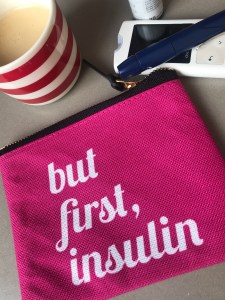
Casualty Girl is the brainchild of talented designer Monica Vesci, a complete and utter star in diabetes sartorial excellence! Have a look at her e-shop for these products and lots more here.
Diabetes and feminism
My post on Monday about privilege and diabetes generated a lot of discussion. I wish I could say that was the end of the chatter and cries of ‘What about me?’ because of the women and diabetes theme, but, alas, it was not.
Georgie Peters, who I adore and admire, wrote a great piece on her blog about the issue too. Read it here.
Something fun
Sure, it’s just a bit of fun, but lots of people have had a giggle as they worked out their name using the Diabetes Australia SuperHEro Name Generator.
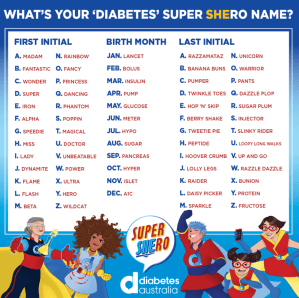
Mine is Phantom Islet Injector. Which, when you think about it, is actually kinda true!
Carolyn’s Robot Relative
Another amazing woman, Dana Lewis, has added yet more strings to her bow, and is now a published children’s book author. I received my copy of ‘Carolyn’s Robot Relative’ on Monday.

It’s a great way to explain diabetes devices (and other health gadgets) to kids.
You can get your own copy on Amazon here, and because Dana is wonderful, she she will using any profits from the sales of the book to cover the cost of copies she will donate to schools and hospitals. She really is one of the best people in the diabetes community!
How to NOT be ‘patient-centric’
PHARMAC, the New Zealand government agency that decides which pharmaceutical and medical devices to publicly fund in NZ, announced this week a new sole arrangement to limit glucose monitoring to meters and strips from Pharmaco (NZ), distributors of Caresens products.
This means that people with diabetes in NZ able to access subsidised meters and strips will have access to only four meters.
Not a great result for people with diabetes who want choice in their diabetes devices, is it? More here.
Insulin affordability in the US
Laura Marston has been a long-time advocate for affordable insulin for people living with diabetes in the USA.
She wrote this piece for the BMJ Blog about her own story of managing insulin affordability, explaining that since her diagnosis in 1996, the list price of a vial of Humalong has risen by over 1200 per cent (that’s not a typo).
Read Laura’s piece to get a good understanding of the situation in the US, and just how messed up – and tough – it is for people with diabetes just trying to afford the drug they need to stay alive.
Asha’s diabulimia story
Asha Brown founded, and is now the Executive Director of, We Are Diabetes, an organisation supporting, and providing information and education for people living with diabetes and diabetes-related eating disorders.
She has written this important piece about living with diabulimia that is a must-read for anyone and everyone affected by diabetes.
What’s next?
There’s no rest for the wicked! The end of WDD does not signal the finish of diabetes activities for the year. In just over two weeks’ time, the IDF’s World Diabetes Congress kicks off and it’s the only large-scale diabetes congress to have a whole stream dedicated to living with diabetes. Lots of diabetes advocates from all over the world will be there. You can start to look through the program here.
Of course I made Blue Circle cookies for WDD.
I used this recipe, (thanks Nigella), and put to use the cookie cutter I bought for this very purpose back in February!

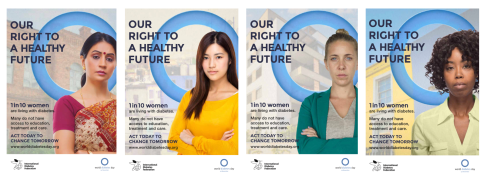
Each year for World Diabetes Day (WDD), the International Diabetes Federation (IDF) selects a theme and develops a suite of information resources. Member Associations of the IDF are encouraged to take on the theme, adapting the message to their country. In previous years, themes have included eye health and diabetes, access to healthy food, and diabetes education and prevention.
This year, the focus is women living with and affected by diabetes. And apparently, some people are not happy.
There are murmurings on a number of SoMe pages that the theme is discriminatory. Men have diabetes, too! And men care for people with diabetes! Why the focus on women? It’s not all about women, you know!
I’ve had a look through all the IDF materials and other WDD materials from other organisations and nowhere has it said anything about men not having diabetes, or not being involved in diabetes care. That’s not the point of the campaign at all, and if that is all anyone is seeing, they are missing the point.
Why the focus on women? Because health outcomes for women – including women with diabetes – are worse than for men. Women Deliver, a leading global advocate for the health, rights and wellbeing of girls and women, has some outstanding resources that show just how significant these differences are. Some information from the IDF materials:
- As a result of socioeconomic conditions, girls and women with diabetes experience barriers in accessing cost-effective diabetes prevention, early detection, diagnosis, treatment and care, particularly in developing countries.
- Socioeconomic inequalities expose women to the main risk factors of diabetes, including poor diet and nutrition, physical inactivity, tobacco consumption and harmful use of alcohol.
- Stigmatisation and discrimination faced by people with diabetes are particularly pronounced for girls and women, who carry a double burden of discrimination because of their health status and the inequalities perpetrated in male dominated societies.
- These inequalities can discourage girls and women from seeking diagnosis and treatment, preventing them from achieving positive health outcomes.
And these points don’t even mention women’s health issues such as diabetes and pregnancy, or reproductive and sexual health.
The campaign is not suggesting that men do not experience struggles when it comes to living with diabetes themselves, or are not involved and integral in the care of others living with diabetes.
But it’s not just the exclusion of men in this year’s campaign that seems to be a problem for some. I’ve seen a number of people complain because they feel the IDF materials are not talking about the great things women with diabetes can do. We can work! We can travel! We can have healthy babies! We can jump out of aeroplanes! We can be successful career women! We can run marathons! We can start businesses!
Of course we bloody can. And, again, nowhere in the campaign collateral is there any suggestion that women are not capable of doing these things. And if you are one of the women who is able to achieve all of those things, despite your diabetes, that is fantastic! But it is the very definition of privilege to think that just because your life is one way, then it must be the same for everyone else – or that if something is not a problem for you then it mustn’t be a problem for anyone else.
Those of us in a position of privilege can use WDD to draw attention to those in need. We can encourage others to donate and to lobby. We can highlight the inequality and inequity of health outcomes for different groups of people. This year, it’s about women.
And you known what? I can’t wait until diabetes health outcomes are the same for everyone, regardless of gender. Because then we won’t need to have a women as a theme.
We can work out how much we fork out to pay for diabetes.
It’s expensive. Of course it is. When I added up the costs earlier this year for a Diabetes Blog Week post, I estimated our family budget takes a hit of about $6,500 (excluding private health insurance) each and every year. That’s a lot of cups of coffee and a lot of pairs of boots.
But if I talk about the financial burden of diabetes alone, I’m selling short just how expensive the condition really is. The dollars I fork out each year are only one part of what it costs me – although it is a lot easier to quantify.
Because, there’s time. So much time.
We sit in waiting rooms, travel to appointments, take time out to make calls to make those appointments, call the pharmacy to order insulin and supplies, visit the pharmacy to collect insulin and supplies. Our prescriptions run out and we have to hastily find a time and way to refill them. We sit on the phone waiting to receive pathology results. We take time out of work time, out of family time, out of social time, out of our own time because diabetes demands it.
And then there is time dedicated to the day-to-day minutiae of ‘doing diabetes’. The time it takes to check our BGLs, or change a pump line, or site a new CGM sensor. Then there is the time to look at data, and act upon it. We lose time to treat lows, treat highs, watch CGM traces, question what to do with random numbers. We build up a sleep debt that never gets repaid, no matter how many early nights or nanna naps we try to sneak in.
It adds up. It all adds up – slowly and deliberately until suddenly we realise just how much time it takes. I tried to give a dollar amount to the time I spend doing diabetes, and stopped when I realised just how terrifying it was. If I was able to dedicate that much more time to paid work, I’d be spending a lot more time in New York each year. And then I got depressed and decided to stop adding up the hours I spend on diabetes.
But still, this is just scraping the surface. The money it costs and the time it takes are significant and must not be underestimated. However, the harder to measure personal costs and emotional burden should not be forgotten either.
I don’t really know how to gauge the extent of those costs. I don’t know how to quantify the psychological impact of diabetes – most of the time I can barely qualify it. But I know it’s significant.
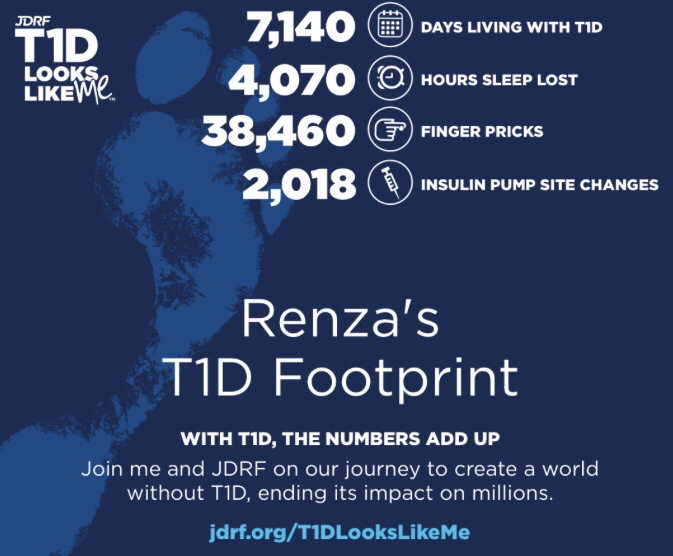
During this month, there are a lot of efforts to try to explain diabetes to those not living with it. JDRF’s T1D Footprint calculator is doing the rounds again, and it’s an effective way to put numbers to just some of the tasks we do to manage our diabetes. I really like they’ve added an extra element to their social media activation: a photo frame with the words ‘T1DYouDon’tSee’ which acknowledges our invisible condition.
Because that’s the thing about diabetes. We can tally up hours and dollars, but measuring the stuff we can’t see is a whole lot harder. And for me, that’s where the real expense in diabetes lies.
It’s not really diabetes awareness time here in Australia. We save that each year for the second week in July and then add an extra spurt of awareness raising on World Diabetes Day. But many of us still decide to jump on the bandwagon of our US friends as they spend the whole of November talking diabetes and giving everything a blue wash.
I always start the month strong, lining up blue clothes and scarves and other accessories to be worn each day. I head off for a blue manicure, regretting it pretty much the minute I walk out of the nail salon. I change my profile picture, and add blue circles to all my photos. I write about every awareness and advocacy activity that comes my way.
By the time 14 November rolls around, I’m already starting to feel exhausted and over the whole thing and by the time my birthday hits in the final few days of the month, I’m ready to slap anyone who wants me to wear blue. All the different initiatives start to roll into one and I can’t remember what I’ve mentioned and what I’ve forgotten to spruik.
So this year I’ve decided to do things a little differently. I knew that I needed to make a change to my usual gung-ho approach when I shared a fun post-a-different-diabetes-photo-every-day Instagram challenge this morning and realised that I was feeling a little ambivilent. I was already feeling the pressure of deciding what to post and didn’t want to commit to posting a diabetes-related photo every day to my socials. So I deleted the post and thought about what I really wanted to achieve this month. And I decided that I want to take a gentle approach to my awareness efforts.
This year, when I get to the end of November, and look back over the month, I’m okay if my SoMe feeds are not a daily reminder of awareness-raising activities. I’m fine with not telling every single person I see that it’s diabetes awareness month and then share one new fact about diabetes for them to commit to memory. I can live with not being sartorially blue or navy or aqua or sapphire for the next thirty days.
Maybe I have some advocacy burn out. Maybe the last couple of weeks of feeling as though I’ve had to defend my treatment decisions have taken a toll.
And yes, I realise how privileged it is to say ‘I don’t want to do diabetes advocacy this month’ when I don’t need to fight for insulin or diabetes supplies. I won’t be abandoning my efforts in this space. (I know that there are some really important access activities coming up in coming weeks and I will be supporting them.)
But I am going to go easy on some of the other things I’m usually all over. And that’s okay. ‘My diabetes; my rules’ extends to how much we want to talk about it. So this year, I’m talking less. I’m not hitching a ride on every bandwagon and I’m taking it easy with the online activism. I’m going less blue and I am absolutely fine with that. T1D will still look like me. (Oh, but I probably will still get a blue manicure. And I’ll probably still regret it.)
I flew into Lisbon, arriving at my hotel just after midnight on Monday. I get that Australia is a long way from everywhere, but the 38 hours’ transit was a record for me and as I tumbled into bed, I dreaded the alarm that would sound a mere 6 hours away.
However, I’ve done this enough times now to know a sure-fire way to overcome jet lag is to organise a relatively early morning meeting that involves coffee and local pastries. (Hello, Pastelaria Versailles and thank you for your beautiful baked goods.)
The main reason for this trip was to attend the Roche #DiabetesMeetup. (Disclosures? Yep-all at the end of this post….) This is the third one of these meetings I’ve attended (read about the first one at EASD2016 here and the next at ATTD2017 here) and, as always, it was great to see the familiar faces of dynamic diabetes advocates doing dynamic diabetes advocacy.
This year, there were a whole lot of new faces, with over 60 diabetes bloggers from across Europe having been invited to become part of the conversation. As well as attended the dedicated satellite ‘consumer’ events, the bloggers are all given press passes to attend all of EASD.
This is astounding. It means that it is impossible to walk around the conference centre without seeing other people with diabetes. Arms adorned with CGM or Libre are not startling – they’re everywhere. The beeps and vibrations of pumps can be heard in sessions, causing heads to bob up, and knowing glances to be shared. Our presence here is undeniable.
On the first official day of the EASD meeting, the third annual #DOCDAY event was held. While Bastian Hauck (the event organiser) starts by inviting bloggers to the event, he warmly and enthusiastically extends the invitation to HCPs and industry too.
On Tuesday, the room was full of people, discussion and enthusiasm
#DOCDAY has become a platform for anyone who attends to take the stage, and five minutes, to share what they’ve been up to in the diabetes advocacy and support space. I stepped down from my usual language soap box, proving that this pony does indeed have more than one trick.
Instead, I spoke about the role of people with diabetes at diabetes conferences. I couldn’t think of a more appropriate time, or a more suitable room to plead my case, even though I knew that I was preaching to a very converted choir!
Two weeks ago, in Perth, there were a few of us wandering the #ADSADEA conference as part of the Diabetes Australia People’s Voice team. And at one point, on Twitter, where our presence is felt more than anywhere else, an interesting, frustrating and downright offensive (if I’m being honest) discussion started.
It was said that diabetes conferences are the safe place of diabetes healthcare professionals and that perhaps a day at the start of the conference could be dedicated to people with diabetes, but the delegate program (delegates being only HCPs) start the next day.
As you can imagine, that didn’t go down too well with some of the diabetes advocates in attendance.
I am actually unable to provide you with the arguments offered as to why people with diabetes should be excluded, but I think it included reasons such as HCPs need a space to be among peers, these are scientific conferences, HCPs need lectures without people with diabetes (not sure why – are we really that terrifying?).
I’m not into preventing people with diabetes attending diabetes conferences. Melinda Seed’s vision of 1000 people with diabetes at the conference is far more aligned with mine. We are not asking that the conference we ‘dumbed down’. I don’t want the sessions to be any different than they are now (with the exception of having PWD as part of the speaker list – but that is regardless of who is in the audience).
Here’s the thing. Organising a team of three consumers to attend (as happened in Australia) required someone to provide funding and coordination. That was Diabetes Australia and I’m really proud that the organisation I work for created this initiative.
To have over sixty advocates supported takes a commitment. I won’t for one moment suggest that I am naïve enough to believe that we are part of industry’s marketing strategy. But we absolutely should be part of that strategy. I am more than happy to give Roche the shout out and kudos they absolutely deserve for bringing us all together. I don’t use any of their products at the moment (although, in the past have used their meters), so I’m not in any way spruiking their devices or suggesting you go and update your meter with one of theirs.
But I am grateful that as part of their engagement with people with diabetes involves bringing us together at a diabetes conference.
What’s the role of people with diabetes at diabetes conferences? Our role is to share from inside with those not here. We’re here to remind attendees that using language that diminishes us and our experiences and efforts in living with diabetes is not okay. We’re here to tell industry they’ve messed up when they design is not spot on, or their marketing misses the mark. We’re here to challenge the idea that we should be quiet, ‘compliant’ and do what we are told.
As I said at #DOCDAY, we have a responsibility to share what we learn. I acknowledge – every single minute of every single conference day – that I am privileged to be here. And that comes with responsibility to share what I see, hear and learn.

DISCLOSURES
My flights and accommodation costs to attend EASD2017 have been covered by Roche Diabetes Care (Global). Yesterday I attended the Roche #DiabetesMeetup (more on that to come). Roche also provided me with press registration to attend ATTD. My agreement to attend their blogger day did not include any commitment from me, or expectation from them, to write about the day or their products.
Last week, I was invited to speak as the consumer in a peer support symposium at ADS ADEA. My talk was called ‘People like me’ because more and more, I’ve come to understand that the real value for me in peer support is the combination of the masses with diabetes – as accessed through the DOC – as well as those who form a part of my ‘inner circle’, or tribe.
So, obviously, my first slide was this one:

And then, I introduced the audience to my tribe from last week:
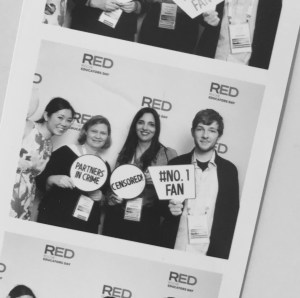
People like me! The #DAPeoplesVoice Team (L-R) Ashley, Melinda, Renza, Frank
The peer support symposium was coordinated by the ACBRD. Last year, they produced this report for the NDSS. They brought together four speakers, each speaking about different considerations of peer support.
After I gave my personal perspective on the peer support that works best for me, Professor David Simmons from Western Sydney University spoke about the evidence. The idea (as outlined in the symposium abstract) was to ‘…identify ways in which they are in synergy and/or tension with one another’.
David began by speaking about the Peers for Progress model, highlighting its four core functions of peer support:
- Assistance in daily management
- Social and emotional support
- Linkages to clinical care and community resources
- Ongoing support, extended over time.
I can only speak for myself and my own experiences, but the peer support I have carved out for myself meets all these points. While points 2 and 4 are probably the most relevant to me, I certainly have used my peers to assist with the day-to-day grind of living with diabetes and have also found connections with clinical support through my peers.
My experience is certainly not structured or formal in any way, however, for me, it works and it works superbly. Which was another point that I made – we need to find the right sort of peer support and that may be different for different people.
Some PWD may prefer to have something that is very organised. I prefer a more ad hoc, dip-in-and-out-as-I-need-it approach, and focus my energies on what I require at specific times. I also love the online community and the support it offers because it meets many of the things I’m looking for: flexibility (there’s not a meeting on the first Monday of each month to attend and if I can’t make that, I miss out); broad reach and a variety of people (which means that I will always find someone to provide support, no matter what the issue; diversity of experiences so my own understanding of what is going on with others is constantly growing, evolving and, often, challenged; all over the world allowing me to connect with people whatever the day of day – or wherever I happen to be (speaking of which…anyone in Lisbon next week?).
Another discussion point during the symposium was to do with the need for evidence to strengthen the case for peer support, which will ensure adequate funding to run programs. I find this a slightly double edged debate, really. I understand that with limited funding, those holding the purse need to know that money is going to go to programs that are known to work. But equally, I know peer support works. People with diabetes know peer support works. Melinda Seed, clearly frustrated (as am I) at the constant need to defend the value and importance of peer support, posed an interesting question, here:
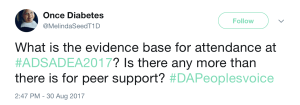
Now, I don’t doubt for one moment that HCPs get a lot of benefit from attending diabetes conferences. Of course they do – they hear from leading experts, learn about the latest research finding, network with colleagues, speak with industry about new diabetes technologies and treatments. The leave feeling inspired, have improved knowledge, feel supported by others doing what they are doing, and have new tips and tricks up their sleeves top improve their practice. They know that. We all do. And yet where is the evidence to support it?
(For the record, someone did point out on Twitter to Melinda that the difference is that conferences are privately funded and therefore do not stand up to the same scrutiny that programs seeking public funding do. Melinda responded (quite correctly) that this argument doesn’t really hold water as many attendees there attend on the ‘government dime’. It is an interesting discussion….)
I think one of the problems we might have is that we narrow the definition of peer support sometimes, and perhaps some people think that it’s too fluffy and feel-good, and just about sitting around someone’s kitchen table and chatting. But as I said in my talk, there is much more than mere ‘tea and sympathy’, (although, I’m reticent to dismiss the power of such interactions because I know that sometimes those moments do produce a lot of support from people who are otherwise feeling very isolated and alone.)
I am speaking at the World Diabetes Congress at the end of this year and will be challenging the notion that peer support is all about group meetings. It is more than the traditional ‘support group’ model. One example I gave was the Pumpless in Vienna story (yeah – I’ll tell that whenever I can!). It was through peer connections that my friend Jo found a pump. It can also be seen and found in other ways – camps, information sessions, structured education programs. Peer support can be found in a lot of places, even if that’s not the term we give to it.
CEO of Diabetes Australia, Greg Johnson, and me talking peer support after last week’s symposium.
Disclosures
Roche Diabetes Australia has covered my travel and two night’s accommodation for my stay in Perth as I am a presenter at the Roche Educators Day (RED). There is no expectation from Roche that I will write anything about the RED, but I expect I will because it’s always such an interesting and enjoyable day!
The remainder of my time in Perth is part of my role at Diabetes Australia.
A recurring theme throughout last week’s ADS ADEA meeting in Perth was the need to manage expectations. I think, in general, we do a really lousy job of this in diabetes.
We’re told that can expect to live a ‘normal life’ after a diabetes diagnosis, when that’s not necessarily the truth.
We’re told we can expect to eat whatever they want, when really, the effort that goes into calculating medication doses depending on the nutrient value of our foods is hard and it may be easier for some to actually limit food choices to make things a little easier.
We’re told to expect a cure in five years’ time, when the truth is that a cure is not even on the distant horizon.
We’re told that we can expect new technology to significantly reduce the burden of living with diabetes, when the reality is that sometimes, it’s more – not less – work.
We’re told to expect person-centred care, when, really, our health system, is not designed to cater for the individual needs of people living with diabetes.
We’re told that emerging technology will be fully automated, smart and cure-like, but we are not told that there will still be human-input necessary and that the devices are not as smart as a functioning pancreas.
We’re told that if we keep our A1c below 7% we can avoid complications, and yet, there is no guarantee, and some of us do develop complications despite an A1c regularly hitting that magic number.
We are told that if we count carbs and dose the right amount of insulin at the right time, we can keep our glucose levels in range, often neglecting to be told that there are a lot of other factors at play.
We are told all this, and then, when these expectations are not met, we are told we’ve failed. Or we are disappointed.
Here’s the thing. The tools are actually really great. Our health system here in Australia is mostly terrific. The majority of our HCPs genuinely do want to give us the best care they can. We don’t need to oversell things as much as we do.
Our expectations are being set so realistically high, that it’s impossible to meet them.
So, THIS is what I would like to say about all the things I’ve covered above to help manage expectations:
Your life will be different after a diabetes diagnosis. But that’s okay. Your new normal is going to be different to your old normal, but hopefully, there will be very things that diabetes will prevent you from doing. Acting like a pancreas is not really normal, but you can do it!
Yeah, you can eat whatever you want. But it’s undeniable that certain foods are harder to manage after your pancreas decides to go on strike. Find what works for you – and that can change. But do be prepared for food to become something that can be a little fraught because you may find that some of your most favourite foods are a little difficult to deal with.
Researchers are brilliant and amazing and the advances in diabetes management are actually quite mind blowing, but a cure? We’re nowhere near that yet. Keep up to date with everything and try to mine through it to work out what is relevant for you. Keep getting excited about management and tech advances – but do keep it in perspective. (Also – consider the source. I promise you that the Channel 10 news or Buzzfeed is NOT going to be where you learn that diabetes has been cured forever.)
You are going to have a lot that you will want to know and work through, and possible a variety of healthcare professionals to see. As wonderful as it would be to have someone to coordinate it all for you, you’ll have to put in the leg work to find the right team, the right service and the right people. And then, once you’ve found them, it’s still up to you to direct what you need. Otherwise you might find yourself at the mercy of a system that is not really going deliver exactly what you need to get the most from it.
You may have heard that in the US there is a (hybrid-closed loop) pump/CGM combo. Some are calling it an artificial pancreas. It’s not. The tech is incredible, but it’s not fully automated. It still requires calibration and it still requires operator input. This is not me being negative, because the tech is exciting. It’s me being realistic about the level of automation
No new devices are going to completely remove the load diabetes adds to your life, or your involvement in their operation. Insulin pumps need buttons pushed; CGMs need calibration, food needs to be considered. Full automation may be the goal, but it’s a while off.
An A1c of 7% or below will indeed reduce your risk of developing diabetes-related complications and there is a lot of evidence to support that. But it doesn’t eliminate the risk. That’s the annoying and somewhat unfair reality of diabetes. Unfortunately, it’s the reality. Obviously, do what you can to manage your diabetes as well as you can. But don’t expect that a number is a guarantee of anything.
Carbs and insulin are only part of the equation. How you’re feeling emotionally, illness such as colds and flus, hormones, nutrients other than just carbs, the phase of the moon (well, maybe not) … all these impact on your numbers. And they change. Don’t expect that there is an equation that will work all the time.
In life, we’re often told to expect the unexpected. But in diabetes, the unexpected is often only that way because what we have been told to expect is unrealistic. If we were told the truth, and provided with realistic expectations from diagnosis – and throughout our diabetes lives, perhaps we wouldn’t feel that we’re constantly falling behind and failing.
Here’s me and my boss talking about expectations in technology.
Disclosures
Roche Diabetes Australia has covered my travel and two night’s accommodation for my stay in Perth as I am a presenter at the Roche Educators Day (RED). There is no expectation from Roche that I will write anything about the RED, but I expect I will because it’s always such an interesting and enjoyable day!
The remainder of my time in Perth is part of my role at Diabetes Australia.





 Diabetogenic