
You are currently browsing the category archive for the ‘Awareness’ category.
I wrote the post below back in 2016 (original version here). The Lancet had just published a piece about the differences in insulin access around the globe and I was once again astounded and pained by just how difficult it is for some people.
I wanted to share it again because with the #SpareARose campaign finishing tomorrow, I thought that a reminder of just how dire the situation is for people born with diabetes in some countries was timely – especially for those of you who have been meaning to make a donation to Life for a Child, but just haven’t managed to yet.
Can you imagine if it was you or your child diagnosed, and that instead of heading to hospital for treatment, and then home again equipped with all the drugs and supplies you needed to manage diabetes, you had been handed nothing but a death sentence? To be honest, I can’t imagine that, because my situation – as with most people reading this blog – was not that.
Please take a moment to make a donation. It takes USD$5 to provide insulin to a child for a month. (And I promise, this is the last time I’ll be writing about this. At least, for now!)
________________________________
The life expectancy for a child diagnosed with diabetes in sub-Sahara Africa is as low as one year. That’s right: one year.
This is a fact for 2018, almost 97 years after the discovery of insulin.
And it is just not good enough.
In The Lancet, this piece was published about the challenges of accessing insulin around the globe. Why is this drug still so unattainable to so many? Why has access to insulin not had a high priority within agencies such as the UN and WHO?
Why are children and adults still dying when there is a medication available?
I am so angry and sad and desperate that this is the situation and while I am pleased that we are starting to increase the conversation about the unfairness of it, it’s just not enough.
Where is the outrage here? We get angry and feel vilified when someone doesn’t understand the difference between type 1 and type 2 diabetes, or because some celebrity dared to say something stupid about diabetes, and we retreat online and complain and bitch and moan. We say that we feel stigmatised and isolated and misunderstood.
And it’s true. Diabetes is stigmatising and isolating. People don’t understand the details. It’s downright, bloody unfair.
But we are not going to die because we can’t get our hands on a bottle of insulin. Perhaps we need to channel some of our oh-so-easy-to-access outrage and frustration towards an issue that can actually save some lives.
A diagnosis of type 1 diabetes in some countries is a death sentence, plain and simple. And a quick one at that.
And this isn’t okay.

Click image to donate
Have you been thinking about making a donation to Spare a Rose; Save a Child, but just haven’t managed to do it yet? Did you think that because Valentine’s Day is over that it’s too late? Watch this and find out why your donation is still greatly needed.
Donate now to have your donation added to the 2018 Spare a Rose tally. Just click on the image below.

Three days in Vienna is never going to be enough, and neither were three days at ATTD. But mother guilt is a very strong motivator for getting back home as quickly as possible.
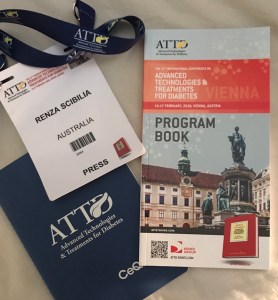
This is the second ATTD conference I attended. Last year, I returned a little bewildered because it was such a different diabetes conference to what I was used to. But this year, knowing what to expect, I was ready and hit the ground running.
There will be more to come – this is the initial brain dump! But come back from more in coming weeks. Also, if you emailed me, shot me a text, Facebooked me, Tweeted me or sent me a owl last week, I’ll get back to you soon. I promise. Long days, and long nights made me a little inaccessible last week, but the 3am wake up thanks to jet lag is certainly helping me catch up!
So, some standouts for me:
DIY
The conversation shift in 12 months around DIY systems was significant. While last year it was mentioned occasionally, 2018 could have been called the ATTD of DIY APS! Which means that clearly, HCPs cannot afford to think about DIY systems as simply a fringe idea being considered by only a few.
And if anyone thinks the whole DIY thing is a passing phase and will soon go away, the announcement from Roche that they would support JDRF’s call for open protocols should set in stone that it’s not. DANA has already made this call. And smaller pump developers such as Ypsomed are making noises about doing the same. So surely, this begs to the question: Medtronic, as market leaders, where are you in this?
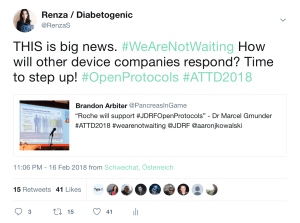
It was fantastic to see true patient-led innovation so firmly planted on the program over and over and over again at ATTD. After my talk at ADATS last year – and the way it was received – it’s clear that it’s time for Australian HCPs to step up and start to speak about this sensibly instead of with fear.
Nasal glucagon
Possibly one of the most brilliant things I attended was a talk about nasal glucagon, and if diabetes was a game, this would be a game changer! Alas, diabetes is not a game, but nasal glucagon is going to be huge. And long overdue.
Some things to consider here: Current glucagon ‘rescue therapy’ involves 8 steps before deliver. Not only that, but there are a lot of limitations to injectable glucagon.
Nasal glucagon takes about 30 seconds to deliver and is far easier to administer and most hypos resolved within 30 minutes of administration. There have been pivotal and real world studies and both show similar results and safety. Watch this space!
Time in Range
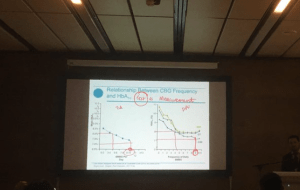
Another significant shift in focus is the move towards time in range as a measure of glucose management rather than just A1c. Alleluia that this is being acknowledged more and more as a useful tool, and the limitations of A1c recognised. Of course, increasing CGM availability is critical if more people are going to be able to tap into this data – this was certainly conceded as an issue.

I think that it’s really important to credit the diaTribe team for continuing to push the TIR agenda. Well done, folks!
BITS AND PIECES
MedAngel again reminded us how their simple sensor product really should become a part of everyone’s kit if they take insulin. This little slide shows the invisible problem within our invisible illness

Affordability was not left out of the discussion and thank goodness because as we were sitting there hearing about the absolute latest and greatest tech advantages, we must never forget that there are still people not able to afford the basics to keep them alive. This was a real challenge for me at ATTD last year, and as technologies become better and better that gap between those able to access emerging technology and those unable to afford insulin seems to widening. We cannot allow that to happen.
Hello T-Slim! The rumours are true – Tandem is heading outside the US with official announcements at ATTD that they will be supplying to Scandinavia and Italy in coming months. There are very, very, very loud rumours about an Australian launch soon but as my source on this is unofficial, best not to add to the conjecture.
How’s this for a soundbite:

GOLD STARS GO TO….
Massive congrats to the ATTD team on their outstanding SoMe engagement throughout the conference. Not a single ‘No cameras’ sign to be seen, instead attendees were encouraged to share information in every space at the meeting.
Aaron Kowalski from JDRF gave an inspired and inspiring talk in the Access to Novel Technologies session where he focused on the significant role PWD have in increasing access to new treatments and his absolute focus on the person with diabetes had me fist pumping with glee!
Ascensia Diabetes packed away The Grumpy Pumper into their conference bag and sent him into the conference to write and share what he learnt. Great to see another group stepping into this space and providing the means for an advocate and writer to attend the meetings and report back. You can read Grumps’ stream of consciousness here.
Dr Pratik Choudhary from the UK was my favourite HCP at ATTD with this little gem of #LangaugeMatters. Nice work, Pratik!
ANY DISAPPOINTMENTS?
Well, yes. I am still disappointed that there were no PWD speaking as PWD on the program. This is a continued source of frustration for me, especially in sessions that claim to be about ‘patient empowerment’. Also, considering that there was so much talk about ‘patient-led innovation’, it may be useful to have some of those ‘patient leaders’ on the stage talking about their motivations for the whole #WeAreNotWaiting business and where we feel we’re being let down.
I will not stop saying #NothingAboutUsWithoutUs until I feel that we are well and truly part of the planning, coordination and delivery of conferences about the health condition that affects us far more personally that any HCP, industry rep or other organisation.
DISCLOSURE
Roche Diabetes Care (Global) covered my travel and accommodation costs to attend their #DiabetesMeetup Blogger event at #ATTD2018 (more to come on that). They also assisted with providing me press registration to attend all areas of ATTD2018. As always, my agreement to attend their blogger day does not include any commitment from me, or expectation from them, to write about them, the event or their products. It is, however, worth noting that they are doing a stellar job engaging with people with diabetes, and you bet I want to say thank you to them and acknowledge them for doing so in such a meaningful way.
This morning, I saw news that President of the Australian Medical Association, Michael Gannon, wants a shock campaign, similar to our hugely successful QUIT (anti-smoking) campaign, to address growing obesity rates, and increase understanding of the ‘frightening end-stage health results of obesity-related type 2 diabetes such as limb amputation, blindness, stroke, heart and kidney failure.’ (The Courier Mail article where this quote is from can be found beyond a paywall here. Some details also freely available here.)
That quote alone would have put me off my breakfast if I was the breakfast eating type. Alas, I am not. Which is good, because there was more…
In an accompanying editorial (also behind a paywall), there was the brilliant idea that ‘…there is room for some shock and awe education…child-friendly information that is both understandable and impactful when it comes to the consequence of living with type 2 diabetes’. The editorial again made the flawed connection between this idea and the success of anti-smoking campaigns.
We can point to the triumph of the QUIT campaign – and should do so as it has been an extraordinarily successful – and long term – initiative. But if anyone believes the success of QUIT came from some shock advertisements on TV, they are so wrong. This campaign has always been a multi-pronged approach: advertising, legislation, taxes, education and – most importantly – funding, and that is why it’s been so successful.
Alongside the high-rotation television, radio and print media commercials (and in more recent times, online ads), there was legislation. Cigarette advertising was banned. As a kid, I remember Summer being brought to us by Benson and Hedges. As we watched the Aussies playing the West Indies in the cricket (seriously, you want me on your trivia team if the questions are about the 1980s West Indian cricket team. I still have a crush on wicket keeper Jeffrey Dujon) it was advertisement after advertisement of cigarettes. The fence around the MCG was adorned with golden B&H logos.
And then, that stopped. Tobacco advertising on television and radio was prohibited as was all print advertising. No longer could cigarette companies hire billboards to spruik their products. Today, cigarettes sold in stores must be hidden away in a cupboard without any advertising at all.
And new and steep taxes were introduced, increasing the cost of cigarettes more and more and more each year.
Smoking became illegal in more and more places: firstly there was no smoking in restaurants and cafes, then pubs. Most recently, smoking has been banned anywhere that food is served, meaning that the last place to have a smoke while eating (outside seating at a café or in an open beer garden) is now not an option either.
There were education programs funded to provide information about the dangers of smoking.
But smoking is not obesity. Tobacco is not food. We can’t use the same approach as the ‘every cigarette is doing you harm’ idea (used recently as part of QUIT). Food is much more nuanced. It’s fine to eat so-called ‘junk food’ occasionally. While there is no safe level of smoking, there is a safe level of eating a little bit of everything!
The idea that some scary advertisements on prime time will in any way solve the issue of obesity is ridiculous. Will these advertisements be shown alongside those for Macdonald’s latest burger, or a new sugary breakfast cereal? Will telling kids the dangers of being overweight and eating ‘bad’ foods happen before or after their Milo– or KFC–sponsored sporting activities?
If we are seriously going to address the obesity issue, we need to get serious with all aspects required for significant change. We need advertising controls, we need (sugar) taxes, we need proper, funded education programs.
And we need to get the messaging right. I was so disappointed to see Michael Gannon single out type 2 diabetes in today’s news. When we talk about the consequences of obesity, we need to stop being so selective about what we connect it to.
Obesity may be a risk factor for type 2 diabetes, but it is also a risk factor for other conditions, including some cancers and cardiovascular disease. And yet we would never, ever blame someone for developing breast or bowel cancer – a diagnosis of which obesity may or may not have contributed to. It is too easy – and lazy – to single out type 2 diabetes.
I don’t for a moment think that we should bury our head in the sand and do nothing about the obesity situation in Australia. But we need to do it properly, we need to do it collaboratively, we need to do it honestly, and we need to do it sensitively.
Here I am speaking too fast, hands waving erratically (#TooMuchCoffee), with an idea about how we can get Spare a Rose, Save a Child better known outside the diabetes community…

Click image to donate
It’s that time again. Supermarkets are covered in red heart-shaped foil balloons, fluffy heart-shaped pillows and velvet heart-shaped boxes of chocolates. Florists are about to hike up the price of roses by three or four hundred percent. And the sex shop in my neighbourhood has an odd display of edible underwear in the front window, surely begging the question: who the hell actually thinks that is a good idea as a gift for any occasion? Anyway, I digress..
It must be Valentine’s Day.
We don’t do Valentine’s Day in our place. It is a Hallmark occasion if ever there was one and quite frankly, the idea of being loving and affectionate and amorous one day a year is ridiculous and would leave me feeling very short-changed.
But despite my complete and utter aversion to organised romance, I have, for the last few years, thrown my weight behind Spare a Rose, Save a Child. And today, with two weeks until Valentine’s Day, it’s time for me to start talking about it again… A reminder of how the whole Spare a Rose thing works:
Instead of giving your Valentine twelve (overpriced) roses, give them 11, saving yourself about AUD$6. Donate that six bucks you’ve saved to Spare a Rose.
All funds raised by Spare a Rose go directly to the Life for a Child program which provides insulin and diabetes supplies for kids in need and your six dollar donation is enough to provide a month’s worth of insulin to a kid who might otherwise not have any.
It’s pretty easy and you don’t need to be good at maths to work out how much to donate to actually make a difference.
Of course you can give more – you can forgo the flower thing altogether, donating the cost of the whole dozen (meaning you’ve just provided a full year’s worth of insulin for a child). Aaron knows my favourite sort of vase on Valentine’s Day is an empty one, with the cost of the whole bunch going to Spare a Rose.
You know, here in Australia it the most it will cost to buy insulin is $39.50. If you have a healthcare card it’s $6.40. We really are so fortunate that the vast majority of Aussies don’t have to worry about insulin prices increasing at terrifying rates or insulin not actually getting into the country. I don’t for a moment think our healthcare system is perfect.
But it is a far cry from places where children and adults are dying because they cannot access insulin. That is the reality for a lot of people, and we can do something about it.
Six dollars. That’s all it takes. And it is as easy as clicking here. Please donate.
DISCLOSURE
Spare a Rose Save a Child is an initiative of a few well known advocates from the DOC in the US. In the last couple of years, they’ve invited me and advocates from the UK to be involve in the campaign. (Obviously, I receive no funding to work on this, and am doing it because I believe in it.)
There were some really important and impactful sessions in the Living with Diabetes stream at #IDF2017 in December last year, but perhaps one of the most significant was the final session. Chaired by Professor Jane Speight, the session was titled ‘Diabetes and mental health: distress, diabulimia and emotional wellbeing’.
Talk about finishing with something to get people thinking and talking!
Bill Polonsky kicked off the session with a talk about how emotional wellbeing is affected by diabetes, and offered some ideas for addressing these issues.
(Can I just say what a stroke of genius it was to have Jane Speight and Bill Polonsky on stage together?! To have two champions of diabetes behavioural psychology in one place was definitely a highpoint of the Congress, and anyone who chose to go to a different session missed out. Big time! … Credit where credit is due to us all, Manny, Mary, Hakeem and Kelly!)
The session ended with Erika Backhoff from Mexico who gave an outstanding presentation on diabetes distress and the importance of appropriate training and understanding of the difference between diabetes-related distress and depression.
But for me, the highlight of the session – and one of the highlights of the entire stream – was Georgie Peters speaking about diabetes-related eating disorders. (Georgie writes a great blog that you can read here.)
Georgie began by sharing her own story of insulin manipulation. I’m not going to write anything about this part of Georgie’s talk, because you can see and hear it all here. (You’ll need to have a Facebook account to view it.)
Often, when people speak about living with a health condition, they are called ‘brave’. I absolutely hate it when people refer to me as brave because I live with diabetes (and all that comes with it). I’m not brave, I’m just doing what I need to do to stay alive.
But Georgie WAS brave and I’ll explain why.
Often, when we hear from people living with diabetes, what we hear about is people conquering mountains (literally and figuratively). We hear tales of the super heroes running marathons and winning medals. These are the socially acceptable stories of living with a chronic health condition: the ‘I won’t be beaten’ anecdotes. They give hope, are meant to inspire and make those not living with diabetes feel better about things because suddenly, it seems that this health condition is manageable and everyone with it is a champion.
But the reality for most people with diabetes is the same as most people with diabetes – we don’t run marathons, we don’t climb mountains, we don’t win gold medals. We are just doing the best we can with the hand we’ve been dealt. And sometimes, we deal with difficult stuff.
Sharing stories of the tough times and the challenging things that often go hand in hand with diabetes is not always easy – for the person sharing the story or for those reading or listening to them
But perhaps that’s exactly why we do need to hear about these stories, and ensure stories like Georgie’s are heard and given a platform.
Just because something is difficult or uncomfortable to listen to doesn’t mean that it should be hidden. This is why people don’t seek the care and assistance they need. It’s why people think they are the only one’s struggling and why they don’t know where to turn.
I could see some people in the audience shifting uncomfortably in their seats as Georgie eloquently, determinedly – and completely unapologetically – shared her experience and, most usefully, offered suggestions for how to work with people with diabetes and eating disorders. I know that I left with a far better understanding of the topic. And an even more resolute desire to keep these types of issues in the public domain.
Disclosure
I was the Deputy Lead for the Living with Diabetes Stream, and an invited speaker at the 2017 IDF Congress. The International Diabetes Federation covered my travel and accommodation costs and provided me with registration to attend the Congress.

Georgie owning the stage at #IDF2017
As explained previously, I don’t do new year’s resolutions for the simple reason that I never stick to them. I’m unable to do the whole SMART thing and make my goals actually attainable, and so after the shortest time (a day… an hour… minutes), have thrown in the towel.
However, I am not above making resolutions for others. Because that’s the sort of person I am. Caring and sharing. Or bossy. You decide.
Here are some New Year’s resolutions for HCPs working with people with diabetes to consider:
- Use language that doesn’t stigmatise – both in front of PWD and away from us.
- And while we’re talking words: use words we understand. We may know a lot about our health condition, but we don’t necessarily understand all the medical speak. If you are talking to us, check in to make sure we actually understand what you are saying to us.
- Lose the judgement. We all judge; we do it subconsciously. Try not to.
- Remember who is in charge. While as a HCP you may have a direction that you would like us to take, or our consultations to follow, that might not work for the person with diabetes. Our diabetes; Our rules. Learn the rules and stick to them. (Also, there are not really any rules, so don’t get shitty when we seem to have no idea what we’re doing.)
- Remember this: no one wants to be unhealthy. Or rather, everyone wants to be the healthiest and best they can be. Use this as an underlying principle when meeting people with diabetes.
- Sure, offer help with setting goals. We all like to work towards something. But setting the goal is actually the easy part. Help us work out the steps to get there. If someone comes to you and wants to lose weight or reduce their A1c, that’s awesome, but they are big asks. So, tiny steps, easily achievable mini-goals and rewards for getting there.
- Acknowledge and celebrate victories. You know that person with diabetes sitting opposite you? For some, just getting there and being there is a huge achievement. Recognise that. Showing up with some data – in whatever format? That’s brilliant – so say so. Sure, it may only be three BGL readings from three different meters and all at different times, but that is a start.
- Diabetes is rarely going to be the most important thing in someone’s life. Please don’t ever expect it to be.
- Include us in every discussion about us – from letters to referring doctors or others in our healthcare team and when it comes to any results of bloody checks or scans. Make sure we have copies of these and understand what they all mean.
- Please be realistic. If someone is currently not checking their glucose levels, don’t ask them to suddenly do six checks a day, analyse the data and send you pretty graphs. Small, attainable, reasonable goals. (Once, during a period of particularly brutal burnout when my meter was not seeing the light of day, my endo asked me to do two checks a week: Monday morning before breakfast and Wednesday morning before breakfast. That was it. Next time I went back to see them, I’d not missed a single one of those checks. And even managed to do a few others as well. I felt amazingly good for actually having managed to do what was suggested and eager to keep going from there.)
- Ask us if we want to be pushed a little. Are we interested in new technologies to try, different meds to consider, a more aggressive treatment plan? Don’t assume you know the answer. Present us with the options and then help us decide if it’s something we want to try.
- Equally, if we’re pushing you because we want something new or more intensive, help us get it, learn about it and support our decision to try it.
- Do not dismiss peer networks and peer support. Offer it, direct us to it, encourage us to find it.
- Be on our side. We need champions, not critics. We need people to cheer us on from the sidelines, go into bat for us when we need an advocate and take over the baton when we’ve done all we can (and shit yeah! – that’s three sports analogies in one dot point – I deserve a gold medal!)
- Understand that diabetes does not start and end with our glucose levels. There is so much going on in our head and sometimes we need to be able to get that sorted before we can even begin to think about anything else. Get to know some diabetes-friendly psychologists, social workers and counsellors, and suggest we see them.
- Please, please, please, when it is time for our appointment, do nothing but be there with us. Of course interruptions may happen, but do apologise and excuse yourself – and do everything possible to minimise them. Look at us, take notes on a piece of paper – not a computer, and listen to us.
- Again…listen to us.
- Explain to us why you feel we need to have something done. It could be as simple as asking us to step on the scales (which often is actually not simple, but fraught) or it could be asking us to have a scary-sounding and invasive procedure. Why are you suggesting this? Is this the only course of action?
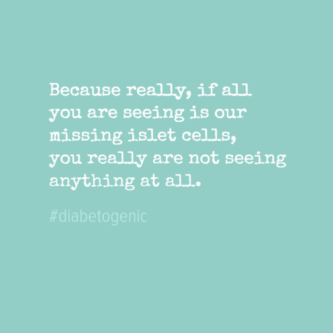
- Treat us like a person, not our faulty body part. And see all of us – not just our missing islet cells. Because really, if all you are seeing is those missing islet cells, you really are not seeing anything at all.
My post at the end of last year about me limping to the end of 2017 was spot on. I don’t think I realised just how exhausted I was until the first day of my holidays when I slept until almost midday, not even getting up for a pee in the middle of the night. (Thank you, Loop!)
That pretty much set the tone for the next three weeks.
I’m not good at holiday holidays. You know, the ones where you spend all your time at home and just mooch around, losing track of which day of the week it is, and using public holidays as signposts for gentle reminders of how much time you have left until your return to the grind.
As it turns out, that was exactly the holiday I had and, most obviously, was exactly the holiday I needed. The initial pangs we all felt at not being in New York with friends, as we often are at this time of year, was eased thanks to visits from four different groups of NY mates all here either visiting family, or stopping by for their vacation. The brutal blizzards in that part of the world also made not being there a little easier, as instead, we managed to build up some vitamin D stores with leisurely walks around the neighbourhood, visiting favourite cafes or trying (unsuccessfully) to tire out the littlest dog at the park.
I spent time with my nose in books, scrolling through pointless social media feeds, trying to make sense of Trump (failed), binge watching Suits or just staring aimlessly at the sky.
I felt myself recalibrate, regroup and reboot until I knew that my breathing had slowed. The constant feeling of ‘what next’ gave way to ‘I’ll do it later’ and the most pressing thought was whether or not I really wanted to bake something right there and then. Usually, the answer was yes.
I realised that I started 2018 with a very different diabetes outlook to previous years. The same comfortable state in which I found myself once I started Looping seems to have moved in permanently. Perhaps it was having time to really notice it made me realise just how much my attitude to diabetes has changed.
I thought back to an early 2017 post last year where I decided that instead of making New Year’s resolutions I was going to have a word that became my guiding directive for the year. The word was ‘pause’ and I was going to do just that before taking on or tackling things.
Truthfully, I didn’t do too well with it all. I threw myself back into things with typical fervour, and the thing I’d hoped for by thinking ‘pause’ was that I would come to the end of the year and feel less overcome, exhausted and shattered.
Nothing changed and I think perhaps I’ve just come to the understanding that we all get like that at the end of the year.
Still no resolutions this year. But I do like the idea of having a word that I come back to when I need to feel centred. And it became clear and very obvious that my word for this year will be ‘focus’.
I don’t feel particularly unfocused. But I like the idea of a reminder to rein me back in when the distractions make it hard to concentrate on what’s important. Background noise can become overwhelming and losing the ability to stay focused and determined slips away all too easily.
And it’s a word that can mean lots of things. More focus on the diabetes issues that matter to me. Access and affordability to diabetes technologies, treatments and insulin will always be important to me both in my ‘real job’ and in my own advocacy efforts. Reducing diabetes stigma and ensuring language helps rather than harms people with diabetes. And peer support, because we need to know and feel that we are not alone. Plus, more focus on my family; more focus on ME.
We’ll see how it goes…
I’m back at work now: rejuvenated and ready to go. Happy New Year – it’s great to see you here!

Wearing stripes, carrying stripes, standing in front of stripes. Some things won’t change in 2018…
How’s your Christmas shopping going? Have you managed to get it all done and wrapped everything up in beautiful vintage newspaper with contrasting artisanal twine? Have you hand-addressed all the gifts on mistletoe leaves, and had Christmas elves bless the bounty? Have you stuffed everyone’s stockings with scented candles, socks and undies, and photo frames?
Yeah, me neither!
Starting to panic? About to head to a frantically busy shopping centre with a million other disorganised and stressed shoppers? Or have you already popped into a local chemist to clear them out of their toiletries packs?
Well, put down the bath bomb! I can help. And the best bit – you can do it all from your kitchen table, while lounging on the sofa, or sipping an iced latte at your local café, which is what I am doing as I am writing this little post.
Children and adults are dying because they can’t access insulin. I don’t mean to rain down on your Christmas parade or tangle your tinsel, but this is the cold harsh truth. It is happening every single day. I know I don’t have to remind most people who read this blog that insulin is not a new or experimental treatment. You all know that it’s been around for close to 100 years.
Insulin should be easy to come by for every single person in the world who needs it to treat their diabetes, but unfortunately, that’s not the case.
I don’t know about you, but this fact makes me angry and despair. The idea that people are dying because they cannot access the very drug that I can easily pick up at any chemist in my neighbourhood actually hurts my brain.
But what if you could make a difference and actually get insulin to those in need AND skip department store queues as you line up to pay for some gift that will probably end up being re-gifted in next year’s office Secret Santa? (Don’t look at me like that – we’ve all done it!)
Well, you can, and it’s as simple as making a donation to a charity that is helping to get insulin into the hands – and bodies – of those who need it most. You can make gifts in the name of any or all of your friends and family, and I bet that they will understand why you have forsaken the novelty cup you usually buy them to do this instead.
When anyone asks me what I want for Christmas – and even if they don’t ask – I say ‘Please make a donation to either Insulin for Life or Life for a Child’.
My parents are doing that for me this year, and truly, it is the best present they could give me – I couldn’t be more pleased.

Click image to donate to Insulin for Life

Click image to donate to Life for a Child.
No one loses here. You avoid screaming kids and whimpering adults at shopping centres, no one gets a pointless gift they have to pretend to have always wanted. And someone is given the gift of insulin, or rather, the gift of life.
Now that’s the spirit of Christmas!





 Diabetogenic