You are currently browsing the category archive for the ‘Awareness’ category.
World Diabetes Day is celebrated each year on Frederick Banting’s birthday. Banting, of course, is credited with co-discovering insulin. That happened back in 1921, so it seems almost unimaginable that people are still unable to access insulin because it is so prohibitively expensive. And yet, that is the reality for children and adults all around the world.
Children like Manuel:
Frederick Banting said ‘Insulin does not belong to me; it belongs to the world’. Insulin belongs to Manuel as much as it does to you and me. But until he, and thousands and thousands of children and adults just like him, can access insulin easily and affordably, Life for a Child will continue to try to bridge the gap.
Read all about Manuel here. His story should be told just like anyone else’s, and in his own words. He is living with diabetes; his diabetes story is his own.
And then, once you have listened to his story, consider making a donation. (Please note that there has been a recent change to where you donate. Start by clicking here.)
Each year, on 14 November, I thank Frederick Banting for my life. I can’t think of any better way to honour his memory than donating to Life for a Child.
With Diabetes Awareness Month in full swing, many of us will have seen the JDRF’s Type 1 Diabetes Footprintflash up on our SoMe feeds as diabetes friends show just some of the ways diabetes has impacted our lives.
This is my one: accurate as of last weekend:
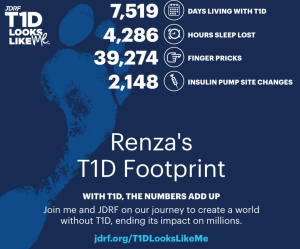
This is just a sample of the numbers that show how much diabetes influences and affects our day to day (and night to night!). If we’re talking numbers when it comes to diabetes, (which I don’t really like to do), there are so, so many more. Here are just some of them… (all are totally random estimations – don’t take anything as gospel here, folks!):
- The number of BGL strips found in unlikely places: 4,500,596,098
- The number of fruit pastilles I can stuff into my mouth at one time whilst in the throes of an ‘I-am-dying-give-me-all-the-glucose’ hypo: 142
- The number of hours being supported by friends with diabetes: 3 – and that’s just today!
- The number of times I’ve caught my pump line on a door handle: an embarrassingly significant number (because: #NotGoodAtDiabetes)
- The total weight I can lift/move when I am having a ‘super-power’ low: 1,450kgs
- The number of red scarves bought at the ADA meeting ‘Stop Diabetes Shop’ because the bloody aircon is too cold at convention centres and I keep forgetting to bring a jacket: 3
- The number of hours after my planned bedtime of 10.30pm I actually go to bed because I’m talking to DOC friends on the other side of the world: 2…3…4 (also: time zones suck)
- The number of times my heart beats per minute when I realise just how low I am, and that there is no easy-to-grab glucose source in sight: 180
- The number of days a Rockadex patch lasts on my arm: 7-10
- The number of nights I’ve lain awake fearing what diabetes has in store for me:more than I care to remember
- The number of handbags I have bought because I’ve convinced myself it will be ‘THE perfect diabetes bag’: 237
- The number of frocks that are hanging in the cupboard unworn because there is no bra that works underneath it and therefore nowhere to house a pump and RL: 25
- The number of supermarket aisles wandered around while low trying to decide what to eat: 8
- The number of jars of Nutella in my house at any one time (for hypo purposes, of course): 4
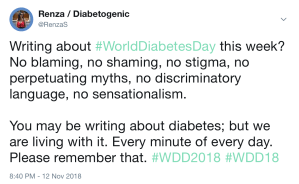
- The number of times I send out a tweet urging health writers to please be considerate when writing about diabetes: a few times a year.
- The number of times I’ve thought a hypo simulator is a good way to explain what it feels to have a hypo to people without diabetes: 0
- The number of gulps of water it takes to try to quench high glucose levels: 36
- The number of times I’ve explained why #LanguageMatters in diabetes: 123,890,456…123,890,457…123,890, 458
- The number of breaths I need to take before explaining – yet again – why I CAN eat that doughnut: 2
- The number of times I have been grateful that diabetes didn’t stand in the way of me having a beautiful baby girl: every single minute of every single day
- The number of ‘I know someone with diabetes, they died’ stories I’ve had to listen to: 6,984
- The number of times I’ve said the words ‘No, it isn’t a pager/nicotine patch, mobile phone, fitness tracker’ etc to explain a piece of diabetes tech strapped to or hidden on my body: 9,465
- The number of tears that have fallen because I feel overwhelmed by diabetes: countless
- The number of times I’ve been glad to have been diagnosed with diabetes: 0
- The number of times I acknowledge just how fortunate I am to have been born into a country where insulin is easily accessible: at least once every day
- The squirts of surface cleaner needed to remove marks from wherever I’ve accidentally left blood after checking my BGLs: 3
- The number of days I’ve wished I didn’t have diabetes: every single one of them
- The number of days I’ve felt so overwhelmed and burnt out by diabetes that I find performing the most basic things (diabetes and non-diabetes) a struggle: Frequently. because diabetes sucks
- Oh – and the number of times I’ve been wearing a white shirt when I’ve had a gusher: every time
- The number of times I’ve said or written ‘My Diabetes; my rules’: 566,285 (3 of those have been in the last 20 minutes)
- The number of times I give thanks to the brains trust behind DIYAPS: hourly
- The number of alerts or alarms from my phone it takes before I actually take note and do something: 6 (unless sleeping and then: whatever)
- The number of times I’ve accurately counted the carbs of anything containing rice: not once
- The number of times I’ve asked ‘Have you spoken with people with diabetes about that?’: lost count…now I just weep
- The number of lancets I have used in the last twenty years: probably about 18
- The number of dot points on this inane and silly list: every single one of them!
Oh, hello! It’s World Diabetes Day this week. And that means one thing and one thing only: diabetes will be elevated to health condition of the week, and we will see it EVERYWHERE.
I recently wrote that I’d been a little out of sorts a couple of weeks ago. I’m back to my usual robust and resilient self, but on the way back, I seem to have misplaced the filter that usually muffles the directness for which I am sometimes pretty much always known.
I realised it was missing when I was speaking at HIMSS last week and I was pretty direct when talking to some app developers. Instead of doing my usual sandwich feedback (i.e. something positive to begin with; suggestions for how it could be better in the middle; something positive to round it out, all with what could be considered a Dolores Umbridge smile on my dial), I went straight for the filling of the sandwich.
It turns out that without my filter, my comments eschew (rather than chew) bread and are all about the meat in the middle. I become totally low carb in my feedback. And I lose my smile. (A doughnut would probably bring that back, though…)
For this week, we will be banging on about the need for diabetes awareness. Of course, this morning as I was dressing and tucking small vibrating or lighting up boxes and infusion sets into my bra, and checking the tape on the CGM on my arm, while wondering if Loop really did have that downward arrow on my Dex under control, all I could think of was diabetes to the left of me; diabetes to the right. And I’m stuck in the bloody middle with it because it won’t leave me alone. I can’t help but be diabetes aware. All the fucking time!
But this week isn’t about us, (this piece from Tom ‘Diabetes Dad’ Karlya from a few years ago does a great job of explaining that in ways less sweary than my own). It’s about putting diabetes on the agenda for those of us who don’t already think about it morning, noon and night because it’s mailing address is our body.
So, for that reason, local newspapers, news bulletins, online new outlets and everywhere else that is trying to fill a 24-hour news cycle with content will want to talk about diabetes. If previous years are anything to go by, what we see will not necessarily be all that great. But that doesn’t need to be the case.
Last week, I was involved in a news segment about diabetes. When I watched in back on the news that night, I was so impressed with the way the story was presented. I’d managed to chat with the reporter as she was putting together the copy for the newsreader to use when introducing the story, and what she would say. There was no use of words such as ‘sufferer,’ ‘diabetic’ or ‘disease’. Instead, it was a balanced story that presented the facts. It was no less a piece because it left out sensationalist language.
I know that news outlets like a melodramatic take on things, but if you are in a position to help frame the way that diabetes is presented in the media, do it! It’s easy to do (the Diabetes Australia Language Position Statement helps) and mentioning that it takes no more time to use engaging and empowering language rather than stigmatising and negative language may help too.
I’m all about hope at the moment – well always – so here is what I hope for this World Diabetes Day:
In the posts celebrating the theme of this year’s WDD, diabetes and families, I hope that nowhere is a person with diabetes made to feel guilty, or that their diabetes is a burden on their family. I know that diabetes affects my family. I know that diabetes has moments of keeping them awake. I know there are times they may worry. But thankfully, I have never, ever heard them tell me, others, news outlets, social media, one of our dogs that they don’t sleep because of my diabetes, or they spend every minute thinking about how diabetes impacts on us, or that my health condition eats into our savings. Think about what you are saying and how we may feel if you talk about us like that.
In news reports, I hope for accurate reporting that doesn’t make us look pathetic or as though we deserve pity. I hope for language that presents the facts about diabetes without adding judgement or blaming us for our condition.
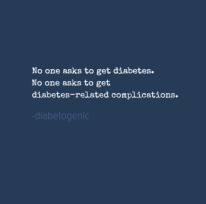
I hope that whoever is thinking, writing, speaking, presenting about diabetes this week remembers that no one asks to get diabetes; no one asks to get diabetes-related complications. Blaming and shaming us does nothing for anyone.
I hope for balance, and that for every story that celebrates an Everest climbing (or similar) we acknowledge the less grand endeavours. Because when speaking about diabetes, we cannot only hear from those at the extremes of the spectrum. Most of us are somewhere in the middle and our stories shouldn’t be left out.
In online groups I hope for no discussions about why we need to change the name of type 1 diabetes to distance ourselves from people with type 2 diabetes. Because: 1. Shut up and 2. Stop it; you’re adding to the stigma.
And more about online groups. If people are sharing news stories that will inevitably show overweight people eating hamburgers, the correct response is not to shame these people and tell them they are pathetic for not eating low carb. Because: 1. Shut up and 2. No one cares about how many grams of fat or how few grams of carbs you ate today, or how much insulin you didn’t need because you ate a bowl of organic kale with some organic tuna with coconut oil for lunch.
I hope that diabetes is presented as a serious health condition that does not discriminate when selecting whose body it wants to hang out with (in?). And that all different body types are represented.
And while we are talking about representation, I hope that we see diversity in diabetes stories from people of different colour, race, religion and sexual orientation. Because factors affecting our diabetes go beyond just the medications we take, and not everyone living with diabetes looks or is the same.
I hope that the voices of people with diabetes are not drowned out by those around us.
I hope to see myths busted.
I hope that somewhere we see that diabetes affects the whole person – body, mind and spirit – and that any solution claiming to help us, addresses each and every one of those parts of us.
I hope to see those who are happy to #MakeDiabetesVisible take whatever platform works for them and shares, shares, shares; and equally those who want to be more quiet ,are given the space to do that too. (Read this beautiful piece from Melinda Seed for more.)
And most of all?
Most of all I hope that no person with diabetes sees anything this World Diabetes Day that makes them feel diminished in any way for having diabetes. Because if that happens, then surely the day cannot be measured a success.
This year for World Diabetes Day, the International Diabetes Federation has decided on the theme ‘Diabetes Concerns Every Family’. According to the WDD website, the aim of the campaign is ‘…is to raise awareness of the impact that diabetes has on the family and to promote the role of the family in the management, care, prevention and education of the condition.’
I get that. I have said it on numerous occasions: it takes a village to live with diabetes.
I was a little nervous when I first saw some of the materials from the campaign, because I was worried that it may focus too much on the negative effects of diabetes and how it burdens the families of those living with diabetes. I know how diabetes impacts my family and I feel enormous responsibility already about that. I don’t need to be reminded of it, and I certainly don’t need to be guilted into being told that if I am not managing my diabetes properly I am doing a disservice to my family.
Although there have been a few little things that hint at those ideas, mostly, what I’ve seen has been positive and focused on celebrating and acknowledging those villagers who help us live with diabetes.
Diabetes Australia has decided on the campaign of #MyDiabetesFamily to highlight the idea of the village, and acknowledge that ‘family’ looks different to a lot of people. For some people with diabetes, it will be their immediate family – parents, partners, kids etc – who are their main cheer-squad and supporters; for others it will be their friends, work colleagues or maybe gym partner. Someone the other day told me that their dog is their most important diabetes supporter, providing them with comfort – and alerting them to lows.
I was asked to put together a collage of the people who I would refer to as #MyDiabetesFamily. This is it:

#MyDiabetesFamily
Obviously, and most importantly, Aaron and the kidlet feature. They know my diabetes in a way that no one else does because they see it most. They see the difficult days, the frustrations and how overwhelmed I can get, but they also see my celebrate the positives. And they have seen how much my diabetes – and my attitude to it – has changed in the last 12 months. In some ways, they benefit from Loop, too because my diabetes intrudes a lot less into our family’s life.
My parents and my sister are on there too – another obvious inclusion. Their support is never ending.
My gratitude for my family – in the more traditional sense of the word – is unending. They may not have diabetes, but they deal with it in different ways. While they may not understand that feeling of unquenchable thirst that comes from high glucose levels, or the panic of an ‘eat the kitchen’ low, they do know what it is like to be spectator to it all and I know that they all wish that I didn’t have to deal with those things – and everything else diabetes has to offer.
And the photo at the top shows just some of my friends with diabetes. As it turns out, this was the first photo on my phone with a group of diabetes friends, and these fab people are just a tiny number who also make up #MyDiabetesFamily; I am lucky to say that there are so, so many more.
These are the people whose islet cells are as absent as my own; these are the people who ‘get it’; these are the people who intrinsically understand what diabetes feels like – even if each of us have different experiences, and we use different words to explain it, and come from and with different perspectives. These are the ‘us’ in #NothingAboutUsWithoutUs; they are the ‘tribe’ in ‘Find your tribe, and love them hard’.
And in the middle? Well, that would be me. Because I am the one who is so grateful to have them all there as part of my life, helping and supporting me.
Want to get involved and celebrate your own diabetes family?
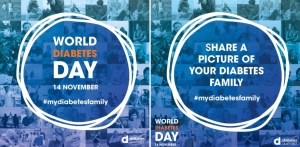
Have a look at the Diabetes Australia Facebook page (click on the image below to be taken there) to find out how.
DISCLOSURE (because they matter and I always disclose. ALWAYS.)
I work at Diabetes Australia, and had some involvement in the development of this campaign. I am writing about the campaign because I think it is a truly important one – not because I was asked to by any Diabetes Australia staff. Plus – I’ll take any opportunity to highlight the folks who make living with diabetes easier!
I’ve been a little out of sorts for the last week or so and this has translated to me feeling a bit distracted, and not sleeping well. I’d forgotten about not getting a good night’s sleep, because Loop completely and utterly changed the way I sleep. Here’s the thing, though: when I am not sleeping well, my glucose levels are far less predictable. And then, when my glucose levels are far less predictable, I sleep less. And so, I enter a cat and mouse chase as I step in and try to sort things out when really, I should stop. And try to sleep more.
I’ve thought about this as I skim through posts about raising awareness of diabetes. Because I realised that in the eagerness of doing the very important work of trying to #MakeDiabetesVisible to everyone else, and raise awareness of what living with diabetes is truly like, I am still becoming aware of things myself. It flies in the face of my belief that this month isn’t about those of us who have diabetes – it’s for the people who don’t, so that we can hopefully improve their understanding of the seriousness of diabetes.
But actually, in the last few days, as I’ve been a little more introspective – and awake more –I’ve become aware of the impact of sleep. Or rather, the impact of the lack of sleep.
I talk a lot about how all-encompassing diabetes is: about the burden of diabetes. This is different for everyone, and in the past I have spent a lot of time (some might suggest navel grazing) trying to define the things that contribute most to that burden for me.
Since I started Looping, I regularly say that I feel less burdened than I ever have.
That is true. And when I think about it makes perfect sense. The automation of Loop means doing fewer diabetes tasks, and that means less burden on the physical things I have to do. It has also resulted in significantly reducing swings in glucose levels. These things alone save me a lot of mental energy. And physical energy too. And keeps my mood far more even.
But this last week; a week that I have felt a lot more needed from me emotionally, diabetes has struggled too. Loop is brilliant at chugging away in the background and keeping everything as stable as possible. Night-times are brilliant because there are far fewer of the contributing factors that send our glucose levels into disarray.
However I have spent more time awake, meaning less time for just chugging and more time for needing to fix things. The less I sleep, the more Loop has to do. And sometimes, it doesn’t cope all that well – especially if I step in to try to give it a ‘helping hand’.
Sleep is so important. We talk about food and exercise and medication and how they impact on our glucose levels. We talk more about the result of stress on our diabetes management. We know that when we get right the equations about those factors and our glucose levels are less variable, we feel better. But sleep? I honestly don’t think that anyone has ever spoken with me about sleep.
Sleeping more is a regular issue for me. I get a second wind late at night and suddenly decide that is the time I should really do some work. Plus, having friends around the globe means needing to negotiate time zones. When they are awake, I often should not be, yet marathon message sessions often happen and that delays sleep too. It works both ways. I’m conscious that good times for me to chat are not necessarily ideal for those in a different hemisphere! Oh – and then there is jet lag. Ugh…jet lag.
Adam Brown has devoted a whole chapter of his book ‘Bright Spots and Landmines’ to the issue of sleep and diabetes. I think I need to have a reread. But more broadly, I think we need to better address the issue of sleep for those of us living with diabetes, because once our quantity and quality of sleep starts to affect our glucose levels, the way we feel overall significantly changes.
I’m feeling much more like my usual self today. I slept a little better last night and my CGM trace has been far nicer; Loop has been able to cope much better, and my time in range has returned to what I have become used to. All in all, it adds up to me feeling like I usually do.
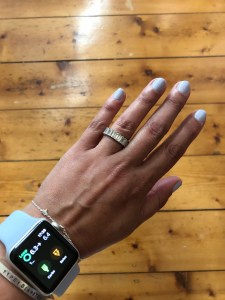
Unfortunately, even with the improved night’s sleep and more time in range, I still wasn’t thinking clearly enough when I chose this colour for my nails. I’ve no idea what to blame for that ill-advised choice, but probably should have learnt by now that awareness raising for diabetes does not need to extend to blue nail varnish. Alas, I have not …
Everything is turning blue. In the US, today marks the start of Diabetes Awareness Month. Apparently, Diabetes New Zealand are also using November as an awareness opportunity, this year focusing on encouraging Kiwis to ‘Act now to live well with diabetes’. (You can read about their activities here.)
While it’s not Diabetes Awareness Month in Australia, those of us in the Aussie diabetes world cannot escape that there is a lot of diabetes happening. We can choose to get on board or ignore it. Except, of course, on World Diabetes Day where we ring everything in blue circles.
Some years I’m totally gung-ho and all enthusiastic and happy to do the whole month. Other years I’m a little more subdued. This year, I think I’ll have a foot in both camps, which was apparent with my swinging mood this morning. I woke up and my attitude was firmly here:

But, after my shower as I searched for something to wear, almost automatically, I went straight for clothes that were blue. Blue. All blue! Every single thing: blue! (Including my eyeliner.)
Diabetes awareness means different things to different people. I firmly subscribe to the My Diabetes, My Rules philosophy, and that also encompasses the issues that we hold near and dear, and fight for with all the energy we can summon. And those issues will be different for different people.
For me, I’ll keep on keeping on throughout November, working on the issues that matter to me. That includes neat little hashtags like #LanguageMatters and #NothingAboutUsWithoutUs. It also includes acknowledging that diabetes is a self-managed condition that we do ourselves more than 99 per cent of the time. I challenge ideas around consent and autonomy. I fight for us to be able to do diabetes in the way that we want – with the right support system around us, using what we need to be our best. I talk a lot about how diabetes is more than numbers and that screening and consideration of our mental health is just as important as screening and consideration of diabetes-related complications. And while we’re on complications, I have spent a great deal of time this year writing about how blaming and shaming people with diabetes and diabetes-related complications is damaging. I beg, beg, beg that Steel Magnolias not be held up as current case study for diabetes and pregnancy. Perhaps most loudly, I cheer the cause of PWD being represented, present, including, involved and highlighted when diabetes is on the agenda…any agenda! Life for a Child remains a cause very close to my heart and something I am privileged to be able to support. And I promote the value and need for peer support, clearly explaining how it is my friends living with diabetes – my tribe – who I count on most because they unquestionably ‘get it’ and that what we learn from our diabetes peers is absolutely critical.
The list is long and at first, it may look like I need to just settle on one or two things and do those properly rather than the half-baked mess it may appear.
But actually, when it all boils down, I think that the truth is that all those issues can be condensed into four main categories: Access, Respect, Choice, Health.
That’s what November is going to be about for me. I’ll keep banging a drum to what may now be a familiar tune. But there is lots more to do. And this month, I’ll be doing it in blue.

I’m still playing catch up on the goings on at EASD. It was such a busy conference – in general and for me personally – that my head is still lost in a lot of what happened and what I saw. It’s somewhat frustrating for me because diabetes conferences are seen as an opportunity for so many meetings of different groups and projects I’m involved in, and that means I don’t get to anywhere near the number of sessions I would like to. When I can, I make sure I live tweet my way through (that’s how I take notes to do write ups later), but this conference was so busy that there was very limited time for that.
But I still did get to see a lot thanks to the satellite events I was invited to and asked to speak at. Plus, this year at EASD, I was involved in something new that was super exciting.
DZD meets #DEDOC was a novel session combining young researchers and (not necessarily young) people with diabetes to give different perspectives on a variety of current research programs. The event was presented by Deutsches Zentrum für Diabetesforschung.
(My very limited German (i.e. I sang in St Matthew’s Passionat University – badly – and was in the orchestra for a German-language version of Threepenny Opera, or rather, Die Dreigroschenoper) is apparently good enough to translate that as the Diabetes Centre for Diabetes Research – so, I guess I’m almost bi-lingual now.)
Bastian Hauck hosted the event and was involved in the project to nominate PWD to speak at the event, and encourage other PWD who were at EASD to come along and listen. This was Bastian doing what he does best – facilitate discussion and encourage engagement by different stakeholders. He always manages to ask questions that get people thinking in different ways and did a stellar job again in this event.
The session was not designed as an excuse for PWD to be critical of the research and researchers, or to find fault in what they were doing. It was not to query the merits of the research either. It was to give the researchers an opportunity to speak about their work (in a rapid fire, five minute pitch), and for PWD to engage in that discussion, asking questions and explaining the relevance of the research to actually living with diabetes. While the project may not have actually come directly from PWD, it was a true collaboration where researchers spoke of what drives them, and we shared what we hope from science.
So, what research was on show?
Firstly, we had Dr Stefan Kabisch speaking about research which compared dietary prevention and treatment of type 2 diabetes with two different interventions: one low carb and one low fat. Cathy van de Mortelewas the PWD involved in this segment of the session, and we couldn’t help but have a little giggle that she had been selected. Those who know Cathy know she is anincredible baker and cook. Her creations are magical and if I lived in Belgium, I would be at her place for dinner three nights a week. But low carb and low fat? Not so much! However, she did give a really useful perspective on the need to remember that different eating plans need to be sustainable and what works for one person may not work for another.
Secondly, Dr Carolin Danielspoke about her research in type 1 diabetes prevention vaccines. Dr Katarina Braune stepped in as the PWD (she is also a researcher and endo) to give her comments on the research. It was interesting hearing Katarina, because she comes from the perspective of a scientist as well as a PWD, so her considerations were different to other PWD who spoke. Her questions and comments incorporated the scientific as much as the ‘real life’, and I loved the way she was able to so succinctly and eloquently translate it all so it made sense to someone like me without a scientific bone in my body!
And finally, Dr Julia Szendrödispoke about diabetes-related complications. While the research was specifically about the mechanisms in the development of complications, as well as looking at potential interventions, I was invited to be the PWD in this discussion to lend my language focus. I highlighted how conversations about diabetes-related complications need to be without judgement and stigma, and that at all times, remember that although a single body part may be in question when speaking about a specific complication, it is attached to a person with a whole body and mind that must also be considered.
To be honest, I felt that my comments were almost redundant because Julia did such a beautiful job in her five minute explanation of her work of ensuring that there was no blaming or shaming. I thanked her for this because the language in pretty much every other discussion of complications I had seen that week was not all that palatable!
I love the idea of including PWD to shape diabetes research. And I loved the discussion at EASD. It was an excellent example of how to include PWD in discussions – even highly scientific discussions. And just how easily it can be done!
This event was the first one, but hopefully the organisers have seen the value of conversation-based sessions including different stakeholders. It would be great for events such as this to attract even more attendees – researchers, HCPs and PWD – although a huge thanks to the German PWD contingent who was there, flying the advocate flag and supporting us – and to see them on the main program of the conference.
DISCLOSURE
I was invited to provide my perspective at the DZD meets #DEDOC presented by Deutsches Zentrum für Diabetesforschung. I did not receive any payment to speak at the session. Thanks to Bastian Hauck from DEDOC (the German Diabetes Online Community) for involving me!
Roche Diabetes Care (Global) covered my (economy) travel and accommodation costs to attend their #DiabetesMeetup Blogger event at #EASD2018 and present at their media event the day before EASD. Roche Diabetes Care also assisted with providing me press registration to attend all areas of the EASD meeting.
I’m heading to Sydney this morning (it’s early…too early) for the Australasian Diabetes Advancements and Technologies Summit – ADATS, (follow along at #ADATS2018), which had me thinking about the conference last year where I spoke about Loop, scared a shitload of HCPs, was almost traumatised into never speaking again in public (almost – didn’t happen) and was happy to be branded non-compliant.
Today will be a far gentler experience – my role is as a member of the organising committee, and as a session chair. Surely no one will want to sue me for that. Right?
As I ponder that, and reminisce about last year’s talk, here are some links. So many links that I have been wanting to share. So, have a cuppa, have a read, and share stuff.
Also, being deliberately non-compliant is kind of fun…

(Disclosure first: My flights from Melbourne to Sydney are being covered by the National Association of Diabetes Centres (NADC), the organisers of ADATS. I am on the organising committee for the conference.)
_________________________________________
Finally DIYAPS makes it to the mainstream media in Aus
I’d heard of The Saturday Paper, (which was a surprise to the journalist who interviewed me), but apparently not all that many people have. It’s a weekly newspaper (somewhat unimaginatively named – it’s a paper and comes out each Saturday) with long-form articles. One of those articles was about DIYAPS and came about after journalist Michele Tyde heard about the Diabetes Australia DIYAPS Position Statement.
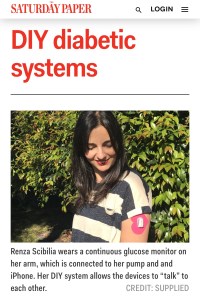
Read the DIYAPS Position Statement here.
The body part is connected to the PWD
‘Talking about the “diabetic foot,” the “diabetic kidney,” or the “diabetic eye” suggests they are somehow separate from the person whose body actually hosts the diabetes. This language suggests the diabetes-complicated body part is more like a malfunctioning car part that needs service – if only we could be provided with a courtesy foot, eye, or kidney to use until our own is better!’
The language at ADA this year (all the way back in June…all the way over in Orlando) didn’t really set off too many alarm bells. Until we had a good look at the program. I wrote this piece with The Grumpy Pumper for diaTribe about how it seems that #LanguageMatters a whole load less when talking about diabetes-related complications…and that needs to change.
Conference blogs
It’s great to see the Ascensia Diabetes Care team continue to support diabetes bloggers by inviting them to write up their thoughts on diabetes conferences. The latest contribution is from Sascha Stiefeling (who blogs at Sugar Tweaks) where he gives some insights into the start of EASD. (It was written in German and translated into English.)
Oh – and here’s the post I wrote for them about the Australasian Diabetes Congress a couple of months ago. (I was not paid to write this, or supported by Ascensia to attend, but I did work with them on their Social Media Summit.)

No weakness at all
On Mental Health Awareness Day this year, UK writer and poet David Gilbert wrote this beautiful post about the strength – not weakness – of living with mental illness.
How we are wrong about obesity
This piece about obesity is a must read. It talks about how weight bias from healthcare professionals and stigma often results in higher weight people avoiding going to the doctor because they fear discrimination, not being believed and being shamed.
More on weight stigma
And read this piece (also on diaTribe) about how weight stigma hurts people and affects health outcomes.
Keep Sight
This week, Diabetes Australia officially launched the first ever national eye screening program, Keep Sight. The program will make it easier for Aussies with diabetes to get their eyes checked. You can read about the program here (from when it was announced back in July).
Disclosure: I work at Diabetes Australia, but was not asked to write about this program. I’m doing so because it is important.

Your story is important
True champion of listening to ‘the patient’, Marie Ennis-O’Connor wrote this wonderful piece about the power of storytelling in healthcare.
Always be kind
I’m always fascinated to read stories from HCPs who write about their experiences on the other side of healthcare. Moving from care-giver to the one needing care can be life-changing. In this BMJ Opinion piece, health researcher Maria Kristiansen writes about how important compassion and kindness from healthcare professionals were for her and her family during her young son’s illness and death.
More on kindness (because we can never have enough)
The first sentence of this article in BMJ by Dr John Launer had me hooked: ‘I’m not a clever doctor, but I’m a kind one’. Have a read.
Diabetes in hospital
I know I’m not the only one to be terrified of needing to go into hospital, worrying about a lack of knowledge about type 1 diabetes treatment and my technology, and having to fight to maintain ownership of my own diabetes care. Adam Brown at diaTribe has written about his recent trip to A&E, surgery and subsequent recovery after his appendix ruptured. Lots of great tips for anyone who may wind up in hospital.
Digital diabetes
How can digital medicine and research, and artificial intelligence transform diabetes? That’s the question research scientist in diabetes, Dr Guy Fagherazzi, asks in his (open source) review in Science Direct that you can read here.
Bake these!
And finally…It’s nearly the weekend and if you have a spare 20 minutes, you really, really should think about baking these! They are crackled parcels of molasses, spice and all things nice and are, quite possibly, one of the best things I’ve ever baked.

After a wonderful couple of weeks of real holidays – sun in Italy, less sun in London – I headed to Berlin, saying good bye to my family as we headed in different directions. I was bound for meetings before EASD officially kicked off. And they were headed to Wales and canal boats with extended family. We could not have found ourselves in more different settings!
My first day in Berlin was dedicated to HypoRESOLVE, the Innovative Medicines Initiative (IMI) funded project looking to provide a better understanding of hypoglycaemia. I am on the Patient Advisory Committee (PAC) for this project, which kicked off back in May this year in Copenhagen.
The project is divided into eight work packages (WP) and it was WP 8 that convened the first meeting. I was there as part of the PAC, and also to provide the personal perspective on hypoglycaemia.
Back in May at the kick off meeting, I had given a talk called ‘The literal lows of my diabetes’, where I spoke about my own experiences of 20 years of diabetes and how hypoglycaemia had impacted on my everyday life. This was a very personal talk, where I spoke about the fear and anxieties of lows, my different hypo personalities and the terror that comes with impaired hypo awareness.
But for this new talk, I wanted to do something different. I didn’t want to highlight my own experiences, because I am but one person and it is important that the audience never feel that they have ‘done diabetes’ and understand the ‘patient view’ because they have listened to one person.
I wanted my focus to be on the disconnect between how hypoglycaemia is regarded in the clinical and research world as compared with the real-living-with-diabetes world.
So, I used the tools at hand, and the fact that there is a vocal and ready to help diabetes online community just a few clicks away and sent out this tweet:

It was apparent straight away, as the responses came flooding in, that the way hypos are described and classified in clinical and research terms is very, very different to the way those of actually experiencing lows see them.
Here is how hypos are categorised in the literature:
 Straight forward, neat, tidy, pigeon-holed.
And yet, when I asked PWD how they would describe hypos, here is what they came up with:
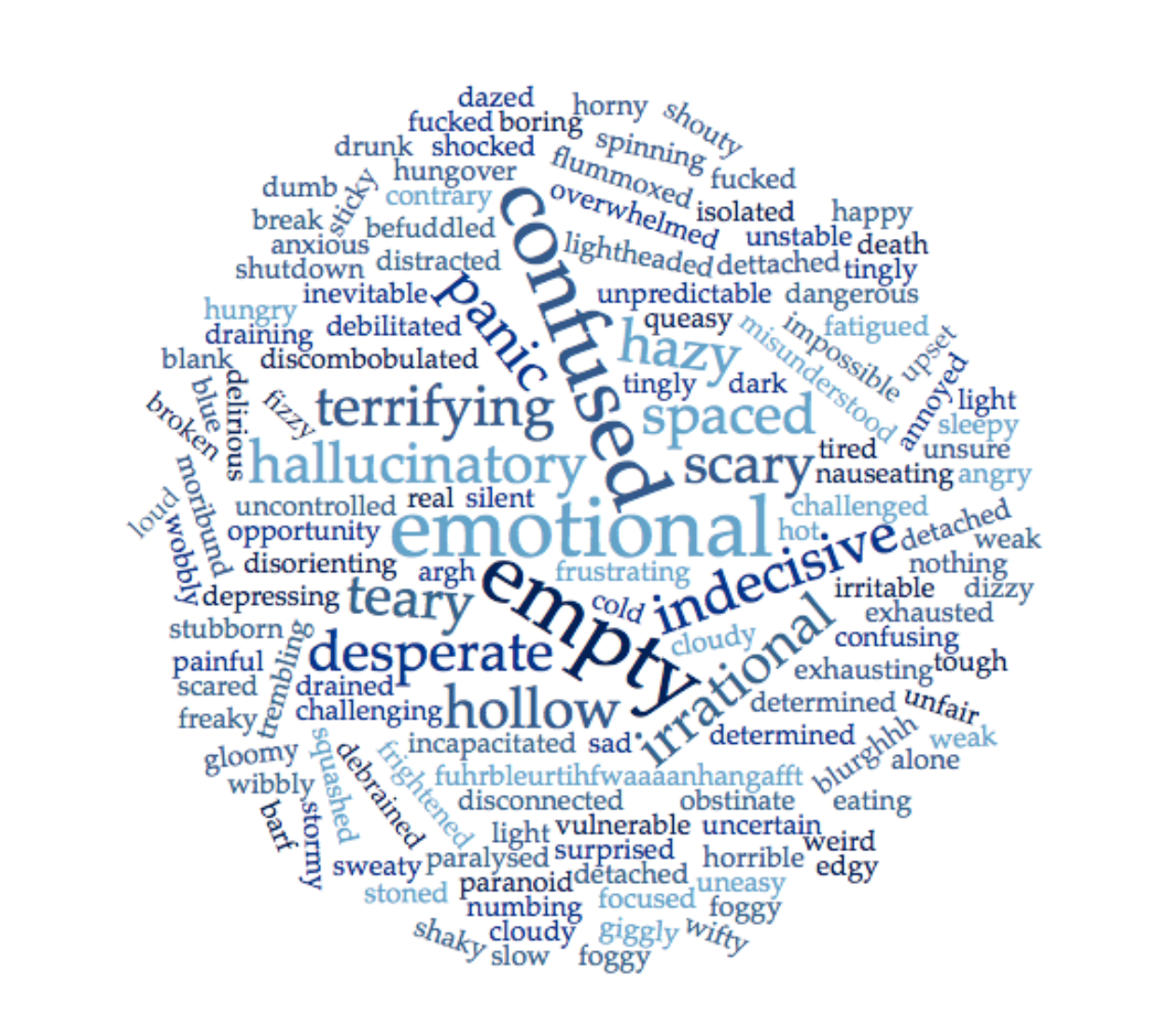
Some of the words were repeated multiple times, others appeared only once. Some of the words are the words I use to describe my own hypos, many I had not considered. Yet every single word made sense to me.
Hypoglycaemia, in the same way as diabetes, is not neat and tidy and it cannot be pigeon holed. I hope that my talk was able to illustrate that point.
And I hope I was able to highlight that using simple words and simple categorisations only service to limit and minimise just how significant and impactful hypoglycaemia truly is for those of us affected by diabetes.
You can keep an eye on the progress of HypoRESOLVE on Twitter, and via the website.
DISCLOSURE
The HypoRESOLVE project funded my travel from London to Berlin and provided me with one night’s accommodation. I am not receiving any payment for my involvement in the Patient Advisory Committee.
Previous disclosures about my attendance at EASD 2018, can be found on this post.




 Diabetogenic