
You are currently browsing the category archive for the ‘Awareness’ category.
I was up bright and early this morning, rushing around to get ready for a flight to Brisbane. ‘Happy Valentine’s Day, babe,’ I said to Aaron as I was pulling a dress over my head, brushing my teeth and checking to see what time the cab was arriving. ‘I didn’t get you anything.’ This announcement isn’t a symptom of twenty years of marriage; it’s not even because we are disorganised; and it’s not because we don’t celebrate Valentine’s Day (although, to be perfectly honest, before getting involved in #SpareARose, we really didn’t even acknowledge this Hallmark day).
These days, Valentine’s Day is a thing in our house, but purely because we’re all about spared roses and empty vases. And this year, Spare a Rose cookies.

Flowers die, children shouldn’t. It’s tragic that we even have to say that in 2019. But we do. Because there are still parts of the world where a type 1 diabetes diagnosis is a death sentence due to lack of access to insulin, and basic diabetes supplies and education.
If you can, please make a donation to #SpareARose. You money will go to Life for a Child and provide insulin to a child with diabetes. Don’t take my word for why this is important; here is Brandon telling his story and sharing how donations such as those raised as part of #SpareARose have helped him to fulfil his dreams. Happy Valentine’s Day.
Last week, the BMJ published a piece I wrote with the Grumpy Pumper. It was part of their ‘What Your Patient is Thinking’ series which includes stories from people sharing their experiences of living with a variety of health conditions, or using health services.
We wrote about the intersection between language and diabetes-related complications and why language matters so much any time this topic is raised. This is our latest piece on the issue (read the PLAID Journal article here, and something we wrote for diaTribe here). We may appear to be one trick ponies, but it seems the appetite for this issue has not in any way diminished – which is good, because there’s lots more to come! (We’re not one trick ponies – I for one can talk for hours about why the fax machine should be made extinct in healthcare.)
It’s been fascinating – and a little overwhelming – to read the responses to the article after it was shared on a variety of social media platforms at the end of last week, and then again over the weekend. It’s also been heartbreaking when people have told stories about how HCPs have spoken about diabetes-related complications in ways that have had negative effects.
It’s refreshing to see many HCPs (including those from outside the diabetes world) sharing and commenting on the article. Much of what we have written is applicable beyond diabetes. It doesn’t matter what health condition someone is diagnosed with; everyone wants to be treated with kindness and compassion and to not be blamed or shamed.
A couple of HCPs have said that after they read the article, they will now consider changing the way the speak. I love this piece from a CDE in the US who said that she honestly thought the words she was using when discussing diabetes-related complications were reassuring until she read our perspective, and now understands that there are better ways to frame the conversation. We only hope that this will lead to PWD feeling less judged and more supported, and not afraid to talk about what is still a taboo topic for so many.
The diabetes and language landscape is broad. I know that there are many who roll their eyes and say that actually, language doesn’t matter, and perhaps we should be focusing on more pressing issues, but I wonder if they are perhaps focussing on issues that they don’t think are really important.
But there is a lot more to this issue than, for example, the debate between being called ‘a person with diabetes’ or ‘diabetic’ – or if it even matters. Regardless of what the specific issue is, we are hoping is that people understand that words really do matter; they have far-reaching consequences; they determine how people feel about their diabetes; and that the right words have the potential to make people feel better equipped to manage their diabetes as best they possibly can.
Please read the BMJ article – it is freely accessibly – and share it with your networks. If you have diabetes, take a copy to your next HCP appointment and leave it for them to read. The way that we make real, sustainable change is to keep pressing a point, and explain why it is important. Hopefully this piece has gone some way to doing that.

The illustration that was commissioned for the print version of the article. Artist Rose Lloyd did such a great job of getting across the messages in the article!
Have you noticed how the social media feeds of many folks in the DOC are starting to look a little rosy? It’s a veritable florist out there at the moment, with lots of people talking and sharing information about #SpareARose.
I’m resharing is a recycled vlog from last year where I suggested that we try to get #SpareARose outside of the DOC and into the conscience of a broader audience. Watch my over-caffeinated rantings…and then tell someone about #SpareARose and ask them to donate.
The address for donations is: www.LFACInternational.org/SpareARose
(If this is your first time here, you may be wondering what’s #SpareARose? It’s a campaign that was developed by some pretty amazing advocates from the diabetes online community back in 2013. The idea is simple: send eleven roses instead of twelve to you love this Valentine’s Day and donate the money you saved (about USD$5 / AUD$7) to #SpareARose. Your donation will go directly to Life for a Child and provide a month of life-saving insulin to a child with diabetes. Spare a rose, save a child. Sounds like a pretty special Valentine’s Day gift to me.)
I read a powerful piece yesterday by Canadian writer, speaker and health advocate, Sue Robins. She has years of experience as a family advocate (her son has Down Syndome), and then, after being diagnosed with cancer, a patient in the health system.
Sue’s post was about her decision to withdraw from the world of patient engagement. Clearly, it was not an easy decision, but one that she felt she needed to make for her own wellbeing. No one could ever blame her.
So much of what I read in Sue’s piece resonated. The desperation she beautifully and eloquently outlined is something that I keenly have felt (feel?). And I know it’s not just me. I see that in the eyes of others trying to elevate the role of ‘patients’ and to ensure that we are truly listened to, and treated with the respect, compassion and kindness we deserve, all the time.
I get the constant battle that we have – and it does feel like a battle a lot of the time. On one hand we feel so invested in what is going on because it is happening to us directly. How can we feel any other way?
If we are living with the condition, it is personal beyond measure. If we are caring for someone and advocating for them, there is a different sense of pressure and investment. And if we decide that this is ‘a calling’ and do it professionally, there is a different again as we try to work within different parameters – the need to keep within the realms of what our work allows, and the less structured realities of actually living with a health condition.
For me, there is a mixture of the professional (because of my job) and the personal (because of my pancreas). I feel the push-pull of that daily.
I get tired. I get overwhelmed. I get discouraged. I get disengaged. I get disheartened.
I feel the system is broken and I feel how that goes on to break people. I have found myself at that breaking point on more than one occasion when the system is failing me, and equally, when I see it failing others and I can’t help.
Operating in a network with so many stakeholders is always difficult, but when each of those stakeholders seems to have a different mission, it becomes impossible. Because as much as we want to think that everyone’s mission is for the best outcome for the ‘patient’, I don’t know that that is necessarily true.
What I want when I walk into a hospital or a clinic appointment (or a GP appointment, pathology room, specialist check-up, operating surgery, or any other healthcare setting) is different to what the hospital administrators want, or the HCP, or policy makers, or any other stakeholder. Despite the claims of mission statements everywhere, it is undeniable that it is not the persons in the so-called person-centred care that direct outcomes.
Every single story we hear where someone is treated poorly, isn’t listened to, is blamed for their condition, is not given time or space to voice their needs, feels uncomfortable with how they have been spoken to, is another example of the system not being person-centred.
In diabetes, it could look like this:
- A person not being given the option of using the device they want to manage their diabetes. I repeatedly hear people say that they were told they could not use the pump they want to use because their clinic doesn’t offer that one.
- A person who is just diagnosed with type 2 diabetes, or needing to go on insulin to treat their type 2 diabetes being told that it was through their doing that this has happened.
- It could be not being able to manage our diabetes as we do at home when we are in hospital – insulin is removed from us, pumps are taken away, we are not allowed to use CGM in hospital and must go back to using blood glucose monitoring, not being able to eat the foods that we want because we must have the ‘diabetic menu’.
- A diabetes-related complication diagnosis is met with judgement instead of information about how to move forward.
- A person with diabetes being denied the time they need to speak about what is really concerning them, instead appointments following a formula that is unable to be adjusted.
It also looks like being excluded from the consultation, development, coordination and evaluation of programs, services, activities and resources that we are meant to use and find useful.
I don’t say these things because I think HCPs are out to get us, or that hospital admin teams are trying to make our lives hell, or that policy makers don’t care. I understand that everyone is working in trying times with funding cuts that are crippling the system. I know there are guidelines that need to be followed.
But at the end of the day, diabetes is our life. Melinda Seed has said ‘We have skin in the game’, a term I use when talking about the safety of using DIYAPS. We mean it literally as well as figuratively.
Again – I am not in any way minimising the commitment and dedication that HCPs have to working in healthcare. I genuinely believe that almost all are there trying to improve our lives and help us make sense of what is going on in our bodies.
But our desired outcomes are different. My KPIs when I walk out of a HCP appointment include feeling positive, feeling listened to and knowing how to move forward until my next appointment. I need to feel that I am equipped, motivated and encouraged.
We can read stories like Sue’s and shrug and say that she is burnt out. Burn out is almost inevitable when living with, or advocating for someone, with a life-long condition. But we shouldn’t be getting burnt out by the system. We get that enough when our bodies decide to start working against us. We need the health system to be working for us. And with us.
Welcome to January when suddenly the only thing that I seem to see on social media feeds, giant billboards around the city, and TV advertisements is details of weight loss programs. Because, of course, that’s what we should all be aspiring to, right? If we were happy to see the back of 2018 after a hard year, losing a few kilos will obviously set us on the track to eternal happiness in 2019.
Right?
Of course not.
Nevertheless, wellness gurus, celebrity chefs, local gyms, celebrity trainers, everyone who drinks green juice and has an Instagram account come into their own when January ticks over, heralding the birth of a new year and, while the fireworks are still bright in the sky, urging us to start a new (and completely unsustainable) diet, detox, and/or exercise plan to lose weight.
Under the guise of pressing us to be the best person we possibly can, they remind us that we have been slobs for all of December and need to shed weight because that will make us happy. Oh, and buy this teatox/12 week program/juice cleanse/lemon fast for a small monthly fee of $39. That’s not much, right? And what value can you put on your happiness, right? Lose weight; be happy. The equation is simple.
Except, it’s not. And when the emotional burden of diabetes is added to this – when there is something else that we are made to feel we need to fix – the start of the year suddenly doesn’t feel full of shiny and bright and new promise. It feels like we are about to fail. Yet again
I like the idea of stopping and hitting the reset button (oh – did you read yesterday’s post?) and if weight loss is your goal, then that’s fine. But we need to stop equating happiness and perfect health with a number on the scales. We need to stop being made to feel guilty because we may have eaten a little more than usual over the holiday period. And we need to stop being made to feel that we should be seeking redemption for our sins of enjoying the holiday period. We need to stop being sold the idea that the road to happiness and health is signposted by losing kilos
Because the reality is that all these messages actually add mental weight. And no one needs that shit in January. Or any time of the year.
But, I have found some ways to shed that weight.
You could start by getting of social media completely. But that’s as laughable to me as suggesting I should be running 5Ks a day and consuming only kale and kombucha. It is, however, worth acknowledging social media – actually, any media – is a fucking nightmare at this time of year, maybe even more so than at other times. But, there are some bright lights out there that, instead of suggesting that we are full of faults and problem areas that need fixing, encourage us to just damn well like (or even love!) who we are. Here are just some things you may want to check out:
Nina Mills is a Melbourne-based dietitian who just gets it. Her blog, Twitter and Insta feeds are well worth following for their no-nonsense approach to eating and anti-diet messaging. She nourishes the SoMe soul with delicious recipes and sensible ideas, and a healthy dose of self-deprecating humour too (her food fails posts are hilariously honest!). It is no secret that I have had very few positive experiences with dietitians – both personally and professionally – in my 20 years with diabetes, but had I met someone like Nina years ago, I would have a very different story to tell.
You can follow Nina at Feel Good Eating on Insta.
Body Posi Betes is run by my mate Georgie, who thankfully has returned from Paris and made Melbourne feel right again. The diabetes thread that weaves its way through her posts is life-affirming, as is the complete and utter refusal to subscribe to any sort of diet culture. She is sassy, sweary and fucking fabulous.
Start with Body Posi Betes on Insta.
Claire Christian is one of my kid’s favourite writers and her Insta stories are full of great ideas and strong feminist messages. She is a high school teacher as well, and if you have teenagers, (especially teenage daughters), check her out. (I have no issue with swearing…obviously…but if you do, you may find some of her posts a little confronting. But if you can push through that, she is just such a great role model for young girls, and 45 year old women too!)
Watch Dumplin’ on Netflix. And then watch it again! It is so, so gorgeous. It’s completely PG, and totally appropriate for kids. Plus, Dolly!
It’s not hard to love Jameela Jamil, and her amazing #IWeigh campaign continues to remind women that we are so, so much more than a number on the scales. She tore strips through celebrity weight loss products at the end of last year with a hilarious video of her spruiking a (fake) detox program. Her posts are brilliant, she is brazenly feminist, and calls out any bullshit she sees.
Her Insta is here. And here’s what I wrote about the #IWeigh campaign last year.
Obviously, there are so many other great thing to check out, and if you have any suggestions, please share them in the comments. This is a great time to curate what and who we follow by removing anything that makes us feel that we have faults or need fixing. Because we don’t. There is nothing wrong with wanting to be better or to find ways to make ourselves feel happier and healthier. But shaming or guilting us into it, or focusing purely on how we look is not the way to happiness. That just weighs us down.

Ice cream is not a reason for guilt. Tastes good, though…
Well, it’s been a year. It’s always the same. Come December, and as Mariah is blaring in every store I walk into, I start to feel exhaustion. But it’s not all bad news. Holidays loom ahead. Sunny weather means more time outdoors. And long, warm nights out with friends and family seem like the perfect way to spend my time away from work. Oh, and perhaps most excitedly, my mother is going to make her famous zippoli – my favourite Italian Xmas food.
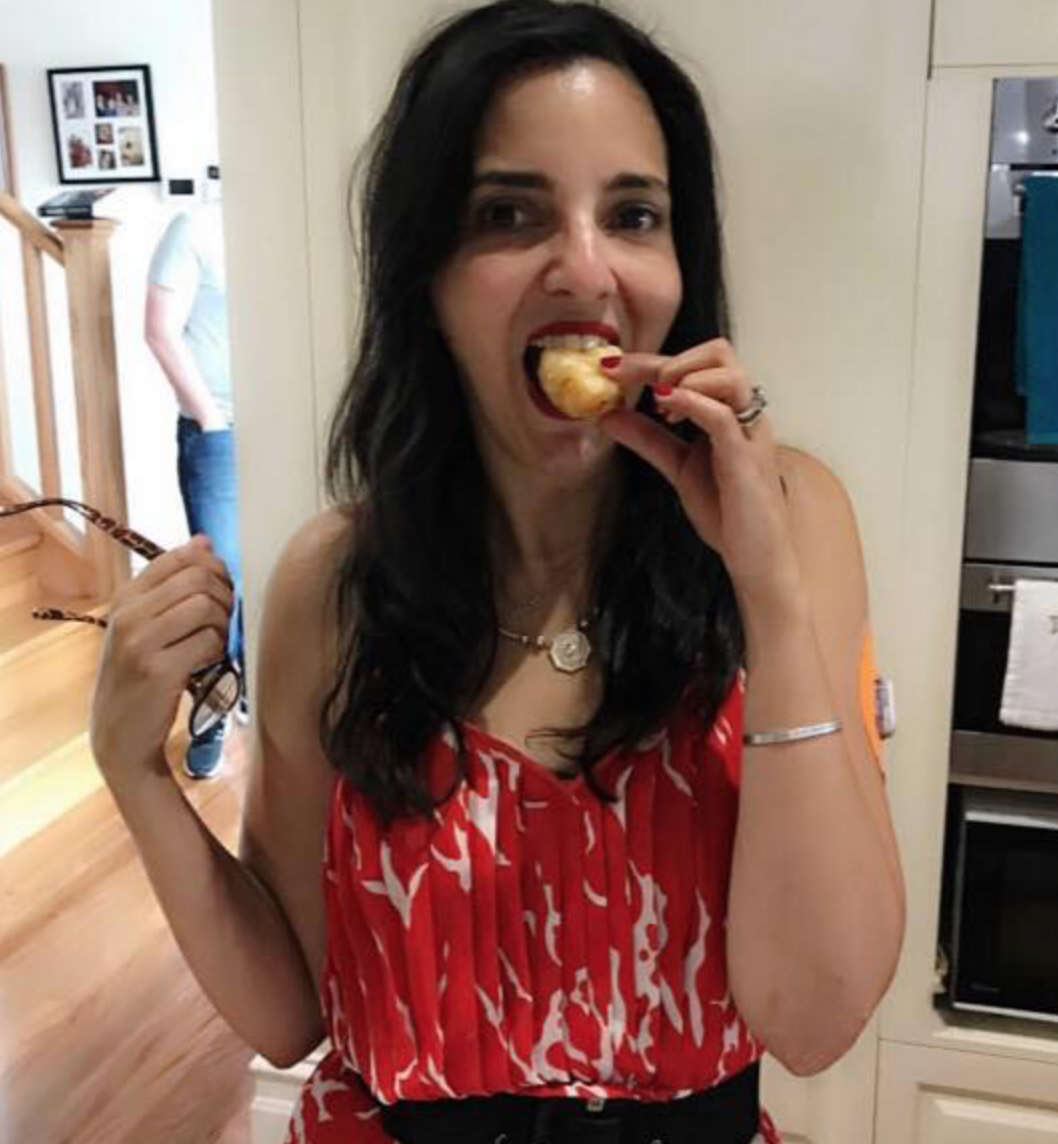
The happiest time of the year is when mum serves up zippoli. What a time to celebrate being from an Italian family!
The diabetes world remains comfortingly – and frustratingly – static at times. There are constants that shape each year, but there are also changes. Some are positive, some lead me to wonder just who is making decisions that impact on PWD and why do they seem so far removed from the realities of living with this condition?
I’m ready to draw a line under 2018 – a bold, thick, solid line – farewelling the year with the knowledge that there will always be some things about diabetes I know to be true.
Diabetes is hard. The relentlessness of it doesn’t really subside. As much as we have tools to try to make things easier, it permeates, something I realised back in July when the wind was knocked out of me as diabetes unleashed itself into every part of me, taking hold and trying to pull me under.
There is no silver bullet. Loop does seem magical to me, but my diabetes is still there. It is just here in a different way – a new normal.
The inequalities of diabetes continue to be an important theme throughout our community and we can’t turn our backs to the fact that access to the most basic of diabetes medications and treatments remains out of reach to many. There is no one way to advocate for change, and I commend everyone working at the front line to improve the situation.
Which brings me to the point where I remind everyone that it is absolutely not too late to make a donation – however small or large – to Life for a Child. Saving the life of a young person at Xmas time seems like an absolute no-brainer to me.
Peer support remains a cornerstone of my diabetes management toolkit. Of course the shape of that support changes – I’ve met some incredible new people this year and been involved in some remarkable projects. At the same time, there have been some important collaborations with diabetes friends I’ve known for some time. It’s those diabetes friends that continue to help me make sense of my own diabetes, make me realise that my village is global, and know that wherever I turn, someone will have my back. I can’t explain just how reassuring that is.
Despite feeling that there have been times that the community has been splintered and a little disjointed, I still believe that the diabetes community is something positive. I also know that it can take time to find your tribe in there, and accept that not everyone has to be best buddies. But when you do find those people who you just click with (and that doesn’t mean agreeing on everything, by the way) you do everything you can to hold on to them, because that’s where the magic of working with peers happens.
While co-design seems to have become a bit of a buzz phrase, there are some examples of it that just make diabetes activities and projects so much better! This year, I’ve had some incredible opportunities to work on projects with a vast array of stakeholders and what can be achieved is incredible.
Sometimes, (a lot of the time?) we need humour in diabetes. And sweary birds. Finding Effin’ Birds earlier this year was a source of such joy and happiness, especially as I realised that (unintentionally) the clever folk behind it have made it all about living with diabetes. I cannot tell you how many moments I have come across one of their pics on my social media feeds and it has perfectly nailed my diabetes mood.
We can’t be afraid to have conversations that can be considered difficult. This was the foundation of the Australian Diabetes Social Media Summit this year, but it went far beyond that. Women, diabetes and sexual health remains an issue that needs a lot more attention. And we need to keep talking about mental health and diabetes.
Language matters. Whatever people believe, the way we speak – and think – about diabetes has far reaching effects. It affects everything from the treatment we receive, the public’s perception of diabetes, where fundraising dollars are allocated and how governments fund diabetes.
And so, I think it is fitting that I round out the year and this post with one of the things I am so proud and honoured to have been involved in. It is one of the best examples of co-design; it involves diabetes peers, it acknowledges that diabetes can be a difficult monster to live with, and it holds people with diabetes up. Oh – and it reminds us that absolutely, completely, utterly, #LanguageMatters.
I’m taking a little break from Diabetogenic to do … well… to do nothing. That’s what I have ahead of me for the next three or so weeks. No plane travel, no speaking engagements, no media, no dealing with the diabetes things that get me down. Except, of course, my own diabetes thing. But I asked Santa for a pleasant few weeks of diabetes being kind to me. I’m sure that’s what I’ll be getting under the tree. As long has he can work out how to wrap it.
I hope that everyone has a lovely festive season. I do know for many it is a really difficult time of the year. Thank you to everyone for reading and sharing and commenting. I’ll be back some time in January. Ready to go again, and to rant and rave, celebrate, and shamelessly talk about what’s going on in my diabetes world. I hope to see you then.
It’s Research Wednesday again. Still not a thing, although Jane Speight from the @ACBRD disagreed with me after I said that last time, so maybe it is a thing?
Anyway, here are a few research studies you may be interested in getting involved in. Remember, participating in research is a great way to help contribute to and shape diabetes care, as well as provide insights that only those of us living with (or around) diabetes truly can. Please do consider getting involved if you can.
Women Loopers in Australia – we need you!
The Australian Centre for Behavioural Research in Diabetes is currently recruiting women for a research project on DIYAPS.
This one has been open for a while and for some reason lots of blokes have participated, but we need some women to get involved. Women are a truly significant part of the DIY world. I know that when I want information about DIYAPS, the first person I look to is Dana Lewis. And for Loop specific info, Katie DiSimone. I also know that there are a lot of women loopers in Australia. And we need you!
So – if you are female, living in Australia, aged 18 years or over, have had type 1 diabetes for at least a year, and using Loop, OpenAPS or AndroidAPS , please consider getting involved. This study involves a phone interview which will take 45 to 60 minutes, and you’ll be asked about your looping views and experiences.
CLICK HERE TO CONTACT THE PROJECT MANAGER FOR FURTHER INFORMATION
(Disclosure: I’m involved in this study.)
Loopers everywhere – we need you!
The OPEN project is a collaboration of international patient innovators, clinicians, social and computer scientists and advocacy organisation investigating DIYAPS. The first piece of work from this consortium is called DIWHY (get it?) which is looking to provide a better understanding of the reasons that people with diabetes decide to take the DIYAPS road, as well as examine barriers and motivators to building and using these systems.
You can participate in DIWHY by taking the online survey which is open to adults with diabetes as well as parents/carers of children with diabetes. The survey is available in English and German.
CLICK HERE TO FIND OUT MORE AND DO THE SURVEY
(Disclosure: I’m involved in this one too…)
Social media and diabetes care
Jacqueline, from the University of Hamburg, is currently looking for people to complete an online survey to help with her Masters thesis. She is looking at the importance and use of social media in diabetes.
The survey is anonymous and will take you about ten minutes to complete.
Still open – new mums with diabetes
Women with type 1, type 2 or gestational diabetes who are either pregnant or have been pregnant in the last year are still needed for a survey from the NHMRC Clinical Trials Centre at Sydney Medical School (from the University of Sydney).
This is a twenty minute survey and the aim of the research is to better understand the glucose monitoring preferences and experiences of women with diabetes during (or planning for) pregnancy.
Look, I could write a whole post here about why and how you can just put aside the idea of buying silly little Xmas gifts for Lois in accounting, and how Reginald in HR really doesn’t need more boxes of Lindt balls because people only truly like one type (dark chocolate for me) and the rest get thrown out.
I could remind you that it’s freaking hot in Australia right now, so the idea of gifting a rose, basil and chai scented candle is ridiculous because why would anyone want to light it and add another heat source to their already overheated house? (Also, stop making candles scented with chai.)
I could moan about how I despise the whole idea of Kris Kringle/Secret Santa, because honestly, I do. It’s nothing more than a waste of time and money.
I could tell you that I am pretty sure that the $30 gift voucher you are thinking of shoving into an envelope for Uncle Angelo is going to languish in a drawer and probably be forgotten.
I could tell you that the book of inspirational quotes that you are going to buy for the cousin you only see once a year will never be opened – and probably be re-gifted (possible back to you) next year.
You know, so I don’t need to tell you, that the half-wilted poinsettia you’re buying at the last minute at Woolies as a gift for the person hosting one of the three hundred Xmas drinks things you’re going to will wind up in the bin after the next three-day heatwave because your host can’t remember to water themselves, much less a seasonal plant.
I could urge you to put down the bath bomb because no one, and I mean NO ONE, needs or wants a bath bomb.
I could do all these things. But there’s no need; I’ve done it before and you know it all. If you really need to read those posts: here’s one. And here’s another. And Grumps has written about it here.
Basically, the message is the same. Think about forgoing those little gifts, and instead make a donation to Life for a Child, and know that THIS gift is actually meaningful. And by meaningful, I mean it will save the life of a young person with diabetes. That’s right: Save. Their. Life.
Insulin is expensive. And yet the dollars you were going to spend on a pretty mindless gift will provide life-saving insulin for around six months. Which sounds a lot better, right?
Good thing you know all this, and I don’t need to write about it again. And it’s also a good thing that you know all you need to do is click here to save a life.
P.S.

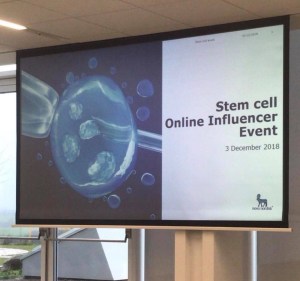
On Monday morning, I was invited to an event at the Novo Nordisk facility in Malov to hear about the latest in diabetes and stem cell research. (Disclosures at the end of the post as always.)
We heard from researchers from the site, as well as Sanjay Dutta from JDRF, and were given a tour of the labs to get a better understanding of the research process. Going into this event, I knew very little about stem cell research and its application in curing diabetes. (I should point out I still know very little…) Before I write more, I do want to highlight that the ethical sensitivity of stem cell research was addressed, although was not a focus of the event. It is undeniable that there are some people who refuse to accept stem cell research, or any treatments that come from it. I am not one of those people, but I was pleased to see the researchers acknowledging that this is an issue for many people around the world.
One of the speakers was Novo researcher Louise Winkel who gave a fantastic overview of stem cell research and how it applies to type 1 diabetes. If Louise was a senior school biology teacher, her students would all go on to study science at tertiary level. She made it interesting, understandable, and translated just what this very technical area of research could mean to those of us living with diabetes.

Jacob Sten Petersen shared how he has been working with Novo in diabetes research for 27 years. That’s a lot of time examining and investigating type 1 diabetes, trying to get a better understanding of just how diabetes works. Despite all the years of experience, and all the time spent with leading researchers and healthcare professionals, Jacob made a point of saying that it wasn’t until he actually met people with diabetes that he realised just how little he truly understood about life with diabetes.
That understanding increased exponentially when his young daughter was diagnosed with diabetes. You might think that having a child diagnosed with diabetes after you’ve given most of your career to researching it may make things a little easier. But listening to Jacob tell the story of his daughter’s diagnosis it was clear that the impact and devastation was no less at all.
As Jacob outlined the timeline of research, I was a little startled when he starting talking about this being the way forward to curing diabetes. I was even more startled at just how confidently, and almost casually, Jacob was talking about the cure. He was putting timeframes out there, saying that he firmly believed that no one in the room would die from, or because of, type 1 diabetes. I could tell that I wasn’t the only one surprised by this declaration.
Both Louise and Jacob were discussed the challenges of finding treatments, and ultimately a cure, for type 1 diabetes. Plus, there is the autoimmune response – you remember, the one that destroyed our beta cells in the first place – that needs to be addressed. Encapsulation will assist with that, but that also has challenges that need to be overcome. (It probably should not have come as a surprise when Louise told us the beta cells are the most difficult and sensitive cells, posing a number of trials, including how they stop secreting insulin the second oxygen concentration drops. Precious? You bet!)
However, despite the difficulties, Louise and Jacob were very clear about their goal and where their research was going: to cure type 1 diabetes.
I am very wary when it comes to talk of a diabetes cure. I don’t know one person with type 1 diabetes who has not heard some version of ‘The cure is just around the corner’. Sometimes that’s quantified with a timeframe. The old ‘five years’ chestnut is popular. At diagnosis, I was told five years; ten at the most. Well, here I am at twenty years and either I’ve not turned the right corner, or my first endocrinologist was being over-optimistic. I think it is probably the latter.
But I thought I’d made peace and accepted that that there would not be a cure in my lifetime, instead turning my hope – I have so much hope – towards better treatments, smarter devices, improved meds. I do not feel sadness or despair when I say I don’t believe I will be cured. I feel hopeful that thanks to ongoing research, my life will be less and less limited by diabetes.
Yet here I was, holding onto each word, and unlocking the part of my mind that I had, perhaps reluctantly, packed away many years ago. Would I allow myself to even think that a cure in my lifetime was a possibility?
The event concluded with a panel discussion, and as questions were invited, I raised my hand to ask how we balance talk about curing type 1 diabetes with managing expectations. Hope is important, but so is not being disappointed.
The discussion that followed was candid. I loved that the researchers could understand my apprehension – and that of a number of others in the room who also shared their reluctance to use the word cure. And that ‘cure’ meant different things to different people.
Because: what is a cure? I don’t think there is a simple answer to that. For some, it would be a fully functioning closed-loop automated insulin delivery device. But that would still involve an element of ‘user input’. Even if calibrations are not required, there will still be the need to change sensors, refill cartridges, change infusion sets.
For others, a fully implantable closed loop device which only needs ‘topping up’ with insulin occasionally would be considered a cure.
I know people who have had islet cell transplants, and pancreas transplants, but they require immunosuppression therapy and I don’t know that necessarily constitutes a cure.
Encapsulation may negate the need for immunosuppression, but would the cells need to be topped up…and how frequently would that need to happen? Would glucose checking still be required?
It is subjective and each person with diabetes would have different criteria they use to accept what is and what isn’t a cure. I don’t know what my criteria is yet.
I like the idea of not dying with – and certainly not dying from – type 1 diabetes. Do I think that is a reality? I don’t know. I feel that my adamant claim that there will not be a cure in my lifetime has been challenged this week and I’m okay with that. Because what hasn’t been challenged is the hope I have.
If in my lifetime with diabetes, the day to day tasks are reduced, the emotional burden is lessened, the fear and anxiety can be diminished, treatment of diabetes-related complications improves, then I feel that I am still somehow out in front. I may not be cured. But each step forward is a step in the right direction. Even if I don’t make it the finishing line and handed a cure.
DISCLOSURE
The DEEPtalk event was hosted by Novo Nordisk and was held at one of their facilities in Copenhagen. I was invited by the Global Patient Relations Team to moderate the event. Novo covered costs for my (premium economy) flights (I used my own frequent flyer miles to upgrade flights) and two nights’ accommodation as well as transfers and meals while I was in Copenhagen.
I was also invited to attend an information event where Novo employees spoke about current stem cell research in diabetes.
There is no expectation from the Global Patient Relations Team (or Novo Nordisk more broadly) that I will write about the event or other activities held while I was in Copenhagen and what I do write is mine. This summary of the stem cell event and presentations is all my own interpretation and has not been reviewed by Novo Nordisk prior to publication.
The other week, as I sat on the stage as part of a panel session at the HIMSS conference in Brisbane, a term kept getting thrown around that had me squirming in my seat. It was not said with any malice – in fact I believe it was being used under the perhaps misguided idea that it is represents positive and empowering language. But as I sat there and the term was being used, almost with abandon, I knew that we were going to have to have a chat about it. As per exhibit A:
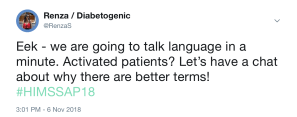
Exhibit A
Activated patient? No. Just no.
When the moment was right, I took a breath. I’d been asked to comment on the current My Health Record situation, and whether I thought it was something that would benefit people living with chronic health conditions. ‘Before I answer the question, can we just consider the term ‘activated patient’ and how it is being used here today – and often in other contexts too. I’ve heard from people on the stage and in the audience use the term ‘activated patients’. I’m really not a fan of this term. In fact, I think it is really quite problematic.’
Activation is something that is done to something. Think Pete Evans and his activated nuts. Or yeast when making bread or cinnamon buns. Or my pink debit card that came in the mail with a sticker across the front telling me how to activate it. Pete Evans’ almonds were just passive little nuts before he decided to activate them. And before the warm water was added to the yeast, it was just powder sitting in a sachet. My pink card was simply a piece of plastic before I called a number, pressed a few other numbers once the automated message was played and agreed to a heap of terms and conditions, making the card able to work.
Those inanimate objects had something done to them to become activated – it didn’t happen on their own. Beforehand, they were passive.
I was not ‘activated’ to become a participant in my own healthcare. I was not given permission to lead the agenda of how I want to engage. I chose the people I would see; the health service I would use; the devices I wear strapped to me. I have never been a passive participant in my healthcare – or any other aspect of my life, for that matter. I have always been active. Of course there are times that I struggle with motivation and may be less active and pro-active, but getting out of those times was never an exercise in activation by others.
The idea that people become activated because they are given the opportunity reeks of the typical paternalistic attitudes that are still rife in healthcare.
Look, we can have a long discussion about the ‘consumerisation’ of healthcare, and how that is what is to blame for terms such as this. It is business lingo and while many think it probably refers to people being in charge of their health, it actually suggests the opposite.
Words that suggest something is being ‘done’ to a person utilising the health system are not empowering. They are not putting the person at the centre. They don’t indicate that the person is driving their care.
The term ‘activated patients’ provides a narrow interpretation about how a person is in charge of their healthcare, because it always is used to highlight people who are loud advocates for themselves, walking into every appointment with a list the length of their arm of things to discuss, therapies they want to use. But not everyone wants to do healthcare that way. Just because someone prefers – and chooses – to have a healthcare professional drive the direction of their care does not necessarily mean they are not ‘activated’.
Also – consider this: if a person can become an ‘activated patient’, that means there must also avenues for them to become a ‘deactivated patient’. That’s certainly not being person-centred. In fact, suggesting that we become something only because we have been given the right to be that way is the opposite of person-centred.





 Diabetogenic