
You are currently browsing the category archive for the ‘Awareness’ category.
People with diabetes know that many times when we have a health concern it is dismissed with phrases such as ‘Oh, that’s more common in people with diabetes’ or ‘It’s part of living with diabetes’. Sometimes, that may be the case, but other times, it absolutely is not, and playing the diabetes card is like a get out of jail free card for HCPs to not do the investigations that they should to confirm diabetes is indeed responsible, and to eliminate anything else. Our concerns are ignored, and sometimes not believed. Not being believed is distressing in a particular way.
It is fair to say that while diabetes has the ability to creep its way into all sorts of places it doesn’t belong, it is also fair to say that sometimes it’s not diabetes.
I’ll say that again for the people in the back: SOMETIMES IT’S NOT DIABETES!
Women – with and without diabetes – have also reported, (and reported and reported) stories of not being believed, or listened to, or properly treated by healthcare professionals when we’ve fronted up to visit the GP or other health professional to discuss something worrying us. Women with painful, heavy, uncomfortable periods are told that it’s just part of being a woman. A diagnosis of endometriosis is not treated as something especially serious because it is common, and we’re told it’s just part and parcel of life for some women. And women going through menopause and perimenopause, are told just to accept it, that it will pass… and it’s just part of being a woman.
Put diabetes and women’s health together and there is a lot of dismissing, ignoring, diminishing, patronising, and belittling.
It needs to stop, and we need to be believed.
I am lucky that I haven’t experienced painful periods. To be honest, I barely even thought about periods until I was ready to try to get pregnant when I realised that my (up until then) good luck of only having a period 3 or 4 times a year wasn’t ideal for someone who needed to know when ovulation was occurring, and, to optimise the change of getting pregnancy, was occurring monthly. When I mentioned my irregular periods, the first thing I heard from most HCPs said was that it was because of diabetes. I wasn’t buying it. I’d started menstruating when I was thirteen. I had eleven years of sketchy periods before I was diagnosed with diabetes. And so, I asked for a referral to an OB/GYN and found one who was the sort of doctor who likes to solve puzzles rather than just ignore them.
He did a laparoscopy, a heap of other tests, and announced that I had PCOS. Not once did he suggest that my diabetes was to blame, but so, so many other HCPs did draw a line between the two. I do understand that there are links between type 2 diabetes and PCOS, and there is some research to suggest that there is a link between type 1 diabetes and PCOS, but thanks to an OB/GYN who wasn’t into making assumptions, I knew that there was more at play.
When I was ready to conceive, a regular cycle was easily achieved with a bit of Clomid. Since I had my daughter, my periods have been like clockwork. The arrive with a tiny bit of cramping that barely registers, and me being annoyed that I need to think about if I have what I need in the bathroom cupboard/work drawer/handbag. But not much else.
But I have friends who have such painful, uncomfortable, debilitating periods that have a really negative affect on their health and wellbeing each and every month. I know of people who miss days of school or work each cycle, who vomit at their period’s onset, and who cry in pain for days each and every month. These friends tell stories of how many HCPs simply shrugged their shoulders and said it was something they just needed to deal with, and perhaps some ibuprofen might help. They tell me that the severity of the pain is not believed. They are made to feel that bleeding through layers of pads, tampons and clothes shouldn’t concern them.
When I have needed to push and push and push to get answers, or to be treated seriously in the first place, or to reject the ‘It’s diabetes’ reasoning, I have been labelled difficult or challenging. When refusing to accept the ‘It’s just a woman thing’, I’ve felt the same way.
Dr Jen Gunter says it shouldn’t be an act of feminism to understand how our bodies work. In exactly the same way it shouldn’t be an act of defiance to demand answers. It also shouldn’t be an act of resilience. All too often, it is all these things.

Do your diabetes appointments take on an eerily familiar routine? When I was first diagnosed, each appointment would open with the words ‘Let me see your book’. My endo was referring to my BGL record, an oblong-shaped book that I was meant to diligently record my minimum of four daily BGL checks, what I ate, what I thought, who I’d prayed to, what TV shows I’d watched and how much I exercised.
I did that for about the first two and a half months, I mean weeks, okay, days and after that the novelty wore off and I stopped.
I’m not ashamed to admit that I did that thing that pretty much every single person with diabetes does at one point or another – I made up stuff. I was especially creative, making sure I used different coloured pens and splotched coffee stains across some of the pages here and there, little blood speckles for proof of bleeding fingers, and, for a particularly authentic take, OJ, to reflect the made-up numbers that suggested I’d been having a few lows.
I’d show those creative as fuck pages – honestly, they were works of art – when requested, roll my sleeve up for a BP cuff to be attached, and step on the scales for my weight to be scrutinised. Simply because I was told that was what these appointments should look like, and I knew no better.
And then, I’d walk out of those appointments either frustrated, because I’d not talked about anything important to me; in tears, because I’d been told off because my A1c was out of range; furious, because I hated diabetes and simply wasn’t getting a chance to say that. And anxious, because looking at the number of kilograms I weighed has always made me feel anxious.
The numbers in my book, on the BP machine or the scales meant nothing to me in terms of what was important in my diabetes life. They stressed me out, they made me feel sad and hopeless, and they reduced me to a bunch of metrics that did not in any way reflect the troubles I was having just trying to do diabetes.
These days, not a single data point is shared or collected unless I say so. I choose when to get my A1c done; I choose when to share CGM data; I choose to get my BP done, something I choose to do at every appointment.
I choose to not step on the scales.
I don’t know what I weigh. I might have a general idea, but it’s an estimation. I don’t weigh myself at home, and I don’t weigh myself at the doctor’s office. I think the last time I stepped on a set of scales was in January 2014 before I had cataract surgery and that was because the anaesthetist explained that it was needed to ensure the correct dose of sleepy drugs were given so I wouldn’t wake up mid scalpel in my eye. Excellent motivator, Dr Sleep, excellent motivator.
Last month, I tweeted that PWD do not need to step on the scales at diabetes appointments unless they want to, and that it was okay to ask for why they were being asked to do so.
There were comments about how refusing to be weighed (or refusing anything, for that matter) can be interpreted. I’ve seen that happen. Language matters, and there are labels attributed to people who don’t simply follow the instructions of their HCP. We could get called non-compliant for not compliantly stepping on the scales and compliantly being weighed and then compliantly dealing with the response from our healthcare professional and compliantly engaging in a discussion about it. Or it can be documented as ‘refusal to participate’ which makes us sound wilfully recalcitrant and disobedient. It’s what you’d expect to see on a school report card next to a student who doesn’t want to sing during choir practise or participate in groups sports.
What surprised me (although perhaps it shouldn’t) was the number of people who replied to that tweet saying they didn’t realise they could say no. it seems that we have a long way to go before we truly find ourselves enjoying real person-centred care.
Being weighed comes with concerns for a lot of people, and people with diabetes often have layers of extra concerns thanks to the intermingling of diabetes and weight. Disordered eating behaviours and eating disorders are more common in people with diabetes. Weight is one of those things that determines just how ‘good’ we are being. For many of us, weight is inextricably linked with every single part of our diabetes existence. My story is that of many – I lost weight before diagnosis and people commented on it favourably, even though I was a healthy weight beforehand. This reinforced that reduced weight = good girl, and that was my introduction to living with diabetes.
From there, it’s the reality of diabetes: insulin can, for some, mean weight gain, high glucose levels often result in weight loss, changes to therapy and different drugs affect our weight – it’s no wonder that many, many of us have very fraught feelings when it comes to weight and the condition we live with. Stepping on the scales brings that to the fore every three months (or however frequently we have a diabetes healthcare appointment).
Is it always necessary, or is it more of a routine thing that has just become part and parcel of diabetes care? And are people routinely given the option to opt out, or is there the assumption that we’ll happily (compliantly!) jump on the scales and just deal with whatever we see on the read out and the ensuing conversation? And if we say no, will that be respected – and accepted – without question? Perhaps another positive outcome is that it could encourage dialogue about why we feel that way and start and exploration if there is something that can be done?
It shouldn’t be seen as an act of defiance to say no, especially when what we are saying no to comes with a whole host of different emotions – some of them quite negative. Actually, it doesn’t matter if there are negative connotations or not. We should not be forced to do something as part of our diabetes care that does not make sense to us or meet our needs. When we talk about centring us in our care, surely that means we decide, without fearing the response from our HCPs, what we want to do. Having a checklist of things we are expected to do is not centring us or providing us the way forward to get what we want.
How do we go about making that happen?
Seventeen years ago, I had a decision to make. Would I enrol our soon-to-be-born baby in research that would tell us if she had any of the antibodies for type 1 diabetes?
I thought about it long and hard. Aaron and I spoke about it a lot. He wanted to support me with whatever I thought would be best. In the end, we decided not to do it. Even before our daughter was born there was a dread that I could barely give word to – I was terrified that I would be responsible for passing on my diabetes to my baby. That feeling hasn’t gone, by the way. I have spent a lot of hours working through it with a psychologist to try to understand the source of the anxiety and learn to manage the fear in a way that doesn’t become all encompassing. Because there were times that I felt paralysed with that fear. I knew I needed to get through that.
I felt horribly guilty about not signing her up straight away and registering her in research. When I returned to work after maternity leave, there was a trial that was in full recruitment mode, and I once again faced the decision. I was actively promoting this study through my work, and speaking to the researchers a lot. A couple of times, I asked if I could speak with them in a personal rather than professional capacity and explain my reticence to enrol my daughter, even though I could understand why the work was so important. I asked for their advice and guidance, and they were always so wonderfully kind and understanding when I said that I simply didn’t feel that I could proceed. I think that part of the reason was that there wasn’t really all that much that could be done if it was identified that she did indeed have one or more of the islet autoantibodies.
Over the last couple of years, there has been a lot of interest and excitement in research into prevention and delay of type 1 diabetes. That ‘p’ word that has only ever been attached to type 2 diabetes now very firmly has a place when it comes to type 1 diabetes. At the ADC earlier this month, I listened to a couple of hours of talks from researchers who were talking all about screening for type 1 diabetes, and interventions that are taking place around the world with remarkable results.
The Type 1 Screen program has been running in Australia since 2018. It is open to relatives of someone with type 1 diabetes, aged 2 – 30 years. After initial screening, people without antibodies are screened every five years; people with antibodies are screened annually. Up until now, screening has been by doing a pathology blood test. However, home collection is being developed and, at the time of the presentation, was about to be launched. Home collection will be done by using blood from a finger prick.
So, what are the benefits of screening for type 1 diabetes? Well, there are many!
Early diagnosis (of anything) is a good thing! In a perfect world, early diagnosis means early treatment which means better outcomes. It also helps people and families prepare for progression to diabetes.
Screening reduces the risk of DKA at diagnosis. While that may make for a less traumatic diagnosis experience, there are also linger term benefits for this. DKA at diagnosis increases the risk of recurrent DKA, a higher A1c and increases the risk of diabetes-related complications.
Prevention is on the horizon! Knowing people who are at risk of type 1 diabetes means employing interventions that have the potential to delay, and may one day prevent, type 1 diabetes. Research using the drug Teplizumab delayed the onset of type 1 diabetes by two years.
Researchers and clinicians are talking about stages of type 1 diabetes and this is where it gets super interesting. Stage three type 1 diabetes I diagnosis and, typically, that’s where treatment starts. But in the future, it’s possible that treatment, including glucose monitoring, could be routine for stages one and two.
I listened to all this carefully and one thing that was clear to me: even seventeen years later, the emotional impact of this is significant. Thankfully, Dr Christel Hendrieckxs from the ACBRD is part of the project team for this work here in Australia. It goes without saying that this is about a lot more than just early diagnosis of type 1 diabetes. There is also the impact on the family, especially if someone in that family already has type 1 diabetes. The mother guilt I have at the thought of passing on diabetes to my daughter is by no means a small thing. I know a number of other parents with diabetes who have similar thoughts.
After that session, I asked my sixteen, almost seventeen, year old how she would feel about enrolling in Type 1 Screen. It’s completely up to her now – I am happy to chat about it, and tell her all about the program, but ultimately, it’s her decision. She understands why I was reluctant to enrol her when she was tiny, but now, I am giving her the option to get involved, and she needs to make her own decision which we’ll fully support. I don’t know what she will decide, but the seed has been planted, and I am here to chat with her about it, and organise times to meet with the researchers too if she’d like.
Watch my Q&A with A/Professor John Wentworth from Type 1 Screen about getting involved in this research.
I probably should stop thinking of my job as ‘my new job’. I’ve been at Diabetes Australia now for well over five years. But for some reason, I still think of it that way. And so do a lot of other people who often will ask ‘How’s the new job?’
Well, the new job is great, and I’ve enjoyed the last five years immensely. It’s a very different role to the one I had previously, even though both have been in diabetes organisations.
One thing that is very different is that in my (not) new job I don’t have the day-to-day contact with people with diabetes that I used to have. That’s not to say that I am removed from the lived experience – in fact, in a lot of ways I’m probably more connected now simply because I speak to a far more diverse group of people affected by diabetes. But in my last job, I would often really get to know people because I’d see them at the events my team was running, year in, year out.
Today, I got a call from one of those people. (I have their permission to tell this story now.) They found my contact details through the organisation and gave me a call because they needed a chat. After a long time with diabetes (longer than the 23 years I’ve had diabetes as an annoying companion), they have recently been diagnosed with a diabetes-related complication. The specific complication is irrelevant to this post.
They’ve been struggling with this diagnosis because along with it came a whole lot more. They told me about the stigma they were feeling, to begin with primarily from themselves. ‘Renza,’ they said to me. ‘I feel like a failure. I’ve always been led to believe that diabetes complications happen when we fail our diabetes management. I know it’s not true, but it’s how I feel, and I’ve given myself a hard time because of it.’
That internalised stigma is B.I.G. I hear about it a lot. I’ve spent a long time learning to unpack it and try to not impact how I feel about myself and my diabetes.
The next bit was also all too common. ‘And my diabetes health professionals are disappointed in me. I know they are by the way they are now speaking to me.’
We chatted for a long time, and I suggested some things they might like to look at. I asked if they were still connected to the peer support group they’d once been an integral part of, but after moving suburbs, they’d lost contact with diabetes mates. I pointed out some online resources, and, knowing that they often are involved in online discussions, asked if they’d checked out the #TalkAboutComplications hashtag. They were not familiar with it, and I pointed out just how much information there was on there – especially from others living with diabetes and diabetes-related complications. ‘It’s not completely stigma free,’ I said. ‘But I think you’ll find that it is a really good way to connect with others who might just be able to offer some support.’
They said they’d have a look.
We chatted a bit more and I told them they could call me any time for a chat. I hope they do.
A couple of hours later, my phone beeped with a new text message. It was from this person. They’d read through dozens and dozens of tweets and clicked on links and had even sent a few messages to some people. ‘Why didn’t I know about this before?’, they asked me.
Our community is a treasure trove of support and information, and sometimes I think we forget just how valuable different things are. The #TalkAboutComplications ‘campaign’ was everywhere a couple of years ago, and I heard from so many people that it helped them greatly. I spoke about it – particularly the language aspect of it – in different settings around the world and wrote about it a lot.
While the hashtag may not get used all that much these days, everything is still there. I sent out a tweet today with it, just as a little reminder. All the support, the connections, the advice from people with diabetes is still available. I hope that people who need it today can find it and learn from it. And share it. That’s one of the things this community does well – shares the good stuff, and this is definitely some of the good stuff!
Want more?
Check out the hashtag on Twitter here.
You can watch a presentation from ATTD 2019 here.
Read this article from BMJ.

Over the weekend, I could not stop thinking about the words ‘from’ and ‘with’, specifically when used before the word COVID. The reason for this is that there seems to have been a subtle shift in the language used by NSW government and health officials when speaking about people dying during this wave. You see, rather than saying people are dying FROM COVID, they’ve started to say dying WITH COVID.
It means something different. It suggests that the person didn’t die from the virus, but from other factors. This is on top of the over-emphasis made at pressers about how people who have died have underlying conditions (I wrote about that last week). The implication is that the person was already unwell; that they were dying anyway.
I know I’m a little fragile at the moment, but not fragile enough to not get fired up when I see language being used in a harmful way, and negatively framing people with chronic health conditions. And so, today, I wrote to the Premier of NSW about this issue.
Here’s what I wrote:
______________________________________
Dear Premier Berejiklian
My name is Renza Scibilia, and I am not one of your constituents. I don’t live in NSW, so you may be inclined to simply disregard this message. I hope you (or rather, someone from your team) will read it, because I know that what I have to say is relevant to many people in your state. In fact, I am sure that you have heard similar sentiments from people in NSW and I am adding my voice to that choir.
I don’t envy the position you are in right now and I’m not here to complain or credit the work you are doing regarding the current serious wave of COVID-19 in your state.
But I would like to make comment on something that is very close to my heart and an area in which I have some experience – health communications.
Communication matters. The words that people use are sometimes employed flippantly and sometimes they are employed deliberately. Either way, they are important. I fear that a change in the words you and your team have recently started is a deliberate move and I believe it is harmful to people like me. When speaking about the tragic deaths of people during this COVID-19 wave, you are now saying they die WITH COVID-19 rather than FROM it.
It may seem ridiculous to draw attention to words that appear so immaterial. Except, of course, they are not immaterial at all. And I believe that the shift is deliberate. And it does a great disservice to the people to whom you are referring.
I live with type 1 diabetes. It’s undoubtedly a serious condition, and one that I have had to manage for the last 23 years. On a day-to-day basis, I do quite impressive mathematical calculations as I measure glucose levels, dose insulin, consider my activity, and monitor my stress levels. This takes time – a lot of time. Outside of diabetes-specific care, I eat well, walk 10K steps a day, and manage my wellbeing as best I can.
Beyond what I do each day, I remain on top of my longer-term diabetes and overall health. I never miss screening checks – diabetes or otherwise; I have annual health checks and I can tell you my BP, resting heart rate, HbA1c, lipids and cholesterol. Most people my age are not this switched on with their health and wellbeing, and because I am, I can confidently say that I am healthier than a lot of people my age.
And so, when you use sweeping statements suggesting that if someone like me was to be diagnosed with, and die from COVID-19, that the reason for my death is my health condition you are not correct. I am not already dying from diabetes.
There is a difference between dying FROM COVID-19 and dying WITH covid. Your change in language is an insult and is upsetting to people like me and it is also misleading. I am healthy, I am fit and if I got covid and died, it would be because of the virus not because of my type 1 diabetes.
I urge you to reconsider how you are speaking about people like me. It is heartbreaking for us to know that in the minds of some, our lives, and our deaths, are so easily explained away. While I am sure your intention is not to make us feel as though we are nothing more than collateral, that is how it sounds. The language you are using frames us and our health conditions as being to blame. It makes us sounds and feel as though we already have one foot in the grave and I can assure you that is not the case.
Language matters, words matter. Please, please be careful when selecting yours.
Sincerely,
Renza Scibilia
Melbourne
At the last IDF Congress, I was invited to be part of the first panel on the opening morning of the meeting. It was all about diabetes and technology. Before the questions, the moderator, my friend Kyle Jacques Rose, asked everyone to introduce themselves. When it got to my turn, I said who I was and then shamelessly and unapologetically said I was the most important person the stage (along with Kyle and Manny Hernandez, who also live with diabetes). I remember looking steadily out into the audience as I made my claim to see the response. There was some who looked taken aback. And then some who cheered (thanks to the other PWD in the room!).
Last week, I was in a two-hour workshop. I knew maybe half the people there. I also knew that I was the only person there to provide the ‘user’ experience. This isn’t uncommon, but it still drives me nuts when it happens, especially in a session that was about finding the right person-centred model of care in the age of telehealth. When it came to introducing myself, I thanked the organiser for inviting me, and said that it was great to be there…as the most important person in the (Zoom) room. One of the researchers I know well and who I have worked with quite a lot in recent years, smiled widely. At least I had one person in the room who got me. I watched again to see how others responded. Some certainly did look a little shocked.
I explained that having people like me to feed into the work is critical, and that it was great that they wanted to hear from someone with lived experience to (and it would have been great to have seen a few other folks doing the same).
So, how do I manage to be ‘the voice’ of lived experience when it comes to these sorts of things? When the meeting is diabetes-specific what do I say that captures the needs and wishes of every single person with diabetes? And, as in this meeting, when it’s about designing a system that is for all people with a variety of health conditions, how do I effectively and adequately tell the HCPs and researchers in the room just what it is that those people want?
The answer is, I don’t. Of course I don’t.
I can’t speak to anyone else’s experience other than my own. I can’t say ‘I need this’ and assume that is what everyone else wants, and I would never make that assumption. Nor do I try to convince anyone that my needs and experiences are representative of anyone’s other than me.
I will advocate until I am blue in the face that there needs to be many different people consulted and engaged in the design, delivery and dissemination of healthcare services, activities, and resources. Sometimes, that does happen. But if it is only me, I am never there to provide specifics of what needs to be done. In fact, I spend most of my time urging (begging and pleading) for assurances that there will be far more, far better, far meaningful engagement from this moment forward.
I see my role is to pointedly, deliberately, unambiguously, and often, bolshily, make sure that the others in the room embed the idea of co-design in everything they do. And do it with wide representation.
I honestly don’t believe that there can ever be too much lived experience representation. But in the cases when there is only very little, I have rarely met anyone who claims to be the oracle of all things to do with lived experience or believe that their ideas are the only one worth listening to. In fact, anytime that has happened that person never is asked back.
When I am asked to help find people for an advisory board, or to be involved in consultation, I always search for people who I know can look beyond their own experience. Again, it’s not because they are expected to speak for others. Rather it’s to know that there are others with different experiences and that, while they are the one at the table in that moment, they will do everything possible to make sure that those others are invited next time.
And THAT, is why, at times like this, people like me are the most important people in the room – those of us who are banging a very loud drum to make sure that our cohort grows and grows. If you are working in healthcare and don’t have people with lived experience as part of the discussion, you’ve forgotten the most important people.
Stop what you’re doing, RIGHT NOW, and go find them.

Yesterday, the Australian vaccine rollout was expanded to include children. This follows the TGA approving the use of the Pfizer COVID-19 vaccine for children in the 12 – 15 year age group. ATAGI responded by including children with diabetes in that age group into Phase 1B, meaning they are eligible right now for a jab (provided, of course, they can find one…!).
Already I’m seeing in diabetes online discussions some parents of kids with type 1 diabetes saying their child will not be getting the vaccine, stating that the reason for that decision is because their type 1 diagnosis came shortly after one of their childhood vaccines.
And so it seems a good time to revisit this post that I wrote back in 2017. It has a very long title that could have been much more simply: correlation ≠ causation.
It is understandable to want to find a reason for a health issue. Being able to blame something means that we can, perhaps, stop blaming ourselves. I imagine that for parents kids with diabetes that desire to find something – anything – to point to would come as somewhat of a relief. But there is absolutely no evidence to suggest that vaccines are that reason.
Unfortunately, the idea that vaccines are the root of all evil and cause everything under the sun is a myth that is perpetuated over and over in antivax groups; groups where science, evidence and logic goes to die. Vaccines save lives and they are safe. Anyone who says otherwise is lying.
My sixteen year old is not in a priority group and cannot be vaccinated just yet, but she is ready to go as soon as her phase has the green light. All the adults nearest and dearest to her – her parents, grandparents, aunts and uncle, friends’ parents – are fully vaccinated now, and she knows what a privilege it is to be in that situation. She understands that with that privilege comes responsibility to do what you can to protect vulnerable cohorts in the community. And she also understands that vaccines are safe and they save lives.
If you are feeling unsure about getting a COVID vaccine – for you or your child – please speak with your GP. Don’t listen to someone in a Facebook group. And that may come as a surprise to anyone who knows how important I consider peer support and learning from others in our community, but to them I say this: I listen to and learn from people in the diabetes community because they don’t suggest anti-science approaches. They talk about support, and provide tips and tricks for living with diabetes. If anyone tells me to ignore doctors (because all they care about is getting rich), or to stop taking my insulin (because there is a natural supplement that will do the trick), I would block them as quickly as I could. Science works. Science is why people with diabetes are alive today. Science is why we have vaccines. Trust science. THAT’S what makes sense.
__________________________________________________________________________
In the next couple of weeks, our kid gets to line up for her next round of immunisations. At twelve years of age, that means that she can look forward to chickenpox and Diphtheria-Tetanus-Pertussis boosters, and a three-dose course of the HPV vaccine.
When the consent form was sent home, she begrudgingly pulled it out of her school bag and handed it to me. ‘I have to be immunised,’ she said employing the same facial expressions reserved for Brussels sprouts.
She took one look at me and then, slightly sheepishly, said, ‘I don’t get to complain about it, do I?’
‘Nope,’ I said to her. ‘You don’t get to complain about needles because…well because…suck it up princess. No sympathy about needles from your mean mamma! And you have to be vaccinated because that’s what we do. Immunisation is safe and is a really good way to stop the spread of infectious diseases that not too long ago people died from. And herd immunity only works if…’
‘….if most people are immunised so diseases are not spread,’ she cut me off, finishing my sentence. I nodded at her proudly, signed the form and handed it back to her. ‘In your bag. Be grateful that you are being vaccinated. It’s a gift.’ (She mumbled something about it being a crappy gift, and that it would be better if she got a Readings gift voucher instead, but I ignored that.)
Over the weekend, the vaccination debate was fired up again with One Nationidiot leader, Pauline Hanson, sharing her half-brained thoughts on the issue.
I hate that I am even writing about Pauling Hanson. I despise what she stands for. Her unenlightened, racist, xenophobic, mean, ill-informed rhetoric, which is somehow interpreted as ‘she just says what many of us are thinking’, is disgusting. But her latest remarks go to show, once again, what an ignorant and dangerous fool she is.
Her comments coincided with a discussion on a type 1 diabetes Facebook page about vaccinations preceding T1D. Thankfully, smart people reminded anyone suggesting that their diabetes was a direct result of a recent vaccination that correlation does not equal causation.
I get really anxious when there is discussion about vaccinations, because the idea that this is something that can and should be debated is dangerous. There is no evidence to suggest that vaccines cause diabetes (or autism or anything else). There is, however, a lot of evidence to show that they do a shed-load of good. And if you don’t believe me, ask yourself how many cases of polio you’ve seen lately. People of my parents’ generation seemed to all know kids and adults with polio and talk about just how debilitating a condition it was. And they know first-hand of children who died of diseases such as measles or whooping cough.
This is not an ‘I have my opinion, you have yours. Let’s agree to disagree’ issue. It is, in fact, very black and white.
A number of people in the Facebook conversation commented that their (or their child’s) diagnosis coincided with a recent vaccination. But here’s the thing: type 1 diabetes doesn’t just happen. We know that it is a long and slow process.

What this shows is that even if onset of diabetes occurs at (correlates with) the time of a vaccination, it cannot possibly be the cause.
When we have people in the public sphere coming out and saying irresponsible things about vaccinations, it is damaging. People will listen to Pauline Hanson rather than listen to a doctor or a researcher with decades of experience, mountains of evidence and bucket-loads (technical term) of science to support their position.
The idea that ‘everyone should do their own research’ is flawed because there is far too much pseudo-science rubbish out there and sometimes it’s hard to work out what is a relevant and respectable source and what is gobbledygook (highly technical term).
Plus, those trying to refute the benefit of vaccinations employ the age-old tactic of conspiracy theories to have people who are not particularly well informed to start to question real experts. If you have ever heard anyone suggesting: government is in the pockets of Big Pharma / the aliens are controlling us / if we just ate well and danced in the sunshine / any other hare-brained suggestion, run – don’t walk – away from them. And don’t look back.
I have been thinking about this a lot in the last couple of days. I have what I describe as an irrational fear that my kid is going to develop diabetes. It keeps me awake at night, makes me burst into tears at time and scares me like nothing else. If I, for a second, thought for just a tiny second that vaccinating my daughter increased her chances of developing diabetes, she would be unvaccinated. If I thought there was any truth at all in the rubbish that vaccines cause diabetes, I wouldn’t have let her anywhere near a vaccination needle.
But there is no evidence to support that. None at all.
I know diabetes, and not much else. I have a few other health conditions that are no more than niggling, requiring minimal effort and engagement with healthcare professional. But they still do need some sort of attention and treatment. The stark difference between that treatment and the treatment for diabetes is that I never have to jump through hoops to get treatment for them.
The other day, I had to go and have imaging on my elbow because said elbow hurts, the doctor thinks it’s tennis elbow which is now being referred to as latte elbow around here because the last time I picked up a tennis racket, Yannick Noah was ranked in the top 10.
I went to the GP, told him what was wrong, and he wrote a referral straight away for an ultrasound and Xray and sent me on my way. Three days later, I had the scans done and today I’m waiting for a telehealth appointment to discuss treatment. There was no ‘let’s wait and see’ if it gets worse.
Diabetes seems to be a lot about waiting and seeing. Or use of arbitrary numbers to determine if something can be used. Or bargaining: you may have <x device/treatment>, but you must do <y intervention> first, even if <y intervention> is not want the PWD is remotely interested in.
When I wanted to start on a pump twenty years ago, I had to go doctor shopping until I could find a doctor who would agree to filling out the requisite forms so my private health insurance would cover the cost of the pump. This was twenty years ago, and while pumps had already been around for a number of years by then, there really weren’t all that many Australians using them, so finding an endo comfortable with the whole thing was not easy.
My first endo told me I hadn’t had diabetes long enough to consider using a pump. Subsequent shopped doctors told me a) my diabetes wasn’t serious enough to warrant a pump, b) my A1c wasn’t high enough to use a pump, and c) my A1c was too low to use a pump.
It took a while before I found a doctor whose response to my ‘I want to use an insulin pump’ was ‘Sure, where do I sign?’.
When CGM came out I’d already found myself the sort of doctor who was more than happy to be guided by what I wanted, because she understood that I knew my diabetes best and therefore was the best person to decide what I wanted in my management arsenal. She’s still my doctor. There’s a reason for that!
Last week, I tweeted this:

The replies and discussion that this tweet started are really not a great snapshot of person-led care. In fact, it’s more like example after example of PWD being told no for not especially great reasons.
It seems that there are two main barriers which are intertwined in some ways.
The first is that HCPs continue to act as gatekeepers of diabetes technologies, deciding who is allowed to access what particular devices and when that can happen. This is problematic and harks back to a time when people with diabetes were mere patients, gratefully accepting what care was doled out to us without question.
Some might think that this sort of archaic attitude is no longer around, but a glance through the replies shows that, sadly, that isn’t the case.
The other barrier seems to be a whole heap of rules that seem to have no purpose other than expecting the person with diabetes meet them before they are deemed worthy of whatever it is they want.
Some of the rules seems arbitrary, others probably come from a sensible place, but are not what person-centred care is about. Many don’t seem to be based in any kind of evidence at all. Regardless, all they do is promote a one size fits all process that must be met before a PWD can proceed, verifying our merit along the way.
The very idea that we need to prove ourselves worthy of a diabetes treatment is offensive. We didn’t need to prove ourselves worthy to be diagnosed with diabetes, so why should we need to do so to have access to the technologies that are there to help us manage it? Why should we need to have diabetes for a certain about of time first, or do an education course that is not necessarily directly related to what we are searching for, or reach a certain A1c to earn our right to access and utilise a piece of diabetes tech?
(There is a third barrier unique to US DOC friends, and that is insurance requirements…. I don’t know all that much about insurance in the US, but I guess it is HCPs employed by, or advising the insurance who set up the ridiculous hurdles and hoops people with diabetes are expected to navigate.)
Now, obviously, there is the (not by any means insignificant) issue of cost. I understand that there is never an endless pot of cash to support people with diabetes. But even in places where there is funding available, or cost is to the individual – not the health system – there are still barriers in place.
Living with diabetes is a constant, tough gig. If we are searching for something to help us through, and we have made the decision that we want to try something new, surely the role of our HCPs is to work with us rather than stand in our way. The holy grail for so many people with diabetes that I speak to is to make diabetes easier. And yet, all these barriers just make it more difficult. That hardly seems fair.
Today is the day. The centenary of what remains one of the greatest medical discoveries ever. Here is a reworked post (first published here). There is not a day that I am not grateful for this discovery. And not a day goes by when I am not aware that the diabetes life I live and the access I have is not the same for everyone around the world.
And so today seems a really good day to make a donation to a charity that supports people with diabetes who need it. For me, when deciding which diabetes charities I’ve decided to donate to, it’s been important that the support is tangible. And that’s why I have repeatedly written about Life for a Child, and Insulin for Life on this blog, and supported them with regular donations for a number of years. Their works provides on the ground support, medications, diabetes supplies, education, as well as doing research. They also have an advocacy function, raising awareness of not only the work they do, but the people they support.
If you are able to make a donation it’s a great day to do it. In amongst the celebrations it’s important to remember not everyone will be able to do that today. Remembering them on this important day in diabetes history is very fitting.
Donate to Insulin for Life
Donate to Life for a Child
______________________________________________________________
There has been lots of discussion about what happened 100 years ago today – on 27 July 1921. University of Toronto scientists Fredrick Banting and Charles Best successfully isolated the hormone insulin. Today, that means that I am alive and kicking, 20 years after my islets stopped making any.
It means that type 1 diabetes treatment moved from being a starvation diet and not much else, to injecting a drug that was life giving and life saving.
It means that I take a drug that while giving me life, is also lethal and if not dosed carefully and with great consideration can cause terrible side effects.
It means that people with diabetes don’t die terrible, agonising deaths simply because they were diagnosed with diabetes.
It means that I need to be able to do crazy calculations to ensure what I put into my body completely and utterly imperfectly mimics what those with functioning islet cells do completely and utterly perfectly.
It means that there is a treatment therapy that gives us hope and life and allows us to live – sometimes very long, long lives.
It means that each and every day I feel fortunate to have been born when I was and not 100 years earlier.
It means I take for granted that I have access to a drug that keeps me going.
It means that there are far too many people around the world who still do not have access to the drug I take for granted. And 97 years later, that is not good enough.
It means that it was 97 years ago – 97 years ago – since the discover of insulin to treat diabetes and we are still without a cure.
And it means that I wonder when there will be the next breakthrough that is as significant and meaningful and life changing and life saving as what those two Canadian scientists discovered 97 years ago.
But mostly. It means that I live with hope. Hope that those scientists are somewhere working away, and perhaps – just perhaps – are about to find that next big breakthrough.

I’ve just placed an order so I can have this print in my office at home.
Alex is donating 20% of all sales of this print to Type 1 International, another charity I have written about a number of times, and supported financially.
You can see more artworks by Alex at her website, Diabetes by Design.
A week out from National Diabetes Week, and this piece has been sitting in my ‘to be published’ folder, just waiting. But the post-NDW exhaustion coupled with lockdown exhaustion, plus wanting to make sure that all my thoughts are lined up have meant that I haven’t hit the go button.
In the lead up to NDW I wrote this piece for the Diabetes Australia website. That piece was a mea culpa, acknowledging my own contribution to diabetes-related stigma and owning it. I also stand by my thoughts that the stigma from within the community is very real and does happen.
But what I didn’t address is just where that stigma comes from. Those biases that many people with type 1 diabetes (and those directly affected by it) have towards type 2 diabetes come from somewhere, and in a lot of cases that is the same place where the general community’s bias about diabetes comes from. It is all very well for us to expect people with type 1 diabetes to do better, but I’m not sure that is necessarily fair. I think that we should have the same expectations of everyone when it comes to stamping out stigma.
And so, to the source of stigma and, as I’ve said before, it comes from lots of places. As someone who has spent the last twenty years working in diabetes organisations, I know that the messaging my orgs like (and including) those that have paid my weekly salary has been problematic. I still am haunted by the ‘scary’ campaign from a few years ago that involved spiders, clowns, and sharks. (If you don’t remember that campaign, good. If you do, therapy works.)
For me personally, I don’t think much stigma I have faced has come at the hands of other PWD. Sure, there’s the low carb nutters who seem to have featured far too frequently on my stigma radar, however, the most common source of stigma has undoubtedly been HCPs.
It’s not just me who has had this experience. The majority of what I have seen online as a response to experiences about stigma involves heartbreaking tales of PWDs’ encounters with their HCPs.
While I will call out nastiness at every corner, and no stigma is good stigma, it must be said that there is a particular harm that comes when the origin of the stigma is the very people charged to help us. Walking into a health professional appointment feeling overwhelmed, scared, and frustrated only to leave still feeling those things, but with added judgement, shame and guilt is detrimental to any endeavours to live well with diabetes. In fact, the most likely outcome of repeated, or even singular, experiences like that is to simply not go back. And who could criticise that reaction, really? Why would anyone continually put themselves in a situation where they feel that way? I wouldn’t. I know that because I didn’t.
It’s one thing to see a crappy joke from a comedian who thinks they’re being brilliantly original (they never are) or the mundane, and almost expected, ‘diabetes on a plate’ throwaway line in a cooking show, but while these incidents can be damaging, they are very different to having stigmatising comments and behaviours directed at an individual as is often the case when it is from a HCP.
Of course, HCPs aren’t immune to the bias that forms negative ideas and opinions about diabetes. In the same way that people with type 1 diabetes form these biases because those misconceptions are prevalent in the community, HCPs see them too. Remember this slide that I shared from a conference presentation?
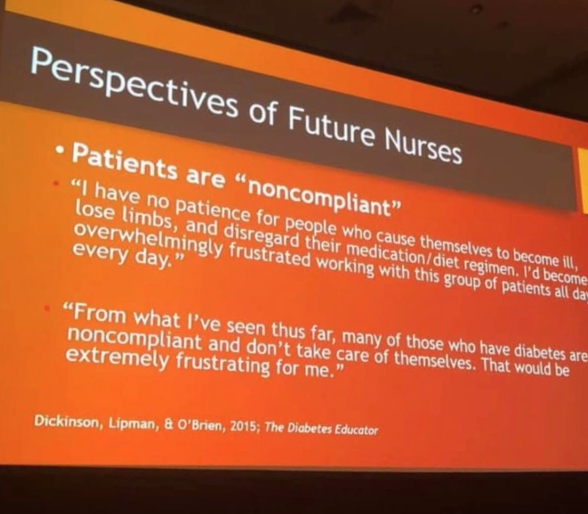
This came from student nurses. Just think about that. Students who were training to be HCPs who would inevitably be working with people with diabetes. A I wrote at the time:
‘They hadn’t even set foot on the wards yet as qualified HCPs. But somehow, their perceptions of people with diabetes were already negative, and so full of bias. Already, they have a seed planted that is going to grow into a huge tree of blaming and shaming. And the people they are trusted to help will be made to feel at fault and as though they deserve whatever comes their way.’
Is it any wonder that, with these attitudes seemingly welded on, that people with diabetes are experience stigma at the hands of their HCPs?
The impetus can’t only be on PWD to call this out. And the calls to fix stigma can’t exclusively rest on the shoulders of PWD – we already have a lot of weight there! It must come from HCPs as well – especially as there is such a problem with this group. Perhaps the first step is to see real acknowledgement from this group of their role here – a mea culpa from professional bodies and individuals alike. Recognising that no one is immune to the bias is a good step. Owning that bias is another. And then doing something about it – something meaningful – is how we make things better for people with diabetes. I really hope we see that happening.
More about this:
Becoming an ally – how HCPs can show they’re really on our side.





 Diabetogenic