
You are currently browsing the category archive for the ‘Advocacy’ category.
You owe no one.
You owe no one involvement in diabetes awareness activities.
You owe no one Twitter fury and outrage when diabetes is misrepresented.
You owe no one a decision to jump on a bandwagon just because everyone else is.
You owe no one your loud voice, your quiet voice, your whispered voice.
You own no one involvement in their diabetes advocacy efforts.
You owe no one blue eye shadow, blue nail polish or blue hairspray.
You owe no one reminders that diabetes doesn’t stop you.
You owe no one explanations for how you choose to advocate or the causes you choose to support.
You owe no one for the type of advocate you are.
You owe no one reasons for who you decide to work with; and who you decide not to work with.
You owe no one.
You owe no one hope.
You owe no one justifications for the technology you choose, or don’t choose.
You owe no one a podium.
You owe no one details for why you are at a conference, a dinner, a meeting, talking diabetes.
You owe no one the right to uses your diabetes as a teaching moment.
You owe no one marathons or mountain climbs or channel swims in defiance of diabetes.
You owe no one your time to just read their blog post, join their support group, sign their petition.
You owe no one a cheer squad.
You owe no one the words and language you choose to use to help make sense of your diabetes.
You owe no one an insight into your diabetes management, your HbA1c, your CGM curve.
You owe no one.
Except.
Maybe…
You owe yourself love and kindness and reminders that on days when diabetes feels too hard, too big, too sad, too … everything … that doing what you can is enough. You owe yourself room to breathe. You owe yourself space to step back and space to step up. You owe yourself pats on the back and high fives. You owe yourself flowers. You owe yourself the freedom to do diabetes your way and in your own time.
You owe yourself. And no one – no one – else.
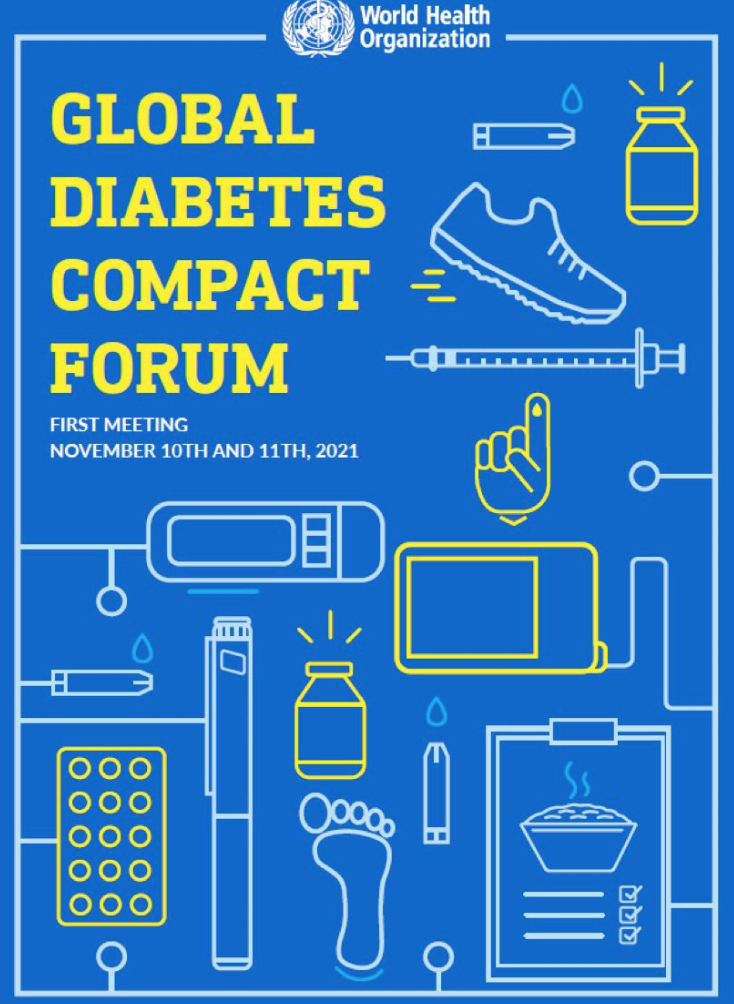
Over the last two days (or last two middles of the night if you’re perpetually in the wrong part of the world as it seems I am), I participated in the excellent first World Health Organisation Global Diabetes Compact Forum. (You can read the Compact which was launched earlier this year here.)
Once again, the WHO team had brought together stakeholders, including diabetes advocates, from across the world to talk about some critically important challenges facing people living with diabetes. These included access to insulin, research and innovation and prevention, health promotion and health literacy. The Forum was definitely not a ‘sit and be lectured to’ event. It was interactive, with everyone having the opportunity to participate and share their experiences and perspectives. The chat function was open and there was a constant stream of engaging, energetic discussion and sharing.
The final session was about prevention and in his introduction, James Elliot, who expertly moderated the event, laid the foundation for the discussion. As with the previous sessions, there were no pre-conceived ideas or narrow focus about the topic.
Prevention isn’t just about prevention of type 2 diabetes. There is a lot of work also going on looking at prevention of type 1 diabetes. And also, once living with diabetes, looking to do what we can to prevent diabetes-related complications.
When I spoke, the first thing I wanted to highlight was the problem I feel with the word prevention, and I revisited previous discussions in which I’ve been involved which highlight the struggle I feel with the word prevention. For too many people it is a word that offers a promise – a promise which guarantees that we can prevent aspects of diabetes that are often well beyond our control. I presented my case for instead focusing on how reducing risk is a far more accurate description of what efforts are truly about, a perspective that I have noticed is being used more and more.
The discussion pivoted to being about complications and associated stigma. Thankfully, this is not the start of the conversation about diabetes-related complications and the way people see them. When I wrote this piece back in 2013, I wrote about the way complications were presented to people with diabetes and how non-modifiable factors such as genetics, are rarely part of the conversation. There seemed to be a very one-dimensional presentation of diabetes-related complications: ‘take care’ of yourself, and you won’t get them.
With communication around complications starting to be included in the language matters movement, I could see that too many people had been told that over-simplistic tale.
It all got taken up a very significant notch when there was a concerted effort in the DOC to encourage dialogue about diabetes-related complications in a non-judgemental and safe way. Suddenly, we were seeing the hashtag #TalkAboutComplications accompany people’s stories, or questions others might have. This led to a real shift, as more and more people shared their experiences, with many saying that it was the first time they had seen others being so open about what was often considered a taboo topic. Starting to peel away the shame and secrecy of what can be a scary part of life with diabetes allowed many people to seek support from peers and help from health professionals.
The legacy of the #TalkAboutComplications idea is that is that there are far more conversations today about diabetes-related complications. There is also a plethora of blog posts, podcasts, journal articles and conference presentations about the topic. I know that there is still significant stigma that we need to chip away at, but actually being able to easily find places online where conversations about complications are normalised and being part of those conversations is contributing to reducing that stigma.
The session at the Global Diabetes Compact Forum was terrific because it tied together diabetes-related complications and stigma. With the theme of access this World Diabetes Day, perhaps we need to think about what that means when it comes to diabetes-related complications. While we absolutely do need to think about all factors at play when it comes to the development of complications, we also need to acknowledge that access is a factor when it comes to outcomes. Access to the right information, including information about risk reduction, access to insulin, access to glucose monitoring devices, access to complications screening, access to early diagnosis and treatment, access to peer support, access to stigma-free treatment, access to mental health support…all these have the very real potential to influence outcomes.
Gosh, there’s lots in the #DOC-iverse (#DOC-osphere?) about seeing diabetes, isn’t there? Yes, yes there is. Not sure about you, but I seem to be seeing a lot of bright, shiny, happy people (and a pop star or model or two) talking about diabetes, when usually they are pretty quiet about the whole diabetes thing. Which is fine. No one needs to spend their time advocating all about diabetes every minute of the day.
But I wonder if any of the marketing boffins who threw together their messages of inspiration bothered to check to see what the International Diabetes Federation are up to for World Diabetes Day on 14 November. Afterall, that’s the showstopper event of the month, isn’t it? Celebrating the birthday of the bloke who I give thanks to every day for keeping me alive.
A bit of history about World Diabetes Day to help understand that it’s not just about privileged folks with diabetes showing off their high-tech gadgets strapped to their impossibly beautiful bodies. (And yes, I know I sound like the Grinch who stole World Diabetes Day, but I think that understanding the foundation of this day is kind of important because that all seems to get swallowed up in PR spin.)
World Diabetes Day means something. In 2006, it became an official United Nations Day thanks to United Nations Resolution 61/225. At the time it was one of only two official UN health days. But even before that, World Diabetes Day had been going on for some time. It was in 1991 that the IDF, together with the World Health Organisation, created World Diabetes Day in response to growing concerns about diabetes.
Over the last thirty years, World Diabetes Day themes have aimed to be inclusive of people from around the globe, but perhaps there has been a (necessary) focus on how to improve diabetes outcomes for people in under-resourced countries. Maybe that’s why I find it a little galling when it appears that the day is about showing off your latest diabetes kit or shouting to the globe about how diabetes doesn’t stop people reaching their dreams. I love positivity and I’m often accused of being far too Pollyanna for my own good, but having a good look beyond our own privilege is important if we’re trying to get across a global idea of what is going on in the world of diabetes.
This year the theme is ‘Access to care: if not now, when?’. The World Diabetes Day website is full of resources that explain the theme. There are materials you can share to help explain just what access means to different people.
It all seems to be a little bit of a throwback to community initiatives of the past. The diabetes community has been the creators of some absolutely stellar campaigns – ideas that seem to have been founded in similar frustrations about which I’m smashing on my keyboard today. In 2014 there was a campaign that asked us to ‘Put the World back in WDD’ which was in response to there being a very Western focus on World Diabetes Day. Sometimes it feels that some things never change. The #Insulin4All hashtag that was first used to highlight how people in under-resourced countries struggle to access insulin is now most often linked with insulin pricing in the US.
Access means different things to different people, and the materials the IDF has put together consider this. Even if you live in a well-resourced country, with decent subsidised, tax-payer funded (never free!) healthcare, it’s likely that some part of your diabetes care is still difficult to access. It may not be insulin or diabetes supplies that are your access issue – it could be mental health support or different tech solutions.
Here in Australia, thanks to Medicare, the PBS and the NDSS, we have well-subsidised diabetes care. It’s not perfect, but it is certainly better than I hear from friends in other places around the world. But there definitely are still deficiencies in our care. Mental health care is limited – and almost impossible, it seems, to access. Only 50% of people with type 1 diabetes can access subsidised CGM and Flash GM through the NDSS. People in rural and remote areas of the country have far more difficulty accessing quality, regular diabetes care. The outcomes for Indigenous Australians with diabetes fall far behind. As always, people who are disadvantaged in some way are disproportionately affected, and face more difficulties accessing the care they need.
How you choose to celebrate (or not) this month and World Diabetes Day is entirely up to you. You may choose to ignore the ‘official’ theme of the day and focus more on other initiatives and once again, all perfectly okay. Just as YDMV, so may your diabetes advocacy.
But if you are interested in focusing more on access, have a look at the World Diabetes Day website and pledge your support for greater access to diabetes care. Read about the Resolution that was adopted by United Nations Member States that calls for urgent, coordinated global action on diabetes.
Look, I know. UN Resolutions don’t sound nearly as sexy as a six pack with a CGM plastered to it, but it is pretty cool that the WHO and the UN are talking diabetes.
And while celebrating the centenary of insulin, learn where insulin is not easy to come by, and why that is. Through volunteer work supporting both Life for a Child and Insulin for Life, I have learnt a lot about the challenges faced by people with diabetes in under-resourced countries. If you can, please consider making a donation this month to either, or both, charities.
And if looking to the community, it’s wonderful to know that there will be a docday° event on World Diabetes Day that is dedicated to the theme of access. You can learn more about that event here. It’s free to join, and will be live streamed on Facebook – you don’t even need to sign up.
But perhaps a final thought. How great would it be if those with really, massively high followings, (and followings not-only-in-the-diabetes-community), used this time to talk about making a real difference – a difference to people with diabetes who are struggling to access the basic drugs and supplies to actually live with the condition.
Sure, ‘seeing diabetes’ helps raise awareness, but as ever, I ask how much of that actually cuts through and gets out of the community that is already seeing diabetes every single minute of every single day?

When I talk about the highs and lows of diabetes it’s not just the rollercoaster of numbers. I wrote yesterday about feeling a little low and overwhelmed after a particularly gruelling day. Today, however, I’m on an absolute high after a busy night, or rather, early morning, giving two talks at the ISPAD conference.
docday° was a little different this time, in a truly brilliant way. It was the first time that the event was on the scientific program of a conference, meaning that it was easier for conference registrants to attend. Having a program session that is truly led and designed and features PWD, elevates the standing of lived experience.
The docday° program highlighted some of the topics very close to the hearts of many people with diabetes. Emma Doble from BMJ spoke about working closely with the docday°voices team to publish stories written by individual and groups of people with diabetes. How fantastic to see the words and lived experience feature in such a prominent medical journal!
I touched on language and diabetes – the first talk on the topic for the conference for me. Steffi Haack gave a beautiful talk about peer support and touched on what we get from being in a community of others with diabetes can offer. Steffi managed to perfectly capture the essence of what the community can offer, while also discussing why it’s not necessarily perfect. And we finished with Tino – Tinotenda Dzikiti – from Zimbabwe talking about access and affordability of diabetes medications and treatments. Tino has been a standout advocate in the dedoc voices program, and I make sure to take any chance I get to listen to him.
After docday°, I was an invited speaking in the Psychosocial Issues in Diabetes Symposium which involved an incredible panel of speakers including Rose Stewart from the UK and Korey Hood from the US. Rose spoke eloquently about the importance of integrating psychologists into diabetes care teams, and Korey provided some terrific tips about dealing with diabetes burnout. I followed the two of them (not daunting at all…!) to talk about the language matters movement in diabetes, starting with a reminder that we are talking about more than language – and it’s certainly more than just specific words. It’s about communication, attitudes, images used, and behaviours.
The way that I speak about language these days is different. I think that at first, I spent the majority of the time explaining what it was all about. These days, there seems to be enough ‘brand awareness’ in the community about language matters and that means being able to home in on some of the more nuanced aspects of it.
And so, while I still talk about words that I (and from research we’ve done, others) consider problematic (‘compliant’ is the one that I like to highlight), I spend more time talking about the image problem diabetes has, and about the trickle-down effect language has had on shaping that image.
I point out that there are people who think that language is not all that important in the grand scheme of things, and that there are more important things to worry about in the diabetes world and I very much understand that. I also understand that people have different focuses. But when I ask people what those important things are, they include issues such as research for a cure and better treatments, better access, more education. And then I can’t help but see and think about how research is less because of the image problem about diabetes. That treatments and a cure need governments to prioritise diabetes when it comes to their research dollars and individuals need to give generously when there are funding drives.
But because diabetes is seen as something not serious, and that people are to blame for their own health condition, we are not seeing those dollars coming our way.
It never is and it never was about picking on certain words; it has always been about changing attitudes. Because that is what will change diabetes’ image problem.
I am an advisor to the #dedoc° voices program. I do not receive any payment for this role.
As an invited speaker at the #ISPAD2021 annual meeting, I was given complimentary registration for the conference.
I am helping organise the Diabetes Australia Global Language Summit, and will be hosting the panel discussion.
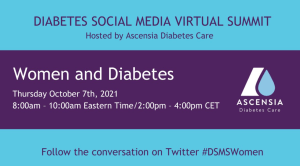
I facilitated an event for Ascensia (disclosures at the end of this piece) last night/early morning and the crappy time was partly (mostly) my fault, because although I sacrificed the Aussies and suggested we draw the short straw in the time zone lottery, I forgot that daily saving would have kicked in for us meaning kick off time was 11pm and not 10pm. That may not seem much – I mean, what’s an hour? – but there is definitely a psychological barrier about doing work after midnight. (Anyway, I digress, and that paragraph has just about put me to sleep).
The reason for last night’s adventures after dark was a facilitating gig for Ascensia’s latest Diabetes Social Media Summit (DSMS). The thing I love about (and why I am so keen to be involved) in these Summits is because they have tacked some difficult topics that are often hidden away.
This one was no different in that we looked to address something that needs more attention – diabetes and women’s health. In my introduction, I wanted to make the point that diversity and inclusion is important when speaking about any aspect of diabetes, and that for us to be truly inclusive in a discussion about women and diabetes, we needed to hear from women who represent all corners of the diabetes world. I particularly referred to needing better representation from women in the LGBTQIA+ community.
The other thing that we had wanted to make sure that we didn’t focus too much on diabetes and pregnancy, because so often that is the only easily information about women’s health and diabetes that can be easily found (and saying that, there does seem to be a bias towards women with type 1 diabetes). Of course, understanding and being aware of how diabetes can impact on pregnancy is important, but it is certainly not the only issue that women with diabetes want or need to know about.
In fact, one of the discussion points was that for some women, pregnancy is not a topic they want discussed. There is the assumption that all women of childbearing age need information about having a healthy baby when that is not the truth. Contraception discussions do not necessarily equal an invitation for pre-pregnancy counselling, and there needs to be some sensitivity in how healthcare professionals in particular raise the topic, and rid themselves of the belief that all women want to have kids.
There is so much more to talk about. So, so much more.
We touched on how much our cycles can impact and influence glucose levels (and a very amusing tangent where we joked about how when we see monthly perfect glucose patterns, they clearly don’t belong to people who menstruate – or people who understand the absolute havoc hormones can wreak on CGM traces).
We spoke about birth control and how the OCP can also make a significant difference to glucose levels, yet many of us were not told about that.
Of course, we spoke of menopause, but only briefly; briefly not because it’s not an important topic (or a super relevant topic), but because we just got caught up talking about other things (and perhaps my facilitating skills weren’t as tight as usual).
And we spoke about how cultural gender issues need to be shown and understood so that the experience of privileged white women with diabetes are not seen as the only experiences.
For me, the central message that I heard time and time and time again was that topics about the very things that occupy a lot of the headspace of women with diabetes are simply not discussed with us. And there is little research to inform our decision making, or even to help us form the right questions to ask. At best, we are given some piss-weak explanation that points a finger at diabetes being to blame. At worst, we are dismissed.
I do wonder when research and diabetes education will catch up. I know that there are some wonderful researchers doing some important work here, but we are so far from normalising discussions about women’s health and diabetes as part of our typical healthcare routines. We’re miles away from getting rid of the preconceived and outdated ideas about women’s sexual health.
Beyond discussing different women’s health matters, we also spoke about just how these discussions fit in the diabetes community. This was a completely unplanned turn for the summit (it was not a topic on the agenda), but I’m glad we had it and I’m glad that I am writing about it. Because of the nature of women’s health, sex and diabetes, there is a lot of taboo, shame, fear, and vulnerability. I know that some of the rawest and most open I’ve been in my writing has been when I have been dealing with moments in my life that were so, so hard and I was so, so vulnerable. When I look back, I sometimes wonder if I was right to hit publish after writing, and perhaps I should have tucked away the paragraphs until I was feeling stronger. Or not published at all. While I have been told that my words have provided some comfort to others facing similar challenges, it left my gaping, open wounds very public and visible.
After writing about miscarriages, I’ve been called selfish for wanting to have a child and potentially passing on diabetes to them. Writing about my fears of passing on diabetes to my child I’ve been told that perhaps I should have thought of that before I got pregnant. Speaking about body image concerns, I’ve been told to toughen up and stop being so shallow. I’ve seen and watched other women with diabetes experience the same thing, and I feel their pain as I watch them navigate the muddy, and sometimes distressing waters.
We spoke about how women are treated in the diabetes community, particularly when we write about struggles and difficulties, and the words and terms that are thrown our way when we dare to share how we are feeling. The ‘angry woman’ trope that I’ve written about before has been directed to many others too.
These discussions are real, and they are necessary. I am one of the loudest, most vocal supporters of peer support and have spoken about the value and importance of diabetes peer support and the online community on stages literally around the globe. Peer support saved me at times when I thought I was broken beyond repair. But it also can be a source of pain and bullying and nasty confrontations, and perhaps we need to have those discussions too so that when someone decides that they are ready to share and be especially vulnerable that they look out for themselves as much as looking out for the community. It’s all very well to want to share to connect and help with our own and others’ isolation but leaving ourselves exposed isn’t easy.
One of the attendees last night reminded us that we could share with selected friends in the community, still allowing for that peer support but under the protection of a safe space. It’s interesting, because until maybe two years ago, I had never experienced how unsafe the community can be to individuals. I’d not felt that before. While I still share a lot, these days I’m more inclined to turn to those trusted friends in the DOC who I know will be honest, open, but never nasty or judgemental.
Online spaces are different for women than they are for men. The misogyny that is inbuilt to even those that we think are allies comes out, often surprising us, as throwaway comments about a woman’s age or appearance. It is ever present in the diabetes community too. I’ve rolled my eyes as some of the most vocal advocates who have loudly aligned themselves as being supporters of women, revert to type, with snide sexist commentary. I’ve seen people in the DOC referred to as ‘angry old women’ for daring to be furious, older than 25 and a woman! I roll my eyes now when I know someone has called me angry. I also know that they’ve just announced to everyone how threatened they are of women who dare to not go quietly, and how they expect us to remain in our place!
There was so much more that we could have spoken about last night. We didn’t touch on body image and disordered eating (and yes, I know that this is not the domain of women only, but this is about us!), we didn’t talk about sex all that much either, even though it is often highlighted as an issue that needs more coverage and information. Again, it’s not because they are not important topics; it was because the fluid conversation took a feminist turn that highlighted a highly biased social and healthcare environment where it is seen as perfectly fine that the needs, and concerns of fifty percent of the diabetes community are barely considered.
Perhaps if we had a more feminist approach to, and model of, healthcare, the misogyny that has meant the topics important to us have not been researched, and are not discussed, could be eliminated. And women with diabetes would not be feeling ignored.
Disclosure
I was invited by Ascensia to help plan the agenda for #DSMSWomen and facilitate the discussion. I have been paid an honorarium for my time.
People with diabetes know that many times when we have a health concern it is dismissed with phrases such as ‘Oh, that’s more common in people with diabetes’ or ‘It’s part of living with diabetes’. Sometimes, that may be the case, but other times, it absolutely is not, and playing the diabetes card is like a get out of jail free card for HCPs to not do the investigations that they should to confirm diabetes is indeed responsible, and to eliminate anything else. Our concerns are ignored, and sometimes not believed. Not being believed is distressing in a particular way.
It is fair to say that while diabetes has the ability to creep its way into all sorts of places it doesn’t belong, it is also fair to say that sometimes it’s not diabetes.
I’ll say that again for the people in the back: SOMETIMES IT’S NOT DIABETES!
Women – with and without diabetes – have also reported, (and reported and reported) stories of not being believed, or listened to, or properly treated by healthcare professionals when we’ve fronted up to visit the GP or other health professional to discuss something worrying us. Women with painful, heavy, uncomfortable periods are told that it’s just part of being a woman. A diagnosis of endometriosis is not treated as something especially serious because it is common, and we’re told it’s just part and parcel of life for some women. And women going through menopause and perimenopause, are told just to accept it, that it will pass… and it’s just part of being a woman.
Put diabetes and women’s health together and there is a lot of dismissing, ignoring, diminishing, patronising, and belittling.
It needs to stop, and we need to be believed.
I am lucky that I haven’t experienced painful periods. To be honest, I barely even thought about periods until I was ready to try to get pregnant when I realised that my (up until then) good luck of only having a period 3 or 4 times a year wasn’t ideal for someone who needed to know when ovulation was occurring, and, to optimise the change of getting pregnancy, was occurring monthly. When I mentioned my irregular periods, the first thing I heard from most HCPs said was that it was because of diabetes. I wasn’t buying it. I’d started menstruating when I was thirteen. I had eleven years of sketchy periods before I was diagnosed with diabetes. And so, I asked for a referral to an OB/GYN and found one who was the sort of doctor who likes to solve puzzles rather than just ignore them.
He did a laparoscopy, a heap of other tests, and announced that I had PCOS. Not once did he suggest that my diabetes was to blame, but so, so many other HCPs did draw a line between the two. I do understand that there are links between type 2 diabetes and PCOS, and there is some research to suggest that there is a link between type 1 diabetes and PCOS, but thanks to an OB/GYN who wasn’t into making assumptions, I knew that there was more at play.
When I was ready to conceive, a regular cycle was easily achieved with a bit of Clomid. Since I had my daughter, my periods have been like clockwork. The arrive with a tiny bit of cramping that barely registers, and me being annoyed that I need to think about if I have what I need in the bathroom cupboard/work drawer/handbag. But not much else.
But I have friends who have such painful, uncomfortable, debilitating periods that have a really negative affect on their health and wellbeing each and every month. I know of people who miss days of school or work each cycle, who vomit at their period’s onset, and who cry in pain for days each and every month. These friends tell stories of how many HCPs simply shrugged their shoulders and said it was something they just needed to deal with, and perhaps some ibuprofen might help. They tell me that the severity of the pain is not believed. They are made to feel that bleeding through layers of pads, tampons and clothes shouldn’t concern them.
When I have needed to push and push and push to get answers, or to be treated seriously in the first place, or to reject the ‘It’s diabetes’ reasoning, I have been labelled difficult or challenging. When refusing to accept the ‘It’s just a woman thing’, I’ve felt the same way.
Dr Jen Gunter says it shouldn’t be an act of feminism to understand how our bodies work. In exactly the same way it shouldn’t be an act of defiance to demand answers. It also shouldn’t be an act of resilience. All too often, it is all these things.

I probably should stop thinking of my job as ‘my new job’. I’ve been at Diabetes Australia now for well over five years. But for some reason, I still think of it that way. And so do a lot of other people who often will ask ‘How’s the new job?’
Well, the new job is great, and I’ve enjoyed the last five years immensely. It’s a very different role to the one I had previously, even though both have been in diabetes organisations.
One thing that is very different is that in my (not) new job I don’t have the day-to-day contact with people with diabetes that I used to have. That’s not to say that I am removed from the lived experience – in fact, in a lot of ways I’m probably more connected now simply because I speak to a far more diverse group of people affected by diabetes. But in my last job, I would often really get to know people because I’d see them at the events my team was running, year in, year out.
Today, I got a call from one of those people. (I have their permission to tell this story now.) They found my contact details through the organisation and gave me a call because they needed a chat. After a long time with diabetes (longer than the 23 years I’ve had diabetes as an annoying companion), they have recently been diagnosed with a diabetes-related complication. The specific complication is irrelevant to this post.
They’ve been struggling with this diagnosis because along with it came a whole lot more. They told me about the stigma they were feeling, to begin with primarily from themselves. ‘Renza,’ they said to me. ‘I feel like a failure. I’ve always been led to believe that diabetes complications happen when we fail our diabetes management. I know it’s not true, but it’s how I feel, and I’ve given myself a hard time because of it.’
That internalised stigma is B.I.G. I hear about it a lot. I’ve spent a long time learning to unpack it and try to not impact how I feel about myself and my diabetes.
The next bit was also all too common. ‘And my diabetes health professionals are disappointed in me. I know they are by the way they are now speaking to me.’
We chatted for a long time, and I suggested some things they might like to look at. I asked if they were still connected to the peer support group they’d once been an integral part of, but after moving suburbs, they’d lost contact with diabetes mates. I pointed out some online resources, and, knowing that they often are involved in online discussions, asked if they’d checked out the #TalkAboutComplications hashtag. They were not familiar with it, and I pointed out just how much information there was on there – especially from others living with diabetes and diabetes-related complications. ‘It’s not completely stigma free,’ I said. ‘But I think you’ll find that it is a really good way to connect with others who might just be able to offer some support.’
They said they’d have a look.
We chatted a bit more and I told them they could call me any time for a chat. I hope they do.
A couple of hours later, my phone beeped with a new text message. It was from this person. They’d read through dozens and dozens of tweets and clicked on links and had even sent a few messages to some people. ‘Why didn’t I know about this before?’, they asked me.
Our community is a treasure trove of support and information, and sometimes I think we forget just how valuable different things are. The #TalkAboutComplications ‘campaign’ was everywhere a couple of years ago, and I heard from so many people that it helped them greatly. I spoke about it – particularly the language aspect of it – in different settings around the world and wrote about it a lot.
While the hashtag may not get used all that much these days, everything is still there. I sent out a tweet today with it, just as a little reminder. All the support, the connections, the advice from people with diabetes is still available. I hope that people who need it today can find it and learn from it. And share it. That’s one of the things this community does well – shares the good stuff, and this is definitely some of the good stuff!
Want more?
Check out the hashtag on Twitter here.
You can watch a presentation from ATTD 2019 here.
Read this article from BMJ.

Over the weekend, I could not stop thinking about the words ‘from’ and ‘with’, specifically when used before the word COVID. The reason for this is that there seems to have been a subtle shift in the language used by NSW government and health officials when speaking about people dying during this wave. You see, rather than saying people are dying FROM COVID, they’ve started to say dying WITH COVID.
It means something different. It suggests that the person didn’t die from the virus, but from other factors. This is on top of the over-emphasis made at pressers about how people who have died have underlying conditions (I wrote about that last week). The implication is that the person was already unwell; that they were dying anyway.
I know I’m a little fragile at the moment, but not fragile enough to not get fired up when I see language being used in a harmful way, and negatively framing people with chronic health conditions. And so, today, I wrote to the Premier of NSW about this issue.
Here’s what I wrote:
______________________________________
Dear Premier Berejiklian
My name is Renza Scibilia, and I am not one of your constituents. I don’t live in NSW, so you may be inclined to simply disregard this message. I hope you (or rather, someone from your team) will read it, because I know that what I have to say is relevant to many people in your state. In fact, I am sure that you have heard similar sentiments from people in NSW and I am adding my voice to that choir.
I don’t envy the position you are in right now and I’m not here to complain or credit the work you are doing regarding the current serious wave of COVID-19 in your state.
But I would like to make comment on something that is very close to my heart and an area in which I have some experience – health communications.
Communication matters. The words that people use are sometimes employed flippantly and sometimes they are employed deliberately. Either way, they are important. I fear that a change in the words you and your team have recently started is a deliberate move and I believe it is harmful to people like me. When speaking about the tragic deaths of people during this COVID-19 wave, you are now saying they die WITH COVID-19 rather than FROM it.
It may seem ridiculous to draw attention to words that appear so immaterial. Except, of course, they are not immaterial at all. And I believe that the shift is deliberate. And it does a great disservice to the people to whom you are referring.
I live with type 1 diabetes. It’s undoubtedly a serious condition, and one that I have had to manage for the last 23 years. On a day-to-day basis, I do quite impressive mathematical calculations as I measure glucose levels, dose insulin, consider my activity, and monitor my stress levels. This takes time – a lot of time. Outside of diabetes-specific care, I eat well, walk 10K steps a day, and manage my wellbeing as best I can.
Beyond what I do each day, I remain on top of my longer-term diabetes and overall health. I never miss screening checks – diabetes or otherwise; I have annual health checks and I can tell you my BP, resting heart rate, HbA1c, lipids and cholesterol. Most people my age are not this switched on with their health and wellbeing, and because I am, I can confidently say that I am healthier than a lot of people my age.
And so, when you use sweeping statements suggesting that if someone like me was to be diagnosed with, and die from COVID-19, that the reason for my death is my health condition you are not correct. I am not already dying from diabetes.
There is a difference between dying FROM COVID-19 and dying WITH covid. Your change in language is an insult and is upsetting to people like me and it is also misleading. I am healthy, I am fit and if I got covid and died, it would be because of the virus not because of my type 1 diabetes.
I urge you to reconsider how you are speaking about people like me. It is heartbreaking for us to know that in the minds of some, our lives, and our deaths, are so easily explained away. While I am sure your intention is not to make us feel as though we are nothing more than collateral, that is how it sounds. The language you are using frames us and our health conditions as being to blame. It makes us sounds and feel as though we already have one foot in the grave and I can assure you that is not the case.
Language matters, words matter. Please, please be careful when selecting yours.
Sincerely,
Renza Scibilia
Melbourne
At the last IDF Congress, I was invited to be part of the first panel on the opening morning of the meeting. It was all about diabetes and technology. Before the questions, the moderator, my friend Kyle Jacques Rose, asked everyone to introduce themselves. When it got to my turn, I said who I was and then shamelessly and unapologetically said I was the most important person the stage (along with Kyle and Manny Hernandez, who also live with diabetes). I remember looking steadily out into the audience as I made my claim to see the response. There was some who looked taken aback. And then some who cheered (thanks to the other PWD in the room!).
Last week, I was in a two-hour workshop. I knew maybe half the people there. I also knew that I was the only person there to provide the ‘user’ experience. This isn’t uncommon, but it still drives me nuts when it happens, especially in a session that was about finding the right person-centred model of care in the age of telehealth. When it came to introducing myself, I thanked the organiser for inviting me, and said that it was great to be there…as the most important person in the (Zoom) room. One of the researchers I know well and who I have worked with quite a lot in recent years, smiled widely. At least I had one person in the room who got me. I watched again to see how others responded. Some certainly did look a little shocked.
I explained that having people like me to feed into the work is critical, and that it was great that they wanted to hear from someone with lived experience to (and it would have been great to have seen a few other folks doing the same).
So, how do I manage to be ‘the voice’ of lived experience when it comes to these sorts of things? When the meeting is diabetes-specific what do I say that captures the needs and wishes of every single person with diabetes? And, as in this meeting, when it’s about designing a system that is for all people with a variety of health conditions, how do I effectively and adequately tell the HCPs and researchers in the room just what it is that those people want?
The answer is, I don’t. Of course I don’t.
I can’t speak to anyone else’s experience other than my own. I can’t say ‘I need this’ and assume that is what everyone else wants, and I would never make that assumption. Nor do I try to convince anyone that my needs and experiences are representative of anyone’s other than me.
I will advocate until I am blue in the face that there needs to be many different people consulted and engaged in the design, delivery and dissemination of healthcare services, activities, and resources. Sometimes, that does happen. But if it is only me, I am never there to provide specifics of what needs to be done. In fact, I spend most of my time urging (begging and pleading) for assurances that there will be far more, far better, far meaningful engagement from this moment forward.
I see my role is to pointedly, deliberately, unambiguously, and often, bolshily, make sure that the others in the room embed the idea of co-design in everything they do. And do it with wide representation.
I honestly don’t believe that there can ever be too much lived experience representation. But in the cases when there is only very little, I have rarely met anyone who claims to be the oracle of all things to do with lived experience or believe that their ideas are the only one worth listening to. In fact, anytime that has happened that person never is asked back.
When I am asked to help find people for an advisory board, or to be involved in consultation, I always search for people who I know can look beyond their own experience. Again, it’s not because they are expected to speak for others. Rather it’s to know that there are others with different experiences and that, while they are the one at the table in that moment, they will do everything possible to make sure that those others are invited next time.
And THAT, is why, at times like this, people like me are the most important people in the room – those of us who are banging a very loud drum to make sure that our cohort grows and grows. If you are working in healthcare and don’t have people with lived experience as part of the discussion, you’ve forgotten the most important people.
Stop what you’re doing, RIGHT NOW, and go find them.





 Diabetogenic