Living with a chronic health condition frequently means lots of health checks. This could mean regular blood tests, X-rays, scans or other things performed by HCPs. Or, as in the case with diabetes, it means ongoing, regular, daily (and several times daily) BGL checks.

Hopefully health checks are all meaningful. By that, I mean they are done for a specific reason and with particular action taken depending on the result. 

I thought about this the other day. I was speaking with someone who had argued with her GP after she had made an appointment for a routine check – a Pap smear. Now, this woman (who is happy for me to share this story) is very connected with her healthcare. She sees her diabetes team regularly and is always up to date with her complications screening. She gets pats on the back from the compliance police.

Her GP knows this because she makes sure that her diabetes team update her GP. 

The GP’s role in diabetes is different for everyone. I have a great GP, but he knowns that when it comes to diabetes, his role begins and ends with ‘You still have diabetes, right?’ And then we laugh and tick ‘diabetes’ off the list. Others have their GP as their primary care physician. 

My friend has the same sort of relationship with her GP as do I. She is also as vocal as I am when it comes to being very clear about the direction of medical appointments. So when she walked into her appointment, she made it very clear that she was there for a Pap test and that was it. 

After she had her Pap test, her GP asked her to step on the scales. ‘Oh,’ said my friend. ‘Why?’ 

It’s exactly the question I would ask. ‘Why?’ And it is the most useful question when it comes to healthcare. I ask it all the time which is really important when your healthcare professional is more from the school of ‘you will do this‘ rather than ‘this is an idea for us to discuss.’

I am more than happy to be thought of as a petulant toddler in the eyes of my healthcare professionals. I expect things to be explained to me – how else am I meant to make an informed decision about my healthcare?

Too frequently, we are asked to submit to tests (as basic as weight, or something far more complicated) or change our medication or treatment without an explanation as to why this is a good thing.

And frequently we do it without thinking. 

Part of being in control of my healthcare is to have full understanding about why we are doing what we do. I check my BGL to give me information to use when it comes to deciding what I will eat or how much insulin I need; I have my blood pressure checked to see if it has changed from the last time I had it checked and if so, if anything needs to be done. I also know it can be a predictor of other things related to diabetes, so it’s something that needs to be checked regularly.

But I refuse to have a check done unless there is a good reason and ‘Oh, just because’ is not a good reason. And that is the reason that my friend’s GP gave her. ‘Do you have some concerns about my weight?’ asked my friend. ‘Do I look different to last time I saw you? I don’t have any concerns, so I’m confused as to why you would suggest  it?’

Now, you can absolutely say that my friend was making a big deal over nothing, I disagree. If there is no reason, why have it done? I could go into something about weight being a fraught issue for a lot of people ( I won’t step onto the scales unless I absolutely have to), but actually that doesn’t matter.

There needs to be a reason. If there is no satisfactory and satisfying response to ‘why?’ it doesn’t happen. Simple as that!

There is much inequality with the health system here in Australia. I know that we have it better than a lot of other countries, but unfortunately, it’s not fair for all. However, there are some things that are, indeed, great.

I have always been exceptionally proud of our National Diabetes Services Scheme. I love telling people about it when I am travelling, explaining how it makes the lives of people with diabetes considerably easier. We don’t need to get our health insurance providers involved; no one is forcing us to use one particular make of meter or strips because that is all that is covered; registering on the NDSS is not all that difficult.

The NDSS has been around since 1987, and in a health system of oft-quoted disparity, it is a shining light in its fairness. (I say this with full knowledge and understanding that people with type 2 diabetes do not have access to insulin pump consumables, but this therapy is primarily used by people with type 1 diabetes – even before the NDSS subsidy came into effect back in 2004.)

However, when it has come to needles, BGL strips and other consumables required in the management of diabetes there has been no discrimination; it has been available to all.

Until now.

Last week, Commonwealth Health Minister, Sussan Ley, announced that following the findings of the Post-Market Reviews of Products Used in the Management of Diabetes, BGL strips would no longer be available to people with non-insulin-treated type 2 diabetes as they have been to date, questioning the effectiveness of self-monitoring of blood glucose (SMBG) for this group.

The report (Part 1 – Blood Glucose Test Strips) announced that people with non-insulin-treated type 2 diabetes will have limited access to BGL strips. That is, access will be provided for up to 12 months’ supply of strips – initially six months and then an additional six months if it is determined the person with diabetes will benefit from further monitoring. The decision is in the hands of the healthcare professional – not the person with diabetes.

The Minister claims these findings to be in line with the Choose Wisely campaign, which, when it comes to type 2 diabetes, I also consider to be flawed.

When the PBAC reviews were first announced (back at the end of 2012), I wrote this piece for the Diabetes Victoria blog about why limiting access to diabetes consumables for any group of people with diabetes is potentially damaging – especially when it relates to taking ownership of managing diabetes – and short sighted. I actually think it is downright irresponsible policy making.

The findings of this review concern me – they worry me greatly. This is the first step in removing control of the tools we need to manage our diabetes in the way we choose. The removal of choice is destructive and limits our ability to tailor our healthcare to our needs.

I don’t have type 2 diabetes, so this in no way affects what I am able to access through the NDSS. But I know many people with non-insulin-treated type 2 diabetes who rely on regular BGL monitoring to assist them to live well with diabetes. They use it as a tool to make better food choices, noting how certain foods affect their BGLs. They use it to monitor the effectiveness of exercise as part of their diabetes management. And they use it because it gives them a sense of control, piece of mind and ownership over their health.

This is sending the message that non-insulin-treated type 2 diabetes is not serious. And that is a very, very dangerous statement to be making.

Disclaimer – I was involved in Diabetes Australia’s submission to the PBAC on all aspects of the Post-Market Reviews of Products Used in the Management of Diabetes. Diabetes Australia strongly supported SMBG for people with non-insulin-treated type 2 diabetes in Part 1 of the reviews.

I had a lovely dinner last night with a colleague and friend. We ate great food, drank terrific cocktails and didn’t shut up except for when the waiter was telling us the evening’s specials (and even then we ‘oohed’, ’aahed’ and ‘yummed’ our way through that).

At one point, my friend reminded me of a beautiful part of the book Captain Corelli’s Mandolin, a book I read when it first came out back in the mid-1990s.

As soon as I got home from our dinner, I searched for it so I could read the words again. Here they are:

Corelli

When I first read the book, these words kind of washed over me. I was hearing them quoted a lot, and in the coming years I heard them read at weddings. They are beautiful words; read aloud it is beautiful prose.

But it wasn’t until last night that I read it and felt really understood it. The poem is an ode to enduring love, but that’s not what struck me. At least, not necessarily the love bit. But the endurance bit certainly did.

Over the last couple of years, things have been difficult. When I look at how I have been managing my diabetes, it has been a series of fits and starts. There are spurts of focus, then dips of almost denial. There are times of desperation and exhaustion and then periods of energy. It’s uneven. New devices see me get enthusiastic and motivated, but only for a short period. Then I return to the slump.

It’s not the exhilarating times that matter. Of course they are wonderful and enjoyable and sustaining and thrilling. Having a new pump or a new meter or a new CGM is a sure-fire way to get me thinking more about diabetes. But this doesn’t last. And it also doesn’t really count.

Equally, it’s not the slumps that matter.

What really matters is actually what you might call the boring times. It’s what comes before and after the flurry of interest of a new toy. Or the times around the ‘nosedives’.  I feel best about my diabetes management not when I am stressed about how little I am doing or happy because I am so focused. It is actually the time when it is just there, plodding along, being considered at an ‘appropriate’ level. It’s not sexy. It’s not dramatic. But it’s so good because I feel relaxed and comfortable about it. It just is.

I am sure that there is something to be said about the fast-paced world we live in and this idea that we always need to be thrilled by something new. It’s too easy to get complacent and comfortable. That’s probably one of the reasons that I embrace new and emerging technologies with such zealousness.

However, if I was relying only on the new stuff to sustain me, it would never last. A new pump becomes just a pump very quickly.  A new meter stops being new and shiny after a while and becomes just a meter. And a CGM may be magical and brilliant and life-changing until it become just another tool in the diabetes tool kit. That doesn’t make them any less important or valuable. But if I was relying on the excitement of the new, I would need a new toy every week or so!

The endurance of ‘just being’. That’s the sweet spot. That’s when I know I am getting it right. I just wish I could work out how to be there a whole lot more!

I am lucky that Aaron is always listening to new music. This CD was a recent purchase. Sometimes I hear something that makes me just so delighted. Like this live performance of my favourite track from the CD.

If you have diabetes and live in Australia, it is highly likely that at some point you would have received some information, support and/or education from Diabetes Australia.

These services range from the provision of information via websites, blogs, magazines, information sessions and webinars. They also involve activities such as camps for children with type 1 diabetes, peer support groups, targeted information sessions which look at issues including men’s health, women’s health (including the very important topic of pre-conception planning and care), programs for young people with diabetes, programs for older people with diabetes, including those in nursing homes, working with culturally and linguistically diverse groups, delivering programs to Aboriginal and Torres Strait Islander communities and the training of health professional training.

More? Well, there is also a huge body of advocacy work – both at an individual and policy level – that takes place, as well as representation on expert panels and working groups.

Yesterday, it was announced that the Government has signed the 6th Community Pharmacy Agreement (6CPA). This agreement covers the supply of PBS medicines and, more broadly, pharmacy remuneration for dispensing subsidised medicines.

A significant change in 6CPA from previous agreements is that from July 2016, NDSS products will be distributed through the pharmacy wholesaler distribution network. This is where it starts to affect people living with diabetes.

Basically, the NDSS is broken into two parts. There is the product supply and delivery component and then the support services component. The latter is where all those things I listed earlier in this post fall.

Okay – let me get the disclaimer palaver out of the way. I work for Diabetes Victoria (formerly Diabetes Australia – Vic). I also have a national role where I work for Diabetes Australia. I am a long standing member of the Diabetes Australia family – something of which I am incredibly proud. My work involves providing information and support services to people living with diabetes in Victoria, and managing a national project about young people and diabetes. I am a spokesperson for the organisation – especially about diabetes technology and social media. I do all these things backed by a team of health professional and consumer experts.

Right – with that out of the way, I will also say that I have no more information than what is available in the public domain, so this is not an opportunity for me to be sneaky in trying to get people talking about this to promote Diabetes Australia’s work. That’s not what this is about. This is about what it means to people with diabetes living in Australia. Because I am one of those people.

The 6CPA clearly outlines that product supply and delivery (that is, all the consumables we use to help manage our diabetes) will now be distributed through the pharmacy network. As a person with diabetes, I am confident that this means that the supply of these products is protected (along with the subsidised prices) and that I won’t be expected to pay more for my strips or pump supplies.

But what about ongoing education and support services? Diabetes Australia has a long history of providing evidence-based information. In recent years, there has been a very strong focus on patient-centred care, and most programs now have some sort of consumer input. Engaging people living with diabetes is considered just as important as engagement with healthcare professionals. I know this is true – I am frequently asked to either be a consumer rep, or (perhaps most pleasingly) assist with finding someone to be a consumer rep.

The provision of diabetes information needs to be done by people who ‘get’ diabetes. I am a really strong believer of this. I believe it to be true of all health conditions – there need to be experts (and that doesn’t only include clinical experts) at the helm. And there needs to be a strong link to the community.

These services Diabetes Australia provides change lives – I hear that every time I speak with a parent whose kid has been to a camp. I heard that – repeatedly – on Saturday at the Diabetes Expo where I was emcee.  I hope this carries on.

Last week, I tweeted/Instagrammed/Facebooked this:

iPhone

Because it is the best cartoon ever. Ever. Ever.

My iPhone could, in some ways, be considered my primary-care physician. It has the ability to manage everything about my diabetes. All in one little hand-held device with a cute Kate Spade cover.

It has the contact details of my real-life (i.e. non-iOS) healthcare team. I don’t even need to dial – I just have to ask Siri to connect me! And she does. Or else she connects me to the Japanese restaurant from where we frequently get Friday night takeaway. Either is good.

It has apps that can do all sorts of things – produce pretty graphs, tell me the time of day that my BGL is the highest (and therefore showing the time of day that I am most likely to have eaten doughnuts) and remind me that I’ve been doing hardly any BGL checks. Judgemental little thing.

It keeps appointment times and, if I was the organised type, could remind me when I need to fill a prescription or am overdue for something. (Note to self: book in pap smear.)

It has all my different social media platforms, easily accessible, so that I can see what is going on with everyone I have ever known and not known, see photos of what people are eating, and get links to videos of dogs and cats being cute. Which make me smile and feel happy which is good for my mental health.

It connects me to people with diabetes at all times of the day. It’s a 24 hour, 7 day a week, 365 day a year peer support group full of people who are able to provide reassurance, humour and love. And teach me to swear at high or low BGLs in all the languages of the world!

It contains vital information including my pump basal rates. Which is good because I am sure that information will come in handy one day.

Dr Google lives in there and she is able to give me information about pretty much anything whenever I like. For example, at 3am when I wake up with a headache and need a diagnosis of the likelihood of some sort of tumour.

Everything I need. Doctor, counsellor, friend and comic. No wonder I start hyperventilating when it’s not in sight!

Consultation time


I have a love of words that stems from a love of reading and a love of conversation. I love learning new words and discovering new meanings. Clever conversation makes me swoon. My favourite TV shows become favourites because of the banter between characters. I read cookbooks by Nigella Lawson as much for her prose as for the recipes.

People who know how to use words are my heroes and I envy them enormously.

Language is a thing of great beauty and power. But with power, there comes an ability to destroy and misuse and oh, oh, oh, how words are misused!

I don’t like abbreviated words. ‘Awks’ is not a word. And ‘totes’ as a noun refers to a bag and as a verb to carrying something around. It is not a substitute for ‘totally’. (Also, it’s possible I am an 82-year-old woman called Beryl who is about to call 3AW and complain about ‘the youth of today’.)

But most of all, I despise made up words.

So it’s a little odd that one of my favourite Tumblrs is all about made up words.

The Dictionary of Obscure Sorrows invents words that fill a gap in language. Creator of the Tumblr is John Koenig and he is incredibly clever in the way he comes up with these new words. He has a Facebook page to explain the etymology for each word (often made up from existing words jumbled together) and YouTube clips, exquisitely telling the story of the word.

Some of the made up words are strangely beautiful, although I wonder if that is because what they intend to describe is beautiful. Unsurprisingly, vellichor is my favourite.

Sometimes, there are no words to describe a feeling or an experience. This is often the case when trying to explain diabetes – especially to people who do not live with it.

Here are some things I wish there were words for:

That feeling when you know you are low but refuse to acknowledge it. Your brain is foggy, yet at the same time your mind is defiantly in denial. 

The frustration you feel when you are desperately trying to play by the book, yet still not getting the diabetes results you would like to see – that you expect.

The love you feel for diabetes technology which is often coupled with an absolute hate of it.

That feeling of meeting someone with diabetes who you just click with and know that you will be friends forever – not because of diabetes, but just because, although kind of because of diabetes! (Ping: These girls. And this one.)

And adding to that – being in a room full of other people with diabetes and hearing the beeping and vibrating and alarming and clicking of a hundred meters/pumps/lancets/pens/CGMs and being absolutely oblivious to it all because it just feels so ‘normal’.

The anticipation of digging a spoon into a new jar of Nutella.

The superciliousness you feel – and the exaltation you feel you deserve – when you change your lancet more than a couple of times of year.

The rare, unusual and yet liberating feeling of being completely, truly, utterly, entirely, wholly naked – no cannula; no sensor; no tape on your body.

The appreciation, gratitude and indebtedness you feel towards your loved ones who are forced to deal with diabetes that one step removed, and love you no less for it.

The realisation that a diabetes blog post you are reading is so perfectly true, so accurately precise and tells your story so honestly that you feel that you wrote it yourself.

Being high and all that comes with it.

I wish there were words for these things. I wish that there was a way that I could express what diabetes is about – how diabetes feels – in a way that is more than just multiple words on paper and a (frequently ridiculous) stream of consciousness that is often nothing more than an unintelligible mess!

I’m not sure that I would ever use Koenig’s words in a sentence – spoken or written – and he is certainly not the first person to make up words. Shakespeare made up words in his writing. Edward Lear did too – really, just what is a runcible spoon? But nonetheless, it is somewhat magical to see – and hear how – random letters come together to create words that seem to somehow, suddenly, make complete sense and give a name to things that we absolutely feel.

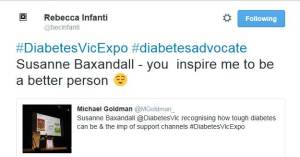
I got to Saturday evening and felt like I needed to collapse! I was more than a little diabetes-ed out. The end of last week and the beginning of the weekend were huge – attendance at a health professional event on Friday, the Diabetes Expo on Saturday and, of course, the gift that keeps on giving, the television thing on Thursday.

When diabetes is so front-and-centre, it is really tough to think clearly and about all the information that has been shoved into my itty-bitty mind. Stopping and searching around for some things I have learnt and taken away can be difficult. Which is why Twitter is good!

Here is what I learnt over the last few days.

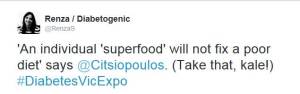
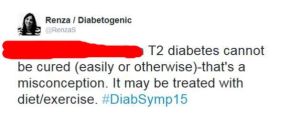
People want information about diabetes. There is still so much misinformation out there that people living with diabetes sometimes have a hard time cutting through the noise and working out what is valuable info and what is made-up-psuedo-science-crap-from-some-idiot-trying-to-sell-you-magic-beans-to-cureall.  So it’s good to have sensible people saying sensible things! (Hashtag – Evidence)

WeekendTweet4


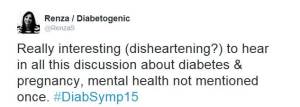
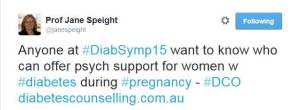
WeekendTweet5And I also learnt that diabetes is still seen and considered by too many as a clinical condition and there is not enough attention given to the emotional impacts of living with it.
WeekendTweet1

Thankfully though, I was reminded that there are people out there who can help with this!

WeekendTweet3

I learnt that Twitter trolls will latch onto hashtags that are getting some attention and try to infiltrate it with their nonsense. These trolls should be ignored. Except, of course, I didn’t. (However, I will not share your Twitter handle here!)

WeekendTweet8

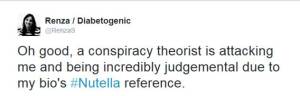
And these nutters will try to discredit you by challenging your Nutella addiction. Fools!

WeekendTweet2

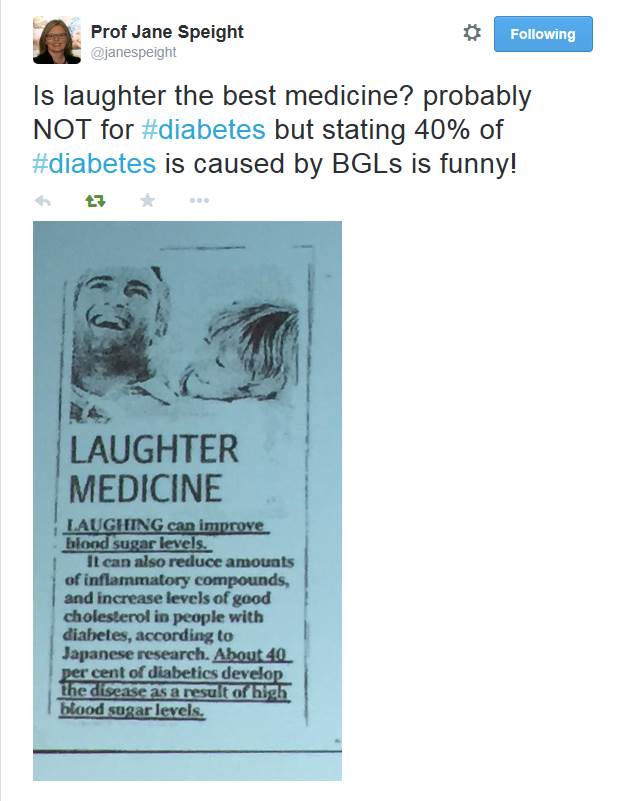
I was reminded why the Herald Sun is not the place to go for credible diabetes information.

WeekendTweet6

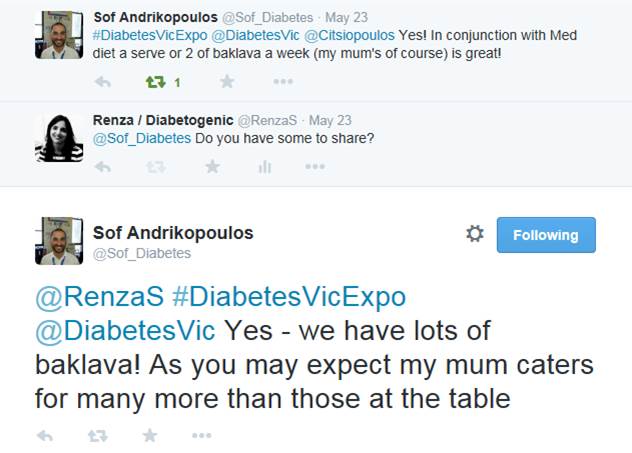
And promised baklava from one of Australia’s leading researchers in diabetes. Thanks Sof!

WeekendTweet7

I learnt that it’s surprising who watches morning magazine television shows. Like the uber-cool waiter at Marios who announced loudly as we walked into the café yesterday, ‘I saw you on TV’!

I remembered that people walk away from these sorts of events feeling positive and rejuvenated and connected. Which makes them worth it in a million different kinds of ways.

WeekendTweet9


WeekendTweet10


And I learnt that after a hugely successful few days of work activities that hanging out with my family, listening to Carol King and drinking coffee in my favourite café and then watching the Eurovision song contest final will make me feel energised and ready to face the new week.

Hello Monday!

I know it’s not Friday, so here is something for your MONDAY listening pleasure!

Today, I am at the Diabetes Victoria and Baker IDI Health Professional Symposium and the first session has me thinking – and sitting down the back of the auditorium banging out this post.

The keynote presenter for the Symposium is Professor Herzel Gerstein talking about hypoglycaemia. He made a wonderful point in the Q and A portion of his presentation, one that I think is frequently overlooked.    

IMG_0783

The language (yes, I’m talking language AGAIN) we use around hypoglycaemia is misleading at times. Generally, we have severe hypoglycaemia and mild hypoglycaemia.

Severe hypos refer to those we need assistance to treat. It may inolve unconsciousness or seizures. Severe hypos sometimes need paramedics’ assistance, or a trip to the hospital.

Mild hypos are those that we can manage ourselves without too much hassle.

The problem with using these two terms is that it makes it sounds as though mild hypos are nothing. They’re just a part of living with diabetes, deal with it, off you go.

That may be the case in practical terms. A so-called mild hypo may mean grabbing a handful of jelly beans, waiting a few minutes and then off you go. Or it might be slightly more than that and take longer. But whatever it is, it’s termed ‘mild’ because no assistance was required.

But the thing with ‘mild hypos’ is that they do have the potential to weed their way into your psyche and suddenly become very significant.

If those mild hypos mean that you are often running late for things, you start to wonder if others are questioning your reliability. If those mild hypos have you needing to sit things out for a moment, you worry your friends or your kids or your family think you are disengaged, not wanting to participate. If those mild hypos result in you being a little vague for a while in work meetings, you start to fear your boss or colleagues think that you are not paying attention, not interested, don’t understand.

These are not ‘mild’ things. These are really significant and mean worrying and stress and anxiety and anger and sadness and fear and guilt and all the other things that diabetes makes you feel. There is nothing mild about it!

I think this is a really important issue for healthcare professionals to remember. By brushing away mild hypos as just a short-term-complication-everyone-has-them notion, the actual impact on the person living with diabetes is ignored. it’s minimising just how big a deal mild hypos can be and not providing any strategies for coping and managing with the emotional side of these episodes.

A mild hypo may not necessarily be terrifying in the moment, it may be quite manageable at the time, it may not affect anyone else or draw too much, if any, attention to the person having the hypo. And this is good!

But don’t for a minute think that it doesn’t mean a silent feeling of dread (and possibly a silent word of thanks to the hypo gods that it was nothing more!) or feelings of significant distress afterwards.

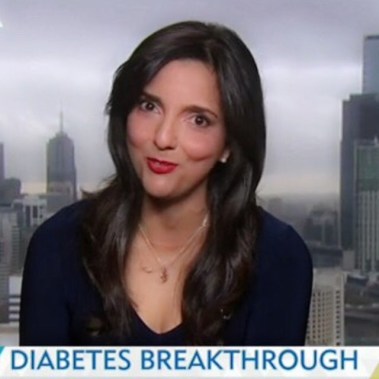
I went to TV Land today to do an interview on a morning show about the artificial pancreas. I am always excited to see type 1 diabetes in the spotlight. Actually, I am always excited and pleased to see any diabetes in the spotlight, provided the reporting is accurate and the information devoid of any myths. And they don’t use the word ‘sufferer’.

I was a little anxious to speak about the artificial pancreas. It was being hailed as a ‘diabetes breakthrough’, which is a little misleading given that the trials for this technology have been underway for some time now. I am always very careful when talking about research and emerging technologies, making sure whatever I say is in context – I don’t ever want to be accused of promising something will be here, available for all, in ‘five years time’. In fact, I had made it really clear when speaking with the producer prior to the interview that this is NOT a cure and that it would probably be better that the word ‘cure’ not even be mentioned.

So, I was asked about how the AP would change things for people and what it would mean and gently speculated (based on a few things I’d read recently about current trials) as to when it would be available. I was a little hesitant at the ‘and what will it cost?’ question, because 1. Who knows? and 2. The answer is most likely ‘Out of reach for most people. Which sucks!’ and I didn’t think that would be a good thing to say on TV when I was doing my best to sound professional.

Big hair. Big make up!

I’ve not seen the clip from this morning yet. Trying to focus on a camera, and listen to people I can’t actually see (they were in Sydney, I was in a dingy box of a room in Melbourne) and not wipe my Bold and the Beautiful-esque make up off whilst flattening my big hair was really not ideal for coming across as poised and professional. But I didn’t giggle uncontrollably. And managed not to swear. So, I think (hope) it was okay!

I got into a cab outside the studio when it was all over and the driver asked me if I was famous. (I would suggest the need to ask that question would also provide the answer, but whatever.) ‘Ha! Ah, no. Really. No,’ I said to him. ‘I was interviewed about diabetes research.’

‘About a cure? My son has type 1 diabetes,’ he turned around to look at me.

I looked back at him. I looked at the desperate look on his face. I know that look – I’ve seen it thousands of time. I’ve worn it thousands of time.

‘No. I’m sorry.’ I said. ‘It was about a potential breakthrough in technology – a new device that may be available in coming years. It will make things easier. But it’s not a cure.’

He looked away, disheartened.

‘I’m sorry. Really. I’m sorry.’

I looked out the window as the cab sped through the city, the buildings all shiny from the rain. And right at that moment, I felt as despondent as my cab driver looked.

UPDATE – You can watch here.


It’s kinda ingenuous to refer to today’s post as ‘Wordless Wednesday’ given the image below is full of words. Plus I’m typing words. So I may as well keep typing a few more.

Inspirational quotes give me the shits. Whether it’s posters on the walls of corporate offices or on the walls of my social media feed, they annoy me.

So here’s one for today!

Know the difference

This one, (found on the Diabetes Support Facebook page), I actually rather love. I am so guilty of referring to myself as a failure because I am not managing my diabetes as well as I would like to be. But at no time have I decided that my health is not worth the effort. And certainly, at no time have I thought that I am not the effort.

But I have slipped up. I have screwed up. I have lost focus and caved. I’ve given in. I’m busy. I’ve become lazy and I have been so, so, so, so distracted. This is a set back. Nothing more. Nothing less. A set back.

Pop over to the Diabetes Victoria blog for my post about this Saturday’s Diabetes Expo. It’s going to be a jam-packed day of diabetes information! If you’re going, make sure you come and say hi to me. I’ll be emceeing throughout the day.

Follow Diabetogenic on WordPress.com

Enter your email address to follow this blog and receive notifications of new posts by email.

Read about Renza

Archives