25943840033_ee6b1ba12a_o

It’s day 2 of Diabetes Blog Week, and the silver lining of being awake at 5am this morning was that I managed to catch up on most of the posts from day 1. This week comes from Karen Graffeo who, as she commented on my blog yesterday, I’ve not met. But we will be remedying that very shortly so I can hug her and say thanks for this. And make her buy me a coffee to help manage the sleep I’ve lost each year (and am yet to make up!) since taking part in #DBlogWeek.

Today’s prompt:  We think a lot about the physical component of diabetes, but the mental component is just as significant. How does diabetes affect you or your loved one mentally or emotionally? How have you learned to deal with the mental aspect of the condition? Any tips, positive phrases, mantras, or ideas to share on getting out of a diabetes funk?

Just this morning on Twitter, I was having a conversation with a few people and eventually I found myself commenting on the emotional side of diabetes. The discussion was specifically relating to someone who had recently started using an insulin pump and I made a comment about how the learning curve could be steep and to take it easy.

Someone jumped in and said that he found the learning curve to not be steep at all (which is great and also highlights the different ways different people respond to diabetes). He commented that he thought it was pretty straight forward and that most people should be able to follow some basic principles – such as timing of glucose checks and understanding what happens around food and insulin (a movable feast as far as I am concern – there is no understanding, just watching with confusion at why something worked yesterday but not today….).

This may be true. There probably are some principles that could be consistent for most people. However, this was not addressing everything I was referring to which may contribute to the gradient of that learning curve.

Matters such as insulin dosing, timing of glucose checks and counting carbs are, just like working out which buttons to push on the new device, technical. But I believe this is certainly not the only side to diabetes.

I pointed out that it was more than just the technical side to a pump start and commented as such, adding ‘emotional concerns of ‘attachment can be difficult for some, explaining in my next tweet that the term attachment was referring to being connected to something 24/7. (This is something that almost everyone I have ever spoken to has mentioned as a real barrier to starting on a pump or other wearable device – the idea of a constant, attached to the body reminder of diabetes. It was even a discussion last Friday at #DX2Sydney.)

Too often, some forget that diabetes is not about only about operational matters. The equation of ‘you eat, you take insulin to cover the food and then you are all good to go’ does not hold true. In the case of technology it is not, ‘you learn to press buttons and then you are fine.’ Just as I am much more than my diabetes, my diabetes is so much more than food, medication and devices.

When people ask me what I find the most difficult about living with diabetes, I am able to answer without hesitation. For me it is a combination of the relentlessness of the condition alongside the way in permeates all aspects of my life. It is particularly disturbing and distressing for me when it impacts my family who shouldn’t have to deal with diabetes.

I don’t have the answers or know how to fix these troubles. But I do know that there are a few things that help.

  • I have learnt to be kind to myself.
  • I have learnt to not compare myself with anyone else.
  • I have learnt that this too will pass – even the darkest diabetes moments have had light somewhere.
  • I have learnt to rely on the people around me who love and support me.
  • I have learnt that the moment that I get complacent and think I have this diabetes thing sorted, I absolutely don’t.
  • I have learnt that looking to the DOC provides me with a million things I’ve not thought of, and one of those things may work for me today.
  • I have learnt that sometimes I need to draw a line in the sand, call it a day, and admit that diabetes is winning right now. But that doesn’t mean it will tomorrow.
  • I have learnt that when all else fails, the things that make me feel best are a hug from Aaron and the kidlet, a message to one of my far away diabetes friends, a perfectly made coffee or a glass of Prosecco, and something to take my mind off diabetes.
  • I have learnt that even though I have really had some dark emotional days with diabetes, I get up and do it again tomorrow. Because that is the only option.

burn out and come back again.

25943840033_ee6b1ba12a_o

It’s day 1 of Diabetes Blog Week which means that this is a week where I will be getting little, if any sleep, as I trawl my way through hundreds of diabetes blogs from bloggers all over the world. Big thanks, as always, to the lovely Karen Graffeo (who I love today, but by the end of the week, in my sleep-deprived state, will be cursing for this initiative!) for coordinating the week and giving diabetes bloggers a chance to share their ideas and thoughts on such terrific topics.

Today’s prompt: Lets kick off the week by talking about why we are here, in the diabetes blog space. What is the most important diabetes awareness message to you? Why is that message important for you, and what are you trying to accomplish by sharing it on your blog?

I have now been writing a blog for over five years now. This is my 602nd post (apparently). That’s a lot of waffle about diabetes!

What’s important about diabetes awareness is not only different for each of us, but it also changes throughout time. I have had particular areas of interest at particular times, but there are certainly some issues and messages that have remained pretty consistent.

So here are a list (and links) of some of the most common messages that appear on Diabetogenic.

Use your words. Wisely. Language and diabetes is important. (And I am so excited that this is a topic for Diabetes Blog Week this year!) I have written A LOT about diabetes and language and most of those posts can be found here. 

#Access4All. And that does mean for all.

Coffee and Nutella are food groups.

My DOC friends – the ones who keep me company at 3am while low, make me laugh at any time with a random tweet or message, or reach out when concerned – are the only reason that I am mostly balanced about diabetes. Without them – and their support – I don’t know where I would be. And the same goes for the IRL friends.

Put us in the room. People with diabetes have a place at all levels, at all diabetes conferences and at discussions with all stakeholders. Our seat is at the head of the table. Make sure we get the invitation!

Diabetes experitse is shared – but different. Except when it comes to MY diabetes. Then the expertise lies squarely with me.

Diabetes is not only about numbers. It is mostly about what is going on in my head.

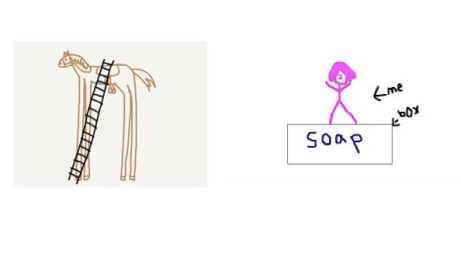
These are the issues that are most important to me. It was once suggested by my boss that the only time I get off my high horse is to climb on my soap box – an accusation that was made in good faith and one that I wear fondly. We all have axes to grind, issues about which we are passionate. And we need that in this as we navigate the world of diabetes.

High horse to soapbox…


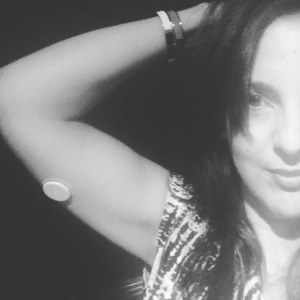
Day two of #Dx2Sydney is about to kick off. Yesterday was about getting to know just who is in the room, as well as getting an idea about the product and yes, we all did get to trial it last night and most of us are now sporting little white discs on our arms. I am slowly, but surely, making my transition to droid with three medical devices stuck on my body.

13164312_10154175709120789_4343775259635765938_n

The droid you’ve been looking for…

Some of us have been commenting on our SoMe feeds already about the event, so I thought I’d quickly put together a list of who is here so you can follow along. There are eight Australian bloggers here and I’d encourage you to support our local talent and have a read (not only about this event – which they may or may not write about).

Matt at Afrezza Down Under

Ashley at Bittersweet Diagnosis

Drew at Drew’s Daily Dose

Frank at Type 1 Writes

Georgie at My Lazy Pancreas

Kim at 1 Type 1

Melinda at Twice Diabetes

Tanya at The Leveled Life

CiUh4paU4AEKpV3

There have been a fair bit of tweeting throughout the couple of days, so you might want to jump on Twitter and check out #DX2Sydney.

Also, lots of people are asking about launch details (including costs) of the Freestyle Libre. The Abbott website has all the information you need.

DISCLOSURES

As explained in yesterday’s post, travel, accommodation, meals and transfer costs have been covered by Abbott. And all attendees have also been given two Freestyle Libre sensors and the reader. 

I may write about my thoughts of using the Libre device after I’ve trialled it for a while. I might not. Abbott have no input to the words I may write. 

 I’m in Sydney for the next couple of days for the Diabetes Exchange (DX) program hosted by Abbott Diabetes Care. The event which runs over two days is part of Abbott’s global DX initiative which aims to bring together diabetes bloggers from all over the world. The Sydney event follows on from the initial meeting in Berlin, and next month, there will be an EU event, this time in Stockholm. (How’s your French? Google translate may be able to help you with this wrap up of the Berlin event from my dear friend Andrea.)

I am terribly excited about the Sydney event for a few reasons. Firstly, it’s all about the tech. Make no mistake, we’re here to talk about the Abbott Freestyle Libre monitoring device which (finally) received TGA approval earlier this year and will be launched into the Aussie market in the very near future. It’s exciting technology – and how clever are Abbott in bringing together a group of bloggers who may just share their experience (of both the event and the device) with others?

I am also excited because I will be surrounded by my peers – others who also live with diabetes. I will be with old friends, others that I only know in the 140-characters-or-fewer world of Twitter and others that I have never met (in real like or online) before. I am especially excited that it is an Australian event because it is always fascinating to see and hear the close-to-home perspective and just how different it can be even though we are accessing the same health system while living with same health condition. (I’m also thrilled to be in a room full of Aussies because it means I won’t spend a significant part of the day asking ‘Does that translate?’ as I try to explain something that makes absolutely no sense to anyone from Europe, the US or the UK.)

I have been very fortunate to sit around tables around the world at similar events and the power and value is not because we all agree with each other. In fact, the real magic happens when there is respectful and robust discussion where everyone is given the opportunity to safely share their experience and perspective. I so hope that is the outcome of the DX2Sydney meeting.

I am facilitating DX2Sydney, which is terrific because it means I don’t have to say much. I mainly get to listen and hear others’ thoughts. The agenda is packed full of interesting topics and there is plenty of time for tangents and questions. Well done to Abbott for bringing us all together. This is a terrific opportunity for us as bloggers, but it is also such a brilliant opportunity for Abbott to get some valuable insight into working with PWD. We have a place at this table; there is no issue with industry and PWD talking, engaging and sharing. I’m so pleased to be here to do that!

Our Aussie blogging community may be small – and this may be only the second time that a group of Aussie diabetes social media influencers have been allowed in a room at the same time (the first time being Diabetes Victoria’s innovative Diabetes SoMe Summit back in 2012), but I am so pleased that we are being given the opportunity to lend our voice to the global DX initiative.

You can follow along on Twitter at #DX2Sydney. And I’ll be linking to any blogs or commentary from the other attendees in later posts.

DISCLOSURE

DX2Sydney is being coordinated and run by Abbott Diabetes Care. The costs for me to attend the two day event (travel, accommodation, meals and transfers) have been covered by Abbott. All attendees will also receive Freestyle Libre product so we can trial the new device. 

There is no expectation that I will write about the event or my thoughts of the device. Abbott may have paid for me to attend, but they have not paid for my words on this blog, social media activity or anywhere else. I do, however, promise to try to keep myself nice and not swear. (But that could go pear-shaped any moment!)

DX2Sydney is being held in the ACDC suite of the hotel. Who said diabetes isn't rock 'n' roll?

DX2Sydney is being held in the ACDC suite of the hotel. Who said diabetes isn’t rock ‘n’ roll?

In the last week, I have had no fewer than six women contact me with the same question. All of them are about to start using a pump and they are concerned about the most important and worrying aspect of wearing a life-saving medical device. ‘Where and how do I wear my pump?‘ they have all asked.

Wearing one’s pancreas on the outside of one’s body has its challenges. There is the challenge of having to explain what the beeping, vibrating, clicking box is all about. There is the challenge of mixing the pump with door handles and anything else protruding (the pump will usually come off second best). There is the challenge of finding a delicate, inconspicuous and subtle way of removing the pump from under clothes to use it.

And, there is the challenge of where to wear the bloody thing. Pumps do nothing for the line of one’s clothing. A square, hard box is lousy for smooth, uninterrupted lines, so I usually tuck my pump into my bra.

But what about for times when one is not wearing a bra? I have found that simply popping my pump in my pocket will inevitably results in a tube tied around a door handle, a yelp (from me) and a pump failing to do what it is meant to do (i.e. deliver insulin and keep me alive).

My walking-in-the-door routine includes high heels kicked off into a corner, pencil skirt removed and bra ripped off which means that my pump is suddenly free flying. Where does the little external pancreas go without the threat of bungee-ing to the floor and hitting the cat on the head?

Today, over at ASweetLife, there is a list of innovative and terrific designers who are solving this (obviously first world, but nonetheless important) issue. Finally, there is cute, attractive and sexy underwear that provides a solution to the ‘where to wear’ question.

It doesn’t surprise me that so many people are anxious about where to wear their pump, in fact it is one of the most frequent questions from people (usually women) who are considering a pump. When giving talks about pump use, I usually stand there and ask the audience if they can see where I am wearing my pump. Most are surprised that there is absolutely no sign of it, even though I often am wearing tight-fitting clothes.

I understand why this is such an important issue for people who are thinking of starting on a pump. Suddenly having something attached to your body 24/7/365 can be quite confronting. Wanting to know that it will work with our clothes should not be dismissed as a frivolous or pointless concern. Our insulin pumps become part of our body, functioning as an organ, albeit one that we have to drive ourselves. Finding ways to accommodate our external pancreas in a way that is beautiful and comfortable is incredibly important. Thanks to the designers finding a way to do that.

Perfect start to Mother’s Day. Just need to work out how to make this happen every day!

I had a gorgeous Mother’s Day yesterday, which included, amongst other things, breakfast in bed, a big family lunch at our place and, after everyone had gone home, an afternoon nap. It was quite glorious and I felt incredibly spoilt by my little family and fortunate to be surrounded by our extended family.

So it is with some guilt that I admit that in with all the happiness and celebrations and gifts and cards and flowers that I had moments of quiet sadness – both yesterday and in the lead up to the day.

Mother’s Day for me is about celebrating my mother who is, quite simply, the best mother in all the lands. There is no doubt about that in my mind.

It is also about being a mother and thinking about how much I love that. But in there, mixed up with the loveliness of it all, I feel pain and sadness.

I feel guilty about it because I do feel so lucky. I have a daughter and she is wonderful. I am a mother and I am so grateful. But I feel that I am missing something – or someone.

In the lead up to Mother’s Day, I was talking with a friend about how I felt and she said to me ‘At least you have your beautiful girl. A lot of people would be so thrilled with that.’ And I am thrilled with my daughter – of course I am. Feeling sad about the babies I lost does not mean that I don’t celebrate what I do have.

I ache sometimes for what could have been. I feel ungrateful even writing this, because I know and try to understand how difficult it is for women who do not have children. I read the stories about how hard Mother’s Day and other occasions are for people who don’t celebrate – for whatever reason and know that it sounds like I am ignoring how lucky I am and being greedy for wanting more.

Those quiet moments of wonder don’t stop hurting. I think about the baby that would have come before my daughter, but mostly, I think of the little ones that would have come after. I think of the one I lost two years after out little girl was born and think about how different our daughter’s childhood would have been if she had a sibling so close in age to her.

And still with so much rawness, I think of the one who would have been three now and how our family would have been turned completely on its head with the arrival of a new baby only a couple of years ago and we would still be muddling through the toddler years.

I had a dream the other night of Mother’s Day morning with Aaron and our daughter, and another little child – a three year old. I couldn’t see if it was a boy or a girl, but there was a bundling little kid also jumping on the bed, helping me unwrap my gifts and bringing me my carefully made breakfast. I kept trying to reach out for the child so I could hug him or her, but I couldn’t. The little one kept wriggling just out of reach, not showing me his or her face.

img_2452I don’t understand these feelings. I don’t understand how I can move – almost in a heartbeat – from feeling like the luckiest mum in the world to feeling pain. But it happens and it especially happens on these days.


I hugged my girl very tightly yesterday. She is the one that my body decided to hold on to and keep; the one I was able to nourish and embrace and watch grow up. She is the reason I am someone’s mother on Mother’s Day. I truly do believe that she is so very much enough. But that doesn’t stop me from wondering ‘What if…?’

I have been closely watching how our US DOC friends are responding to the situation with United Healthcare insurance  limiting the choice of insulin pumps to Medtronic devices only. They have effectively removed the ability for the person with diabetes to select the pump that best works for their diabetes management (at least without a flight through – what  I imagine would be – a terribly arduous appeals process).

My knowledge of the US health system is rudimentary, but I do frequently read about how treatment choices are dictated by health insurers. This is absolutely shocking to me – the idea that my health insurer gets a say in what insulin I pump into my body, which strips I use to check my BGL or the device I use to administer insulin is terrifying.

While I am appalled at the insurer for their complete and utter lack of concern for the person living with diabetes, I am not really surprised. I have never felt that an insurer is on the side of the insured.

But I am very concerned at how Medtronic has behaved here, because despite any rhetoric, this is not the best outcome for, or in the best interest of, the person living with diabetes. For a company that has often shown they are genuinely interested in listening to the consumer, this flies in the face of any consumer-centric attitude and reeks of nothing more than greed.

The commentary from US DOC folks has been swift, consistent and damning, and I continue to read and learn with much interest as they eloquently and passionately plead the case for choice. I am, as I often am, inspired and motivated by the way the community comes together to fight the good fight.

But I am dismayed that there is a need for so much fighting. Living with diabetes is hard enough without having to battle red tape, bureaucracy and corporate hacks who are so out of touch with what living with a chronic condition is about.

And I also watch with fear, because I know that as much as we have freedom of choice in Australia (for now), we shouldn’t take it for granted. We know our insurers are always looking for ways to cut costs, increase profits and raise premiums.

We have already seen some insurers here take measures to make it harder to claim for a pump. There are stories of insurers insisting a higher level of cover for insulin pump rebates, instead of the basic hospital cover that was once the norm; longer qualifying periods have been introduced before a claim for a pump can be made; the number of years between upgrades are sneakily being increased in policies.

Whatever the change, it is clear the outcome for people with diabetes is that we are being screwed. We shouldn’t be too smug here in Australia as we watch from afar, because I fear it is just a matter of time before these sorts of measures are introduced here.

Here are some responses from the US DOC:

Kerri from Six Until Me (also. happy 11th blogaversary!)

Bennet from Your Diabetes May Vary

Kelly from Diabetesaliciousness

Round up from Diabetes Mine and this Storey

Kelly and Adam at Diatribe

Marina from The Betes Organization

Melissa for ASweetLife

Rick Phillips at Radiabetes

And finally, keep an eye on DPAC for update

#AccessMatters

#MyPumpMyChoice

#PatientsOverProfits

Growing up, when I infrequently visited our family GP, he was always referred to by his first name. I do remember when we were really young putting a ‘Doctor’ before his first name, but we never referred to him by his surname. He was always ‘Dr Sam’ until he became just ‘Sam’.

Since being diagnosed with diabetes and becoming a frequent flyer of healthcare services, I have only ever addressed HCPs by their first name. (Except my endo who frequently gets referred to by her first and middle name together, but that is because my kid has the same middle name (named for my endo) so when speaking to and of each other, we use both names..)

When meeting a new HCP, I will walk into a first appointment, hand extended as we do our introductions. I always say, ‘Please call me Renza,’ although I don’t know that I have ever had a doctor not call me by my first name in the first instance. In fact, usually, when called in from the waiting room, they do so by using my first name.

So it’s probably not surprising that I found myself prickling a little as I read this article from a couple of months ago, written my an oncologist from the US. James Salwitz MD tells the story of a new patient – an elderly man who attended with his adult son. The son insisted on calling Dr Salwitz* by his first name which, apparently, was a little unnerving for the doctor. He referred to it as a cultural faux pas, suggesting that it was being done to… ‘diminsh the power and value of my experience, control and guidance.’ 

Now, I know it is possible that there are some cultural differences here. In Australia, we seem to have a far more relaxed attitude about being formal. And we also don’t necessarily consider that using someone’s first name shows a lack of respect as suggested by Dr Salwitz and some of the commenters at the end of the piece.

I asked a few people – also regular users of healthcare – and most said they used only first names. A few said they would always refer doctors by their titles, but nurses by their first names. This raises another point about the hierarchy of healthcare professionals. I’m not sure why one would be more inclined to use Dr Diabetes for the endo, but not Ms/Mr Diabetes for the nurse.

I treat and regard my healthcare team with nothing other than respect. I speak to them with respect, I respect their time and how busy they are, and I recognise their professional expertise. How I address them does not diminish this respect, nor undermine their qualification.

What was not clear in the article I read was how Dr Salwitz addressed the person he was treating (or his son). If there was an expectation from doctors that they are addressed by their professional title, then surely they should demonstrate the same courtesy (if that is what it is) and address their patients by their title and surname.

Any discomfort can be solved at the first greeting. This is one of the reasons the #HelloMyNameIs campaign is so important. Clear introductions from the beginning establish how people would prefer to be addressed. If unsure, the question ‘Is it okay for me to call you by your first name’ can be asked by both physician and consumer.

Feeling comfortable in our medical appointments is necessary if we are to get the most from the limited time we have before our HCPs. And for that to occur, there needs to be mutual respect and no imbalance of power. I feel very fortunate to have that with my team.

*Thought is best to refer to Dr Salwitz by his title throughout this post. 

Business cards seem a little out of date these days. In our digital world, I more often than not now tell people to ‘Find me on LinkedIn’ rather then reach into my bag and locate a probably dog-eared business card. Although, with a name like mine, sometimes it is easier just to hand over something that has all my details printed clearly to avoid the song and dance of spelling my name (‘…no I-B; not I-V….’). So, I had some new cards printed when I started my new job and they are tucked away ready for use at conferences and meetings.

However, there are days that I wish business cards were more reflective of what is going on around me and could be used to explain how I am feeling or even suggest how someone might like to respond to my mood.

Here are some that I have found recently (and a couple of golden oldies) that would be particularly handy.

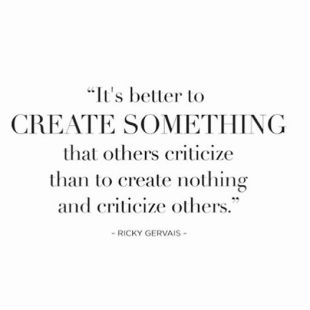
13094212_10154152180710789_4477232919671152733_n

This one came across one of my SoMe feeds yesterday and I felt that Ricky Gervais was speaking directly to me. (We’ll workshop the ‘I hear Ricky Gervais speaking to me through the computer issue another time perhaps.) The constant arm-chair complaints from people about anything and everything, just for the sake of complaining is draining. This couldn’t have come at a better time or been more relevant to the crap I have been dealing with recently. Thanks Ricky!


Useful for those with ridiculous cure claims (carry a white Sharpie and replace cinnamon as required).

Useful to hand out to those with ridiculous cure claims (carry a white Sharpie and replace cinnamon with whatever else is being recommend as required).

My family is Calabrese, not Sicilian, but the sentiment works nonetheless. This is from one of my all-time favourite movies, 'The Princess Bride'.

My family is Calabrese, not Sicilian, but the sentiment works nonetheless. This is from one of my all-time favourite movies, ‘The Princess Bride’.


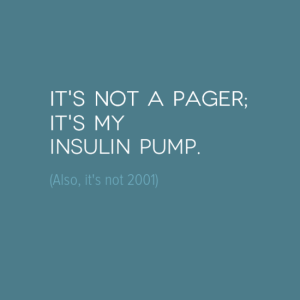
0a0ait27snotapager3b0ait27smy0ainsulinpump0a-default copy

For technophobes.


A useful card to hand out to people trying to drag me into their mess.

A useful card to hand out to people trying to drag me into their mess.


Always good advice!

Always good advice!


11902313_10153536978920789_3642880806505089004_n

For people who insist on sprouting motivational quotes at me, here is a pretty response.


11401484_10153377080370789_943537275429192693_n

When I am rendered completely speechless (it may happen….), this card explains what I probably need to get moving…


img-thing

Exasperation in a Gilmore Girls quote.


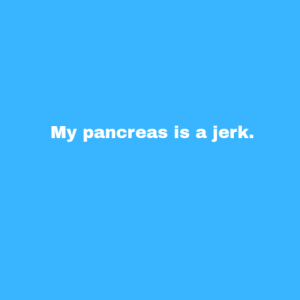
Useful for explaining diabetes in five words.

Useful for explaining diabetes in five words.

And finally, this one has an explicit language warning and as my kid reads my blog (but hopefully won’t click), you’ll have to go to this link for what is fast becoming my favourite saying. (Do not click if offended by the C word – and in this case, I am not talking ‘compliant’.)


Your body is not broken.’

I received this message from someone who reads my blog. They were not being aggressive or rude, but there was an element of frustration in their words to me. The messenger was trying to get me to focus on the things that do work, rather than the things that don’t and she reminded me that the odds are strongly in favour of things that function as they were intended!

I am so tied up with how my body behaves and what it doesn’t do that sometimes I do forget what it can do. And I am (to a lesser degree, but still too much) concerned with how my body looks, and attribute the things I don’t like to the ‘broken-ness’ of it. I spend too much time seeing what I don’t like, leaving me unhappy and miserable with not only the malfunctioning inner parts, but also the outer shell.

I thought about this as I was eating dinner the other night – home cooked chicken noodle soup with heaps of veggies. But then I remembered I’d eaten a doughnut and a coffee and not much else for the rest of the day.

I thought of this as I climbed into my car this morning, but made sure I parked a distance from work so I could walk a little bit further than I if I had driven pretty much to the front door and found a space there.

I thought about this as I sat curled up in front of the television, mindlessly watching a movie, but remembered that I had been on my feet all day, rushing around, racing through the airport and on my feet for all but the hour I was strapped into a seat on my flight back home.

I thought about this as I lay awake at 2.30am, working on my iPad, knowing I should be asleep. But I remembered that I’d managed a nap that afternoon so my sleep debt wouldn’t be too horrendous.

I thought about this as I rushed around this morning getting ready for work, late as usual, and pulled on a pair of new and very high boots. There will be a time I’ll need to start wearing sensible shoes. ‘That day is not today,’ I said to myself as I stood up tall in front of the mirror, admiring the heels and buckles and leather.

I thought about this as I had a glass of champagne and then a second to celebrate a night out, reminding myself it was the first drink I’d had all week.

I don’t treat my body as a temple. I don’t do what’s needed to keep it ticking along as best it can. I don’t worry about things such as the number of serves of vegetables I eat each day; the fact that I don’t eat breakfast most days; that I eat bacon on Saturday and Sunday most weeks or how on the rare occasions I eat bread, I slather it an inch thick with real, salted butter.

I know my BG pretty much every minute of the day, but other numbers that contribute to the measure of health – weight, BP, cholesterol – I have no idea about, unless they’re fresh in my mind from a recent blood check.

I wonder if I should feel bad about how I treat my body. But I don’t and I don’t really think that if I did more, the things I consider ‘broken’ would be fixed. I know that if I were to look at the balance sheet, I would certainly be engaging in more healthy than unhealthy behaviours.

I also know that the things that may not necessarily be best for my body (high heeled boots, doughnuts and coffee for breakfast etc.) give me pleasure. My broken body allows for that. In fact, it makes me realise that perhaps it is not so broken after all. And that has to count for something.

Follow Diabetogenic on WordPress.com

Enter your email address to follow this blog and receive notifications of new posts by email.

Read about Renza

Archives