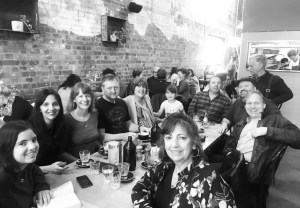
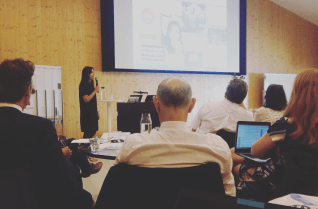
Another week, another opportunity to hang out with some Aussie diabetes bloggers and advocates. I’m back in Sydney for today and tomorrow, facilitating Abbott’s third Australian Diabetes Exchange meeting. You can follow along on Twitter, Facebook and Insta at #D2Sydney2018. (And you can read about previous DX events here and here.)

The timing of the event coincides with the launch of Abbott’s Freestyle LibreLink app, which allows Freestyle Libre users to use their mobile phone (Android or iPhone) as the scanner for their Libre sensor. That’s right, point phone at Libre sensor, swipe, glucose level appears on phone screen. This means no need to carry the reader with you.

Freestyle LibreLink launches in Australia on 5 June, so it won’t be available until then, but we’ve been able to have a little play today to see how it works. The app provides pretty much the same information as the reader, so as well as current glucose readings and the previous eight hours of data, there are screens that show averages, time in range, and predictive HbA1c. It’s easy to use, looks clean, and for anyone already familiar with the Libre reader, the transition to phone-as-scanner should be smooth.

I am all about making diabetes easier. I frequently say that I lament the days when I could run out the door with my phone, keys and wallet and nothing more. Diabetes doesn’t really allow us to do that, thanks to all the paraphernalia we need to carry with is. While we still will need to carry lots of kit, by doubling up our mobile phone as a sensor scanner, we are able to take one thing less with us in our (oversized) diabetes kit bag.

Now, I have been doing this for some time. I’ve been using Dexcom G5 since it was launched in Australia, and Loop since August last year, so my phone is as much a medical device as it is a Twitter machine. But I was paranoid at first that my phone battery would die and I would be unable to check my glucose levels. It’s happened maybe twice.

Some things to think about if you are new to the phone-as-receiver-of-glucose-data. Charge your battery to capacity before you leave the house. Have a charger with you at all times. (I have one in my car, one at work and one in my bag). Consider carrying a battery pack – and don’t forget you need to charge that too if you want it to be of any use. There are cases which double as a back-up battery. Consider investing in one of them. And if you are worried that you are going to be caught short, chuck the reader in your bag until you get the hang of having your phone charged at all times!

Some people may think this is a gimmick, but I firmly believe that is not the case. Having our current non-diabetes technologies become part of our diabetes gear makes sense. We want things to talk to each other, and this is exactly what this is doing. We’re seeing it more and more.

Reducing burden, making diabetes less a pain in the arse and finding ways to make things easier. I’m all for that!

Want more information about Freestyle LibreLink? Keep an eye out on the Abbott Diabetes Care website here.

Disclosure

Abbott Diabetes Care have paid for my travel, food and board while in Sydney. They provided me with one Freestyle Libre sensor and advanced access to the Freestyle LibreLink app. (However, I will be deleting it tomorrow at the end of the DX2Sydney 2018 event as it is not available for use until it is launched on 5 June 2018.)

As is always the case, I have not been paid, or asked, to write about product or this event. I’m just a caring, (over) sharing type of person.

Last Friday, as I was getting ready to fly home from Copenhagen, I realised that the beautiful city was being inundated with some of my favourite European diabetes bloggers and advocates.

I was lucky enough to manage to meet up with the truly wonderful Tine who I have come to know and love through my involvement in the Roche Blogger program. When it comes to dynamic, sassy, smart and downright wonderful advocates, Tine is at the top of the list. We caught up briefly, talked about diabetes and language, and drank iced coffees and I am so glad that I got to see her gorgeous face.

Tine. She is so wonderful!

Unfortunately the rest of us were ships in the night and probably standing right near each other on opposite sides of the departure/arrival gates divide at Copenhagen airport. Brutal!

My friends were in Copenhagen to meet with the team from YpsoMed, which they do a couple of times a year, to talk about the YpsoPump and other YpsoMed products, advances in diabetes technologies and come together for some peer support. Some of them are using the YpsoPump, but certainly not all of them.

I’ve had a play with the YpsoPump a few times in recent years. My good mate Finn, who blogs here, (in German; Google Tanslate is your friend) stayed with us a couple of years ago when he visited Australia, and I tried bribing him with Tim Tams in exchange for his YpsoPump. Alas, my tactics didn’t work. (Apparently he needs it to infuse insulin into his body or something.)

And each year at EASD, I would annoy the team on the YpsoMed stand by demanding to know when they were bringing their pump to Australia. (This is standard line of questioning for me at international conferences when I see technology I like the look of and thing we should have access to. I am probably known as the annoying woman from Australia, a badge I am willing to wear and a cross I am willing to bear.)

Yesterday, the YpsoPump was launched in Australia. I’d like to think it was my pestering, but the reality is that it is a smart move by a company that has been around the diabetes world for some time now and saw a market that is truly crying out for some choice.

Lucky us!

So, here are a couple of things of note about the YpsoPump

  • Undeniably, the first thing that is abundantly clear is the size of the pump. It is teeny-tiny compared with other offerings. The Medtronic 640G, in a side by side comparison, looks like a monster. (This was one of my criticisms when I trailed that 640G a couple of years ago. It felt bulky, clumsy and huge!) The YpsoPump is streamlined and sleek, and sits comfortably down my bra. (First thing I did with it. I know; all class.)
  • The touchscreen and icons are a departure from the buttons we have come to expect on insulin pumps. When the pump is ‘sleeping’ it is completely black and blank. This adds to the sleek look of the device.

(Having a little play at EASD last year.)

  • It is pretty easy and intuitive to use. We got to have a play and set up the pump yesterday and it was simple and logical. Loading and priming the glass cartridge was quick. The cartridge holds 1.6ml of insulin – this is not a pump for people on huge daily doses of insulin.
  • The pump uses and is integrated with a smart phone app (search MyLife from the App Store to download for free). At this stage it is uni-directional, so the pump cannot be driven from your phone. (i.e. The pump speaks to the phone/app; the phone/app doesn’t speak to the pump.) However, this is something that will, in the future, happen. (‘In the future’ apparently means a couple of years.) For those of us Looping, we shake our heads, because we are currently doing this and it makes no sense that regulatory processes are holding up something that is already available and perfectly safe. It also negates the whole thing about discretion when it comes to the pump. If you still need to pull it out from under your clothes, it doesn’t matter how small the thing is – you still need to pull it out from under your clothes!
  • Really pleasingly, customer service is all being run out of Australia which means that whoever you speak with has a really good understanding of the Aussie health system. This is especially useful for ironing out any potential glitches with getting approval through PHI.
  • Consumables are already on the NDSS. Want this pump? It’s ready to go. Talk to your HCP!

Two other things I asked about were a little broader than simply the use, design and practicalities of the pump.

Firstly, I wanted to know what was going to be done to protect us from coming to love this device, only to see it disappear from the market in four or six or eight years’ time. I have lived through the loss of the beloved Cosmo pump (I LOVED that pump!) and now Animas. While for some this can be seen as just an evolving market, I think it is much more than that. We are intimately connected with these devices. We see pumps come and go from the market. We invest in them, we become attached to them (literally and figuratively). To have them disappear from the market is heartbreaking for some people. I was grateful that Eberhard from YposMed acknowledged our disappointment. He told us that the company has been around for a long time and is very invested in continuing to provide new, innovative and cutting edge technologies to the diabetes market. I hope he is right, because I can see people falling in love with this pump very easily.

And secondly, I wanted to know what sort of engagement YpsoMed were doing to ensure that what they are delivering (they have a lot of things in the pipeline, including a patch pump due for release in 2012/22) really aligned with what people with diabetes want and need. Their engagement with the community is strong and they seem committed to it. The European blogger group has been meeting regularly and provide feedback on design and development. The launch of the product into Australia was with consumers (the HCP launch is today). There is definitely a desire to work and link closely with people in the community and that should be commended.

Just some of the advocates and bloggers at the YpsoPump launch yesterday.

With the YpsoPump ready to go in Australia, we are seeing increased choice in the pump market. No longer should we feel pushed into a pump that we don’t really want because that’s all there is, or all that is supported. This is only a good thing for people with diabetes.

You can find out more about the YpsoPump by going here.

DISCLOSURES

You bet! YpsoMed flew me to Sydney, put me up in a hotel, and fed and watered me. They did not pay me for my time, nor for my words. They did not pay me to ask annoying questions – or to not ask annoying questions for that matter. You can and should consider this when reading what I have written today.

I’m back from a very busy week in London and Copenhagen. I arrived back in the door at home exactly two minutes after Harry and Meghan got hitched, so I missed the whole happy occasion. If only we had some sort of magical way to see photos and videos and relive beautiful experiences like that. Oh well, never mind.

The main reason for my trip was for the kick-off meeting for Hypo-RESOLVE, a new four-year project focusing on better understanding hypoglycaemia. I’m there as part of the Patient Advisory Committee (PAC), which is made up of advocates from across Europe. Obviously, it is now legislated that an Australian also be included in any European diabetes advocate activities. I believe it’s called the Eurovision Law.

The project is made up of eight work packages, each led and staffed by leading European diabetes researchers and clinicians, and after seeing just who was going to be in the room, I suddenly was struck down by the worst case of Imposter Syndrome I have ever experienced. This didn’t get any better when I was told that the presentation I had been asked to give was not only for the PAC. No – it would be in front of all eighty project participants. I looked at the list of who I would be standing up and speaking to, and cursed the meme- and photo-filled presentation I had prepared, wondering if I could pretend to understand statistics and graphs, and add some to my slide deck to at least try to sound smart.

I decided to stick with what I knew (memes, cartoons, photos of weird hypo tales), and left the slide deck as it was, hoping against all hope that I would manage to keep myself nice, and sound as though I understood what I was speaking about.

I was asked to give a talk about the real life experiences of hypoglycaemia. Fortunately I have kept a pretty good record of the literal lows of my diabetes (which, incidentally, was the title of my talk). Thanks to the search function on Diabetogenic, I was able to easily pull together a number of stories about the lows I’ve had. This proved to be more useful than I realised because these days, lows are few and far between. Since I started Looping, I’ve not had the sort of low that has made me want to write about it and try to analyse what it all means in my diabetes life. In fact, I’ve not had any lows that have required anything more than a mouthful of juice or a couple of fruit pastilles to treat.

Reading back through my blog posts was actually really quite confronting, and I found myself getting emotional as I read details of terribly scary lows and how they had impacted on me – in the moment, and in the days following. As I read, I remembered the anxieties I felt about something happening while low that would seriously affect my family.

I’ve not asked them, but I wonder if the fact that I have so few hypos these days makes Aaron and the kidlet feel calmer about my diabetes. They still see me sucking on a juice box every now and then, but it is done without urgency, and without the look in my eyes that betrays the calm I used to try (and fail) to convey.

In my talk, I really tried to express just how significant hypos have been in my life with diabetes. I tried to explain that even once a low is ‘fixed’ there are often residual effects – effects far beyond just trying to work out what my glucose levels would do after playing the how-low-can-you-go-hypo-limbo.

I spoke about how the emotional fallout after a nasty hypo can be crippling, leading me to second guess every diabetes decision I made, wondering what I had done to cause the low in the first place – because that is the ongoing narrative of diabetes….we did something wrong to cause the hypo (or the complication, or the high, or the technology failure). And I really tried to explain how sometimes there are no answers, no matter how hard we look, or how desperate we are to find something to blame.

Of course I spoke about the language of lows and how the words we use impact on the way that hypos are considered. There is no doubt that ‘severe’ hypos are serious and need urgent attention and investigation, but so-called ‘mild’ hypos can be just as burdensome.

Obviously, everyone’s hypo stories will be different and I took great pains to clarify that I was speaking of my own experiences only. In the past, hypos have terrified, paralysed and alarmed me. I was afraid to sleep, I was afraid of lows when awake. I was scared I would have a particularly nasty low around my daughter and scare her. I am fortunate that my deliberate non-compliance has resulted in almost no lows, and feeling safer that I have ever felt before. My fear of hypoglycaemia is manageable these days, yet I don’t take for granted that it will always be like this. I still carry hypo food around with me – there is no point tempting the hypo gods by not being prepared!

I’ll be writing more about Hypo-RESOLVE in coming days. I’m so pleased to be involved in such an exciting and interesting project; I’m honoured to have been selected for the PAC. I’m beyond thrilled that PWD are included in the DNA of the project – right from the kick-off, not brought in at the last minute for comment when all the decisions have been made. And mostly, I am grateful that hypoglycaemia is being given the attention it deserves. I honesty hope that one day no one ever needs to feel the panic and fear that so many of us have come to know.

Kicking off the kick-off meeting (Click for source)

You can read all about Hypo-RESOLVE in the Innovative Medicines Initiative media release from last week announcing the launch of the project. My flights and accommodation to attend the Hypo-RESOLVE kick off meetings were funded from within the project. PAC members are volunteers on this project.

I’m in London for a couple of days of meetings before flying to Copenhagen….for another couple of days of more meetings. But I was smart this time, managing to set aside a whole day before the meetings start to do this:

These three women – these wonderful women – are part of the lifeline I have to help me manage diabetes. It may have been faulty pancreaes that brought us together, but what ties us together is support, friendship and love.

Thank you Annie, Georgie and Izzy for coming to meet me in my jet-lagged state in London. Thank you for building me up, and filling my jar. I couldn’t do this diabetes shit without you all.

I woke yesterday morning to a shit storm on Twitter. I had dozens and dozens of notifications where I had either been retweeted, mentioned or @-ed. (And yes, sorry, I did just turn the @ symbol into a verb). I was hoping that someone was sharing news with me that in the eight hours I’d been asleep, diabetes had been cured, JK Rowling had released a new Harry Potter book, or Nutella would be sponsoring me to…well, eat Nutella.

Alas…it was none of these. No; it was not.

I slipped down the rabbit hole of people replying to a tweet where I’d shared an awesome blog post by my mate and all ‘round wonderful human, Georgie Peters. Georgie was commenting on the recent study which has been widely shared (and written up in the NY Times) about type 1 diabetes and LC diets. (If you’ve not read the NY Times article, do! The study is really interesting and as someone who predominantly follows LC it all makes perfect sense to me…and makes my CGM trace devoid of roller coasters lines.)

Georgie’s piece was not demonising LC. In fact, quite the opposite. She was suggesting that it is absolutely a valid way of eating for some people, just as eating moderate to high carbs might be.

Distilled into one word, Georgie’s post was about CHOICE.

In more than one word, Georgie was warning that diets that are inherently restrictive in nature could lead to an increased risk in eating disorders. Georgie was specifically referring to children on LC diets who are not given a choice in the way they are eating, or as she far more eloquently puts it: …the food choices of children and their right to bodily autonomy.’

Choice. It all comes down to choice.

Apparently, that was completely lost on the people challenging what Georgie was saying. One person was somehow trying to say that the idea that a diet restricting carbs was no different to a kosher diet, and does that mean that people following a kosher way of eating have an increased rate of eating disorders? (If you can join the dots to make something that even remotely makes sense, please do so for me, because I have tried and keep coming up with a massive question mark.)

Another doctor claimed that she insists all her surgical patients go on a low carb diet (pre-surgery), and that they have no choice in the matter. Two things: type 1 diabetes isn’t the same as prepping for surgery. And any doctor who even suggestedthere being no choice in anyaspect of my diabetes management would be given the sack very quickly. (I’ve no idea about pre-surgery diets, because that’s not my thing. Diabetes is. Georgie’s post was about diabetes, not about pre-surgery diets. The surgeon’s comments added to my confusion, because: apples and oranges…which are probably banned on her LC diet. And further down the rabbit hole we go.)

The food we eat; the diet we follow, are inherently personal choices. No one has the right to insist that there is only one way of eating. One of the frustrations that some of us who do want to follow a LC diet have is that there are some HCPs who refuse to even acknowledge that it could possibly be a positive and useful diet for people with diabetes, some going so far to say it is harmful.

The other day as many of my friends shared the NY Times article, I saw them plead for others to open their minds. I want that, too! I want people to have the information about how LC might work as a diabetes management strategy and be open to the idea. But more than that, I want people to then choose what works for them.

And when it comes to parenting (and I know that I don’t have a kid with diabetes, but I am a parent), I know this to be true: we all want what is best for our children. The thirteen-year-old in our house doesn’t have complete autonomy over food choices, because I do ninety percent of the shopping for food and cooking. I like it that way, because I get to eat what I want, and don’t have to do any of the cleaning up after I’ve messed up the kitchen! Win, win!

While she doesn’t have a choice in what is served up at the dinner table, she does get to decide what of it she eats. I know she doesn’t have diabetes, so when it comes to thinking about food, she doesn’t have to consider her glucose levels. But there is far more to health than that.

I am doing all I can to inform and educate her on what makes for a healthy, balanced diet. I have to trust that what I am doing is enough to result in her making healthy choices most of the time.

Choice – that’s what Georgie was writing about. Is it really that hard to understand?

In kind of related, but really, just that I want to share something: this nut and seed bread is incredible:  

It’s low carb (at least, it is the way I make it, because I swap the oats for coarsely ground hazelnuts) and, quite frankly, is the best thing I have ever eaten. (To make it decidedly not low carb, slather in Nutella…!)

There is something to be said for the comfort of routine. Yesterday, I had my annual eye check. And like clockwork, it played out the same way it always has.

Just like always, the week before my appointment, I received a reminder message from doctor’s office. That cued the call to my dad to lock him in for chauffeuring and morale duties.

Just like always, a little part of the back of my mind was occupied with the upcoming appointment and a series of ‘what if’ scenarios played out.

Just like always, the night before my appointment, my anxiety levels were heightened. I tried to alleviate them with a bit of twitter humour.

Just like always on the day of the appointment, Dad picked me up and just like always, I told him how nervous I was. ‘Twenty years of diabetes now, dad.I’m worried this might be the appointment where the news isn’t all good.’

And just like always, he said ‘Just wait and see. There’s not point worrying before you see your doctor.’ His morale boosting comments, just like always, right on point.

Just like always, I nervously waiting in the second waiting room to be called in to the first appointment.

Just like always, the orthoptist had me read from a chart and put drops in my eyes and sent me on my way to the next waiting room. And just like always, my vision blurred and my heart rate increased.

Drops in; vision blurring. Waiting…

Just like always, my dreamy ophthalmologist called me into his room. (Dreamy because he’s lovely to look at. But more dreamy because he is just so damn kind to me in my ridiculous nervous state). ‘Are you well,’ he asked, just like always asks, and I realised that I have not always answered, ‘Yes. So well…’

Just like always, he said: ‘Your vision and eye pressure look good, Renza. No changes at all since last time.’

Just like always I allowed myself to smile a tiny bit. But no too much. Because the reason we were really there hadn’t happened yet.

Just like always, he turned down the lights in the room and shone an almost painfully bright light into my eyes. He asked me to look this way and then that way. He looked at the front and back of both of my eyes.

And just like always, when he’d looked for all he needed to look for, he turned the lights back on and smiled at me. ‘There is no sign of retinopathy or any other diabetes-related eye problems. Your eyes are great.’

Just like always, I breathed again. I smiled. Really smiled. ‘I’ve had diabetes for twenty years now. Today’s news has made me really happy.’ I said. And I thanked him for giving me such good news.

Just like always I wandered back down the corridor, feeling far lighter. I paid the bill, I found my dad.

And just like always, he looked at my beaming smile and said, ‘I told you so. Just like I always do.’

We have a beautiful tree over the back laneway at our place. Usually at this time of the year, it is in full autumn brilliance. The red and gold leaves catch the gorgeous afternoon sunlight, and where the leaves have already littered to the ground, the branches are bare.

But this year, things have been a little different. Our tree brought out its autumn clothes a much later than usual, but sure enough a couple of weeks ago, we noticed that the leaves were beginning to turn. Every day, I’d look over the fence to see a deeper red, a more golden glow. Sure, we hadn’t needed to turn the heating on inside the house yet, and my really warm knits were still tucked away in the cupboard, but the tree was promising winter and cooler days.

Blossom buds. In May…

Over the weekend, as I sat in the kitchen, the back door open letting in a lovely breeze, I looked up at our tree. And there, on the bare branches, I could see something shooting. I went outside to have a closer look and realised that what I could see was the start of the blossom that comes out in the middle of springtime.

Our poor tree was looking mighty confused. I was confused. This isn’t how things go. The seasons are meant to be somewhat regulated and ordered.  I like order. Order makes sense. This didn’t make sense at all to my brain, which likes things to be as they should be!

This wasn’t the only confusion I dealt with this week. Last Friday, I spoke about DIY diabetes technology at a health professional event and there was a lot of confusion.

I only had ten minutes (seriously not long enough to talk about something that is a completely novel concept to most of the audience), so I spoke fast, waved my hands around faster and tried to simplify the whole idea of looping into about 8 slides. ‘Renza will be around afterwards if you have questions,’ the emcee announced to the audience who all looked slightly bamboozled and winded after I finished.

There were questions. Lots of them about how Loop works, what it really is and who can use it.

But the one thing that seems to garner the most confusion is the cost. ‘You didn’t say how much has cost you,’ a few people said to me once the event was finished. Actually, I did. (Admittedly, very quickly, because: 10 minutes!) ‘Well, you need to source a pump that works, so that may be costly. And if the person using it is over 21, they will need to fund CGM themselves. Plus, the Riley Link is about $150 and there is a cost associated with becoming an Apple developer,’ I repeated what I’d said in my talk. (Obviously, I was talking Loop, but there was an OpenAPS user in the room too and I think he may have answered a couple of questions about the cost of his set up.) ‘No, no…what about the actual cost to use the app? How much does that cost?’

I have had this question asked probably more than any other. For some reason, people don’t seem to understand the concept of open source information sharing. No one is making money through this. The clever people who have developed DIY diabetes solutions place the details online for anyone to see and use. For free.

But this seems to be a confusing concept for a number of people.‘Wait. So no one is making in money from this? What about the people who worked it out in the first place? They are. Right?’ 

‘Nope,’I always reply, wondering how many ways I need to say it (along with wondering why I am so lousy at communicating things and also, if my hands waving around are distracting people).

Inevitably, the next comment is ‘Well, I’m not sure why someone doesn’t try to commercialise it. That would get it through regulations, wouldn’t it?’

At that point, it’s my turn to look confused. Why is it so difficult for people to understand that there are actually people in the world who genuinely want to do something good for others? Or that the WHOLE point of the #WeAreNotWaiting ‘movement’ is the fact that there is no waiting for regulations that are inevitable with commercialisation?

I guess that unless you are part of this community, it could be difficult to understand. But the generosity of those in the community is on show all the time. Whether that be the people doing the grunt work behind the scenes to make the dreams of DIY diabetes a reality, or the people who are then writing the step by step instructions so even fools such as me can follow those instructions, or the incredible community members who are ready to jump in any time to answer SOS calls for help when something doesn’t seem to be working, these people are doing it all for nothing more than the gratitude of those of us who are reaping the rewards of their cleverness and kindness.

The confusion – and disbelief – about this community is confusing to me, because every day I see how incredible it is. I only wish I was smart enough to give back even a fraction of what I have received from those brilliant folks who are there for the rest of us. And I really wish I was able to do a better job explaining what a marvellous bunch of people they are!

When I was in my teens and twenties, I was, just as many women are, dismayed with the way I looked, and susceptible to the claims of beauty products that promised I could be thinner, more toned, more beautiful, smoother, more attractive, more <insert whichever part of me obviously needed improving>.

Of course, all of the things I was desperate to change and refine were measures of my worth, right? Because if I was thinner, more toned, more beautiful, smoother, more attractive, more <insert required improvement> that would make me a better person. Right? Of course.

I didn’t look like one of the supermodels (not just models, mind; these ones were super) that were everywhere I looked. At the time, I was spending all my energies being a flute player, but even the classical musical world wasn’t spared the attention to how women should look, with Jane Rutter suddenly appearing wrapped in nothing more than a bedsheet and a sultry look (impressive with a flute shoved against her bottom lip, while playing Debussy). ‘Great’, I thought. ‘Now not only do I have to look like a fucking model. I have to do it while playing flute. Naked.’

The feelings of inadequacy were strong and I know I spent far too much time desperately wishing I looked different. I probably spent too much money on products that promised to make that happen. And delivered nothing.

When I was twenty-one, someone gave me a copy of Kaz Cooke’s fabulous book Real Gorgeous. I can’t remember who it was, but suspect it was my mother. I read it in one sitting. I already knew of Kaz Cooke (from her brilliant ‘Keep Yourself Nice’ column in the weekend papers), but this book was a revelation. She laid bare all the sneaky tips and tricks and lies the beauty industry used to expose our insecurities, feel as though we needed to be different and, subsequently, buy their products. Of course, I already knew what she was saying. There was nothing in there that, when I had a moment of rational thinking, I didn’t already understand. But to have it set out so practically and emphatically was just what I needed to get over the idea that I needed to look and be different to how I was.

I actually saw Kaz at Marios over the weekend and stopped her she walked past me. I introduced myself and the kid (who was so horrified and embarrassed that she looked as though she wished the ground would swallow her up), and thanked her for all her books, but especially Real Gorgeous. ‘It saved me, in some ways.’ I told her.

And it did. It stopped the self-doubt. And it made me confident enough to admit to myself that I was more than enough. Just the way I was. And that nothing about the way I looked needed improving. (Thankfully, this was before I tried any naked flute playing. At least, any in public…)

As it turns out, I struggled with the same insecurities and feelings of inadequacy and self-doubt when it came to being diagnosed with diabetes. I think it is only in recent years that I have come to understand that the constant second guessing about being good enough achieves nothing other than increasing my anxieties and contributing to burn out.

With time, I came to apply the same cynical filters to diabetes product advertising as I now had permanently in place when looking at health and beauty advertising. In the same way that not every woman looks like Cindy Crawford, not every blood glucose check will be 4.8mmol/l.

‘Real Gorgeous’ wisdom on the left. Real diabetes on the right.

One of the most damaging things that we can do is compare ourselves to others. Because when we do, we often fall short. Our A1c may be higher, our time in range lower, our technology not as advanced, our healthcare professionals not the ones on the TV or on conference stages.

Being around and sharing with others living with diabetes is wonderful (here are twenty reasons why) but it can be damaging if the only thing you are doing is using them as a yardstick for your own diabetes.

It took me many years to stop feeling that I needed to ‘keep up’ with my diabetes peers, or that my diabetes needed to look like someone else’s diabetes. While I may try to align myself with others who have similar ideas about diabetes, I do it on my own terms, using and doing the things that work best for me.

The way I have adopted DIYAPS is not the same as many others. I call it ‘Loop Lite’, using just the absolute basics, without any of the add-ons. I don’t produce pages of graphs to analyse, because that’s not what I need. But what I do is perfect for me.

The same goes for finding the way to an eating plan that works for me. While learning about the details of LCHF, I refused to go ‘all in’ as many seem to. I adapted it for the way I live.

The way I do diabetes and the way my diabetes behaves is enough. It is right for me. It is my Real Diabetes.

Today, I have a brand new copy of Real Gorgeous on my desk, all wrapped up. It’s a gift for the kidlet who is already a huge Kaz Cooke fan (she has had Girls Stuff on her shelf for a few years now).  She already has a very healthy filter when it comes to beauty advertising, but I know that it is possible that she will be susceptible to the same feelings of self-doubt that I was.

I want her to know she is enough. So very much more than enough. We all are.

Click on photo to order your own copy of ‘Real Gorgeous’.

I don’t know where I would be if it wasn’t for the support, love, friendship and sustenance I get from my peers with diabetes. A long time ago, I wrote that the two most powerful words in the English language are ‘me too’. Realising that others understand, have experienced and know what I am going through means that I never feel truly alone. It doesn’t matter what time of the day it is, I know I can always find someone – a diabetes peer – to talk to and help me through.

I wish I knew this from when I was diagnosed. I felt really alone for the first few years I lived with diabetes. To be honest, I don’t think I necessarily wanted to meet anyone with diabetes as soon as I was diagnosed, but I certainly did a short time later, once I realised that diabetes wasn’t just for Easter (when I was diagnosed)…it was for life.

Today, I couldn’t be without those I have come to know because of our shared lazy pancreases. I am so lucky to have them in my life.

  1. What this tweet says:
  2. At diagnosis, being made aware of peer support is a really good idea and I so wish that I had been told how to find other people like me when I was diagnosed and felt so alone.
  3. There is no right way to do peer support. Whatever works for your – that’s your peer support model!
  4. Peer support may be catching up with a mate for a coffee or a beer, or it could be sitting in a room while someone speaks to you. Or a walking group, or a sports group (allegedly). Or a diabetes camp. It can be a formal structure or something more akin to a casual book group. For my money, I’m all about the informal, unstructured model. That is what works best for me. But just as with everything to do with diabetes, there is no one size fits all and it’s important that all options are available so people can find out what works best.
  5. So, yes – this works when it comes to peer support too.
  6. I promise you – what you learn from your peers will be as important, if not more important, than anything you will ever learn from a diabetes healthcare professionals. It will probably be more relevant and practical too.
  7. You don’t need to love everyone you meet – just because they have diabetes. Dodgy beta cells can’t be the only thing you have in common.
  8. The connection you find with the people you do ‘click’ with and love could be to do with your life stage, personal experiences, philosophy about living with diabetes or mutual love of Effin’ Birds.
  9. AKA: 
  10. There is an undeniable feeling of luck, love and gratitude when meeting someone that is in your tribe. And that extends to when you introduce their family to yours and you realise that you have made family friends forever. AKA: This time in New York City.
  11. Sometimes, there is no need for words. Support, love and encouragement can all be said in one glance.
  12. I have found some of my closest diabetes friends online. The DOC is a diverse and varied community. You just need to work out the people and activities that work for you!
  13. Online peer support can be just as valuable – and sometimes more so – that face-to-face peer support. There is nothing scary about meeting diabetes friends online.
  14. So with that in mind, be open to meeting new people. You can easily get stuck in a peer support rut with people you once really connected with, but, for whatever reason, are ready to meet new people. That’s okay.
  15. And with THAT in mind, remember that involvement in peer support can be transient. Just because your ideal peer support model looks one way today, doesn’t mean you need to do it the same way forever.
  16. There may be times that really, you’re not interested in speaking with others with diabetes, or feel you don’t need support from other panreatically-challenged folk. That’s okay too. (You can always come back if and when you are ready.
  17. For peer support to work and be truly effective, it needs to be a safe, judgement free environment. (Which is pretty much how everything to do with diabetes needs to be for it to work…)
  18. Linking and connecting with other people with diabetes can be life changing and life saving. Search Simonpalooza in Google to see what I mean. Or read the Pumpless in Vienna story here. 
  19. Peer-led support groups are most successful when the person doing the leading clearly has no agenda other than wanting to build a community. If you want to look at a beacon of someone who is all about community, building people up and being nothing other than inclusive, look no further than Cherise Shockley who started and continues to oversee the first diabetes tweetchat!
  20. Peer support can happen anywhere. Diabetes in the wild moments often provide the most incredible opportunities to connect. Just remember though, not everyone is necessarily open to sharing all their diabetes tales with a complete stranger you meet while waiting for a coffee. (That last point is mostly for me.)

Peers.

I had a great conversation the other day with someone who was interested to talk about diabetes and language with me. ‘I’m trying to get a better grasp of why it’s something so important to you, because, quite frankly, I couldn’t care less what people say about diabetes.’ 

This isn’t the first time people have asked me this. And it’s certainly not the first time I’ve been asked why I spend so much time speaking about diabetes language matters.

I know the reasons, but to be perfectly honest, I’m not sure that I have them especially well mapped out when I need to explain them. So, let me try here.

There is a tangled and complicated link between the words used when talking about diabetes, and how we feel about it and how diabetes is perceived by others. That link then goes off on all sorts of LA-freeway-like tangents to include diabetes and stigma, and discrimination.

The effects of how we frame diabetes can be felt by us individually. But they can also be far reaching and affect how others feel about diabetes.

We know that language has the potential to make people with diabetes feel judged and stigmatised. In fact, most PWD I know have at some time or another faced someone speaking to them using Judgey McJudgeface words. Of course, we all respond differently to this. For some people, it’s water off a duck’s back. They couldn’t care less what people say and just ignore it. For others, it’s almost a challenge – they use it as motivation to prove that they ‘won’t be beaten’.

But that’s not the case for everyone. For some people, it can be absolutely paralysing.

Fear of being judged and shamed may lead to some PWD to not wanting to attend HCP appointments and, as a consequence, falling behind on complication screening. Some PWD may not even tell their loved ones they have diabetes for fear of being judged. I have met PWD who made the decision to keep their diabetes a secret and for years, not telling another person. This can add to feelings of terrible isolation.

When diabetes is spoken about in stigmatising and demeaning ways, this leads to the spreading of misinformation. And this can have far reaching consequences.

We know that kids with diabetes may be teased by their schoolmates. Their teachers may not respond appropriately to diabetes because of the way diabetes is framed in the media or by others. We can’t really blame teachers. If diabetes is punchline fodder for every B-grade comedian, or an excuse to point fingers at those living with it by every tabloid news outlet, how can we expect anyone to take it seriously?

(And if right now you are thinking ‘This is why we need to change the name of type 1 diabetes’, stop it! People with type 1 diabetes shouldn’t be teased or mocked or judged, but neither should people with type 2 diabetes. This isn’t about people understanding the differences between type 1 and type 2 – this about understanding diabetes.)

The language we use when talking about prevention in diabetes – whether it be preventing type 2 diabetes or preventing diabetes-related complications – means that there is an underlying idea that developing type 2, or complications must be the fault of the individual. ‘If you can prevent it and haven’t, it’s your fault. You obviously lived an unhealthy lifestyle/are lazy/didn’t listen to your doctor/failed to follow instructions/refused to do what you were told etc.’.Can you imagine hearing that, or feeling that is what people think about you – all the time? This is the language – these are the words – used to talk about diabetes.

A couple of weeks ago in the UK, it was Prevent Diabetes Week. I saw countless tweets from people urging, begging, pleading with others to remember that type 1 diabetes can’t be prevented and the week refers only to type 2 diabetes. I wonder if those tweeting realised that comments such as these actually contribute to the stigma associated with type 2 diabetes? Of course type 1 diabetes can’t be prevented. But in many cases, neither can type 2 diabetes. There are so many non-modifiable factors associated with a type 2 diagnosis – factors beyond the control of the individual.

But let’s look beyond individuals, the health system and the education system for a moment. What else happens in other settings when diabetes is spoken about in stigmatising ways?

Health organisations, including diabetes organisations, frequently seek donations from the public to continue the important work they do. There is only so much money in the donation pie, and yet there are more and more competing organisations representing people with different health conditions wanting a piece of that pie.

Donations are harder to come by from the general community when there is the idea – the wrong idea – that diabetes is a largely preventable lifestyle condition that is the fault of those diagnosed. There is not the idea that people who have developed cancer brought it on themselves, even though we know that some of the risk factors associated with a breast cancer diagnosis are the same as for type 2 diabetes.

Research dollars for diabetes are far less than for other health conditions. We see that every year when successful NHMRC grants are announced. Diabetes is the poor cousin to cancer research and CVD research.

Diabetes is just as serious as any other condition that is worthy of research dollars and fundraising dollars. Yet because of the way we speak about it and the way diabetes as a condition has been framed, there is a perception that perhaps it isn’t.

Words matter. Language matters.

So, what I want to say to people who think that talking about language and words is a first world problem that only occupies the minds of the privileged is this: I acknowledge my privilege. But this isn’t simply about words. It’s about perception.

Until diabetes is considered the same way as other conditions that are taken seriously and thought of as blameless, the trickle-down effect is people with diabetes will continue to feel stigma. Diabetes will continue to be the poor cousin of other health conditions and diseases because there is the misconception it is not as serious. People will not as readily make donations towards fundraising initiatives. Research dollars will continue to fall short, instead going towards ‘more worthy’ conditions.

That’s why I care so much about diabetes language. Because, language matters… so much.

Follow Diabetogenic on WordPress.com

Enter your email address to follow this blog and receive notifications of new posts by email.

Read about Renza

Archives