Last year, I was invited to the Australian launch events of two insulin pumps. Within a month of each other, the YpsoPump and Cellnovo pump were introduced into the Australian market: a market with a huge appetite for something new. Although Cellnovo had launched softly the previous year, the Australian distributor seemed to be increasing their business and had the pump’s inventor, Julian Shapley, in the country to give a presentation and answer questions.

At both events, we were wined and dined, and the latest bells and whistles of these two new offerings were confidently and excitedly shared with us. I listened carefully, keen to hear not only about the technical specifications, but also about the customer service that would be offered to those choosing these devices and their plans for the future. I’ve learnt over the years that reading glossy brochures only gives one part of the overall picture of using a particular device, so I was looking forward to asking those questions that give a much better idea of what is going on.

At some point during each of the events’ proceedings, I asked the same question. I wanted to know how these companies were safeguarding from these devices being launched on the market with great fanfare only to see them disappear after people had started using the very products in front of us.

Of course, I was assured and reassured that the companies were here for the long-haul and that they were future-proofing themselves by insuring they were preparing for the technology we all expect. Closed loop systems were coming; integration with CGM was an almost done deal; their algorithms would be better, smarter than anything we had seen before. And yes, they absolutely understood the concern I was expressing at the thought that just as quickly as their device had won our hearts and minds, it would disappear from market altogether. Of course, of course, of course that was not going to happen and I shouldn’t for a minute even think that was how things would turn out.

I listened. And I believed them.

Last week we heard that Cellnovo was ceasing production of its pump and all current users would be transitioned onto different devices. This played out over a couple of days. The first announcement was that Cellnovo was going into administration, but I wasn’t ready to shut the coffin lid just yet – we’d seen that happen before. But then, a mere day or two later, the announcement came that all manufacturing and commercial activities would cease, and that no new PWD would be started on Cellnovo products. Coffin. Nailed Shut.

Let’s put aside any opinions of the Cellnovo pump, because that’s not what this is about. I know there were some people who really weren’t fans of the device. My limited interaction with it left me interested, but not keen to slap one on my upper arm and call it my new pancreas. But I know some people who love it and have found it to be the right insulin delivery device for them. My diabetes; my rules and all that.

I also know a number of people who started using Cellnovo as their first pump. In Australia it was the closest thing we had to a ‘patch pump’ and they liked the idea of not having to deal with centimetres of tubing. When I wrote that Cellnovo would be launched here, I had a number of people reach out in great excitement. With Omnipod repeatedly stalling getting through our funding model, this was as good as they were going to get to the device they thought would be best for them.

And so, Cellnovo has won the heart and minds of some people. Just as mine were won over by the Cozmo and Animas pumps. And when they are taken away from us, our hearts break a little.

We learn to tolerate and accept – and sometimes even love – these devices. I wear mine as close to my heart as I possibly can, hearing it gently whir as it delivers insulin, sometimes in perfect time with my heartbeat. We do what we can to make them fit with us seamlessly. We know they will never really be part of our body; but we do what we can to work with and around them.

There is nothing and there is no one who I have ever been as literally attached to as the devices that are connected to my body 24/7 for the last eighteen years. I have loved them and hated them in equal measure as each day I try to accommodate them as best I can while at the same time appreciating and acknowledging what they do for me. And I hear this from others who have been wearing insulin pumps (and other diabetes devices) – some for years, some far more recently.
So, with this in mind – and this is something many of us have written and spoken about – and what played our last week, the almost cavalier attitude to my question at the event last June has left a sour taste.

Let me be clear here: this isn’t directed to the team at Medical Specialties Australasia (the Australian distributors of Cellnovo). They have been nothing but professional, friendly and approachable, and from the first time I met with Aaron Crook, it was clear that they were keen to make a success out of things and were pleased to be offering more choice to PWD in Australia. It’s possible they only found out about all of this a short time before the announcement was made. And really, it isn’t necessarily about Cellnovo. They are just the latest in the casualties of medical devices, and now join the ranks of Cozmo, Animas and Asante pump and the Navigator CGM. I am sure that they never wanted this to happen.

And yet, it has.

Of course, the closure of a business leaves a mess, and many casualties in its wake, but perhaps those that will feel this the most personally is PWD – the people who have come to rely on these devices to survive. We are already doing all we can to live with a condition that demands so much. We struggle to find what works for and alongside us and when we do, we want to keep it forever. Our own pancreas already decided to stop working; having to contend with the one we chose as its replacement disappearing as well seems more than just a little cruel and unfair.

Disclosures

I have none that are relevant to this post. My travel and accommodation for both launch events were covered by MSA and Ypsomed and were declared at the time. 

I am blunt and I am direct. I am often criticised for my lack of finesse and accused of having the subtlety of a sledgehammer. Guilty, guilty, guilty as charged.

But I have always believed that the best way to address any issue is to get it out in the open, talk about it and normalise it so people feel comfortable discussing it.

New Yorker Cartoons.(Click for image details.)

This has resulted in some uncomfortable times. There was the time I spoke at a healthcare professional event about some research we’d conducted on diabetes-related eating disorders, and the subsequent information resource we’d developed about the issue which provided information for people could seek help. A dietitian stood up during the question time and told me in no uncertain terms that this work was irresponsible and that we had just written an instruction manual showing people with diabetes how to develop an eating disorder. I reminded her of the research I’d just presented which showed that over 60% of the women in the survey had explicitly stated that they had omitted, altered, or restricted insulin for the purpose of weight loss and suggested that no one needed an instruction manual – we already knew how to do it. I also pointed out that over 80% of the women had never had a conversation about it with a HCP, so perhaps it WAS time we started talking about it so people knew how and where to get help.

Then there was the time at ADATS when I introduced the concept of DIYAPS to pretty much everyone in the room, terrifying them all. That was fun. As was the bit where a couple of endos suggested that I needed to be ‘reined in’.

After writing a booklet on diabetes and pregnancy. After being awarded a grant to publish it as a national resource, we sent the booklet out to all women with type 1 diabetes aged 16 – 40 years. The response we received from a bucket load of parents was that they did not want this issue raised with their daughters and how dare us for sending them information suggesting they have sex and get pregnant. (For the record – the booklet did neither of those things. It did, however, reassure young women with diabetes that a healthy pregnancy was possible, and that pre-planning said pregnancy was the best way for that to happen.)

When I was at Diabetes Vic, my team developed two resources about diabetes and sexual health and contraception (one for young women and one for young men). We knew that this information was desperately needed, and that young people wanted to know about how to be safe having sex, but there were concerns that the response from some quarters would be that we were promoting promiscuity. (Surely that word should only be accompanied by someone who has teleported here from the 1930s.)

And, of course, the pieces I’ve written on sex and diabetes have elicited a huge discussion about how they had never before even seen anything about diabetes, women and sexual health – and, it turns out, it was the first time many women had even seen the topic raised.

There is so much more: I write about pregnancy loss, because as hard as it was to live through it, it was harder to feel alone. I write about the emotional toll of diabetes because too often all we hear about is the impact of numbers. I write about burnout because it is a reality for me – and so many others.

These taboo topics are elephants in diabetes rooms around the world and it’s time we did more than just acknowledge them – we need to change that.

Disordered eating behaviours, concerns and problems with sex and sexual health, diabetes-related complications, mental health conditions are facts of life. People experience them. There is nothing shameful about any of them.

NOT talking about them makes them seem shameful.

How do we get to a point where those topics that have been so difficult to broach previously become as everyday as a conversation about a broken arm in a cast; that when we need to discuss something about our sexual heath or mental health with a health professional we are as comfortable as talking about an earache?

I’d quite like this SHAG elephant in a room!


I saw this tweet the other day:

Click for original tweet

Diabetes work is often invisible, too. Even though people may sometimes see us completing some of the daily bits and pieces we have to do, so much of us staying upright is done behind the scenes, unseen by anyone.

Not too long ago, a (non-diabetes) HCP said to me that they thought it was incredible how people with diabetes just get on with things and do them without any effort. He had just heard me speak about day-to-day living with a chronic health condition such as diabetes. ‘I had no idea what was involved. I see lots of people with diabetes and just had no clue of all of the little things that just seem to happen,’ he said to me. ‘We really have no choice,’ I said to him. ‘We just have to do it all.’

And most of it is largely invisible.

Every day we fill up that dispenser so we can do what has to be done.

I know as well as anyone that there are times that things almost run dry. But of course, we can never truly run all the way down. Regardless of how exhausted, burnt out, frustrated, emotional we feel about diabetes, we still do what we need to do: Pump lines get changed, cartridges get filled with insulin, CGM sensors (eventually) get replaced, calibrations (sometimes) happen, hypos get treated, batteries get changed.

We still need to make sure there is always just enough for us to push that last bit out and lather up – so that we can treat when low or give insulin when high. Those are the days that there is barely enough in the dispenser to create much lather at all.

We can ask someone else to remind us to fill up the dispenser and help us along our way, and that help is always appreciated. How incredible it is when we have someone picking up our supplies, or throwing out the waste from a sensor change, or reaching for a full bottle of insulin for the fridge! But there is so much more to it that just the physical jobs.

When washing our hands, that lather is more than just the soap and water. Mostly, it’s the effort of us rubbing our hands together. No one else can do that bit for us and diabetes is so much the effort we put in on top of those physical tasks. It’s a lot of work to maintain the right headspace in order to actually feel capable. No one else can do that part for us really. We just do it and do it quietly.

Imagine if every time we did some diabetes task we announced it. In the last half hour that would be:

  1. I silenced my CGM alarm
  2. I silenced it again
  3. For fuck’s sake shut up. And alright, I’ll calibrate!
  4. I checked my blood glucose
  5. I entered the number in my Dex app
  6. I checked my Loop app while my phone was open
  7. I had two fruit pastilles because I realised I’d over bolused for the jam drop I’d only half-eaten a little earlier
  8. I replenished the fruit pastille stash in my bag
  9. I checked my Loop app again
  10. Bloody hell – Loop now telling me that my pump battery is low
  11. I changed the battery on my pump

I know I bang on about diabetes a lot, but can you imagine if I actually broadcast every single time I did something to attend to my diabetes. (I truly think there are some people who believe I do that. How disillusioned they are!)

Almost twenty-one years of living with diabetes and as that number gets bigger, I find myself wondering if I will ever work this thing out and get good at it. I may look like I have it together most of the time, but honestly, most weeks I am merely one push of the dispenser plunger away from being completely, utterly empty.

This came up on my Insta feed yesterday:

Jasmine Dowling is an Australian designer and digital content creator. She takes the most beautiful photos, and the way she maximises the Queensland sun in her photos is often breathtaking.

I’m fairly certain that when Jasmine sat down to do the above design she wasn’t thinking about diabetes. But I thought of nothing else when I saw it.

The negative self-talk that seems to move in when our functioning beta cells move out can be so destructive at times. I know that most days, I feel that I could, should, must be doing more even when it really is enough.

So, I’m leaving it here as a reminder – to me and anyone else who needs it. We are doing what we can. And that is enough.

You can follow Jasmine Dowling on Instagram here. 

Last Friday, I took part in my first Facebook Live chat as part of The Lowdown campaign. (If you’ve not watched the Facebook live chat, you still can by clicking here.) I was joined by former AFL footballer, Jack Fitzpatrick, who has lived with type 1 diabetes for about six years.

Jack and I could not be more different. He speaks a language of sport of which I know barely one or two words. His perspective of the first few years of his life with diabetes are very, very different to mine. He talks about how, thanks to his workplace – and AFL football club – he had a doctor and dietitian working with him every day. He worked out how to fit diabetes into his job with the help of HCPs that most of us see a few times a year at the most.

But there are also similarities. We were both diagnosed as young adults and we had to learn how to manage a very demanding health condition at a time when there is far more fun to be had. On Friday, we spoke about hypos, and his stories made complete and utter sense to me.

The Lowdown campaign is a beautiful story telling initiative. That’s what has happened over the last week – PWD told their stories about hypos and time and time and time again, there were comments from other PWD who recognised that story. We recognised the way our heart might beat faster, or the confusion that heralds plummeting glucose levels. We nodded as we heard about people over-treating, because in the moment, that is all we feel we can, and must, do. We smiled at the silly things we read others do when low, (hello, HypoBoy).

Every time I saw a comment from someone who said a version of ‘That happens to me too!’ I felt tingles. That connection comes only when we feel that we are not alone, that someone understands what we are going through. I get it – it’s why I read diabetes blogs and listen to diabetes podcasts. I’m looking for real life, authentic stories, the lived experience.

As I said in the Facebook live chat, this campaign is a form of peer support. Because that is exactly what is happening – people with diabetes supporting each other, using stories that resonate, make us feel like we part of a tribe, helping us understand that our way of dealing with something is just as legitimate as anyone else’s.

We all do it – we all seek out those that stories mirror our own. That doesn’t mean that we have to think the same way or do the same things or feel the same way. It’s not about there being a one size experience or everyone having the same thoughts and ideas. In fact, the diversity in what we see and read is important because it means that we can find the ones that we connect with most and help us better make sense of our own experience.

Too often, the story of diabetes is told using statistics. That is the way researchers and healthcare professionals and governments talk. But for those of us actually living with diabetes, it will never be about the one in how-ever-many-thousand. We don’t want to hear how the dice is likely to roll or how the numbers keep getting more and more stacked against us the longer we live with this condition. We don’t connect with data, statistics or numbers. We connect with people and to their stories. That’s what we need to tell. And that’s what we need to hear.

A few years ago, I was introduced by my endo for I talk I was about to give. I was there to do a bit about how I like to be treated by HCPs, and there was a whole bit in there about how I was more than my numbers.  We’d chatted about how I would like to be introduced and I suggested she should read my bio and then say ‘And Renza’s last A1c was…’ before I would cut her off. It was a good lead into my talk.

My endo is one of the very few people who actually does know what my A1c is. As a matter of course, I don’t share it. It’s my data. I own it. Sure, I may post a screenshot of a recent CGM trance because right there and then it contributes to how I am feeling. But it is my own and my decision to put it out there for others to see. I understand that there may be judgement from others, or they may want to share their opinion. That’s fine. I can take it.

I would never, ever ask another person with diabetes what their A1c is. Or what their blood sugar is in the moment. In fact, I deliberately look away if someone pulls out their glucose meter or checks the CGM app on their phone. Of course, if someone wants to tell me what their numbers are, I’m happy to listen.

But I would never, ever ask. And would very pissed off if someone asked me. Imagine if someone asked you your weight? How would you feel about that?

Why is it that even though there are so many different aspects to our health that are measured, it is glucose levels or A1cs that are the ones that get shared around – by ourselves and by others. Get onto any online diabetes group and you will see this happening. I have to sit on my fingers and keep them away from the keyboard when the data being shared does not belong to the person doing the sharing. Some groups have regular ‘roll call’ threads where they ask for most recent glucose results. People sharing their own numbers is one thing – sharing someone else’s is another thing altogether, especially when it is annotated with what the person ‘did wrong’ to ‘cause’ the out of range number.

How can we truly believe that people see us as more than our numbers if that is what is shared? That was the point my endo and I were making during her introduction…she read my bio outlining all the things that I do believe go towards defining me. Yet there she was at the end focusing on a number that I refuse to believe does.

Imagine participating in a ‘current weight’ thread. How comfortable would anyone feel doing that? Or would they even consider sharing someone else’s weight online? (Step down now if you’re a Kardashian and that’s just regular Insta fodder.) I know that there are weight loss groups who do online weigh-ins. While I would never do it, they’re adults making the decision to do it.

I have a number of adult friends who use CGM share apps so that their friends, HCPs or loved ones can keep an eye on what’s going on with their glucose levels. (I’ve done this in the past, but don’t do it now.)

I asked some of them if they set up rules around how this sharing works. Some do. For example, they share only at certain times; they are clear about when they want the person they’re sharing with to get in touch, (one friend said that her partner is allowed to call her if she is low and hasn’t messaged within 20 minutes to say she’s on it – if she messages, he leaves her alone); they do not want to hear any judgement calls from the person seeing their data (and that goes double, triple, quadruple if that person has a functioning pancreas), they do not want to be asked if they have bolused as their trace inches (gallops) higher.

I guess what everyone is trying to do is make sure that they don’t feel as though they are under surveillance.

I asked these friends if there had been a conversation about ‘on-sharing’ – that is, the person who had access to their CGM data sharing it with others. No one had. I never had that conversation when I was using share apps because I knew that no one would think for a moment that was okay. They knew that flashing what they could see on their app to anyone around them was not okay – the information was not theirs to share. My friends said they knew their data was safe too.

Some people may think I am making too much of a deal about nothing. That it is just sharing a number in the moment and that is it. Or it is a moment of pride, sharing a loved one’s A1c they have worked hard on or CGM graph for the day, or snapshot showing how much time they’ve been in range.

But actually, I think it is more than that. I see it as saying that in that moment, that person with diabetes is only about a number and data. That is never, ever the case.

POSTSCRIPT

I wrote this piece a while ago and have been reluctant to publish it but changed my mind after seeing a conversation about this online earlier this week (that I stayed well clear of).

Please see my musings through the lens with which I am writing: I am an adult with diabetes. I was diagnosed as an adult. My perspective is my own and I don’t for a moment claim to understand anyone who is not a woman in their mid-40s, diagnosed with T1D at 24, living near the middle of a large city, who drinks too much coffee. And is called Renza.

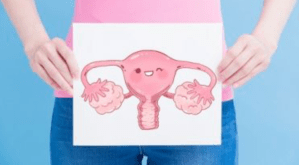
Today I’m talking about cervical screening checks. Because yesterday, I had mine. (Oh, did I mention that I’m an over-sharer?)

Let’s be honest. No woman ever gets excited about having a cervical screen. At least, no woman I’ve ever met. Maybe if they handed out lollypops at the end, (or something more applicable for the area being screened?), we might get more excited, but as things go, rocking up for our scheduled cervical cancer screening is not really one of those things we anticipate with glee. (Or maybe you do. And if so – good for you!)

My OB/GYN – who is now purely my GYN because the OB part of me has shut up shop for good – called me (well, his receptionist did) while I was in Berlin. The call came at some ridiculous hour of the night, so I ignored it, rolled over and went back to sleep, making a note to return the call when I got back to Australia.

I knew that was I was well overdue for a check-up – I’d been thinking I needed to make an appointment and was also a little confused about the new screening procedure and process. It’s changed since my last screening. I knew that pap smears were a thing of the past and that a new cervical screening check had replaced it.

But I didn’t really understand about the change to timeframes or just what the new check was all about. So, I made, and prepared myself for, the appointment.

I’ve known my gynaecologist for a long time now – about seventeen years. He knows diabetes and pregnancy which was why I started seeing him. He was the one who I went to for all my pre-conception care and then he was my OB each time I was pregnant. He has seen me at my absolutely lowest as I dealt with the heartbreak and trauma of recurrent miscarriages. But he also was the one who handed me our daughter the day she was born, so he has seen me at my most elated, too.

This time, I walked in with absolutely no intention of talking about babies, other than mentioning that mine is now fourteen which obviously makes no sense because surely I am still only 36 and I had her when I was three days shy of 31. (This is a lie. No one believes it.) I was there to talk about how hopeless I was because I’d completely neglected thinking about needing a cervical screening check. And have the said check.

There is a reason that I continue to go back to the same doctors for seventeen years. It’s because they don’t judge, and they treat me as though I have a life outside the body part in which they specialise. (Which is good when seeing this particular doctor, because I am more than my vagina.) Before getting to the reason I was there, he asked me how I was and what I was up to. We spoke about the work I was doing. He asked specific questions about my health and asked me how I found the Dexcom that was clearly visible on my upper arm. We started to talk about DIYAPS, and how that was working for me. He wanted to know about my family and how they were, and what sort of a kid the tiny baby he delivered on that day back in November 1998 had become. (She reads a lot more now. And has more sassy opinions.)

Then I mentioned that I had been a little remiss in organising my cervical screening check and started to say how I was usually a lot better at this and that I always, always make sure my diabetes screening was up to date and that I NEVER miss an appointment with my ophthalmologist, but that this one had slipped through the cracks. He didn’t shake his head and tell me to be better. Instead he said, ’It’s great you’re here today. Life is busy and there is a lot going on.’ It may not be healthy to love your gynaecologist, but after that comment I remembered why I had always been so fond of him.

He then explained how the new screening worked, and why the changes were made. He spoke about what was involved today and how long it would take for me to get the results. ‘We call you whatever the result,’ he said and I realised that was a really useful piece of information. If I had a missed call from his rooms in seven to ten days’ time, not knowing that calling everyone was routine, I would have worried that something was wrong until I’d been able to speak to someone.

He started by taking my blood pressure. ‘Is your blood pressure usually okay when you have it checked?’ he asked. ‘Yep. Always fine. Why? Is it high?’ My heart rate was slightly elevated, and I was anxious. (See point above about no one wanting to have this particular screening check.) ‘A little,’ he said. ‘But I know that you’d be anxious about this. It’s nothing to worry about if you have recently had your BP done and it was okay.’ 

I have always appreciated how this doctor, when asking questions, explains why he is asking them. ‘Any changes to your period, bleeding in the middle of your cycle, or bleeding during or after sex?’ He asked, going through what each of these things could mean.

The rest of the examination took all of about 5 minutes. He explained everything that was going on, and I distracted myself during the bit where I had a piece of cold metal inside me by asking about the HPV vaccination.

I’m not sure if that was necessarily the best time to have a conversation about why it’s important to have this vaccine (there’s more about it here, including who the vaccine is for and when they should have it). He told me it protects against the types of HPV that cause around 70% of cervical cancer, as well as other cancers (vaginal, vulval, anal, throat and penile), and protects against genital warts.

We then both had a lot to say about our frustrations with anti-vax lunatics and their anti-science idiocy, and why Pete Evans should be sent to an island (one other than Australia) and left to his paleo devices where he can’t harm anyone else. (Thankfully the cold metal instrument has been removed, and I was covered up by a sheet again by this stage. We were both getting a little ranty and I was waving my hands around; being completely exposed could have made that awkward…)

When I was dressed and sitting opposite him again, he asked if I had any questions. I had a few, and he answered them clearly. I mentioned again that I would make sure that I had future checks as scheduled and he suggested I be less hard on myself.

He’s right, of course. Diabetes alone puts so much pressure on us – as well as all the screening we need to keep on  top of there is the daily stuff too. (I love that he understands diabetes and realises just what it takes to deal with it.) Add to it the other things we need to stay on top of – such as screening of our lady bits – and it’s no wonder that sometimes something will slip through to the keeper.

And of course, there are a number of other reasons that we delay or postpone having this particular check done. For some women, there can concern or embarrassment. Even if we know that the actual procedure takes only minutes, it’s not especially comfortable. And then there are concerns about the state of our lady garden. According to a 2018 survey by a British cancer charity, a third of women won’t make an appointment for a cervical screening if they haven’t waxed or shaved their pubic area, and are embarrassed about how their vulva looks. I could scoff and say how ridiculously shallow, but you bet that I have had that concern too.

I know that this, as with all screenings, is important because early detection of any changes means early treatment and that is always the best approach. And so, I’m trying to stop beating myself up for the fact that I was overdue getting this done and instead pat myself on the back for actually having made and kept the appointment. I’ve done my bit. I now wait for the results and then take it from there.

More information about cervical cancer screening here.

Click for source of image.

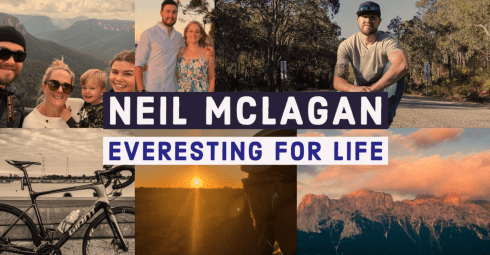
Have you ever heard of an ‘Everesting Challenge’? No? Neither had I until recently. It involves a cyclist climbing a single hill the number of times that’s required to reach a total ascent of 8498 metre to equal Mt Everest. Oh – it gets better. It has to be done in a single ride. It’s known as one of the toughest cycling challenges in the world and I’m exhausted just writing about it. Now I know what it is, I can confidently say that I will never be completing this challenge.

But Neil McLagan is, and he is doing it for a really good cause. He will be raising funds for Insulin for Life (IFL) Global. I’ve written about IFL Global before, and have done some (volunteer) work before, promoting what they do.

As a refresher, IFL Global is a not for profit organisation, raising awareness of the lack of insulin and diabetes supplies in developing countries. The organisation collects and transports insulin and supplies and then distributes them to clinics and health professionals in these countries, as well as offers a complications screening program in places where this simply does not happen.

IFL Global’s mission is that no one should die because they can’t afford or access insulin. Their efforts save lives and help those with diabetes survive and thrive in their communities.

Obviously this is something that I will support – not by starting to do extreme cycling, but by promoting those doing it. And that brings me back to Neil McLagan.

Neil will be undertaking his ‘Everesting Challenge’ by climbing Admiral Road in Bedfordale, Western Australia more than eighty times. Apparently, that is going to take him more than eighteen hours. It’s not the first time that Neil has undertaken this sort of challenge. Last year he rode solo and unsupported from Sydney to Perth raising funds for another diabetes cause. Over twenty days, he spent a total of almost 180 hours on his bike, riding a total of 4011kms (almost 2,500 miles). He says that his ‘Everesting Challenge’ will be one of the most physically and mentally difficult single day challenges. He’s not kidding!

Oh – did I mention that Neil has type 1 diabetes?

He is hoping to raise AUD$20,000, along with a lot of awareness about Insulin for Life Global. Without the work they do, a type 1 diagnosis for many people in the counties where they have a presence would almost certainly mean a drastically shortened life.

This is where you can help.

Look – if you’re inclined to get on a bike and ride it for the equivalent of climbing Mt Everest while fundraising for IFL Global, all the power to you. Please let me know and I promise to throw more than just a couple of bucks your way.

But if you’re like me and would prefer to sit in a café reading about people like Neil, you can still help.

You can make a donation by clicking here. Every donation counts – don’t ever think that $5 won’t make a difference.

And you can follow Neil’s story by liking his Facebook page here and following his adventures, and sharing it with your friends.

Please do consider making a donation to Neil’s efforts. Insulin for Life Global is truly a very important cause and is making a massive difference to the lives if people with diabetes.

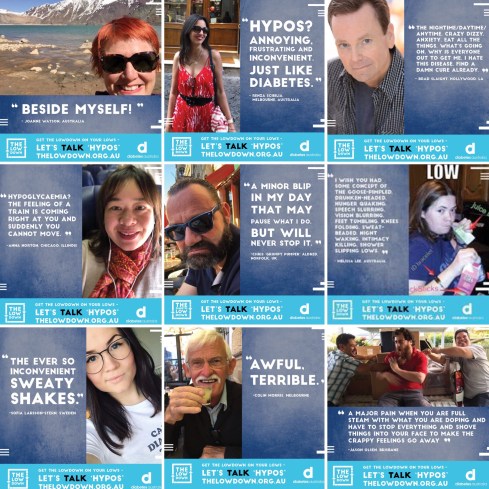
Yesterday, Diabetes Australia launched a new campaign called The Lowdown (please read my disclosure statement at the end of this post). It’s all about hypoglycaemia, and designed to get hypos out in the open by encouraging people with diabetes to share the realities of what hypos mean, look and feel like.

I love this campaign because it’s truly about people with diabetes. You’ll see and hear our stories and our experiences, and it will provide a forum for us to learn from each other. (Vote 1 peer support!)

There is stigma associated with hypos. Have you ever had a low and been asked ‘What did you do for that to happen?’. Or has someone ever asked you why you are not better prepared if you find yourself without enough (or any) hypo food on you? Has someone overreacted when you have been low, making you feel that you need to manage them at the same time as dealing with your hypo? Or has someone told you that you shouldn’t be having (as many or any) hypos?

All these things have happened to me and the result was that often I simply wouldn’t say when I was low, or I would downplay the situation. Reading stats such as ‘people with diabetes have on average <insert arbitrary number> of lows a week’ always made me feel like an overachiever, because I could guarantee that I was having more lows than whatever stat was quoted.

One thing I could rely on was that my friends with diabetes never made me feel like lows were my fault, or that I was hopeless because I didn’t have enough stuff with me. More likely, they would silently pass me a few jelly beans or fruit pastilles and leave me to deal with things myself, which is exactly what I need to do when low.

The last thing I need is someone throwing a million things at me (‘Here…I have juice, sweets, sugar, a glucose IV…’)and stressing out (or even worse – saying that Iam stressing them out) and asking every two minutes if I am okay. (I know that people are doing this out of concern. But seriously, the last thing any of us need when we are low is dealing with someone more flustered around us!)

This campaign is for PWD by PWD and that is why I love it. I’m hoping it will help us understand that others are dealing with the same crap around lows that we are. And that it is nothing to be ashamed of. Getting things out in the open is always a good way to reduce stigma and make people feel comfortable talking and seeking the help they may need.

So, let’s talk about lows. Share your story and read what others have to say – remembering that, as always, we are not a homogenous group and you are likely to read a variety of different stories. That’s great! Hypos affect people in different ways. For some they are significant and can be terribly scary, and for others they are simply an inconvenience that just needs to be dealt with and then they can move on. No one’s experience is any less or more legitimate than another’s.

Just some of the people who have already contributed to #TheLowdown2019


How to get involved

It’s easy!

Share a video or photo about how hypos make you feel. Share your post on your social media account (Facebook, Twitter, Instagram etc.) using the hashtag #TheLowdown2019. Please make sure you use the hashtag so we can find your contribution and share it and add it to our website.

If you’re not on social media, you can email a photo of yourself (perhaps holding up a card with one word which best describes how hypos make you feel) to thelowdown@diabetesaustralia.com.au

This page of The Lowdown website explains more.

Disclosure

I work for Diabetes Australia and have had some input into the development of this campaign. I am writing about it because I hope that it will get more people engaged and interested in what the campaign has to say, and encourage contributions.

I have not been asked by anyone at Diabetes Australia to write about The Lowdown here or on any other social media platform (but I’m sure they’re pleased I have).  

Transparency is always important to me and I declare everything relevant (and not relevant!) on Diabetogenic. You need to understand and consider my bias when I am writing and sharing. You can always contact me if you have any questions about this.

Last month, I clicked over eighteen years of wearing an insulin pump. Every day in those 18 years – that’s over 6,500 days – there has been a cannula inserted into the skin on my stomach, sides or thighs. And for pretty much all of those days, a pump has been housed down my bra. (When I first started pumping I used to wear it on my waistband, but tired of the attention that drew so shoved it away. Out of others’ sight; out of others’ minds.)

Add to that there is the CGM I have worn on and off for the last eleven or so years – and for the last five, it’s been there pretty much every day. Oh – and about 18 months ago, a RileyLink also became a permanent fixture, also shoved down my bra. It’s an out-and-out diabetes tech party down there.

So you would think that after all this time, it is no big deal seeing, feeling, or acknowledging these devices and how they are housed on this body of mine. You would expect that I would be completely and utterly accepting of the devices by now, and how to accommodate them on my body.

And yet, I’m not.

Now, I need to say that I love my diabetes technology. I understand that it makes my life with diabetes much easier. I also understand – and never forget for a moment – just how lucky I am to have it. I absolutely wouldn’t be without it and I know that for me it is the best possible way to manage my own diabetes.

But thinking for a moment that I forget that I’m wearing these devices is wrong.

I find it fascinating when I hear people say that for their child/partner/friend (or for HCPs, PWD they see) that their diabetes device is just part of their life, it’s normal, it’s just part of them.

No. It’s not. My devices are additions because a bit of my body is broken and doesn’t do what it is supposed to do. We may not make a fuss about it or just seem to tuck them away (or leave them out on show), but do we really consider them just ‘part of our body’?

I don’t think I will ever be fully comfortable with how they feel or look on me. There is some serious body image stuff going on when I see the tape gripping these devices on to me. When I throw on a bathing suit for a day at the beach, the devices I need to consider and the way they are on show make me feel painfully awkward.

They are a reminder every time I see them – every time the tubing nearly gets ripped out when I go to the loo or catch it on a doorknob; every time I get too close to the doorframe and knock my CGM; every time I’ve put on a bra that doesn’t really work and my RL falls out; every time my pump and RL shift a little and become starkly obvious – that it is not normal to wear a pancreas on the outside of one’s body.

It’s a reminder every time my kid snuggles into me when she is sitting on my left side and leans her head on my arm. ‘Your diabetes is sharp’, she says to me and we have a little giggle as she wriggles around until her head finds real estate not taken up by Dexcom. Or in bed at night, as I go to roll over and find I can’t move because my pump has found its way under my husband. It turns out that it’s not just me needing to accommodate my external pancreas, making me even more conscious of its presence.

The beeps and buzzes and vibrations that these devices emit means I make noises different to others. The way that sometimes it’s just impossible to ignore the constant reminders and just accept it all as ‘part of me’.

Perhaps the only time I get close to not feeling the constant reminders of my tech is when the people around me are also wearing these devices. We spy a CGM on someone’s arm, pump tubing winding its way out from under someone’s top or hear the tell-tale beep of some sort of diabetes technology and we can ignore it because it’s not our own and everyone else is doing it too!

We do a lot to normalise the realities of diabetes. We do that for our own benefit, but I know that I also do it a lot to limit concern of those around me. This is one of those things I do to minimalism how diabetes affects me and to normalise something that is…well, not normal. I would never make a big deal about how I feel about wearing this technology because I sound whingy and precious, (possibly the alternate title for this blog post). But don’t for a minute think that you can dismiss it as not a big deal or just part of us. Because it’s not and never will be.

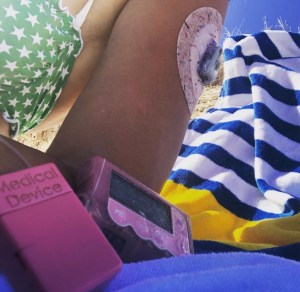
Devices on the beach.

Follow Diabetogenic on WordPress.com

Enter your email address to follow this blog and receive notifications of new posts by email.

Read about Renza

Archives