I regularly say that I wish I had an assistant to take care of all the diabetes admin. I’d like to be able to hand over all the scheduling, paperwork and the general keeping track if it all that takes time, brain power and forces us to find room that those not living with diabetes can dedicate to making sure they remember if there is milk in the fridge or when the new season of The Good Place starts.

It would be a thankless job, and I doubt that anyone would be interested in doing it, but I can dream.

A couple of weeks ago, Diabetes Australia officially launched KeepSight, the first ever national eye screening program for people living with diabetes. It’s actually a super easy concept: PWD register to be part of KeepSight and then receive reminders when it is time to have an eye check. No more needing to remember the last time you had a check-up.

This is similar to the cervical screen program that has been around for a number of years now. I have relied on reminders from that program to alert me when it is time to make an appointment for a screening check. KeepSight will help us keep track of our eye checks.

I could give stats about the number of people who are missing out on regular eye checks, and even more stats about rates of diabetes-related eye complications. But I won’t. Because that is not what is getting me excited about this program.

I’m excited because this is one of those simple ideas that goes towards making our lives with diabetes easier. And, quite frankly, there’s not enough of that happening!

Click on the link below; it takes literally two minutes to register.

Now, if we could just find a way for insulin scripts to never run out, diabetes supplies to be endlessly replenished when running low and all our other appointments sorted, we’d be halfway to making this condition just a tiny but easier to manage.

Disclosure

I work for Diabetes Australia, but I am not writing about this because I have been asked to. I am doing it because I genuinely think this is a program that goes towards helping those of us living with diabetes and I will always share anything that does that.

But you do need to be aware of who pays my salary each week and consider my bias when I share things by my employer. You have a right to know that, which is why I will always make sure that it’s clear – each and every time I write about anything in which I am involved. Transparency is important.

7am alarm.

Alarm off.

Out of bed.

Check pump site – looks a bit red so rip it out.

Into the shower.

Remove glue residue from old pump site.

Dry off.

Moisturiser.

Refill pump.

New cannula in.

Prime pump.

Apple watch on.

Check Loop app is working on watch.

Get dressed.

Tuck pump away in my bra.

Tuck RileyLink away in bra, too.

Dexcom app alarm sounds.

Calibrate CGM.

Make up on.

Run fingers through hair – that will do.

Check handbag for low supplies.

Loop low battery notification.

Get battery and coin out of spares bag.

Change battery in pump.

Double check supplies in spares bag.

Add another battery.

Throw Riley Link charging cable in handbag.

Say good bye to family.

And dogs.

Red lipstick.

Dexcom sensor expiring warning.

Clear alarm – restart will be later in the day.

Walk out door.

Get in car.

Check Loop on watch. Green and steady.

Drive to work.

Sing loudly in car.

Get to work.

Open laptop.

Grab coffee cup.

Bolus for coffee.

Walk to café.

8.14am Coffee.

Diabetes like you mean it.

This post marks one thousand posts here on Diabetogenic*. That’s a lot of senseless rambling, ragey-moments, times celebrating and despairing about diabetes, and links to brilliant ideas and post… or to things that have either amused, frustrated, delighted or annoyed me.

A thousand posts in and diabetes is still a constant in my life (damn it). And I remain not good at diabetes…and I have many of those thousand posts to prove it.

There are clearly some recurring themes that I write about. I say that I am a one trick pony, but perhaps that’s not completely true. I seem to have a few tricks up my sleeve, really. And now I’m confused, because ponies don’t usually have sleeves and my metaphors are very, very mixed.

Here are the things that seem to have taken up a lot of writing time and words over these thousand posts…


Peer support

Most of the time, I am pretty positive about living with diabetes. Let me be clear: that doesn’t mean I love it, or even like it. But I feel that generally, I know where it belongs in my life and it seems to fit in that place as well and happily (begrudgingly) as it can.

I know that one of the reasons that I feel this way is people in the diabetes world I am lucky enough to call friends and peers. Online friends, in real life friends and those who cross both boundaries are a critical part of my living-well-with-diabetes strategy. Knowing that there are only a very few places around the world where I couldn’t find someone from this community to have a coffee/tea/prosecco/mojito with gives me an incredible sense of comfort. (And reassurance in case of diabetes emergency…)

I say that my peers with diabetes help me make sense of my own diabetes and that’s true. Knowing people who understand innately what it is like to share a body with diabetes means that I never feel alone. Diabetes is so isolating at times – even for those of us surrounded by great people who support and encourage us. As much as I need those people and am grateful for them, it is others living with diabetes that help me realise that I am never, ever alone in dealing with the ‘diabetes things’.

The diabetes online community is made up of lots of people and not all have diabetes. We each bring our own experience and perspective to it. I’ve learnt so much from those living arounddiabetes and how they incorporate it into life, because it comes with its own set of challenges and victories. That is why the community is so valuable – its diversity and range of experiences and perspectives.

I regularly talk about the value of community and diabetes peers and finding our tribe. It can take time to settle into just who and what that looks like, and it changes because there are always new people around. But it is so worth it. My tribe? I love them so hard.

Nothing about us without us

I am not the tattooing type but if I was, I think that I would have this phrase inked on my body somewhere (or maybe I’d be really pretentious, and have it written in Latin: Nihil de nobis sine nobis, according to Google translate.) It remains a frustration of mine that this isn’t the starting point for pretty much anything and everything to do with diabetes care. The fact that we still need to fight for a seat at the table – or a ticket to a diabetes conference – is, quite simply, not good enough. Having others speak for us, on our behalf thinking they know what we need, is offensive.  It should never be the case that non-PWD voices speak for us or over us. Ever. Our stories are powerful, but they are ours and we should have the platform to tell them in our own way; in our own voice.  Tokenism is rife and sometimes, that frustrates me even more than when we are completely excluded. The delusion of inclusion is, I think, worse.  Whilst there may have been some strides made to true co-design and inclusion, we have not come far enough and until we get this write, I’ll have a lot of content fodder for this blog.

Food

I like food. I write about it a lot. And I want to be Nigella. That’s really all I have to say about it right now…

Waffles in Brussels. Both were excellent.

More than numbers

Apparently, stating the obvious is still necessary in diabetes. We are more than numbers; our A1c does not define us; our worth is not wrapped up in our glucose levels. We have been saying these things for years…decades…and yet there are still times that this is what we are reduced to.

New treatments, devices, drugs, education programs are measured in reduction of A1c. Perhaps this is because it can be measured, but talk about only getting part of the story. I can’t help but think that if PWD were part of establishing research protocols, there may be far more than numbers to assess the success of a treatment or therapy. (See also: nothing about us without us…)

Women’s health

In recent years I’ve written about the issues specific to women, health, sex and diabetes a number of times because there is so little out there about it. And it seems it resonated with a number of women who wrote to tell me (and the HCP who saw me in the fresh produce section at my local Woolies and yelled how she loved my idea of giving lube in diabetes event bags).

Anyway…talking about the stuff that may not be the easiest is important. It’s the only way we get remove stigma and encourage people to share their stories. Which helps others. That’s why I have openly written and spoken about miscarriages and infertility. And eating disorders. (I know – not an exclusively women’s health issue.) There is nothing shameful or embarrassing about these topics. Other than we don’t speak about them enough.

Learning from and supporting others

The Interweb Jumbles I write are my favourite (and cheat’s) way of pulling together all the things I’ve seen that have interested me and leaving them in future place for (my) future reference. Plus, I love sharing what others in the diabetes community and world are doing.

I have always benefited from the generosity of others in this community who have shared my work and I pay that back whenever and wherever I can. Supporting each other is critical.

There’s so much going on in the diabetes world all the time and I highlight the things that resonate because I think that if they mean something to me, they may mean something to someone else, too.

Science. Science. Science

From pseudo-science rubbish, to ridiculous made-up diabetes cures to anti-vax delusions. How much writing material have they provided!

I live in hope that one day – and may that day be soon – we won’t still have to read about these charlatans trying to convince us that all that ails us can be cured with fairy dust and positive thought, or that vaccines are evil and cause diabetes, or that ‘wellness warriors’ are the true experts and professionals when it comes to diabetes.

While a lot of what I write is spent mocking these fools, there is an underlying seriousness to it all. Who can forget little Aiden Fenton who died after his parents stopped giving him insulin, instead leaving him to be treated by a ‘slap therapist’?

Anyone who is sprouting any treatment that is not based in science when it comes to diabetes or perpetuating anti-vax rubbish is as barbaric as the man who was charged with Aiden’s death.

The whole person

Diabetes happens because of something not working properly with our pancreas. But it affects every single part of us – something that astoundingly still seems to surprise some people.

Considering our mental health and emotional wellbeing is critical when assessing just how diabetes impacts on our every day. For some, diabetes seeps into every single part of us and for others, we keep it at bay and manage around us. For most of us, there is an ebb and flow of just how that works.

And while we’re talking about the whole person, diabetes-related complications may be specific to a particular body part, but those body parts remain connected to the rest of us.

For so long, we get metaphorically chopped up with as only bits of us get attention and focus. But nothing in diabetes is ever in isolation. That’s just not how it works.

And finally, language

The trick this (however-many-trick) pony is most known for is #LangaugeMatters and you know what, I’m happy to wear that. I really am. If I was to stop this blog today (thought about it…1,000 has a nice rounding off feel to it), and never spoke about diabetes ever again (oh, if only), I would not be disappointed if this was what people thought of when they thought of me and this blog.

Language matters. It does and I refuse to, for a moment, believe that it doesn’t. I am certainly not the only person playing in this space and I am so grateful to have a tribe of language matters peers and colleagues can rise above the small details to understand just why this issue does really matter.

___________

Thanks to everyone who has read one or more of these thousand posts. Thanks especially to the people who keep coming back. I can’t promise that there are going to be a thousand more posts. And I can’t promise that I will learn any new tricks other than the ones that I seem to have on repeat at times. These issues remain important to me and perhaps to you too.

* At EASD, my mate Bastian Hauck gave me a head’s up that I was getting close to publishing the 1,000 post on this blog. I’d not have had a clue otherwise. Thanks, Bastian!

Recently, I was tagged in a tweet that asked for my thoughts on a discussion that was already in progress, and had started with this tweet from diabetes consultant Pratik Choudhary:

(Click for original tweet and to read discussion)

It’s a long thread (that seems to still be going), but it is worth a read to see some different perspectives and thoughts on the role of psychologists as part of the diabetes multi-disciplinary team.

I think that Pratik’s original tweet is right in that diabetes clinicians have a role to play in acknowledging diabetes-related distress and working with PWD by asking the right questions.

But just asking isn’t enough and rarely actually gets to the root of it all. Because unless we are asked and can understand why we are behaving a certain way, we don’t know how to stop it. Why do we feel guilty? Why do we feel that we need to be perfect in the first place? Why do we base so much of our own worth on numbers (TIR or A1c)?

But in the real world, I don’t think these questions are being asked, and there are myriad reasons that’s the case. Some clinicians wouldn’t have a clue what or how to ask. And then if they did, they’d struggle to know what to do with the answers. Only recently, I heard of a diabetes educator say ‘You just have to do it’ to a PWD who had opened up and said they were really not checking their glucose levels because they felt ‘over’ diabetes and simply unable to manage its significant daily tasks.

I nodded in recognition when I heard this story because that was me for the first three and a half years of living with diabetes.

Also, sometimes PWD feel too ashamed and guilty to admit the distress they’re experiencing to their HCP, instead promising to do better and check more and respond accordingly.  But do nothing of the sort.

That was me, too.

In the limited time we get with our diabetes HCPs, we seem to have a focus on numbers and basal rates and tweaking X and Y to make Z better. We are in diabetes mode because we know those minutes are precious and diabetes is what we are meant to be focusing on – even though diabetes may be so far down our list of concerns we sometimes (try to) forget we even have it.

Yeah. That has been me too.

Even though I have an endocrinologist who asks the right questions, doesn’t fill those silences where I am looking for the right words, is encouraging and supportive and never judgemental, and understands that diabetes-related distress can be paralysing, she was not who I needed to get through those times. I love that she knew that.

She also knew that no matter how many SMART goals we set together, and even if I said that I would be able to do them because I could see they were achievable and completely not unrealistic, until I had a mental health professional work with me there was no way I was going to do them.

One of the first things she did when I started seeing her seventeen and a half years ago was refer me to a psychologist. The guilt that I was feeling about the imperfect numbers – or the lack of imperfect numbers because I was barely checking them, was steeped in a complex and convoluted mess. I needed a mental health professional whose expertise was to help guide me through it all and show me how to get things sorted.

THAT was what I needed at that point in my diabetes life…and numerous other times since then too.

For me, there has always a lot to the cause behind my diabetes-related distress, and speaking with many of my peers, they would say the same thing. I didn’t understand that it was okay for me to grieve my life before diabetes. I could remember it well – the days of not needing to think diabetes, breathe diabetes, sleep diabetes. My life was different post-diagnosis, but the recurring messages I’d heard was that diabetes wouldn’t stop me and I should just get on with life.

Well, I have done that. But that doesn’t mean I didn’t need time to mourn the days where I didn’t do all that. Having someone help me where diabetes now fit in my life was essential to clearing a path for me to actually make diabetes happen. And for the record – I’ve needed counsel with this several times because diabetes’ place does change around depending on other things in my life.

So where does a psychologist fit in the diabetes health professional equation?

For me, it must be as part of any multidisciplinary team.

I’m not sure that the day I was diagnosed would have been the right time for me to have an appointment with a psychologist (but let’s be honest, it would have been no less helpful that the dietitian and her rubber food moulds), but I certainly do wish that I’d know that having someone to talk about my mental health was a sensible thing for when I  needed it, and given clear directions about how to go about getting an appointment. I was told about the eye specialists and podiatrists that would be part of my future team, but no one thought to mention a mental health professional.

It shouldn’t have taken almost four years – four very difficult years in a lot of ways.

Over the years, seeing a psychologist has helped me with my diabetes management enormously. Those times when diabetes has terrified me to the point of paralysis and inactivity, the times where I wanted to blame diabetes for other things going on (because it is there and I generally don’t like it so it’s convenient to point my finger at it!), the times when the uncertainty of diabetes and the fear of what lies ahead, or the times when life overall has felt just too big and scary and diabetes just doesn’t get a look in … I have benefited from having a mental health professional to work with. In fact, I doubt that I would see diabetes is the way I do now without that support.

There is so much more to managing diabetes than simply doing diabetes. And there is more to diabetes distress than just acknowledging that it is there. Having diabetes specialists who understand about distress is valuable. But I really do think that understanding it ourselves, being able to identify warning signs, and developing sustainable strategies to deal with it any time it comes back needs the expertise of a psychologist.

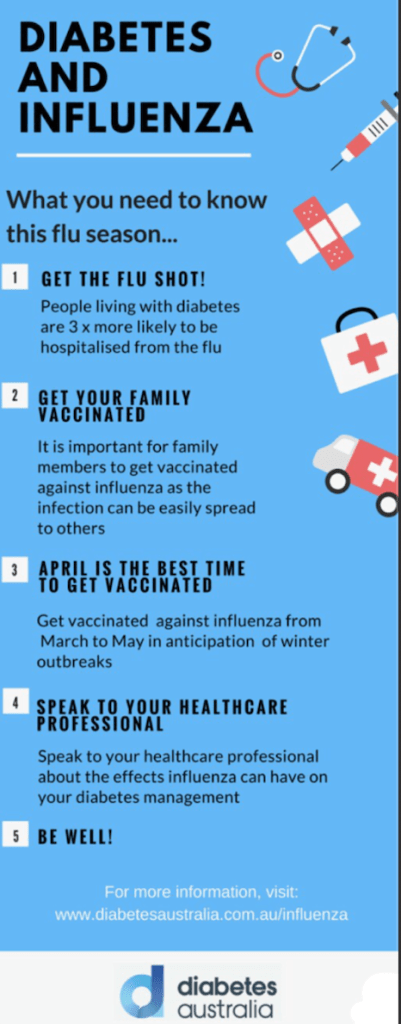
It’s that time of year in Australia. The weather is cooling down, leaves are turning, daylight saving ends over the weekend, and we are reminded that soon it will be time for our annual flu-vax.

This has coincided with a significant number of different pieces in the media about vaccines. Some of them are well written and well informed pieces focusing on the science behind why vaccines work. Some of them are not. (Cheat sheet: science-based pro-vaxx stories good / crazy no-science anti-vax stories bad.)

There often seems to be a groundswell after some celebrity chef, wellness blogger, person famous for being famous or, (as we’ve seen recently) WAG comes out and explains why vaccines are the devil and we should all rely on ionised water, sunshine and pixies rather than evidence and science.

So, today, I thought I’d share some of the things I’ve seen recently which support the vaccination message.

No platform for anti-vaxxers

I’m going to start with this. Meet Zubin Damania, MD – or as he’s known on YouTube, ZDoggMD. I know – I cringed, too. But he speaks sense and the first time I watched this video, I was nodding in agreement. ZDogg (cringe again) has decided that he is not going to in any way entertain any discussions with anti-vaxxers anymore. He’s not going to enter debate, he’s not going to try to show them the science or the facts and debate them. Instead, he’s going not allowing them a platform on any discussion he is involved in. Where he has previously permitted anti-vaxxers to share their views, he won’t be doing that anymore.

I like this approach. Previously when I have written about this topic, people disagree and put forward their ridiculous hippy-dippy delusions about the dangers behind vaccines. Not any more. I will be deleting any anti-vaxx comments on this blog from now on. This is a pro-vaccine place only. I believe the science. So science we shall speak.

What’s it going to take to stop anti-vaxxers?

According to this piece from the New York Times there is no stopping the anti-vaxx brigade because they are not willing to listen. Instead, they believe in conspiracy theories and their own ‘alternative’ facts with no foundation in science.

When a doctor advises against childhood vaccines…

This piece from Melbourne writer, Van Badham, is heartbreaking. Her mother had been advised by their family GP to not give Van the measles vaccine. Van caught measles at 17 and almost died.

Can I just add here, if your doctor is sympathetic to anti-vaxx views, find a new doctor (or nurse or any other HCP for that matter).

Measles in Europe

A recent piece in BMJ explains how measles cases have tripled from 2017 to 2018. That’s one year. More than 80,000 people in 47 European countries had measles in 2018.

A fall in type 1 diabetes and the rotavirus vaccine

A new study by Melbourne Researchers says that the drop in the number of children aged 0 – 4 years diagnosed with type 1 diabetes could be associated with the introduction of the rotavirus vaccine of Aussie infants. It’s the first time we’ve seen a fall in diagnosis rates since the 1980s.

Record-breaking measles cases in NSW (this is not something to be proud of)

Just this week, this article appeared in the Sydney Morning Herald telling of two babies contracting measles. They were too young to be vaccinated. There have been 29 cases of measles in Sydney since xmas and NSW is looking to have the highest rates of measles in five years. Measles – a vaccine-preventable disease.

Show this article next time you hear an anti-vaxxer selfishly claim their children are ‘perfectly healthy & don’t need to be poisoned by toxic vaccines’.

Ten year study shows that MMR vaccinated children LESS likely to develop autism

From Denmark: a ten year study which examined data on over 650,000 children showed that not only is there no link between MMR and autism, but children who were vaccinated were seven per cent less likely to be diagnosed with autism than children who were not vaccinated.

You think flu is not serious?

Dr Jen Gunter wrote this great piece where she shares her own experience of ‘flu as well as those from others who commented on twitter. The ‘flu is not a cold. It is not a little inconvenience. It can and does kill.

Smart kids; foolish parents

But perhaps my favourite story about vaccines lately is this one which tells of rebellious children defying their anti-vaxx parents by getting vaccinated. Let’s just remember that most of those parents preventing their children from being vaccinated probably didn’t have foolish parents and are, in fact, vaccinated themselves. But they think nothing of exposing their children to vaccine-preventable diseases, and putting others in the community at risk.

These teens are amazing and good on them for believing the science and fixing what their parents didn’t. Maybe there is hope…

Evil Mr Vaccine…

Diabetes and the flu-vaccine. It’s time.

I hate that almost every week scientists have to come out and debunk the latest claims made by some completely hopeless anti-vaxxer: some footballer’s wife is running workshops highlighting the (made up) dangers of vaccines and is telling anyone and everyone who’ll listen that she will not be vaccinating her unborn child; a former swimmer says that people should weigh up both sides and make up their own mind; a celebrity chef endorses anti-vaxx campaigners, (while at the same time advises against using sunscreen).

And every time something like this happens, scientists have to stop doing their important science work, and go on breakfast radio and TV to explain patiently why these comments from these village idiots are rubbish, and then defend their own work and the work of their colleagues.

There are very few people in our community who for medical reasons cannot be vaccinated, and the rest of us need to be to protect them, and other vulnerable populations. Herd immunity works. And so do vaccines. Just vaccinate. There is no debate.

I’ve been working for diabetes organisations now for coming up to eighteen years and unsurprisingly have accumulated some truly fascinating things along the way.

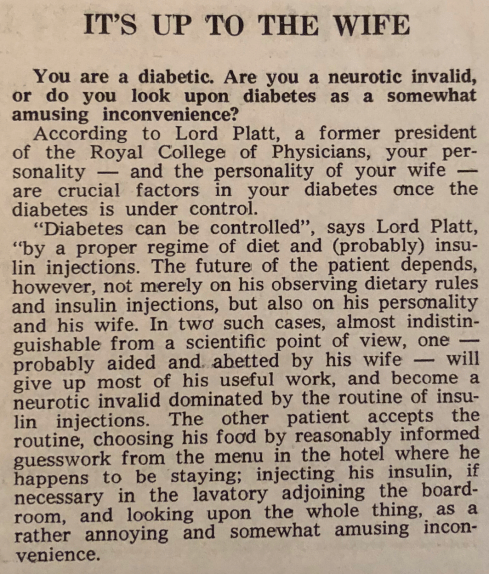
Including a photocopy of a 1972 edition of ‘Victory’, the ‘Official publication of the Victorian Diabetic Association’ (now known as Diabetes Victoria).

I was flicking through it the other day and came across this gem:

Apparently, ‘the wife’ is the reason her husband either becomes overanxious about his diabetes or instead, takes charge and continues his existence as a captain of industry, putting diabetes in its rightful place. That’s right, it is ‘the wife’s’ fault her husband becomes a blithering mess unable to look after himself and incapable of doing more than curling up in his favourite chair, wearing his favourite slippers and cardigan while being (over) parented by his partner. This must be because 1972 wives have some sort of enchantress powers that conquer any man’s autonomy or decision-making abilities.

1972 wives sound magical and awesome. How do I become one?

All joking aside, if we remove all gender references in this piece and have it just about the way in which others treat us and how that influences our view about our diabetes, there is, perhaps, an element of truth to the thinking behind it all.

What I need (and am fortunate to have) is a group people around me to support me as I make decisions and diabetes the way I want and need. They back me by being there with a shoulder to lean on or an ear to listen if I ask, but never take over or try to ‘fix’ things.

This sort of support helps us know that we can do this. I may never think of diabetes as ‘an amusing inconvenience’ (there is little to be amused about a lazy pancreas), but I will never see myself as neurotic or incapable.

I certainly don’t want a 1972 wife (or a 2019 partner, parent, sibling, friend, colleague, healthcare professional, associate or anyone else) dictating how I feel about the health condition that lives in me. I do want them to laugh with me at this ridiculousness, though. And promise me that they will continue to keep being exactly the way they are right now! (And maybe joining me when I tell off anyone who suggests – even for a second – that I inject in the lav adjoining the boardroom.)

Here’s the deal. Changing one word for another that means exactly the same thing is not addressing the whole #LanguageMatters issue. Acknowledging that one word doesn’t work and may not be especially empowering and positive for people with diabetes only to replace it with another that is equally problematic is not really helping.

Case in point: more and more healthcare professionals and researchers have accepted that the word compliant, (and its friends non-compliant and compliance) are out. So, they replace them with adherent, and non-adherent and adherence.

No. Just no. And stop it.

They mean exactly the same thing and do the same thing: rap people with diabetes over the knuckles for not following an often-imposed plan about how we should manage the condition we live with. (‘Should’ is also a dirty word as far as I’m concerned, but we’ll deal with that another day.)

I am frequently asked what words would be better, but I prefer to give an explanation about the reasons these words are problematic. Because I think if people have an understanding of why these words set some of us off, perhaps they may be less likely to simply swap out one tricky word for another.

Let me refer to the Diabetes Australia Language Position Statement for a moment:

‘Use of the terms ‘(non-) compliant’, ‘(non-) adherent’ is particularly problematic. Such terms characterise the individual as cooperative or uncooperative, especially when used as adjectives to describe the person rather than the behaviour. Using these labels can mean opportunities are lost to ask relevant questions, develop collaborative goals, tailor treatment regimens and make referrals that actively support the person to manage his or her diabetes. Attempts to increase ‘compliance’ and ‘adherence’ generally involve persuading the person with diabetes to change his or her behaviour to fit the health professional’s agenda.’

There is a lot of judgement attached to these terms.

I think back to when I was diagnosed with diabetes and the first inkling I had that I was going to struggle to follow directions was when the dietitian I saw the day after diagnosis showed me a rubber mould representing the quantity of mashed potato I should eat in one sitting. I was twenty-four years old and knew just how much food I liked on my plate and that was not it. In fact, it looked more like the quantity I would eat over a week – not one meal.

I mentioned that to the dietitian. I explained how I love food, but I eat until I am full and then stop because I’d learnt that listening to my body was a really important to me. (That sounds all Zen-like, but truthfully, it is just so I don’t get the revolting over-full feeling when I don’t listen to my body’s signals!) Surely there had to be a way that I could still do that even with diabetes along for the ride. Right?

She just looked at me and told me that I had to eat that amount because of my insulin dose. ‘Can I take less insulin then?’ I asked. ‘No. That’s not how it works,’ she replied, without explaining why.

So, I nodded and promised to eat thirteen kilos of potatoes at every meal. And within a week I had worked out how to eat less, dose less and still listen to my body. Oh – and I learnt how to lie to HCPs and tell them what they wanted to hear. And that I never, ever wanted to sit in a room with another dietitian.

Was I being ‘non-compliant’? Well, I certainly wasn’t following what I had been instructed to do. But I was eating what made me feel good and dosing insulin accordingly. Surely that had to count for something? Yet, when I returned to see the dietitian for the follow up appointment that I diligently (compliantly?) kept, she tut-tutted me for not following the eating plan she had given me – an eating plan into which I’d had no input.

This is a recurring theme in diabetes. We hear of people being ‘told off’ for not following treatments, but we are not given the opportunity to help shape those treatments.

Being ‘compliant’ in diabetes suggests that we are doing what we are told. It means that we don’t question, we just willingly follow directions without considering whether or not they work for us. It also suggests there are rules and that if we follow them – if we ‘comply’ with them – we can expect the outcomes to always be the same. Diabetes doesn’t work that way.

I think back over the two decades I’ve lived with diabetes and know that time and time and time again I have been thought of as ‘non-compliant’ simply because I didn’t do what a HCP thought was the best thing for me, instead working my way around and finding what worked. Diabetes isn’t fun, so you bet I have looked for ways to do things that take less effort, less time, less brainpower, less burden. That’s not because I don’t care. It’s because when I find a way that works better for me, I’m more likely to do it.

Every single one of those times that a HCP has thought of me as ‘non-compliant’ was a missed opportunity for us to work together to collaboratively come up with treatment plans, strategies and goals that worked for me.

When we are accused of being ‘non-compliant’ with medication, activity or eating plans, attending appointments, filling in glucose records or anything else that we are expected to do in diabetes, it’s not because we are being wilfully naughty. It is because whatever we have been asked to do is not right for us – we simply cannot do it, or don’t understand why. Sometimes of course we don’t want to do it, but there is usually a reason why we then don’t act.

Compliant (and non-compliant) are dirty words in diabetes. And replacing them with adherent (and non-adherent) doesn’t make it any better because they mean the same thing.

If you are a healthcare professional and use these words when referring to PWD, I suggest that you stop and start again. Think about what you are saying. The person in front of you is not a naughty child, waiting for your approval or rebuke. They do not need to be told that they have failed at meeting (what were probably unrealistic) expectations. They certainly don’t need to feel ashamed and judged by you.

What we need is something quite simple, really. We need to be asked what matters to us and what will work for us. We may need to be asked that a few times. If you are talking about a course of treatment, make sure that we understand that it is just a suggestion and that we can alter it to fit us. Remind us that if we can’t follow it that doesn’t mean we’ve failed. It probably means that together we need to tweak things so that we can follow.

Until the language that we see routinely in diabetes is about supporting, encouraging people with diabetes and positively influencing the broader community discussion about our condition, I will continue to call out any time I hear these words being used. I accept that there is no quick fix. And while I accept that healthcare is incredibly traditional in its communication, I refuse to accept it as a reason to continue to use language that is so damaging. ‘Because we always have’ or ‘Because they’re the words we use that make sense’ is not an excuse to refuse make change for the better.

Postscript

It’s not only in diabetes where we see this sort of language. See this tweet from The Grumpy Pumper about flaws in using the word compliant when it comes to those living with dementia.

Postscript two

Yes, yes, yes I do use the term ‘deliberately non-compliant’ as a badge of honour, wear t-shirts with the phrase boldly blazed across the front of it and carry a phone case with it proudly (in pink) splashed over it. It was used to reflect the opinion of healthcare professionals after I gave a talk about using DIYAPS. 

Last year, I was invited to the Australian launch events of two insulin pumps. Within a month of each other, the YpsoPump and Cellnovo pump were introduced into the Australian market: a market with a huge appetite for something new. Although Cellnovo had launched softly the previous year, the Australian distributor seemed to be increasing their business and had the pump’s inventor, Julian Shapley, in the country to give a presentation and answer questions.

At both events, we were wined and dined, and the latest bells and whistles of these two new offerings were confidently and excitedly shared with us. I listened carefully, keen to hear not only about the technical specifications, but also about the customer service that would be offered to those choosing these devices and their plans for the future. I’ve learnt over the years that reading glossy brochures only gives one part of the overall picture of using a particular device, so I was looking forward to asking those questions that give a much better idea of what is going on.

At some point during each of the events’ proceedings, I asked the same question. I wanted to know how these companies were safeguarding from these devices being launched on the market with great fanfare only to see them disappear after people had started using the very products in front of us.

Of course, I was assured and reassured that the companies were here for the long-haul and that they were future-proofing themselves by insuring they were preparing for the technology we all expect. Closed loop systems were coming; integration with CGM was an almost done deal; their algorithms would be better, smarter than anything we had seen before. And yes, they absolutely understood the concern I was expressing at the thought that just as quickly as their device had won our hearts and minds, it would disappear from market altogether. Of course, of course, of course that was not going to happen and I shouldn’t for a minute even think that was how things would turn out.

I listened. And I believed them.

Last week we heard that Cellnovo was ceasing production of its pump and all current users would be transitioned onto different devices. This played out over a couple of days. The first announcement was that Cellnovo was going into administration, but I wasn’t ready to shut the coffin lid just yet – we’d seen that happen before. But then, a mere day or two later, the announcement came that all manufacturing and commercial activities would cease, and that no new PWD would be started on Cellnovo products. Coffin. Nailed Shut.

Let’s put aside any opinions of the Cellnovo pump, because that’s not what this is about. I know there were some people who really weren’t fans of the device. My limited interaction with it left me interested, but not keen to slap one on my upper arm and call it my new pancreas. But I know some people who love it and have found it to be the right insulin delivery device for them. My diabetes; my rules and all that.

I also know a number of people who started using Cellnovo as their first pump. In Australia it was the closest thing we had to a ‘patch pump’ and they liked the idea of not having to deal with centimetres of tubing. When I wrote that Cellnovo would be launched here, I had a number of people reach out in great excitement. With Omnipod repeatedly stalling getting through our funding model, this was as good as they were going to get to the device they thought would be best for them.

And so, Cellnovo has won the heart and minds of some people. Just as mine were won over by the Cozmo and Animas pumps. And when they are taken away from us, our hearts break a little.

We learn to tolerate and accept – and sometimes even love – these devices. I wear mine as close to my heart as I possibly can, hearing it gently whir as it delivers insulin, sometimes in perfect time with my heartbeat. We do what we can to make them fit with us seamlessly. We know they will never really be part of our body; but we do what we can to work with and around them.

There is nothing and there is no one who I have ever been as literally attached to as the devices that are connected to my body 24/7 for the last eighteen years. I have loved them and hated them in equal measure as each day I try to accommodate them as best I can while at the same time appreciating and acknowledging what they do for me. And I hear this from others who have been wearing insulin pumps (and other diabetes devices) – some for years, some far more recently.

So, with this in mind – and this is something many of us have written and spoken about – and what played our last week, the almost cavalier attitude to my question at the event last June has left a sour taste.

Let me be clear here: this isn’t directed to the team at Medical Specialties Australasia (the Australian distributors of Cellnovo). They have been nothing but professional, friendly and approachable, and from the first time I met with Aaron Crook, it was clear that they were keen to make a success out of things and were pleased to be offering more choice to PWD in Australia. It’s possible they only found out about all of this a short time before the announcement was made. And really, it isn’t necessarily about Cellnovo. They are just the latest in the casualties of medical devices, and now join the ranks of Cozmo, Animas and Asante pump and the Navigator CGM. I am sure that they never wanted this to happen.

And yet, it has.

Of course, the closure of a business leaves a mess, and many casualties in its wake, but perhaps those that will feel this the most personally is PWD – the people who have come to rely on these devices to survive. We are already doing all we can to live with a condition that demands so much. We struggle to find what works for and alongside us and when we do, we want to keep it forever. Our own pancreas already decided to stop working; having to contend with the one we chose as its replacement disappearing as well seems more than just a little cruel and unfair.

Disclosures

I have none that are relevant to this post. My travel and accommodation for both launch events were covered by MSA and Ypsomed and were declared at the time. 

I am blunt and I am direct. I am often criticised for my lack of finesse and accused of having the subtlety of a sledgehammer. Guilty, guilty, guilty as charged.

But I have always believed that the best way to address any issue is to get it out in the open, talk about it and normalise it so people feel comfortable discussing it.

New Yorker Cartoons.(Click for image details.)

This has resulted in some uncomfortable times. There was the time I spoke at a healthcare professional event about some research we’d conducted on diabetes-related eating disorders, and the subsequent information resource we’d developed about the issue which provided information for people could seek help. A dietitian stood up during the question time and told me in no uncertain terms that this work was irresponsible and that we had just written an instruction manual showing people with diabetes how to develop an eating disorder. I reminded her of the research I’d just presented which showed that over 60% of the women in the survey had explicitly stated that they had omitted, altered, or restricted insulin for the purpose of weight loss and suggested that no one needed an instruction manual – we already knew how to do it. I also pointed out that over 80% of the women had never had a conversation about it with a HCP, so perhaps it WAS time we started talking about it so people knew how and where to get help.

Then there was the time at ADATS when I introduced the concept of DIYAPS to pretty much everyone in the room, terrifying them all. That was fun. As was the bit where a couple of endos suggested that I needed to be ‘reined in’.

After writing a booklet on diabetes and pregnancy. After being awarded a grant to publish it as a national resource, we sent the booklet out to all women with type 1 diabetes aged 16 – 40 years. The response we received from a bucket load of parents was that they did not want this issue raised with their daughters and how dare us for sending them information suggesting they have sex and get pregnant. (For the record – the booklet did neither of those things. It did, however, reassure young women with diabetes that a healthy pregnancy was possible, and that pre-planning said pregnancy was the best way for that to happen.)

When I was at Diabetes Vic, my team developed two resources about diabetes and sexual health and contraception (one for young women and one for young men). We knew that this information was desperately needed, and that young people wanted to know about how to be safe having sex, but there were concerns that the response from some quarters would be that we were promoting promiscuity. (Surely that word should only be accompanied by someone who has teleported here from the 1930s.)

And, of course, the pieces I’ve written on sex and diabetes have elicited a huge discussion about how they had never before even seen anything about diabetes, women and sexual health – and, it turns out, it was the first time many women had even seen the topic raised.

There is so much more: I write about pregnancy loss, because as hard as it was to live through it, it was harder to feel alone. I write about the emotional toll of diabetes because too often all we hear about is the impact of numbers. I write about burnout because it is a reality for me – and so many others.

These taboo topics are elephants in diabetes rooms around the world and it’s time we did more than just acknowledge them – we need to change that.

Disordered eating behaviours, concerns and problems with sex and sexual health, diabetes-related complications, mental health conditions are facts of life. People experience them. There is nothing shameful about any of them.

NOT talking about them makes them seem shameful.

How do we get to a point where those topics that have been so difficult to broach previously become as everyday as a conversation about a broken arm in a cast; that when we need to discuss something about our sexual heath or mental health with a health professional we are as comfortable as talking about an earache?

I’d quite like this SHAG elephant in a room!


I saw this tweet the other day:

Click for original tweet

Diabetes work is often invisible, too. Even though people may sometimes see us completing some of the daily bits and pieces we have to do, so much of us staying upright is done behind the scenes, unseen by anyone.

Not too long ago, a (non-diabetes) HCP said to me that they thought it was incredible how people with diabetes just get on with things and do them without any effort. He had just heard me speak about day-to-day living with a chronic health condition such as diabetes. ‘I had no idea what was involved. I see lots of people with diabetes and just had no clue of all of the little things that just seem to happen,’ he said to me. ‘We really have no choice,’ I said to him. ‘We just have to do it all.’

And most of it is largely invisible.

Every day we fill up that dispenser so we can do what has to be done.

I know as well as anyone that there are times that things almost run dry. But of course, we can never truly run all the way down. Regardless of how exhausted, burnt out, frustrated, emotional we feel about diabetes, we still do what we need to do: Pump lines get changed, cartridges get filled with insulin, CGM sensors (eventually) get replaced, calibrations (sometimes) happen, hypos get treated, batteries get changed.

We still need to make sure there is always just enough for us to push that last bit out and lather up – so that we can treat when low or give insulin when high. Those are the days that there is barely enough in the dispenser to create much lather at all.

We can ask someone else to remind us to fill up the dispenser and help us along our way, and that help is always appreciated. How incredible it is when we have someone picking up our supplies, or throwing out the waste from a sensor change, or reaching for a full bottle of insulin for the fridge! But there is so much more to it that just the physical jobs.

When washing our hands, that lather is more than just the soap and water. Mostly, it’s the effort of us rubbing our hands together. No one else can do that bit for us and diabetes is so much the effort we put in on top of those physical tasks. It’s a lot of work to maintain the right headspace in order to actually feel capable. No one else can do that part for us really. We just do it and do it quietly.

Imagine if every time we did some diabetes task we announced it. In the last half hour that would be:

  1. I silenced my CGM alarm
  2. I silenced it again
  3. For fuck’s sake shut up. And alright, I’ll calibrate!
  4. I checked my blood glucose
  5. I entered the number in my Dex app
  6. I checked my Loop app while my phone was open
  7. I had two fruit pastilles because I realised I’d over bolused for the jam drop I’d only half-eaten a little earlier
  8. I replenished the fruit pastille stash in my bag
  9. I checked my Loop app again
  10. Bloody hell – Loop now telling me that my pump battery is low
  11. I changed the battery on my pump

I know I bang on about diabetes a lot, but can you imagine if I actually broadcast every single time I did something to attend to my diabetes. (I truly think there are some people who believe I do that. How disillusioned they are!)

Almost twenty-one years of living with diabetes and as that number gets bigger, I find myself wondering if I will ever work this thing out and get good at it. I may look like I have it together most of the time, but honestly, most weeks I am merely one push of the dispenser plunger away from being completely, utterly empty.

Follow Diabetogenic on WordPress.com

Enter your email address to follow this blog and receive notifications of new posts by email.

Read about Renza

Archives